Sample Category Title
Risk Premiums Vanish And Reappear
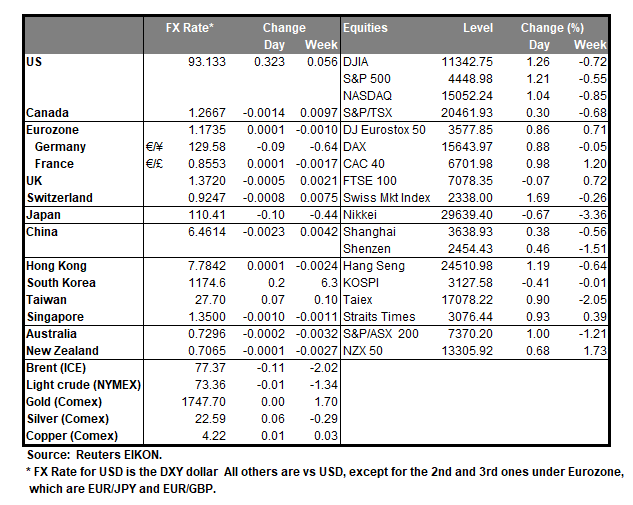
Concerns over Evergrande and international contagion effects vanished overnight in a session that was notable for the unwinding of risk premia in the US dollar and gold. Fed Chairman Powell said the risks would be contained in China with the press running stories today say the government had apparently told local governments to prepare for an Evergrande collapse.
None of that seemed to matter however as Wall Street hit the buy button until it broke with US stocks rallying powerfully. In another unusual development, despite markets being “comfortable” with the impending Fed taper which likely starts at the year end, US bond yields also rose substantially across the curve overnight. Clearly, some parts of the market are more comfortable than others. We have, of course, been led down the higher US yield path before, only for it to be a box canyon. If a rise in US yields is sustained though, it will be interesting to see how long the Tina-massive can keep forcing equities higher.
The US build-back-better bill and debt ceiling saga continue to rumble along in the background, gone but not forgotten. I have a feeling that the passage of both is a story with more still to give. The US Budget Committee is meeting this weekend regarding the USD 3.50 trillion bill and developments on that front, or the debt ceiling could yet cause some Monday morning volatility. That might explain gold’s recovery in part this morning. We also have a veritable crowned bar of Fed speakers to come today, including Chairman Powell.
This weekend also sees the German federal election. Although there is much noise surrounding the outcome, the possible coalition permutations are labyrinth and will almost certainly not be clarified on Monday, or next week. The election may be good for some intra-day volatility in the Euro on Monday morning Asia time, but not much else.
The PBOC has injected another CNY 120 billion via the 14-day repo again today, and this time, it appears to be soothing Evergrande nerves. That is despite offshore US bondholders reporting that they have not received their coupon payments, due yesterday, and reports of missed salary payments at their EV subsidiary. Gold once again appears to be the preferred method of hedging that weekend risk with Asian investors today.
The Turkish Lira (TRY) become TRY-my-patience with investors overnight after the central bank unexpectedly cuts rates, despite inflation being near 20%. USD/TRY rose 1.22% to 8.7700 on the latest dose of Erdogan-omics and has 9.00 written all over it once 8.800 breaks. In contrast, a slightly hawkish tone to the Bank of England policy decision saw sterling leap in overnight trading as markets rushed to price in an early 2022 rate hike.
Japan’s Core Inflation rose to, errrr, 0.00% this morning, with headline Inflation holding steady at -0.20%. This appears to be a cause for celebration in Japanese markets who take what they can get after 20 years. Jibun Service Flash PMI for September also rebounded to 47.4, still contractionary, but less so than previously. The Nikkei is on fire today after Japan returned from holiday so even less bad news would be good news in a market like this.
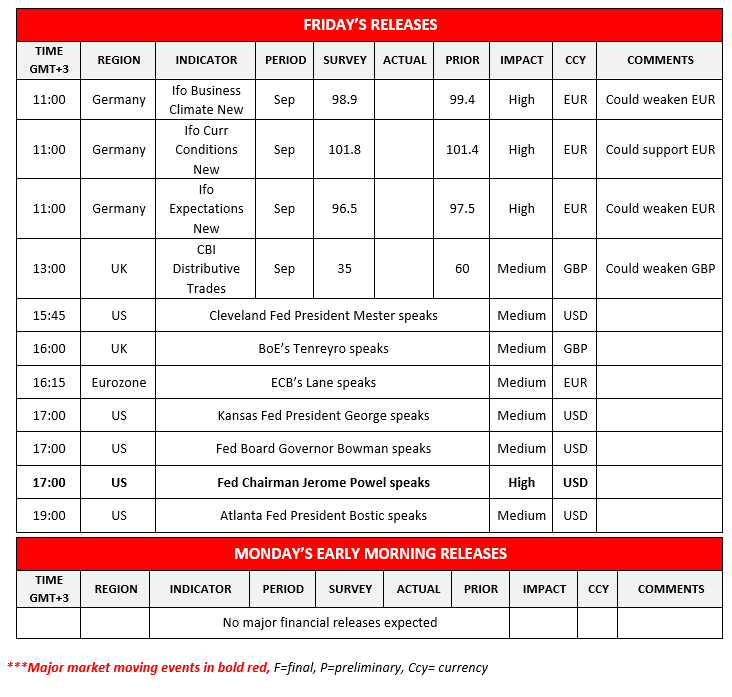
Singapore Industrial Production should recovery into positive territory later today, but it and Malaysian Inflation will be of only passing interest to local markets, myopically focussed on developments in China. With an election on Sunday, Germany’s IFO Business Climate data today is likely to meet the same fate. US markets are in buy everything mode as the week closes, and only some hawkish words from Mr Powell or his fellow Fed presidents are likely to make the Tina’s turner to the downside.
USD Retreats As Market Sentiment Improves
The USD tended to weaken against its major counterparts yesterday as the market sentiment improved erasing the gains made from the Fed’s interest rate decision and at some point, the USD index reached a one week low. On the other hand, US stockmarkets rallied as more risk on sentiment pushed the bulls forward given that concerns of a contagion from a potential default of China’s Evergrande developing group eased considerably. Also, gold prices edged higher, during today’s Asian session recovering some ground, possibly encouraged by the weakening USD after a wide drop marked yesterday. No major financial releases are expected today from the US; hence fundamentals could be in the epicenter, yet we have a high number of Fed officials scheduled to speak among them Fed Chairman Powell, who could draw the market’s attention to monetary policy issues once again.
The USD index dropped yesterday breaching the 93.20 (R1) support line now turned to resistance. In its downward motion the index also broke the upward trendline guiding it since the 16th of September hence we temporarily switch our bullish outlook in favor of a sideways bias. It should also be noted that the RSI indicator below our 4-hour chart is at the reading of 50, implying a rather indecisive market as to what direction to follow. Should a buying interest be displayed for the USD we may see it breaking the 93.20 (R1) resistance line and aim for the 93.70 (R2) level, practically causing the prior upward trendline to shift. Should the selling of the USD be renewed, we may see the index breaking the 92.85 (S1) support line and aim for the 92.40 (S2) support level.
BoE’s interest rate decision pushed the pound higher
The pound strengthened against the USD, EUR and JPY after the release of BoE’s interest rate decision yesterday. The bank maintained its interest rate at 0.10% and its asset purchases program remained also unchanged at £895 billion in total. For the bank inflationary pressures are still considered as transitory, there are worries for the employment market after the furlough scheme closes at the end of September, while industrial production is adversely affected by supply chain issues. Yet the dissidents regarding the banks’ QE program seem to have increased to two as the Committee voted by a majority of 7-2 for a continuance of the government bond purchases. The last part may have been the one providing support for the pound as it is the hawkish signal of the accompanying letter, while also there seem to be some preparations for a potential rate hike possibly in 2022. On the other hand, UK fundamentals seem to still be worrisome, given the energy crunch and the supply chain issues and could weigh on the pound. We may see pound traders today keeping an eye out for CBI distributive trades for September while on the monetary front, BoE’s Silvana Tenreyro is scheduled to speak.
GBP/USD rose yesterday reaching the 1.3750 (R1) resistance line. We tend to switch our bearish outlook in favor of a sideways movement bias for now, as the pair in its upward movement broke the downward trendline guiding since the 14th of September. Some slight bullish tendencies could be present for the pair as the RSI indicator below our 4-hour chart is above the reading of 50, yet the indicator’s downward slope seems to imply that they tend to fade away. Should the bulls actually get control over cable’s price action, we may see it breaking the 1.3750 (R1) line and aim for the 1.3875 (R2) level. Should the bears be in charge we may see the pair aiming if not breaching the 1.3600 (S1) support line.
Other economic highlights today and the following Asian session:
Today we note the release of Germany’s Ifo indicator’s for September, while we also get a high number of speakers from various central banks which could gain on attention.
USD Index H4 Chart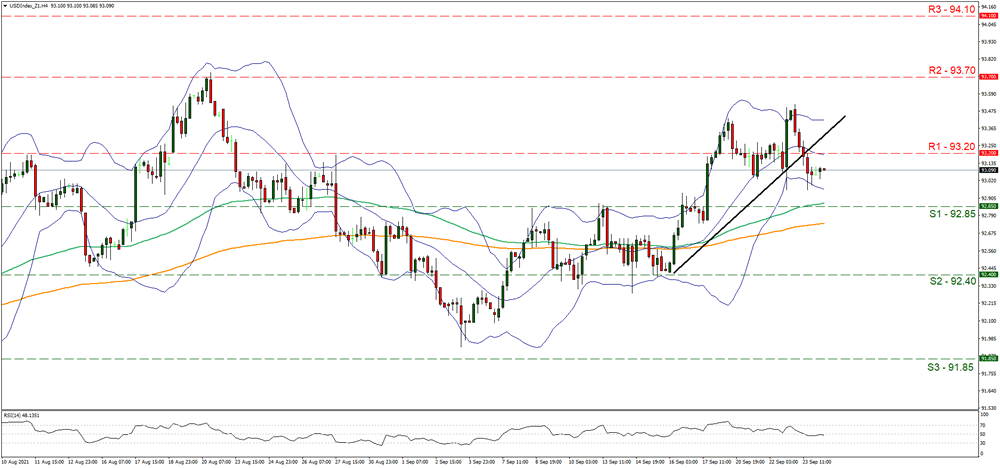
Support: 92.85 (S1), 92.40 (S2), 91.85 (S3)
Resistance: 93.20 (R1), 93.70 (R2), 94.10 (R3)
GBP/USD Cash H4 Chart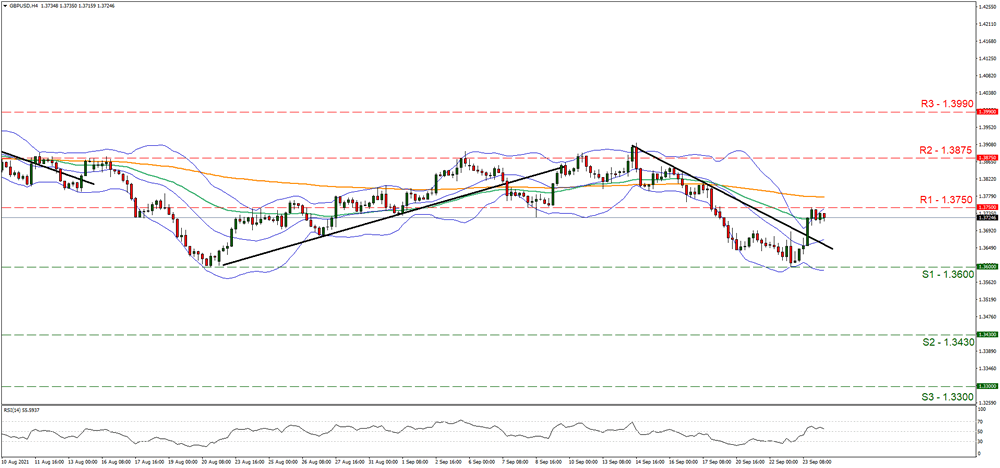
Support: 1.3600 (S1), 1.3430 (S2), 1.3300 (S3)
Resistance: 1.3750 (R1), 1.3875 (R2), 1.3990 (R3)
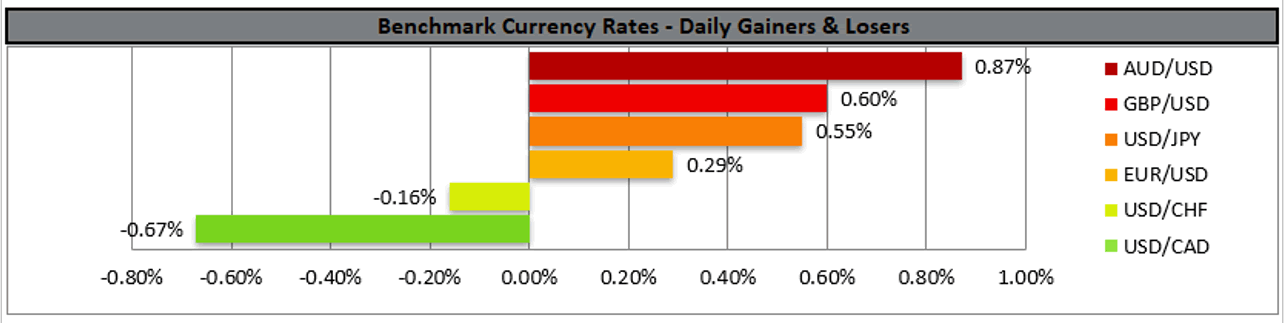
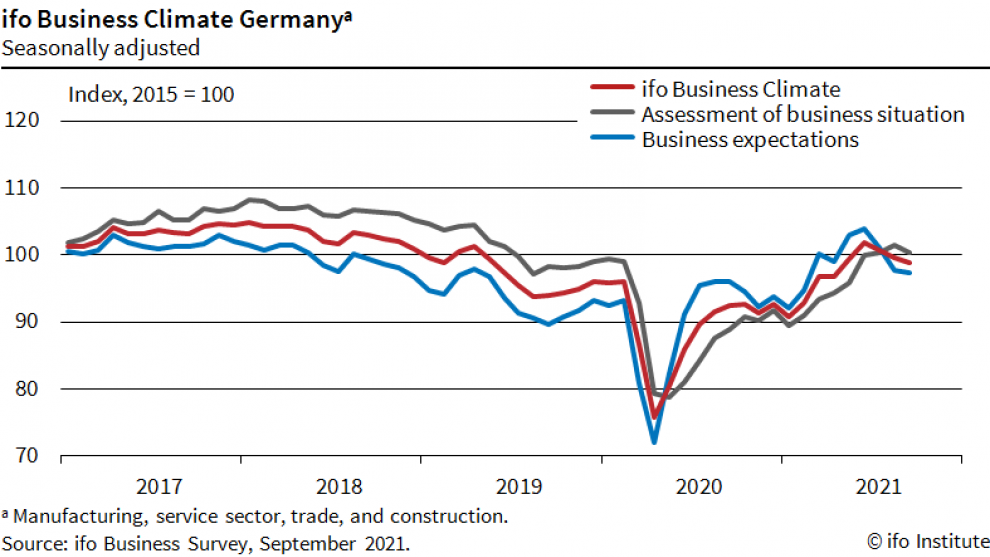
Germany Ifo business climate dropped to 98.8, bottleneck recession in manufacturing
Germany Ifo Business Climate dropped from 99.6 to 98.8 in September, below expectation of 100.4. That's also the third decline in a row. Current Assessment index dropped from 101.4 to 100.4, below expectation of 100.8. Expectations index dropped form 97.5 to 97.3, below expectation of 100.0.
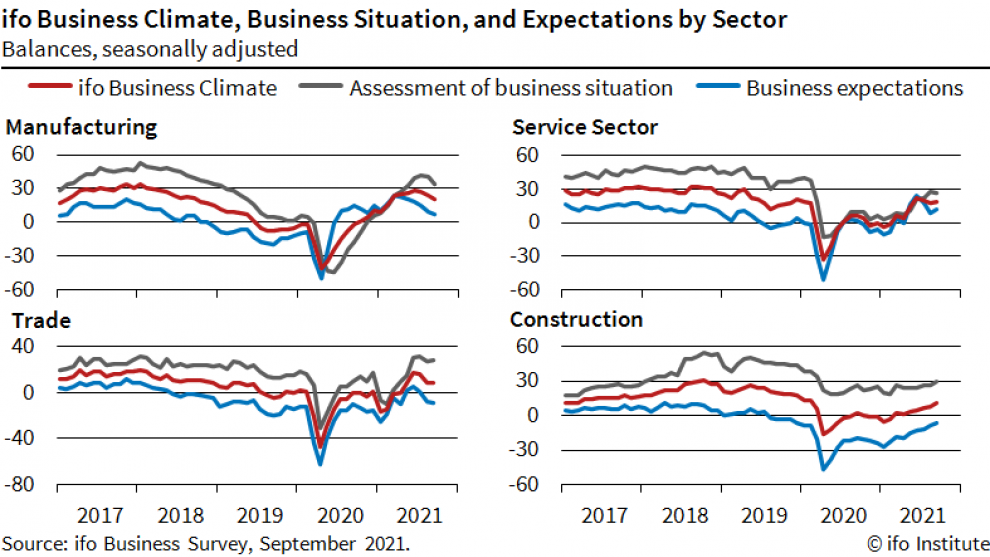
Looking at some more details, manufacturing dropped sharply from 24.2 to 20.0. Services rose from 17.8 to 19.1. Trade ticked lower from 9.0 to 8.9. Construction rose from 8.1 to 10.9.
Ifo said: "Companies were less satisfied with their current business. They were also more skeptical about the coming months. Problems in the procurement of raw materials and intermediate products are putting the brakes on the German economy. Manufacturing is experiencing a bottleneck recession."
NZD/JPY Bounces Off Support
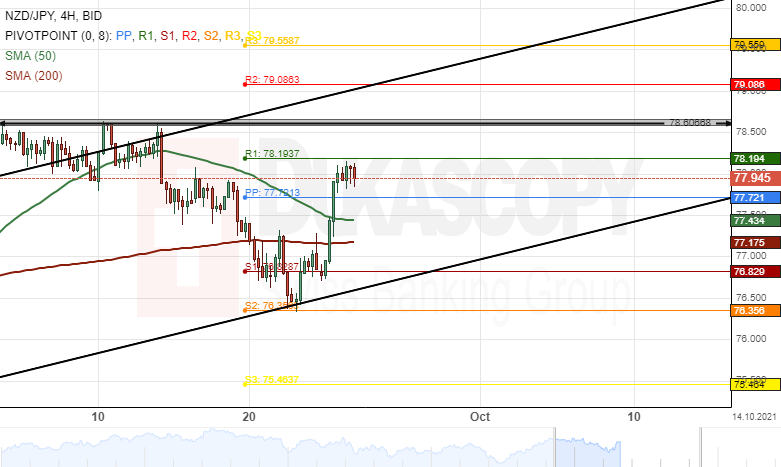
The NZD/JPY currency pair bounced off the lower boundary of an ascending channel pattern at 76.35 on September 21. As a result, the New Zealand Dollar has surged by 173 pips or 2.26% against the Japanese Yen since this week's trading sessions.
Given that the exchange rate has bounced off the support line, bullish traders could continue to pressure the price higher during the following trading sessions.
However, the currency exchange rate might encounter resistance at 78.60 within this session.
CAD/CHF Bulls Could Prevail
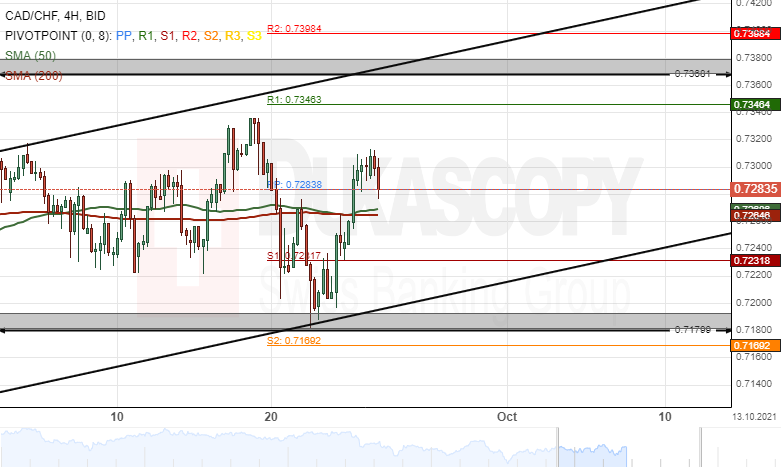
The Canadian Dollar has surged by 115 pips or 1.60% against the Swiss Franc since this week's trading sessions. The currency pair breached the 50– and 200– period SMAs on September 23.
Technical indicators suggest selling signals on the 4H and daily time-frame charts. The exchange rate could continue to edge higher in an ascending channel pattern during next week's trading sessions.
However, the currency exchange rate could encounter resistance at 0.7340 within this week's session.
EUR/USD Analysis: Faces Resistance Zone
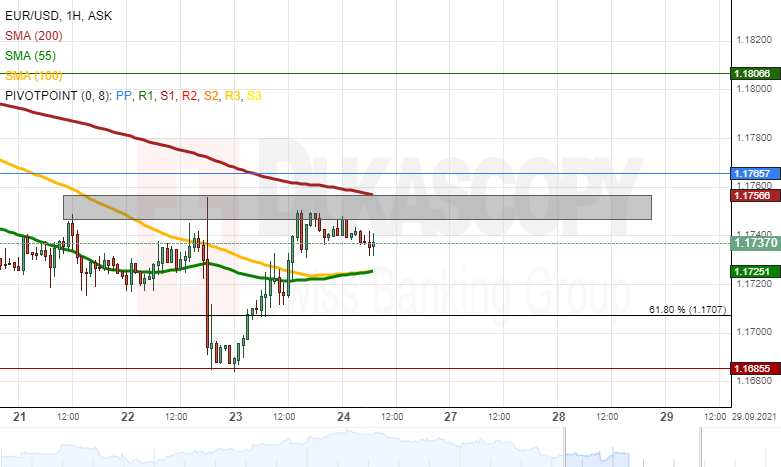
On Friday morning, the EUR/USD currency exchange declined, as it had bounced off the this week's high zone that surrounds the 1.1750 level.
In the case of the pair continuing to decline, it could find support in the 55 and 100-hour simple moving averages at 1.1725. Below these levels, the 1.1700 mark and the 61.80% Fibonacci retracement level could provide support.
On the other hand, a potential surge would test the 1.1750 level and the 200-hour simple moving average near 1.1755. Above these levels, the weekly simple pivot point provides resistance at 1.1766.
GBP/USD Analysis: Is Pushed By 200-Hour SMA
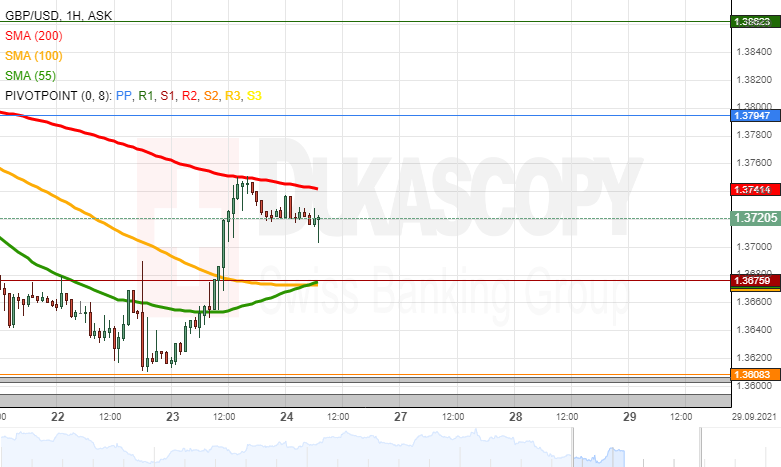
On Friday, the GBP/USD currency exchange rate declined. The decline started on Thursday when the Bank of England caused surge ended at the 200-hour simple moving average at the 1.3750 level.
If the rate continues to decline, it would most likely look for support in the 55 and 100-hour SMAs and the weekly S1 simple pivot point at 1.3676. Below these levels, there is no support as far as the large low-level zone near 1.3600.
However, a surge would face the 200-hour SMA somewhere near the 1.3740 level. Above the 200-hour SMA the weekly simple pivot point stands at 1.3795. In addition, both the 1.3750 and 1.3800 levels are likely going to provide resistance.
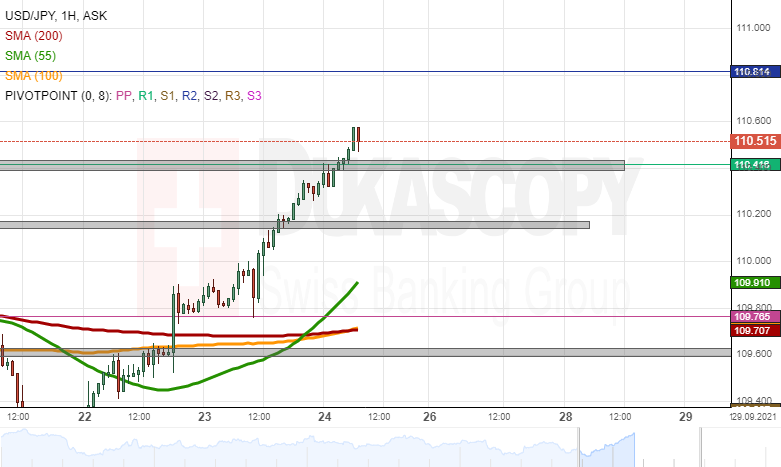
USD/JPY Analysis: Reaches Above 110.50
On Friday, the USD/JPY currency exchange rate passed the resistance of the 110.40 level, which was strengthened by the weekly R1 simple pivot point. Moreover, the rate reached above the 110.50 mark.
In the near term future, the pair could continue to surge. A surge would most likely reach for the resistance of the weekly R2 simple pivot point at 110.81 before aiming at the 111.00 level.
In the meantime, a bounce off from any of the mentioned resistance levels would be expected to look for support n the 110.40 levle and the weekly R1 simple pivot point.
Gold Analysis: Hits New Low Level
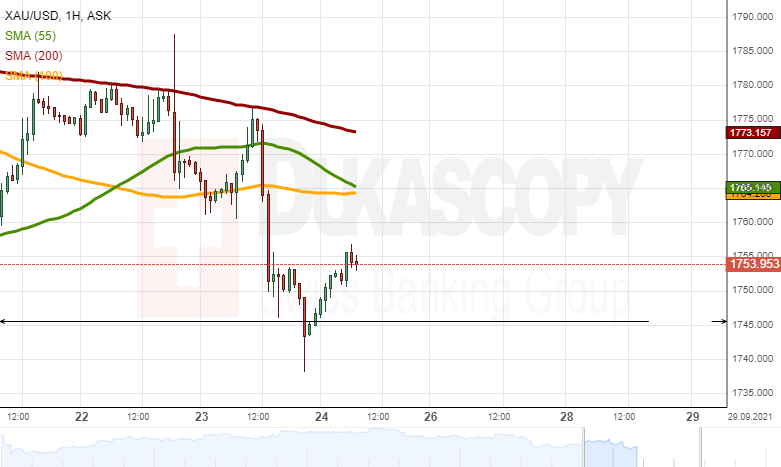
The yellow metal's price booked a new recent low level on Thursday, as it shortly traded at the 1,738.40 level. However, a recovery followed the piercing of the 1,740.00 mark.
On Friday morning, the commodity price was heading higher. The upwards move was expected to find resistance first in the combination of the 55 and 100-hour simple moving averages at 1,765.00 and afterwards the 200-hour SMA near 1,770.00.
Meanwhile, a decline of the price is highly likely going to look for support in round price levels, as there are no close by technical support levels.
USDCAD Loses Battle With Key Resistance, Uptrend Stagnates
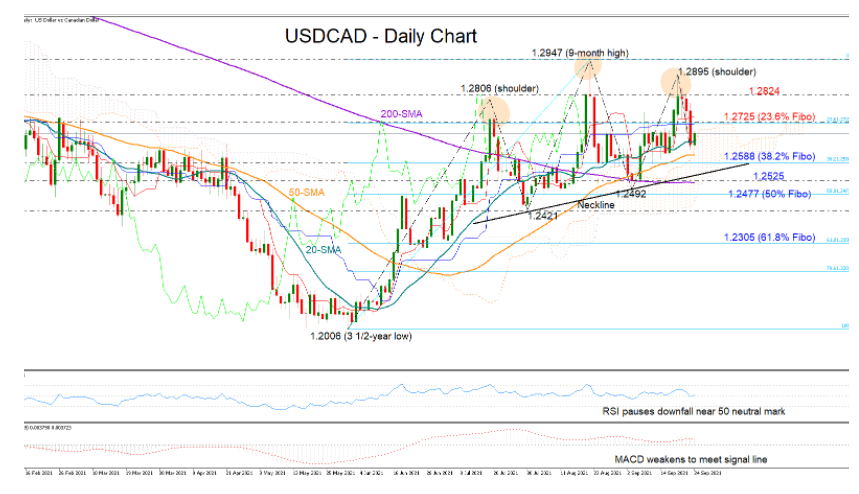
USDCAD saw its bullish efforts evaporate near the tough resistance of 1.2824 for the second time at the start of the week despite the peak at 1.2895, with the price aggressively slumping to 1.2832 in the aftermath.
The short-term risk is currently viewed as neutral as the RSI has paused its downfall around 50, while the MACD has pulled lower within the positive area to test its red signal line.
As regards the market trend, the bullish intersections between the simple moving averages (SMAs) are still endorsing the upward trajectory from the June lows, though the pair’s incapability of creating fresh higher highs this month has degraded the quality of the trend.
Nevertheless, unless the price dives below the 200-day SMA and the previous low of 1.2492, confirming a bearish head and shoulder structure, the upward pattern will remain valid. Prior to that, support could occur near the 50-day SMA and the 1.2588 mark, where the 38.2% Fibonacci retracement of the 1.2006 – 1.2947 is also positioned. Should the market close below 1.2492, the spotlight will shift to July’s trough of 1.2421.
In the positive scenario, if the price sets a strong foothold around the surface of the Ichimoku cloud, the 23.6% Fibonacci of 1.2725 may immediately block the way towards 1.2824, as it did early in August. A sustainable move above 1.2824 would open the door for the nine-month high of 1.2947, a break of which is required to upgrade the outlook in the medium-term picture.
In summary, USDCAD is currently holding a neutral short-term bias, but its medium-term uptrend seems to be languishing. Yet, only a decisive close below 1.2492 would officially signal a trend reversal.