

Sample Category Title
EURUSD Is Possibly Bearish
Technical analysis
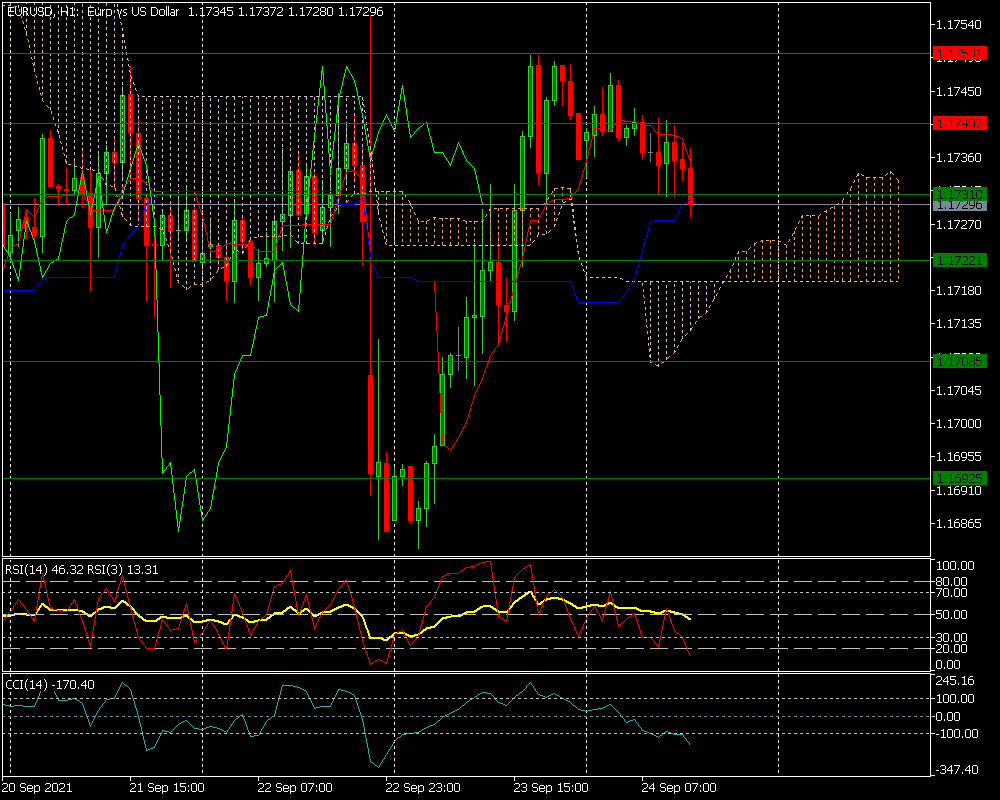
The RSI(14) and the RSI(3) point to a possible downwards correction
The Ichimoku indicator displays a prevailing flat
The CCI suggests a possible upwards movement.
Most likely scenario - SELL
Target prices: 1.17221 1.17085
Alternative scenario - BUY
Target prices: 1.17407 1.17501
Key levels
Support 1.17221 1.17085
Resistance 1.17407 1.17501
NZD Dips As Trade Deficit Balloons
The New Zealand dollar is in negative territory in the Friday session. NZD/USD is currently trading at 0.7043, down 0.35% on the day.
New Zealand trade deficits surges
The New Zealand dollar is a risk-sensitive currency, so it shouldn’t really come as a surprise that we are seeing significant volatility as the Evergrande crisis unfolds. Early in the week, concerns over the future of the Chinese property giant were at a fever pitch, which sent risk appetite tumbling and the kiwi lower. These fears have subsided, at least for now, as the New Zealand dollar climbed almost one percent on Thursday. Still, the situation remains precarious, as Evergrande, which is the largest issuer of junk bonds in Asia, missed an interest payment on Thursday. Global investors have been left guessing as to what Chinese authorities plan to do with the ailing company- the choices range from bailout to breakup to default. As the uncertainty continues over Evergrande’s future, we can expect further volatility on the currency markets.
Fed Chair Jerome Powell stated that the fallout from Evergrande is mostly limited to domestic China and that the contagion risk is low. Investors seized on these comments, which have lifted risk appetite and weighed on the US dollar and supported the kiwi’s impressive rally on Thursday.
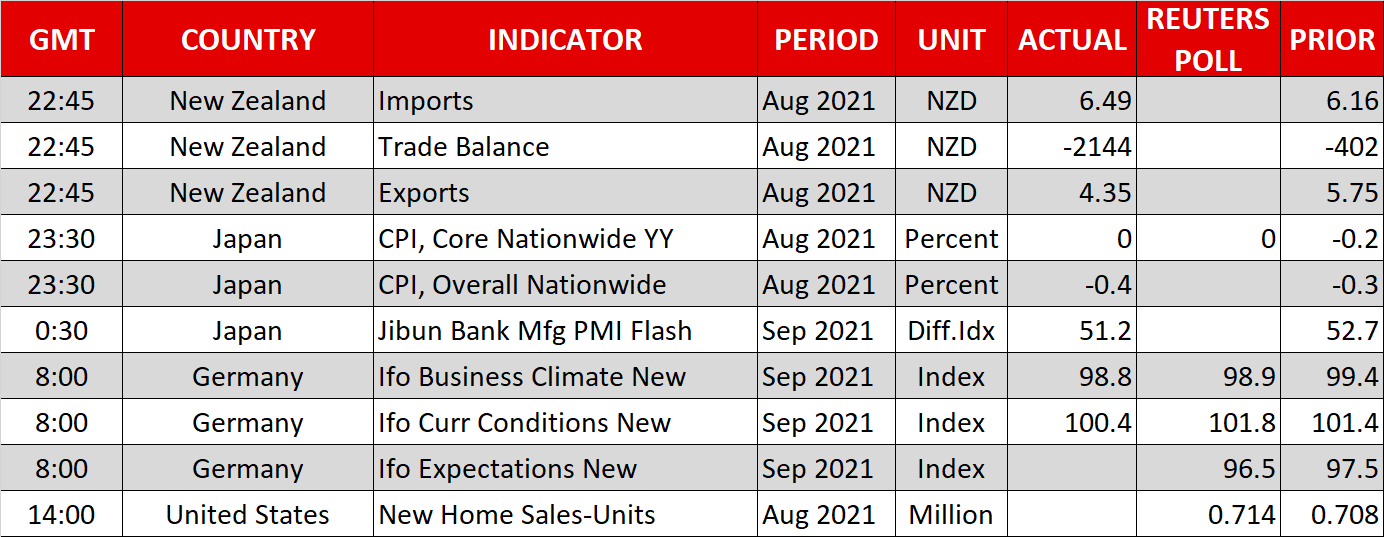
With no tier-1 events out of the US or New Zealand today, New Zealand’s trade balance for August (MoM) was in focus, and the sharp surge in the trade deficit has weighed on the New Zealand dollar. New Zealand exports were largely unchanged, while imports were sharply higher, resulting in a trade deficit of NZD 2.1 billion, marking a second straight trade deficit.
NZD/USD Technical
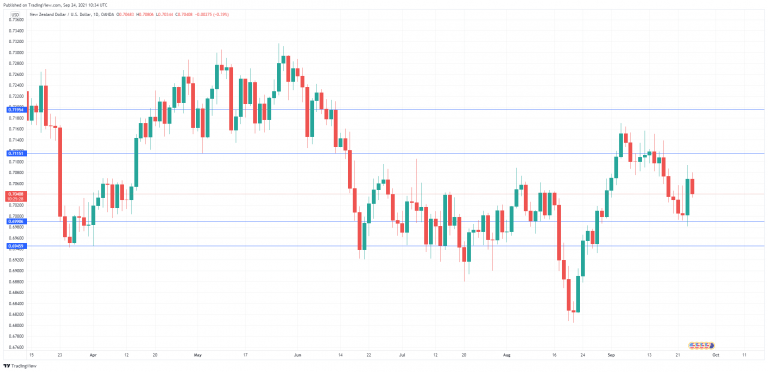
- On the upside, 0.7115 is the next resistance line. This is followed by resistance at 0.7195
- There are support lines at 0.6990 and 0.6945
Gold Bulls Need To Hold 1750
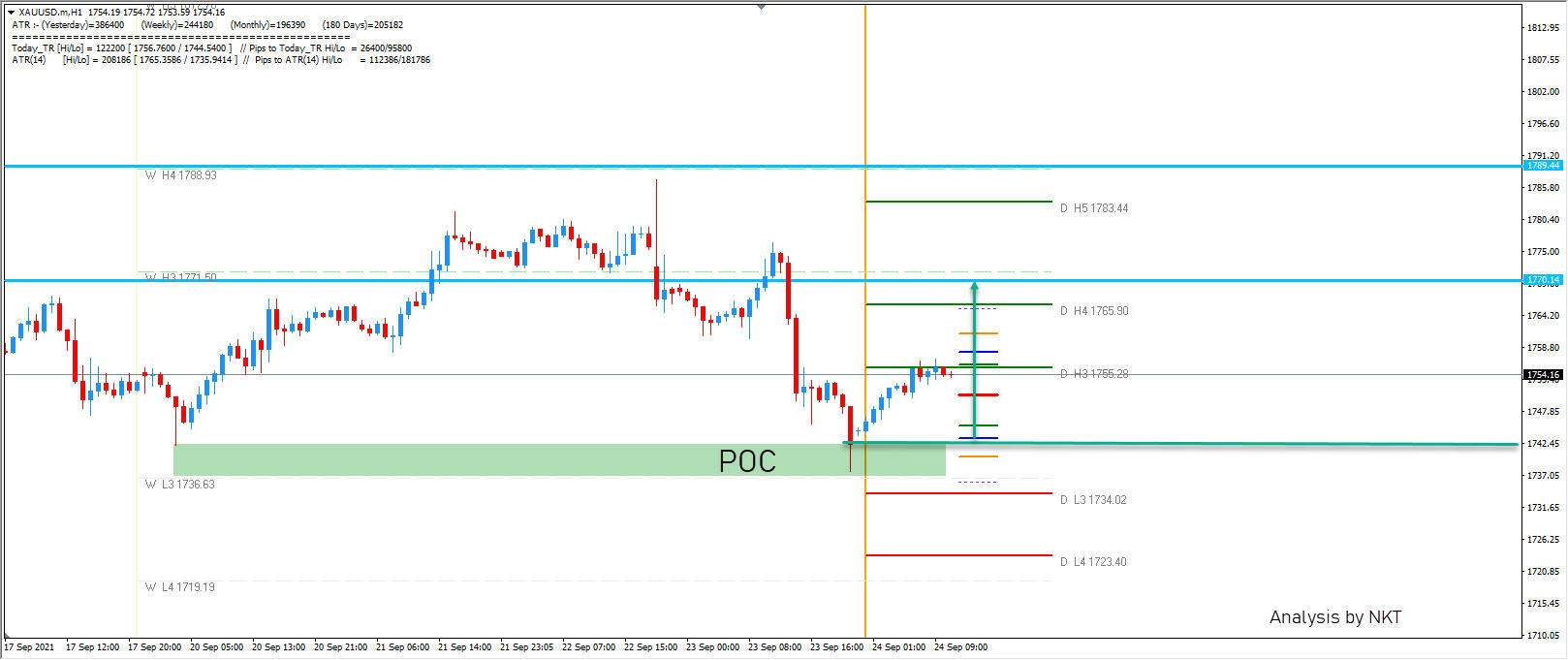
Gold bulls need to hold the 1750 level. If the price breaks higher, we should see a momentum up.
It's a very hard time for bulls. Gold went strongly down and the price is congesting around 1755. We should see a move above if we want the price to be bullish. Watch 1770 as the final TP. If the price breaks below 1750 we could see 1742. This level might be also good for longs so watch out.
Supply Shortages Weight On German IFO Survey
Notes/Observations
- Evergrande questions persist.
- Supply shortages weight on German IFO Survey.
- Focus on Germany ahead of the elections this Sunday.
Asia
- Japan Sept Preliminary PMI Manufacturing registered its 8th month of expansion ( 51.2 v 52.7 prior).
- Japan Aug National CPI YoY: -0.4% v -0.3%e; CPI Ex-fresh food (Core) YoY: 0.0% v 0.0%e.
- China PBoC injected CNY120B in 14-day reverse repos (net add of CNY110B) (Note: ahead of upcoming 1-week holiday).
- China property developer Evergrande situation: No word yet on payment from the firm on the $83.5M bond interest due on Thurs (Sept 23rd). Company entered a 30 day grace period.
- China Econ Daily: China should control imported inflation risks; currently imported inflation was only impacting raw material costs.
- China State Planner NDRC stated that working on solving issues of rising raw material prices and power limits. Told state owned firms to strictly fulfill gas supply contracts to fertilizer companies.
- China Foreign Ministry spokesperson Zhao Lijian: There was only one China in this world, and Taiwan could not be separated from China (Note: China criticized Taiwan's bid to join CPTPP trade pact).
Europe
- UK Government stated that they could assign soldiers to drive petrol tankers after BP was forced to ration fuel deliveries due to the lack of lorry drivers.
- Italy Government approved package to address higher energy prices.
Americas
- US House Budget Committee to meet Sat afternoon (Sept 25th) to discuss reconciliation Bill.
- White House tells agencies to prepare for a possible shutdown of the US government.
- US Household Net worth rose to record $141.7tn in Q2 2021.
Speakers/Fixed income/FX/Commodities/Erratum
Equities
- Indices [Stoxx600 -0.58% at 464.80, FTSE -0.18% at 7,065.95, DAX -0.52% at 15,562.15, CAC-40 -0.73% at 6,653.08, IBEX-35 +0.01% at 8,877.50, FTSE MIB -0.08% at 26,061.00, SMI -0.72% at 11,852.19, S&P 500 Futures -0.29%].
- Market Focal Points/Key Themes: European indices open generally lower and remained in the red as the session wore on; better performing sectors include financials and health care; sectors among those trending negative include consumer discretionary and materials; sportswear names under pressure after Nike cuts outlook yesterday; GoldenTree places block of Bawag shares; no major earnings expected in the upcoming US session.
Equities
- Consumer discretionary: Adidas [ADS.DE] -3.5%, Puma [PUM.DE] -3%, JD Sports Fashion -2% [JD.UK] (Nike earnings), Mitie Group [MTO.UK] +2% (trading update).
- Healthcare: Astrazeneca [AZN.UK] +1.5% (trial results), Lysogene [LYS.FR] -1.5% (earnings).
Materials: Avon Protection [AVON.UK] +6% (contract).
Speakers
- ECB chief Lagarde stated that many causes of higher prices were temporary; To see movement on inflation front. Still had lots of slack in employment. Saw return to stability in upcoming year. Not tapering stimulus but recalibrating program.
- ECB's Visco (Italy) stated that EU inflation rate was expected to be back under 2% in 2022. Reiterated Council view that factors behind rise of inflation are temporary.
- German IFO Economists noted that supply shortages had worsened in Sept and saw no signs that they would ease.
- Hungary Fin Min Varga stated that 2021 GDP growth could be above 7.0%.
- Poland Central Bank's Lon: No sure how to vote at Nov policy meeting. Important not to support the solutions that could lead to a radical strengthening of the PLN currency (zloty).
- Poland Central Bank's Hardt stated country returning to pre-pandemic growth but concerned about prospect for CPI as 2nd round effects appear to be surfacing. Low interest rate did risk de-anchoring of inflationary expectations.
- Ukraine PM Shmyhal stated that the country had sufficient amount of stored gas for winter.
- China State Planner NDRC: To strictly prohibit financial support for new cryptocurrency mining projects.
- China PBoC urgied curbs to crypto noting that such related activities were illegal.
Currencies/Fixed income
- USD was steady after recent gains inspired by the Fed's clear taper signal and inching forward of rate lift-off plans.
- GBP/USD stayed above the 1.37 level after the BOE noted on Thursday that two of its policymakers had voted for an early end to pandemic-era government bond-buying and markets brought forward their expectations for an interest rate rise to March. Focus turned to an upcoming speech by BOE Gov Bailey next week for further clues about a possible interest-rate hike.
- USD/JPY at 1-month high above the 110.35 area as dealers note that BOJ’s accommodative policy contrasted with the tightening bias of major central banks.
- European yields continued to edge higher in the session. Peripheral spreads were steady. Dealers noted that a new German government with a softer stance on austerity and no strong opposition against a permanent EU debt capacity would argue for tighter Euro Zone periphery spreads.
Economic data
- (FI) Finland Aug PPI M/M: 1.4% v 3.4% prior; Y/Y: 15.5% v 14.8% prior.
- (CZ) Czech Sept Consumer Confidence Index: -6.5 v -1.5 prior; Business Confidence: 7.4 v 9.3 prior; Composite Confidence Index: (Consumer & Business Confidence): 4.6 v 7.2 prior.
- (TR) Turkey Sept Capacity Utilization: 78.1% v 77.1% prior.
- (TR) Turkey Sept Real Sector Confidence NSA (unadj): 113.3 v 112.2 prior; Real Sector Confidence (seasonally adj): 113.4 v 113.9prior.
- (SE) Sweden Aug PPI M/M: 2.0% v 2.7% prior; Y/Y: 15.8% v 13.5% prior.
- (CN) Weekly Shanghai copper inventories (SHFE): 44.6K v 54.3K tons prior.
- (DE) Germany Sept IFO Business Climate Survey: 98.8 v 99.0e; Current Assessment Survey: 100.4 v 101.8e; Expectations Survey: 97.3 v 96.5e.
- (IT) Italy Sept Consumer Confidence Index: 119.6 v 115.8e; Manufacturing Confidence: 113.0 v 112.7e; Economic Sentiment: 133.8 v 114.2 prior.
- (RU) Russia Narrow Money Supply w/e Sept 17th (RUB):14.54 T v 14.49T prior.
- (TR) Turkey Aug Foreign Tourist Arrivals Y/Y: 119.4% v 367.0% prior.
- (TW) Taiwan Aug Export Orders Y/Y: 17.6% v 21.3%e.
Fixed income issuance
- (IT) Italy Debt Agency sold €2.5B vs. €2.0-2.5B indicated range in 0.0% Jan 2024 BTP Bonds; Avg Yield: -0.32% v -0.29% prior; bid-to-cover: 1.58x v 1.51x prior.
- (IT) Italy Debt Agency (Tesoro) sold €B vs. €0.75-1.0B in 0.4% May 2030 inflation-linked bonds (BTPei); Real Yield: -0.85% v -0.45% prior; bid-to-cover: 1.41x v 1.40x prior.
Looking ahead
- 05:25 (EU) Daily ECB Liquidity Stats.
- 05:30 (IN) India to sell combined INR310B in 2026, 2034, 2035 and 2050 bonds.
- 05:30 (ZA) South Africa to sell combined ZAR1.2B in I/L 2029, 2038 and 2046 Bonds.
- 06:00 (UK) Sept CBI Retailing Reported Sales: 34e v 60 prior; Total Distribution Reported Sales: No est v 45 prior.
- 06:00 (UK) DMO to sell £2.0B in 1-month, 3-month and 6-month bills (£0.5B, £0.5B and £1.0B respectively).
- 06:45 (US) Daily Libor Fixing.
- 07:00 (IN) India announces upcoming bill issuance (held on Wed).
- 07:00 (MX) Mexico July Retail Sales M/M: +0.2%e v -0.6% prior; Y/Y: 11.7%e v 17.7% prior.
- 07:30 (IN) India Weekly Forex Reserve w/e Sept 17th: No est v $641.1B prior.
- 07:50 (NL) ECB’s Elderson, Netherlands, SSM member).
- 08:00 (CL) Chile Aug PPI M/M: No est v 1.9% prior.
- 08:00 (BR) Brazil mid-Sept IBGE Inflation IPCA-15 M/M: 1.0%e v 0.9% prior; Y/Y: 9.9%e v 9.3% prior.
- 08:00 (UK) Daily Baltic Dry Bulk Index.
- 08:00 (ES) Spain Debt Agency (Tesoro) announces upcoming bond issuance.
- 08:30 (BR) Brazil Aug Current Account Balance: +$1.3Be v -$1.6B prior; Foreign Direct Investment (FDI): $6.0Be v $6.1B prior.
- 08:45 (US) Fed's Mester.
- 09:00 (BE) Belgium Sept Business Confidence: 6.8e v 7.6 prior.
- 10:00 (US) Aug New Home Sales: 712Ke v 708K prior.
- 10:00 (US) Fed chief Powell with members Clarida and Bowman.
- 10:00 (US) Fed’s George.
- 10:00 (UK) BOE's Tenreyro.
- 11:00 (EU) Potential sovereign ratings after European close (Fitch on Belgium, Iceland, Cyprus sovereign ratings; Moody’s on Sweden and Hungary sovereign ratings; S&P on Germany sovereign rating).
- 12:00 (US) Fed's Bostic.
- 13:00 (US) Weekly Baker Hughes Rig Count.
The Analytical Overview Of The Main Currency Pairs
The EUR/USD currency pair
Technical indicators of the currency pair:
Prev Open: 1.1687
Prev Close: 1.1738
% chg. over the last day: +0.44%
In general, the business activity index in the manufacturing and service sectors decreases in European countries (Germany, France). It indicates a slowdown in economic recovery. Economists expect that the ECB will also start to reduce the asset purchase program until the end of this year. Otherwise, the further growth of inflation cannot be avoided.
Trading recommendations
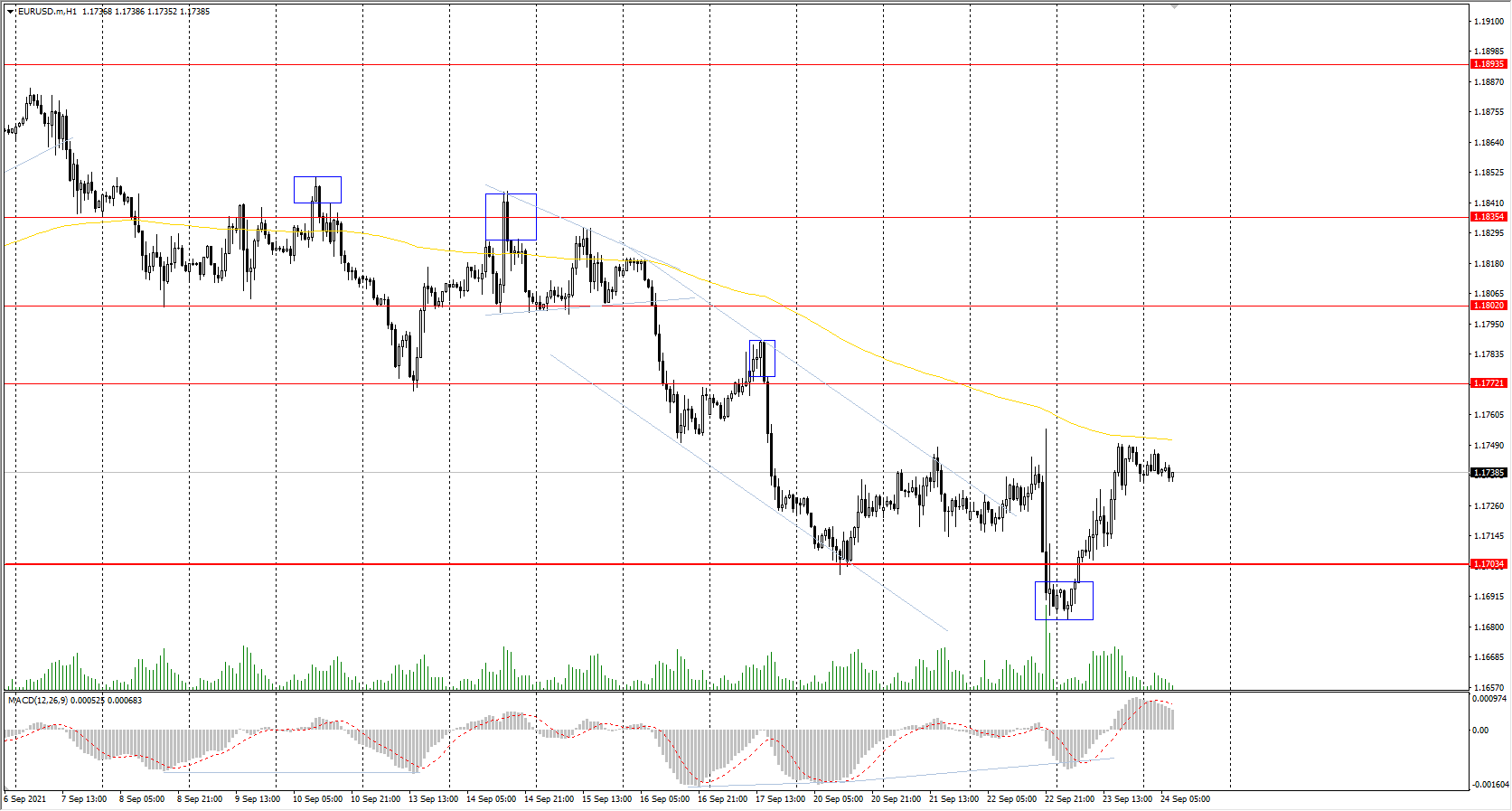
Support levels: 1.1704, 1.1620
Resistance levels: 1.1772, 1.1802, 1.1835, 1.1894, 1.1934, 1.1969
From the technical point of view, the general trend of the EUR/USD currency pair is bullish. The price is trading near the priority change level. The MACD indicator shows a divergence. Under such market conditions, buy deals can be considered from the priority change level. It is best to look for sell trades from the resistance levels near the moving average or after the breakdown of priority change level.
Alternative scenario: if the price breaks down through the 1.1704 support level and fixes below, the mid-term uptrend will likely be broken.
News feed for 2021.09.24:
- German Ifo Business Climate (m/m) at 11:00 (GMT+3);
- US New Homes Sales (m/m) at 17:00 (GMT+3);
- US Fed Chair Jerome Powell’s Speech at 17:00 (GMT+3).
The GBP/USD currency pair
Technical indicators of the currency pair:
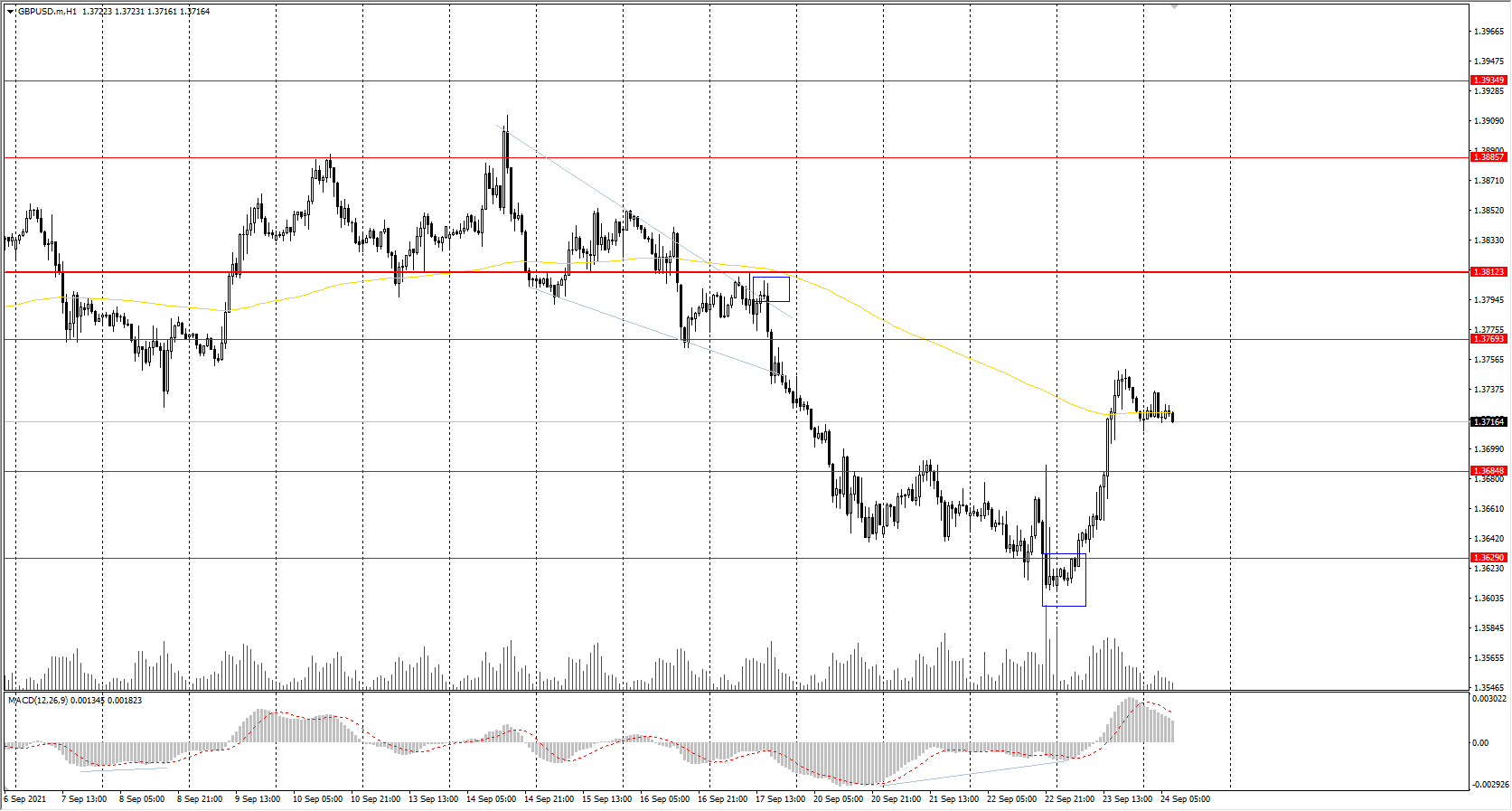
Prev Open: 1.3612
Prev Close: 1.3719
% chg. over the last day: +0.79%
The Bank of England kept the interest rate at 0.1% and the volume of government bond purchases at GBP 875 billion. On the back of this news, the British pound sharply strengthened yesterday. But the index of business activity in the manufacturing and services sectors has declined over the last month, indicating that the recovery is slowing down.
Trading recommendations
Support levels: 1.3685, 1.3629, 1.3614, 1.3525
Resistance levels: 1.3769, 1.3812, 1.3886, 1.3935, 1.4002
On the hourly time frame, the GBP/USD trend is bearish. But the MACD indicator became positive. Under such market conditions, it is better to look for sell trades from the resistance levels near the moving average line. Buy deals should be considered only intraday and only with short targets from the support levels.
Alternative scenario: if the price breaks out through the 1.3812 resistance level and consolidates above, the bullish scenario will likely resume.
The USD/JPY currency pair
Technical indicators of the currency pair:
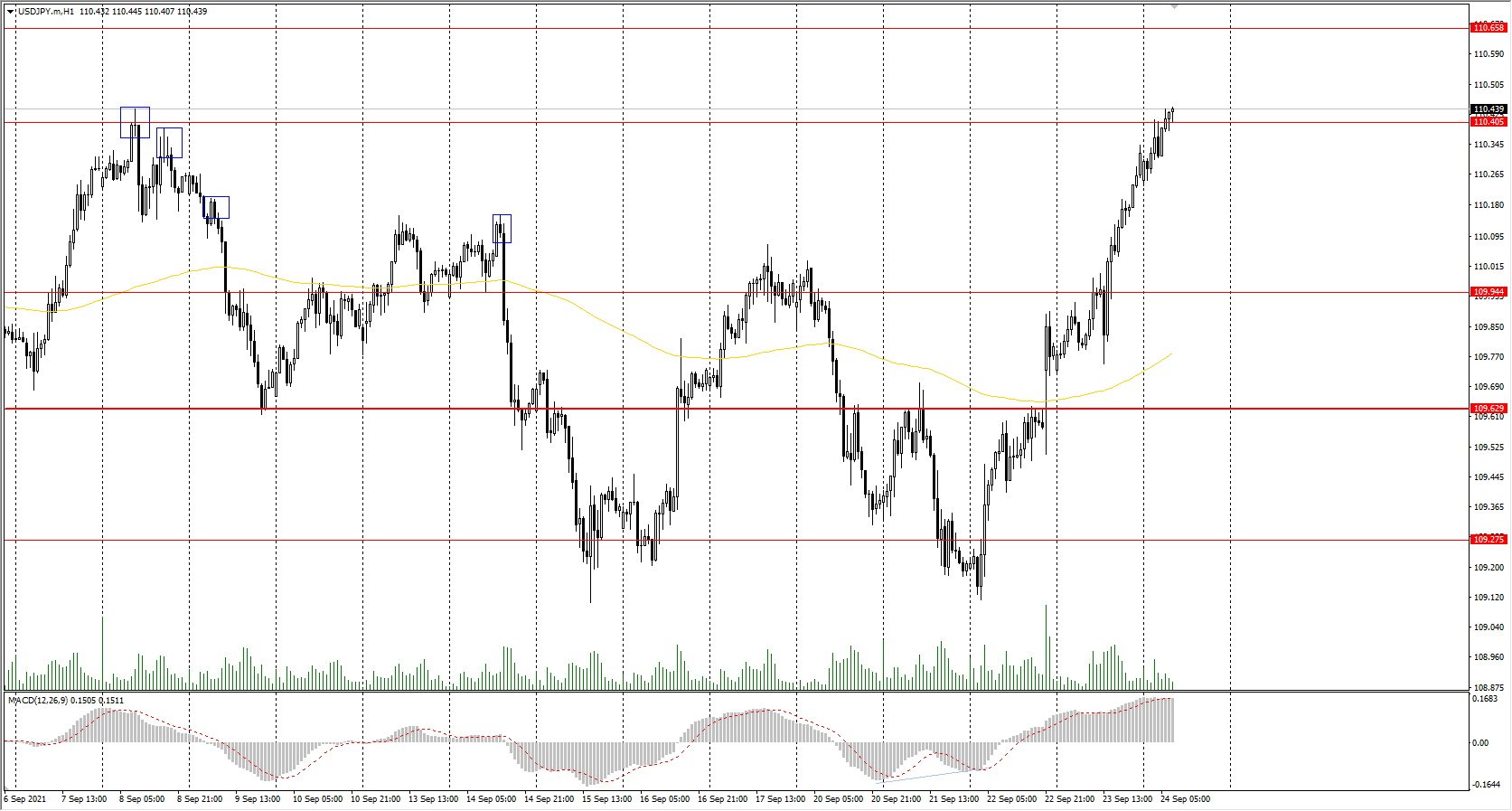
Prev Open: 109.73
Prev Close: 110.32
% chg. over the last day: +0.54%
Japan's consumer price index has not changed compared to the previous month, which put an end to its decline for the first time in 13 months. The core inflation index, which excludes food and energy prices, decreased by 0.5% in August compared to a year earlier. The Japanese yen lost its positions against the dollar on this news.
Trading recommendations
Support levels: 110.40, 109.94, 109.63, 109.28, 108.65
Resistance levels: 110.65, 110.95
The main trend of the USD/JPY currency pair has changed to bullish. Against the background of the Japanese Yen weakness, the USD/JPY quotes sharply rushed up. The price broke through the priority change level. The MACD indicator has become positive. There are signs of overbuying but no signs of reversal. Under such market conditions, it’s better to look for buy positions from the support levels after a small pullback, as the price has deviated strongly from the moving average. Sell positions should be considered only throughout the day from the resistance levels but only after the sellers' initiative.
Alternative scenario: if the price falls below 109.63, the uptrend is likely to be broken.
News feed for 2021.09.24:
- Japan National Core Consumer Price Index (m/m) at 02:30 (GMT+3).
The USD/CAD currency pair
Technical indicators of the currency pair:
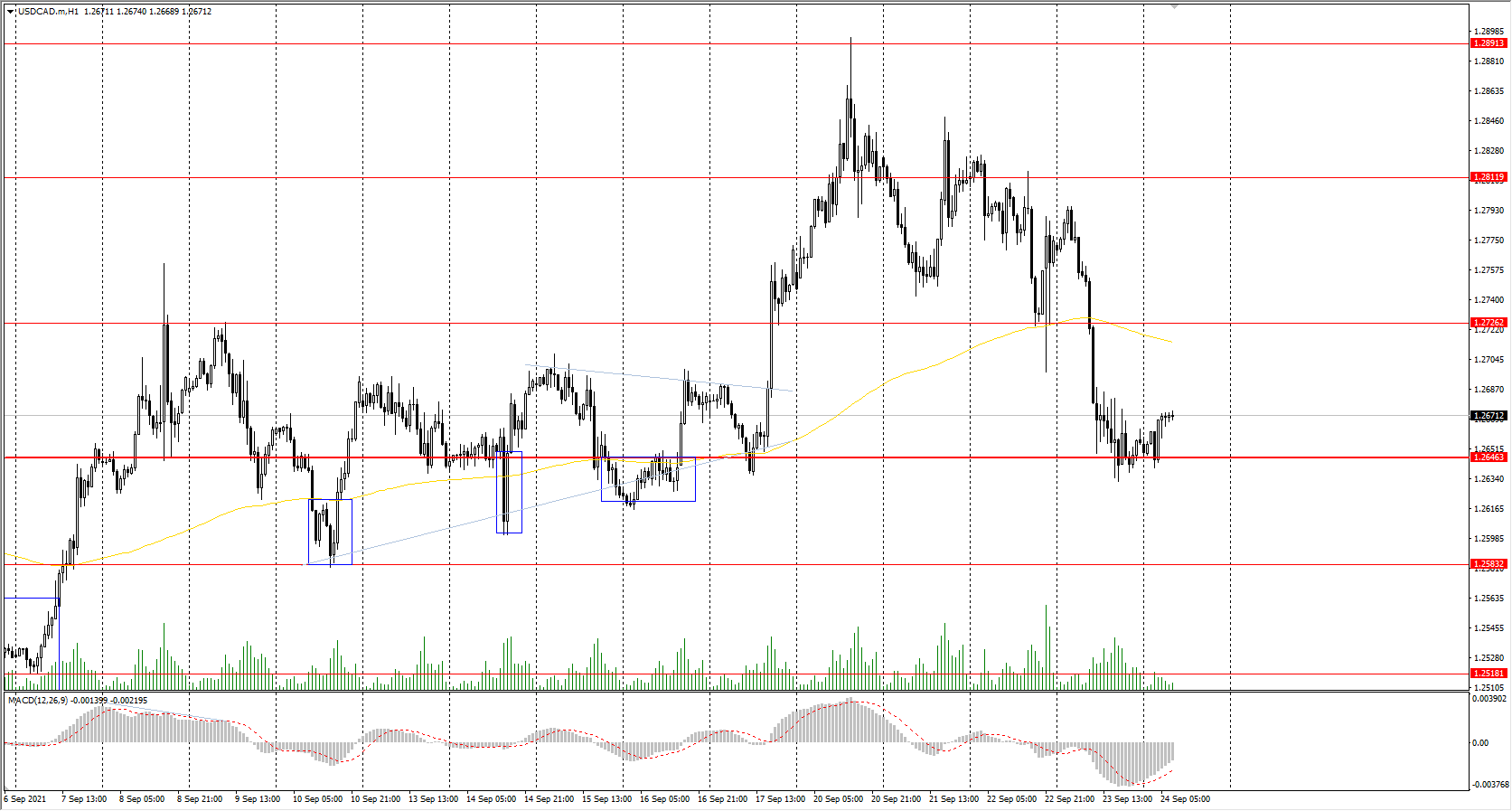
Prev Open: 1.2772
Prev Close: 1.2655
% chg. over the last day: -0.92%
The Canadian dollar is a commodity currency, so the USD/CAD currency pair is highly dependent on the dynamics of the dollar index and oil prices. The dollar index decreased yesterday, while oil prices increased sharply. As a result, on the background of the strengthening of the Canadian dollar, the USD/CAD currency pair declined.
Trading recommendations
Support levels: 1.2646, 1.2583, 1.2518, 1.2425
Resistance levels: 1.2726, 1.2812, 1.2891, 1.2951
From the technical point of view, the situation is uncertain. The local uptrend is about to end, as the price is trading below the moving average and has reached the priority change level. The MACD indicator is negative with no signs of reversal. Under such market conditions, it is better to buy from the priority change level after additional confirmation in the form of a buyers' initiative. It is best to look for sell deals from the resistance levels near the moving average.
Alternative scenario: if the price breaks down through the 1.2646 support level and fixes below, the uptrend will likely be broken.
The US And European Stock Indices Are Recovering
The US stock market ended Thursday trading in the green zone. The Dow Jones increased by 1.48%, the S∓P 500 added 1.21%, and the Nasdaq Composite added 1.04%. Thursday's gains in the Dow Jones and S&P 500 were the highest in the last two months. With a high probability, investors can look forward to a slight increase in stock quotes until November. Still, with the beginning of the "tapering" (reduction of the QE program), the markets will correct much stronger. Hedge fund analysts expect a deeper correction till December, and then there will be an increase ahead of the "Christmas rally."
The US Secretary of Commerce said that the Biden administration's lifting of international travel restrictions in early November would significantly boost the US economy.
The US House of Representatives passed the legislative initiative on new sanctions against the Nord Stream 2 pipeline yesterday as part of the defense budget for the next fiscal year (starting October 1).
European stock indices traded without a single trend yesterday. Investors were assessing the results of the meetings of the US Federal Reserve System (Fed), Bank of England, and the Swiss Central Bank. By the end of the day, German DAX increased by 0.9%, French CAC 40 added 1%, Spanish IBEX 35 added 0.8%, Italian FTSE MIB jumped by 1.4%. Meanwhile, the British FTSE 100 index decreased by 0.07%. The Bank of England kept the interest rate at 0.1% and left the volume of government bond purchases at GBP 875 billion. On the back of this news, the British pound strengthened. But the index of business activity in the manufacturing and services sectors has declined over the last month, indicating that the recovery is slowing down. Also, BP, the largest oil company, told the British government that some of its gas stations in the UK had run out of gasoline and diesel fuel due to supply chain problems. The Swiss central bank kept its interest rate at -0.75%.
The US oil inventories are at their lowest since 2018, while European stocks remain below average for this time of year. Vitol Group, the world's largest independent oil trader, expects global oil demand to rise by another half-million barrels a day this winter as the energy crisis associated with gas forces a drive to consume other fuels. Vitol Group analysts predict oil prices to rise to $80 a barrel.
Natural gas prices are skyrocketing as seasonally low inventories in Europe, rising demand in China, and supply constraints from Russia lead to a conflict for raw materials for power generation before winter.
The People's Bank of China has injected 460 billion yuan ($71 billion) into the banking system over the past five business days, including 70 billion yuan on Friday. It helps ensure sufficient liquidity during the Evergrande crisis. Due to tighter regulation by the authorities, home sales values in China fell by 20% year on year. It is expected that the decline in the real estate market will also affect emerging markets, affecting global demand for commodities. Fitch Ratings lowered its forecast on China amid Evergrande uncertainty and said it expects China's economy to grow at 8.1% this year, down from a previous estimate of 8.4%. The central bank of the Philippines kept its key interest rate unchanged as the economy recovered steadily.
Main market quotes:
- S&P 500 (F) 4,448.98 +53.34 (+1.21%)
- Dow Jones 34,764.82 +506.50 (+1.48%)
- DAX 15,643.97 +137.23 (+0.88%)
- FTSE 100 7,078.35 −5.02 (−0.071%)
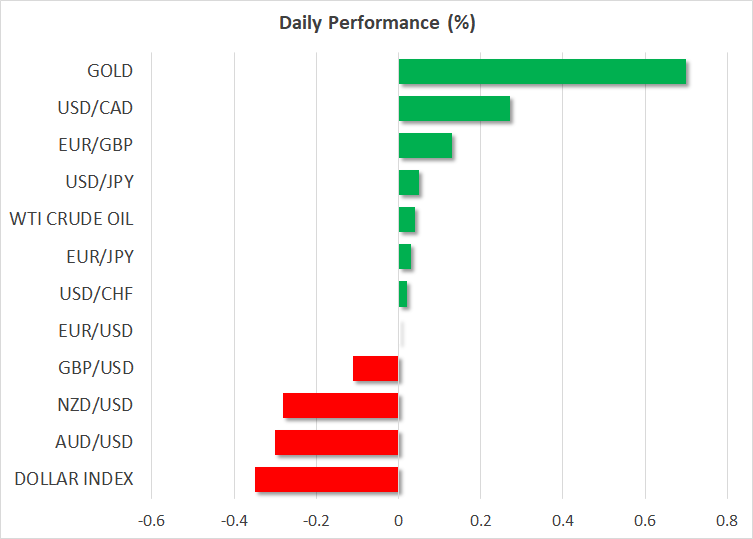
- USD Index 93.10 −0.37 (−0.39%)
Important events for today:
- Japan National Core Consumer Price Index (m/m) at 02:30 (GMT+3);
- German Ifo Business Climate (m/m) at 11:00 (GMT+3);
- US New Homes Sales (m/m) at 17:00 (GMT+3);
- US Fed Chair Jerome Powell’s Speech at 17:00 (GMT+3).
Bond Markets Come Alive As Tighter Policy Looms, Stock Rally Eases
- Sovereign bond yields jump on optimism and rising prospect of policy tightening
- Equities rebound fizzles out as lingering doubts about Evergrande cuts party short
- Dollar gives up all post-Fed gains but limited bounce back for riskier currencies
Bond markets finally wake up to the sound of central banks
US Treasury yields led the surge in global government bond yields amid a delayed response to the flagging of an imminent taper announcement by the Federal Reserve on Wednesday. Bond traders finally took notice of the global shift in monetary policy after both the Bank of England and Norges Bank followed up the hawkish soundbites at their respective meetings on Thursday.
The Norges Bank hiked its policy rate by 25 basis points, becoming the first major Western central bank to do so during the pandemic, while the Bank of England signalled the possibility of a rate increase in Q1 2022.
The yield on 10-year UK gilts shot up after the BoE meeting, hitting the highest since March 2020 today. However, with the Fed likely to keep buying bonds until the middle of next year, 10-year Treasury yields could only manage 2½-month high of 1.4520%.
Higher yields and Evergrande woes dent stock rally
Wall Street seemed unfazed by the initial spike in yields and the major US indices rallied for a second straight day on Thursday. Fed Chair Powell’s bullish take on the US economy, combined with the repeated message by world central banks that the supply constraints and consequent surge in inflation will be temporary, helped to revive optimism about the global growth outlook. Investors will be able to hear more from Powell later today when he speaks at 14:00 GMT.
The Dow Jones gained the most, closing up 1.5%, while the S&P 500 and Nasdaq Composite ended the day with gains of 1.2% and 1.0%, respectively. However, e-mini futures were in the red on Friday, with the Nasdaq slipping the most. The jump in long-term borrowing costs is likely weighing on tech stocks with bloated valuations as yields extended their gains today.
However, ongoing uncertainty surrounding Evergrande’s liquidity problems is casting a shadow over the broader markets amid fears of a possible global contagion from the crisis. Most Asian stock markets closed lower today and European shares fell back as well.
Evergrande missed an interest payment on its dollar bonds on Thursday, despite coming up with funds to settle a local bond payment. The company has 30 days to make the payment before defaulting but the lack of transparency around its financial health as well as about any potential state bail out by Chinese authorities is making investors nervous.
Rebound in risky FX falters despite soft dollar
The mood in currency markers was also somewhat dampened on Friday from the slight risk-off in equity markets, though the safe haven currencies were struggling to gain significant traction.
The US dollar edged up slightly from yesterday’s lows against a basket of currencies and the yen and franc were mixed. The greenback’s downside reversal from the immediate post-Fed boost hasn’t translated into much of a rebound for the risky commodity-linked dollars. The aussie, kiwi and loonie are not showing a clear direction in the aftermath of the FOMC meeting and all three were paring yesterday’s gains today.
The euro hovered near its highs, however, around $.1735, while sterling was seeking support from the $1.37 level. The pound got a huge lift from the Bank of England on Thursday as investors brought forward their expected timing of a rate hike, with interest rate futures indicating odds of more than 50% for a move in February. But the downside risks for the British economy have been growing lately and traders don’t seem to share the same optimism as BoE policymakers, hence, the relatively modest boost for the pound.
Oil Extends Rally, Gold Slides
Oil’s rally continues
The fall in US crude inventories, surging natural gas prices, OPEC+ production struggles, a slow return of pre-Ida US production, and most importantly, a weaker US dollar, continue to support oil prices which had another impressive overnight rally. Brent crude and WTI jumped 1.80% higher to USD 77.25 and USD 73.25 a barrel.
With more negative stories about the impact of gas shortages coming out of the UK and Europe each day, and with Asian buyers bidding up spot gas cargoes, oil prices are likely to remain firm as a gas substitute. Any large sell-offs due to speculative zeal are likely to be very short in duration and followed by an equally aggressive bounce. Oil prices have crept 10 cents higher in Asia, and as usual, Asian buyers are reluctant to chase prices higher, although I expect them to be out in force on any large price dips.
Brent crude now has USD 78.00 in its sights which opens the path to a test of USD 80.00 a barrel. Support is at USD 77.00 and USD 76.10 a barrel initially. WTI has resistance at USD 74.25 and USD 75.50 a barrel. Support appears at USD 73.00 and USD 71.70 a barrel. One note of caution for the oil rally is that the relative strength indexes (RSIs) on both contracts are approaching overbought levels. Oil may trade sideways over the next few sessions to consolidate gains, rather than immediately power to new highs from here.
Risk-premia unwind torpedoes gold
Gold prices slumped overnight despite the US dollar also tumbling as investors hurriedly unwound Evergrande risk premia after soothing words from Jerome Powell. Gold slumped by 1.45% to USD 1742.00 an ounce. In Asia, weekend risk hedging by local investors has seen gold rise 0.50% to USD 1751.50 an ounce.
Much of gold’s recent rally has been built of increasing fear gauges led by our friends in China. It is unlikely that the Evergrande saga is past “peak-fear,” and we are probably only one headline from another haven rally. As such, gold is not likely to capitulate lower this week. Notably, support at USD 1740.00 an ounce held fast overnight. However, unless Evergrande turns into a contagion mess, gold is unlikely to gain enough momentum to recapture USD 1800.00 an ounce.
I continue to believe that any gold rally this week to run out of momentum in the USD 1780.00 zone, and that USD 1740.00 an ounce continues to support. A daily close below USD 1740.00 signals further losses to USD 1680.00 next week.
The US Dollar Haven Premium Vanishes
Dollar dips after Powell comments
Overnight markets were unusual in that US yields jumped higher, as did stocks, but the US dollar sunk by quite some distance. The dollar index tumbled 0.38% to 93.08, unwinding the previous day’s gains. Some have put it down to Powell’s post-FOMC comments that the bar to rate hikes is high, but I believe his comments saying Evergrande fallout is mostly limited to domestic China caused New York to unwind the haven premium built-in over this week. A rate hike by Norway and seemingly hawkish tones from the Bank of England may also have added headwinds, with the pound rallying, dragging the euro higher. Notably, the risk-correlated Australian and New Zealand dollars also had big rallies overnight, further supporting the risk-premia unwind thesis.
GBP/USD leapt 0.76% higher to 1.3720 after the BOE statement caused investors to bring forward rate hike expectations to early 2022. I suspect the market may have overdone the rally with GBP/USD tracing out a double top at 1.3750. If clearer heads prevail and markets decide to head into the weekend with caution, GBP/USD could reverse course. Support at the head and shoulders neckline near 1.3600 remains critical support. EUR/USD also rallied, climbing 0.43% to 1.1740 where it remains sharply unchanged in Asia. With a German election this weekend, EUR/USD is likely to run out of steam ahead of 1.1800, and failure of 1.1650 will signal a large directional downside move.
With Evergrande risk premia subsiding, the risk-centric AUD and NZD both rallied impressively overnight. AUD/USD rose 0.77% to 0.7295 and NZD/USD rose 0.95% to 0.7060 where both remain in a sideways Asian session. 0.7220 and 0.6980 remain important support levels, with failure signalling potentially 200 points of losses. The ability of the antipodeans to maintain gains rests on whether risk sentiment remains positive. Both will probably head south again on negative China or US headlines.
The PBOC, once again, announced a neutral fix for USD/CNY this morning, with the PBOC liquidity injection not flowing through to yuan weakness. That continues to be a supportive factor for Asian currencies which rallied broadly overnight. However, the rally was more due to a weaker US dollar and not change in sentiment towards the region and its vulnerability to fallout from China. As such, swing in sentiment to the downside will probably see the overnight gains unwind just as quickly.
Asian Markets Mixed
Asian equities show a modest North/South divide
Fading Evergrande concerns and remarks from Powell about the high bar to rate hikes left New York in taper-be-damned mode overnight, with stocks rising powerfully. The S&P 500 rose by 1.27%, while the tech-heavy Nasdaq recorded a 1.04% with the cyclical-heavy Dow Jones leaping by 1.47%, probably being the most sensitive of the big three to future US rate hikes. The rally was even more impressive given that US yields also firmed notably overnight, reinforcing that you ignore buy-the-dip at your peril.
Asian markets are having a very mixed day with US futures maintaining their gains. There is a real North/South divide in Asian markets today. Japan is playing catchup and then some, after returning from holiday. The Nikkei 225 has powered 2.0% higher with the FOMO gnomes, like New York, out in force. The Kospi, by contrast, is unchanged, perhaps weighed by North Korea refusing to engage with President Moon’s call to officially end the Korean War. Taipei, by contrast, has leapt 1.0% higher.
On mainland China, the PBOC’s dollop of liquidity today, totalling CNY 120 billion, appears to have settled Evergrande nerves. The broader Shanghai Composite is flat but the narrower Shanghai 50, containing SOE behemoths, is up by 0.60%. The CSI 300 has also rallied by 0.55% while Hong Kong is flat. China markets look keen to engage in a contained Evergrande story, but just can’t pull the trigger completely. Of the three main indices, Hong Kong is the most vulnerable as Evergrande is listed there. The nascent recovery in China markets remains at the mercy of their being no new negative Evergrande headlines.
Further south, ASEAN markets are maintaining a very cautious stance despite the impressive rallies in the US overnight. Clearly weekend US political and Evergrande risks are causing a sense of cautious pragmatism, and rightly so. Singapore is down 0.15%, with Kuala Lumpur falling 0.50% and Jakarta remaining unchanged.
Australian markets are also in the red although there appears to be a lack of concrete drivers behind the negativity. Reports that China may be looking for more ways to cap commodity prices and a more pragmatic view to Evergrande may be weighing on sentiment. The IMF downgraded its growth forecast for Australia for 2021 but upgraded its 2022 one. The ASX 200 and All Ordinaries are limping into the weekend down 0.40%.
Europe piggy-backed the US higher overnight, but with a mixed day in Asia and plenty of weekend risk ahead, not least the German elections, I expect European markets to open flat to slightly negative this afternoon. US markets will be at the mercy of the big line-up of Fed speakers and debt ceiling/spending developments.