

Sample Category Title
GBP/USD Mid-Day Outlook
Daily Pivots: (S1) 1.3588; (P) 1.3639; (R1) 1.3668; More...
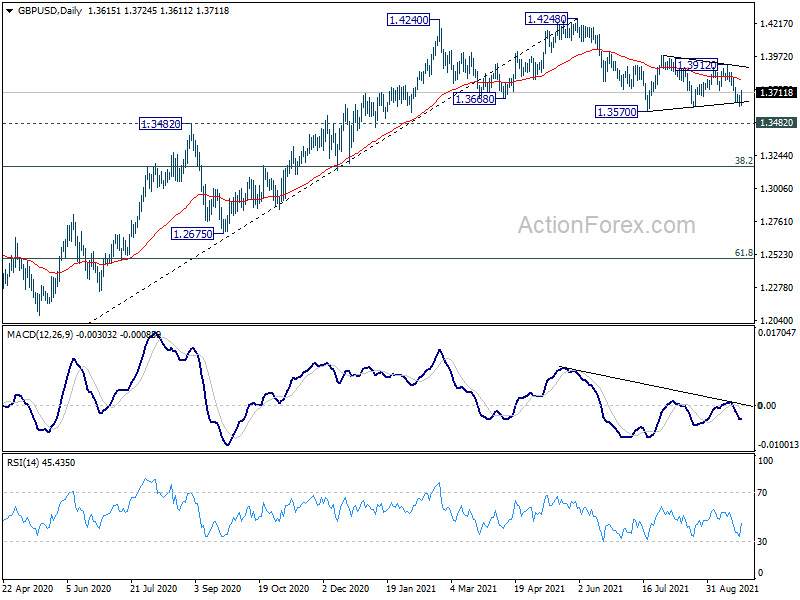
GBP/USD's break of 1.3691 minor resistance argues that fall form 1.3912 might have completed at 1.3608, after defending 1.3570/3601 support zone. Intraday bias is back on the upside for 1.3912 resistance. On the downside, however, break of 1.3570 will target 1.3482 key support level. Sustained break there will carry larger bearish implication and target 1.3163 fibonacci level.
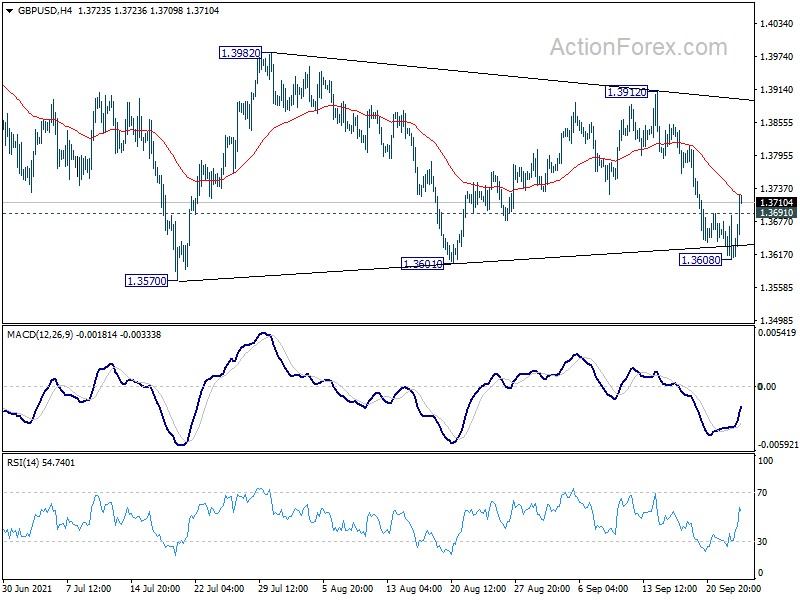
In the bigger picture, as long as 1.3482 resistance turned support holds, we'd still treat price actions from 1.4248 as a corrective move. That is, up trend from 1.1409 (2020 low) is in favor to resume. Decisive break of 1.4376 key resistance (2018 high) would indeed carry long term bullish implications. However, sustained break of 1.3482 will at least bring deeper fall to 38.2% retracement of 1.1409 to 1.4248 at 1.3164, or even further to 61.8% retracement at 1.2493.
Sterling Rebounds on Hawkish BoE Surprise, Risk Sentiments Improved
Sterling rebounds strongly after two BoE MPC member voted for tapering. Also, recent developments strengthened the case of modest tightening. Commodity currencies are also firmer following mild rebound in the stock markets. On the other hand, Yen, Swiss Franc and Dollar turned softer on improvement overall risk sentiment. But for now, the Pound is still the worst performing for the week while Swiss Franc is the strongest.
Technically, GBP/USD's break of 1.3691 minor resistance suggests that fall from 1.3912 has completed, and stronger rise could be seen to retest this resistance. Similarly, GBP/JPY's break of 150.80 minor resistance suggests that stronger rise would be seen to 152.82 resistance. Focus will be on whether EUR/GBP would break through 0.8499 to target a test on 0.8448 low. Overall, there is prospect of a turnaround in Sterling.
In Europe, at the time of writing, FTSE is down -0.09%. DAX is up 0.70%. CAC is up 0.74%. Germany 10-year yield is up 0.0432 at -0.279. Earlier in Asia, Japan was on holiday. Hong Kong HSI rose 1.19%. China Shanghai SSE rose 0.38%. Singapore Strait Times rose 0.93%.
US initial jobless claims rose to 351k, above expectations
US initial jobless claims rose 16k to 351k in the week ending September 18, above expectation of 317k. Four-week moving average of initial claims dropped -750 to 335.75k.
Continuing claims rose 131k to 2845k. Four-week moving average of continuing claims dropped -16k to 2804k, lowest since March 21, 2020.
Canada retail sales dropped -0.6% mom in Jul, estimated to rebound in August
Canada retail sales dropped -0.6% to CAD 55.8B in July, better than expectation of -1.2% mom fall. That's the third decrease in four months, driven by lower sales at food and beverage stores (-3.4%) and building material and garden equipment and supplies dealers (-7.3%). Sales decreased in 5 of 11 subsectors. Based on advance estimates, sales rose 2.1% mom in August.
BoE stands pat, Ramsden and Saunders voted for taper
BoE voted unanimously to keep Bank Rate unchanged at 0.10%. However, it voted 7-2 to keep the government bond purchase target at GBP 895B. Dave Ramsden and Michael Saunders voted to lower purchase target to GBP 860B.
In the statement, it said that since August meeting, "the pace of recovery of global activity has showed signs of slowing", "global inflationary pressures have remained strong", and "there are some signs that cost pressures may prove more persistent".
BoE reiterated that "some modest tightening of monetary policy over the forecast period was likely to be necessary". Developments since August "appear to have strengthened that case".
"The Committee will be monitoring closely the incoming evidence regarding developments in the labour market, and particularly unemployment, wider measures of slack and underlying pay pressures; the extent to which businesses pass on wage and other cost increases, as well as medium-term inflation expectations."
UK PMI composite dropped to 54.1, heading towards a bout of stagflation
UK PMI Manufacturing dropped from 60.3 to 56.3 in September, below expectation of 59.0, a 7-month low. PMI Services dropped from 55.0 to 54.6, below expectation of 55.0, a 7-month low. PMI Composite dropped from 54.8 to 54.1, also a 7-month low.
Chris Williamson, Chief Business Economist at IHS Markit, said:
"The September PMI data will add to worries that the UK economy is heading towards a bout of 'stagflation', with growth continuing to trend lower while prices surge ever higher.
"While there are clear signs that demand is cooling since peaking in the second quarter, the survey also points to business activity being increasingly constrained by shortages of materials and labour, most notably in the manufacturing sector but also in some services firms. ...
"Shortages are meanwhile driving up prices at unprecedented rates as firms pass on higher supplier charges and increases in staff pay...
"Business expectations for the year ahead are meanwhile down to their lowest since January, with concerns over both supply and demand amid the ongoing pandemic casting a shadow over prospects for the economy as we move into the autumn."
Eurozone PMI composite dropped to 56.1, unwelcome combination of sharply slower economic growth and steeply rising prices
Eurozone PMI Manufacturing dropped from 61.5 to 58.7 in September, below expectation of 60.4, a 7-month low. PMI Services dropped from 59.0 to 56.3, below expectation of 58.4, a 4-month low. PMI Composite dropped from 59.0 to 56.1, a 5-month low.
Chris Williamson, Chief Business Economist at IHS Markit said:
"September's flash PMI highlights an unwelcome combination of sharply slower economic growth and steeply rising prices.
"On one hand, some cooling of growth from the two-decade highs seen earlier in the summer was to be expected. On the other hand, firms have become increasingly frustrated by supply delays, shortages and ever-higher prices for inputs. Businesses, most notably in manufacturing but also now in the service sector, are being constrained as a result, often losing sales and customers.
"Concerns over high prices, stressed supply chains and the resilience of demand in the ongoing pandemic environment has consequently eroded business confidence, with expectations for the year ahead now down to the lowest since January.
"For now, the overall rate of expansion remains solid, despite slowing, but growth looks likely to weaken further in coming months if the price and supply headwinds show no signs of abating, especially if accompanied by any rise in virus cases as we head into the autumn."
Germany PMI Manufacturing dropped from 62.6 to 58.5 in September, below expectation of 61.3, an 8-month low. PMI Services dropped from 60.8 to 56.0, below expectation of 60.3, a 4-month low. PMI Composite dropped from 60.0 to 55.3, a 7-month low.
France PMI Manufacturing dropped from 57.5 to 55.2 in September, below expectation of 57.3, lowest in 8 months. PMI Services dropped slightly from 56.3 to 56.0, below expectation of 56.0, lowest in 5 months. PMI Composite dropped from 56.9 to 55.1, lowest in 5 months.
SNB stands pat, upgrades inflation forecasts slightly
SNB kept sight deposit rate unchanged at -0.75% today. Also, it remained "remains willing to intervene in the foreign exchange market as necessary, in order to counter upward pressure on the Swiss franc." It also reiterated that "the Swiss franc remains highly valued".
The new conditional inflation forecast for 2021 is raised to 0.5% in 2021 (up from June's 0.4%). For 2022, it's raised to 0.7% (from 0.6%). For 2023, it's kept unchanged at 0.6%. SNB said it's "primarily due to somewhat higher prices for oil products as well as for goods affected by supply bottlenecks."
SNB also said, in the baseline scenario, it anticipated a "continuation of the economic recovery", assuming pandemic containment measures will not need to be tightened significantly again. GDP is expected to grow around 3% in 2021, downwardly revised, attributable to "less dynamically than expected" development of consumer-related industries. GDP is expected to return to pre-crisis level in H2. But overall production capacity will "remain underutilised for some time yet".
Australia PMI composite rose to 46.0, early signs of a turning point
Australia PMI Manufacturing rose from 52.0 to 57.3 in September, hitting a 3-month high. PMI Services also rose from 42.9 to 44.9, staying in contraction but hit a 3-month high. PMI Composite rose from 43.3 to 46.0.
Jingyi Pan, Economics Associate Director at IHS Markit, said: "The extension of COVID-19 restrictions into September continued to dampen business conditions in the Australian private sector, although the slight easing of restrictions was picked up in the latest IHS Markit Flash Australia Composite PMI, seeing the overall Composite Output Index contracting at a slower rate in September. This may also be suggesting that we are looking at early signs of a turning point.
"The employment index meanwhile pointed to higher workforce levels, which was a positive sign following the decline recorded in August, driven by the severe COVID-19 disruptions. That said, price pressures intensified once again for Australian private sector firms while evidence of worsening supply constraints gathered, all of which remains a focal point for the Australian economy."
GBP/USD Mid-Day Outlook
Daily Pivots: (S1) 1.3588; (P) 1.3639; (R1) 1.3668; More...
GBP/USD's break of 1.3691 minor resistance argues that fall form 1.3912 might have completed at 1.3608, after defending 1.3570/3601 support zone. Intraday bias is back on the upside for 1.3912 resistance. On the downside, however, break of 1.3570 will target 1.3482 key support level. Sustained break there will carry larger bearish implication and target 1.3163 fibonacci level.
In the bigger picture, as long as 1.3482 resistance turned support holds, we'd still treat price actions from 1.4248 as a corrective move. That is, up trend from 1.1409 (2020 low) is in favor to resume. Decisive break of 1.4376 key resistance (2018 high) would indeed carry long term bullish implications. However, sustained break of 1.3482 will at least bring deeper fall to 38.2% retracement of 1.1409 to 1.4248 at 1.3164, or even further to 61.8% retracement at 1.2493.
Economic Indicators Update
| GMT | Ccy | Events | Actual | Forecast | Previous | Revised |
|---|---|---|---|---|---|---|
| 23:00 | AUD | Manufacturing PMI Sep P | 57.3 | 52 | ||
| 23:00 | AUD | Services PMI Sep P | 44.3 | 42.9 | ||
| 07:15 | EUR | France Manufacturing PMI Sep P | 55.2 | 57.3 | 57.5 | |
| 07:15 | EUR | France Services PMI Sep P | 56 | 56.1 | 56.3 | |
| 07:30 | CHF | SNB Interest Rate Decision | -0.75% | -0.75% | ||
| 07:30 | EUR | Germany Manufacturing PMI Sep P | 58.5 | 61.3 | 62.6 | |
| 07:30 | EUR | Germany Services PMI Sep P | 56 | 60.3 | 60.8 | |
| 08:00 | EUR | Eurozone Manufacturing PMI Sep P | 58.7 | 60.4 | 61.4 | |
| 08:00 | EUR | Eurozone Services PMI Sep P | 56.3 | 58.4 | 59 | |
| 08:00 | EUR | ECB Economic Bulletin | ||||
| 08:30 | GBP | Manufacturing PMI Sep P | 56.3 | 59 | 60.3 | |
| 08:30 | GBP | Services PMI Sep P | 54.6 | 55 | 55 | |
| 11:00 | GBP | BoE Interest Rate Decision | 0.10% | 0.10% | 0.10% | |
| 11:00 | GBP | BoE Asset Purchase Facility | 875B | 875B | 875B | |
| 11:00 | GBP | MPC Official Bank Rate Votes | 0--0--9 | 0--0--9 | 0--0--8 | |
| 11:00 | GBP | MPC Asset Purchase Facility Votes | 0--2--7 | 0--1--8 | 0--1--7 | |
| 12:30 | CAD | Retail Sales M/M Jul | -0.60% | -1.20% | 4.20% | |
| 12:30 | CAD | Retail Sales ex Autos M/M Jul | -1.00% | -1.50% | 4.70% | 4.80% |
| 12:30 | USD | Initial Jobless Claims (Sep 17) | 351K | 317K | 332K | 335K |
| 13:45 | USD | Manufacturing PMI Sep P | 61.1 | 61.1 | ||
| 13:45 | USD | Services PMI Sep P | 55.1 | 55.1 | ||
| 14:30 | USD | Natural Gas Storage | 76B | 83B |
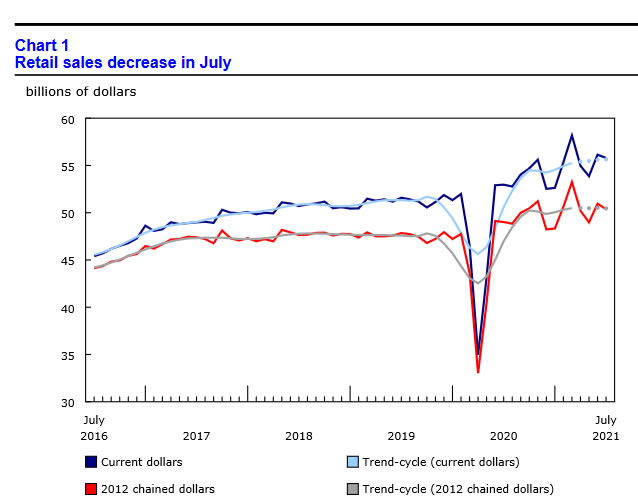
Canada retail sales dropped -0.6% mom in Jul, estimated to rebound in August
Canada retail sales dropped -0.6% to CAD 55.8B in July, better than expectation of -1.2% mom fall. That's the third decrease in four months, driven by lower sales at food and beverage stores (-3.4%) and building material and garden equipment and supplies dealers (-7.3%). Sales decreased in 5 of 11 subsectors. Based on advance estimates, sales rose 2.1% mom in August.
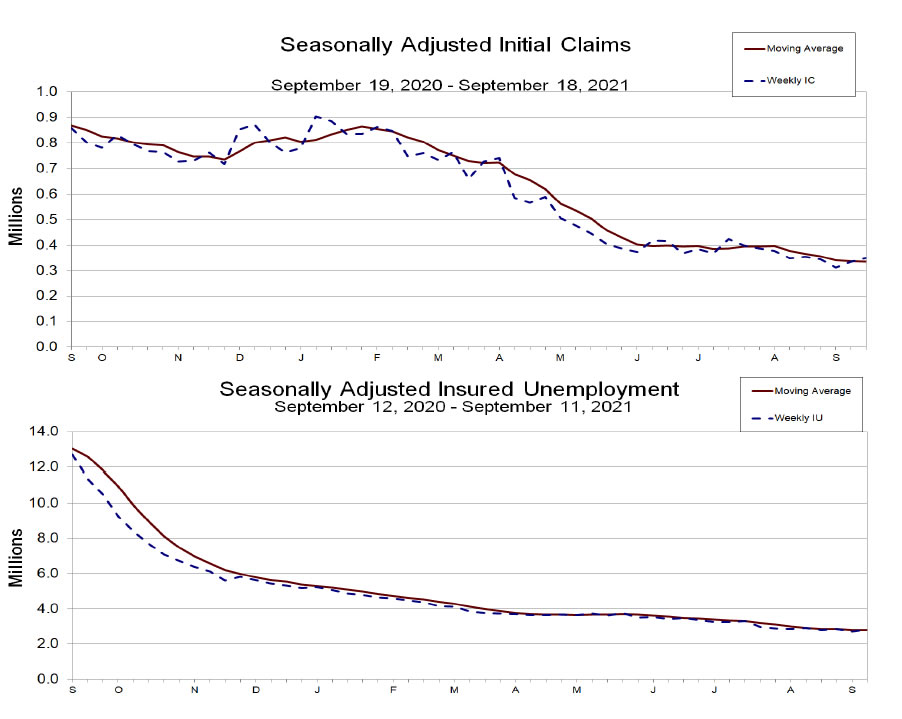
US initial jobless claims rose to 351k, above expectations
US initial jobless claims rose 16k to 351k in the week ending September 18, above expectation of 317k. Four-week moving average of initial claims dropped -750 to 335.75k.
Continuing claims rose 131k to 2845k. Four-week moving average of continuing claims dropped -16k to 2804k, lowest since March 21, 2020.
CAD Climbs After FOMC, Retail Sales Next
The Canadian dollar is rallying strongly in the Thursday session. Currently, USD/CAD is trading at 1.2676, down 0.76% on the day. We could see further movement from the pair in the North American session, as Canada releases Retail Sales reports for July.
Dovish FOMC raises risk appetite
The highly-anticipated FOMC meeting delivered the goods, sort of. The markets had anxiously been looking for the Fed to provide some clarity on tapering, and there was even hope that policymakers might provide a timeline for scaling back bond purchases. After the meeting, Fed Chair Jerome Powell said that the Fed could taper in November if he was satisfied with the economy’s performance. As well, the dot plot showed that two more members projected a rate hike in 2022.
The markets’ reaction is that the Fed is in no hurry to raise interest rates, as they still believe that inflation will be transitory in 2022. The Fed may be committed to tapering in the next few months, but a rate hike is further down the road. This has sent risk appetite higher, lifting minor currencies like the Canadian dollar.
In his remarks, Powell mentioned the two key areas that the Fed is monitoring ahead of a taper – inflation is running well above the Fed target of 2%, while unemployment, which has dropped to 5.2%, still has some ways to go before reaching the Fed goal. The markets will be closely scrutinizing upcoming inflation and employment numbers, which will be major factors in the Fed’s decision as to when to press the taper trigger.
USD/CAD Technical
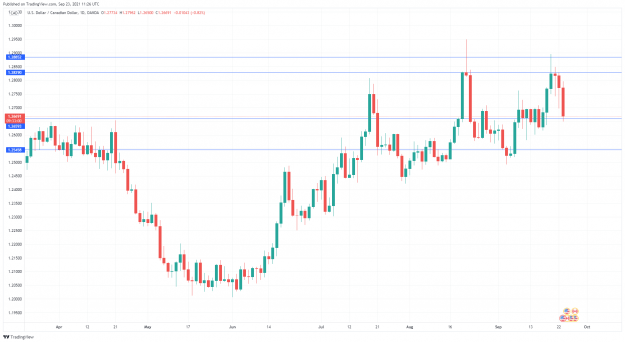
- On the upside, there is resistance at 1.2829. This is followed by resistance at 1.2885
- Support at 1.2659 is fluid. Below, there is support at 1.2545
BoE stands pat, Ramsden and Saunders voted for taper
BoE voted unanimously to keep Bank Rate unchanged at 0.10%. However, it voted 7-2 to keep the government bond purchase target at GBP 895B. Dave Ramsden and Michael Saunders voted to lower purchase target to GBP 860B.
In the statement, it said that since August meeting, "the pace of recovery of global activity has showed signs of slowing", "global inflationary pressures have remained strong", and "there are some signs that cost pressures may prove more persistent".
BoE reiterated that "some modest tightening of monetary policy over the forecast period was likely to be necessary". Developments since August "appear to have strengthened that case".
"The Committee will be monitoring closely the incoming evidence regarding developments in the labour market, and particularly unemployment, wider measures of slack and underlying pay pressures; the extent to which businesses pass on wage and other cost increases, as well as medium-term inflation expectations."
(BOE) Bank Rate Maintained at 0.1%
Monetary Policy Summary, September 2021
The Bank of England's Monetary Policy Committee (MPC) sets monetary policy to meet the 2% inflation target, and in a way that helps to sustain growth and employment. At its meeting ending on 22 September 2021, the Committee judged that the existing stance of monetary policy remained appropriate. The MPC voted unanimously to maintain Bank Rate at 0.1%. The Committee voted unanimously for the Bank of England to maintain the stock of sterling non-financial investment-grade corporate bond purchases, financed by the issuance of central bank reserves, at £20 billion. The Committee voted by a majority of 7-2 for the Bank of England to continue with its existing programme of UK government bond purchases, financed by the issuance of central bank reserves, maintaining the target for the stock of these government bond purchases at £875 billion and so the total target stock of asset purchases at £895 billion.
In the MPC's central projections in the August Monetary Policy Report, UK GDP was projected to recover further over the remainder of the year, with demand growth boosted by a waning impact from Covid-19 (Covid). There was projected to be a period of excess demand in the near term, before demand and supply were expected to return broadly to balance as demand growth slowed and constraints on supply eased. CPI inflation was projected to rise temporarily in the near term, to 4% in 2021 Q4, owing largely to developments in energy and goods prices. Conditioned on the market path for interest rates, CPI inflation was expected to fall back to close to the 2% target in the medium term.
Since the August MPC meeting, the pace of recovery of global activity has showed signs of slowing. Against a backdrop of robust goods demand and continuing supply constraints, global inflationary pressures have remained strong and there are some signs that cost pressures may prove more persistent. Some financial market indicators of inflation expectations have risen somewhat, including in the United Kingdom.
Bank staff have revised down their expectations for the level of UK GDP in 2021 Q3 by around 1% since the August Report, leaving the expected level of Q3 GDP around 2½% below its pre-Covid level. This downward revision in part reflects the emergence of some supply constraints on output. These have been evident in surveys showing historically lengthy supplier delivery times and backlogs of work, significant material and labour shortages in a number of sectors, and lower than normal levels of inventories. Momentum appears to have picked up in services-orientated sectors where output remains well below pre-Covid levels. Although official estimates of retail sales have weakened somewhat, other indicators of spending have generally remained at strong levels, as has consumer confidence.
The Labour Force Survey unemployment rate fell to 4.6% in the three months to July, slightly below the August Report forecast, while HMRC payroll data suggest that employee numbers (which include furloughed jobs) surpassed their 2019 Q4 level in August. The number of full and part-time furloughed jobs has continued to decline, but, on the basis of the most recent reported number of 1.7 million in July, to a materially lesser degree than estimated in the August Report. There have been few signs of any increase in redundancies, and the stock of vacancies has increased further, as have indicators of recruitment difficulties. Bank staff's estimate of underlying pay growth has picked up, to above its pre-pandemic rate.
Uncertainty around the outlook for the labour market has therefore increased. Key questions include how the economy will adjust to the closure of the furlough scheme at the end of September; the extent, impact and duration of any change in unemployment; as well as the degree and persistence of any difficulties in matching available jobs with workers. The Committee will review these, along with other, developments as part of its forthcoming forecast round ahead of the November Monetary Policy Report, which will also include its periodic assessment of the supply side of the economy.
Twelve-month CPI inflation rose from 2.0% in July to 3.2% in August, compared with the 3.0% figure expected in the August Report, and triggered the exchange of open letters between the Governor and the Chancellor of the Exchequer that is being published alongside this monetary policy announcement. Core inflation also rose to 3.1% in August, its highest rate since November 2011. While base effects accounted for the majority of the increase in CPI inflation between July and August, global cost pressures have continued to affect UK consumer goods prices. To a lesser degree, the reopening of the economy has led to a further increase in some consumer services prices. Indicators of households' medium-term inflation expectations have increased in recent months, with the Citi/YouGov five-to-ten year ahead measure at its highest level since 2013 in September.
CPI inflation is expected to rise further in the near term, to slightly above 4% in 2021 Q4, owing largely to developments in energy and goods prices. The material rise in spot and forward wholesale gas prices since the August Report represents an upside risk to the MPC's inflation projection from April 2022. Most other indicators of cost pressures have remained elevated. The Committee's central expectation continues to be that current elevated global cost pressures will prove transitory.
The MPC's remit is clear that the inflation target applies at all times, reflecting the primacy of price stability in the UK monetary policy framework. The framework also recognises that there will be occasions when inflation will depart from the target as a result of shocks and disturbances. In the recent unprecedented circumstances, the economy has been subject to very large shocks. Given the lag between changes in monetary policy and their effects on inflation, the Committee, in judging the appropriate policy stance, will as always focus on the medium-term prospects for inflation, rather than factors that are likely to be transient.
At its previous meeting, the Committee judged that, should the economy evolve broadly in line with the central projections in the August Monetary Policy Report, some modest tightening of monetary policy over the forecast period was likely to be necessary to be consistent with meeting the inflation target sustainably in the medium term. Some developments during the intervening period appear to have strengthened that case, although considerable uncertainties remain. The Committee will be monitoring closely the incoming evidence regarding developments in the labour market, and particularly unemployment, wider measures of slack and underlying pay pressures; the extent to which businesses pass on wage and other cost increases, as well as medium-term inflation expectations.
At this meeting, the Committee judged that the existing stance of monetary policy remained appropriate.
Minutes of the Monetary Policy Committee meeting ending on 22 September 2021
1) Before turning to its immediate policy decision, the Committee discussed: the international economy; monetary and financial conditions; demand and output; and supply, costs and prices.
The international economy
2) The global economy had continued to recover and UK-weighted global GDP growth in 2021 Q2 had been broadly in line with expectations at the time of the August Monetary Policy Report. Global activity was now expected to grow at a slightly slower pace in Q3, however, accounted for largely by weaker growth in the United States and China. There had also been some early evidence of a rotation in demand from goods to services, with the services PMIs above or in line with the manufacturing PMIs in the United States and the euro area. Against a backdrop of robust goods demand and continuing supply constraints, global inflationary pressures had remained strong and there were some signs that cost pressures might prove more persistent.
3) Euro-area GDP had picked up by 2.2% in 2021 Q2, stronger than had been expected at the time of the August Report. The number of Covid cases appeared to have stabilised in most euro-area countries alongside a recovery in mobility and continued progress in vaccination programmes. Turning to Q3, the euro-area manufacturing PMI had remained well above its historical average, although it had fallen back to its weakest level in six months in August, with supply constraints affecting activity. The services PMI had also remained elevated. Bank staff now expected euro-area GDP growth in Q3 to be somewhat stronger than at the time of the August Report, but the level of GDP was expected to remain below its pre-Covid level.
4) US GDP had risen by 1.6% in 2021 Q2, slightly weaker than had been expected at the time of the August Report. In the labour market, non-farm payrolls had increased by 235,000 in August, a much slower pace than the average of around 1 million jobs that had been added over the previous two months. The unemployment rate had nevertheless fallen to 5.2%. Although Covid cases had now started to fall across most US regions, they had remained elevated and the pace of the vaccination rollout had slowed considerably in recent months, as some southern states in particular had seen a lower take-up. But mobility and activity had held up in these states despite this, consistent with the link between cases and activity having weakened. Real personal consumption spending had fallen by 0.1% in July, with services spending continuing to recover relative to goods spending. The most recent high-frequency spending data had also pointed to some slowdown in consumer spending, although they had remained above their pre-Covid levels. Overall, US GDP in Q3 was expected to rise by somewhat less than at the time of the August Report.
5) Chinese activity had slowed in July, with the re-imposition of localised lockdowns in response to outbreaks of Covid weighing on mobility. Official data and business surveys had pointed to a further moderation in activity in August, and GDP in 2021 Q3 was expected to rise by slightly less than at the time of the August Report.
6) The recovery in other large Emerging Market Economies (EMEs) had been weaker than expected at the time of the August Report, accounted for particularly by the impact on GDP of the delta variant-driven second wave in India. Covid cases in these EMEs had generally fallen in recent months and there had been an increase in the pace of vaccination rollouts in some of these economies, although vaccination rates had still remained below the levels seen in most advanced economies. Indicators of economic mobility had generally held up across EMEs recently, even when Covid cases had risen.
7) Global inflationary pressures had remained strong. Manufacturing input and output prices had continued to rise sharply, albeit at marginally slower rates. Oil prices had remained elevated compared to their pre-Covid levels, with the Brent oil spot price around $74 per barrel. Wholesale gas prices had risen sharply in Europe and Asia, driven by a combination of strong global demand and a range of supply constraints, including a low level of inventories after an unusually long and cold winter in Europe, as well as a lower-than-usual availability of wind energy in recent weeks. Non-energy commodity prices, in aggregate, had been largely unchanged. Shipping costs had continued to rise, with spot rates rising particularly sharply on certain routes. The strength in shipping costs had continued to reflect a range of factors, including strong global goods demand, as well as supply chain disruptions such as congestion and Covid-related closures at some large ports. Supplier delivery times had continued to rise. Supply conditions had appeared to have improved slightly in some sectors such as semiconductor production, although it would take some time for previous order backlogs to clear. Global containerised trade flows had continued to recover and world trade volumes had been 6.5% above pre-pandemic levels in 2021 Q2.
8) In the euro area, twelve-month headline HICP inflation had risen to 3.0% in August, from 2.2% in July, stronger than had been expected at the time of the August Report. Core inflation had also risen to 1.6% from 0.7%, accounted for in part by a substantial increase in clothing and footwear inflation.
9) US CPI inflation had remained elevated in August, although it had eased slightly to 5.3% in August from a 13-year high of 5.4% in June and July. Headline PCE inflation had picked up a little further to 4.2% in July, and core PCE inflation had remained unchanged at 3.6%. The rise in headline inflation had primarily been driven by sectors that were sensitive to the reopening of the US economy. But there had been some signs that price pressures in other sectors were easing. For example, the contribution to inflation of used cars prices and other durable goods prices had eased in the past couple of months.
Monetary and financial conditions
10) Since the Committee's previous meeting, advanced-economy financial market prices had generally moved within a narrow range. Equity prices and corporate bond spreads had changed little, while shorter-term and longer-term government bond yields had increased slightly. Most recently, global equity prices had been more volatile, in part driven by the financial distress at Evergrande Group, one of China's largest property developers.
11) Market implied measures of advanced-economy policy rates had increased slightly since the Committee's previous meeting. In the United Kingdom, increases in the level of Bank Rate to 25 basis points and 50 basis points were now expected in May 2022 and December 2022 respectively, compared to August 2022 and February 2024 at the time of the Committee's previous meeting. Market expectations of the first 25 basis point increase in the federal funds rate in the United States had been brought forward to February 2023 from June 2023. At its meeting on 9 September, the ECB Governing Council had decided to reduce moderately the pace of asset purchases under the Pandemic Emergency Purchase Programme. The Governing Council had left its key policy rates unchanged.
12) Some financial market indicators of inflation expectations had risen somewhat, including in the United Kingdom. Near-term measures of inflation compensation, such as the one-year inflation swap rate, one year forward, had risen substantially in the United Kingdom since the Committee's previous meeting. The driver of this movement appeared to be the stronger than expected CPI inflation outturn. Five-year inflation swap rates, five years forward, an indicator of medium-term inflation expectations, had increased slightly and were around 20 basis points above their 2019 average.
13) Real yields implied by advanced-economy longer-term government bonds had fallen substantially since their recent peak in March 2021, and were now significantly lower than their pre-pandemic levels. Alongside this, advanced-economy equity prices had increased materially since the beginning of this year, such that, in some large advanced economies, they had increased significantly above their pre-pandemic levels.
14) Market contacts had put forward several possible explanations for this constellation of asset prices. Some had attributed low real yields primarily to expectations of monetary policy, which could remain highly accommodative if central banks looked through any transitory increases in inflation, while also supporting risky asset prices. These contacts had expected real rates to rise over time, with a range of views around how gradually this might occur. Other contacts had attributed low real yields to a more pessimistic outlook for medium-term global growth than had appeared to be incorporated into equity valuations.
15) The sterling effective exchange rate had been broadly stable since the previous MPC meeting.
16) Mortgage credit conditions in the United Kingdom had eased further, with a further fall in lending spreads on most mortgage products. Spreads on products with loan-to-value (LTV) ratios lower than or equal to 75% were now similar to spreads in January 2020, while spreads on products with LTV ratios higher than 75% had remained above their January 2020 levels. The number of mortgage products available had continued to improve, with availability for products with low LTV ratios now similar to pre-pandemic levels, although availability for products with high LTV ratios had remained below pre-pandemic levels. Supervisory intelligence suggested that lenders had become more optimistic about the economic outlook, while bank wholesale funding spreads had fallen over recent months and ring-fenced banks had ample liquidity from strong deposit growth.
17) Credit conditions for unsecured borrowing by households and for lending to small and medium-sized enterprises had changed little since the Committee's previous meeting and spreads had remained below the MPC's forecasts made earlier this year.
Demand and output
18) Since the MPC's previous meeting, the number of hospitalisations of Covid-19 (Covid) patients and deaths within 28 days of testing positive for Covid had tended to rise in the United Kingdom, although the number of Covid cases had started to fall back again most recently. The number of people that had been asked to self-isolate temporarily through various channels had declined sharply following a change in guidance in August that meant that those people who had had two doses of a Covid vaccine no longer had to isolate if they came into contact with someone who had tested positive for the virus. The UK Government had recently announced its autumn and winter plan for responding to Covid, including that all children aged 12 to 15 would be offered one dose of a Covid vaccine, and that all adults over 50 and those that were clinically vulnerable would be offered a booster jab. Covid-related restrictions on international travel had also been relaxed recently.
19) According to the ONS's first quarterly estimate, UK GDP had risen by 4.8% in 2021 Q2, close to the projection incorporated into the August Monetary Policy Report for the quarter as a whole. That had left the level of GDP around 4½% below its pre-Covid level in 2019 Q4. Within the expenditure components, household consumption had been estimated to have risen by 7.3% following the reopening of the retail and hospitality sectors through the second quarter, although that had been a somewhat weaker increase than expected in the August Report. Business investment, which was often subject to revision, had also risen by less than had been expected, by 2.4% and had remained around 15% below its pre-Covid level. Government consumption had increased by over 6%, as education output had rebounded due to the recovery in pupil attendance after earlier restrictions had been lifted.
20) Ahead of the MPC's next meeting, the ONS would release Blue Book-consistent revisions to GDP as part of the Quarterly National Accounts published on 30 September, including significant methodological changes such as the introduction of double deflation and improvements to deflators for items such as telecommunications and clothing. Some of these changes were expected to raise pre-pandemic economic growth rates.
21) Official output data for June and July had been somewhat weaker than expected in the August Report, with monthly growth rates of 1.0% and 0.1% respectively, implying that the level of GDP had been around 3½% below its 2019 Q4 level in the middle of the year. The downside news appeared to have reflected signs that bottlenecks in supply chains and labour shortages had started to affect output, particularly in the manufacturing and construction sectors, combined with a slower-than-expected recovery in demand in some consumer-facing services.
22) A further recovery in activity appeared to be underway in components of output that had remained well below their pre-Covid levels to date, such as some consumer-facing services, and transport and workplace-related services. For example, faster indicators of the use of public transport and the number of flights had risen over recent weeks. And there was some evidence to suggest spending on entertainment and recreational events had increased, as restrictions had loosened further. Education output was also likely to have risen towards its normal level. Taken together, these components were judged likely to account for a large part of the GDP growth expected in 2021 Q3.
23) Other indicators of household spending had generally remained at strong levels, as had consumer confidence. Although official estimates of retail sales volumes had fallen by 0.9% in August, the level of sales had remained over 4% above its pre-Covid level. Food store sales had fallen, while faster indicators of restaurant spending had picked up. Housing activity indicators had remained robust, including mortgage approvals for house purchase. Although the July UK House Price Index had unwound almost all of its record rise in June, perhaps related to the timing of the tapering of the temporary stamp duty cut in England and Northern Ireland, other timelier house price data had picked up further.
24) It appeared likely that the impact of supply constraints on output would prove more persistent. Supplier delivery times had continued to lengthen materially in the manufacturing and construction sectors according to the latest PMI surveys. And over half of the respondents to the latest CBI Industrial Trends survey had reported that materials or components were a factor limiting production over the next three months, with about a third of respondents noting that skilled labour was also a limiting factor, both of which were close to historical series' highs. Supply chain issues had led respondents to the latest CBI's Distributive Trades survey to report the lowest level of retail inventories, relative to expected sales, on record. Backlogs of work had also risen according to that component of the services PMI, linked primarily to shortages of key staff. Intelligence from the Bank's Agents suggested that, against a backdrop of strong demand, it might take some quarters for supply issues to be resolved in some cases. Separately, recent high spot wholesale gas prices had significantly affected the production plans of some sectors.
25) Overall, Bank staff had revised down their expectations for 2021 Q3 GDP growth from 2.9% at the time of the August Report to 2.1%, in part reflecting the emergence of some supply constraints on output. That would leave the level of Q3 GDP around 2½% below its pre-Covid level.
26) Alongside the launch of Spending Review 2021 on 7 September, the Government had announced a new, Health and Social Care Levy from April 2022, the proceeds of which would be used for spending on health and social care. This would be based on an increase in National Insurance Contributions for all working adults and a rise in dividend tax rates. The overall envelope for core day-to-day departmental spending was otherwise assumed to follow the path set out at spring Budget 2021. The Government had also announced that the state pension triple lock would be suspended for fiscal year 2022-23. The Spending Review would conclude on 27 October alongside both an autumn Budget, and an updated economic and fiscal forecast by the Office for Budget Responsibility.
Supply, costs and prices
27) The Labour Force Survey (LFS) unemployment rate had fallen to 4.6% in the three months to July, slightly below the expectations in the August Monetary Policy Report. The unemployment rate had remained 0.8 percentage points above its 2019 Q4 level of 3.8%. LFS employment had grown by 0.6% in the three months to July, slightly above expectations at the time of the August Report. HMRC payroll data suggested that employee numbers had increased by 241,000 in August and had surpassed their 2019 Q4 level, although these data were prone to revision. The inactivity rate had fallen to 36.7% in the three months to July and had unwound around one fifth of its increase over the course of the pandemic.
28) HMRC administrative data suggested that around 1.7 million jobs, just under 7% of private sector jobs, had been furloughed on the Coronavirus Job Retention Scheme (CJRS) in July, compared to around 2 million jobs furloughed in June. This was a materially higher number of jobs furloughed than had been assumed at the time of the August Report, in part possibly reflecting the downside news in GDP growth over that period. Additionally, the reweighting of the ONS's Business Insights and Conditions Survey (BICS) had led to a substantial upward revision to the estimated share of private sector jobs furloughed, relative to the data that had been available at the time of the August Report. Recent BICS data suggested that the number of jobs furloughed had declined to around 6% of private sector jobs over the two weeks to 5 September. Staff estimates suggested that just under half of those jobs furloughed had been on a flexible form of furlough that allowed those employees to have undertaken some work with their employer. The proportion of salary for furloughed hours covered by the Government had been tapered progressively, from 80% to 70% in July and to 60% from 1 August, with employers required to top up to 80% since July. The CJRS would end on 30 September 2021.
29) Indicators of redundancies had remained subdued in the run-up to the end of the CJRS. The level of LFS redundancies had fallen in the three months to July, and the redundancy rate had decreased to 3.4%, around ½ percentage point below pre-pandemic levels. HR1 notifications, a statutory requirement that recorded the advance notification of planned redundancies of 20 or more staff at a single establishment, had remained low, even as the relevant statutory consultation periods overlapped with the end date of the CJRS. Smaller businesses had been disproportionate users of the furlough scheme, however, and by definition were not required to make HR1 notifications. The BICS data had not pointed to an increase in planned redundancies by small businesses over the next three months, although intelligence from the Bank's Agents had highlighted a risk of some micro businesses, which employed only one or two staff, closing permanently upon the CJRS's closure.
30) Indicators of labour demand had remained strong and the labour market appeared to have tightened further. The stock of job vacancies had risen above 1 million in August, surpassing the previous record set in July. The ratio of vacancies to unemployment had also risen rapidly, and had surpassed its 2019 average on a single month basis. The REC index of staff availability had tightened at a record pace in August. Intelligence from the Bank's Agents suggested that recruitment difficulties had become more widespread and acute in recent months. Agents' contacts had attributed labour shortages to a combination of factors, including demand recovering more quickly than expected and a reduction in the availability of EU workers. The shortage of Heavy Goods Vehicle (HGV) drivers had been exacerbated by an ageing workforce and a backlog of licence testing.
31) Private-sector regular Average Weekly Earnings (AWE) had risen by 7.8% in the three months to July on a year earlier, compared to 8.4% in the three months to June. AWE growth had continued to be boosted by compositional effects, given that job losses had been skewed towards lower-paid employees during the pandemic. AWE growth had also been pushed up mechanically by the CJRS recently, with just under 7% of private sector jobs having been furloughed in July, compared to around 23% in July 2020. The CJRS had been a drag on measured pay growth over the pandemic period prior to May. Adjusted for the mechanical effects of the CJRS and changes in composition, Bank staff estimated that private sector regular pay growth had been around 4%, above pre-pandemic rates. The REC Report on Jobs permanent staff salaries index, which measured the monthly pay growth of new permanent hires, had increased to its highest level on record and had pointed to robust pay growth of new hires. The Bank's Agents' contacts had reported an increase in pay settlements recently. Their contacts had also reported that pay increases had been significantly higher for workers with skills in particularly short supply, such as HGV drivers, while the use of one-off bonuses to retain staff had become more widespread.
32) Twelve-month CPI inflation had risen from 2.0% in July to 3.2% in August. As the inflation rate in August had been above 3%, an exchange of letters between the Governor and the Chancellor of the Exchequer was being published alongside these minutes. Core inflation had also risen from 1.8% in July to 3.1% in August, its highest rate since November 2011. The headline CPI outturn for August had been 0.2 percentage points above the projection in the August Report. That upside news had been accounted for largely by recreational and audio-visual goods, food and accommodation services.
33) Base effects had accounted for the majority of the increase in twelve-month inflation between July and August. The base effects from last year's Eat Out to Help Out scheme, which had dragged on prices in August last year, and the temporarily reduced VAT rate for hospitality, holiday accommodation and attractions dropping out of the annual calculation, had largely accounted for a rise in services inflation to a four-year high. Additionally, other items, such as clothing and footwear and airfares had grown at below average rates in August last year.
34) Global supply bottlenecks had continued to affect UK consumer goods prices. Some consumer goods markets had also been affected indirectly by supply bottlenecks. For example, continuing semiconductor shortages had disrupted new car production, which had led to an increase in demand in the used car market. Twelve-month used car price inflation had risen to 18.3% in August.
35) The reopening of the economy had led to a pickup in some consumer services prices. Recent monthly price increases had been particularly pronounced, relative to historical averages, for those services most directly affected by previous restrictions, such as restaurants recreational and accommodation services.
36) The Committee discussed the near-term outlook for consumer prices. CPI inflation was expected to rise further temporarily, to slightly above 4% in 2021 Q4, slightly higher than the projection in the August Report.
37) Around half of the near-term projected above-target inflation was expected to be accounted for by elevated energy price inflation. The projected contribution of energy prices from October 2021 reflected a base effect as well as Ofgem's most recent announced increases in the standard variable tariff caps on retail gas and electricity prices. Spot and forward wholesale gas prices had risen materially since the publication of the August Report, against a backdrop of strong demand and some supply disruption. This could represent a significant upside risk to the MPC's inflation projection from April 2022, when Ofgem next updated its retail energy price caps based on the relevant forward contracts, and meant that CPI inflation would remain slightly into 4% until 2022 Q2, all else equal.
38) Core goods inflation was expected to remain above pre-pandemic averages, accounting for most of the remainder of the projected above-target inflation. In contrast to much of the pandemic period, services inflation was expected to rise slightly, to rates close to pre-Covid averages, which in part reflected a continued recovery of activity in consumer-facing services, as well as the tapered rise in VAT on hospitality, holiday accommodation and attractions from October. Most indicators of cost pressures had remained elevated. Manufacturer's output prices, excluding food and energy, had grown at an annualised rate of close to 10% in the three months to August. Survey-based measures of output and input price inflation, such as the PMIs, had remained at around their recent historically high levels. The Banks' Agent's contacts had reported that there had been more signs of cost pass-through in the manufacturing and construction sectors recently. The Banks' Agent's contacts had also reported some signs of firms passing on some labour cost increases in labour-intensive sectors.
39) Indicators of households' medium-term inflation expectations had increased in recent months, with the Citi/YouGov five-to-ten year ahead measure at its highest level since 2013 in September. The Bank/Kantar five-year ahead measure of households' inflation expectations had also increased slightly, but was now around its historical average. There was the potential for short-term measures of households' expectations to rise further in the coming months, as they had tended to move with official inflation outturns previously. Such movements in these short-term measures would not be inconsistent with household inflation expectations remaining anchored. The August Decision Maker Panel had reported an increase in companies' one-year ahead own-price inflation expectations. Professional forecasters, on average, expected less of a rise in inflation in the short term than the August Report projection, according to the latest HM Treasury survey of independent forecasters.
The immediate policy decision
40) The MPC sets monetary policy to meet the 2% inflation target, and in a way that helps to sustain growth and employment.
41) In the MPC's central projections in the August Monetary Policy Report, UK GDP had been projected to recover further over the remainder of the year, with demand growth boosted by a waning impact from Covid-19 (Covid). There had been projected to be a period of excess demand in the near term, before demand and supply had been expected to return broadly to balance as demand growth slowed and constraints on supply eased. CPI inflation had been projected to rise temporarily in the near term, to 4% in 2021 Q4, owing largely to developments in energy and goods prices. Conditioned on the market path for interest rates, CPI inflation had been expected to fall back to close to the 2% target in the medium term.
42) The Committee reviewed recent developments, including the extent to which they had been in line with the projections in the August Report.
43) Since the August MPC meeting, the pace of recovery of global activity had showed signs of slowing. Euro-area GDP growth in 2021 Q2 had been higher than expected at the time of the August Report, and was now expected to be somewhat stronger in Q3 as well. Developments in US GDP had shown the opposite pattern, although the link between Covid cases and activity there had continued to weaken. Growth in China and other large Emerging Market Economies had also weakened somewhat. There had been some early evidence of a rotation in demand from goods to services, with the services PMIs above or in line with the manufacturing PMIs in the United States and the euro area recently.
44) Against a backdrop of robust goods demand and continuing supply constraints, global inflationary pressures had remained strong and there were some signs that cost pressures might prove more persistent. Oil prices had remained elevated and global shipping costs had continued to rise. Wholesale gas prices had risen substantially across Europe. Supply conditions appeared to have improved slightly in the global semiconductors sector, although it would take some time for previous order backlogs to clear. Headline and core consumer price inflation had risen in the euro area and had remained elevated in the United States.
45) Since the Committee's previous meeting, global equity prices and corporate bond spreads had generally changed little, while shorter-term and longer-term government bond yields had increased slightly, including in the United Kingdom. Mortgage credit conditions in the United Kingdom had eased further, with a further fall in lending spreads on most mortgage products.
46) As of 22 September 2021, the total stock of assets held in the Asset Purchase Facility had reached £852 billion, including £108 billion of the £150 billion programme of UK government bond purchases announced on 5 November 2020.
47) Bank staff had revised down their expectations for the level of UK GDP in 2021 Q3 by around 1% since the August Report, leaving the expected level of Q3 GDP around 2½% below its pre-Covid level. This downward revision in part reflected the emergence of some supply constraints on output. These had been evident in surveys showing historically lengthy supplier delivery times and backlogs of work, significant material and labour shortages in a number of sectors, and lower than normal levels of inventories. Momentum appeared to have picked up in services-orientated sectors, where output had remained well below pre-Covid levels. Although official estimates of retail sales had weakened somewhat, other indicators of spending had generally remained at strong levels, as had consumer confidence.
48) Bank staff's initial assessment was that recent fiscal announcements were likely to be broadly neutral for the growth outlook, as higher spending on health and social care would be funded by an increase in National Insurance Contributions and a rise in dividend tax rates. The overall envelope for core day-to-day departmental spending was otherwise assumed to follow the path set out at spring Budget 2021. Ahead of the Committee's next meeting, the Government would conclude its Spending Review on 27 October alongside both an autumn Budget, and an updated economic and fiscal forecast by the Office for Budget Responsibility.
49) The Labour Force Survey unemployment rate had fallen to 4.6% in the three months to July, slightly below the August Report forecast, while HMRC payroll data suggested that employee numbers (which included furloughed jobs) had surpassed their 2019 Q4 level in August. The inactivity rate had fallen in the three months to July and had unwound around one fifth of its increase over the course of the pandemic.
50) The number of full and part-time furloughed jobs had continued to decline, but to a materially lesser degree than had been estimated in the August Report. That surprise could only partly be explained by downside news in GDP growth. HMRC administrative data suggested that around 1.7 million jobs, just under 7% of private sector jobs, had been furloughed on the Coronavirus Job Retention Scheme (CJRS) in July, with just under half of those jobs on a flexible form of furlough that allowed those employees to have undertaken some work with their employer. Recent Business Insights and Conditions Survey (BICS) data suggested that the number of jobs furloughed had declined to around 6% of private sector jobs over the two weeks to 5 September. The end of the CJRS on 30 September would remove this support to incomes.
51) There had been few signs of any increase in redundancies, and the stock of vacancies had increased further, as had indicators of recruitment difficulties. Contacts of the Bank's Agents had attributed labour shortages to a combination of factors, including demand recovering more quickly than expected and a reduction in the availability of EU workers. The shortage of Heavy Goods Vehicle drivers had been exacerbated by an ageing workforce and a backlog of licence testing.
52) Bank staff's estimate of underlying pay growth had picked up, to above its pre-pandemic rate. The Bank's Agents' contacts had reported that pay increases had been significantly higher for workers with skills in particularly short supply, while the use of one-off bonuses to retain staff had become more widespread.
53) The Committee discussed explanations for the surprisingly high number of jobs that were still recorded as being furloughed, despite other signals of a rapidly tightening labour market. One possibility was that some companies had continued to use the CJRS to hoard labour ahead of an expected recovery in demand, even though the cost of that strategy had increased recently. Although some of these companies might choose to let staff go at the end of the scheme, others might be sufficiently confident of future demand to retain them. A substantial proportion of furloughed jobs had been at very small companies, including those with a single employee, for which the decision to reopen or not might depend more on idiosyncratic conditions. To the extent that some businesses had not yet brought staff back fully to their pre-Covid workplaces, this might have prolonged furlough in other businesses that supported these workplaces through ancillary goods and services. It was also possible that a greater number of furloughed workers had been able to find second jobs with alternative employers, or had expanded the scope of existing second jobs, which were allowable under the CJRS. These workers would probably not become unemployed at the end of the scheme, although, if they accounted for a large proportion of those still furloughed, it would make current high vacancy rates more difficult to explain.
54) Another hypothesis was that, due to shifts in the pattern of demand during the pandemic, those on furlough were not suitable matches for the job vacancies currently available. Although vacancies had risen across the economy, including in sectors with a high number of furloughed jobs, there could be mismatch at a more granular level across companies within the same sector. In that case, any increase in unemployment following the end of the CJRS might, at least in part, be more structural than cyclical.
55) Overall, the Committee judged that uncertainty around the outlook for the labour market had increased. Key questions included how the economy would adjust to the closure of the furlough scheme at the end of September; the extent, impact and duration of any change in unemployment; as well as the degree and persistence of any difficulties in matching available jobs with workers.
56) The Committee would review these, along with other, developments as part of its forthcoming forecast round ahead of the November Monetary Policy Report, which would also include its periodic assessment of the supply side of the economy. Ahead of the next MPC meeting, official data on furlough numbers would only be available for August, although additional, timelier information would be available from the BICS, other surveys and the Bank's Agents, including on any potential increase in redundancies. Official labour market data for October, covering the period following the closure of the CJRS, would not be published until after the November MPC meeting.
57) Twelve-month CPI inflation had risen from 2.0% in July to 3.2% in August, compared with the 3.0% figure expected in the August Report, and had triggered the exchange of open letters between the Governor and the Chancellor of the Exchequer that was being published alongside this monetary policy announcement. Core inflation had also risen to 3.1% in August, its highest rate since November 2011. While base effects had accounted for the majority of the increase in CPI inflation between July and August, global cost pressures had continued to affect UK consumer goods prices. To a lesser degree, the reopening of the economy had led to a further increase in some consumer services prices.
58) CPI inflation was expected to rise further in the near term, to slightly above 4% in 2021 Q4, owing largely to developments in energy and goods prices. The material rise in spot and forward wholesale gas prices since the August Report represented an upside risk to the MPC's inflation projection from April 2022, and meant that CPI inflation could remain above 4% into 2022 Q2, all else equal. Most other indicators of cost pressures had remained elevated. The Committee's central expectation continued to be that current elevated global cost pressures would prove transitory. Indeed, there were still good reasons to expect material supply responses in commodity and other global markets, pushing down on future input prices and import costs. That said, should the pandemic reinforce the retrenchment of globalisation, there would be less scope for these factors to create future disinflationary pressures. And current elevated inflationary pressures could potentially lead to some second-round effects on consumer prices.
59) Some financial market indicators of inflation expectations had risen somewhat, including in the United Kingdom. The UK five-year inflation swap rate, five years forward was around 20 basis points above its 2019 average. Indicators of UK households' medium-term inflation expectations had increased in recent months, with the Citi/YouGov five-to-ten year ahead measure at its highest level since 2013 in September. The Bank/Kantar five-year ahead measure of households' inflation expectations had also increased slightly, but was now around its historical average. Taking together the full range of evidence from financial market measures and surveys of households, businesses and professional forecasters, the Committee judged that UK inflation expectations remained well anchored. But given recent developments, the Committee would monitor very closely the risk that domestic and global demand and cost pressures could further affect medium-term inflation expectations.
60) The Committee turned to its immediate policy decision.
61) The MPC had, since the second half of 2020, had policy guidance in place specifying that it did not intend to tighten monetary policy at least until there was clear evidence that significant progress was being made in eliminating spare capacity and achieving the 2% inflation target sustainably. There remained a range of views on the Committee about whether the conditions of that guidance were met, but all members agreed that the previous formal guidance was no longer useful in the present situation.
62) The MPC's remit was clear that the inflation target applied at all times, reflecting the primacy of price stability in the UK monetary policy framework. The framework also recognised that there would be occasions when inflation would depart from the target as a result of shocks and disturbances. In the recent unprecedented circumstances, the economy had been subject to very large shocks. Given the lag between changes in monetary policy and their effects on inflation, the Committee, in judging the appropriate stance of monetary policy, would as always focus on the medium-term prospects for inflation, rather than factors that were likely to be transient.
63) At this meeting, most members of the Committee judged that the existing stance of monetary policy, which included the previously announced £150 billion increase in the target stock of purchased assets, remained appropriate. There was a range of views about the most likely near-term path of unemployment following the closure of the furlough scheme. However, all members in this group agreed that the outlook for the labour market, and hence underlying inflationary pressures, was particularly uncertain, and that some of this uncertainty should be resolved over coming months. Hence, there was a high option value in waiting for that additional information before deciding if and when a tightening in monetary policy might be warranted. If there were signs that the unemployment rate was increasing significantly following the end of the CJRS, it might take somewhat longer to assess the extent to which that rise was structural or cyclical, and, if structural and pushing down on effective supply in the economy, for how long that might persist.
64) For members in this group, it remained likely that inflation would fall back in the medium term in line with the projection in the August Report, as supply bottlenecks were cleared, demand growth eased, and companies' pricing power moderated. On one view, abstracting from current constraints on effective supply, GDP remained well below its medium-term potential level and monetary policy could have a role in sustaining demand, with a view to reducing the degree of medium-term scarring. On another view, the economy had shown further signs of normalising recently and demand could remain strong even while supply constraints proved more long-lasting. CPI inflation had continued to surprise on the upside, some indicators of cost pressures appeared somewhat more persistent and financial market inflation break-evens had continued to rise gradually. Different members placed different weights on these arguments. For all members in this group, monetary policy would at some point need to start to unwind some of its post-pandemic stimulus.
65) All members in this group agreed that any future initial tightening of monetary policy should be implemented by an increase in Bank Rate, even if that tightening became appropriate before the end of the existing UK government bond asset purchase programme.
66) For two members, the economic outlook warranted a tightening in the monetary policy stance at this MPC meeting. There was increasing evidence from a range of global and domestic cost and price indicators that inflationary pressures were likely to persist. Record vacancy levels and the pace of underlying wage growth were evidence of ongoing tightness in labour market conditions, alongside other signs of capacity pressures. These members judged that, with the existing policy stance, inflation was likely to remain above the 2% target in the medium term. This reflected a greater impact from cost pressures, and the prospect of a larger and more persistent level of excess demand in the United Kingdom than in the central forecast in the August Report.
67) These two members preferred to stop the current asset purchase programme as soon as practical after this meeting rather than continuing it until around the end of the year, as currently planned. Continuing with asset purchases when CPI inflation was above 3% and the output gap was closed might cause medium-term inflation expectations to drift up further. A decision to curtail the asset purchase programme at this meeting would imply a modest policy tightening and mitigate that risk, which might otherwise ultimately necessitate a more abrupt subsequent tightening in policy and hence a greater adjustment in growth and employment. It would demonstrate the Committee's commitment to returning inflation to target in the medium term and ensuring that medium-term inflation expectations remained well anchored.
68) At its previous meeting, the Committee had judged that, should the economy evolve broadly in line with the central projections in the August Monetary Policy Report, some modest tightening of monetary policy over the forecast period was likely to be necessary to be consistent with meeting the inflation target sustainably in the medium term. Some developments during the intervening period appeared to have strengthened that case, although considerable uncertainties remained. The Committee would be monitoring closely the incoming evidence regarding developments in the labour market, and particularly unemployment, wider measures of slack and underlying pay pressures; the extent to which businesses passed on wage and other cost increases, as well as medium-term inflation expectations.
69) The Chair invited the Committee to vote on the propositions that:
Bank Rate should be maintained at 0.1%;
The Bank of England should maintain the stock of sterling non-financial investment-grade corporate bond purchases, financed by the issuance of central bank reserves, at £20 billion;
The Bank of England should continue with its existing programme of UK government bond purchases, financed by the issuance of central bank reserves, maintaining the target for the stock of these purchases at £875 billion.
The Committee voted unanimously in favour of the first and second propositions.
Seven members (Andrew Bailey, Ben Broadbent, Jon Cunliffe, Jonathan Haskel, Catherine L Mann, Huw Pill and Silvana Tenreyro) voted in favour of the third proposition. Two members (Dave Ramsden and Michael Saunders) voted against this proposition, preferring to reduce the target for the stock of UK government bond purchases from £875 billion to £840 billion.
Operational considerations
70) The existing programme of £150 billion of UK government bond purchases had started in January and its completion was expected by around the end of 2021. Further details of the planned operational approach to gilt purchases between the August and December MPC meetings had been set out in the Market Notice accompanying the August 2021 minutes. Should market functioning worsen materially, the Bank of England stood ready to increase the pace of purchases to ensure the effective transmission of monetary policy.
71) The Committee would keep the asset purchase programme under review. If needed, there was scope for the Bank of England to re-evaluate the existing technical parameters of the gilt purchase programme.
72) Consistent with the Committee's previous guidance, the MPC agreed to reinvest the cash flows associated with reductions in the stock of sterling non-financial investment-grade corporate bond purchases held by the Asset Purchase Facility back into eligible corporate bonds, commencing in November 2021. As announced in March, this reinvestment programme would be the first to take the climate impact of the issuers of bonds into account. Further details of reinvestment operations would be published in a Market Notice nearer the time, alongside details of how the Bank's approach to 'greening' the portfolio would be implemented this year.
73) The following members of the Committee were present:
Andrew Bailey, Chair
Ben Broadbent
Jon Cunliffe
Jonathan Haskel
Catherine L Mann
Huw Pill
Dave Ramsden
Michael Saunders
Silvana Tenreyro
Tom Josephs was present as the Treasury representative.
As permitted under the Bank of England Act 1998, as amended by the Bank of England and Financial Services Act 2016, Dorothy Thompson was also present on 15 and 17 September, as an observer, for the purpose of exercising oversight functions in her role as a member of the Bank's Court of Directors.
GBPJPY Makes Slight Headways From Bottom Of Range
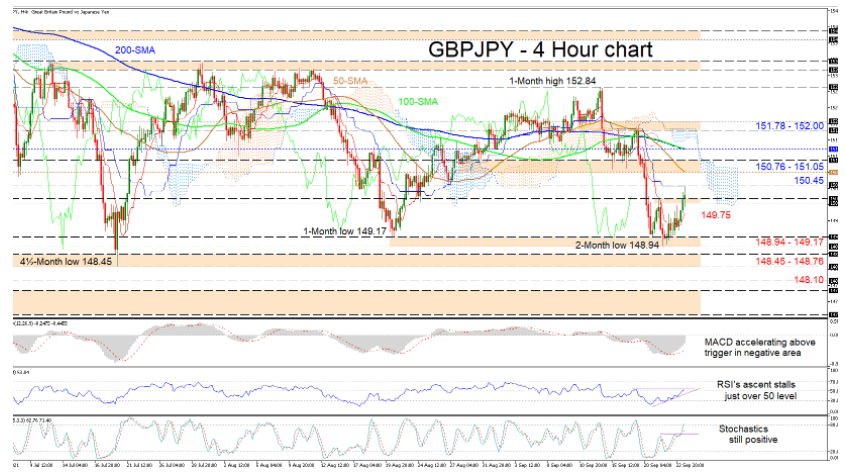
GBPJPY has pushed higher off a two-month low of 148.94 and is finding some difficulty in extending the move far above the 150.00 mark. The bearish simple moving averages (SMAs) are endorsing the decline from the 152.84 peak, while the Ichimoku lines are conveying a drop in the pair’s negative potency, but have yet to signal that downward forces have fully abated.
As things stand, the short-term oscillators are suggesting positive momentum is on the rise. The MACD, in the negative region, is soaring above its red trigger line towards the zero threshold, while the RSI is looking set to improve in positive territory. The stochastic oscillator is also promoting extra upside price action.
If the pair continues to make progress, initial friction to additional gains could develop around the 150.45 barrier before buyers face a tough resistance zone between the 50-period SMA and the 151.05 obstacle. Overstepping this barricade and the Ichimoku cloud, the price may jump towards the converged 100- and 200-period SMAs at 151.32. Should the bulls remain confident, they may then steer the pair to test the resistance section of 151.78-152.00.
Otherwise, if sellers resurface and drive the price lower, an immediate support band could emanate from 150.12 until the 150.00 handle. Successfully directing the pair beneath this, the red Tenkan-sen line at 149.75 could delay the bears from challenging the support base of 148.94-149.17. Diving below this floor, the price may meet the upside defence of 148.45 - 148.76 that has held from March 24, and was tested on July 20. From here, sinking further, sellers may target the 148.10 low from early March.
Summarizing, in the short-term timeframe, GBPJPY is ranging between the limits of 148.45 and 153.47. That said, buyers are making efforts to improve, yet the picture remains slightly skewed to the downside keeping price action around the base of the consolidation.
GBP/USD: BoE Faces Major Dilemma
Like many other major central banks, the Bank of England faces a major dilemma: start reducing stimulus in the face of the rapidly rising inflationary pressures or let inflation cool down naturally as the impact of supply bottlenecks, energy price spikes and other temporary factors fade. Mirroring this dilemma has been the price action in the pound, with the GBP/USD refusing to form a major trend so far this year. But with rates being below last year’s high, the risks are skewed slightly to the downside heading to the BoE decision:
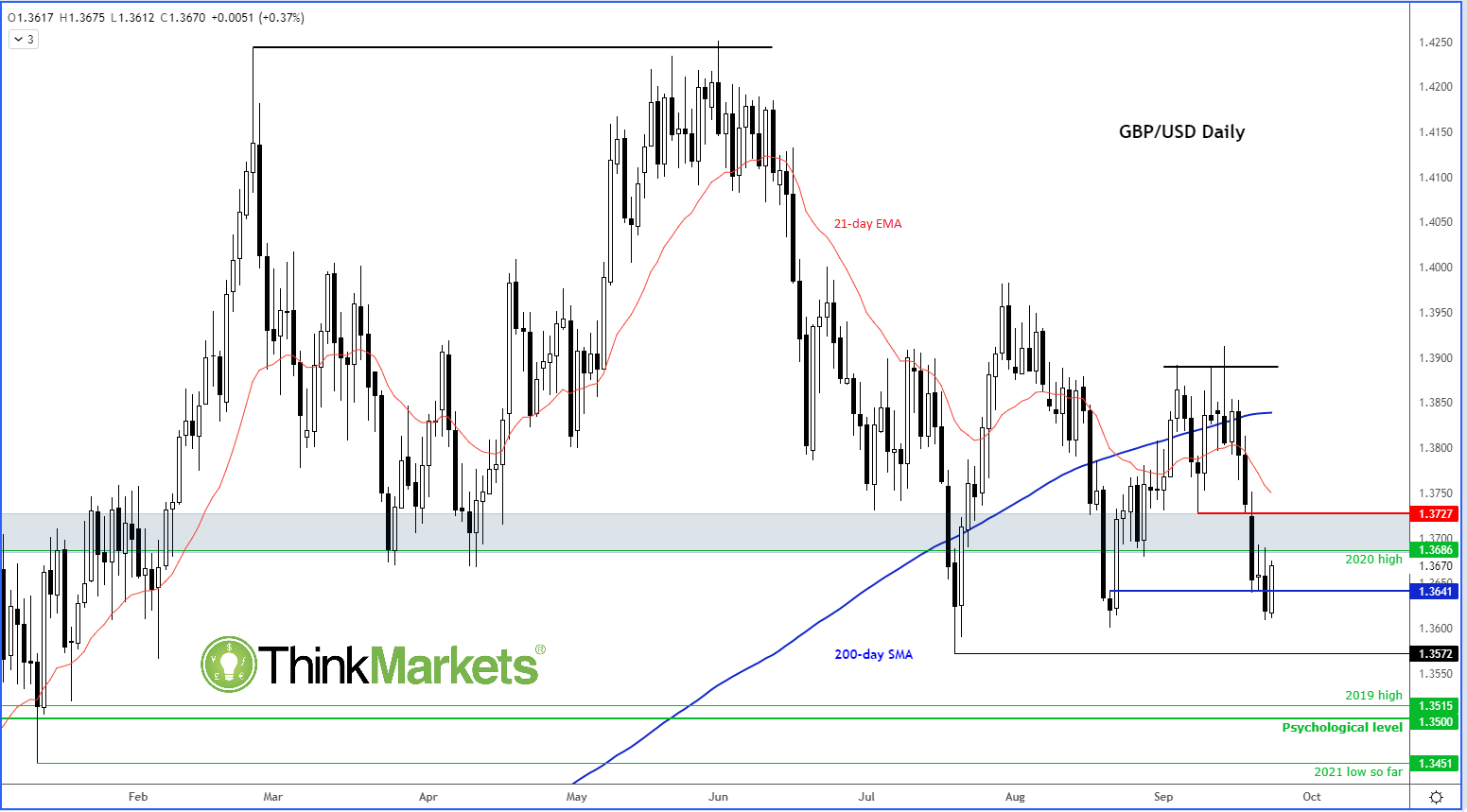
So far, the majority of central bank officials both home and abroad have been tolerant to inflation.
It would come as major surprise if the BoE deviates from this camp, and no one is expecting any changes to monetary policy at today’s meeting. But what the market will be looking out for, especially as there are now two new MPC members, is whether the composition of the hawks change from just one previously. Are we going to see two or more dissenters calling for a reduction in QE? Will there be any noticeable change in the tone of the MPC that would suggest policy tightening is going to be imminent in early 2022. If that’s the case, we may see a sharp rally in the pound, with the currency having spent much of the summer trading in a sideways range.
The hawks would point to the fact that inflation has surged higher in many parts of the world. In the UK, CPI has jumped to 3.2% year-over-year from 2.0% recorded in the previous month. It is not just headline CPI, but core CPI, RPI, PPI – you name it – everything is going up. In order to prevent inflation from overcooking, the BoE will need to start withdrawing support soon.
However, the economy faces many supply issues which could negatively impact growth in the coming months. This morning’s softer PMI data suggests economic growth has already started to slow down. With energy prices surging, inflation on the rise and the furlough scheme about to expire, and not to mention the potential for new Covid mutations to emerge, the UK and global economies face an uncertain future.
Against this backdrop, the BoE might be more vocal about the growth outlook, making them more confident that the upsurge in inflation is indeed going to be temporary.
So, there is a compelling reason why the BoE might not be as hawkish as they should be given the levels of inflation we are seeing currently. If that’s the case, the markets may push out rate hike bets well beyond May 2022 and thus send the pound lower.
The BoE’s decision comes in a busy week for central banks, with those in Switzerland, South Africa, Turkey and Norway also meeting today. Last night, The Federal Reserve kept policy unchanged as expected but Chair Jerome Powell said the US central bank could begin scaling back asset purchases in November and complete the process by mid-2022. Additionally, more policymakers indicated they would vote for a rate hike next year.
BoE Meeting Looms As Markets Digest FOMC
The British pound has reversed directions on Thursday and is in positive territory. GBP/USD is currently trading at 1.3672, up 0.41% on the day.
BoE likely to maintain course
The BoE finds itself in a delicate position, as recent economic data shows the recovery stumbling, while inflation remains well above target. Just ahead of the meeting, Manufacturing PMI for August slowed to 56.3, down from 60.3. The BoE began tapering its QE programme in May, but the timing of a rate hike remains unclear. ING noted that the financial markets expect the BoE to raise rates in Q2 of 2022, but it does not expect a hike until the end of next year. The BoE is unlikely to provide much insight into rate policy at today’s meeting, but investors will be interested to see if the Bank continues to insist that the recent spike in inflation is transient.
At the FOMC policy meeting on Wednesday, policy makers signalled to the markets that the Fed was prepared to commence tapering by the end of the year. However, no commitments were made, as Fed members said in the rate statement that if progress continues as expected, “a moderation in the pace of asset purchases may soon be warranted.” Fed Chair Powell added in follow-up comments that the Fed “could easily move ahead at the next meeting, or not, depending on whether those tests are met.” Powell helpfully circled the two key areas that the Fed is monitoring ahead of a taper – inflation is running well above the Fed target of 2%, while unemployment, which has dropped to 5.2%, still has some ways to go before reaching the Fed goal.
The Fed’s dot plot indicated a slightly more hawkish stance, as nine members now project a rate hike in 2022, up from seven members previously. The Fed is being cautious with regard to rate hikes, showing they are in no rush to hike even as a taper looks imminent.
GBP/USD Technical Analysis
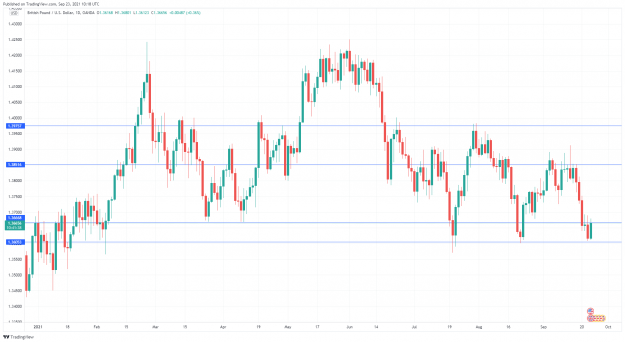
- There are resistance lines at 1.3851 and 1.3975
- The pair continues to test support at 1.3666. Below, there is support at 1.3605