Sample Category Title
USD/JPY Bounces Off Triple Bottom
The US dollar recovered after the Fed signaled an interest rate hike next year.
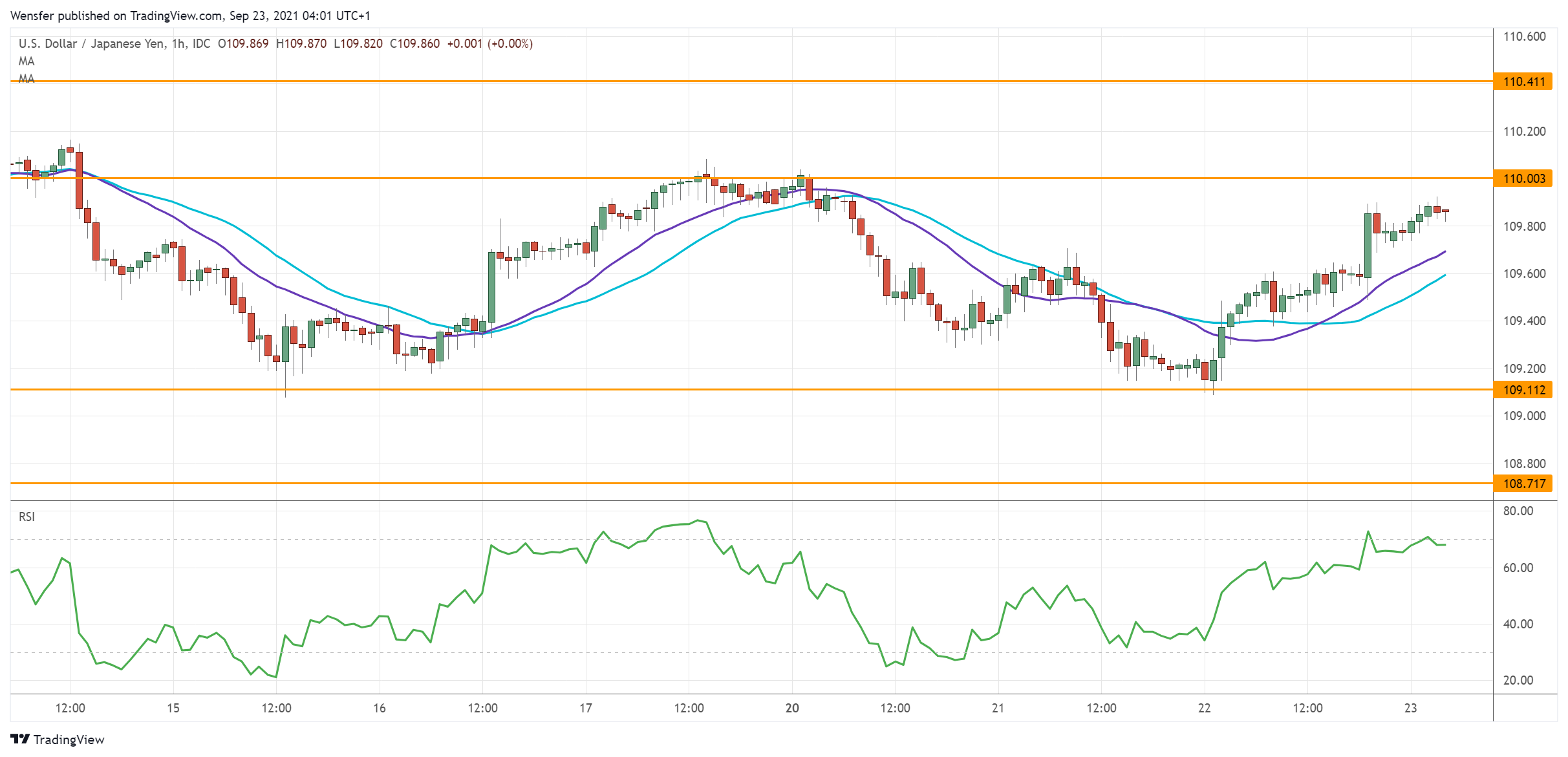
The fall below 109.60 had made buyers cautious in an extended consolidation with the market marred by indecision as the pair swung between 109.10 and 110.40. A triple bottom at 109.10 is a sign of strong buying interest when the RSI showed an oversold situation.
The bulls need to push above the psychological level of 110.00 to trigger a rally. Otherwise, a break below 109.10 may force them to bail out and send the pair to 108.70.
The Dollar Returns Part Of The Post-Fed Gain With EUR/USD
Markets
Markets went into the Fed policy decision with a constructive mood as fears on the fall-out of the Evergrande credit problems eased. Investors showed confidence that the Fed wouldn’t spoil the constructive risk sentiment and didn’t change their minds even as Powell and Co took an important step toward policy normalization. If economic progress continues as expected, a moderation in asset purchases might ‘soon’ be warranted. Read: to be announced in November. Even as the start and the pace of the reduction hasn’t been decided yet, Powell assumes purchases to die out mid next year. Powell repeated that the start of tapering doesn’t include any signal on the start of interest rate increases. The projections of the individual governors show that half of the MPC sees a first rate hike (end) 2022, with the median policy rate forecast at 1% in 2023 and 1.75% in 2024. Governors eased growth expectations for this year (5.9% from 7%) but the recovery will stay on track (2022 3.8% from 2.3%). Inflation was upwardly revised (4.2% from 3.4% in 2021, 2.2% from 2.1% next year) and is projected to stay above 2% for four consecutive years. Even so, Chair Powell still sees this in line with the ‘temporary’ narrative. The market reaction was interesting. The yield curve showed a ‘logical’ flattening with the 2-y rising 2.5 bps. Long term yields declined though (-2.2 bps for 10-y, -4.8 bps for 30-y) even as the reduction of asset purchases will go rather fast (+/- 6m). The flattening was driven by lower inflation expectations. Real yields hardly changed. Higher ST yields (temporary?) propelled the dollar. DXY closed at 93.46. EUR/USD dropped below 1.17 (close 1.1687), but key USD resistance at DXY 93.73 and EUR/USD 1.1664 was left intact. Equites maintained most of their intraday gains (about 1%).
Asian risk sentiment this morning remains constructive as fears on Evergrande ease further. The dollar returns part of the post-Fed gain with EUR/USD trying to regain 1.17. Today’s calendar is well filledwith preliminary PMI’s giving an update on the momentum in global activity. An, albeit gradual, deceleration in activity might be on the cards. Several central bankers including the Norges bank, the Swiss national Bank, the Bank of England, the Central Bank of Turkey and the South African Reserve bank announce policy decisions. The Norges Bank is expected to raise rates by 0.25%. Most other CB’s are expected to keep a wait-and-see stance. This also applies to the BoE. UK Inflation accelerated in August, but growth is slowing and the BoE probably wants more clarity on the labour market as support programs are phased out. On core interest rate markets, yesterday’s reaction to the Fed decision showed that real rates stay sticky at low levels. A break of the US 10-y yield north of 1.37% won’t be that easy short term. For the German 10-y yield -0.27% remains first upside reference. The jury is still out for the dollar, but with the Fed’s ‘new policy path’ behind us, the upside drift of USD might ease. EUR/GBP yesterday tested the 0.8610/15 resistance going into the BOE meeting.
News headlines
The Brazilian central bank raised its policy rate as expected by 100 bps from 5.25% to 6.25%, the highest level since early 2018 to mid-2019 (6.5%). Since the start of the tightening cycle in March, the BCB added 425 bps. On top, the bank pledged another 100 bps next month in order to bring inflation back to target (3.75% this year & 3.5% in 2022). Inflation currently stands at 9.68% Y/Y (August) with severe drought adding to the global, Covid-generated, price pressure. The BCB’s projection point at 8.5% inflation at the end of this year and 3.7% end 2022. The Brazilian real survived the combination Fed/BCB rather well, closing near unchanged at 5.29.
Polish central banker Kochalski defended the dovish camp inside the MPC. They put growth above inflation even if the latter will remain above 5% for the remainder of the year. “The decision to tighten monetary policy must not contribute to an excessive risk of disrupting the economic recovery after the pandemic”. The weaker zloty is often perceived as an argument to flip the balance towards a rate hike as it adds to the sticky inflation, but Kochalski turns the argument around saying it helps the economic recovery which is currently key. EUR/PLN, remains above 4.6 which is the softest zloty level since the end of March.
SNB stands pat, upgrades inflation forecasts slightly
SNB kept sight deposit rate unchanged at -0.75% today. Also, it remained "remains willing to intervene in the foreign exchange market as necessary, in order to counter upward pressure on the Swiss franc." It also reiterated that "the Swiss franc remains highly valued".
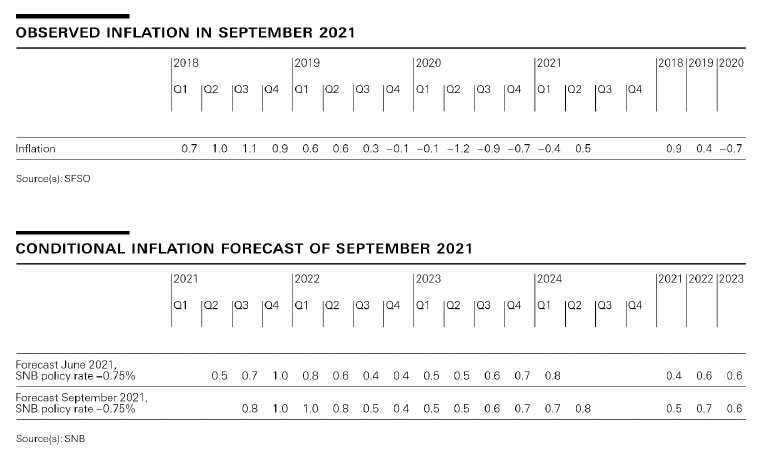
The new conditional inflation forecast for 2021 is raised to 0.5% in 2021 (up from June's 0.4%). For 2022, it's raised to 0.7% (from 0.6%). For 2023, it's kept unchanged at 0.6%. SNB said it's "primarily due to somewhat higher prices for oil products as well as for goods affected by supply bottlenecks."
SNB also said, in the baseline scenario, it anticipated a "continuation of the economic recovery", assuming pandemic containment measures will not need to be tightened significantly again. GDP is expected to grow around 3% in 2021, downwardly revised, attributable to "less dynamically than expected" development of consumer-related industries. GDP is expected to return to pre-crisis level in H2. But overall production capacity will "remain underutilised for some time yet".
(SNB) Swiss National Bank maintains expansionary monetary policy
The SNB is maintaining its expansionary monetary policy with a view to ensuring price stability and providing ongoing support to the Swiss economy in its recovery from the impact of the coronavirus pandemic. It is keeping the SNB policy rate and interest on sight deposits at the SNB at −0.75%, and remains willing to intervene in the foreign exchange market as necessary, in order to counter upward pressure on the Swiss franc. In so doing, it takes the overall currency situation into consideration. The Swiss franc remains highly valued.
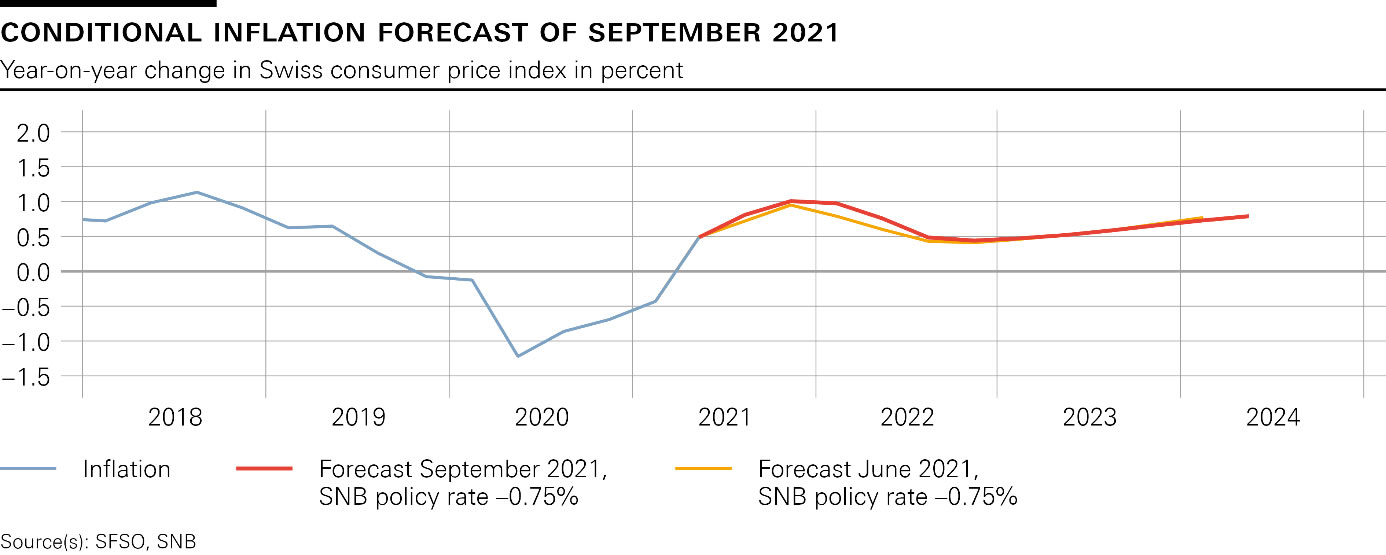
The new conditional inflation forecast for 2021 and 2022 is slightly higher than in June (cf. chart 1). This is again primarily due to somewhat higher prices for oil products as well as for goods affected by supply bottlenecks. In the longer term, the inflation forecast is virtually unchanged compared with June. The new forecast stands at 0.5% for 2021, 0.7% for 2022, and 0.6% for 2023 (cf. table 1). The conditional inflation forecast is based on the assumption that the SNB policy rate remains at −0.75% over the entire forecast horizon.
The coronavirus pandemic, which is now in its second year, is continuing to shape the global economy. Although many countries have once again eased their containment measures since the spring, which contributed to strong global economic growth in the second quarter, infections have risen significantly again in numerous countries – including Switzerland – over the summer.
In its baseline scenario for the global economy, the SNB assumes that rigorous containment measures will no longer be necessary thanks to progress on the vaccination front. The current solid growth momentum is thus expected to continue in the coming quarters. Nonetheless, in many countries it will take some time for utilisation of production capacity to return to normal.
This scenario for the global economy is subject to high uncertainty, with risks on the upside and downside alike. On the one hand, the situation surrounding the pandemic could deteriorate, adversely affecting the economy once again. On the other hand, the economic policy measures introduced since the outbreak of the pandemic could support the recovery more strongly than anticipated in the baseline scenario.
In Switzerland, having declined slightly in the fourth quarter of 2020 and the first quarter of 2021, GDP increased strongly in the second quarter to just below its pre-crisis level. The situation on the labour market also continued to improve. Recently, however, economic momentum has slowed somewhat.
In its baseline scenario for Switzerland, the SNB anticipates a continuation of the economic recovery. This is also based on the assumption that the pandemic containment measures will not need to be tightened significantly again. Against this backdrop, the SNB expects GDP growth of around 3% for 2021. In June, the SNB had still been assuming higher growth. The downward revision is primarily attributable to the development of consumer-related industries such as the trade industry and hospitality, which performed less dynamically than expected.
GDP is likely to return to its pre-crisis level in the second half of the year. However, overall production capacity will remain underutilised for some time yet. Owing to the pandemic, the forecast for Switzerland, as for the global economy, remains subject to heightened uncertainty.
Mortgage lending and residential property prices have risen strongly in recent quarters. Overall, the vulnerability of the mortgage and real estate markets has increased further. The SNB regularly reassesses the need for the countercyclical capital buffer to be reactivated.
Daily Technical Analysis
EUR/USD
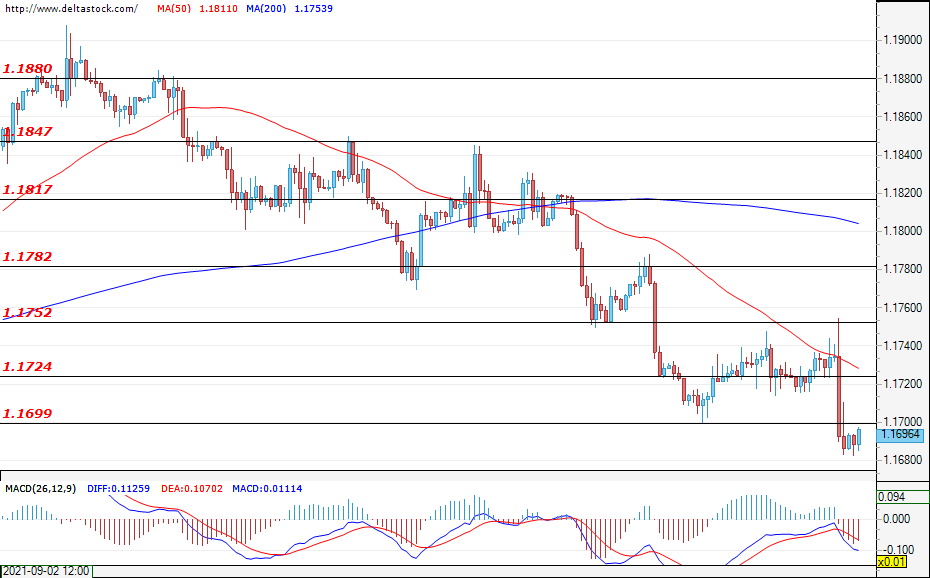
Current level - 1.1696
After the unsuccessful attempt of the currency pair to breach the support zone at 1.1700 at the beginning of the week, followed by a corrective move towards the resistance zone at 1.1752, we are observing another attempt to break the mentioned support during today's session. This time the bears managed to gain enough momentum trading below 1.1700, but the breakthrough still needs confirmation. With the deepening of the sell-off the first significant support lies at 1.1600. The sentiment for the time being is rather negative, where the announcement of the initial jobless claims data for the US (today; 12:30 GMT) could cause an increase in the volatility of the currency pair.
| Resistance | Support | ||
| intraday | intraweek | intraday | intraweek |
| 1.1699 | 1.1752 | 1.1600 | 1.1450 |
| 1.1724 | 1.1782 | 1.1600 | 1.1300 |
USD/JPY
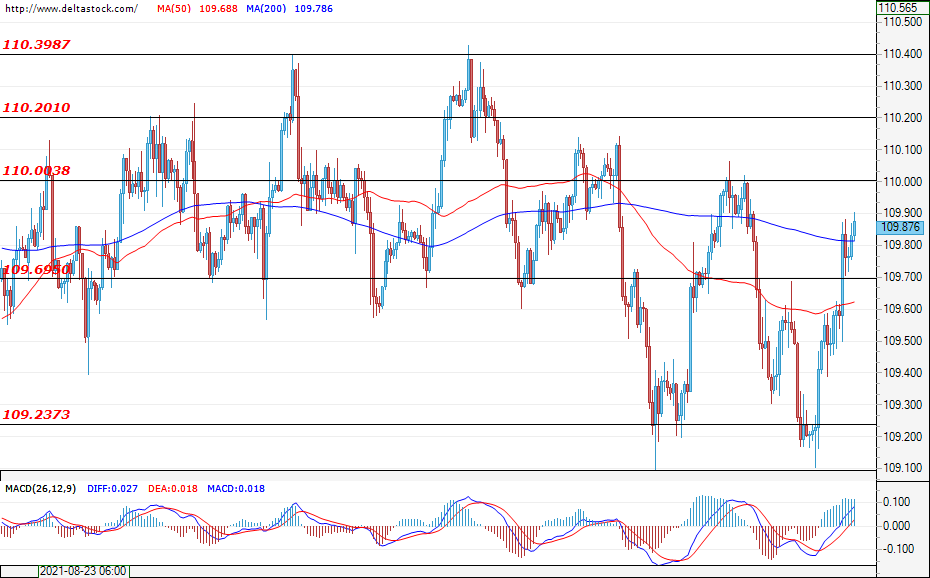
Current level - 109.87
We witnessed a second unsuccessful attempt for a breach of the support zone at 109.23, followed by a recovery during the last trading session. At the time of writing, the currency pair is trading just above the support at 109.69 - a level that recently we have considered as a first significant resistance. This movement could restore the range move in the narrow channel between 109.23 - 110.20.
| Resistance | Support | ||
| intraday | intraweek | intraday | intraweek |
| 110.00 | 110.20 | 109.69 | 108.80 |
| 110.20 | 111.40 | 109.23 | 108.80 |
GBP/USD
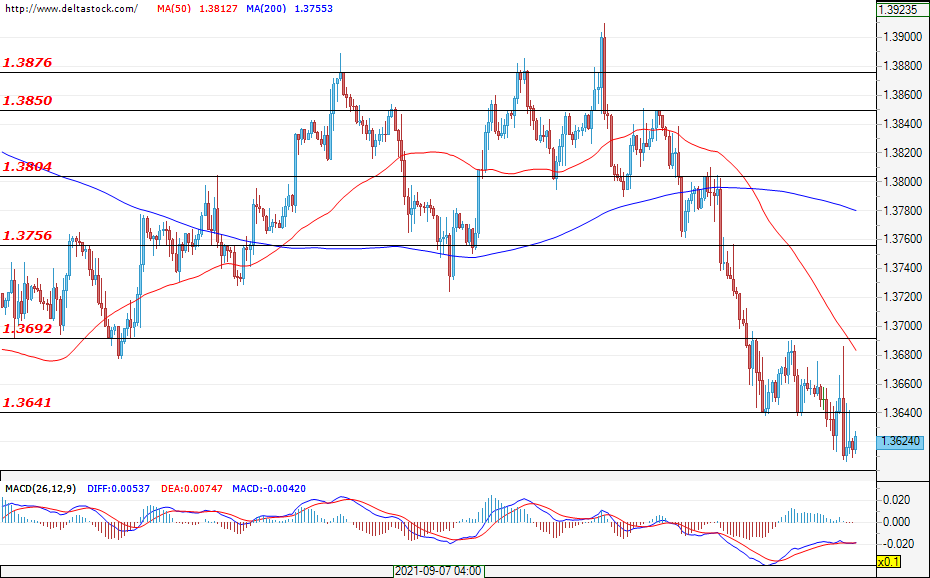
Current level - 1.3624
The pound has continued to lose ground against the US dollar since the beginning of last week. The bears managed to gain enough momentum to prevail in the market, and at the time of writing, the currency pair is trading just above the main support at 1.3600. A successful breach of the mentioned zone could drastically increase the sell-off and could lead to a test of the next significant levels of the larger time frames at 1.3500, followed by 1.3200. Today, investors' attention will be focused on the announcement of the Bank of England interest rate decision (11:00 GMT) when increased volatility is expected.
| Resistance | Support | ||
| intraday | intraweek | intraday | intraweek |
| 1.3641 | 1.3756 | 1.3600 | 1.3450 |
| 13692 | 1.3804 | 1.3500 | 1.3200 |
GBP/JPY Daily Outlook
Daily Pivots: (S1) 149.05; (P) 149.50; (R1) 149.99; More...
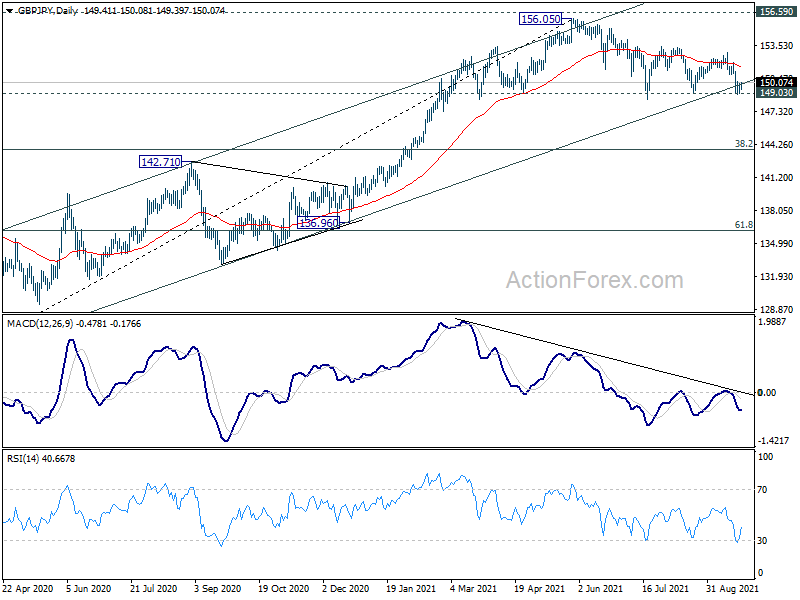
Intraday bias in GBP/JPY is turned neutral with current recovery. On the downside, decisive break of 148.43/149.16 key support zone will resume whole fall from 156.05 to 143.78 fibonacci level. On the upside, above 150.80 minor resistance will turn intraday bias back to the upside for 152.82 resistance instead.
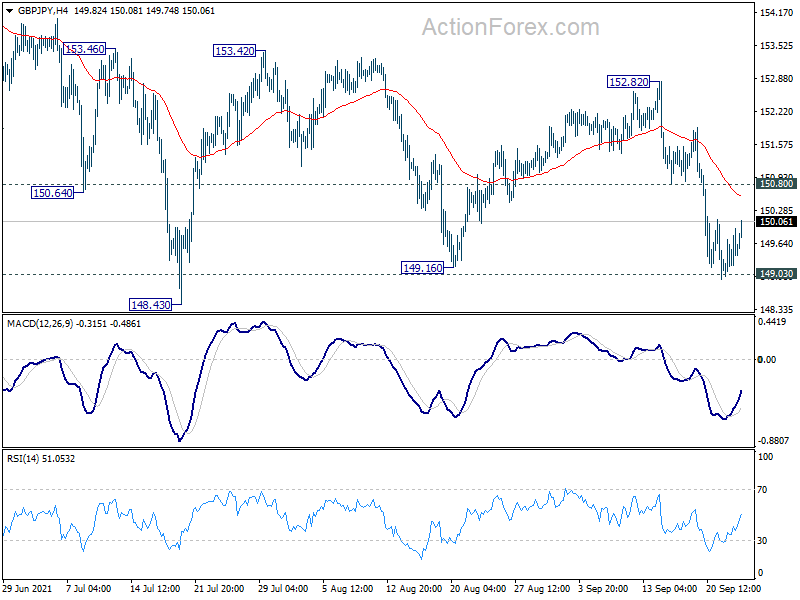
In the bigger picture, rise from 123.94 is seen as the third leg of the pattern from 122.75 (2016 low). As long as 149.03 support holds, such rise would still resume at a later stage. However, sustained break of 149.03 support will indicate rejection by 156.59. Fall from 156.05 would be at least correcting the whole rise from 123.94. Deeper fall would be seen back 38.2% retracement of 123.94 to 156.05 at 143.78 first.
EUR/JPY Day Outlook
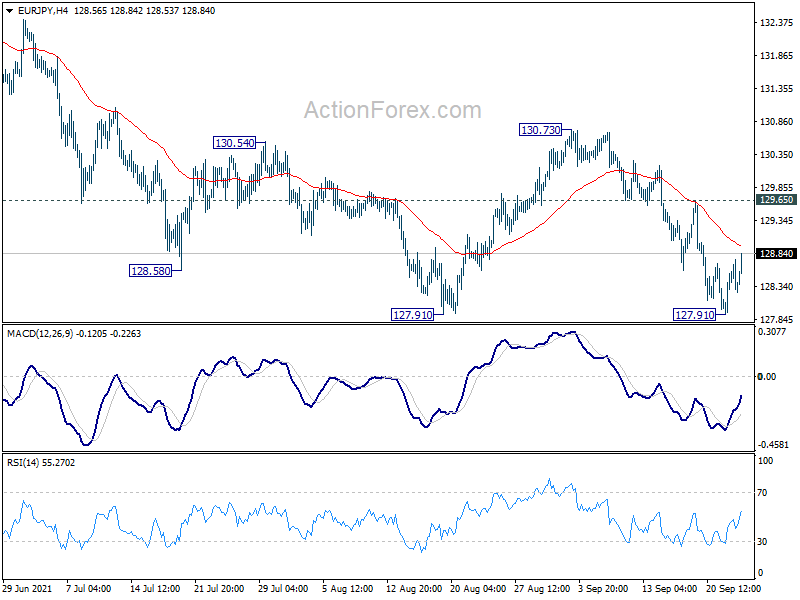
Daily Pivots: (S1) 127.95; (P) 128.36; (R1) 128.80; More....
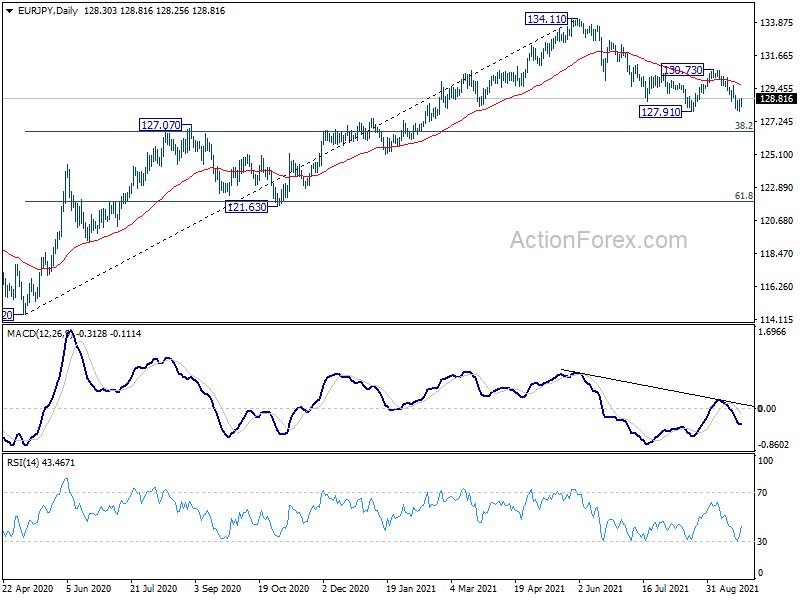
Intraday bias in EUR/JPY is turned neutral as it recovered after hitting 127.91 support. On the downside, break of 127.91 will resume the fall from 134.11 and target 127.07 resistance turned support. Sustained break there will carry larger bearish implication and pave the way to 121.91 fibonacci level. On the upside, however, break of 129.65 will turn bias back to the upside for 130.73 resistance instead.
In the bigger picture, rise from 114.42 is seen as a medium term rising leg inside a long term sideway pattern. As long as 127.07 resistance turned support holds, further rise is still expected to retest 137.49 (2018 high). However, firm break of 127.07 will argue that the medium term trend has reversed, deeper fall would be seen to 61.8% retracement of 114.42 to 134.11 at 121.94.
EUR/GBP Daily Outlook
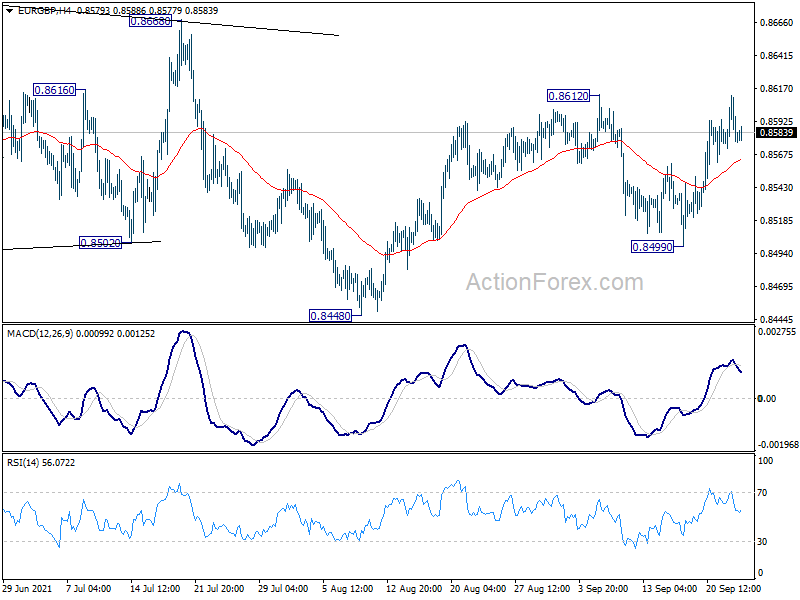
Daily Pivots: (S1) 0.8568; (P) 0.8590; (R1) 0.8607; More...
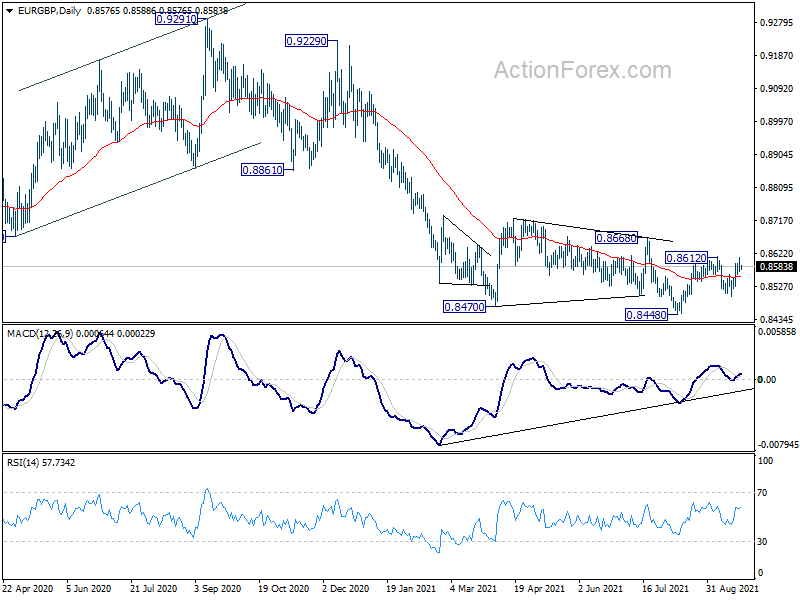
Intraday bias in EUR/GBP is turned neutral with 4 hour MACD crossed below signal line. On the upside, firm break of 0.8612 will resume the rebound from 0.8448 to 0.8688 key structural resistance. Sustained break there will be a strong sign of larger bullish reversal. On the downside, however, break of 0.8499 support will bring another fall towards 0.8448 low instead.
In the bigger picture, price actions from 0.9499 (2020 high) are still seen as developing into a corrective pattern. Deeper fall could be seen as long as 0.8668 resistance holds, towards long term support at 0.8276. However, firm break of 0.8668 resistance would argue that a medium term bottom was already formed. Stronger rise would be seen to 0.8861 support turned resistance to confirm completion of the corrective pattern.
EUR/AUD Daily Outlook
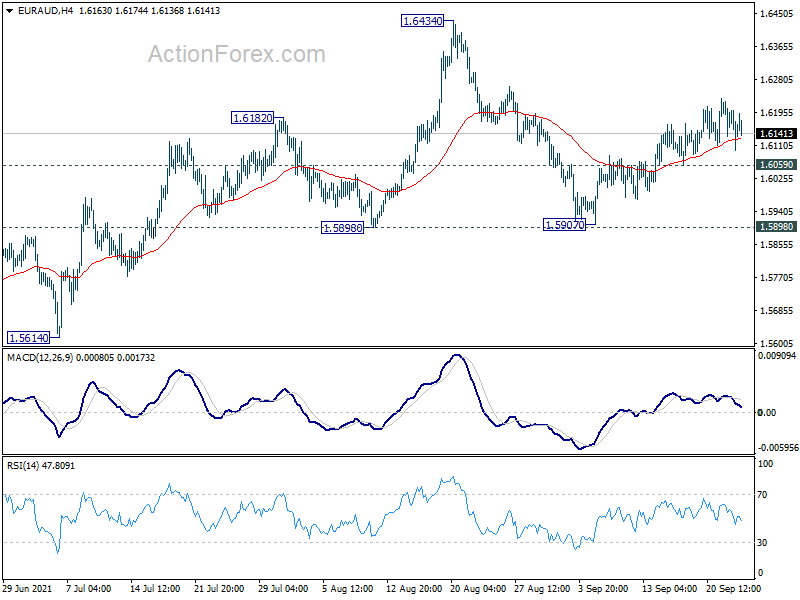
Daily Pivots: (S1) 1.6093; (P) 1.6160; (R1) 1.6217; More...
With 1.6059 minor support intact, further rise is still mildly in favor in EUR/AUD for retesting 1.6434 high. With 1.5898 support intact, larger rise from 1.5250 is still in progress, and break of 1.6434 will confirm resumption, for 1.6988 fibonacci level. On the downside, break of 1.6059 minor support will turn bias back to the downside for 1.5898 structural support instead.
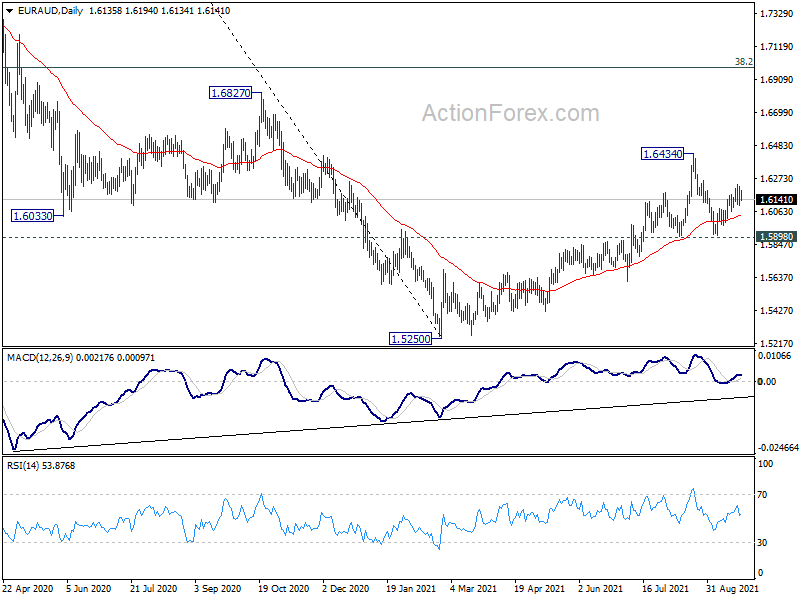
In the bigger picture, rise from 1.5250 medium term bottom is currently seen as a correction to the down trend from 1.9799 first. Stronger rise could be seen to 38.2% retracement of 1.9799 to 1.5250 at 1.6988 next. We'd tentatively expect strong resistance from there to limit upside, at least on first attempt. Meanwhile, break of 1.5898 support will indicate that the rebound has completed. Larger down trend from 1.9799 might be ready to resume through 1.5250 low.
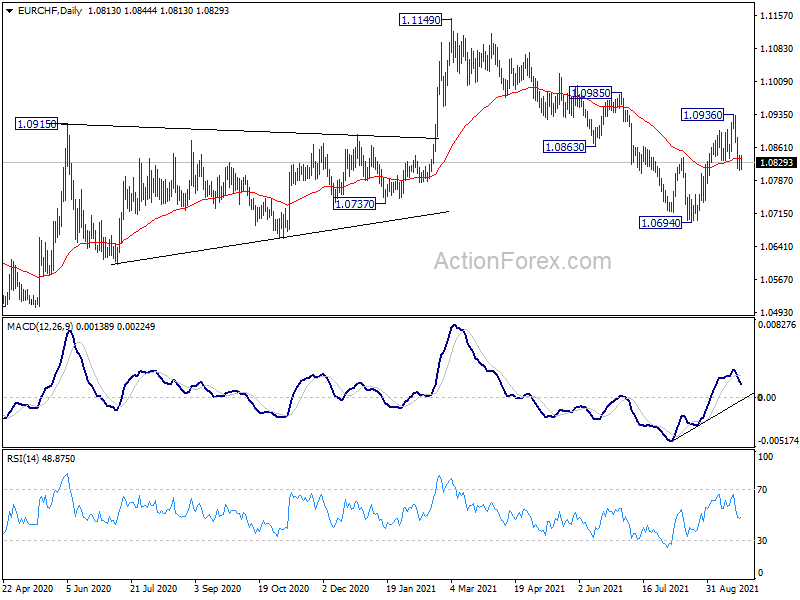
EUR/CHF Daily Outlook
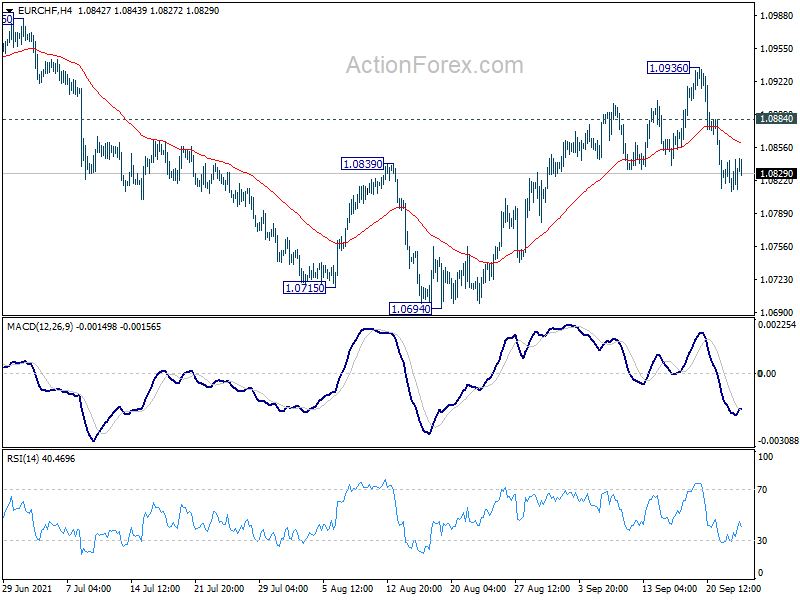
Daily Pivots: (S1) 1.0813; (P) 1.0829; (R1) 1.0845; More....
Intraday bias in EUR/CHF stays mildly on the downside at this point. Rebound from 1.0694 could have completed at 1.0936 already. Deeper fall would be seen back to retest 1.0694 low. Break there will resume whole decline from 1.1149. On the upside, break of 1.0884 minor resistance will turn bias back to the upside for 1.0936 again.
In the bigger picture, the stronger than expected rebound from 1.0694 and break of 55 week EMA (now at 1.0861) mixes up the medium term outlook. On the upside, break of 1.1149 will resume the whole rise from 1.0505 (2020 low). On the downside, break of 1.0694 will revive some medium term bearishness for 1.0505 and below.