

Sample Category Title
Sunset Market Commentary
Markets
With the eco calendar almost empty markets only had to cope with two topics: the potential consequences of the Evergrande credit debacle and the Fed policy decision. Regarding the first one, investors for now conclude that the impact for markets outside China, directly via credit exposure and indirectly via the broader impact on Chinese growth/Chinese demand for foreign goods, should be manageable. For a second consecutive day European equities, which are more sensitive to developments in China, outperform their US counterparts. European indices again recoup about 1%. Monday’s loss hasn’t been reversed yet, but a close of the EuroStoxx 50 north of the 4082 neckline would give some comfort. US indices gain about 0.5% shortly after the open. For now, this risk-rebound mainly occurred on equity markets. Some hard-hit commodities (Iron ore, copper, oil…) also entered calmer waters. The impact on bonds and FX is much more modest. These markets keep a wait-and-see bias ahead of this evening’s Fed decision. Both US and German yields are hovering around the flatline. Intra-EMU spreads narrow up to 2 bp (Spain/Italy). The US dollar mostly trades little changed (DXY 93.25, EUR/USD 1.1730). Remarkably, the usual FX safe havens, the Swiss franc and the yen, are parting ways. The CHF extends its comeback (EUR/CHF 1.0820). The yen eases with USD/JPY returning to the mid 109.50 area. Sterling remains in the defensive ahead of tomorrow’s BoE meeting. EUR/GBP is nearing the 0.8614 short-term top/resistance.
A small recap on issues the Fed needs to ‘clarify’ at this evenings policy announcement. Policy rates will remain unchanged, but change is coming ever closer regarding asset purchases. We favour a scenario of the Fed reducing the current pace of bond buying ($120bn p/m) starting from October (or November to keep at least most doves on board). The time table/pace of tapering also matters. We assume purchases to end mid-2022. Such a scenario might support real yields across the curve. Next question is how the end bond buying will roll-over into a genuine hiking cycle. Fed Chair Powel will try to separate both steps to maintain flexibility. However, some (regional) Fed members in the dots might show their preference for a tighter time table as they see rising inflationary risks. Two additional members changing their view might put the median expectation for a first rate hike end 2022. 2 or 3 additional hikes both in 2023 and 2024 in our view is a feasible option. Such a rather concrete perspective on the start and the first phase of a rate hike cycle, might raise interest rates especially in the 3y-7 y sector of the curve with some bear flattening at for longer maturities. This should also support a the short term momentum of the greenback.
News Headlines
The German Ifo institute in its Autumn 2021 economic forecast downgraded this year’s GDP prognosis from 3.3% to 2.5%, while raising it in 2022 from 4.3% to 5.1%. While contact-intensive service industries are recovering strongly from the coronavirus crisis, value added in manufacturing is shrinking due to supply bottlenecks for key industrial intermediate products. The high growth rate in 2022 is largely due to the low level of production of goods and services in 2021. In the course of 2022, the momentum of the overall economic recovery will decrease. The German inflation rate is likely to rise further to around 4.5% by the end of the year. Only in the coming year will it then gradually fall again and approach the 2% mark. The Ifo-forecasts are subject to some risks. A first significant downside risk stems from the assumed rates of infections and vaccinations. A second downside risk exist in connection with prolonged bottlenecks in the supply of intermediate products. Finally, there is also uncertainty about the direction of fiscal policy after this weekend’s German elections.
ECB Governing Council Member Muller said that discussing boosting the regular Asset Purchase Programme once Pandemic Emergency Purchases come to an end (March 2022) is an option, but such increase is by no means guaranteed. Given the currently very favorable financing conditions and the solid recovery, raising the APP volume in spring next year isn’t necessary the best way to avoid a cliff effect.
USD/JPY Mid-Day Outlook
Daily Pivots: (S1) 109.04; (P) 109.37; (R1) 109.56; More...
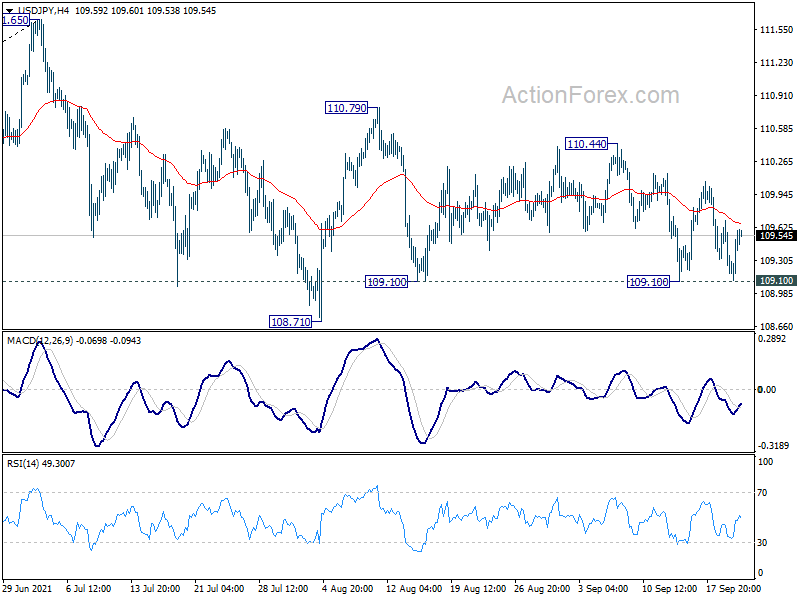
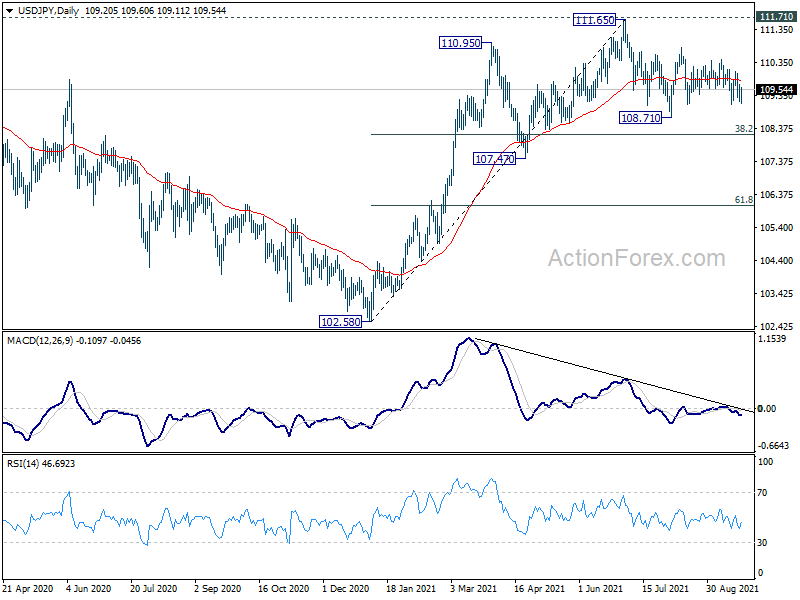
Intraday bias in USD/JPY remains neutral as sideway trading continues. On the downside, break of 109.10 will argue that larger fall from 111.65 is resuming. Deeper decline should then be seen to 108.71 support first, and then 38.2% retracement of 102.58 to 111.65 at 108.18 next. On the upside, above 110.44 will turn bias back to the upside for 110.79, and then 111.65 high.
In the bigger picture, medium term outlook is staying neutral with 111.71 resistance intact. The pattern from 101.18 could still extend with another falling leg. Sustained trading below 55 day EMA will bring deeper fall to 107.47 support and below. Nevertheless, strong break of 111.71 resistance will confirm completion of the corrective decline from 118.65 (2016 high). Further rise should then be seen to 114.54 and then 118.65 resistance.
USD/CHF Mid-Day Outlook
Daily Pivots: (S1) 0.9213; (P) 0.9248; (R1) 0.9272; More....
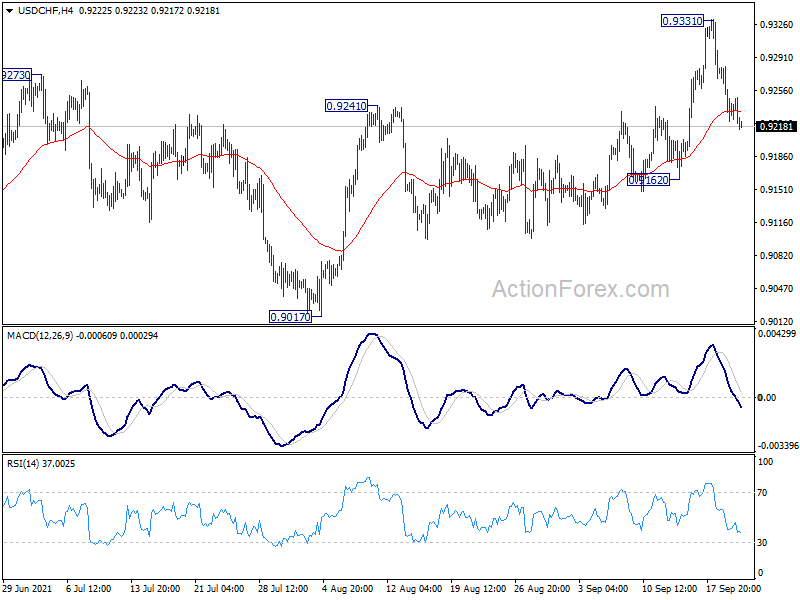
Outlook in USD/CHF is unchanged and intraday bias stays neutral for consolidation form 0.9331. Further rise will remain in favor as long as 0.9162 support holds. On the upside, break of 0.9331 resistance will resume the rise from 0.8925 to 0.9471 key resistance. Sustained break there will carry larger bullish implications. However, break of 0.9162 will turn bias back to the downside for 0.9017 support instead.
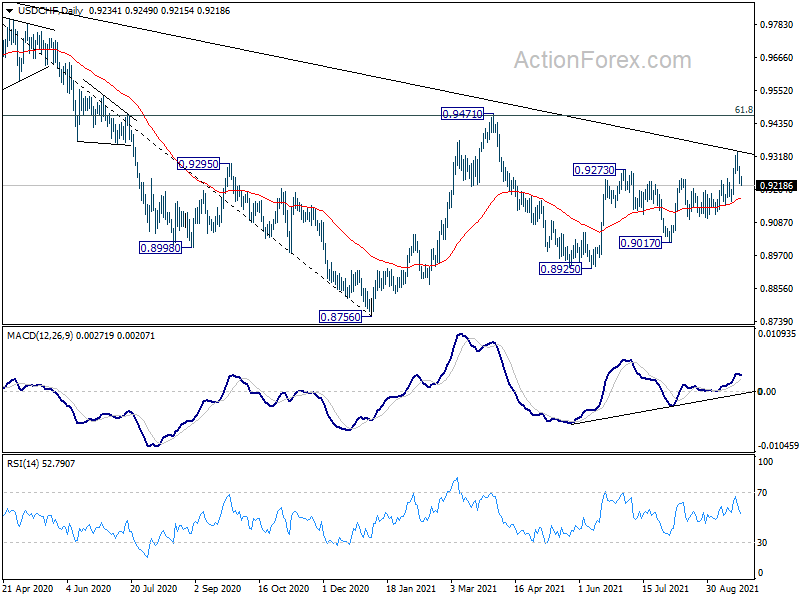
In the bigger picture, the strong rally above 55 week EMA (now at 0.9182) now tilts favor to the case of bullish trend reversal. That is, decline from 1.3042 (2016 high) is probably completed at 0.8756 already. Sustained break of 0.9471 resistance should confirm this case and pave the way to retest 1.0342 ahead. However, rejection by 0.9471 will mix up the outlook again and retain some medium term bearishness.
EUR/USD Mid-Day Outlook
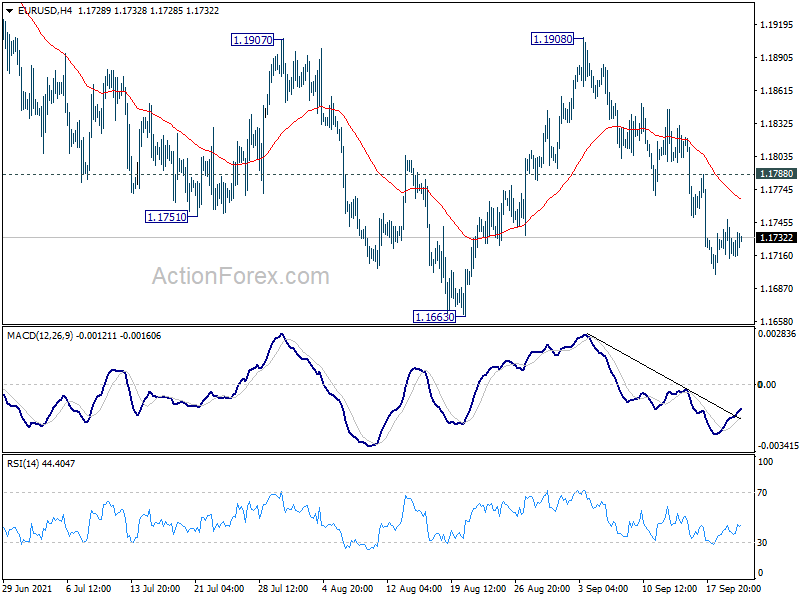
Daily Pivots: (S1) 1.1710; (P) 1.1730; (R1) 1.1744; More...
Further fall is still expected in EUR/USD with 1.1788 minor resistance intact, for 1.1663 support. Firm break there will resume the fall from 1.2265, and the pattern from 1.2348, to 1.1602 key support next. On the upside, above 1.1788 minor resistance will turn bias back to the upside for 1.1908 again.
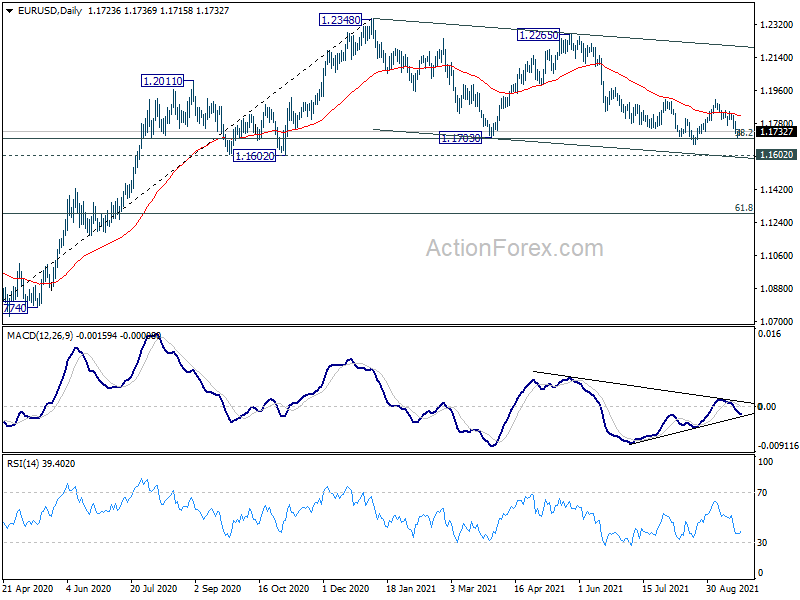
In the bigger picture, rise from 1.0635 is seen as the third leg of the pattern from 1.0339 (2017 low). Further rally remains in favors long as 1.1602 support holds, to cluster resistance at 1.2555 next, (38.2% retracement of 1.6039 to 1.0339 at 1.2516). However sustained break of 1.1602 will argue that the rise from 1.0635 is over, and turn medium term outlook bearish again. Deeper fall would be seen to 61.8% retracement of 1.0635 to 1.2348 at 1.1289 and below.
GBP/USD Mid-Day Outlook
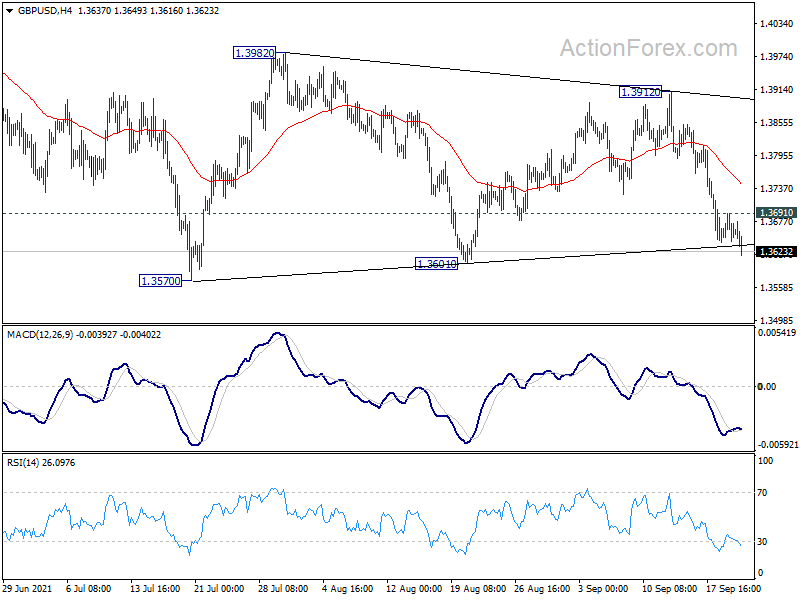
Daily Pivots: (S1) 1.3636; (P) 1.3665; (R1) 1.3688; More...
GBP/USD's fall from 1.3912 is still in progress and intraday bias remains on the downside for 1.3570/3601 support zone. Larger decline from 1.4248 is likely resuming and break of 1.3570 will target 1.3482 key support level. Sustained break there will carry larger bearish implication and target 1.3163 fibonacci level. On the upside, above 1.3691 minor resistance will turn intraday bias back to the upside for 1.3912 resistance instead.
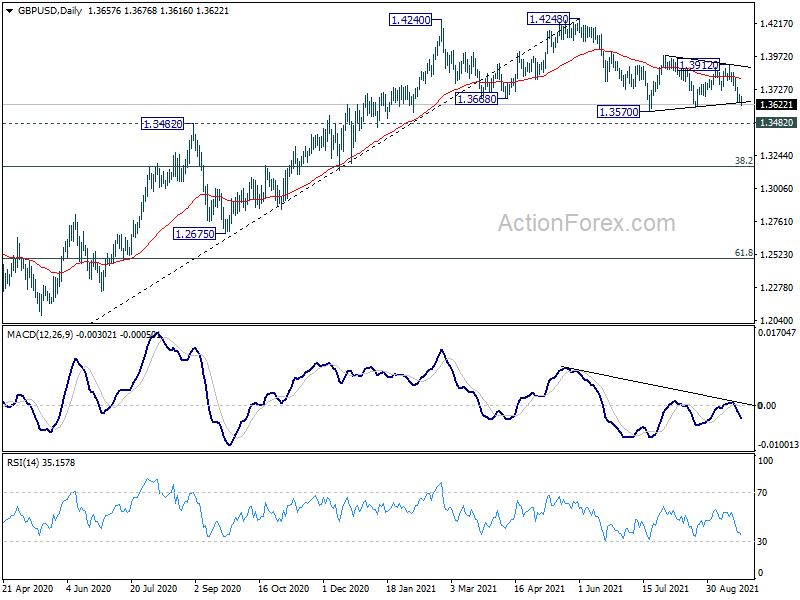
In the bigger picture, as long as 1.3482 resistance turned support holds, we'd still treat price actions from 1.4248 as a corrective move. That is, up trend from 1.1409 (2020 low) is in favor to resume. Decisive break of 1.4376 key resistance (2018 high) would indeed carry long term bullish implications. However, sustained break of 1.3482 will at least bring deeper fall to 38.2% retracement of 1.1409 to 1.4248 at 1.3164, or even further to 61.8% retracement at 1.2493.
Sterling Staying in Selloff Mode, Quiet Markets Await Fed
Trading in the forex markets is rather subdued today, as FOMC policy decision, dot plot and economic projections are awaited. The markets could come back to live if there are some hawkish twists in Fed's projections. For now, Sterling is staying in selloff mode, even though momentum diminished a bit. Yen is also soft today, but it's just digesting some of this week's gains. On the other hand, Aussie is recovering mildly, together with Kiwi, as risk sentiment stabilizes.
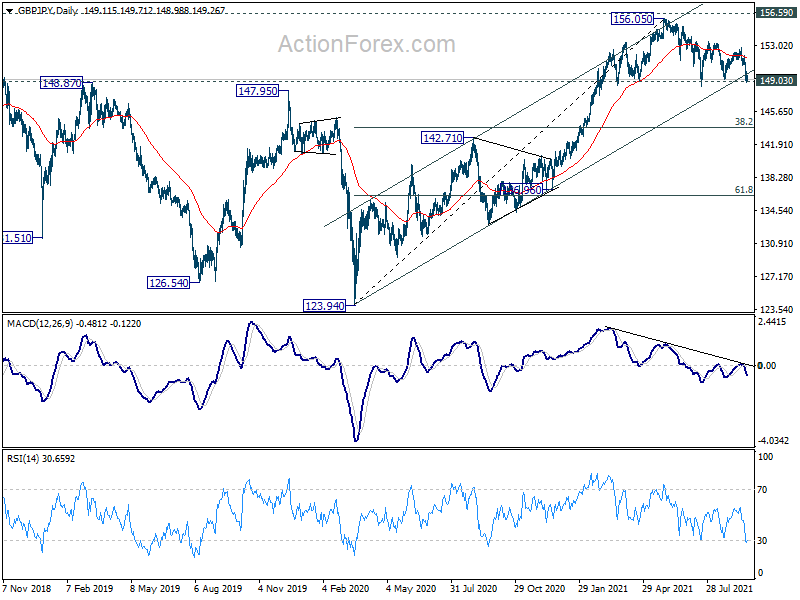
Technically, EUR/GBP is now approaching 0.8126 resistance and break will resume the rise from 0.8448 to 0.8668 key structural resistance. GBP/JPY is pressing 149.03 key support zone and sustained break would resume the fall from 156.05 towards 143.78 fibonacci level. GBP/USD is also heading to 1.3601 support and break there would solidify downside momentum through 1.3570 support towards 1.3482 medium term support. The moves could come before BoE rate decision tomorrow, if FOMC triggers some volatility in the markets.
In Europe, at the time of writing, FTSE is trading up 1.38%. DAX is up 0.72%. CAC is up 1.22%. Germany 10-year yield is up -0.0085 at -0.321. Earlier in Asia, Nikkei dropped -0.67%. China Shanghai SSE rose 0.40%. Singapore Strait Times dropped -0.49%. Japan 10-year JGB yield dropped -0.0038 to 0.036. Hong Kong was on holiday.
Fed not ready for tapering yet, some previews
No change in policy is expected from FOMC today and Fed is likely not ready to announce tapering yet. Chair Jerome Powell would just reiterate that "substantial further progress" has been "met for inflation", and there has also been "clear progress toward maximum employment". Also, it's appropriate to start tapering "if the economy evolved broadly as anticipated
A major focus in the median dot plot, where two rate hikes were penciled in by 20223. For 2022, there were 7 out of 18 participants anticipating one or two hikes. The overall picture could tilt towards the hawkish side if just one or two members bring forward their rate forecasts to 2022. Meanwhile, the new staff economic projections will catch some attention too.
Here are some suggested readings on Fed:
- FOMC Preview: Fed to Affirm Tapering Could Come This Year. Focus Turns to Dot Plot
- Fed Meeting: Forget the Slow Crawl to Tapering, it's the Dot Plot that Matters
- FOMC Meeting Preview: Will We Get A Taper Hint?
- Fed Research – Preview: What to Do in a Bad Trade-Off?
- Musical Chairs at the Fed: Powell or Brainard?
ECB Muller: We should be able to end PEPP in March
ECB Governing Council member Madis Muller said, "given the recovery that we're seeing in the economy, also the outlook for inflation and most importantly the extremely favorable financing conditions that we continue to have in the euro area, we should be able to end PEPP in March as it has been communicated and as it has been the original plan." He added, "if you ask what is the most likely outcome then to me personally, this is the base case."
Muller also argued that inflation could start stronger than ECB's forecasts. "Looking at possible factors that could be pushing prices higher and those that could be pulling it lower, the factors pushing prices higher seem to be stronger at the moment," he said. "It's more likely that we will have inflation, for example, in 2023 higher than 1.5% rather than lower. The same probably applies for the 1.7% inflation forecast for 2022."
However, "it would be a problem if there is a very sharp cliff effect at the end of the pandemic emergency purchase program," he noted. "part of the discussion we will have on how to phase out PEPP and what it would mean for asset purchases going forward." A potential increase in the APP program was being discussed. But, "of course the decision will depend on market conditions next spring and the economic outlook at that point."
Ifo cut Germany GDP growth forecast to 25% in 2021, raised to 5.1% in 2022
Ifo lowered Germany growth forecast for 2021 sharply from 3.3% to 2.5%. But 2022 growth forecast was upgraded by 0.8% to 5.1%.
"The strong recovery from the coronavirus crisis, originally expected for the summer, is further postponed," Ifo chief economist Timo Wollmershaeuser said.
"Industrial production is currently shrinking as a result of supply bottlenecks for important intermediate goods. At the same time, service providers are recovering strongly from the coronavirus crisis."
BoJ stands pat, notes supply side constraints
BoJ left monetary policy unchanged today. Under the yield curve control framework, short term policy interest rate is held at -0.10%. 10-year JGB yield target is kept at around 0%, without upper limit on bond purchases. The decision was made by 8-1 vote, with Goushi Kataoka dissenting as usual, pushing for strengthening easing. It also pledged to closely monitor the pandemic impact and "will not hesitate to take additional easing measures if necessary".
Overall assessment on the economy was maintained as its has "picked up as a trend" but "remained in a severe situation" due to the pandemic home and abroad. But it noted that some exports and production have been "affected by supply-side constraints". Weakness has been seen in some industries on business fixed investment. Employment and income "remained weak" while private consumption remained "stagnant". Core CPI has been at around 0% and inflation expectations have been "more or less unchanged".
BoJ Kuroda: Consumption to strengthen, external demand remains solid
In the post meeting press conference, BoJ Governor Haruhiko Kuroda said the recent slump in consumption was "in a way unexpected". But he's still optimistic on consumption outlook. He added that the decline was not because households lacked income, but more due to the pandemic keeping them from boosting spending. He added, "as the pandemic subsided, consumption is expected to strengthen."
Kuroda also said he expected "external demand to remain solid" and there is no need to project a "clear slowdown" in US and China growth. He added that actual economic indicators, consumption and output were growing very steadily in the US. The woes of Evergrande is see as "purely" and individual company's issue, and that of the real estate sector.
Australia leading index dropped to -0.5% in Aug, more weakness on the way
Australia Westpac-MI leading index dropped from 1.4% to -0.5% in August. Westpac said "the Leading Index has held up surprisingly well during this downturn but it seems likely that there is more weakness on the way." For example, commodity prices and equities are likely to drag the index down further based on the developments in September.
Westpac doesn't expect RBA to make any change to policy settings until February next year. It expects asset purchases to be fully wound back by May/August next year.
GBP/USD Mid-Day Outlook
Daily Pivots: (S1) 1.3636; (P) 1.3665; (R1) 1.3688; More...
GBP/USD's fall from 1.3912 is still in progress and intraday bias remains on the downside for 1.3570/3601 support zone. Larger decline from 1.4248 is likely resuming and break of 1.3570 will target 1.3482 key support level. Sustained break there will carry larger bearish implication and target 1.3163 fibonacci level. On the upside, above 1.3691 minor resistance will turn intraday bias back to the upside for 1.3912 resistance instead.
In the bigger picture, as long as 1.3482 resistance turned support holds, we'd still treat price actions from 1.4248 as a corrective move. That is, up trend from 1.1409 (2020 low) is in favor to resume. Decisive break of 1.4376 key resistance (2018 high) would indeed carry long term bullish implications. However, sustained break of 1.3482 will at least bring deeper fall to 38.2% retracement of 1.1409 to 1.4248 at 1.3164, or even further to 61.8% retracement at 1.2493.
Economic Indicators Update
| GMT | Ccy | Events | Actual | Forecast | Previous | Revised |
|---|---|---|---|---|---|---|
| 0:30 | AUD | Westpac Leading Index M/M Aug | -0.30% | -0.10% | ||
| 3:00 | JPY | BoJ Interest Rate Decision | -0.10% | -0.10% | -0.10% | |
| 13:00 | CHF | SNB Quarterly Bulletin Q3 | ||||
| 14:00 | EUR | Eurozone Consumer Confidence Sep P | -6 | -5 | ||
| 14:00 | USD | Existing Home Sales Aug | 5.89M | 5.99M | ||
| 14:30 | USD | Crude Oil Inventories | -6.4M | |||
| 18:00 | USD | Fed Interest Rate Decision | 0.25% | 0.25% |
Bank Of England Policy Meeting: A Hawkish Tilt With Some Caution
The Bank of England has already discussed the mechanics for switching to monetary tightening and although the plan could only materialize under specific circumstances, the talking itself is a sign that the tightening process is nearing. The main question, however, is when the central bank will make the first move. Certainly, Thursday's policy meeting will not be the right time, but the latest upbeat economic stats may justify some hawkish statements. While this could bode well for the pound, the central bank will need to sound more optimistic than investors anticipate to cheer the bulls, although this could be challenging for the BoE. The announcement is due at 11:00 GMT.
Second thoughts on inflation
The BoE chief Andrew Bailey recently confirmed that the board was evenly split between those who believed that there was clear evidence the economy is making progress in eliminating spare capacity and achieving 2.0% inflation sustainably, and those who felt that more needs to be done.
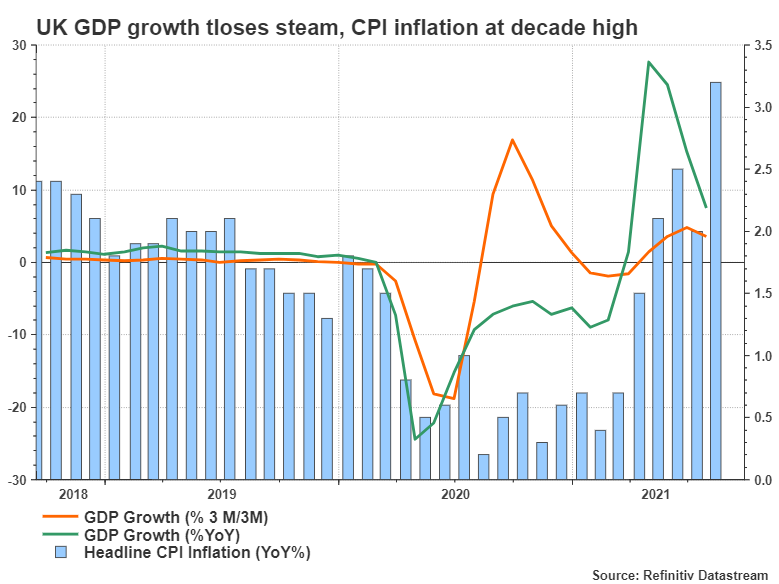
Michael Saunders, one of the MPC members who belongs to the hawkish camp, lately reiterated his view for an early termination to the BoE’s asset purchase program, which is scheduled to end in December at 895 billion pounds with the potential of an extension if economic conditions deteriorate. But more policymakers will probably join him this week after the surprising spike in the August CPI inflation index and the significant growth in employment. Particularly, consumer prices continued to accelerate above the central bank’s price target of 2.0%, jumping by 3.2% y/y, up from the 2.9% expected, while growth in payroll employment clocked in at 183k in July, almost doubling the 93k forecasted by analysts.
It is not certain whether the end of the furlough program this month, which subsidies a portion of wage costs, will force some businesses to limit their workforce, though the above stats are currently a bright sign that the pandemic effects have become less detrimental.
To tighten, or not to tighten
For the BoE, however, the decision of setting an official date for stimulus withdrawal could be more complex, especially when it comes to interest rates, which are expected to increase by 0.15 basis points to 0.25% at some point in the second half of 2022 and then move up to 0.50% by the end of the same year.
On the one hand, the transitory inflation could become stickier in the coming months as supply chain disruptions and a shortage of raw materials may keep boosting energy prices, as it is already happening with gas prices.
Theoretically, more persistent rises in prices translate to a tighter monetary policy, but if the central bank tightens too early, it may discourage consumption at a time when a 12bln pound tax-raising plan is already on the map in the first half of 2022, threatening to ease the pace of recovery. The story could take a different turn if wage growth picks up steam, but so far there is little backing for wage increases in the short term despite the shortage of qualified workers. Still, note that households' saving ratio as a share of GDP has been on the rise since the drop in the third quarter of 2020. 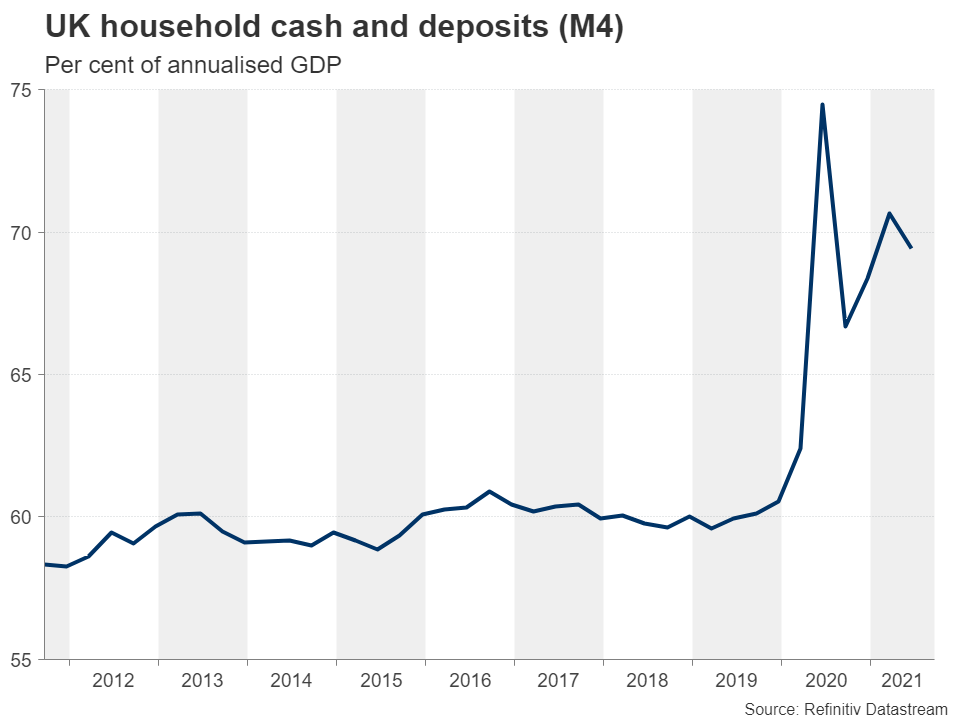
On the other hand, if the BoE does nothing, letting inflation get out of control, it will need to raise interest rates more aggressively in the future at a time when high prices would have already eaten into consumers’ pockets.
GBP/USD
The good news for those who expect a hawkish BoE meeting is that the new BoE chief economist, Huw Pill, who will be participating in the voting process for the first time since his nomination, is considered a hawk on policy. Therefore, his contribution could add pressure for the latest round of asset purchases to end this week or stop at the expiration date in December. If that is the case, pound/dollar could advance towards the key 1.3840 resistance area, where the 200-day simple moving average blocks the way higher.
Alternatively, if the BoE lets its asset purchase program expire as scheduled, but keeps the door open to a resumption if economic circumstances deteriorate, also postponing any rate hike commitments to November, pound/dollar could break the lower boundary of its three-month-old range area at 1.3600 and head for the 1.3500 – 1.3450 region.
The decline could start earlier if the flash Markit/CIPS PMI figures for September miss forecasts at 08:30 GMT. Expectations are for the composite index to pull back to 54.5 from 54.8 previously, though unless the services sector, which leads growth in the UK, tumbles, the data may not squeeze the pound. 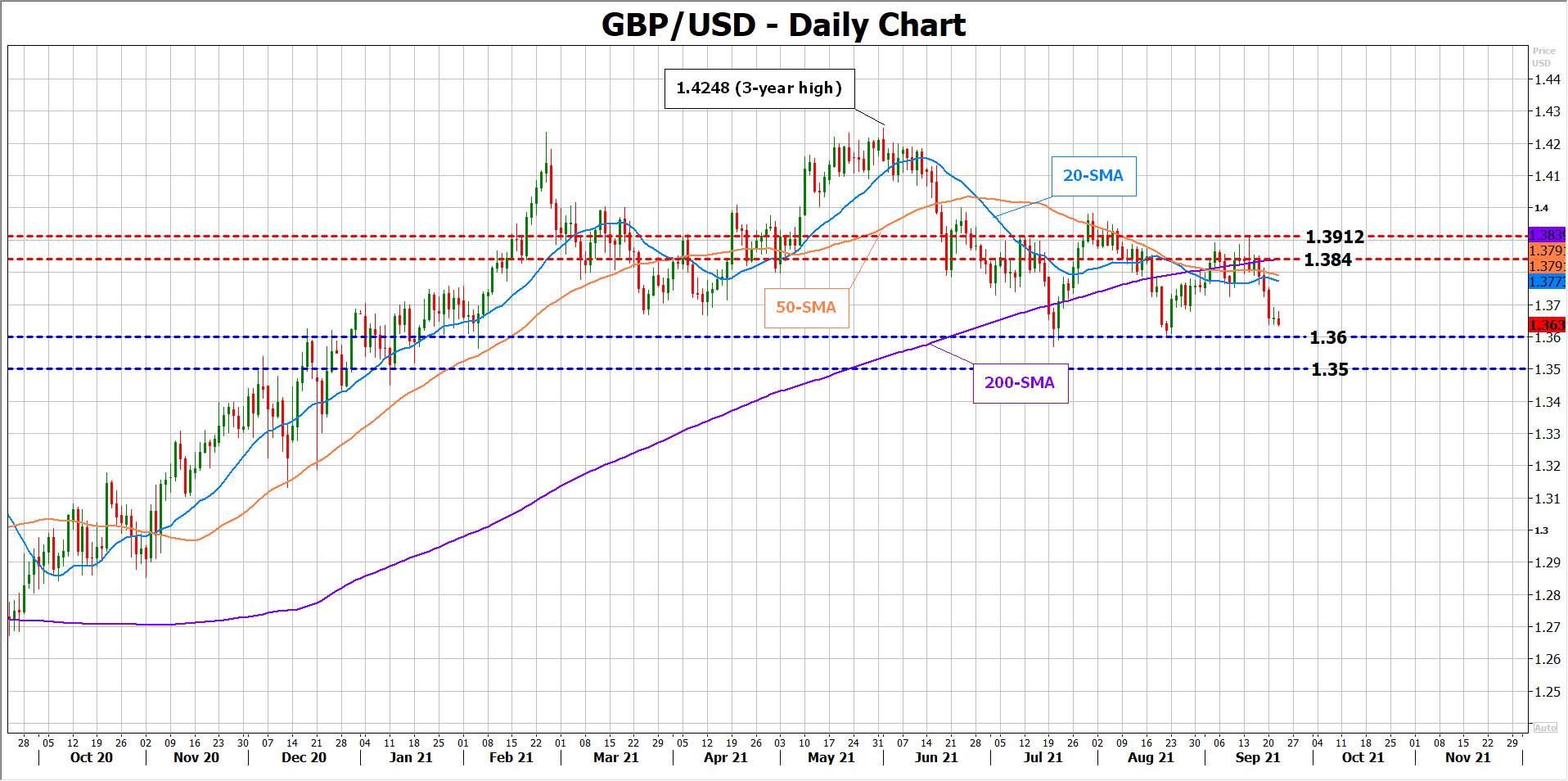
EURUSD Is Possibly Bearish
Technical analysis
The RSI is slightly above 50, staying neutral
The MACD line is reaching 0 from the downward territory.
Most likely scenario - SELL
Target prices: 1.17219 1.17075
Alternative scenario - BUY
Target prices: 1.17487 1.17882
Key levels
Support 1.17219 1.17075
Resistance 1.17487 1.17882

SNB Expected To Hold The Course
The Swiss franc is trading quietly in the Wednesday session. USD/CHF is currently trading at 0.9220, down o.17% on the day.
Markets await FOMC decision
The Federal Reserve will be in the spotlight, as the FOMC holds an important policy meeting later today. We may see another twist in the taper-on-taper off saga, as expectations are running high that the Fed may signal that it will make an announcement at the November meeting as to whether it will commence tapering. Fed Chair Powell has stated on numerous occasions that there is no link between a decision to taper and a hike in rates. Still, the markets are keenly following any clues about rate movements, which makes the dot plot at today’s meeting a potential market mover. If the dot plot indicates that FOMC members have brought forward projections of a rate hike, the US dollar could get a significant lift in the North American session.
In sharp contrast to the FOMC meeting, the markets are not expecting any interesting developments at the SNB policy meeting on Thursday with regard to monetary policy. The SNB will maintain its deposit rate of -0.75% (the lowest of any major central bank) and there are no plans for any changes in policy. SNB Vice President Fritz Zurbruegg said in an interview earlier this month that the negative rate policy was essential to ensure that the Swiss franc does not appreciate and curb economic growth. Taking a page for the Fed’s playbook, Zurbruegg said that the spike in inflation was temporary, and he expected inflation to remain low in the medium term. For the SNB, it’s business as usual, despite other central banks hiking rates or moving in that direction.
USD/CHF Technical
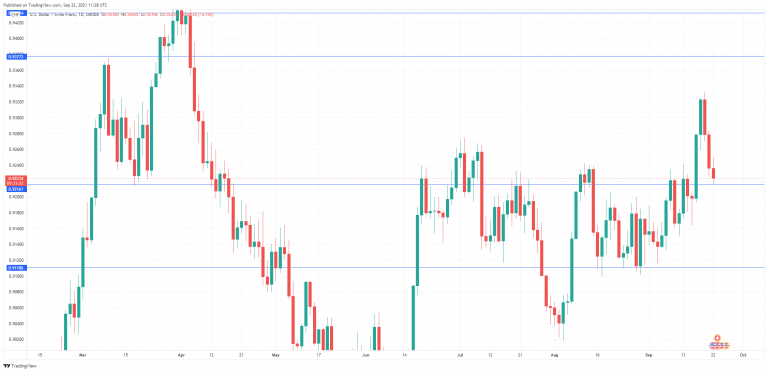
- USD/CHF is testing support at 0.9216. Below, there is support at 0.9110
- There is resistance at 0.9377, followed by resistance at 0.9432
Aussie Steadies Ahead Of FOMC
The Australian dollar has steadied on Wednesday, after posting four consecutive losing sessions. Currently, AUD/USD is trading at 0.724, up 0.17% on the day.
Risk aversion sends Aussie lower
The Australian dollar has been on a downswing, with several factors combing at the same time to take the wind out of the currency. The Aussie is marked by a high correlation with risk sentiment and commodity prices, and developments in China have had a negative impact. The crisis around Evergrande, a giant Chinese property firm, has sapped risk appetite, while China’s warning to crack down on commodity prices has chilled the demand for commodities.
The Australian dollar is steady on Monday, as investors’ nerves have been soothed somewhat by media reports that Evergrande will make coupon payments on bonds that are due on Thursday. Still, this is likely to be only a temporary lull in the crisis, as investors anxiously wait to see how the Chinese authorities intend to respond.
Market focus has shifted to the Federal Reserve, as the FOMC holds an important policy meeting later today. Policy makers may not divulge much on the taper front, but could signal that a decision on how to proceed will be made at the November meeting. The rate statement and follow-up comments from Fed Chair Powell may not stir up the currency markets. The dot plot however, which projects timelines for rates hikes or cuts could be a market-mover, if members move up hiking expectations. Such a hawkish move would likely provide the US dollar with a boost.
AUD/USD Technical
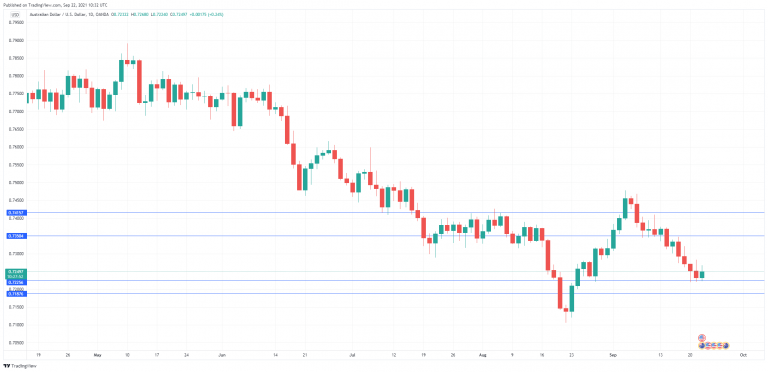
- There is resistance at 0.7340, followed by 0.75415
- On the downside, 0.7226 is a weak support line. Below, there is support at 0.7187