“Takaichi trade” remained the dominant theme in markets today. Nikkei added nearly 1.5% on the day, pushing to yet another record high as Japanese driven by expectations that Prime Minister Sanae Takaichi’s government will pursue expansionary fiscal policies and pro-growth reforms after the speculated snap election. Yen selloff extended earlier in the session, but momentum showed signs of exhaustion as the currency staged a mild recovery during early European trading.
While the broader trend remains Yen-negative, price action suggests traders are becoming more cautious at stretched levels. Talk of potential intervention has intensified, tempering aggressive selling. While no concrete action has been taken, the growing volume of official warnings appears to be having some effect on positioning, at least in the near term.
Japan now finds itself in a clear policy dilemma. For the BoJ, the government’s fiscal stance will be critical. Easier fiscal policy and reform momentum would reduce downside risks to both growth and inflation, allowing policy normalization to continue gradually. At the same time, accelerating yen weakness risks importing deflationary pressure. A sharply weaker currency could force the BoJ to strike a more hawkish tone, even if domestic conditions alone would not justify faster tightening.
Meanwhile, comments from BoJ Governor Kazuo Ueda offered little new guidance. He reiterated that rates would continue to rise and monetary accommodation be adjusted if the outlook materializes, adding that wages and inflation are likely to increase gradually — a message markets largely ignored.
Elsewhere, US institutional credibility remained firmly in focus, with markets digesting an unusually forceful show of support for Fed Chair Jerome Powell from the global central banking community. In a rare joint statement, 14 major central bank heads publicly expressed solidarity with Powell, highlighting concerns that political pressure on the Fed risks undermining monetary policy independence.
The statement — signed by leaders including the ECB, BoE, BoC, and the Bank for International Settlements — stressed that central bank independence is the “cornerstone of price, financial and economic stability”. The group praised Powell’s “integrity” and “unwavering commitment” to the public interest, framing the issue as one with global implications rather than a purely domestic US matter. The unified message highlighted the seriousness of the situation. Coordinated statements of this nature are exceedingly rare, typically reserved for moments of systemic stress.
Notably, the BoJ did not join the statement. Japan’s Chief Cabinet Secretary Minoru Kihara said the matter concerns the BoJ’s own judgment and that the government would refrain from commenting.
In FX performance terms for the week so far, Yen remains at the bottom of the table, followed by Swiss Franc and then Dollar, which has stabilized modestly. Sterling leads gains, followed by Kiwi and Loonie, while Euro and Aussie are mixed in the middle.
China’s exports jump 6.9% yoy in Dec, US decoupling continues
China’s December trade data surprised to the upside, pointing to resilient external demand despite ongoing tariff tensions. Exports surged 6.6% yoy, more than double expectations of 3.0%. Imports rose 5.7% yoy, far exceeding forecasts of 0.9% and marking the strongest growth since September last year. The trade balance posted a USD 114.1B surplus, broadly in line with expectations.
However, the headline strength masked a deepening collapse in trade with the US. Shipments to the US plunged -30% yoy, extending a ninth straight month of contraction, while imports from the US fell -29% yoy. By contrast, China’s trade with other regions remained robust. Exports to the EU and ASEAN climbed 12% and 11% respectively. While imports from Europe jumped 18%. Imports from Southeast Asia declined -5%.
For the full year, exports grew 5.5% while imports were flat, driving China’s trade surplus to a record USD 1.19T, up 20% from 2024. Trade with the US weakened sharply amid tariff frictions, with exports down -20% and imports falling -14.6%.
Commenting on the data, General Administration of Customs spokesperson Lv Daliang called for dialogue and negotiation, stressing that China–US trade relations should remain mutually beneficial.
Bitcoin jumps on rebalancing and hedge demand, 98k crucial for bullish reversal
Bitcoin has started the year on a strong footing, surging to a two-month high today as the near-term rebound resumes. The move signals a renewed bid for the world’s largest cryptocurrency after a period of weakness in Q4 last year.
A key driver has been a sharp pickup in institutional flows. U.S. spot Bitcoin ETFs recorded their largest single-day inflows in three months, totaling USD 753.7m on Tuesday. The surge suggests investors are rotating back into risk assets following year-end portfolio rebalancing.
Beyond positioning effects, demand is also being supported by rising geopolitical uncertainty. With tensions intensifying since the start of the year, some investors appear to be revisiting Bitcoin as an alternative hedge alongside traditional safe havens.
A third, more structural factor may also be emerging. Questions surrounding US institutional stability — particularly renewed scrutiny over the Fed — could encourage gradual diversification away from dollar-linked assets, lending longer-term support to “itcoin demand.
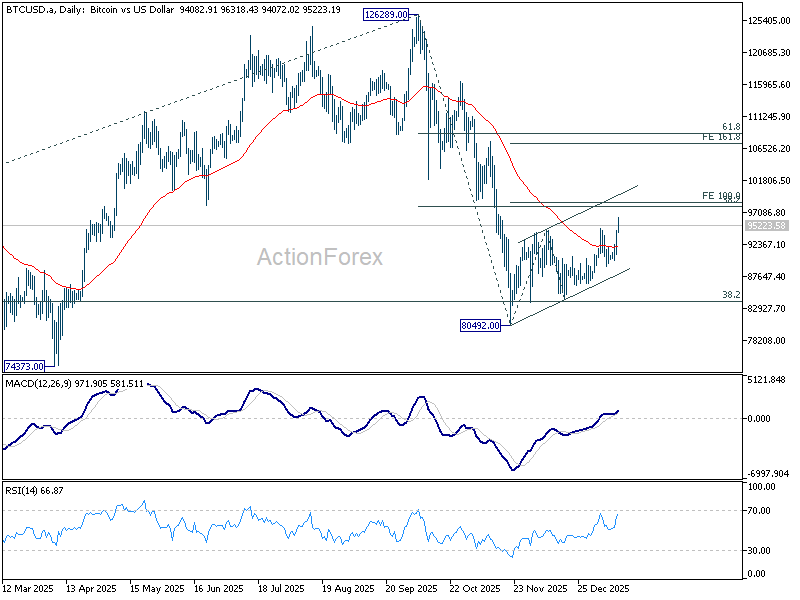
Technically, as Bitcoin’s rebound from 80,492 resumed, the focus is now firmly on cluster resistance zone around 98k. That area includes 38.2% retracement of 126,289 to 80,492 at 97,986, and 100% projection of 80,492 to 94,570 from 84,380 at 98,458.
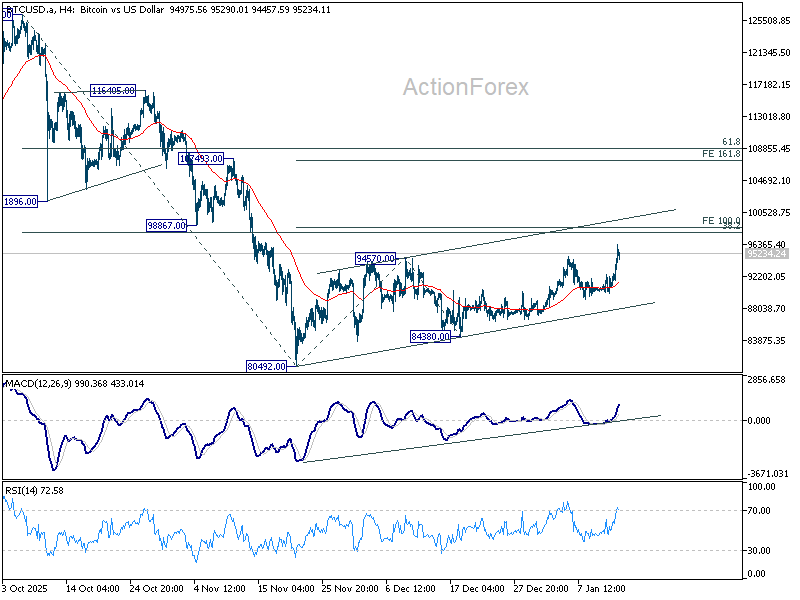
Decisive break of 98k zone is needed to solidify the case that “itcoin is reversing the whole down trend from 126,289. In that case, strong rise would be seen back to 61.8% retracement at 108,794 and above.
However, rejection by 98k zone will setup another falling leg to resume the fall from 126,289 through 80,492 at a later stage.
EUR/JPY Daily Outlook
Daily Pivots: (S1) 184.55; (P) 185.04; (R1) 185.83; More…
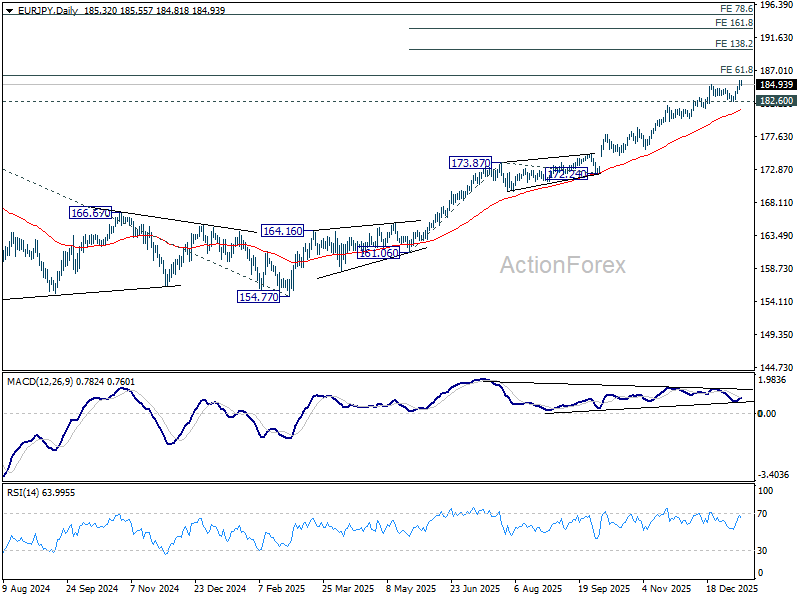
Intraday bias in EUR/JPY is turned neutral first with current retreat and some consolidations would be seen below 185.55 temporary top. But further rally is expected with 182.60 support intact. Above 185.55 will resume larger up trend to is 186.31 fibonacci level. Firm break there will pave the way to 138.2% projection of 151.06 to 173.87 from 172.24 at 189.94.
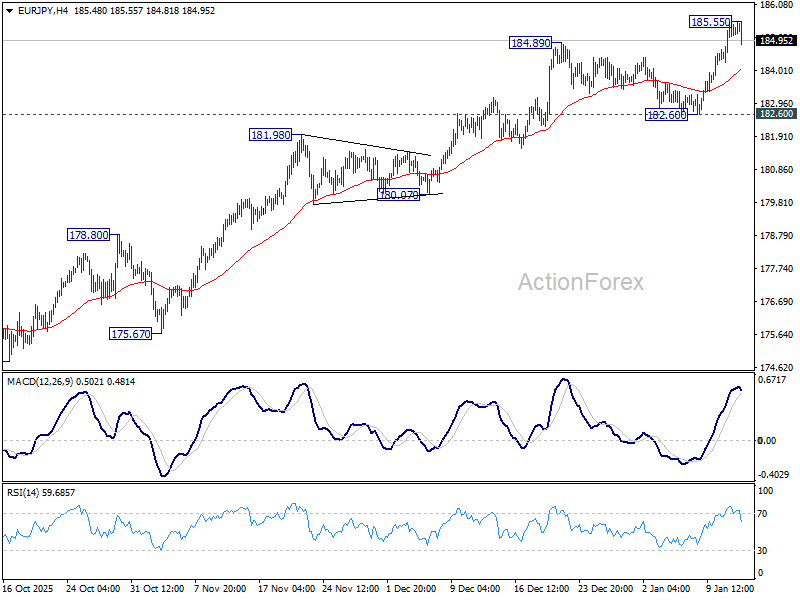
In the bigger picture, up trend from 114.42 (2020 low) is in progress and should target 61.8% projection of 124.37 (2021 low) to 175.41 (2024 high) from 154.77 (2025 low) at 186.31. Firm break there will target 78.6% projection at 194.88. Outlook will remain bullish as long as 175.41 resistance turned support holds, even in case of deep pullback.