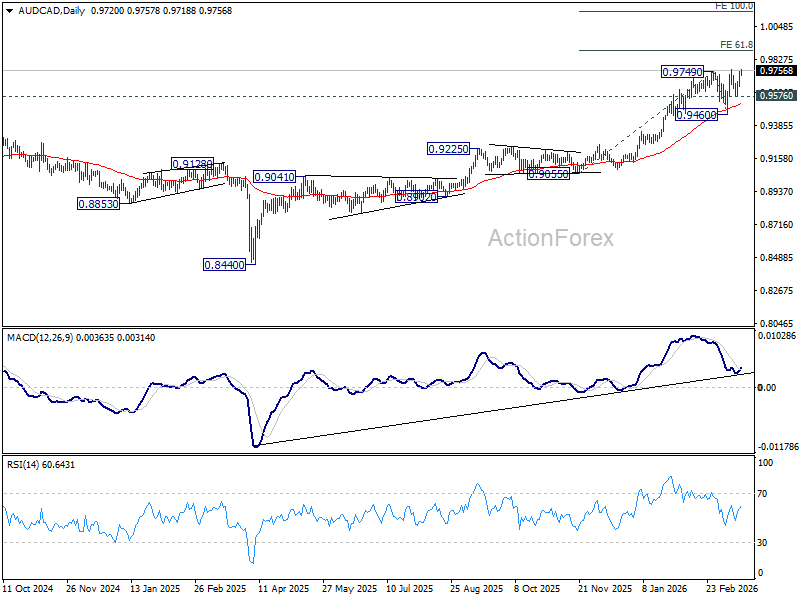
AUD/CAD moved higher this week as markets increasingly positioned for a divergence in policy outlook between the RBA and the BoC. Attention now turns to the BoC decision today, where rates are expected to remain unchanged at 2.25% for the third consecutive meeting. Notably, this level already sits at the lower bound of the Bank’s estimated neutral range of 2.25%–3.25%, meaning any rate cut would push policy into accommodative territory. Any dovish guidance today could drive the next upleg in AUD/CAD.
At first glance, the surge in oil prices would argue for a more cautious or even hawkish stance from the BoC, given the inflationary impulse. However, Canada’s domestic backdrop tells a different story. February CPI slowed to 1.8% yoy, below the 2% target. Core measures such as CPI common also eased notably from 2.7% to 2.4%, suggesting underlying inflation pressures are already moderating.
At the same time, the labor market is flashing clearer warning signs. Employment dropped by -84k in February, with losses concentrated in full-time jobs, pointing to weakening demand conditions. Combined with ongoing pressure from U.S. tariffs, the economy faces a dual hit from softer growth and external uncertainty.
This creates a policy dilemma where oil-driven inflation is offset by deteriorating domestic fundamentals. As a result, Governor Tiff Macklem is more likely to emphasize growth risks than inflation concerns. More importantly, any signal that the BoC is prepared to return to easing later this year, i.e. a “dovish hold”, would weigh on the Canadian Dollar.
Technically, AUD/CAD is attempting to resume its uptrend from 0.8440 (2025 low). Sustained trading above 0.9749 resistance would open the way toward 61.8% projection of 0.9055 to 0.9749 from 0.9460 at 0.9889 quickly. As long as 0.9576 support holds, the near-term outlook remains bullish, with policy divergence continuing to provide the fundamental backing for further upside.