


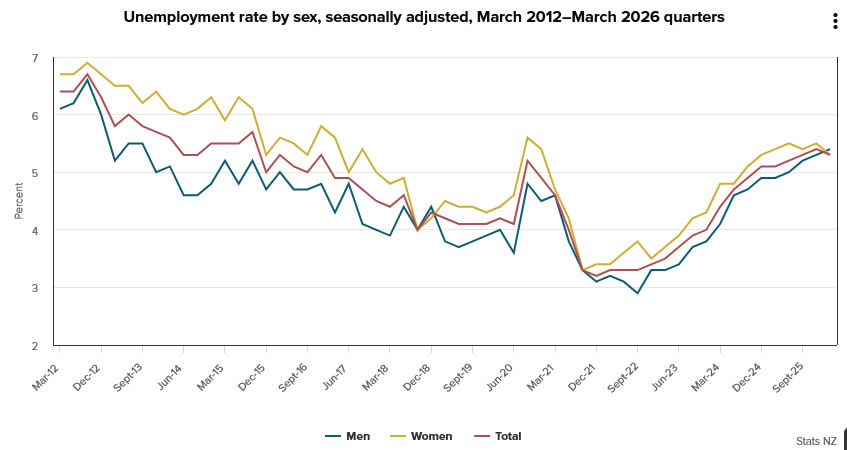
New Zealand’s labor market showed tentative signs of stabilization in the first quarter, with the unemployment rate unexpectedly falling from 5.4% to 5.3%, below expectations for no change. Employment rose 0.2% qoq, slightly under the expected 0.3% gain, marking modest improvement.
However, the decline in unemployment was not entirely driven by stronger hiring. The labor force participation rate edged down from 70.5% to 70.4%, while the employment rate held steady at 66.7%. This suggests that part of the fall in unemployment reflected weaker labor force participation rather than a significant acceleration in job creation.
For the Reserve Bank of New Zealand, the key takeaway was steady growth in wages. Private sector wage growth, measured by the Labor Cost Index, rose 0.4% qoq, leaving annual growth steady at 2.0%. Public sector wages increased 1.7% yoy, while overall salary and wage rates rose 2.0% yoy. With annual CPI inflation running at 3.1%, wage growth remains well below consumer price inflation, suggesting limited evidence of a wage-price spiral.
The data are likely to reinforce the RBNZ’s cautious wait-and-see stance. While energy-related inflation risks remain elevated, stable wage growth gives policymakers more confidence that broader inflation pressures are not yet becoming entrenched through the labor market. As a result, the figures support the view that the RBNZ can remain on hold at 2.25% through the winter rather than rushing toward additional tightening.
| Indicator | Previous | Latest |
|---|---|---|
| Employment Growth (QoQ) | 0.5% | 0.2% |
| Unemployment Rate | 5.4% | 5.3% |
| Underutilisation Rate | 12.9% | 12.9% |
| Employment Rate | 66.7% | 66.7% |
| Participation Rate | 70.5% | 70.4% |
| Private Sector LCI (YoY) | 2.0% | 2.0% |





