The Bank of Japan hiked. The Reserve Bank of Australia paused. Neither decision surprised markets. Yet the reaction in AUD/JPY may be telling a more important story.
The cross drifted lower after the BoJ raised rates by 25 basis points to 1.00%, the highest level since 1995, while the RBA kept rates unchanged at 4.35%. On paper, neither outcome represented a major policy surprise. But traders appear to have come away more convinced that Japan’s normalization cycle still has room to run than that Australia is preparing another near-term rate increase. That subtle shift in expectations is beginning to work against AUD/JPY.
The BoJ’s message was straightforward. Inflation risks are still tilted to the upside, helped by higher energy costs and a weak Yen. However, the 7-1 vote also highlighted ongoing caution within the Board, with one member arguing that risks to growth and employment outweighed inflation concerns. There was no strong signal that policymakers are preparing to accelerate tightening. Instead, the market’s base case remains another rate increase by the end of the year. Even so, that is enough to keep the Yen supported.
The RBA, meanwhile, delivered what can best be described as a hawkish hold. Officials warned that inflation remains too high and acknowledged that higher fuel costs are feeding into broader prices. But they also pointed to slowing consumer spending, softer housing activity and signs that tighter policy is gaining traction. The statement kept the door open to another hike if needed, yet stopped well short of signaling that August is the likely timing. For traders hoping for a stronger tightening signal, that was a disappointment.
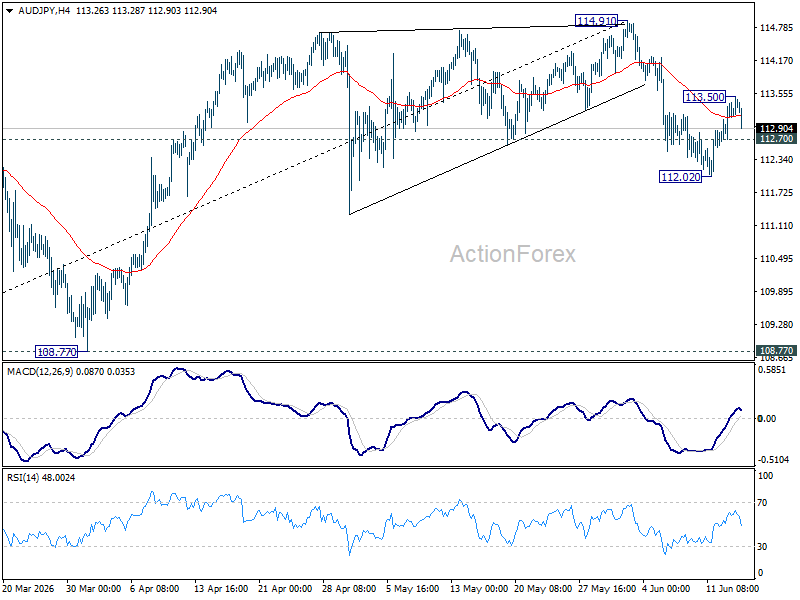
Technically, the picture is becoming more interesting. AUD/JPY has slipped below its 55 4H EMA, raising the possibility that the recovery from 112.02 to 113.50 has already run its course. A break of 112.70 would expose the 112.02 low, while a decisive move below that support would confirm that the decline from 114.91 is resuming.
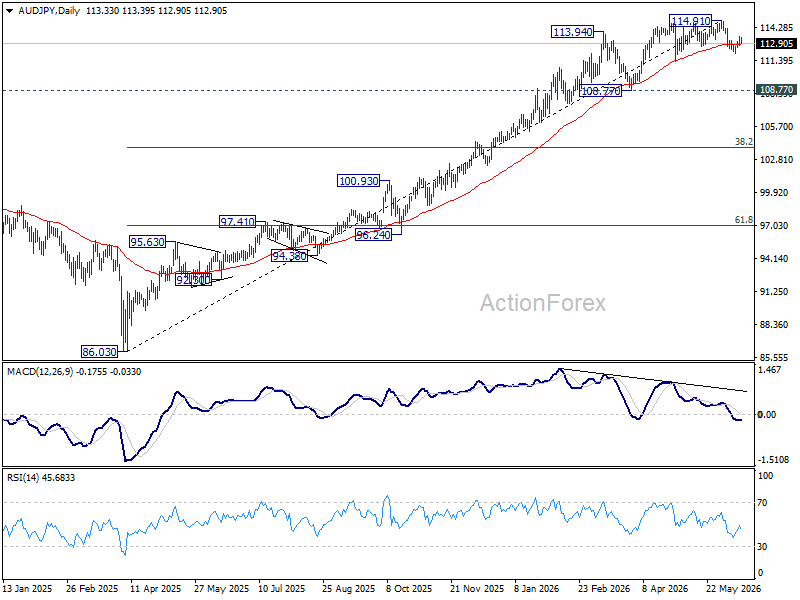
The bigger risk lies beyond the short-term charts. Bearish divergence on D MACD is visible. If AUD/JPY breaks 112.02 and establishes itself below 55 D EMA (now at 112.83) sustainably, the case for a medium-term correction would strengthen considerably. In that scenario, a move back toward 108.77 becomes increasingly plausible.
The policy gap between Australia and Japan remains wide, but it is no longer moving decisively in Australia’s favor. That may be the first warning sign that AUD/JPY’s powerful rally is finally running out of steam.