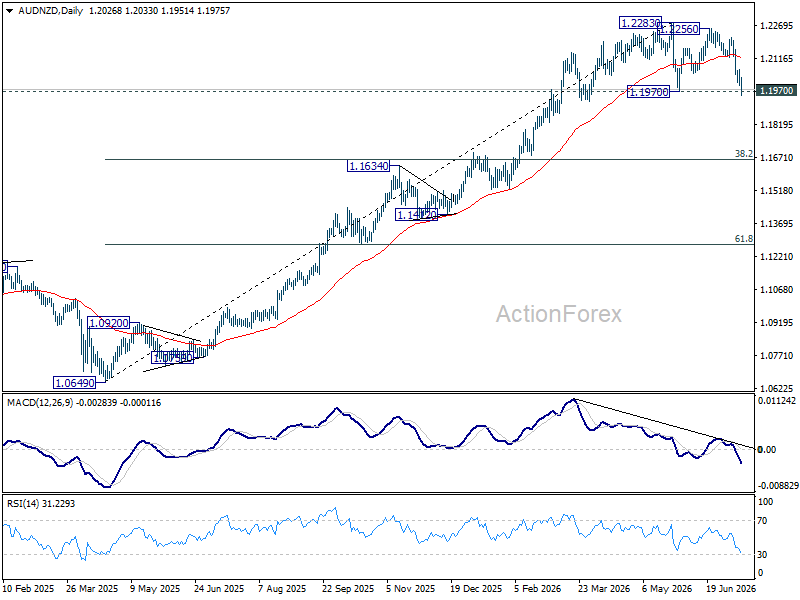
Only a week after the Reserve Bank of New Zealand suggested lower oil prices would help ease inflation, one of its most senior policymakers is already questioning that assumption. Chief Economist Paul Conway’s latest remarks have given the New Zealand Dollar another boost, as investors conclude that the recent rebound in energy prices could require the RBNZ to tighten policy further than markets anticipated just days ago. That shift is now pushing AUD/NZD toward the neckline of an important double top, with the cross reflecting diverging monetary policy paths on either side of the Tasman.
Conway’s speech, “Finding Signal in the Inflation Noise“, acknowledged that falling oil prices had initially eased near-term inflation pressures. However, he argued the recent resurgence in Middle East tensions has delivered “another significant inflation shock” and warned that inflation may not slow as quickly as the RBNZ’s own forecasts suggest.
More importantly, he pointed to structural changes in New Zealand’s pricing behavior. New research from the central bank indicates businesses are passing higher costs through to consumers more readily than in the past while proving less willing to reverse those increases when costs decline. If that behavior alters inflation expectations, Conway said, “monetary policy may need to respond more firmly to re-anchor inflation expectations,” while cautioning that well-anchored expectations “cannot be taken for granted.”
Markets responded by bringing forward expectations for further tightening. Overnight index swaps now imply the Official Cash Rate rising from current 2.50% to around 3.0% by December, with another increase expected early next year. That marks a notable shift from the narrative surrounding last week’s policy decision, when lower fuel prices had encouraged expectations that the RBNZ could move only gradually after delivering its first rate hike in three years. The rebound in oil prices has quickly forced investors to reassess that outlook.
The implications are particularly clear in AUD/NZD. While the Reserve Bank of Australia has already delivered three rate hikes this year and is widely expected to adopt a slower, more measured pace, the RBNZ is viewed as having more ground to make up. That narrowing policy gap provides a strong fundamental backdrop for continued New Zealand Dollar outperformance.
The technical picture is beginning to reinforce that macro story. AUD/NZD has already shown signs that the five-wave rally from 1.0649 has run its course, with bearish divergence emerging on D MACD. Focus is now squarely on the 1.1970 neckline. A decisive break would confirm a double top at 1.2283 and 1.2256, opening the way toward 38.2% retracement of 1.0649 to 1.2283 at 1.1659.