TL;DR: NZD/JPY fell over 1% despite the RBNZ’s second consecutive hike, as an Iran-driven oil shock reduced carry appetite, increasingly hawkish BoJ rhetoric strengthened the Yen, and the RBNZ’s own gradual guidance disappointed markets pricing a faster path.
Four Forces Are Hitting NZD/JPY at Once
NZD/JPY fell more than -1% on Wednesday, even after the RBNZ delivered a second consecutive 25bp rate hike to 2.75%. At first glance, that looks contradictory — higher New Zealand rates should normally support NZD. But the current decline is being driven by several forces pointing in the same direction: an Iran-driven oil shock has weakened risk appetite and encouraged carry reduction; BoJ rhetoric is reinforcing expectations for faster Japanese tightening; US pressure is adding urgency to the Yen story; and the RBNZ’s own guidance disappointed markets looking for a more aggressive hiking path.
That distinction matters for durability. Geopolitical risk and equity weakness can reverse quickly if oil retreats or US-Iran tensions ease. But BoJ-RBNZ policy divergence could persist even after risk sentiment stabilizes. In other words, oil triggered the broad move, while central-bank divergence amplified it.
Iran and Oil Trigger the Risk-Off Layer
Fresh Middle East escalation pushed Brent as high as around $97 earlier Wednesday, reviving concern over the Strait of Hormuz, inflation, and another round of US-Iran retaliation. Asian equities reflected the deterioration in risk appetite, with the Nikkei down around -2.5% and the KOSPI falling almost -4%.
For NZD/JPY, this matters through carry rather than a simple safe-haven mechanism. NZD is highly sensitive to global risk appetite, while the Yen has historically served as a funding currency for positions in higher-yielding assets. When volatility rises and investors reduce leverage, those trades are unwound by selling higher-beta currencies and buying back the Yen.
That gives Middle East escalation a clear transmission channel into NZD/JPY. But it’s only the first layer. Wednesday’s selloff is larger because the Yen itself is also receiving increasingly hawkish policy support.
The BoJ Debate Is Moving Beyond September
Markets are already close to fully pricing a BoJ hike at the September 17–18 meeting, so simply expecting a move from 1.00% to 1.25% is no longer especially new. The more important question is whether September marks the start of a faster tightening cadence.
US Treasury Secretary Scott Bessent has added pressure from Washington. NHK reported that Bessent told Finance Minister Satsuki Katayama and BoJ Governor Kazuo Ueda at the G20 meeting that Japan’s “next step should be to raise interest rates.” Nomura’s Mari Iwashita highlighted the credibility of that signal, saying: “Whenever Bessent made comments on Japanese monetary policy, the BOJ followed through with rate hikes.”
BoJ board member Hajime Takata then sharpened that message on Wednesday in Sapporo. He described “2026 [as] a regime change” and argued policy should become “nimble and data-dependent,” rather than being “bound by particular intervals or ranges anticipated in the markets.” Takata was already the sole dissenter in July, proposing an immediate hike from 1.00% to 1.25%.
That makes the current Yen story less about one September move and more about the possibility that the BoJ abandons its twice-yearly tightening rhythm. If markets begin pricing another hike substantially sooner than previously expected, Yen-funded carry becomes structurally less attractive.
RBNZ Delivered the Hike but Not the Hawkish Path
The New Zealand side produced the opposite surprise. The RBNZ raised the OCR from 2.50% to 2.75% by consensus, but NZD sold off sharply because markets were trading the future path rather than Wednesday’s decision itself. The RBNZ characterized tightening as gradual and stressed that policy isn’t on a preset course.
Its quarterly-average OCR projections rise only gradually from 2.8% in December 2026 to 3.0% in March 2027, 3.1% in June and September, and 3.2% by December 2027. Governor Anna Breman also emphasized the need to assess how rate increases already delivered are transmitting through the economy before deciding the next step.
Inflation risks aren’t viewed uniformly either. Hayley Gourley, Karen Silk, Prasanna Gai, and Breman saw risks tilted to the upside, while Paul Conway and Carl Hansen judged them balanced. That 4–2 split matters because it shows the Committee agrees on the current hike but not on the need for an aggressively hawkish future path.
So the RBNZ delivered hawkish action but a dovish reaction. Rates rose, but the policy message didn’t validate expectations for rapid tightening.
BoJ and RBNZ Are Moving in Opposite Directions at the Margin
This is what makes NZD/JPY particularly useful. The BoJ is telling markets not to assume rate hikes will remain six months apart. The RBNZ is telling markets not to assume further hikes will come quickly.
That doesn’t mean the RBNZ is turning dovish outright — it’s still tightening and sees inflation risks. But relative monetary-policy surprise is what matters for FX. Japan is challenging expectations for gradualism just as New Zealand is reinforcing them.
The pair therefore captures more than generic risk aversion. It combines:
- Higher geopolitical risk → lower carry appetite.
- Faster BoJ normalization risk → stronger Yen.
- Slower-than-hoped RBNZ tightening → weaker NZD.
That three-way alignment explains why NZD/JPY is moving more aggressively than either central-bank headline might imply in isolation.
ActionForex’s Technical View on NZD/JPY: Break of the 55-Day EMA Shifts Focus to 91.02
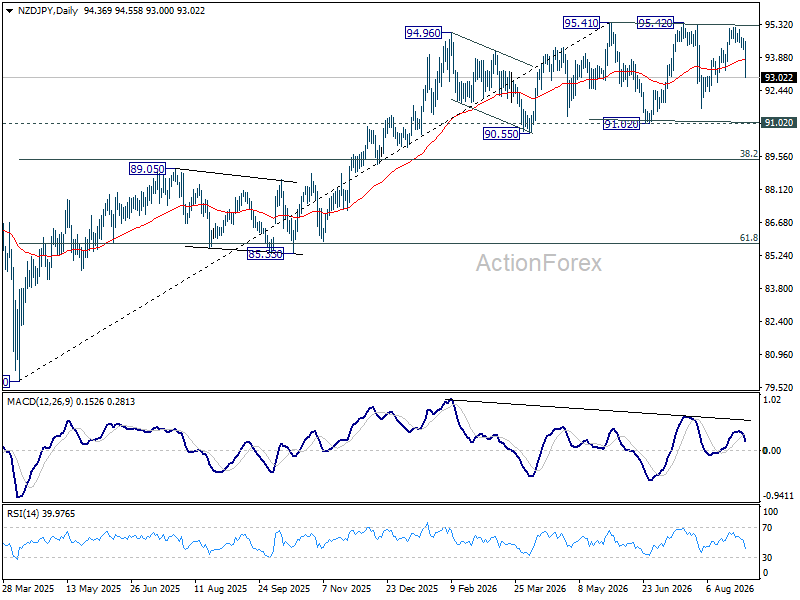
The technical picture has deteriorated sharply. NZD/JPY’s fall through the 55-day EMA around 93.78 confirms the rebound from 91.64 completed at 95.18. The decline from 95.18 is now viewed as another falling leg within the broader consolidation from 95.41.
The near-term bias stays lower while 94.21 minor resistance holds, with focus turning to 91.02 support. Strong support could emerge around that zone and trigger a rebound.
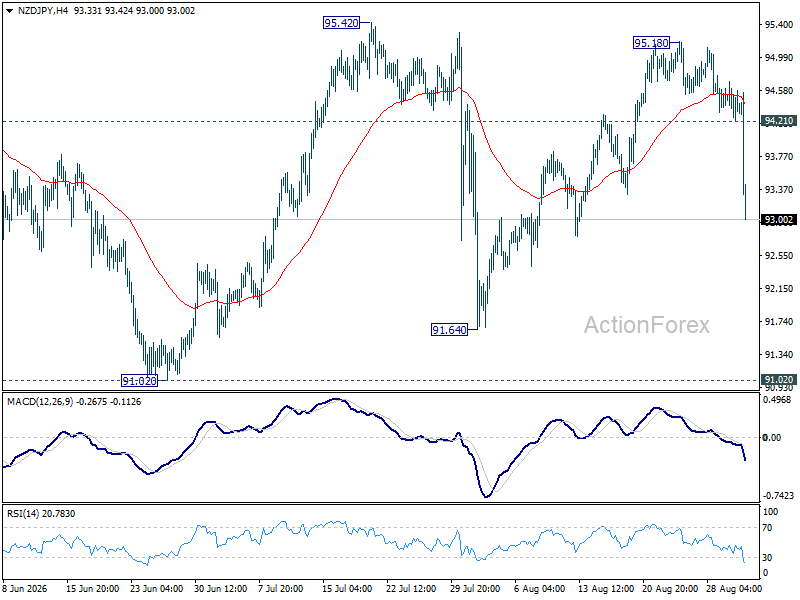
However, downside risk becomes more serious if carry unwind intensifies alongside further equity weakness and higher oil. A break of 91.02 would expose 89.44, the 38.2% retracement of the larger rise from 79.79 to 95.41.
One caution is that the 4H RSI has already fallen close to 20, leaving the pair deeply oversold in the short term. A rebound would therefore not be surprising. But the technical damage would remain intact unless NZD/JPY can recover above 94.21 and, more importantly, regain the lost 55-day EMA.
What Determines Whether the Selloff Lasts?
There are two separate questions. The first is whether the geopolitical catalyst persists. Brent’s move toward $102 is key — if oil continues higher and Asian equities remain under pressure, carry reduction can extend and accelerate downside in NZD/JPY. If US-Iran tensions ease and Brent retreats, that part of Wednesday’s move could reverse quickly.
The second is whether policy divergence survives beyond the current risk shock. The BoJ’s Sept. 17–18 decision and guidance will test whether Takata’s call for more nimble tightening is gaining broader support. In New Zealand, upcoming data will determine whether the RBNZ stays in wait-and-assess mode or shifts toward a faster path. Friday’s US payrolls also matter indirectly through global yields and risk appetite.
For now, NZD/JPY isn’t falling because of one headline. Iran escalation triggered carry reduction, the BoJ’s increasingly hawkish message strengthened the Yen side, and the RBNZ’s gradual guidance weakened the Kiwi side. That combination makes the current decline more than a simple geopolitical trade.
Key Takeaways
- NZD/JPY fell over 1% despite the RBNZ’s second straight hike, because markets traded the future path (gradual, disappointing) rather than the decision itself.
- Bessent’s public pressure on the BoJ and Takata’s “2026 regime change” comments suggest Japan may abandon its twice-yearly tightening rhythm for something faster.
- The RBNZ’s 4–2 committee split on inflation risk and quarterly-average OCR path (only reaching 3.2% by December 2027) confirm hawkish action but dovish forward guidance.
- Iran-driven oil moving toward $102 is the reversible layer of this selloff; BoJ-RBNZ policy divergence is the layer that could persist even if geopolitical risk eases.
- NZD/JPY has broken its 55-day EMA, opening a path toward 91.02 and then 89.44, though a 4H RSI near 20 leaves the pair deeply oversold and due for a possible bounce.