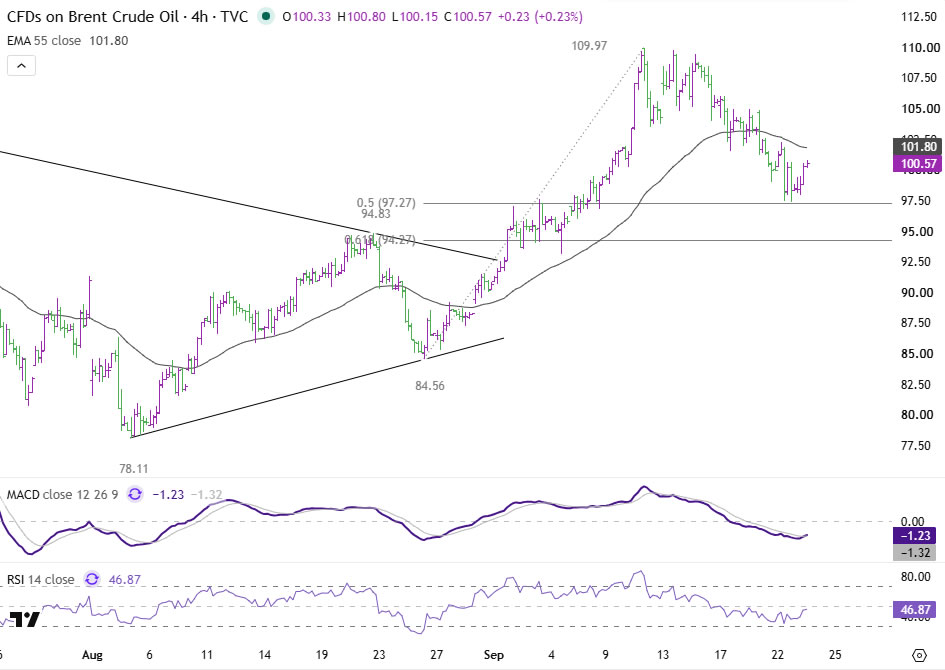
What’s happening: Brent completed a round trip, falling into the low $98s on Tuesday as traders priced a faster Hormuz reopening, then reclaiming $100 as focus shifted from whether Iran’s diplomatic offer is real to how long any agreement would take to restore actual oil flows. CAD strengthened broadly on the oil rebound, but USD/CAD still edged higher because Dollar has an additional tailwind of its own: a hawkish week of Fed commentary keeping meaningful odds on an October hike.
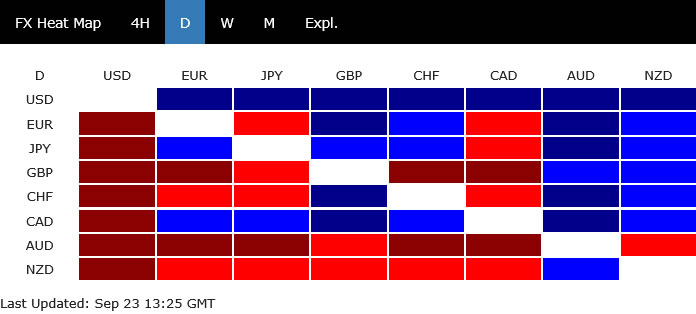
Why it matters: That produces an unusually clean FX hierarchy: higher oil lifts CAD above currencies with no energy tailwind, but higher oil plus stronger Fed rate expectations let USD beat CAD itself. That’s why the heat map can show both currencies strengthening at once even as USD/CAD grinds higher.
Oil’s Round Trip Changes the Message
Brent’s round trip back above $100 is telling a more nuanced story than Tuesday’s selloff suggested: Iran’s Hormuz offer appears real, but markets still see little evidence that an agreement will come quickly. That reversal has lifted CAD—but the Dollar has an additional tailwind strong enough to push USD/CAD slightly higher as well. Brent, which had fallen into the low $98s as traders initially priced the possibility of a faster reopening of the Strait of Hormuz, recovered back above $100 as the focus shifted from whether diplomacy exists to how long any agreement might take.
The diplomatic opening itself has gained credibility. Reuters reported that Iran could reopen Hormuz within seven days if Washington eases military pressure and lifts its blockade on Iranian ports, while subsequent contacts in New York showed negotiations moving beyond indirect signaling. Iranian state television confirmed that Foreign Minister Abbas Araghchi met US envoy Steve Witkoff and presented Tehran’s conditions, while US President Donald Trump described recent contacts as “very good” and said there was “a lot of momentum” toward an agreement.
But none of that establishes a fast resolution. Iran still wants Washington to move first on the blockade and other demands, while Trump told the UN that he expected a deal only after the November midterm elections. Military rhetoric has also continued alongside diplomacy. The result is a market that increasingly believes the offer is substantive, but still sees a large gap between talks and restored oil flows.
Iran’s Diplomatic Signals This Week
- Reuters: Iran could reopen Hormuz within seven days if Washington eases military pressure and lifts its blockade on Iranian ports.
- Iranian state television: Foreign Minister Abbas Araghchi met US envoy Steve Witkoff in New York and presented Tehran’s conditions.
- Trump: described contacts as “very good,” with “a lot of momentum” toward an agreement, but told the UN he expects a deal only after the November midterm elections.
- Iran wants Washington to move first on the blockade and other demands; military rhetoric has continued alongside diplomacy.
Brent Back Above $100 Restores the Stand-Down Range
That distinction explains Brent’s reversal. Tuesday’s break below $100 was the first serious attempt to price something more than a pause in military escalation. Instead, Brent has quickly reclaimed $100.
That does not negate the diplomatic progress. It suggests the market is distinguishing between an offer that could eventually reopen Hormuz and a near-term agreement capable of normalizing physical supply. Saudi Arabia’s restart of the East-West Pipeline provides genuine additional routing capacity, but Hormuz itself remains constrained, and Reuters noted that traders still see limited downside until more actual supply returns through the strait.
For now, the earlier $100–110 framework remains intact. Concrete US movement on the blockade or a confirmed path toward reopening Hormuz would put 94.27 back into focus. Without that, the return above $100 says unresolved supply risk still commands a premium.
Key Levels
- Brent: fell into the low $98s Tuesday, reclaimed $100.
- $100–110 stand-down range treated as intact for now.
- Next downside level if the range breaks: 94.27.
- What would reopen that path: concrete US movement on the blockade or a confirmed path toward reopening Hormuz.
- Saudi’s East-West Pipeline restart adds routing capacity, but Hormuz itself remains constrained; traders see limited downside until actual supply returns through the strait.
CAD Finally Gets Its Oil Tailwind
The FX response is much cleaner than during Tuesday’s oil selloff. CAD is broadly stronger against the rest of the major-currency field as Brent rebounds, consistent with the usual Canadian terms-of-trade channel.
But the Loonie has not beaten the Dollar. USD/CAD edged higher, showing that CAD’s oil support is being offset by an even stronger USD backdrop.
That distinction is important. The Canadian story is straightforward: higher crude improves the relative income outlook for a major oil exporter and restores some of the support that disappeared when Brent briefly slipped into the $98s.
The Dollar has a more complicated mix of support. The US energy-export position means higher oil is no longer necessarily the pure external drag it once was, while Gulf supply disruption has also encouraged substitution toward US crude. But the cleaner differentiator is interest rates.
Dollar Has the Extra Rates Tailwind
Fed officials have reinforced a relatively hawkish message this week. Alberto Musalem warned that policy remained on the accommodative side, Austan Goolsbee emphasized persistent supply shocks and overheating risks, while Susan Collins backed the September hike and warned that inflation could remain notably above target. Collins said a “somewhat more restrictive federal funds rate” would help ensure inflation returns durably to 2%.
With markets still assigning substantial probability to another October move, that gives USD an independent source of support that CAD does not share.
The resulting FX hierarchy is unusually clean:
Higher oil helps CAD beat currencies without an energy tailwind.
But:
Higher oil plus stronger US rate expectations allow USD to beat CAD itself.
That is why the heat map can show both currencies strengthening at the same time even as USD/CAD edges higher.
This Week’s Hawkish Fed Voices
- Musalem: policy remains “on the accommodative side.”
- Goolsbee: emphasized persistent supply shocks and overheating risks.
- Collins: backed the September hike, warned inflation could stay notably above target, called for a “somewhat more restrictive federal funds rate.”
- Markets: still assign substantial probability to another October move.
Two Tailwinds, One Winner
| Force | Effect |
|---|---|
| Higher oil | Lifts CAD above currencies without an energy tailwind |
| Higher oil + stronger Fed rate expectations | Lifts USD above CAD itself |
Diplomacy Now Needs Action, Not Another Headline
The next oil move will depend less on whether Washington and Tehran are talking and more on whether either side acts on the conditions now on the table. Trump has acknowledged ongoing contacts and expressed confidence that an eventual settlement can be reached, while Tehran has attached reopening Hormuz to concrete US concessions.
Until there is movement on those conditions, the market can simultaneously believe that diplomacy is genuine and that the crisis remains far from resolved.
For Brent, $100 remains the key dividing line between a deeper premium unwind toward 94.27 and a return to the established $100–110 stand-down range.
For currencies, the split is equally clear. CAD needs oil to remain supported. USD has oil-related support at the margin, but more importantly it has the additional lift from Fed repricing. That combination is why the Dollar and Loonie can rise together while USD/CAD still grinds higher.
Related Coverage
Global PMI Watch
Eurozone PMI Composite Jumps to 41-Month High as Germany Accelerates and France Returns to Growth — a broad-based acceleration that came with renewed inflation pressure of its own.
UK PMI Composite Slips to 51.7 as Growth Slows and Inflation Pressures Intensify — slower UK growth paired with intensifying price pressure, keeping the BoE caught between the two.
Australia PMI Composite Slumps to 50.8 as Manufacturing Contracts and Job Losses Return — a sharper slowdown with manufacturing back in contraction and the first employment decline in four months.
Fed Voices
Fed Barkin Says Inflation Risks Outweigh Jobs Risks, Leaves Door Open to More Hikes — another hawkish voice this week, adding to the Musalem, Goolsbee and Collins commentary behind Dollar’s rates tailwind.
Cross-Asset & FX Watch
SNB May Do Nothing Tomorrow—So What Is Driving EUR/CHF and GBP/CHF Lower? — how falling oil and easing rate-differential pressure may matter more for CHF than tomorrow’s decision itself.
Silver Is Beating Gold Despite a Stronger Dollar—Is AI Capex the Missing Driver? — a similar-flavored divergence in precious metals playing out alongside today’s FX puzzle.
FAQ
If both Dollar and CAD are strengthening, why is USD/CAD still rising?
CAD’s strength comes only from the oil tailwind. Dollar has that same oil-related support at the margin plus an independent lift from this week’s hawkish Fed commentary (Musalem, Goolsbee, Collins) and meaningful odds on an October hike, giving USD the edge over CAD specifically.
Is Iran’s Hormuz offer actually credible?
It looks more substantive this week, Iran’s Foreign Minister Araghchi met US envoy Witkoff directly, and Trump described the contacts as “very good” with “a lot of momentum.” But Iran wants Washington to move first, and Trump told the UN he expects a deal only after the November midterms, so the market is separating a credible offer from an imminent restoration of physical oil flows.
What would push Brent back toward 94.27?
Concrete US movement on the blockade or a confirmed path toward reopening Hormuz. Without that, Brent reclaiming $100 signals the market still sees unresolved supply risk as commanding a premium, and the $100-110 stand-down range stays intact.
Key Takeaways
- Brent completed a round trip, falling into the low $98s Tuesday before reclaiming $100 as focus shifted from whether Iran’s Hormuz offer is real to how long any agreement would take to restore actual oil flows.
- Iran’s diplomatic signals grew more credible this week, Foreign Minister Araghchi met US envoy Witkoff, and Trump called contacts “very good,” but Trump told the UN he expects a deal only after the November midterms, keeping the $100-110 stand-down range intact for now.
- CAD strengthened broadly on oil’s rebound, a straightforward terms-of-trade effect for a major oil exporter.
- Dollar strengthened even more, because this week’s hawkish Fed commentary and meaningful odds on an October hike gave USD an independent tailwind CAD doesn’t share, which is why USD/CAD edged higher even as both currencies rose broadly.
- For oil, $100 remains the key dividing line between a deeper premium unwind toward 94.27 and a return to the established $100-110 range; for currencies, CAD needs oil to stay supported while Dollar has both the oil tailwind and the Fed-repricing lift.
What to Watch Next
Whether Washington or Tehran act on the conditions now on the table rather than just signaling further, which would be the real trigger for Brent to break decisively out of the $100-110 range in either direction. Also watch whether next week’s Fed speakers keep reinforcing October hike odds, which is the piece of Dollar’s current tailwind that CAD has no equivalent for.