


What’s happening: Dollar strengthened against every major currency Thursday as three drivers moved together: October Fed hike odds surged to 77.5%, from roughly 53% a day earlier and under 10% a month ago, pushing the 10-year Treasury yield to around 5.14%, its highest since 2007; Brent extended its rally above $105 as Houthi forces advanced toward the Bab el-Mandeb corridor, opening a second oil chokepoint alongside Hormuz; and the US and China extended their trade truce by only two months, to January 10, rather than locking in a more durable reset.
Why it matters: Each of these drivers had previously been offset by something else, lower oil, hopes for diplomacy, or expectations of a longer trade truce, and those counterweights weakened at the same time. That’s what turns Thursday into a genuine convergence day rather than three unrelated headlines, and why the macro configuration is currently unusually aligned in Dollar’s favor.
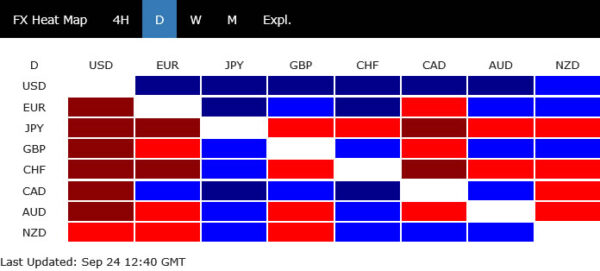 Currency Heat Map.
Three Risks Converge as Dollar Takes Control
The Dollar strengthened broadly on Thursday as Fed tightening expectations, renewed oil-supply risk and a shorter-than-hoped US-China trade reset all moved in the same direction. The 10-year Treasury yield pushed to around 5.14%, its highest since 2007, the 2-year approached 4.90%, and the 30-year rose above 5.44%. Brent meanwhile extended its rally above $105. The FX heat map showed the Dollar advancing against every other major currency, turning what had been several separate market themes into one unusually coherent macro move.
Thursday’s Cross-Market Snapshot
- 10-year Treasury yield: around 5.14%, highest since 2007.
- 2-year yield: approaching 4.90%.
- 30-year yield: above 5.44%.
- Brent: above $105.
- Dollar: advancing against every other major currency on the FX heat map.
Treasury Breakout Pulls Fed Repricing Forward
The most direct support came from rates. New York Fed President John Williams said it was “reasonable” to expect another rate hike before year-end, while stressing that the timing still depends on incoming data. Markets have moved further, with the probability of an October hike rising to 77.5%, compared with roughly 53% a day earlier and below 10% a month ago.
At the last FOMC meeting, 16 of 18 Fed policymakers signaled at least one more hike in 2026, while the latest projections do not put core inflation back at 2% until 2029, reinforcing the message that the inflation problem is expected to persist even if the exact policy path remains data-dependent.
That repricing is now showing up as a genuine Treasury breakout rather than another test of familiar resistance. The 10-year has moved through the resistance cluster that had capped the latest advance, although a sustained close above that zone is still needed to confirm the break and expose the next projection near 5.4%. The 2-year has already cleared 4.8%, keeping 5% as the next upside target.
The US move is also unfolding inside a broader global bond selloff, with Japan’s 10-year JGB reaching 3.055% and other developed-market yields trading around multi-year highs. That makes the current pressure more than a purely US story, even if Fed repricing remains the cleanest driver of Dollar strength.
Fed Repricing at a Glance
- Williams: another 2026 hike “reasonable,” but timing still data-dependent.
- October hike probability: 77.5%, up from roughly 53% a day earlier and under 10% a month ago.
- Last FOMC: 16 of 18 officials signaled at least one more hike in 2026; core inflation not projected back at 2% until 2029.
- 2-year yield: cleared 4.8%, next target 5%.
- 10-year yield: through its resistance cluster, needs a sustained close above to confirm the break, next projection near 5.4%.
- Global context: Japan’s 10-year JGB at 3.055%, other developed-market yields near multi-year highs.
Oil Risk Spreads From Hormuz to Bab el-Mandeb
Oil added a second inflationary impulse. Brent climbed toward $106 as evidence of progress in US-Iran diplomacy remained limited and Iranian President Masoud Pezeshkian used his UN address to reject pressure from Washington while keeping the door open to negotiations. The US delegation walked out as he began speaking, underscoring how far the political relationship remains from normalization.
More importantly for the physical oil market, Houthi forces have advanced to the Red Sea coast near the Bab el-Mandeb corridor, and Yemeni government forces said they repelled a fresh push on the critical Taiz-Aden route overnight.
That broadens the oil-risk map from one chokepoint to two. The disruption around Hormuz had already pushed Saudi Arabia to rely more heavily on alternative export arrangements, including its East-West Pipeline and Red Sea infrastructure. But Asian-bound barrels leaving the Red Sea still depend on passage through Bab el-Mandeb.
The implication is not that the Saudi workaround has disappeared, but that the workaround itself now carries another layer of geopolitical risk. At the same time, stronger oil is feeding back into the rates story.
Oil Risk Developments
- Brent: climbed toward $106.
- Pezeshkian’s UN address: rejected US pressure, kept the door open to negotiations; the US delegation walked out as he began speaking.
- Houthi forces: advanced to the Red Sea coast near Bab el-Mandeb.
- Yemeni government forces: repelled a fresh push on the Taiz-Aden route overnight.
- Saudi workaround (East-West Pipeline, Red Sea infrastructure) still functioning, but Asian-bound barrels from the Red Sea still depend on Bab el-Mandeb passage.
US-China Truce Buys Two Months, Not Resolution
The third strand came from Washington and Beijing. The US and China extended their existing trade truce by only two months, to January 10, preserving the immediate détente but keeping the next deadline close. The short extension suggests neither side was prepared to lock in a more durable reset, leaving the core trade relationship under pressure even as negotiations continue.
The two countries have also opened a formal dialogue on AI risks, including an incident-communication mechanism and plans for further talks, but the larger disputes over tariffs, technology and market access remain unresolved. The result is a process that is still moving, but without enough substantive progress to remove trade uncertainty from the market.
Truce Details
- Extension: two months, to January 10.
- New AI dialogue: an incident-communication mechanism and plans for further talks.
- Still unresolved: tariffs, technology and market access.
Why This Is a Convergence Day
That is why Thursday stands out as a convergence day rather than three unrelated headlines. Fed repricing is widening the Dollar’s rate advantage; higher oil is reinforcing inflation pressure and geopolitical risk; and the short China truce preserves rather than removes trade uncertainty. Each theme had previously been offset by something else—lower oil, hopes for diplomacy, or expectations of a longer trade reset. Those counterweights weakened together.
What Could Break the Convergence
What breaks the convergence is equally clear. A materially softer payrolls report or inflation print could pull October Fed expectations and yields back down. Concrete de-escalation around either Hormuz or Bab el-Mandeb would remove part of the oil premium. And substantive progress on tariffs, rare earths or technology before January 10 would turn the China extension from a holding pattern into something more durable.
Until one of those offsets reappears, the immediate macro configuration remains unusually aligned in the Dollar’s favor.
Three Drivers, Three Potential Offsets
| Driver | Current Reading | What Would Break It |
|---|---|---|
| Fed / rates | October hike odds at 77.5%, 10-year around 5.14% | A materially softer payrolls report or inflation print |
| Oil | Brent above $105, two chokepoints now in focus (Hormuz and Bab el-Mandeb) | Concrete de-escalation around either chokepoint |
| China trade | Truce extended only two months, to January 10 | Substantive progress on tariffs, rare earths or technology before January 10 |
Related Coverage
Fed & Yields Deep Dive
October Fed Hike Odds Hit 70%, US Yield Breakout Puts EUR/USD at Risk — the technical picture behind today’s Treasury breakout and what it means for EUR/USD’s 1.13 support zone.
Fed’s Williams Says Another 2026 Hike Is “Reasonable,” but Won’t Commit to October — the full context behind Williams’s comments driving today’s Fed repricing.
US Jobless Claims Slip to 197k as Layoffs Remain Subdued — the labor-market resilience giving the Fed little reason to slow down.
Global Central Bank Watch
SNB Holds at 0%, Raises Inflation Forecasts on Oil and Weaker Franc — another central bank feeling the same oil and currency pressures as the Fed, from a very different starting point.
Global Data Watch
Canada Retail Sales Fall Broadly in July, but August Advance Points to Rebound — a soft print with an early sign of recovery already visible.
Germany Ifo Business Climate Rises to 89.9 as Recovery Gains Traction, Manufacturing Still Lags — a broad beat that still leans more on expectations than current activity.
Australia Adds 39.5k Jobs, but Rising Unemployment Reveals a Softer Undercurrent — a headline beat undercut by an all part-time composition and rising unemployment.
Japan Growth Slips a Gear While Weak Yen Keeps Inflation Pressure Elevated — a slowdown story with the same weak-currency, high-energy-cost inflation pressure running through today’s convergence.
FAQ
Why is today being called a “convergence day” instead of three separate stories?
Each of the three drivers, Fed repricing, oil-supply risk, and the short China trade truce, had previously been offset by something else. Those offsets weakened at the same time Thursday, turning what looks like three headlines into one coherent, self-reinforcing Dollar move rather than three unrelated developments.
How much has the market moved on an October Fed hike?
October hike odds jumped to 77.5%, up from roughly 53% a day earlier and under 10% a month ago, pushing the 10-year Treasury yield to about 5.14%, its highest since 2007.
Why does Bab el-Mandeb matter if Hormuz disruption already pushed Saudi Arabia to alternative routes?
Those alternative routes, including the East-West Pipeline and Red Sea infrastructure, still depend on Asian-bound barrels passing through Bab el-Mandeb. Houthi advances toward that corridor add a second layer of risk to the workaround itself, not just to Hormuz.
Key Takeaways
- Dollar strengthened against every major currency Thursday as Fed hike bets, oil-supply risk and a short US-China trade truce all moved in the same direction at once.
- October Fed hike odds rose to 77.5% from roughly 53% a day earlier and under 10% a month ago, pushing the 10-year Treasury yield to about 5.14%, its highest since 2007.
- Oil risk broadened from one chokepoint to two as Houthi forces advanced toward Bab el-Mandeb even as Hormuz disruption continued, pushing Brent toward $106.
- The US and China extended their trade truce by only two months, to January 10, preserving the immediate détente without resolving the larger disputes over tariffs, technology and market access.
- Each driver had previously been offset by something else, lower oil, diplomacy hopes, or a longer trade reset, and those offsets weakened together, which is what turned Thursday into a convergence rather than three unrelated headlines.
What to Watch Next
A materially softer payrolls report or inflation print that could pull October Fed expectations and yields back down. Concrete de-escalation around either Hormuz or Bab el-Mandeb that would remove part of the oil premium. And whether substantive progress on tariffs, rare earths or technology emerges before the January 10 China truce deadline. Until one of those offsets reappears, the current alignment stays in Dollar’s favor.





