


Our summary of recent economic events and what to expect in the weeks ahead.
Canadian Highlights
- Canadian labour market momentum softened further in September, strengthening the case for a Bank of Canada pause later this month.
- Strong August trade data point to modest support for Q3 growth, though tariff-related front-running could lead to softer trade flows in the coming months.
- We continue to expect the BoC to hold rates steady on October 28th, with the next CPI report likely determining whether inflation risks warrant renewed tightening.
U.S. Highlights
- Oil prices remained volatile as markets weighed shifting Middle East tensions, improved flows through the Strait of Hormuz, and hurricane-related production shutdowns in the Gulf.
- U.S. Treasury yields edged lower as healthy demand at 10- and 30-year auctions helped ease pressure from the recent rise in term premiums.
- Financial markets remained confident that the Fed would hold rates at their next meeting, though next week’s CPI report will be monitored closely.
Canada – Labour Market Weakens, Inflation Remains the Wild Card
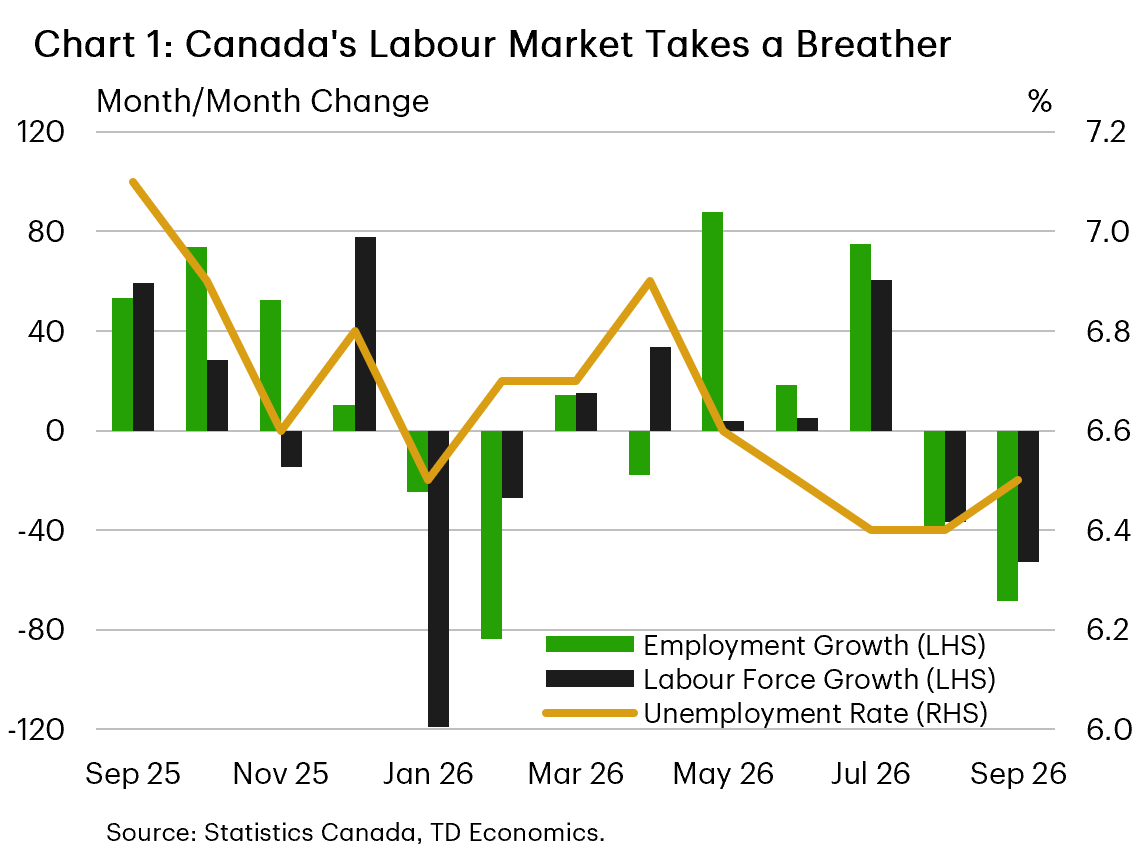
With less than three weeks until the Bank of Canada’s October 28th rate decision, attention this week was squarely on the labour market. September’s employment report disappointed relative to expectations, with employment falling by 68k following a decline of more than 40k in August. The weakness pushed the unemployment rate up a tenth to 6.5% (Chart 1). Job losses were equally split between full-time and part-time work, with one bright spot being that private sector employment held steady. To be sure, Canada’s labour market has held up better than many expected this year given ongoing trade tensions, elevated uncertainty and softer economic growth. However, this report suggests the labour market is still searching for more durable momentum.
Financial markets responded swiftly, with Canadian bond yields falling 6-10 basis points across the curve as investors pared expectations for near-term policy tightening. The Canadian dollar also weakened roughly six-tenths of a cent against the USD, remaining near an 18-month low, while the TSX gave back some of its recent gains. Elsewhere, WTI crude continued to oscillate around the $90/bbl mark.
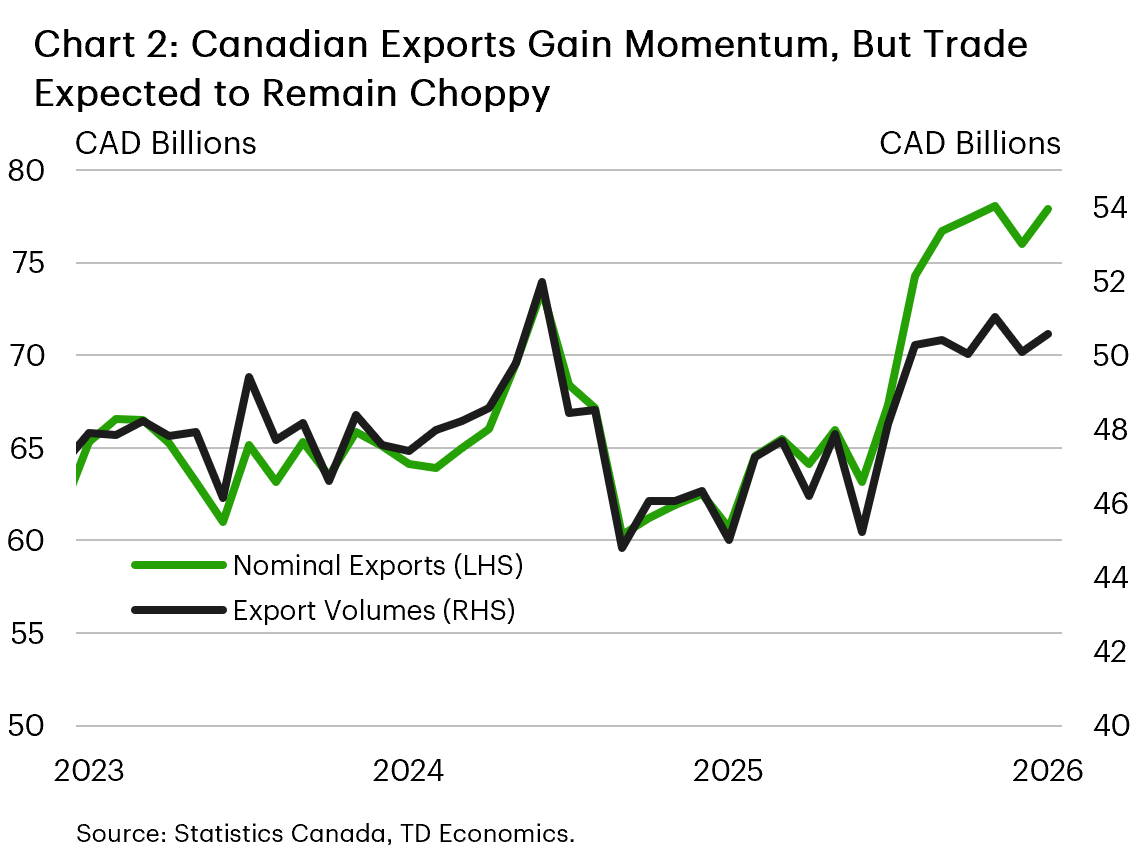
Meanwhile, this week’s trade data painted a somewhat firmer picture of underlying economic activity, with some caveats. Exports rebounded sharply in August following a temporary pullback in July. Stronger shipments of crude oil, diesel, nuclear fuel, consumer goods and industrial machinery helped drive gains across most major export categories (Chart 2). Some of August’s strength reflected businesses pulling activity forward ahead of recent tariff measures, suggesting some payback is likely in the coming months. For now, trade is positioned to provide a modest boost to Q3 GDP growth, though new tariffs, countermeasures, and U.S. import restrictions are likely to weigh on cross-border flows through year-end.
Taken together, we don’t think that this week’s developments will materially alter the Bank of Canada’s near-term thinking. Our base case remains for policymakers to leave rates unchanged as they continue to assess the balance between downside risks to growth and upside risks to inflation. Recent economic data suggests that the growth side of the equation may be becoming less concerning. And by contrast, persistently higher energy prices are a continued source of upside inflation risk, though evidence of pass-through into underlying inflation measures remains limited.
That leaves the October 19th CPI report as the most important data point to guide the BoC’s policy direction. A mild reading, particularly across core measures, would reinforce our view for the BoC to remain on hold. However, firmer core inflation and a broader pickup in price pressures would support the case for some policy tightening. For now, we think the Bank will remain content on taking a more data-dependent approach to their next policy move.
U.S. – U.S. Treasuries Stabilize as Oil Prices Oscillate
The first full week of the third quarter was relatively light on economic data releases. WTI oil prices oscillated between $88-93/barrel this week, as markets weighed reports regarding improved oil flows through the Strait of Hormuz and conflicting reports about the status of geopolitical tensions in the region. The first Atlantic hurricane of the year, Hurricane Isaias, has also provided a modest boost to oil prices as its path through the Gulf toward Alabama and the Florida panhandle has resulted in temporary shutdowns covering 1.3 million barrels per day.
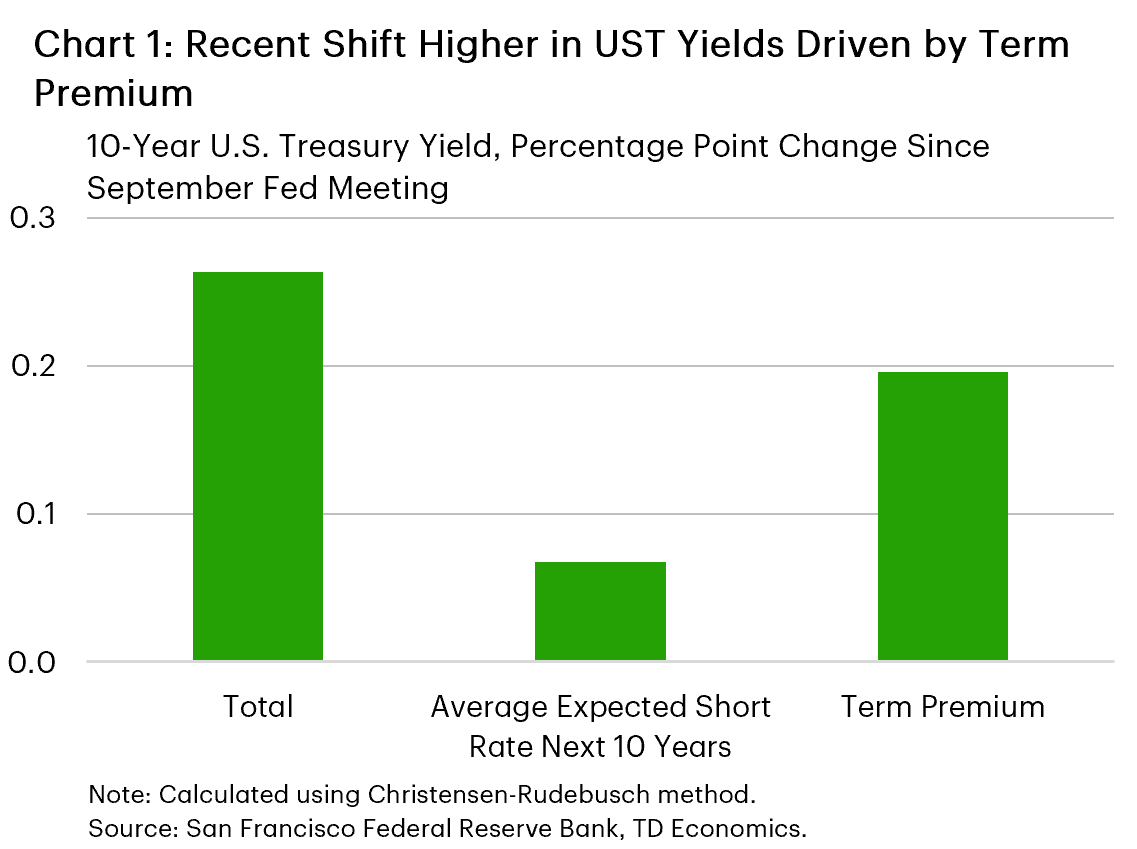
In credit markets, the march higher in global government bond yields eased over the past week. While concerns regarding the confluence of high national debt levels and higher for longer interest rates remain, U.S. Treasury auctions for 10-and 30-year bonds showed that investor demand remained healthy in the primary market. Given that most of the uptick in U.S. Treasury yields since the Federal Reserve’s September meeting has been a function of the risk premium (Chart 1) – the additional compensation demanded by investors to hold federal government debt – this development helped to alleviate some of the pressure on the U.S. Treasury market.
In terms of the economic data that we did receive this week, the advance estimates for international trade in August showed that the U.S. trade deficit widened to its highest level since March 2025 – the period that saw significant front-loading of imports in advance of the implementation of global tariffs. Surging imports of AI-related products continued to be the central catalyst of this trend, which more than offset the boost to nominal exports from higher energy prices. Elsewhere, the ISM Services index showed that service-based businesses continued to expand in September, albeit at a slower pace. Notably, the prices paid index hit its highest level since July 2022, illustrating the sustained pressure on input costs for businesses.
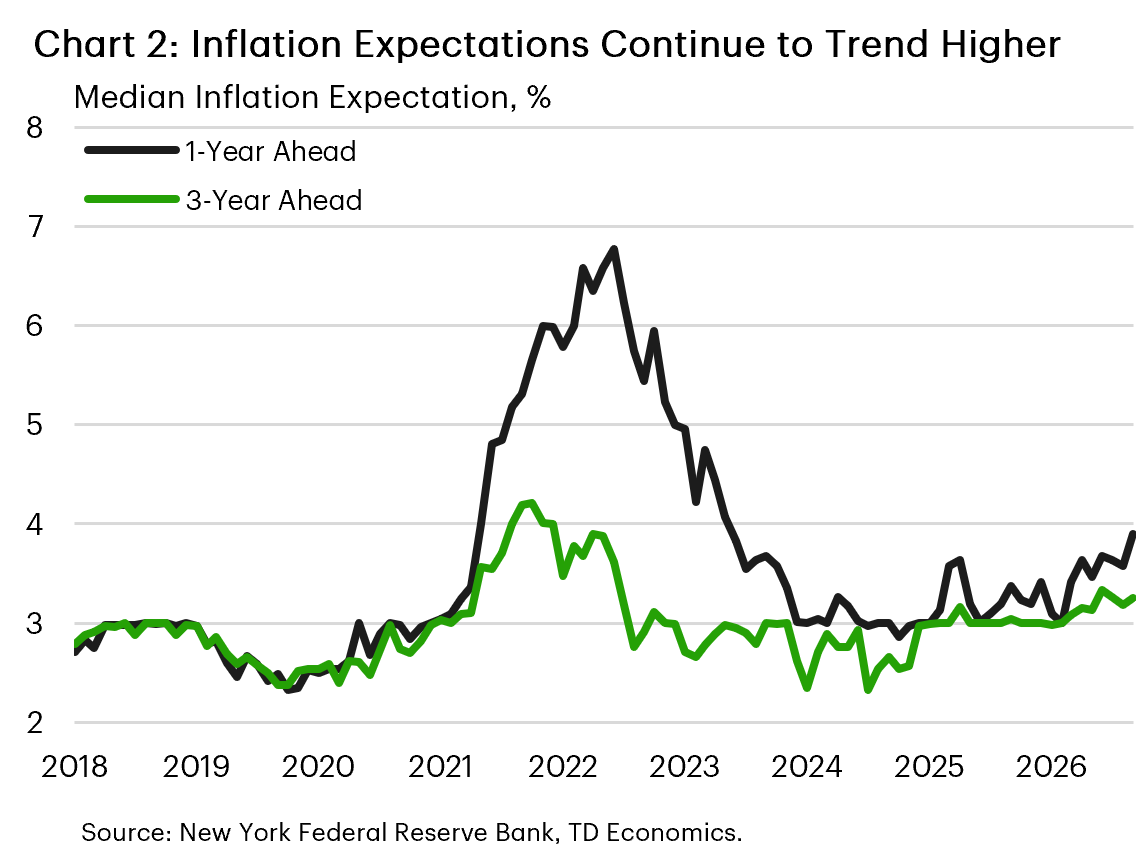
This remains a concern for the Federal Reserve, as noted in the release of the September meeting minutes this week. Committee members cited several risks to the inflation outlook, including persistent core inflation, higher energy prices, significant investment activity related to AI, and possible tariff increases. Consumers appeared to be of a similar mind, with the median 1-year ahead expectation for inflation hitting its highest level in over three years in September – just under 4% (Chart 2).
We’ll get a first look at September inflation next week when the CPI report is released on Wednesday. Consensus expectations are calling for an acceleration in total inflation, but a modest deceleration in core inflation in terms of the monthly change. If the data comes in as expected, then it will likely confirm market expectations for the Fed to refrain from raising rates at their next meeting at the end of the month. However, a material upside surprise could put the meeting back in play for a hike, with the overall bias of the FOMC remaining cautiously hawkish.





