


Next week’s U.S. CPI release should show prices rose 0.6% in September, driven by energy, while core inflation remains contained, consistent with a Fed hold in October. September existing home sales likely slipped 1.0%, while retail sales should show resilient but moderating spending. Abroad, we expect monthly U.K. GDP to show above-consensus momentum with a 0.2% gain in August. India’s inflation likely accelerated to 5.65% in September, reinforcing the tightening outlook, while we expect China’s CPI rose to 1.1%, potentially delaying further easing.
United States:
- Existing Home Sales (Monday), CPI (Wednesday), Retail Sales (Thursday)
Advanced Economies:
- U.K. Monthly GDP (Thursday)
Emerging Markets:
- India CPI (Monday), China CPI (Wednesday)
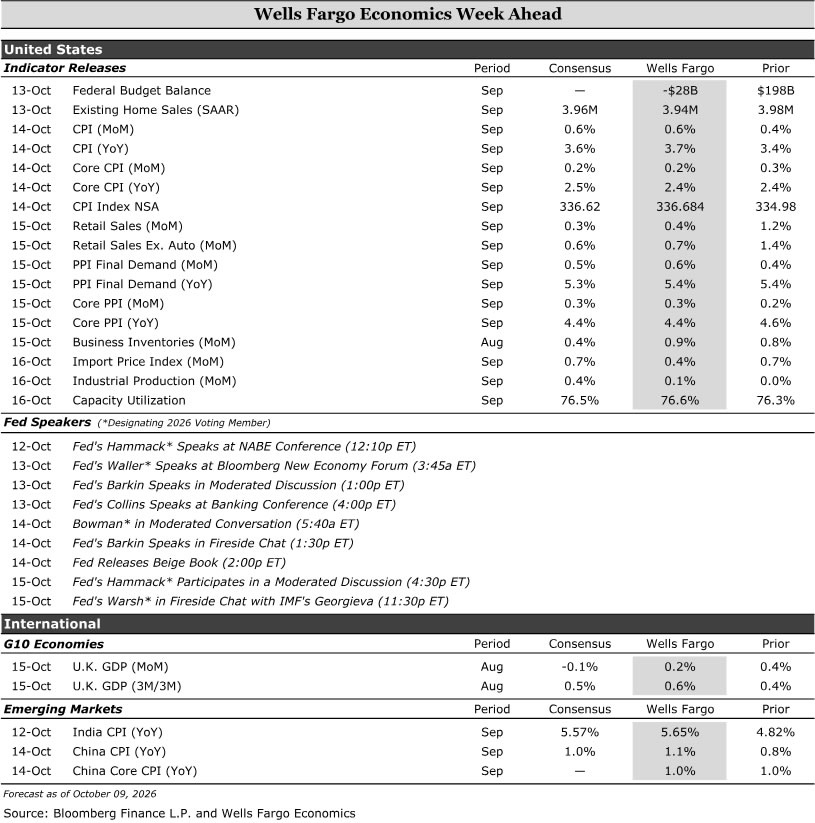
U.S. Week Ahead
Existing Home Sales • Monday
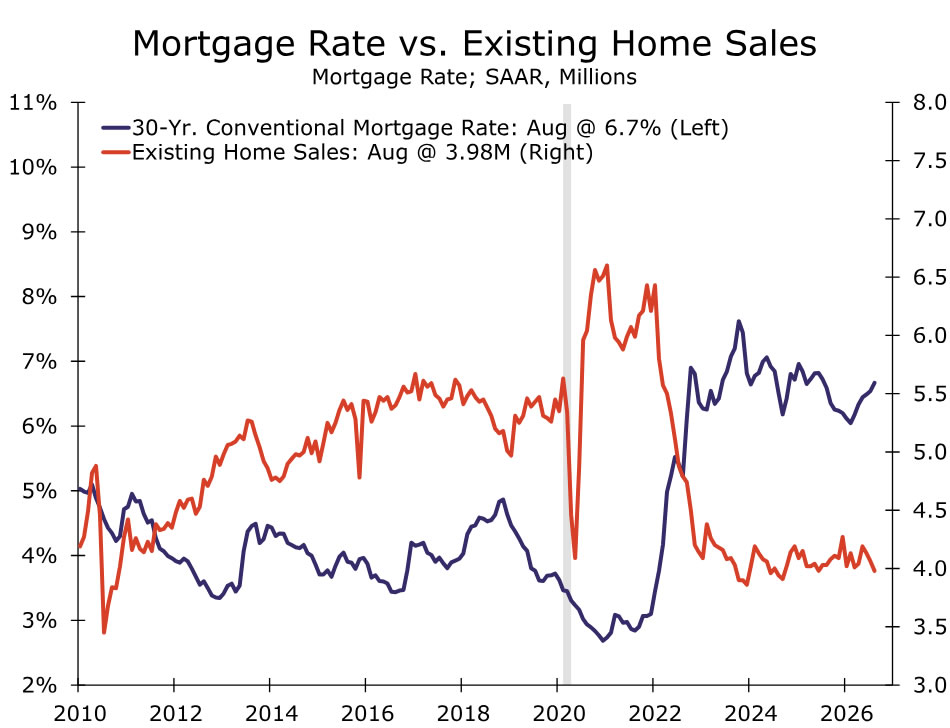
Rising mortgage rates are weighing on an already weak housing market. Existing home sales slid for a third consecutive month in August, pushing the annualized sales pace below four million for only the eighth time since 2011. Meanwhile, limited supply continues to support home price growth, further eroding affordability.
Affordability conditions have only worsened since then. Mortgage rates are now around 7.4% to 7.5% according to Freddie Mac and Mortgage News Daily. That’s nearly 100 bps higher than they were three months ago in July. Next week’s print reflects deals closed in September, so it will not capture the full effects of this hike. However, elevated rates likely kept the housing market under pressure. We look for existing home sales to retreat by 1.0% to 3.94M.
Source: NAR, Freddie Mac and Wells Fargo Economics
CPI • Wednesday
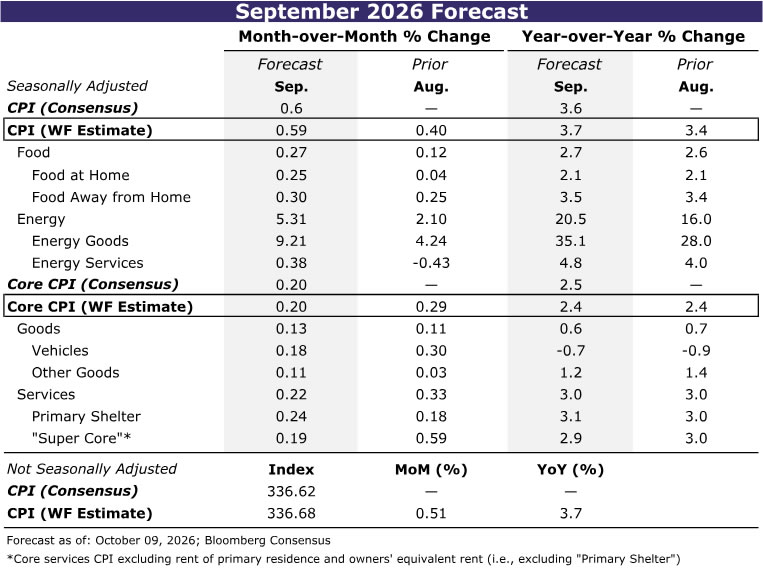
The September CPI report is likely to tell a familiar story: headline inflation remains tied to developments in the Middle East, while underlying price pressures are tamer. We estimate the CPI rose 0.59% in September. Gasoline prices increased sharply during the month, while food inflation likely firmed as higher transportation costs get gradually passed through to consumers.
Outside of food and energy, inflation appears to have moderated. We expect the core CPI to rise 0.20%, down from a stronger-than-expected 0.29% increase in August. Last month’s upside surprise stemmed from an outsized increase in wireless telephone services as major providers implemented price hikes. That dynamic is unlikely to be repeated in September and should help core services inflation ease back toward a 0.2% monthly gain after rising 0.3% previously.
Elsewhere in services, primary shelter inflation likely picked up modestly to a 0.24% increase, while medical care prices should rebound after declining in August. Offsetting those gains, we expect travel-related services inflation to cool. Lodging away from home appears to have caught up to alternative measures of hotel rates last month, while airfare hikes are poised to moderate after a sprint that has left them more than 20% above year-ago levels.
Core goods inflation is likely to hold steady in September. Most goods categories appear to be stabilizing as tariff-related price pressures continue to fade, while vehicle price inflation is settling into a firmer pace after a weak first half of the year.
All told, we expect the report to reinforce that underlying inflation pressures remain contained even as higher energy prices continue to push headline inflation around from month to month. Should our forecast prove correct, core CPI would hold steady at 2.4% year-over-year, leaving core inflation as measured by CPI unchanged this year and consistent with a Fed hold in October.
Source: Bloomberg Finance L.P. and Wells Fargo Economics
Retail Sales • Thursday
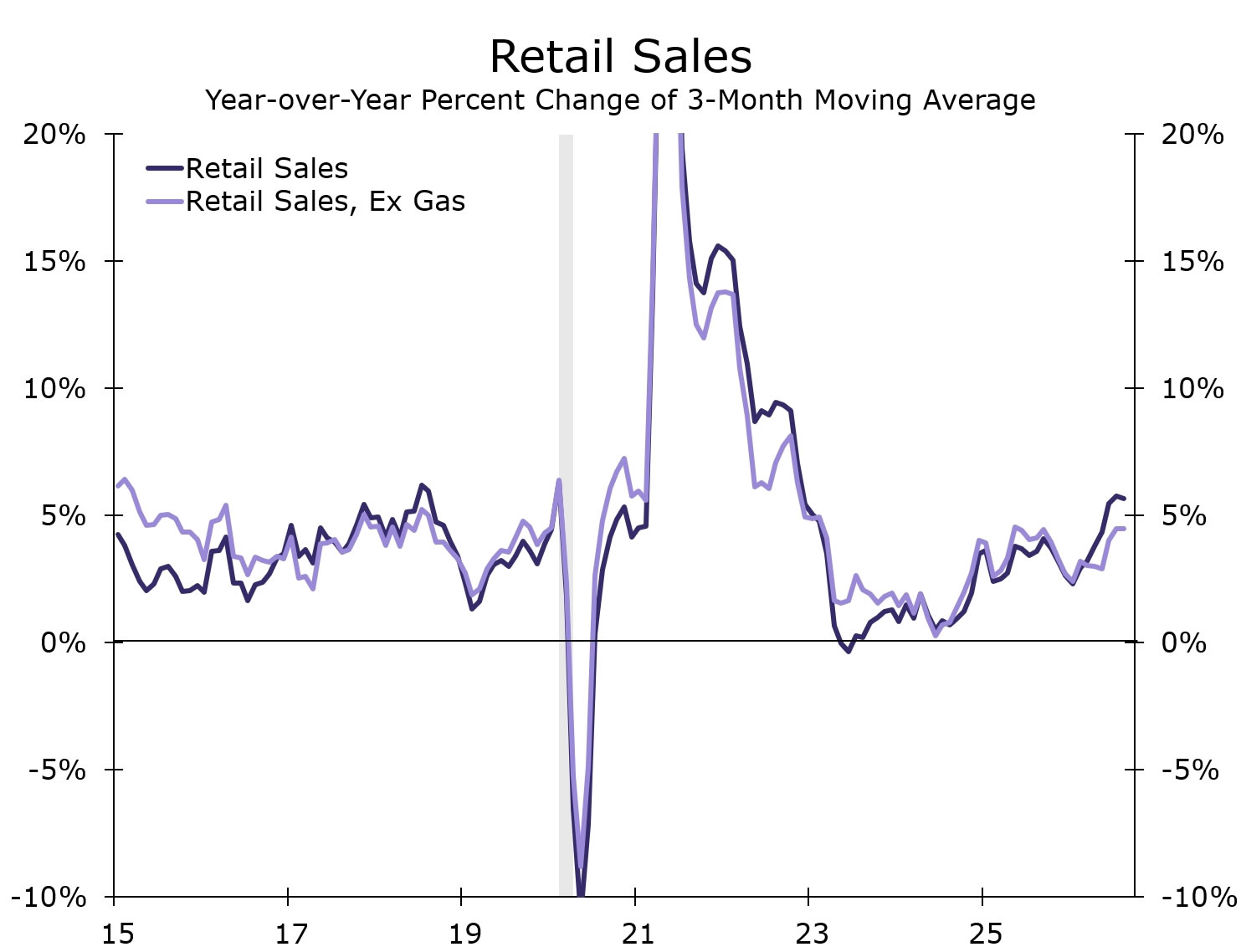
Consumer resilience remains in focus. Retail sales leaped over 1% in August, with broad-based strength across retailers while recent revisions to the BEA’s national accounts data point to a somewhat firmer income backdrop and suggest households may have more support to spend than previously thought.
That said, we look for some moderation in September and forecast overall retail sales to rise 0.4%. Higher gasoline prices should provide a lift to headline sales, with the average price of a gallon rising nearly 30 cents during the month. However, that boost is likely to be partially offset by softer auto sales and some payback in nonstore retail spending following monthly distortions tied to the earlier timing of Amazon Prime Day. Taken together, the report should still point to a consumer that continues to spend at a healthy, albeit less robust, pace.
One thing of note—In late September, the Census revised its retail sales estimates to make historical corrections and to include recently available survey data. These revisions lowered the retail sales level since 2023 with sales now about $36B lower as of August than previously thought. Recent growth wasn’t materially altered and revisions to real retail sales were much more modest, consistent with only modest tweaks in the BEA’s recent annual adjustments to real personal consumption expenditures. The revisions thus do not materially alter our read on the current state of spending.
Source: U.S. Department of Commerce and Wells Fargo Economics
Advanced Economies Week Ahead
U.K. Monthly GDP • Thursday
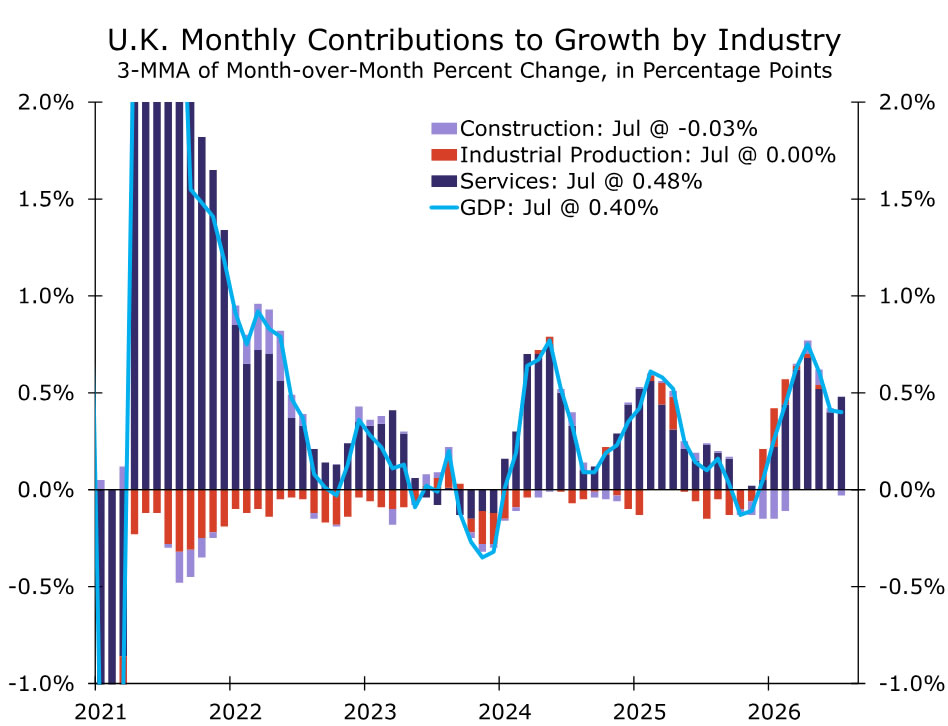
The UK economy may have more momentum than consensus expects. While consensus looks for a contraction in August, we expect monthly GDP to rise 0.2% month-over-month, with growth reaching 0.6% on a 3M/3M basis. Some payback is likely after strong gains in June and July, though August’s PMI survey data suggest the expansion continued. Services should remain the main driver after accounting for nearly all of July’s 0.4% month-over-month increase. Recent activity indicators also suggest that technology-related demand is providing some support to services and manufacturing, with AI-related investment potentially adding to growth momentum.
Higher energy prices and tighter funding conditions should weigh on activity, though the impact may become more visible in later data. Another resilient GDP print would support our view of stronger growth in Q3 and keep a November Bank of England rate hike in play.
Source: Bloomberg Finance L.P. and Wells Fargo Economics
EM Week Ahead
India CPI • Monday
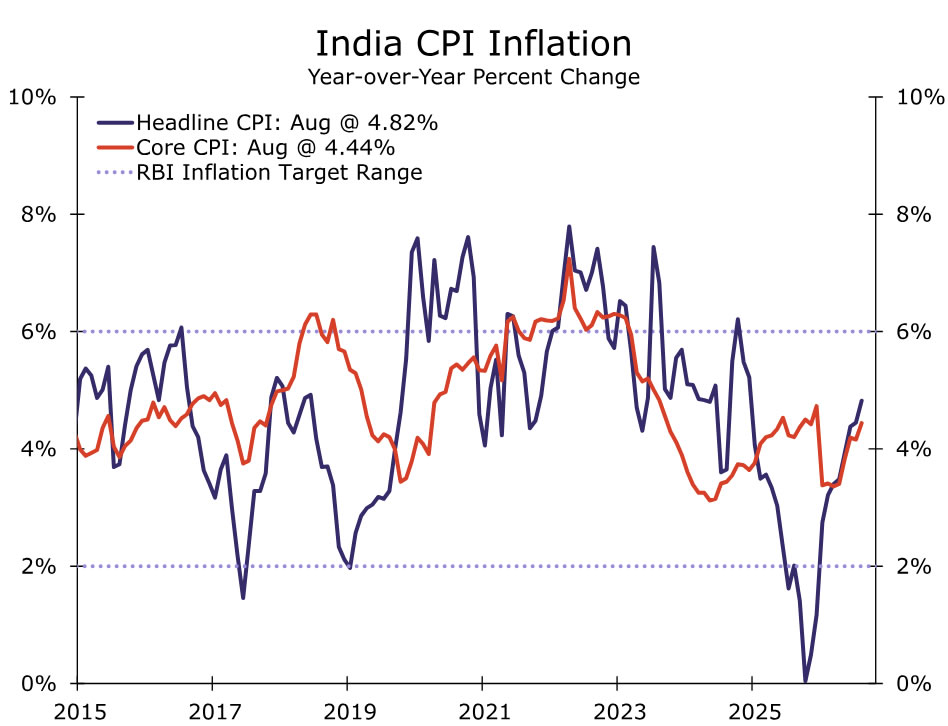
India’s September CPI print, due next week, should show inflation accelerating sharply. We expect headline CPI inflation to rise to 5.65% year-over-year, led by higher food and fuel prices. Recent weather conditions have pushed vegetable prices higher, particularly onions, while tomato prices have also started to rise. Sugar prices remain elevated despite easing from their peak in early September, while lower potato prices should provide only a modest offset. At the same time, the rise in global energy prices has increased fuel costs despite government efforts to limit the impact on consumers.
More importantly for the policy outlook, core inflation has also picked up in recent months and suggests price pressures may be broadening. A further rise would strengthen the case for continued tightening, particularly if higher food and energy costs begin to feed into other categories.
The Reserve Bank of India raised its policy rate by 25 bps this week and shifted its stance from neutral to “calibrated tightening,” which signals that the next move will likely be either a pause or another hike. We continue to expect another 25 bps hike in Q1-2027, which would take the policy rate to 5.75%, where we expect it to remain through our forecast horizon.
Source: Bloomberg Finance L.P. and Wells Fargo Economics
China CPI • Wednesday
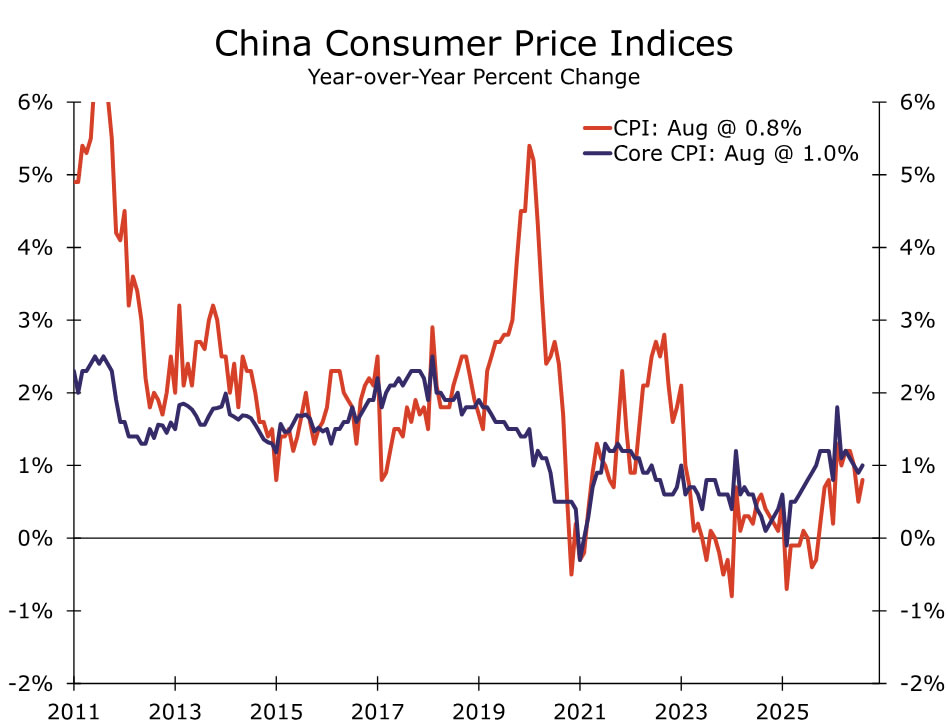
China’s September inflation report will show whether higher energy costs are finally feeding through to consumer prices. We expect headline CPI inflation to rise from 0.8% to 1.1% year-over-year, while core inflation should remain at 1.0%. Higher fuel prices should drive much of the increase after China raised gasoline prices twice in September, while food prices are providing less deflationary support than earlier this year.
Despite the expected rise in headline inflation, underlying price pressures remain subdued. The gap between producer input and output prices suggests firms are absorbing much of the increase in costs, likely due to weak demand. September’s PMIs showed some pass-through in manufacturing as output prices rose, while services firms lowered prices despite higher input costs amid intense competition. In our view, cautious consumers and limited pricing power should contain the broader impact on core inflation.
The case for further PBoC easing remains, as the rise in inflation largely reflects higher costs rather than stronger demand. However, firmer near-term inflation could make policymakers more cautious and delay additional Reserve Requirement Ratio cuts into 2027.
Source: Bloomberg Finance L.P. and Wells Fargo Economics





