Markets opened the week with a clear but measured risk-off tone following dramatic escalation in Middle East tensions over the weekend. While safe-haven flows were evident in Asia, price action so far remains contained rather than disorderly. Investors are reacting, but not capitulating.
Equity markets in the region reflected caution rather than panic. Japanese and Hong Kong stocks both declined roughly -1.5%, a notable pullback but far from crisis territory. The moderation suggests investors are still assessing whether escalation marks prolonged regional war or temporary shock.
Oil initially spiked on reports that shipping through Strait of Hormuz has effectively stalled. With major carriers such as Maersk suspending transit through both Hormuz and Suez due to safety concerns, roughly 15 million barrels per day of flows are potentially disrupted. However, gains were tempered after OPEC+ announced a larger-than-expected output hike, cushioning supply shock.
Gold reacted more decisively, jumping above 5350. Yet even this move appears orderly rather than panicked. The metal remains well below its historical peak near 5600, and momentum resembles extension of existing rebound rather than vertical flight to safety.
In currency markets, Swiss Franc leads gains, followed by Dollar. Canadian Dollar also outperforms, supported by firmer crude prices despite tempered spike. At the weaker end, Kiwi sits at the bottom, followed by Sterling, both pressured by risk aversion. Yen, typically a haven, is softer as markets increasingly price delayed tightening from BoJ, limiting its defensive appeal. Euro and Aussie trade in middle of pack.
Geopolitical shock intensified after confirmed death of Ali Khamenei, triggering broader regional involvement including Lebanon, Kuwait and Bahrain. The widening scope of the conflict has heightened uncertainty around energy supply and political stability.
Attention now shifts to Iranian succession. Reports indicate Mojtaba Khamenei and Ali Larijani are positioning for influence, with Hassan Khomeini viewed as wildcard candidate. Market reaction will hinge on whether power consolidates around hardline or moderate leadership.
If Islamic Revolutionary Guard Corps backs Mojtaba, investors may anticipate continued hardline stance and prolonged confrontation. Conversely, traction for Larijani or Khomeini could fuel hopes for rapid de-escalation, triggering risk rebound across equities and cyclicals.
Also, any signs of internal IRGC coup or fragmentation within clerical leadership would represent far more destabilizing scenario. Such outcome could amplify volatility well beyond current contained levels.
Traders will also monitor Pentagon press briefing for clues on whether operations are entering new phase. Equally important is messaging from US President Donald Trump, who indicated willingness to hold talks with “new leadership” in Iran. Naming specific counterpart could either stabilize expectations or deepen uncertainty.
In Asia, at the time of writing, Nikkei is down -1.56%. Hong Kong HSI is down -1.39%. China Shanghai SSE is up 0.54%. Singapore Strait Times is down -1.88%. Japan 10-year JGB yield is down -0.027 at 2.085.
War premium lifts, violent move possible if 100 gives way
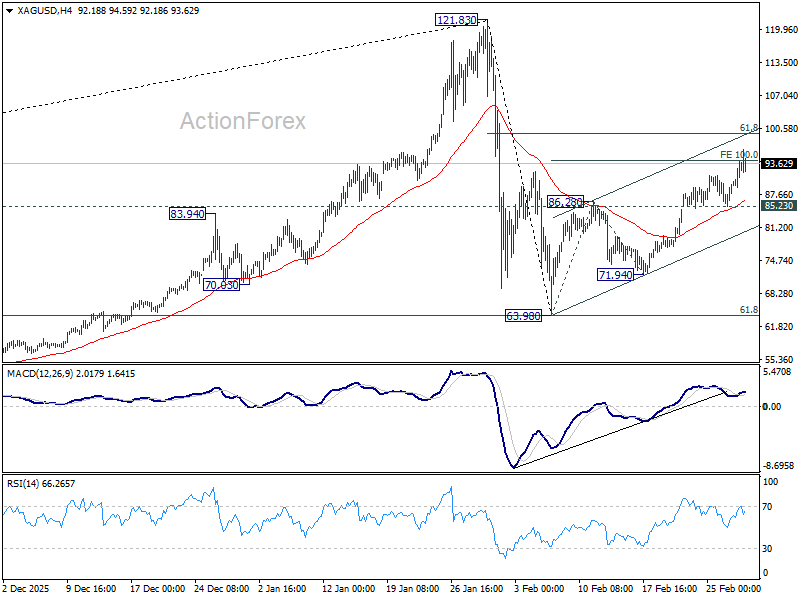
Silver edged higher as markets reacted to escalating tensions in Middle East, with US-Israel-Iran conflict driving aggressive safe-haven flows. Prices surged to an intraday high above 96 before easing slightly as traders locked in partial profits. Despite intraday consolidation, underlying bid remains intact as war premium continues to underpin precious metals.
For now, further gains remain favored while conflict risk dominates sentiment. However, psychological barrier at 100 is shaping up as key battleground in coming sessions. Market structure and positioning suggest that a firm and sustained break above 100 is not expected at this stage without a significant fresh escalation.
Technically, current advance from 63.98 is viewed as second leg of corrective pattern following record high at 121.83. 100% projection of 63.98 to 86.28 from 71.94 at 94.24 has already been met, suggesting measured target of the pattern has technically been satisfied.
While upside bias remains, strong resistance is expected around 61.8% retracement of 121.83 to 63.98 at 99.78. That zone aligns closely with psychological 100 handle and could cap gains. On downside, break below 85.23 would be first signal that rebound from 63.98 has completed.
That said, market dynamics could shift rapidly if physical demand intensifies. An urgent scramble for physical bars amid worsening geopolitical conditions could tighten liquidity and generate squeeze conditions, propelling Silver decisively through 100 and reopening path toward 121.83 record high.
WTI soars above 70 despite OPEC+’s “band aid” production hike
On Sunday, the OPEC+ “V8” coalition took a proactive stance by accelerating production hikes to 206,000 bpd starting in April. This move—surpassing the 137,000 bpd initially anticipated—serves as a strategic pivot to buffer a market shaken by the sudden U.S./Israeli strikes on Iran. While the alliance officially points to “market fundamentals,” the timing is clearly a response to the geopolitical flashpoint in the Middle East.
Technically, WTI exhibited extreme volatility at the Monday open, surging past 75 before settling to trade near 70. Despite the OPEC+ supply boost, the near-term outlook remains bullish so long as the 67.36 resistance turned support level holds.
Sustained trading above 70 psychological mark should open the door for a retest of 78.87 key resistance (2025 high). That should be the “line in the sand” for the current bull run.
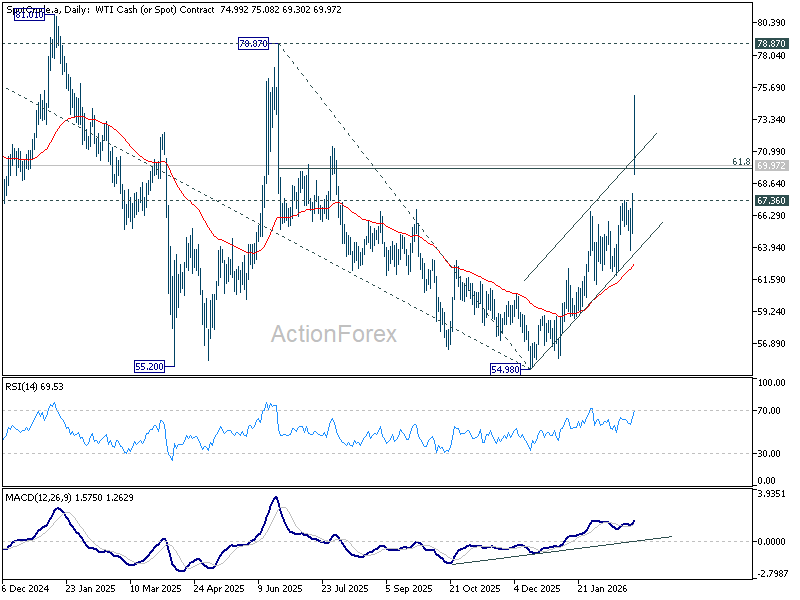
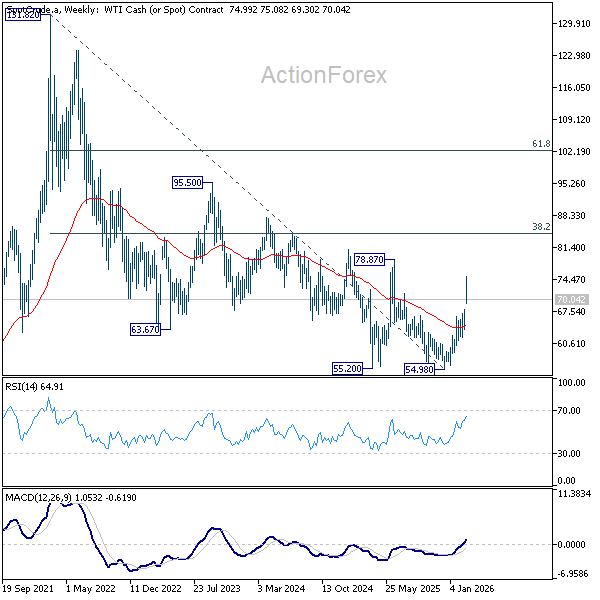
While a firm break of 78.87 isn’t yet expected, a clean break above it would signal a structural trend reversal, unwinding the multi-year downtrend from of 131.82 (2022 high). That could happen in the “nightmare scenario” of a total blockade in the Gulf, that could easily propel prices toward triple digits.
Japan’s PMI manufacturing finalized at 53.0, output and orders post fastest gains in years
Japan’s PMI Manufacturing was finalized at 53.0 in February, rising from 51.5 in January and marking highest reading since May 2022. The data point to a clear acceleration in factory activity, with the sector extending its expansion and signaling that recovery momentum is broadening at the start of Q1.
According to Annabel Fiddes, Economics Associate Director at S&P Global Market Intelligence, companies reported the quickest increases in output, new orders, employment and purchasing activity in more than four years. Business confidence also climbed to highest level since mid-2024, supported by expectations that global demand will continue to revive, particularly across technology and automotive sectors.
While input cost pressures eased slightly, price growth remained elevated by historical standards, partly reflecting impact of “weak Yen” on imported materials. Nevertheless, stronger demand could improve firms ability to pass on higher costs, helping to stabilize margins.
US NFP, UK fiscal risks and China target set tone for volatile week
March begins with markets delicately balanced between resilience and repricing risk. The week ahead is defined by one dominant risk event — US Non-Farm Payrolls — but the surrounding calendar ensures volatility will not be confined to Friday. Fiscal credibility in the UK, China’s growth ambitions, and renewed central bank messaging in Australia could all create cross-currents across the markets.
The High-Stakes Events:
Friday’s US non-farm payrolls report would be the most influential event. After January’s strong jobs print, positioning has tilted toward patience rather than imminent easing. That shift was highlighted by comments from known dove Fed Governor Christopher Waller, who explicitly opened door to holding rates unchanged if labor market strength proves durable. A second robust payroll report would likely push expectations for next Fed cut well into second half of year, reinforcing support for and Dollar. Conversely, meaningful downside surprise could revive earlier easing bets.
Sterling traders face their own pivotal moment on Tuesday with UK Spring Statement. Although framed as forecast update under government’s “one major fiscal event per year” rule, markets are laser-focused on fiscal headroom and updated growth projections. If the Office for Budget Responsibility delivers grim growth outlook or if policymakers hint at emergency tax adjustments, Sterling could face sharp repricing. Fiscal credibility remains critical anchor for the Pound’s stability.
The Silent movers:
Asia-Pacific currencies may find direction from China’s annual “Two Sessions,” beginning March 4–5. Investors will watch closely for 2026 GDP target and signals around 15th Five-Year Plan priorities. Ambitious growth target or large-scale infrastructure and technology stimulus would likely lift AUD and NZD through improved commodity and trade expectations.
Tuesday also features appearance by RBA Governor Michele Bullock at AFR Business Summit. While the consensus is for another hike in May, some market participants currently lean toward view that last month’s increase was “one and done.” Any hint that tightening cycle is not finished could catch these dovish positioning off guard.
Switzerland adds quieter but meaningful risk with Wednesday’s CPI. Inflation is already exceptionally low, leaving SNB wary of excessive currency strength. A print significantly below zero would heighten risk of verbal intervention against CHF. In current environment of geopolitical tension, Franc has benefited from safe-haven flows. However, ultra-low inflation limits tolerance for further appreciation. Weak CPI could therefore make CHF a silent casualty of its own stability.
Here are some highlights for the week.
United States (USD):
- ISM PMIs (Mon & Wed)
- ADP Employment (Wed)
- Non-Farm Payrolls & Retail Sales (Fri):
Eurozone (EUR):
- Eurozone Flash Inflation (Tue):
- Eurozone Retail Sales (Thu):
- Eurozone GDP & Retail Sales (Fri):
United Kingdom (GBP):
- UK Spring Statement (Tue):
Switzerland (CHF):
- Swiss CPI (Wed):
Australia (AUD):
- Australia Q4 GDP (Wed)
China (CNY):
- The “Two Sessions” (Starts Mar 4)
- NBS & Private PMIs (Wed)
EUR/CHF Daily Outlook
Daily Pivots: (S1) 0.9052; (P) 0.9097; (R1) 0.9133; More….
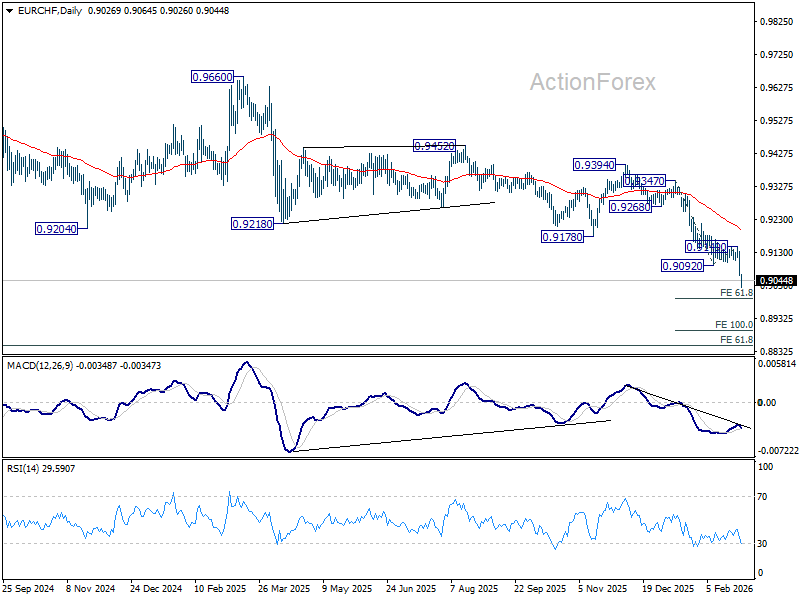
EUR/CHF’s fall continues today and intraday bias remains on the downside. Current down trend should target 61.8% projection of 0.9347 to 0.9092 from 0.9149 at 0.8991 first. Firm break there will target 100% projection at 0.8894 next. For now, near term outlook will stay bearish as long as 0.9149 resistance holds, in case of recovery.
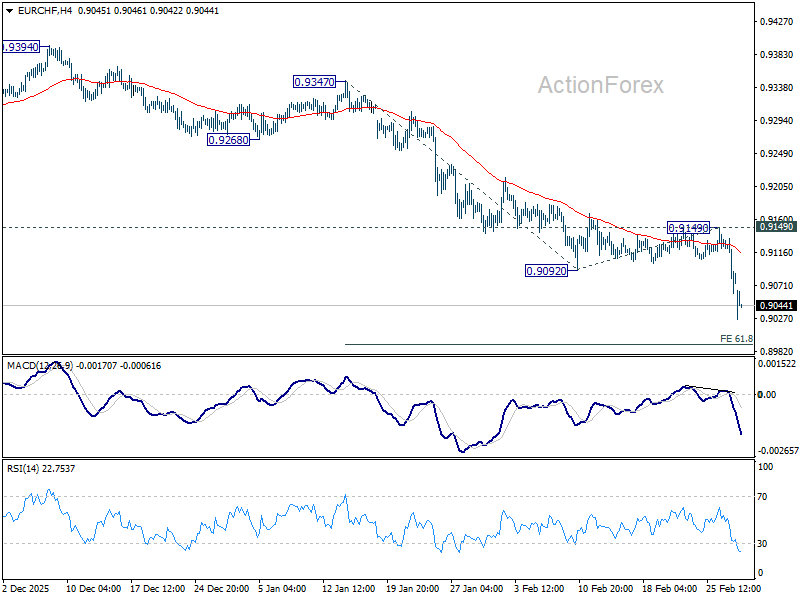
In the bigger picture, down trend from 0.9928 (2024 high) is still in progress. Next target is 61.8% projection of 1.1149 to 0.9407 from 0.9928 at 0.8851. Outlook will stay bearish as long as 0.9394 resistance holds, in case of rebound.