Attention is firmly on Islamabad as the United States and Iran begin their first high-level talks since the onset of war, with markets looking for signs of a breakthrough that could evolve into a broader Islamabad Accord. The outcome would be as a defining moment for energy markets, inflation, and global risk sentiment, with delegations led by US Vice President JD Vance already on the ground for what could shape the trajectory of the ceasefire and beyond.
At its core, the Islamabad meeting is not just another diplomatic event—it is the single most important macro catalyst in the current environment. The talks aim to transform a fragile two-week ceasefire into a more durable framework, with implications stretching from the reopening of the Strait of Hormuz to the normalization of global energy flows.
From here, three broad scenarios emerge. A breakdown in talks would see markets revert quickly to pre-ceasefire positioning, with oil surging back toward crisis levels and risk sentiment deteriorating. A “freeze” scenario—where dialogue continues without concrete progress—would likely leave markets range-bound, as optimism fades but no new escalation is priced in. The third and most market-moving outcome is the emergence of a framework for an eventual accord, even without a finalized deal.
Crucially, markets will not wait for signed agreements—they front-run credible trajectories. If investors see even a partial framework emerging from Islamabad, pricing could shift rapidly toward a de-escalation scenario. In that case, Dollar would be at risk of a sharp selloff, driven by improving risk appetite, falling oil prices, and a renewed focus on policy divergence against the Fed.
Three Scenarios: Breakdown, Freeze or Framework
The baseline framework for the Islamabad talks revolves around three possible paths: breakdown, freeze, or framework. Each scenario represents a different stage of geopolitical risk pricing and carries clear implications for global markets.
1. Breakdown: The “Operation Epic Fury” Reset
A breakdown would mark the most disruptive outcome. Failure to reach common ground would likely send markets back to pre-ceasefire positioning, with oil prices rebounding sharply toward $120 and equities reversing last week’s gains. Investors would quickly reposition for renewed escalation, reintroducing inflation risks and tightening financial conditions.
2. The “Freeze”: Range-Bound Purgatory
A “freeze” scenario, by contrast, would extend the current uncertainty. Continued dialogue without concrete commitments—particularly on the Strait of Hormuz or sanctions—would likely stall the recent rally. Markets could drift sideways, as the absence of progress caps optimism while the absence of escalation limits downside.
3. The Framework: Front-Running the Accord
The most constructive scenario is the emergence of a framework for an eventual Islamabad Accord. Importantly, markets do not require a finalized agreement to react. Even incremental progress—such as agreement on key issues or timelines—can be enough to trigger forward-looking positioning. With risk assets already supported by strong momentum since the ceasefire announcement, traders may move early, driving equities toward new highs and pulling oil back toward $90 or even lower as expectations shift toward de-escalation.
Risk-On Momentum Could Drive Dollar Lower
If markets begin to front-run a credible path toward an Islamabad Accord, the first and most immediate driver of Dollar weakness would be a powerful extension of risk-on sentiment. Equity markets have already built strong upward momentum, with S&P 500 posting its best weekly performance since November and now sitting within striking distance of record highs. In such an environment, investors are likely to lean aggressively into risk assets.
At the same time, Fed expectations provide a crucial tailwind to this move. Recent inflation data supports the view that the oil shock has not yet translated into broader inflation pressures. Core CPI edged up only modestly from 2.5% yoy to 2.6% yoy in March, offering little evidence of second-round effects. This keeps the Fed’s “transitory” narrative intact, allowing policymakers to look through the energy-driven spike in headline inflation.
There are, however, concerns around inflation expectations. The University of Michigan survey showed a sharp jump in one-year expectations from 3.8% to 4.8%, alongside a rise in long-run expectations to 3.4%. On the surface, this could challenge the Fed’s confidence. But these readings are backward-looking, with most responses collected before the April 7 ceasefire and the subsequent pullback in oil prices.
Besides, expectations are likely to be highly sensitive to developments in energy markets. If oil declines on progress toward an Islamabad Accord, inflation expectations could reverse just as quickly as they rose. This would reinforce the view that current inflation fears are not yet entrenched.
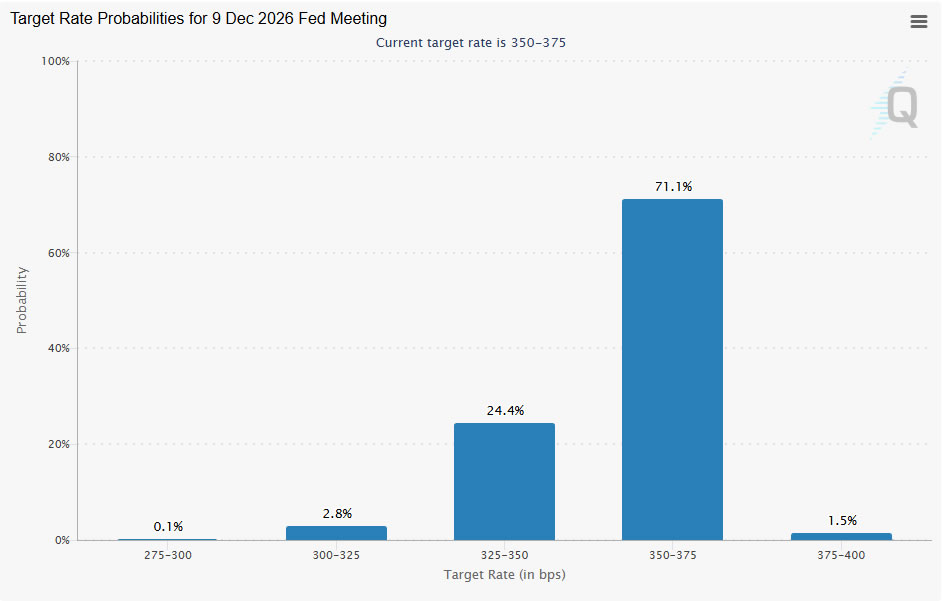
Market pricing reflects this balance. Futures indicate minimal probability of rate hikes by the end of the year, with odds near 1.5%. The majority expectation remains for the Fed to hold at 3.50–3.75% before eventually easing. In other words, rate cuts are seen as delayed rather than cancelled.
Hike vs Hold: The Split That Could Sink Dollar
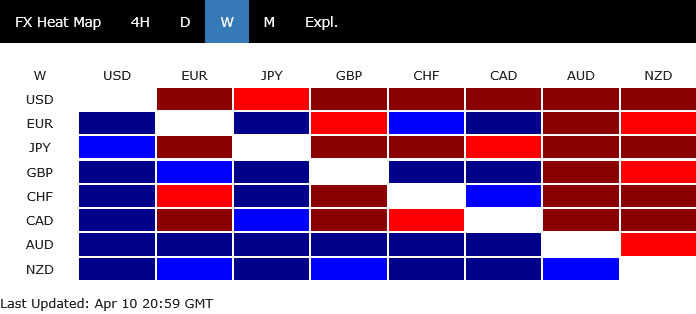
The second key driver of Dollar weakness, if markets front-run an Islamabad Accord, lies in widening central bank policy divergence. In a de-escalation scenario, the Fed is likely to remain on hold in the near term and then pivot back toward rate cuts once the oil shock fades. This places it firmly in the “hold-to-ease” camp, in contrast to several major central banks that are either tightening or preparing to tighten further.
This emerging “hike versus hold” split is becoming increasingly pronounced. The European Central Bank, the Reserve Bank of Australia, the Bank of Japan, and likely the Bank of England form the tightening camp, while the Fed, Bank of Canada, Reserve Bank of New Zealand, and Swiss National Bank remain more cautious. Such divergence creates a structural headwind for the Dollar by compressing its yield advantage.
The ECB, in particular, stands out. With its policy rate at 2.00%, close to neutral, it has more room to raise rates compared to the Fed’s 3.50–3.75% range. Europe’s greater sensitivity to energy shocks also increases the urgency for tightening, as policymakers seek to prevent second-round inflation effects from taking hold.
By contrast, the Fed is already operating near the upper bound of its neutral range, as highlighted in recent FOMC minutes. With the labor market stable rather than overheating, policymakers can afford to pause and assess incoming data. If inflation pressures ease alongside falling oil prices, the next move is more likely to be a cut than a hike.
The RBA further reinforces this divergence. Already in an active tightening cycle this year, it faces inflation pressures from both strong domestic demand and supply-side disruptions linked to the closure of the Strait of Hormuz. Markets are pricing additional hikes in the coming months, widening the policy gap with the Fed.
In this context, policy divergence acts as a powerful secondary force amplifying Dollar downside. If risk-on sentiment initiates the move, shifting yield dynamics can sustain it, making any selloff in the Dollar both sharper and more persistent.
AUD/USD Eyes 0.72 Break, EUR/USD to Follow if Accord Scenario Plays Out
In the event that markets front-run a credible Islamabad Accord, FX markets are likely to move decisively. The combination of risk-on sentiment and widening policy divergence would favor currencies like Australian Dollar and Euro, while putting sustained pressure on Dollar.
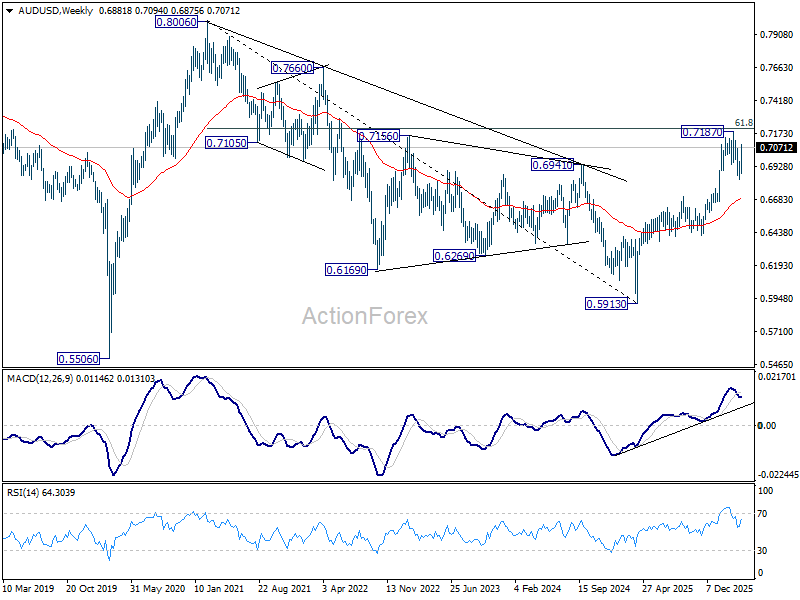
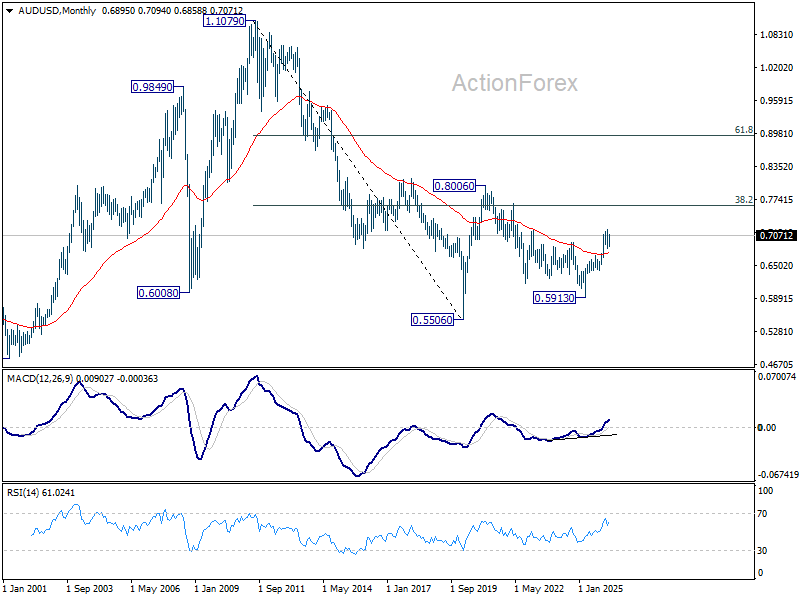
AUD/USD stands out as the clearest beneficiary. Improved global risk appetite and widening the rate differential could propel it through 0.72 key resistance. That would set up resumption of the medium term up trend. In such a scenario, AUD/USD’s move toward 0.80 would become more than a tactical trade, and evolve into a base case for carry-focused investors
EUR/USD is also positioned for upside, with a retest of the 1.20 key psychological level likely under a de-escalation scenario. Importantly, the ECB’s tolerance for Euro strength could have subtlety shifted. While policymakers previously expressed concern about excessive Euro strength due to its deflationary impact, the current environment is different. With energy-driven inflation pressures elevated, a stronger Euro could help contain import costs, reducing the urgency to resist currency appreciation. A sustained break above 1.20 would therefore carry different implications than in previous cycles. Rather than being seen as a policy problem, it could be tolerated—or even welcomed—as part of the broader effort to stabilize inflation.
S&P 500 Uptrend Holds, Dollar Index Risks Renewed Downtrend
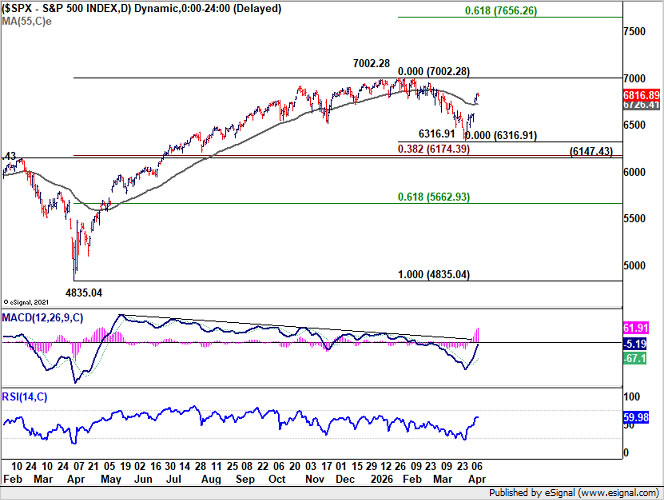
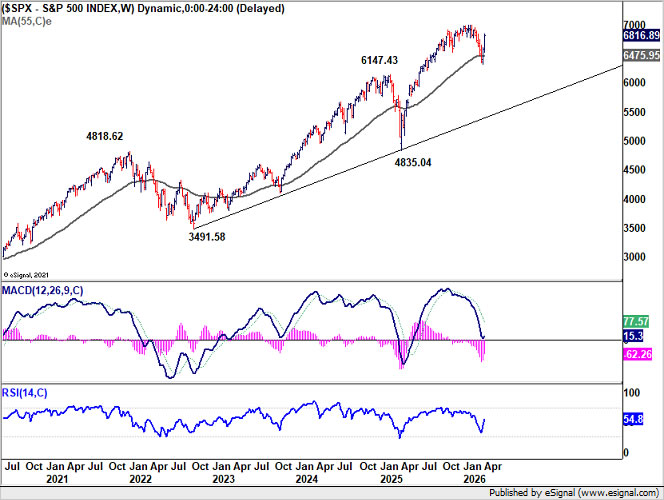
S&P 500’s strong rebound last week suggests that the corrective decline from 7,002.28 has likely completed at 6,316.91. Notably, firm support emerged from a key cluster zone, including 6,147.43 resistance-turned-support, 38.2% retracement of 4,835.04 to 7,002.28 at 6,174.39, and the 55 W EMA (now at 6,457.95). This confluence reinforces the view that the longer-term uptrend remains intact.
Retest of the 7002.28 high should be seen next. While initial upside may be capped there, potentially extending the current consolidation pattern with another pullback, decisive break would signal resumption of the broader uptrend. In that case, the next target lies at the 61.8% projection of 4,835.04 to 7,002.28 from 6,316.91 at 7,656.26.
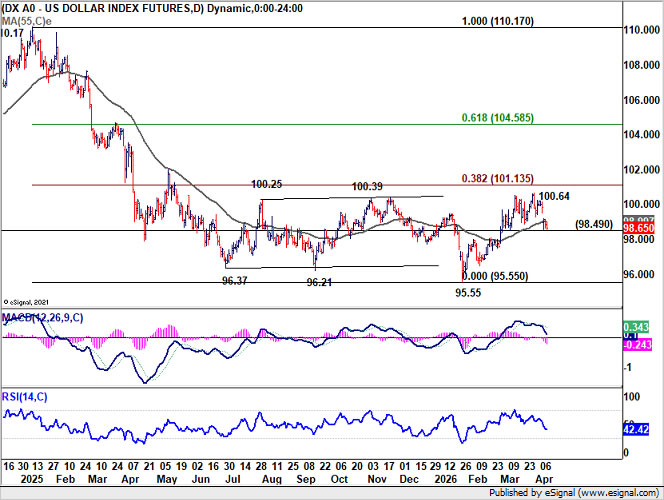
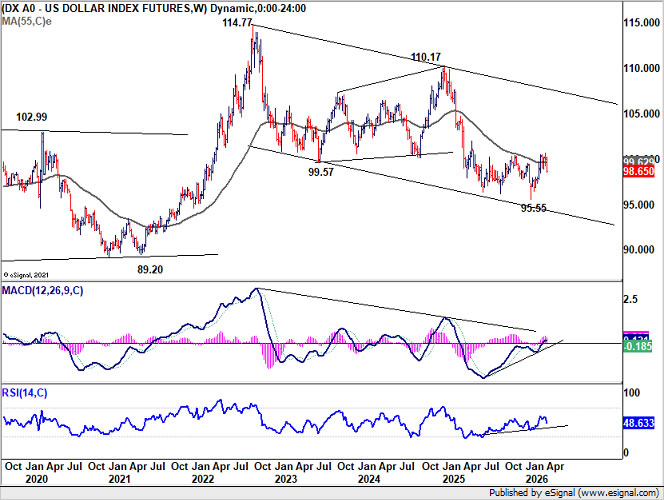
For Dollar Index, 98.65 support is now in focus following last week’s decline. Firm break below this level would suggest that the rebound from 95.55 has already topped at 100.64. The rejection near 38.2% retracement of 100.17 to 95.55 at 101.13, alongside the 55 W EMA (now at 99.62), keeps the medium-term outlook Bearish.
Should 98.65 give way, retest of the 95.55 low should be seen next. Decisive break below that level would confirm the resumption of the broader downtrend from the 114.77 (2022 high).
AUD/USD Weekly Report
AUD/USD’s strong rebound last week suggests that pullback from 0.7187 has completed at 0.6832 already. Initial bias stays mildly on upside this week for retesting 0.7187. Strong resistance could be seen there to bring another fall to extend the near term corrective pattern. On the downside, below 0.7021 minor support will turn intraday bias neutral again first.
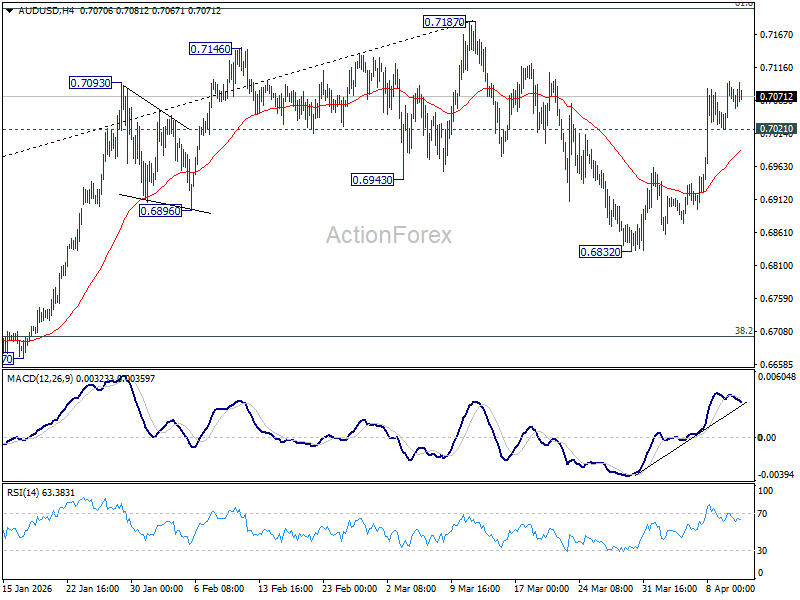
In the bigger picture, as long as 0.6706 cluster support holds, rise from 0.5913 (2024 low) should still be in progress. Decisive break of 61.8% retracement of 0.8006 to 0.5913 at 0.7206 will solidify the case that it’s already reversing the down trend from 0.8006 (2021 high). However, firm break of 0.6706 will dampen this bullish case, and bring deeper fall back to 0.6420 support, and possibly below.
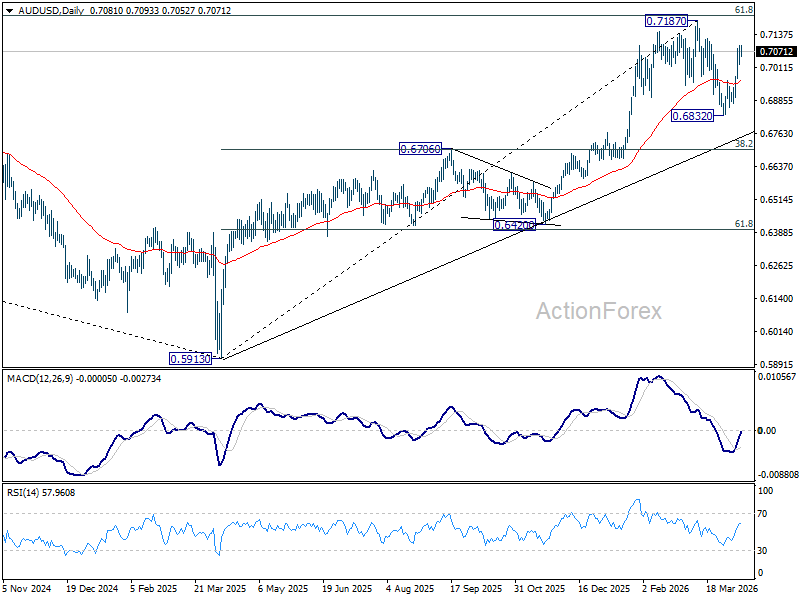
In the long term picture, rise from 0.5913 is seen as the third leg of the whole pattern from 0.5506 (2020 low). It’s still early to judge if this is an impulsive or corrective pattern. But in either case, further rise should be seen back to 0.8006 and possibly above. This will remain the favored case as long as 55 W EMA (now at 0.6683) holds.