




RBNZ stands pat, outlook remains highly uncertain

    RBNZ left stimulatory monetary policy unchanged as widely expected, with OCR at 0.25% and  Large Scale Asset Purchase and Funding for Lending program unchanged. It maintained that to meet the requirements of sustainable 2% inflation and maximum employment will “necessitate considerable time and patience”. The committee is also “prepared to lower the OCR if required”.

    The medium-term growth outlook was “similar” to the scenario presented in the February statement. Outlook remains “highly uncertain, determined in large part by both health-related restrictions, and business and consumer confidence.” The would be some temporary factors for near-term price pressures, including global supply chain disruptions and higher oil prices. But medium-term inflation and employment will “likely remain below its remit targets in the absence of prolonged monetary stimulus.”

    Full statement here.

    Australia Westpac consumer sentiment rose to 118.8, highest since 2010

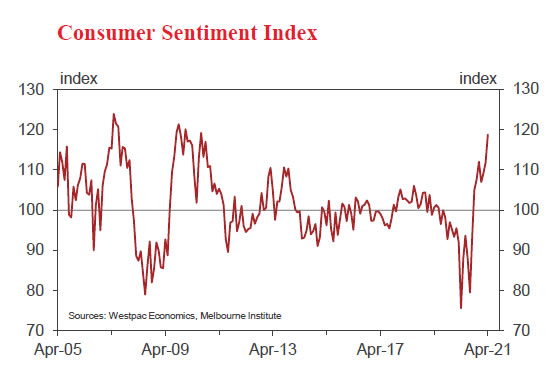
      Australia Westpac consumer sentiment rose 6.2% to 118.8 in April, up from 111.8. it’s the highest level since August 2010, “when the Australia’s post-GFC rebound and mining boom were in full swing”. The survey continues to signal that “consumer will be the key driver of above-trend growth in 2021”.

      Westpac expects RBA to maintain currency policy settings on May 4. Markets will focus on the new economic projections to be released with the SoMP on May 7. Overall, the forecasts would be consistent with the policy guidance that, “it will still be some time – 2024 at the earliest – before the Bank expects to achieve its full employment and inflation targets.”
      Full release here.

      Fed Harker: No reason to withdraw support yet

        Philadelphia Fed Bank President Patrick Harker said, “Fed policy is going to hold steady”. He added, “while the economic situation is improving, recovery is still in its early stages, and there’s no reason to withdraw support yet.” He also noted that “we’re not seeing inflation running out of control.” Instead, he’d be more concerned with inflation that is too low.

        Boston Fed President Eric Rosengren told WSJ that he’s expecting a “very strong economy over the course of this year”, and unemployment to “get quite low by the end of the year.” But he’s not giving a specific forecast about where the rate liftoff to be, as there’s no such foresight in the only post-war pandemic. “I think we’re two years away from when that likely is going to become a much more important question,” he said.

        NIESR: UK GDP to grow 1.8% in March, 2.2% in April

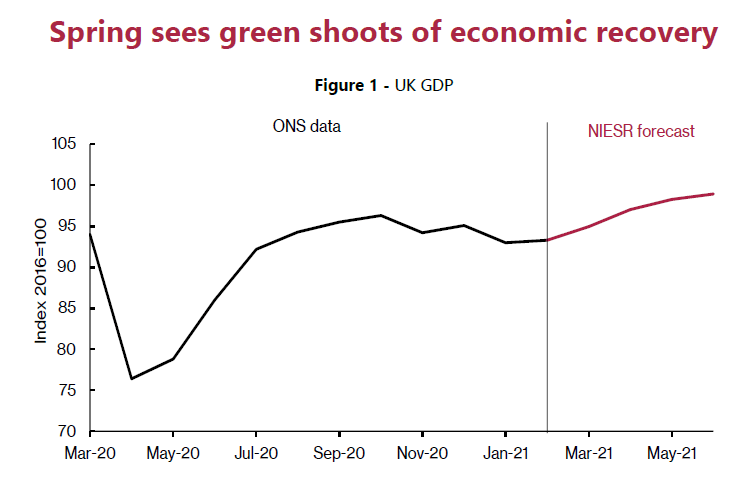
          NIESR said UK’s GDP is likely to have contracted by -1.5% qoq in Q1, with 1.8% mom growth in March. April is forecast to see GDP growth of 2.2% mom, driven by partial re-opening of pubs and restaurants. Assuming continuation of vaccination and re-opening, first estimate of Q2 GDP growth is 4.6% qoq, driven by pent-up demand and a return towards pre-Covid levels in the hospitality and retail sectors.

          Rory Macqueen Principal Economist – Macroeconomic Modelling and Forecasting: “Despite little change in restrictions, a return to growth in February and upward revisions to January GDP mean that the contraction in the first quarter will be much smaller than anticipated….

          “if the vaccine programme and lifting of restrictions continue on schedule this provides a firm basis for continuing growth in the second quarter and 2021 overall. The third wave in Europe and the success of other countries in vaccinating their populations will also have relevance for the recovery of the UK, as an open economy.”

          Full release here.

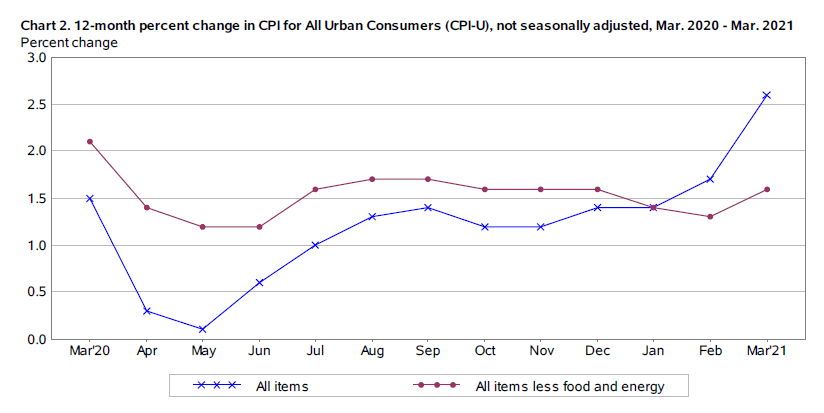
          US CPI accelerated to 2.6% yoy, core CPI up to 1.6% yoy

            US CPI rose 0.6% mom in March, above expectation of 0.5% mom. That’s the highest 1-month increase since August 2012. Core CPI, all items less food and energy, rose 0.3% mom, above expectation of 0.2% mom.

            Annually, headline CPI accelerated to 2.6% yoy, up from 1.7% yoy, above expectation of 2.5% yoy. Core CPI accelerated to 1.6% yoy, up from 1.3% yoy, matched expectations.

            Full release here.

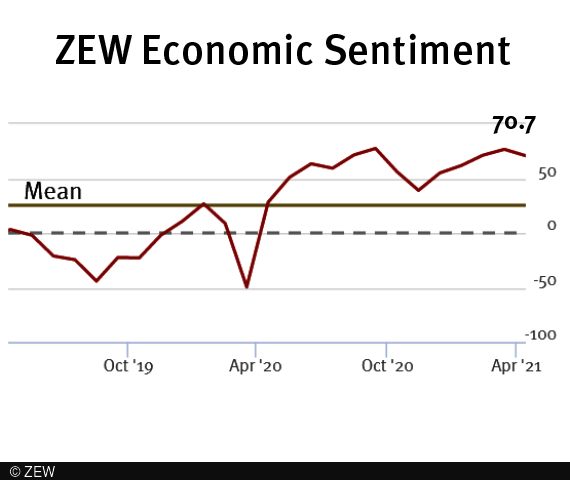
            German ZEW economic sentiment dropped to 70.0, somewhat less euphoric

              German ZEW Economic Sentiment dropped to 70.7 in April, down from 76.6, below expectation of 79.5. That’s the first decline since November. Current Situation index improved to -48.8, up from -61.0, above expectation of -52.0. Eurozone ZEW Economic Sentiment dropped to 66.3, down from 74.0, below expectation of 73.2. Current Situation index rose 4.3 pts to -65.5.

              “The financial market experts are somewhat less euphoric than in the previous month. The ZEW Indicator of Economic Sentiment is, however, still at a very high level and the current situation is assessed much more positively than in March. Fears of a stricter lockdown have led to a decline in expectations for private consumption. Nevertheless, the outlook for exports is better than in the previous month,” ZEW President Professor Achim Wambach comments on the current expectations.

              Full release here.

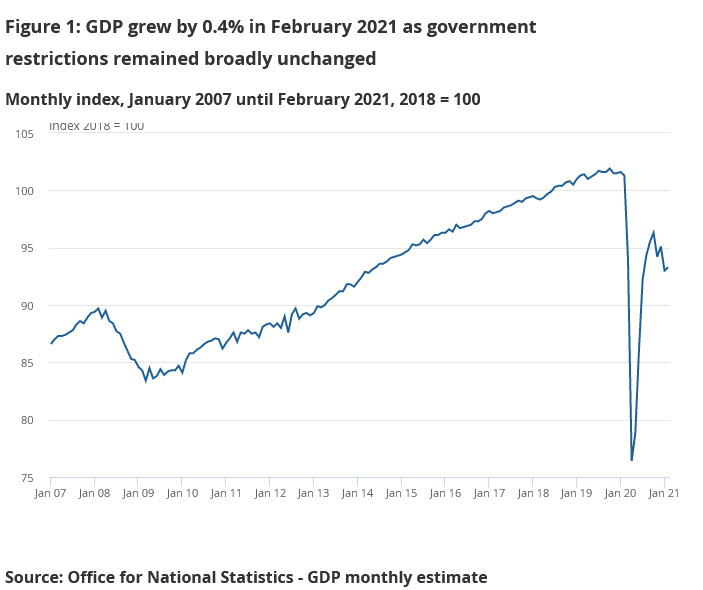
              UK GDP grew 0.4% mom in Feb, still down -3.1% from Oct recovery peak

                UK GDP grew 0.4% mom in February, below expectation of 0.6% mom. Service sector grew 0.2% mom. Production grew 1.0%, with manufacturing up 1.3% mom. Construction grew 1.6% mom.

                Comparing to pre-pandemic level seen in February 2020, overall GDP was still down -7.8%. Services was down -8.8%. Production down -3.5%, with manufacturing down -4.2%. Construction was down -4.3%.

                Comparing to initial recovery peak in October 2020, overall GDP was down -3.1%. Services was down -3.9%. Production was flat, with manufacturing down -0.3%. Construction was flat.

                Full release here.

                Also released, goods trade deficit widened to GBP -16.4B in February, larger than expectation of GBP -10.4B.

                BoJ Kuroda: There’s quite a lot of positives from a weak yen

                  BoJ Governor Haruhiko Kuroda told the parliament today that there’s “quite a lot of positives for Japan from a weak Yen”. Companies with overseas profit could have their yen-denominated value increase from a lower yen. Nevertheless, a weak Yen might not boost export as much as the part, because many manufacturers now produce goods locally in the overseas markets.

                  Though, Kuroda also emphasized the important for exchange rates to move at equilibrium levels. It’s “not as if the weaker the yen the better, or the stronger the better”.

                  China exports rose 30.6% yoy in Mar, imports rose 38.1%

                    In March, in USD term, China’s export grew 30.6% yoy to USD 241.1B. Imports rose 38.1% yoy to 227.3B. Trade surplus came in at USD 13.8B, well below expectation of USD 52.0B. From January to March, exports rose 49.0% yoy to USD 710.0B. Imports rose 28.0% yoy to USD 593.6B. Trade surplus was at USD 116.4B.

                    From January to March, exports to EU rose 56.7% yoy to USD 110.2B. Imports from EU rose 33.0% yoy to USD 73.4B. Exports to US rose 74.7% yoy to 119.2B. Imports from US rose 69.2% to 46.5B. Exports to Australia rose 50.5% yoy to USD 14.1B. Imports form AU rose 20.9% yoy to USD 33.7B.

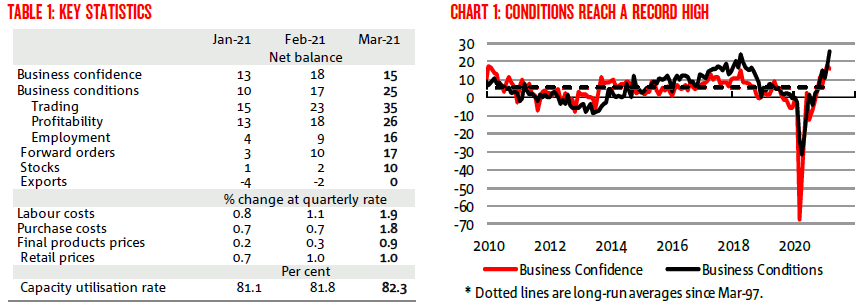
                    Australia NAB business conditions rose to 25, record high

                      Australia NAB business conditions rose from 17 to 25 in March, hitting a record high. The rise was driven by strong increases in all sub-components. Looking at some details, trading condition rose from 23 to 35. Profitability condition rose from 18 to 26. Employment condition rose from 9 to 16. Forward orders rose from 10 to 17. Business confidence dropped to from 18 to 15, but remains well above its long-run average.

                      NAB said, “This is a very solid survey result. Businesses are telling us activity continues to increase at a very healthy rate as we have move past the rebound phase in activity with the earlier removal of pandemic-related restrictions. Overall, the recovery over the last year has been much more rapid than anyone could have forecast.”

                      Full release here.

                      Fed Bullard: Stay with very easy monetary policy inside the pandemic tunnel

                        St. Louis President James Bullard said in a Bloomberg TV interview that “It’s too early to talk about changing monetary policy.” Policymakers want to “stay with our very easy monetary policy while we are still in the pandemic tunnel”. “If we get to the end of the tunnel,” he added, “it will be time to start assessing where we want to go next.”

                        “When you start to get to 75% vaccinated, 80% vaccinated and CDC starts to give more hopeful messages that we are bringing this under better control and starts relaxing some of their guidelines, then I think the whole economy will gain confidence from that,” Bullard said. “Cases are up right now, that is a little bit concerning.”

                        Fed Rosengren sees an unusually strong post-recession recovery

                          Boston Fed President Eric Rosengren said in a speech, “assuming virus variants do not become especially problematic, we should see an unusually strong post-recession recovery.”

                          “The combination of accommodative monetary and fiscal policy, and consumers and firms well positioned to renew spending, should result in returning to full employment much more quickly than after the last financial crisis and Great Recession,” he added.

                          However, “many of the underlying problems that can disrupt financial stability – as at the outset of the pandemic – still need to be addressed.”

                          Full speech here.

                          BoE Tenreyro: Recovery heterogeneity even within advanced economies

                            BoE policy maker Silvana Tenreyro said in an online discussion that upcoming recoveries diverge between advanced and emerging economies. And, “heterogeneity even within advanced economies”.

                            That’s partly due to “different speeds of vaccine rollout”. There are still “continued high virus prevalence in many countries, which “may lead to further lockdowns, trade and supply chain disruption”.

                            She also noted, “one lesson that we learned from the financial crisis is that withdrawing policy support too early can be very costly… Withdrawing it too early … can lead to scarring effects on the labour market that would be very costly and slow down growth going forward.”

                            Gold could still retest 1755 resistance after brief retreat

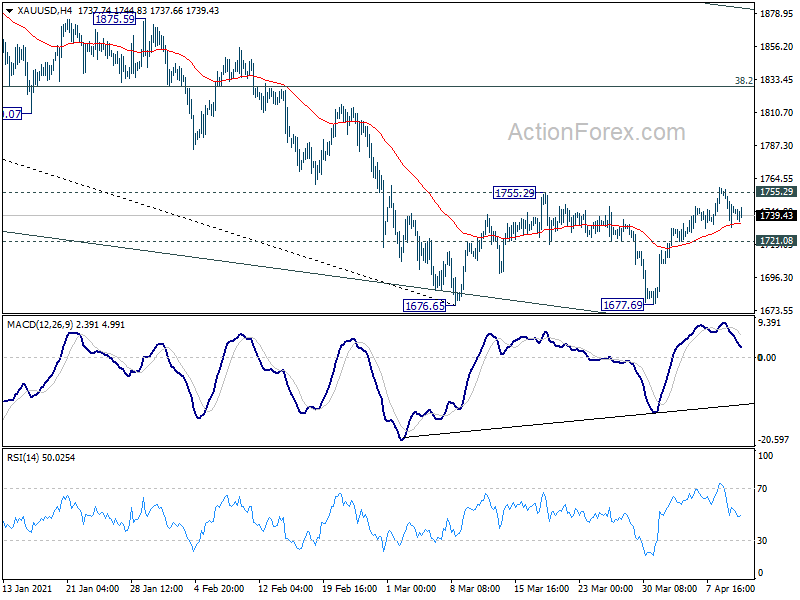
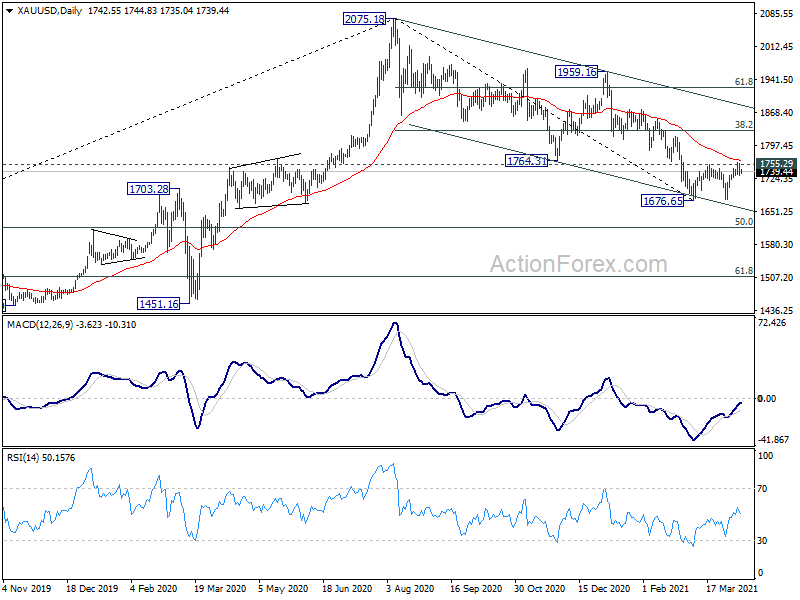
                              Gold failed to sustain above 1755.29 resistance last week, but subsequent retreat is so far shallow. Further rally remains in favor with 1721.08 minor support holds. At this point, firm break of 1755.29 and 55 day EMA (now at 1763.39) would still consider to have completed a double pattern reversal pattern (1676.65, 1677.69). Stronger rebound should at least be seen to 38.2% retracement of 2075.18 to 1676.65 at 1828.88.

                              However, break of 1721.08 will indicate that price actions from 1676.65 is just a three wave sideway consolidation pattern. Fall from 2075.18 is then ready to resume for another low.

                              Eurozone retail sales rose 3.0% mom in Feb, EU rose 2.9% mom

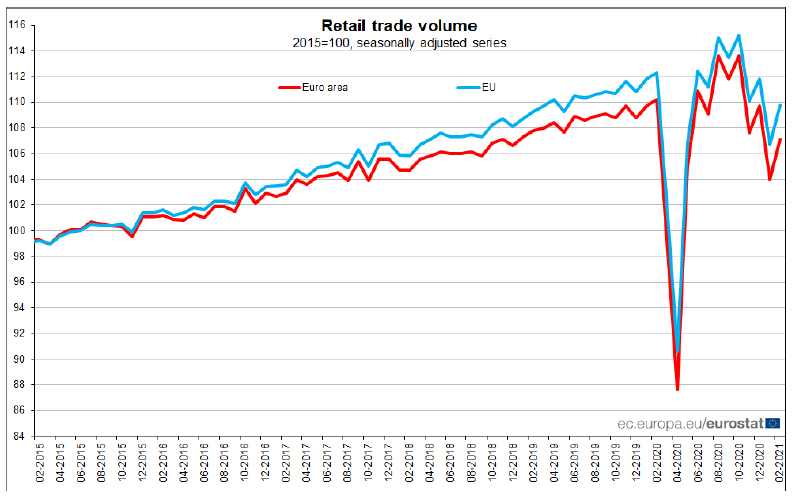
                                Eurozone retail sales rose 3.0% mom in February, well above expectation of 1.4% mom. Volume of retail trade increased by 6.8% mom for non-food products and by 3.7% mom for automotive fuels, while it decreased by -1.1% mom for food, drinks and tobacco.

                                EU retail sales rose 2.9% mom. Among Member States for which data are available, the highest increases in total retail trade were registered in Austria (+28.2%), Slovenia (+16.4%) and Italy (+8.4%). The largest decreases were observed in Malta (-1.5%), France and Hungary (both -1.2%).

                                Full release here.

                                Bitcoin back pressing 60k on strong open, aiming for new record

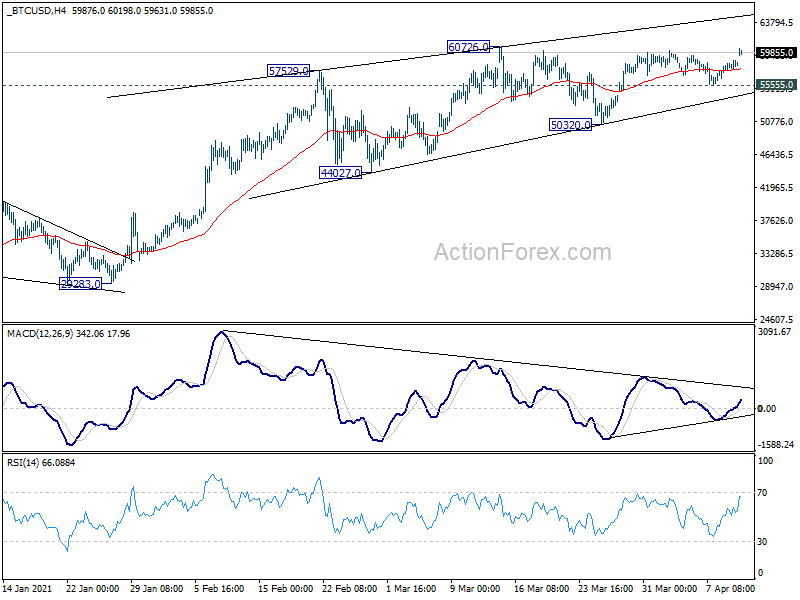
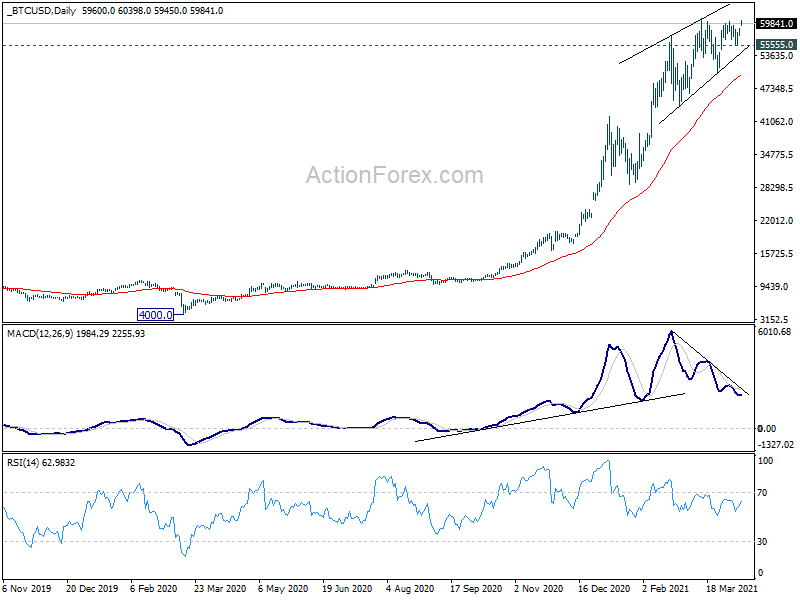
                                  Bitcoin gapped higher as the week starts, breaking through last week’s high and it’s back pressing 60k handle. Recent up trend is still in progress and bitcoin could break through record high at 60726 any time soon.

                                  Yet, we’d maintain that it has been losing upside momentum since February, as seen in 4 hour MACD. Also, current rise from 50320 is seen as the fifth leg of the terminal triangle that started 29283. Hence the break to new record high should be relatively brief, and a sizeable correction should follow.

                                  Nevertheless, in case of a pull back, break of 55555 support is needed to confirm short term topping first. Otherwise, outlook will remain bullish and risk will stay on the upside.

                                  Fed Powell: H2 going to be very strong but risks are still out there

                                    In the CBS’ 60 Minutes aired on Sunday, Fed Chair Jerome Powell said “we feel like we’re at a place where the economy’s about to start growing much more quickly and job creation coming in much more quickly”. He added that the growth in H2 is “going to be very strong”.

                                    “There really are risks out there,” he added. “And the principal one just is that we will reopen too quickly, people will too quickly return to their old practices, and we’ll see another spike in cases.” But even in that case, any spike in cases wouldn’t be as disastrous as prior ones, thanks to vaccinations. The economy will still “move ahead more quickly to the extent we keep the spread of COVID under control.”

                                    The time to for the administration to reduce the budget deficit is “when the economy is strong and we’re fully recovered and people are working and taxes are rolling in,” he said. “The time to do that is not now.”

                                    ECB: Panetta: Waiting on inflation will even be more costly

                                      Fabio Panetta told Spanish newspaper El Pais in an interview published on Sunday, “the ECB has failed to reach its aim for too many years already.” And, “we cannot be satisfied with inflation at 1.2% in 2022 and 1.4% in 2023. The argument that we could extend the horizon to meet the aim is not a convincing one.”

                                      “Waiting will be even more costly,” Panetta added. “It would make it more difficult to re-anchor inflation expectations and we would risk a permanent reduction of economic potential.”

                                      Fed Clarida: Most of early rise in inflation will revert by year-end

                                        Fed Vice Chair Richard Clarida said in a Bloomberg TV interview that there is a lot of “pent-demand” as well as “pent-up supply” in the economy. Both supply and demand will be in play as the year progresses. The “baseline expectation” is that most of the early rise in inflation this year will “revert by year-end”.

                                        “If inflation at the end of the year has not declined from where it is at the middle of the year might be ‘good evidence’ of inflation that is not transitory,” he added.

                                        Also, Clarida reiterated that “substantial progress is actual progress.” Fed will inform the public about the progresses “as we go through the year”. “We will have ample opportunities as data comes in to inform Fed observers on our progress”, he said.

                                        Canada employment grew 303k in Mar, unemployment rate dropped to 7.5%

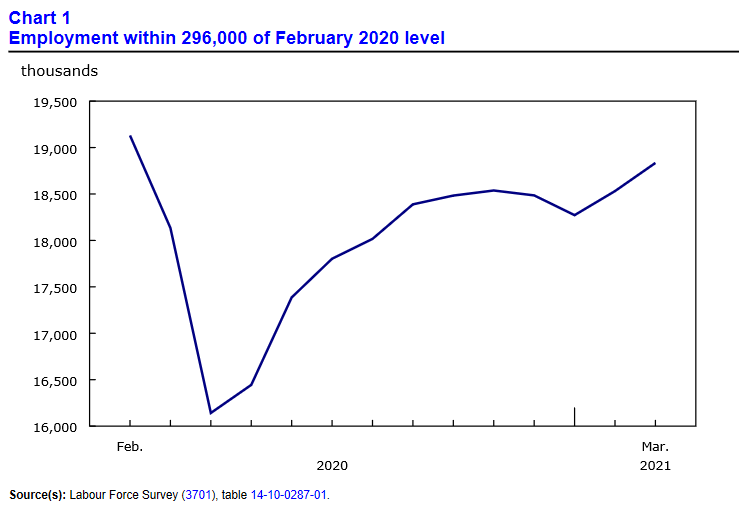
                                          Canada employment grew 303k, or 1.6% mom in March, well above expectation of 90k. Full time employment rose 175k while part-time employment rose 128k. Employment was then within 1.5% of its prepandemic level in February 2020. Unemployment rate dropped sharply by -0.7% to 7.5%, below expectation of 8.0%. That’s also the lowest level since February 2020.

                                          Full release here.