EU Katainen: US auto tariffs probe very difficult to understand

    European Commission Vice President Jyrki Katainen respond to the Trump’s intention to impose new tariffs on automobile imports. Katainen criticized that would be “against the WTO” and “it’s very difficult to imagine it to create any sort of threat to national security. He reiterated that “it’s very difficult to understand”.

    But he also noted that “we have now just heard what has been said and there is a long journey to the practice … We don’t expect this to further complicate the issue. We just have to find a solution that is fair.”

    ECB Praet: There are some clouds depsite good economic conditions

      ECB Chief Economist Peter Praet said in in an event in Brussels today that economic conditions in Eurozone remain good. Recent data softness was partly due to temporary factors and “supply constraints” only. But he noted “there are some clouds and we should be watchful because that can go into confidence in a more fundamental way.” Those clouds include the loose fiscal policy of Italy’s new eurosceptic government, as well as international trade tensions.

      ECB Governing Council member Vitas Vasiliauskas also noted that geopolitical factors would be analyzed before the central bank make a decision on its asset purchase program. In particular, Vasiliauskas noted the markets have already reacted to the Italian government change. And he said ECB has to take that into account.

      Finally some good UK data as retail sales rose 1.6% mom in April. Pound recovers

        Finally, there’s some good news from the UK. Headline retail sales jumped 1.6% mom in April, much higher than expectation of 0.7%. Excluding auto and fuel, retail sales also jumped solidly by 1.3% mom, versus expectation of 0.4% mom.

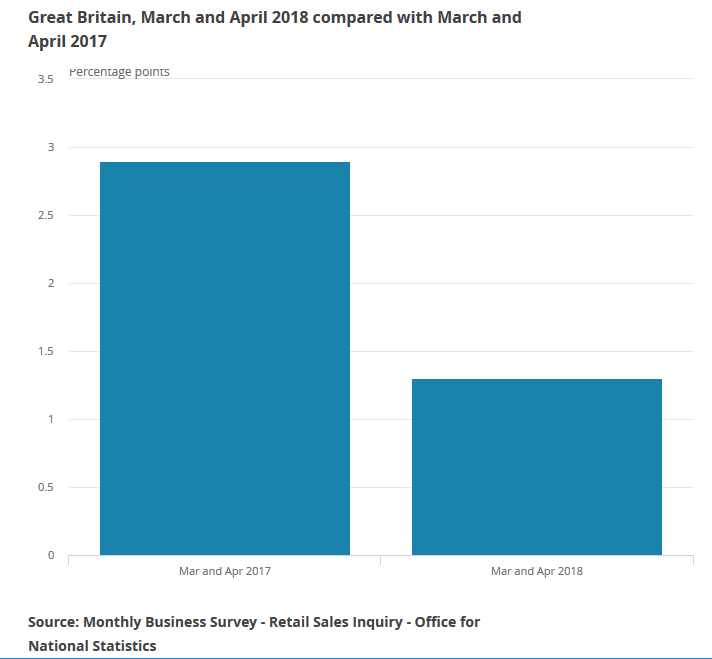
        The ONS noted that “the effects of the adverse weather on sales introduces further volatility to the monthly growth rate in April 2018.” And, “combining March and April to compare the two months with the same two months a year earlier provides a more stable picture of the year-on-year growth”.

        Combining both March and April, sales grew 1.3% in 2018, much lower than 2.9% back in 2017. Full release here.

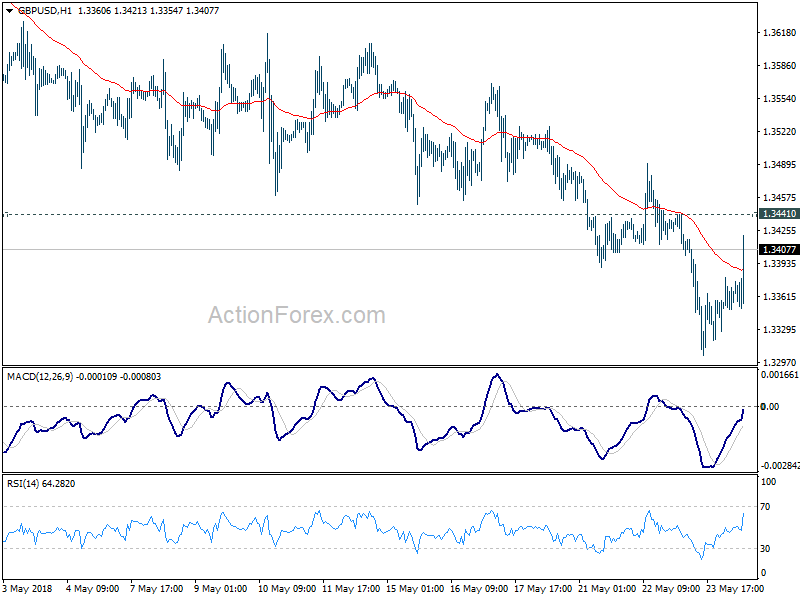
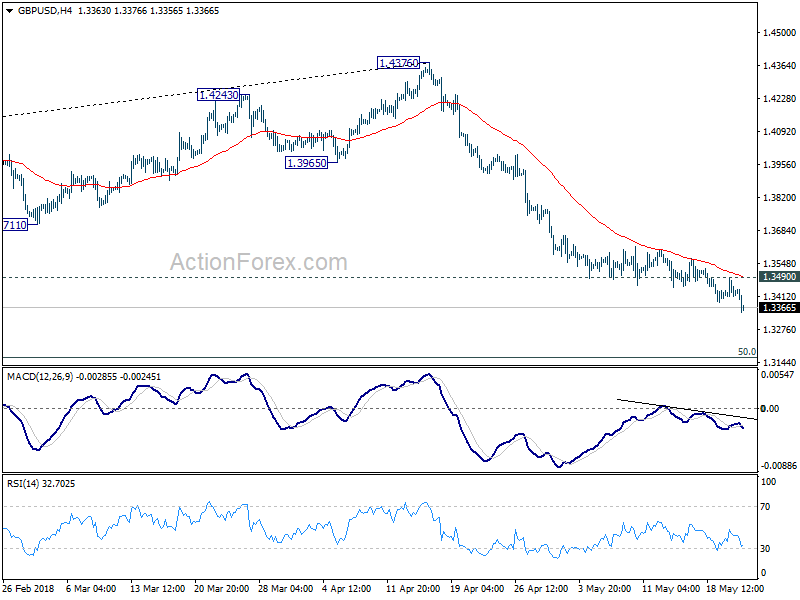
        Nonetheless, Sterling is lifted immediately by the release. GBP/USD’s focus will be back on 1.3441 minor resistance.

        German Merkel welcomed in her visit to China

          German Chancellor Angela Merkel is having a fruitful visit to China. Chinese Premier Li Keqiang said, in joint appearance with Merkel, that “China’s door is open” and welcome German vehicle makes to invest there. Li also pledged that “if they come across any problems during their investment, especially when it comes to legal protections, I can clearly tell you that China is striding forward to being a country with rule of law.”Li also said China has always supported a unified and prosperous Europe and that China and Germany uphold free trade.

          Besides, Li also noted “the euro is an important choice in our foreign currency reserves, and so we are continuing to buy European debt.” And, “even when certain European countries had sovereign debt crises, China kept the broader picture in mind.”

          In addition, Merkel also secured the support from China on the current Iran nuclear deal, despite US withdrawal.

          North Korea warns US of nuclear-to-nuclear showdown

            Right now, whether the scheduled meeting between North Korean leader Kim Jong-un and Trump on June 12 in Singapore remains uncertain. North Korean Vice Foreign Minister Choe Son-Hui issued a strong statement today in response to US Vice President Mike Pence’s recent comments. Choe slammed Pence’s unbridled and impudent remarks” that threatens if “if Kim Jong-un doesn’t make a deal”, North Korea could end up like Libya.

            Choe added that “we will neither beg the US for dialogue nor take the trouble to persuade them if they do not want to sit together with us.” And she warned, “whether the US will meet us at a meeting room or encounter us at nuclear-to-nuclear showdown is entirely dependent upon the decision … of the US.”

            She went further and said “we can also make the US taste an appalling tragedy it has neither experienced nor even imagined up to now.” And, “as a person involved in the US affairs, I cannot suppress my surprise at such ignorant and stupid remarks gushing out from the mouth of the US vice-president,”

            Earlier on Wednesday, Trump said “it could very well happen. Whatever it is, we’ll know next week about Singapore. And if we go, I think it will be a great thing for North Korea.”

            Revisiting Japan April trade data as US threats car tariffs

              In response to Trump’s probe on auto tariffs, Japanese Chief Cabinet Secretary Suga noted that Japan is closely monitoring the situation and emphasized that any trade steps should be in accordance with WTO rules. Trade Minister Seko said the potential auto tariffs are regrettable and warned that the would cause confusion in the global economy.

              As a recap on recent Japanese trade statistics, the Finance Ministry reported JPY 626B surplus in April, up 30.9% from a year ago. Exports jumped 7.8% to JPY 6.8T, up fro the 17th straight months. Import rose 5.9% JPY 6.2T.

              Japan’s trade surplus with the US rose 4.7% to JPY 616B as export rose 4.3% and import rose 3.9%.

              Transport equipment is a major contributor to the export to US, and overall export growth in April. Total transport equipment contributed to 39.4% of exports to the US and grew 5.3% to JPY 507B. Motor vehicles was a large part, at 30.2% of total exports to the US, grew 10.0% to JPY 389B.

              Japan is one of the few top 10 steel importers to the US who’s not even granted a temporary exemption on steel tariffs. Though, iron and steel products exports to the US rose 13.7% in April to JPY 18.2B.

              All details can be found here.

              Yen surges, Nikkei drops as Trump mulls car tariffs on national security ground

                Yen’s broad based rally extends today as Nikkei dives over -1% as led by selloff in car makers shares.

                Sentiments are hurt by news that the US is considering to impose as much as 25% tariffs on import cars. Similar to steel and aluminium tariffs, national security is used as the excuse for the investigation under Section 232 of the Trade Expansion Act of 1962.

                Commerce Secretary Wilbur Ross said in a statement that “there is evidence suggesting that, for decades, imports from abroad have eroded our domestic auto industry.” And, the department will “conduct a thorough, fair, and transparent investigation into whether such imports are weakening our internal economy and may impair the national security.”

                In a separate statement, US President Donald Trump said: “core industries such as automobiles and automotive parts are critical to our strength as a Nation.”

                Some see the the car tariffs as a threat to force concessions in NAFTA talks, which has been in deadlock. This could also be an act to address pressure to EU, in particular on Germany for trade talks. But Japan could be the hardest hit if the tariffs are implemented. Japan is one of the few top 10 steel importers to the US who’s not even granted a temporary exemption.

                In 2017, US imported 8.3m vehicles, including 2.4 million from Mexico, 1.8 million from Canada, 1.7 million from Japan, 0.9m from South Korea and 0.5m from Germany.

                Yen stays strongest, Euro weakest in a volatile day

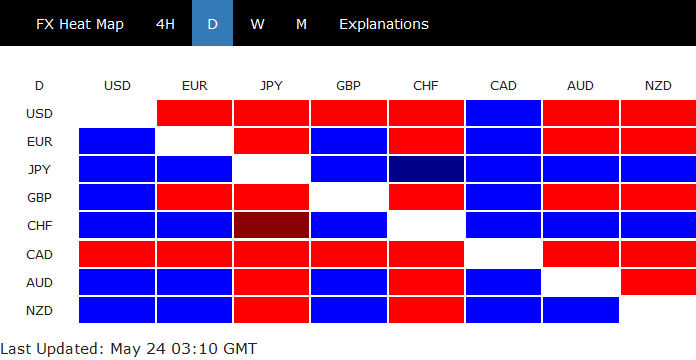
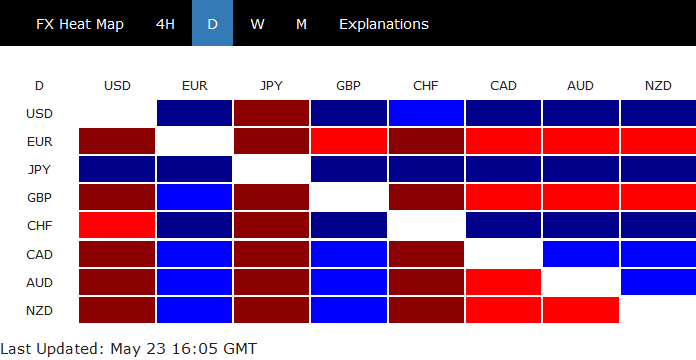
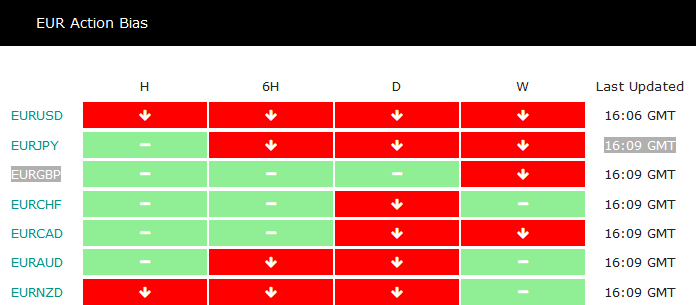
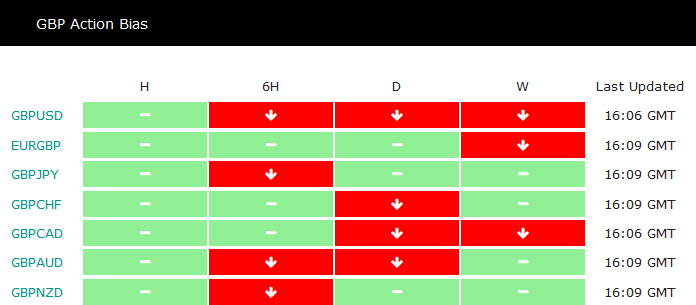
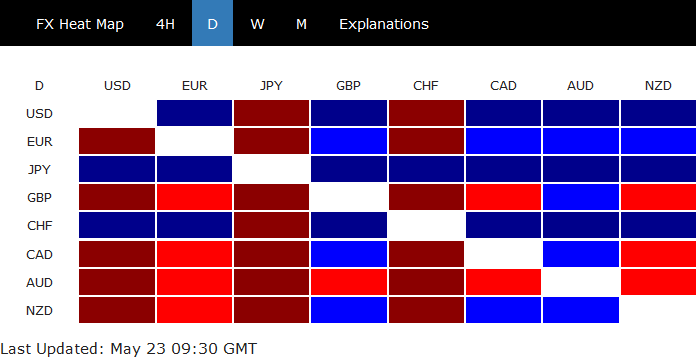
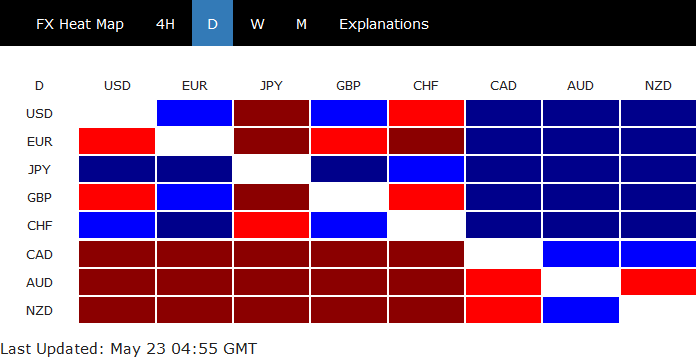
                  As an early sum-up of the day, Yen remains the strongest one, followed by Dollar. Euro and Sterling were taking turns to be the weakest. For now, Euro is the worst performer.

                  But it’s really hard to judge who’s worst. As both the Action Bias tables are beautifully red. (Well yes, EUR/GBP W action bias in red actually means Euro is weaker). Both will face more challenges ahead, with ECB meeting accounts and UK retail sales scheduled for tomorrow.

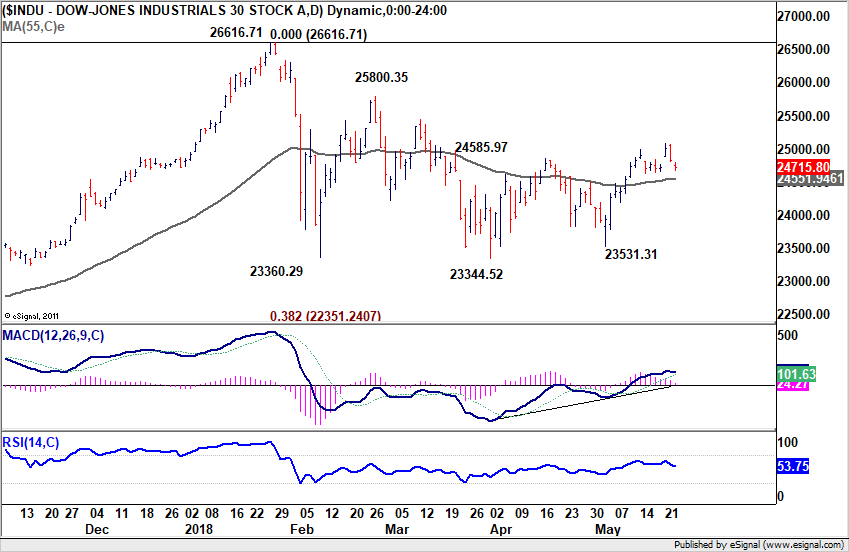
                  Looking ahead in the session, there are two technical levels to note. One is 55 day EMA (24552) in DOW. Even though it’s still quite far away from the current level, a close below will have important near term bearish implication. Another one is 3.00 in 10 year yield.

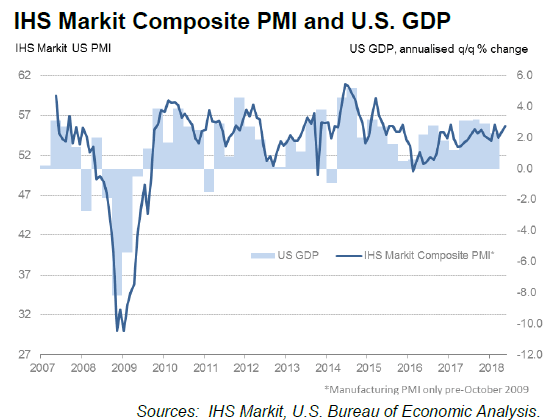
                  US May PMI points to encouragingly solid pace of economic growth of 2.5-3%

                    Markit US PMI manufacturing rose 0.1 to 56.6 in May, hitting 44 month high. PMI services rose 1.1 to 55.7, at 3 month high. Both were above market expectations.

                    PMI composite rose to 55.7, up from 54.9, at a 3 month high.

                    Comments from Chris Williamson, Chief Business Economist at IHS Markit:

                    “The flash May PMI surveys point to an encouragingly solid pace of economic growth of 2.5-3% with monthly job gains running at just over 200,000, though the interesting action is coming on the prices front.

                    “Input costs measured across both manufacturing and services are rising at the fastest rate for nearly five years, with the goods-producing sector seeing the steepest cost increases for seven years in recent months.

                    “Furthermore, supplier delivery delays, a key forward-indicator of inflationary pressures, have risen to the highest seen in the 11 year survey history. Rising demand has stretched supply chains to the extent that suppliers are increasingly able to demand higher prices. At the same time, higher oil and energy prices are pushing up firms’ costs.

                    “Business optimism meanwhile remains at a three-year high, with companies commonly expecting rising demand to help drive business growth, setting the scene for further strong survey results in coming months.”

                    Full release here.

                    Also from US, new home sales dropped to 662k annualized rate in April, below expectation of 678k.

                    USDJPY recovers as Trump said China trade deal moving along nicely

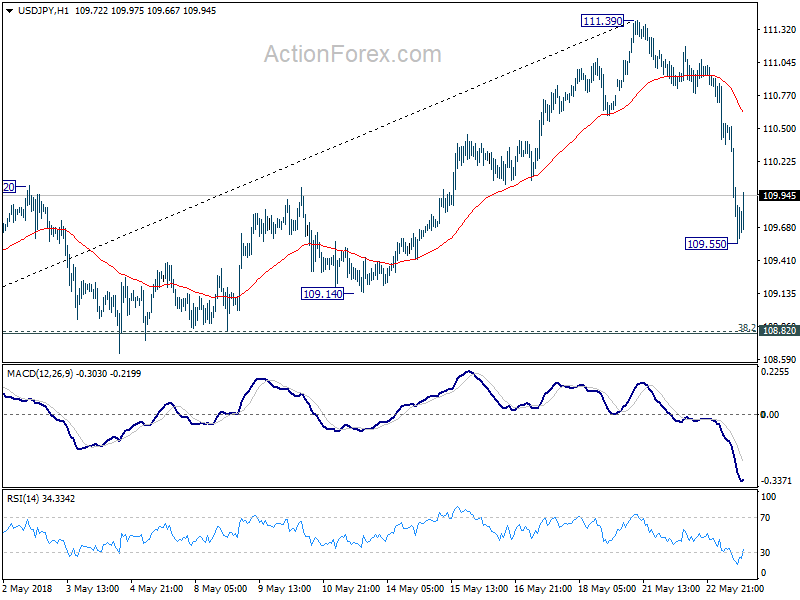
                      After dipping to as low as 109.55, USD/JPY recovers on Trump’s tweet that the trade deal with China is “moving along nicely.

                      Twitter

                      By loading the tweet, you agree to Twitter’s privacy policy.
                      Learn more

                      Load tweet

                      For now, 109.55 is not even seen as a temporary bottom yet. We’ll have to seen how is goes to decide. The markets are reflections of the world. When the world is erratic, the markets couldn’t be calm.

                      ECB Coeure: Asset purchase will end this year

                        ECB Executive Board member Benoit Coeure he’s not worried about slowdown and the central bank is still on course to end the asset purchase program this year.

                        Coeure told German newspaper Die Zeit that “at the end of last year, I said that I didn’t expect that our asset-purchase program would need to be extended again. I see no reason to change my view.” And, policymakers expect the economic expansion to continue, and are “increasingly confident that inflation will rise towards our aim of below, but close to, 2 percent.”

                        Regarding the upcoming new Italian government. Coeure said “it’s too early to comment on plans we don’t know.” But he emphasized that “on fiscal policy in general, the ECB’s view is well known: Europe has fiscal rules and they should be respected.”

                        Yen crosses in downside acceleration as US, German and UK treasury yields tumble

                          Yen crosses continue to trade lower in European session and accelerate after weaker than expected Eurozone and UK data.

                          EUR/JPY broke 109.22 support and then 128.94 support without hesitation. GBP/JPY also broke 147.04 support. Both confirm near term down trend resumption.

                          USD/JPY also takes our near term channel which should now bring deeper corrective fall to 108.82 support.

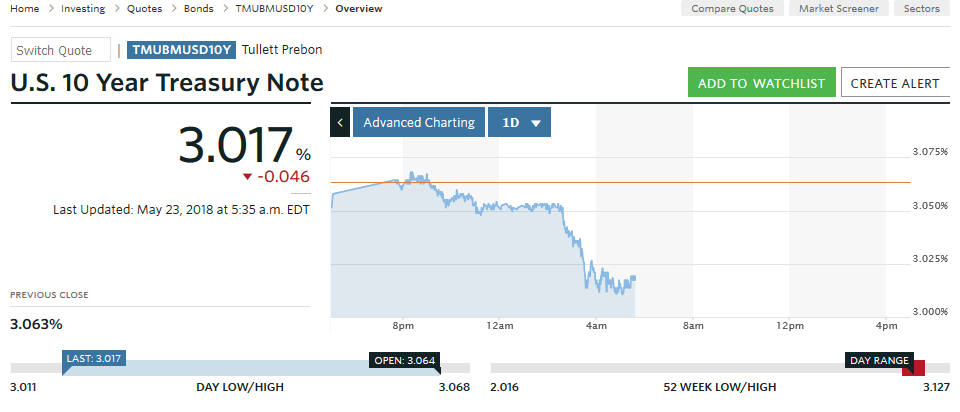
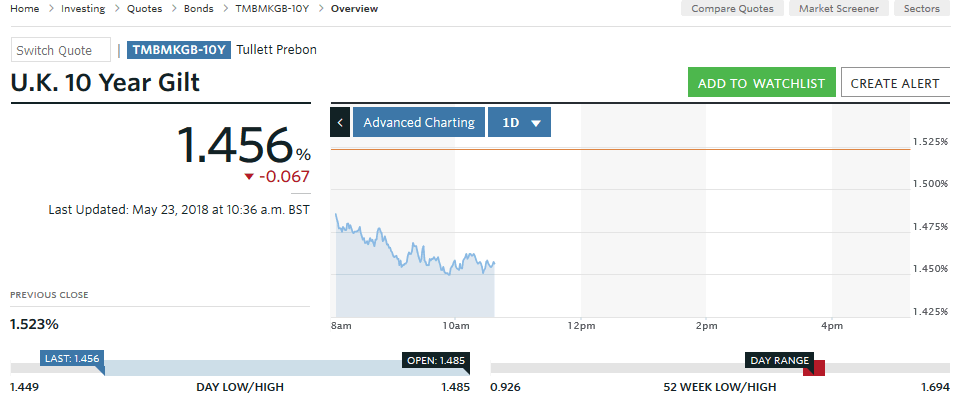
                          Falling treasury yield is seen as the main factor driving the moves.

                          US 10 year yield reaches as low as 3.011, comparing to yesterday’s close at 3.063.

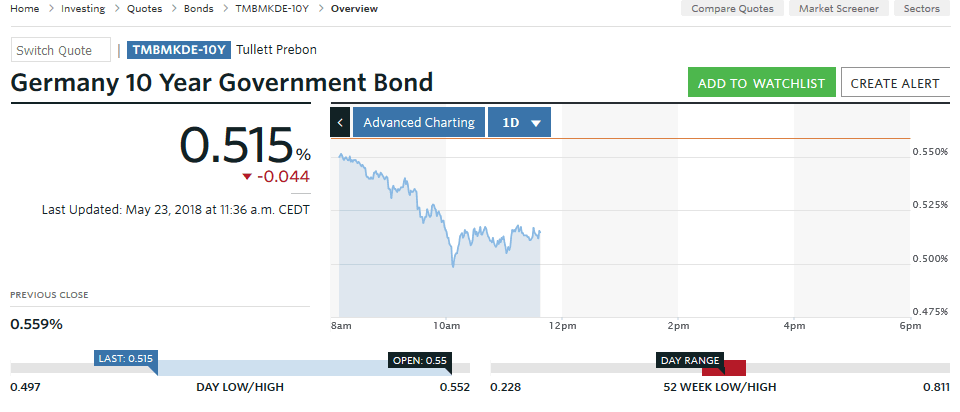
                          German 10 year bund yield reaches as low as 0.497, comparing to yesterday’s 0.559.

                          UK 10 year gilt yield dips to as low as 1.449, comparing to yesterday’s 1.523.

                          Chart screenshots from MarketWatch.

                          Pound hammered by UK CPI miss, ONS blamed timing of Easter

                            Pound was knocked down after another data miss. Headline CPI slowed for the third month in a row to 2.4% yoy in April, down from 2.5% yoy and missed expectation of 2.5% yoy. Core CPI also slowed to 2.1% yoy, down from 2.3% yoy and missed expectation of 2.2.% yoy.

                            The Office of National Statistics noted that air fares made the largest downward contribution to the change in CPI. It noted that “the timing of Easter in the middle of April 2017 contributed to air fares rising by 18.6% on the month whereas this year, Easter fell at the beginning of April before the price collection period and there was no price rise. Instead, fares fell slightly, by 0.2%, between March and April.

                            Full release here.

                            Poor weather was blamed for weak Q1 GDP. Timing of Easter is now blamed for CPI slowdown. But whether they’re true or now, the chance of an August BoE hike looks slimmer after the release.

                            Also from UK, RPI accelerated to 3.4% yoy in April, up from 3.3% yoy, met expectation. PPI input rose to 5.3% Yoy, PPI output was unchanged at 2.7% yoy, PPI output core slowed to 2.4% Yoy. House price index was unchanged at 4.2% yoy in March.

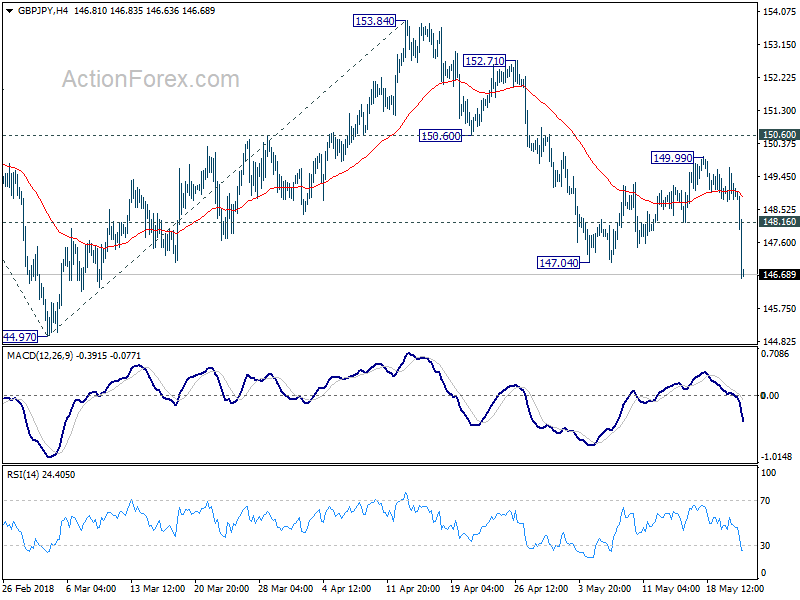
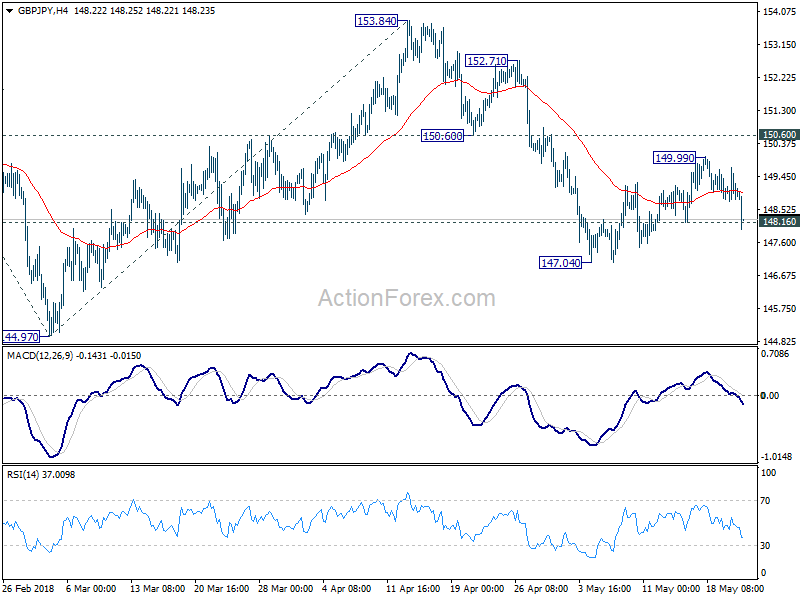
                            GBP/JPY responds to the release by diving through 147.04 support, confirming resumption of recent decline from 153.84. 144.97 is the next target.

                            GBP/USD drops to further to 1.3345 and is on course for 1.3161 fibonacci level.

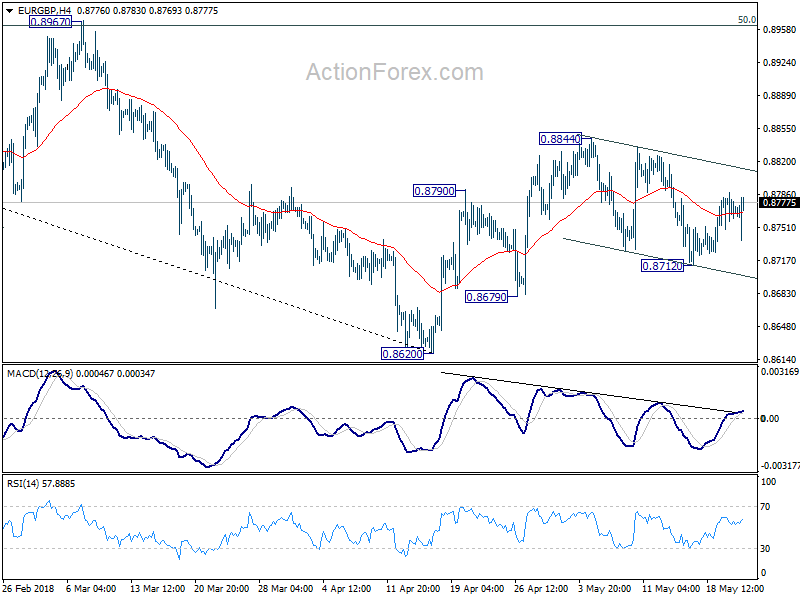
                            EUR/GBP is stay in range, because Euro is weighed down by its own weaker than expected PMI data.

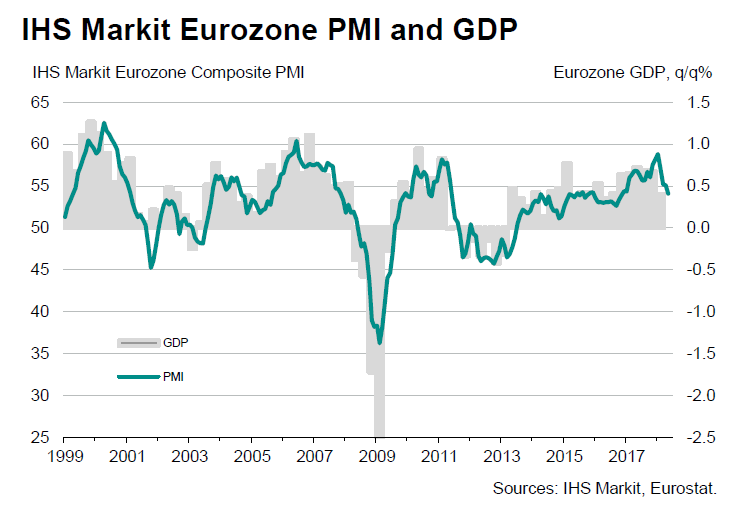
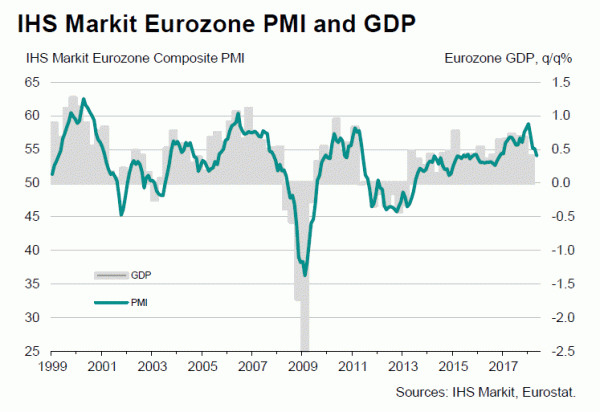
                            Eurozone PMI hit 18-month low, but still point to 0.4% GDP growth in Q2

                              Eurozone PMI manufacturing dropped to 55.5 in May, down from 56.2, missed expectation of 56.0, hitting 15-month low.

                              PMI services dropped to 53.9, down from 54.7, missed expectation of 54.7, hitting, 16-month low.

                              PMI composite dropped to 54.1, down from 55.1, hitting 18-month low.
                              Comments from Chris Williamson, Chief Business Economist at IHS Markit:

                              “The May PMI brought yet another set of disappointing survey results, though once again a note of caution is required when interpreting the findings. While prior months have seen various factors such as extreme weather, strikes, illness and the timing of Easter dampen growth, May saw reports of business being adversely affected by an unusually high number of public holidays.

                              “Furthermore, despite the headline PMI dropping to an 18-month low, the survey remains at a level consistent with the eurozone economy growing at a reasonably solid rate of just over 0.4% in the second quarter.

                              “Job creation is also continuing to run at an encouragingly robust rate and optimism about the business outlook remains above its long-run average.

                              “However, it’s also becoming increasingly evident that underlying growth momentum has slowed compared to late last year, especially in relation to exports. Hiring has consequently shown signs of being reined-in. More expensive oil and rising wages are meanwhile continuing to push companies’ costs higher, but weak final demand means firms are struggling to pass these higher costs onto customers.

                              “Some of the fog will hopefully lift with the June PMI data, providing a clearer signal of the underlying growth momentum. Until then, however, it’s likely that the disappointing May survey results will rekindle some concerns regarding downside risks facing the euro area economy.”

                              Full release here.

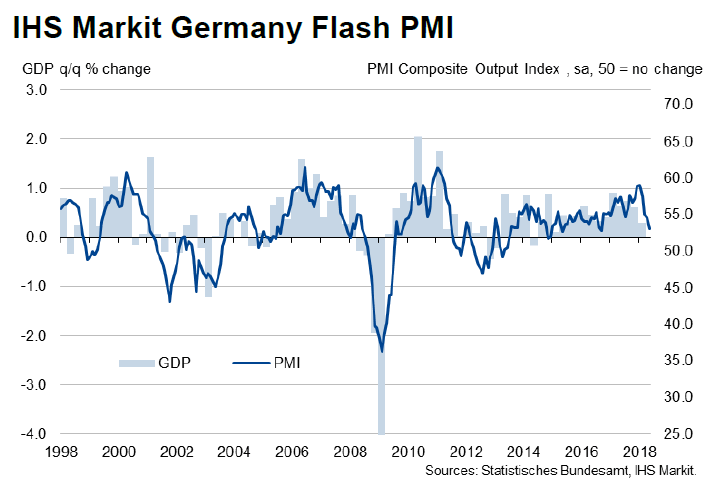
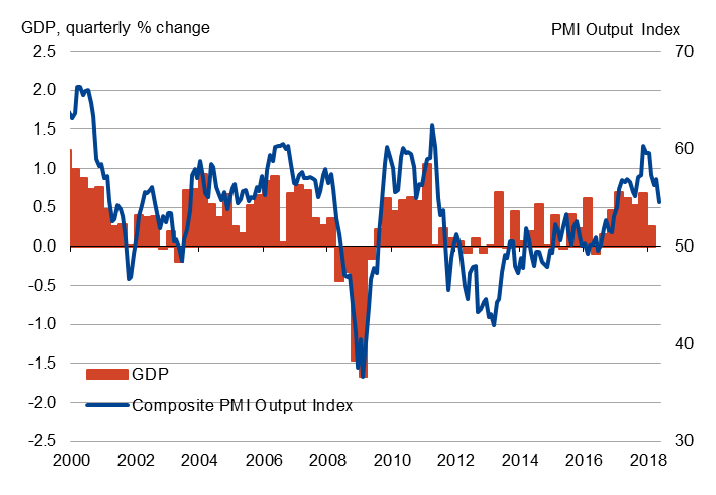
                              Germany PMI hit 20-month low, slowdown continued

                                Germany PMI manufacturing dropped to 56.8 in May, down from 58.1, missed expectation of 57.9. That’s the lowest in 15 months.

                                PMI services dropped to 52.1, down from 53.0, missed expectation of 53.1. That’s a 20-month low.

                                PMI composite dropped to 53.1, down from 54.6, hitting 20-month low.

                                Comment from Phil Smith, Principal Economist at IHS Markit:

                                “The flash PMI data indicate that the recent slowdown in Germany’s private sector continued into May. Business activity showed the weakest rise for over a year-and-a-half, and it was a case of slower growth across both the manufacturing and services segments of the economy.

                                “There was some anecdotal evidence suggesting that the timing of public holidays during the month had led to workers taking days off to bridge the holidays and weekends. However, weaker order book growth and a further waning of business confidence point to the economy carrying a lot less underlying momentum than at the end of 2017.

                                “Latest data meanwhile indicated an ill-timed resurgence in cost pressures faced by businesses, linked largely to rising oil prices. The recent cooling of demand has meant increased pressure on margins, with selling price inflation moving in the opposite direction to that of input costs.”

                                France PMIs showed renewed slowdown

                                  France PMI manufacturing rose to 55.1 in May, up from 53.8 and beat expectation of 53.7, hitting 3 month high.

                                  But PMI services dropped to 54.3, down from 57.4 and missed expectation of 57.2, hitting 16- month low.

                                  PMI composite dropped to 54.5, down from 56.9, hitting a 16 month low.

                                  Markit noted that the data in May signalled a “renewed slowdown in French private sector output growth”.

                                  Comments from Alex Gill, Economist at IHS Markit:

                                  “Having showed signs of resilience in April, May saw a renewed slowdown in French private sector growth. Moreover, the headline composite output index signalled the weakest rate of expansion for almost a year-and-a-half, indicating that the French private sector’s economic revival is losing further steam in the second quarter.

                                  “On a brighter note, the data highlighted a better month for the manufacturing sector, with rates of expansion accelerating on a number of key metrics, including output, new orders and employment.”

                                  Japan PMI: Weakest expansion in manufacturing growth in nine months

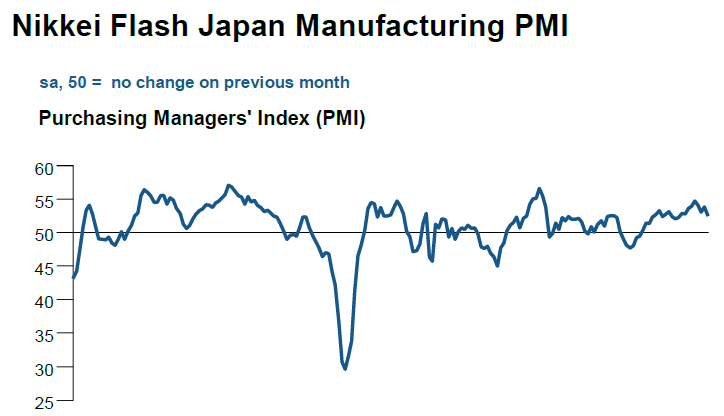
                                    The Nikkei flash Japan manufacturing PMI dropped to 52.5 in May, down from 53.8 and missed expected of 54.6. In the release it’s noted that new order growth softened to 9-month low. However, input prices surged at the fastest pace since January 2014.

                                    Also, Joe Hayes, Economist at IHS Markit, noted:

                                    “Despite the promising upturn in April data, May’s flash release erred on the side of disappointment as the headline figure signalled the weakest expansion in manufacturing growth in nine months.

                                    “Employment growth eased, in line with a weaker accumulation of work backlogs due to softer demand pressures. That said, new export sales expanded faster amid the recent dollar strength vs. JPY.

                                    “However, there was further evidence that supply-side constraints may be impacting output potential, as material shortages contributed to the greatest lengthening of delivery times in seven years. Consequently, input prices soared at the fastest pace in 52 months.”

                                    Full release here.
                                    RBNZ has significant room for easing, no need for unconventional policies

                                      RBNZ released a 22-page bulletin article titled “Unconventional monetary policy since the Global Financial Crisis” today.

                                      In a summary, RBNZ hailed that the “unconventional” monetary policies adopted by some major central banks were “successful in easing financial conditions”. And, there were “emerging research suggests they boosted inflation and activity.”

                                      But in case of RBNZ, the OCR is currently at 1.75%, and it’s “not projecting a significant decrease in the OCR”. Therefore, RBNZ has “significant further room to ease monetary policy in a conventional way, and conventional monetary policy remains effective in influencing inflation and activity.”

                                      Separately, RBNZ Assistant Governor John McDermott said in an interview that while there is “no imminent prospect” of using unconventional policy, the probability of needing them at this point in the cycle is higher than it ever was in history”. Therefore, “it would be silly of us not to be ready just in case.”

                                      UK Hammond rejected CBI’s call for customs union after Brexit

                                        UK Chancellor of Exchequer Philip Hammond rejected the call from business leaders on customs union after Brexit. Hammond said that government shared the CBI’s desire to “minimise frictions and burdens, to avoid new barriers in Ireland and to grow British exports”.

                                        However, he emphasized that “we do not agree that staying in the customs union is necessary to deliver them.” And he tried to persuade the business leaders that ministers were “confident we can develop a solution that will allow us to move forward while meeting your concerns”.

                                        This was in response to CBI President Paul Drechsler’s speech in the in the group’s annual dinner. There Paul Drechsler urged US Prime minister Theresa May to “break the Brexit logjam and fast”. And he added that UK should remain in the customs union with the EU “unless and until an alternative is ready and workable”.

                                        Yen surges, stocks down as capricious assertive Trump unsatisfied with China trade talk

                                          Yen surges broadly in Asian session while Canadian, Australian and New Zealand Dollars are the weakest one. This is the typical development with risk aversion. DOW closed down -0.72% or 178.88 pts to 24834.41 overnight. S&P 500 lost -0.31% to 2724.44. NASDAQ dropped -0.21% to 7378.46. In Asian Nikkei is trading down -1.13% at the time of writing. HK HSI is down -1.0%.

                                          Market seemed to respond negatively to Trump’s comment that he’s “not satisfied” with the trade talks with China. And called the negotiations just a “start”. That’s rather inconsistent with Treasury Secretary Steven Mnuchin’s comment that the meeting made “very meaningful progress”. Also, it remains unclear when the planned Kim-Trump summit will happen on June 12 in Singapore. Trump just said that “whether or not it happens, you’ll be knowing pretty soon” .

                                          But as European Council President Donald Tusk described before, the American administration has capricious assertiveness. So unpredictably is somewhat predictable.

                                          Technically, GBP/JPY is a pair to note as 148.16 minor support is broken, which suggests completion of corrective rebound from 147.04 at 149.99. UK CPI will be a focus today and another miss would push the cross through 147.04 towards 144.97 low.