


Canadian Highlights
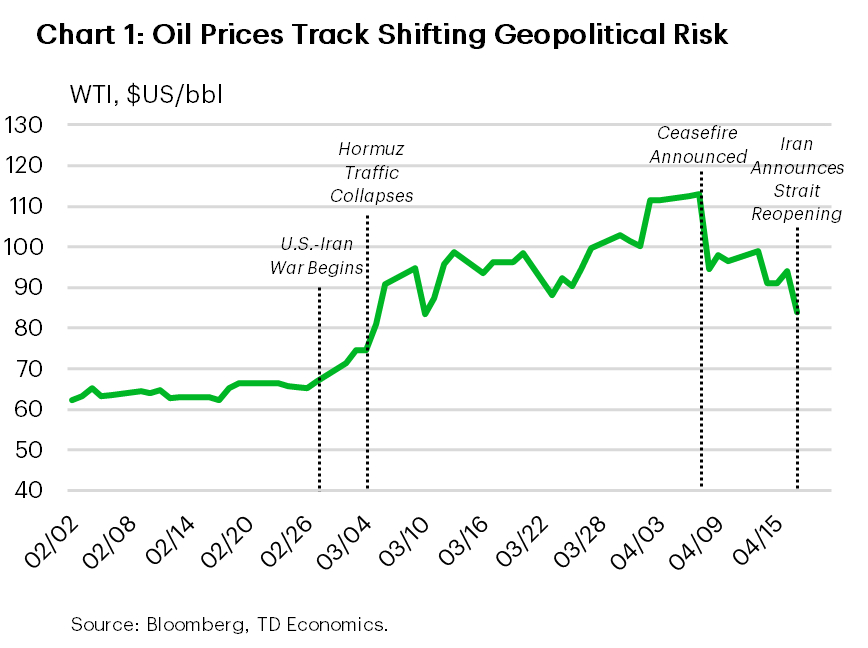
- Iran announced that the Strait of Hormuz will be open to commercial traffic during the Israel-Lebanon ceasefire. Details are still unfolding, but oil prices have plunged on the news.
- Ottawa moved earlier this week to blunt fuel‑price pressures by suspending the federal excise tax on gasoline, diesel, and aviation fuels through Labour Day.
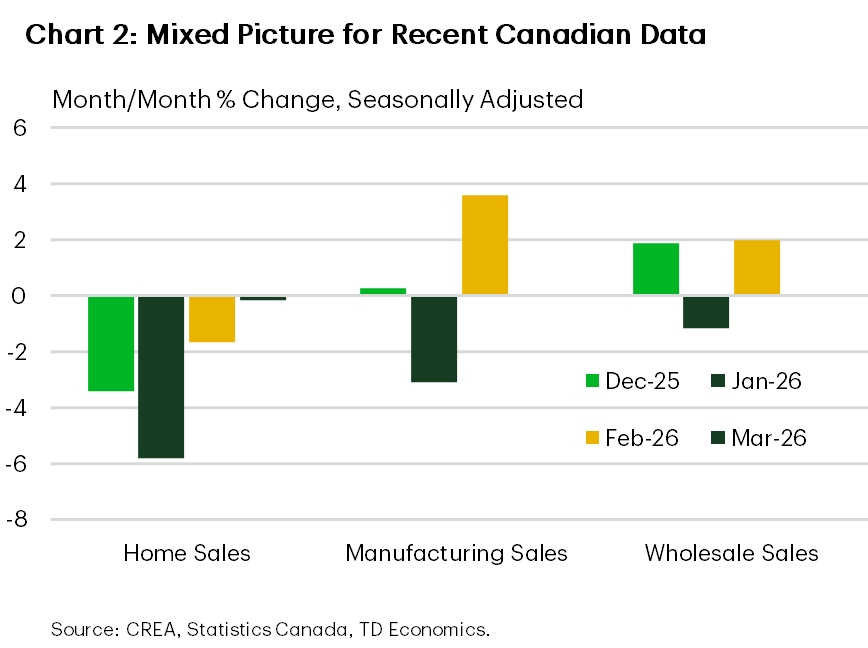
- Rebounds in manufacturing and wholesale sales in February offset continued softness in the housing market. Inflation data next week should confirm that underlying trends still argue for the Bank of Canada to keep interest rates steady at its April 29th decision.
U.S. Highlights
- Oil prices plummeted Friday morning as Iran declared the Strait of Hormuz fully open to commercial traffic during the 10-day cease fire between Israel and Lebanon.
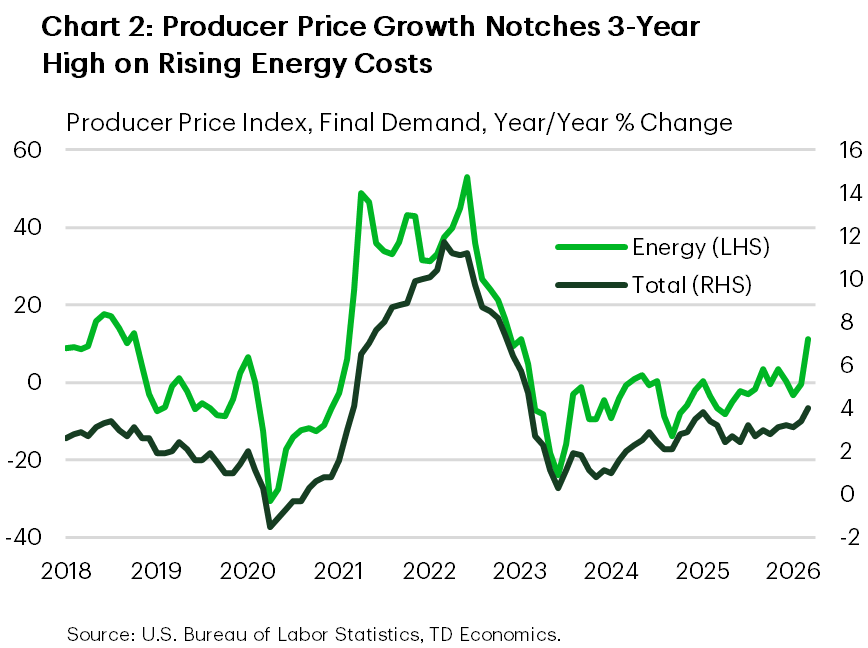
- The producer price index rose to a three year high of 4% year-on-year in March, as energy prices rose sharply during the month.
- Federal Reserve officials generally voiced caution in public comments this week, as uncertainty related to the duration of the conflict complicates monetary policy deliberations.
Canada – Tax Breaks and Open Straits
Hopes for a sustained easing in Middle East tensions firmed this morning after Iran announced it would fully reopen the Strait of Hormuz to commercial shipping for the duration of the Israel–Lebanon ceasefire. The move sent WTI prices cratering to below $84/bbl, down 13% on the week (Chart 1). That said, Tehran emphasized the reopening is temporary and conditional on the ceasefire holding, leaving markets sensitive to any renewed flare‑ups. Markets still need to digest the news, but for now, the TSX edged up roughly 1.5%, supported by strength in energy shares, while reduced U.S. Dollar safe-haven demand and supportive commodity prices lifted the CAD by 1.2% to 73.2 cents/USD.
In response to higher fuel costs, the Carney government announced a temporary suspension of federal fuel excise taxes earlier this week. These taxes amount to 10 cents/litre on gasoline and 4 cents/litre on both diesel and aviation fuels. The suspension will run from April 20th through Labour Day (September 7th), delivering about $2.4 billion in tax relief. The move is framed as short-term affordability support for households and fuel intensive sectors. The Liberal government also secured a majority in parliament this week after sweeping three federal byelections in Ontario and Quebec.
We won’t need to wait long to see how Ottawa’s finances are faring, with the Spring Economic Update set for April 28th. This update will show how war related shocks and new affordability measures affect the outlook. Importantly, this will be the first spring update under the new fiscal calendar adopted last fall, and markets will watch closely to see how temporary relief measures and higher defence and infrastructure ambitions are reconciled with medium-term deficit management.
Data releases continued to show subdued, but stabilizing, activity (Chart 2). National home resales were nearly flat in March, and prices slipped. Housing starts also weakened. The Canadian housing market remains stuck between uncertainty and affordability challenges, with early-spring activity lagging typical seasonal levels. However, manufacturing and wholesale sales improved in February, rebounding from January’s decline. This recovery was driven by better transportation equipment output, as auto assembly lines returned to normal after shutdowns for retooling. While these gains are positive, they follow earlier softness and leave activity levels only slightly higher than a year ago.
Next week’s focus turns to March inflation data, due Monday, which will help clarify how much of the recent energy shock is feeding through beyond gasoline. With inflation having been relatively well behaved heading into the conflict, the Bank of Canada (BoC) is likely to look through near term energy driven volatility, provided core measures remain contained. That sets up an important backdrop for the April 29th BoC decision, where we expect the policy rate to remain unchanged at 2.25%. That said, we expect them to monitor this shock carefully and act if circumstances change.
U.S. – Temporary Reopening of Strait of Hormuz Boosts Financial Markets
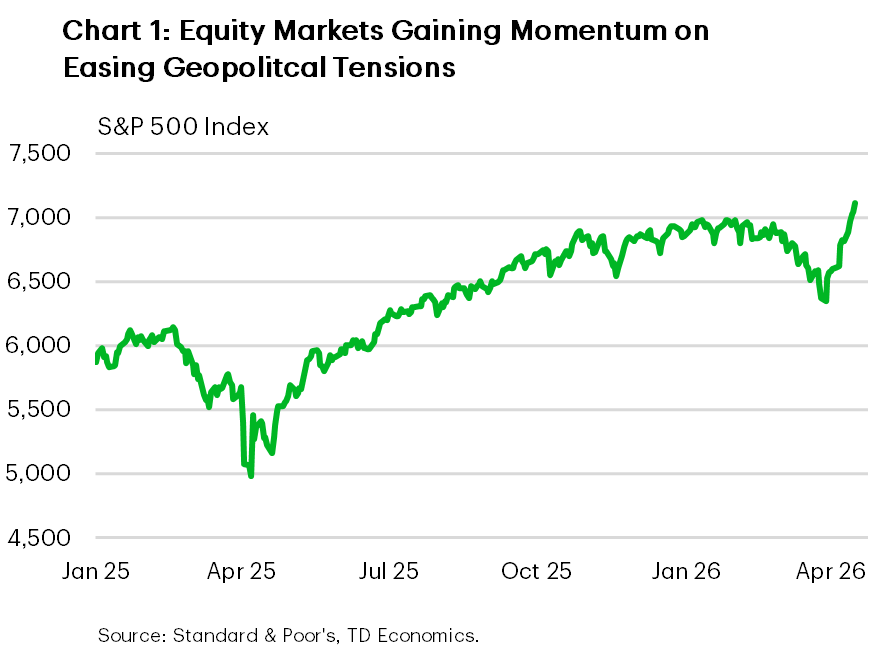
As the seventh week of the conflict in the Middle East comes to a close, the attention of financial markets remains squarely focused on the comments of officials in relation to a sustained resolution. Iran’s foreign minister announced Friday morning that the Strait of Hormuz would be open to commercial traffic during the recently negotiated 10-day ceasefire between Israel and Lebanon. This was met by a positive reaction in financial markets, but geopolitical risks are likely to remain elevated until a permanent resolution is achieved. The S&P 500 rose 4.4% this week to a new all-time high (Chart 1), while WTI oil fell 16% to $81/barrel as of the time of writing.
Economic data releases were sparse this week, but we did get an update on the housing market, which showed a 3.6% decline in existing home sales in March. The conflict in the Middle East and concerns regarding its impact on inflation has led to upward pressure on U.S. Treasury yields and subsequently mortgage rates. With mortgage rates continuing to fluctuate near a 6-month high of 6.4%, housing demand is likely to remain soft to start the spring buying season.
On the inflation front, the producer price index showed a sharp uptick in March, with energy prices driving the annual percentage change in the final demand index to 4% – the highest level since early 2023 (Chart 2). Similar to the March consumer price index report, spillover of higher energy prices into core inflation was largely absent, but this will be a key risk the Federal Reserve will be monitoring moving forward. If the current downward trend in oil prices is substantiated by a concrete resolution to the current supply disruptions in the Middle East, then this inflation shock is likely to prove transitory. However, risks remain skewed to the contrary the longer it takes for a permanent resolution to be achieved, with material impacts on households and businesses already occurring.
In the Federal Reserve Beige Book for April 2026, the conflict was cited as a major source of uncertainty that complicated decisions around hiring, pricing, and capital investments. In addition to higher energy costs, which were reported across all regions, businesses also reported facing input cost pressures from tariffs on metal products – which were expanded at the start of April – in addition to higher technology costs. Cumulatively, businesses noted these pressures were leading to margin compression, which could weigh on economic growth moving forward when combined with elevated uncertainty.
Comments from Federal Reserve officials this week were cautious overall. New York Fed President Williams stated on Thursday that stagflation risks were a concern, but also that the current stance of monetary policy was well-positioned to deal with the impacts of the conflict. Chicago Fed President Goolsbee also noted this week that the longer the conflict persists, the less likely rate cuts are for this year. In the wake of lower oil prices Friday morning, markets have increased bets to better than 50-50 that the Fed will cut rates a quarter point by the end of the year.





, while WTI oil fell 16% to $81/barrel as of the time of writing.)