- The United Arab Emirates exit from OPEC+ highlights growing internal tensions and weakens the cartel’s ability to coordinate supply
- Short term market impact remains limited due to supply disruptions linked to the blockade of the Strait of Hormuz
- In the medium term, the UAE’s spare capacity may increase global supply once logistical constraints ease
- Recent price declines in Brent crude oil likely reflect profit taking after a strong rally driven by geopolitical risk
A smaller coalition from eight to seven producers
The global oil market is entering a phase of growing institutional uncertainty, as the ability of OPEC+ to coordinate supply continues to weaken. A clear manifestation of this trend is the decision by the United Arab Emirates to leave both OPEC and OPEC+, effective May 1, 2026. As a result, only seven countries, down from the original eight that agreed in April 2023 to implement additional production cuts, will participate in the upcoming policy meeting.
Underlying tensions quotas compliance and strategic divergence
The UAE’s departure is not a sudden development but the outcome of prolonged internal tensions. Disagreements have centered on production levels and, crucially, on compliance with agreed quotas. The UAE repeatedly exceeded its production limits, undermining the credibility of the group’s supply management framework. At the same time, the country has been expanding its production capacity, putting it at odds with the restriction focused strategy led by key players such as Saudi Arabia.
These economic frictions have been compounded by geopolitical considerations. Amid escalating regional conflict and instability in the Gulf, Abu Dhabi has grown increasingly dissatisfied with the level of political and strategic support received from its neighbors. This has accelerated the shift toward a more independent energy policy focused on maximizing national output and flexibility.
Limited short term impact amid supply disruptions
Despite the significance of the UAE’s exit, its immediate impact on the oil market is limited. Production across the Gulf region is already well below capacity due to the blockade of the Strait of Hormuz, one of the most critical transit routes for global oil flows. In this context, physical export constraints outweigh formal production quotas, rendering OPEC+ decisions largely symbolic in the short term.
Although new quotas are likely to be announced at the routine meeting, their practical relevance remains minimal. The cartel continues to operate within a formal framework, but its ability to effectively control supply has been significantly diminished.
Medium term risks unconstrained capacity and market rebalancing
The implications of the UAE’s exit become more meaningful in a scenario where logistical constraints ease and export routes normalize. The UAE possesses substantial spare production capacity, estimated at around 700,000 – 800,000 barrels per day, which it can deploy without being bound by OPEC+ agreements. This creates the potential for a faster supply response and a shift in market balance once normal conditions resume.
Long term outlook rising competition and price volatility
Over the longer term, the erosion of quota discipline and the increasing number of producers operating outside coordinated frameworks could lead to a more competitive supply environment. This raises the likelihood of heightened price volatility and, in extreme scenarios, the risk of a price war among major oil exporters.
While the UAE’s withdrawal does not immediately alter global supply dynamics, it represents a significant structural development. It highlights the weakening cohesion within OPEC+ and signals a gradual transition from coordinated market management toward a more fragmented and competitive oil landscape.
Technical view on the oil market
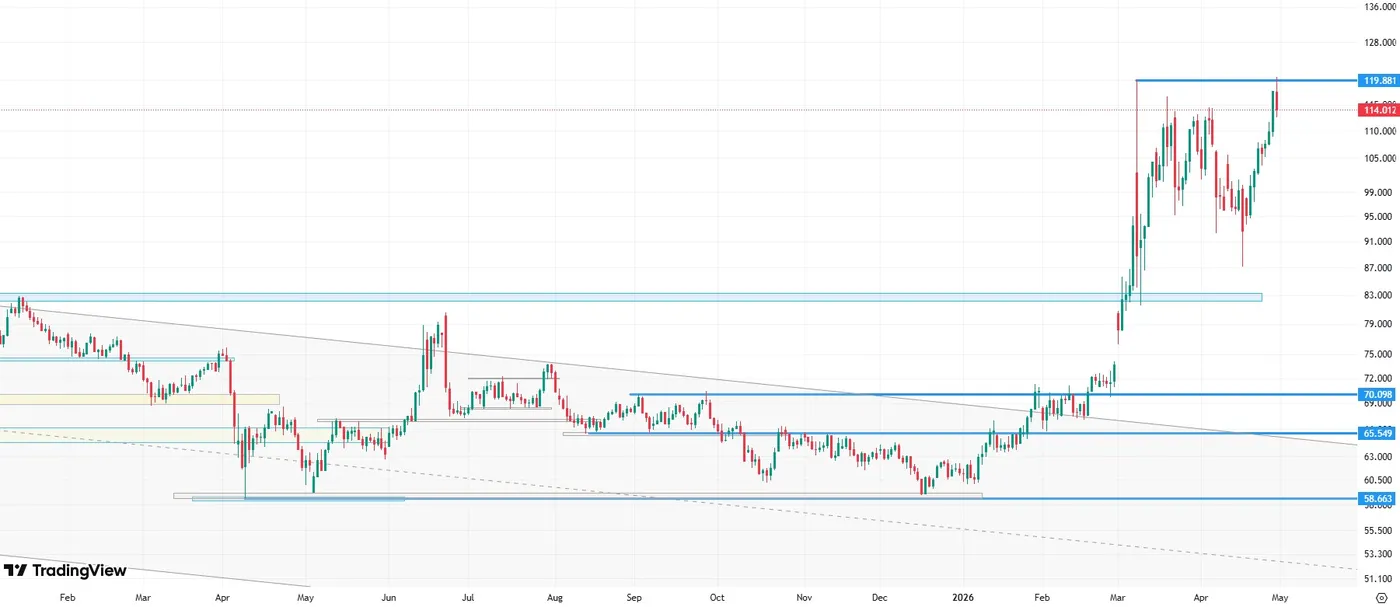
Brent crude oil price (CFD), daily data, source: TradingView
Oil prices are declining today, which may be driven by news regarding the decision of the United Arab Emirates to leave OPEC+. The market appears to be reacting to the potential for increased supply in the medium term, as well as weakening cohesion within the cartel, both of which are putting short term downward pressure on prices. Currently, Brent crude oil is trading around 114 USD per barrel, while West Texas Intermediate stands near 106.5 USD.
At the same time, Brent crude oil prices have matched and even exceeded the highs seen at the beginning of the Middle East tensions. This could indicate that the market has entered a phase of profit taking, particularly among short term investors who entered positions during the recent upward momentum driven by geopolitical risk.
As a result, the current pullback does not necessarily signal a reversal of the broader trend, but rather a natural correction following a strong rally and a retest of previous highs.