Key takeaways
- USD/JPY rebound stalls: The 3-day rebound is losing momentum at the key 158.55 inflexion level, with technical signals pointing to bearish reversal risk.
- UST-JGB yield gap narrows: The 2-year yield spread has fallen to 2.64%, which could support renewed yen strength if the narrowing continues.
- NFP is the key catalyst: A break below 157.95 could expose 157.30 and 156.32, while a move above 158.55 could open the door to 159.45.
The recent three-month period of yen weakness from May 2026, which saw the JPY plummet to a 40-year low of 163.99 per US dollar on 23 July 2026, was “recused” by a two-day FX intervention that included a historical US-Japan joint effort on 30 July and 31 July that strengthened the yen to 155.23 on Monday, 3 August 2026.
However, the yen’s strength stalled, and USD/JPY staged a 3-day rebound of 2.08% (low to close), closing at 158.46 on Thursday, 6 August 2026, nearly giving up half of the gains seen in the yen from last week’s FX Intervention.
As speculators focus on long-term dynamics, such as geopolitical uncertainty from the US-Iran situation that can dampen Japan’s growth prospects, this, in turn, delays the Bank of Japan’s (BoJ) normalisation of its monetary policy stance of gradual interest rate hikes.
The UST-JGB yield gap is the next focus for traders
Fig. 1: 2-YR US Treasuries/JGBs yield spread with USD/JPY as of 7 Aug 2026 (Source: TradingView). The information presented is historical information, and past performance is not indicative of future performance.
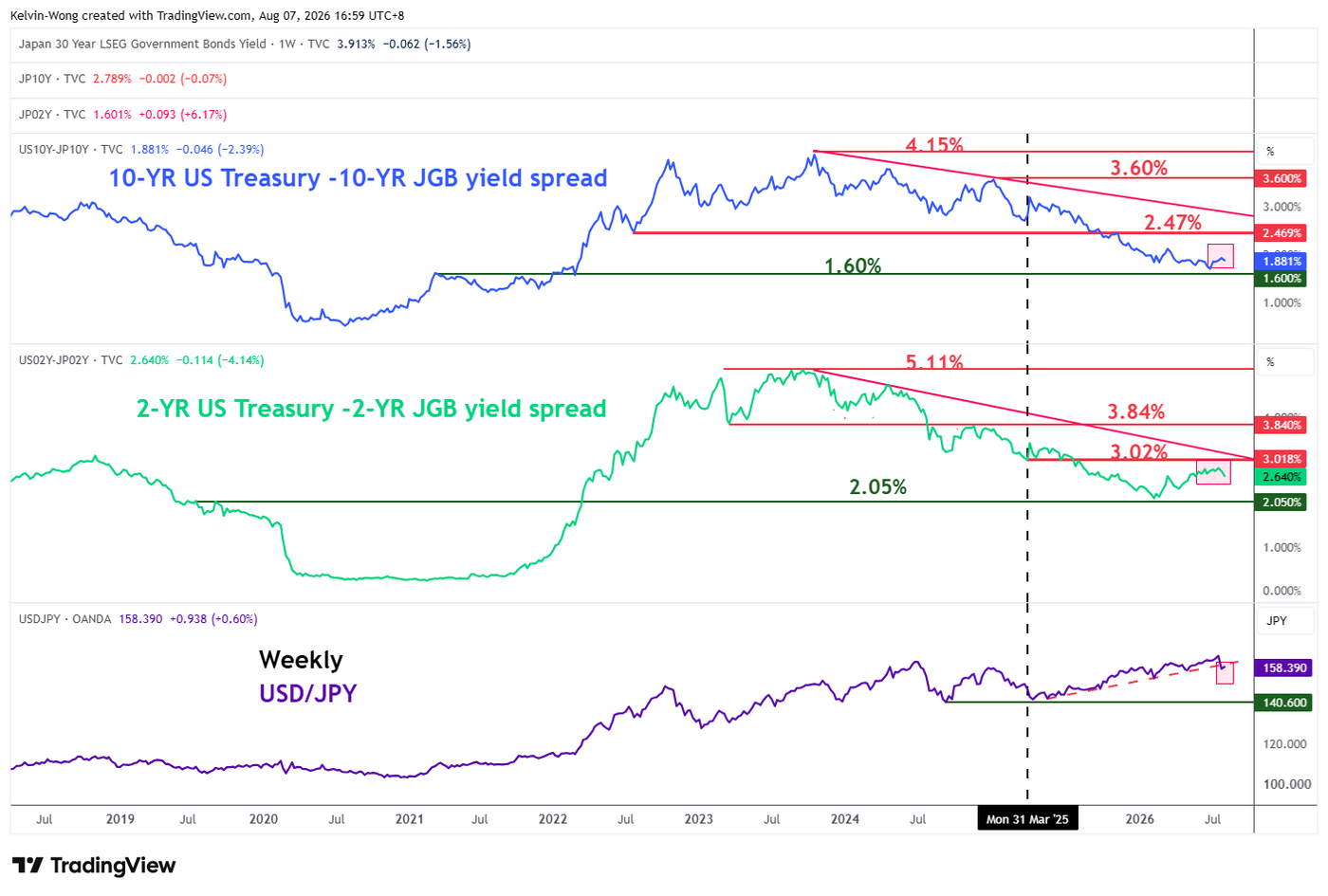
The rise of the USD/JPY (yen weakness) from 152.71 to July’s 40-year high print of 163.99 has been accompanied by a widening of the monetary policy sensitive 2-year yield spread between the US Treasury Notes (UST) and the Japanese Government Bonds (JGBs) from 2.12% to 2.82% over the same period (see Fig. 1).
Interestingly, the 2-year UST-JGB yield spread (gap) has started to reverse down (narrowed) right below a key medium-term resistance of 3.02% to now trade at 2.64% at this time of writing, which in turn reinforces a major bearish breakdown of the USD/JPY from its former ascending trendline support from April-May 2026.
Hence, a continuation of the narrowing of the 2-year UST-JGB yield spread towards 2.05% may see a revival of USD/JPY weakness, given a key risk event later at 8.30 pm SGT: the US non-farm payroll release for July (57K: June, consensus: 80K).
Let’s now decipher the potential short-term expectations (1 to 3 days) of USD/JPY from a technical analysis perspective.
USD/JPY – short-term bullish momentum is losing strength at inflexion point
Fig. 2: USD/JPY minor trend as of 7 Aug 2026 (Source: TradingView). The information presented is historical information, and past performance is not indicative of future performance.
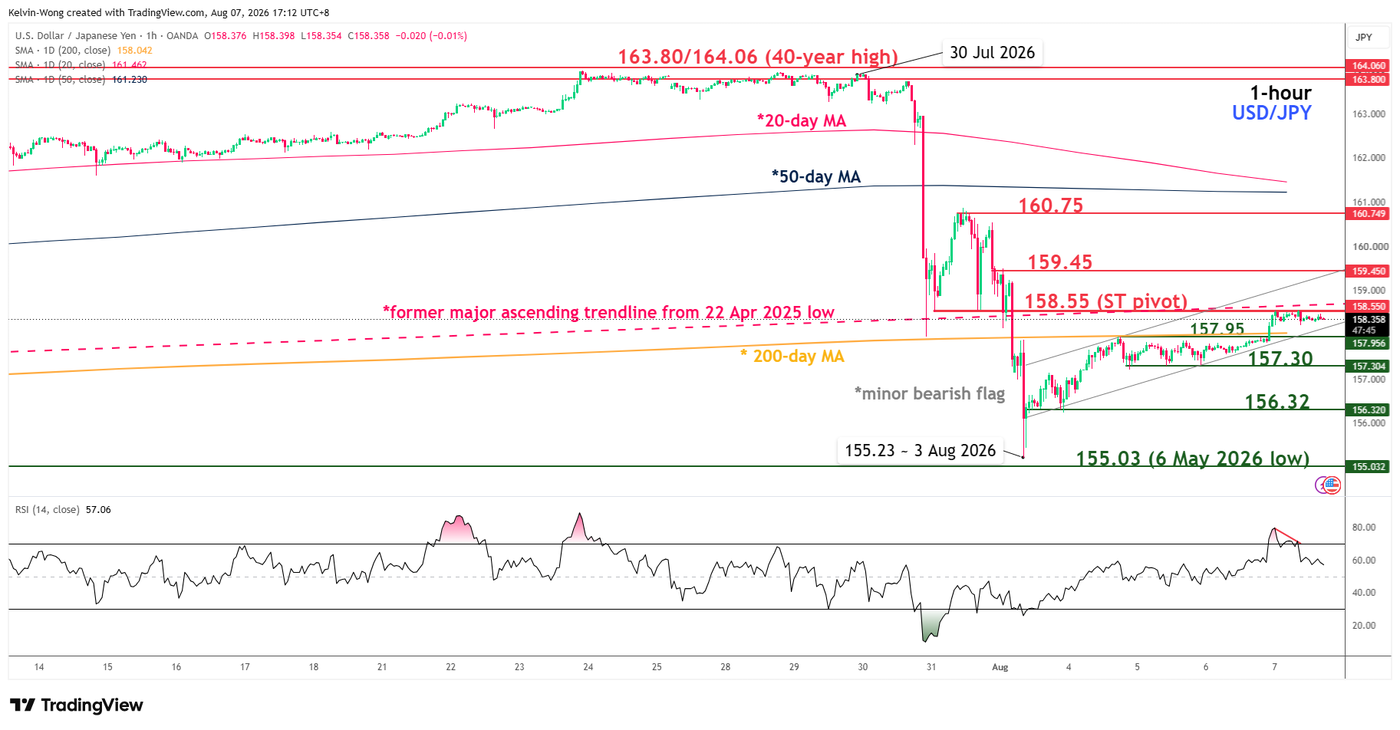
The 3-day rally in USD/JPY from Monday, 3 August 2026, to a low of 155.23 has reached an inflexion level of 158.55 defined by a confluence of elements (the former major ascending trendline from 22 April 2025 low, former minor swing low of 31 July 2026, and 38.2% Fibonacci retracement of prior down move from 30 July 2026 high to 3 August 2026 low).
In addition, the recent price action in USD/JPY is likely to have taken the form of a minor “bearish flag” configuration (dead cat bounce), suggesting a pause in an ongoing short-term downtrend, coupled with a bearish divergence in the hourly RSI momentum indicator at its overbought region (see Fig. 2).
Therefore, given that USD/JPY price action has pushed up to the inflexion level of 158.55 (current intraday high of 158.57 at this time of writing) amid bearish elements, USD/JPY may be due for an imminent minor bearish reversal.
A break below the potential downside trigger level of 157.95 (200-day moving average) may reinforce the bearish reversal scenario, exposing the intermediate supports of 157.30 and 156.32 in the first step.
On the other hand, clearance and an hourly close above the key short-term pivotal resistance at 158.55 would invalidate the bearish scenario, opening the door to a further potential squeeze up towards the medium-term resistance at 159.45.