


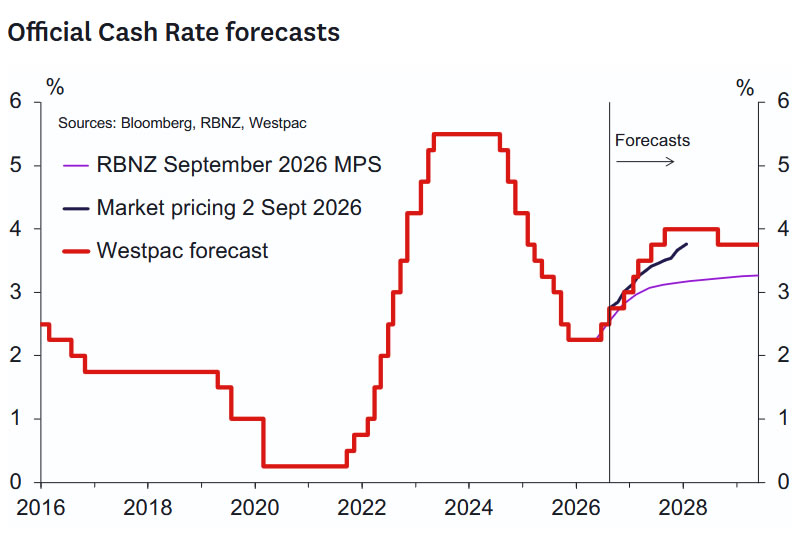
- As expected by Westpac and the market, the RBNZ lifted the OCR by 25bps to 2.75%.
- The decision was reached by consensus.
- The RBNZ’s revised OCR forecasts are little changed from May and in the near term signal a likely pause in October and a 25bp hike to 3% in December.
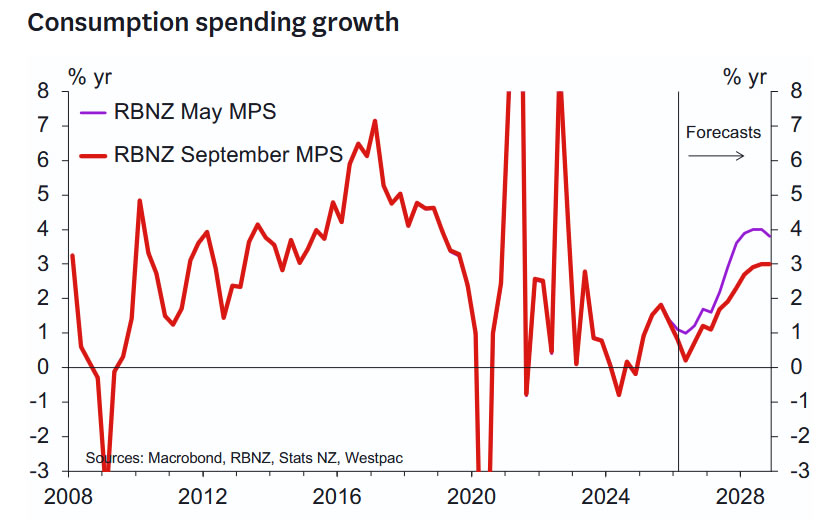
- The RBNZ lifted its very short-term growth forecasts but significantly moderated its medium-term growth forecasts, reflecting a weaker view of consumption trends.
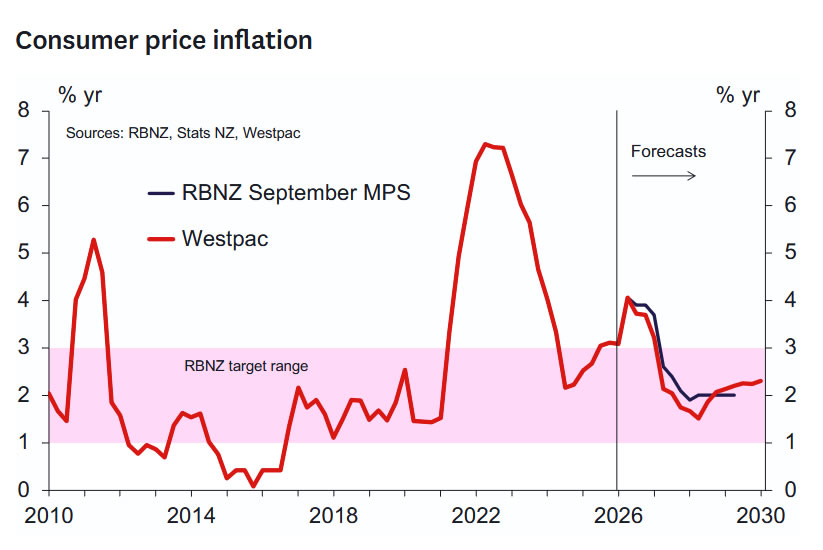
- The RBNZ has revised up its inflation forecasts for next year, reflecting expectations of persistent domestic inflation.
- A majority of MPC members see upside risks to inflation coming from persistent domestic inflation pressures. All members see downside risks to growth.
- The RBNZ’s estimates of the neutral OCR are unchanged and lie in a 3-3.5% range.
- Westpac continues to expect a pause in the OCR in October and a 25bp hike to 3% in December. Our view of a peak OCR of 4% in 2027 remains unchanged.
- The 2yr swap rate fell 8bps following the meeting. The market now prices one further 25bp hike this year, with a 30% probability that this happens in October.
Key Takeout: A Data-Dependent October Pause, with a Hike on the Cards for Christmas
As very widely expected, the RBNZ lifted the OCR by 25bps to 2.75%. The decision was reached by consensus, with no vote required.
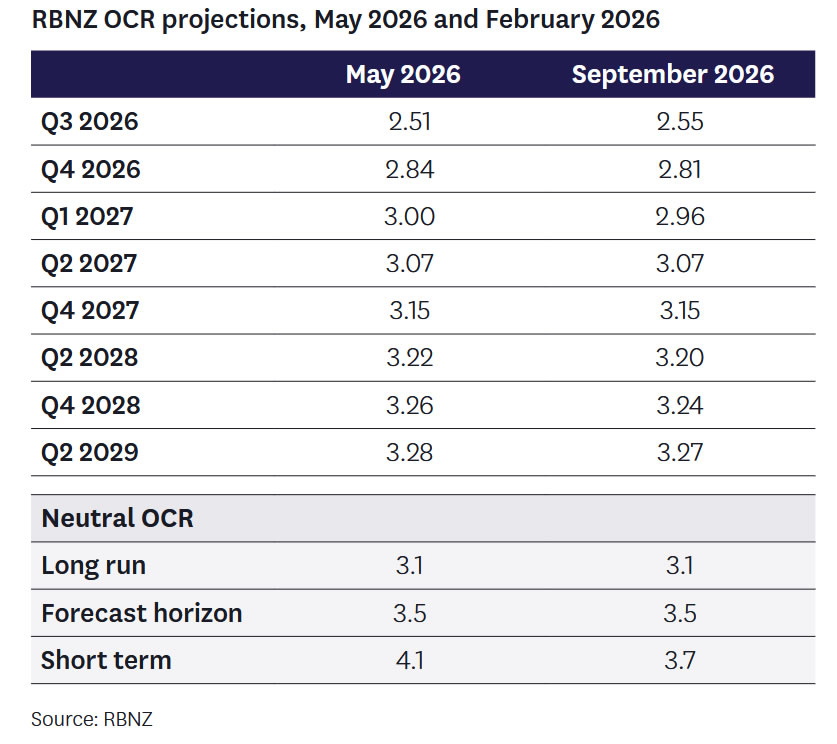
Importantly, the RBNZ now forecasts an average OCR in Q4 2026 of 2.81%, compared with 2.84% in the May MPS. This forecast is exactly consistent with the delivery of a 25bps rate hike at the 9 December meeting following an unchanged decision at the next meeting on 28 October (a 25bp hike at the October meeting, followed by a pause in December, would have yielded a forecast of 2.93%).
In the Record of Meeting, it is noted that “Future policy will depend on the Committee’s judgement of the balance of risks to medium-term inflation. This approach allows the Committee to observe and assess the effects of reduced monetary stimulus.” We think that this language also suggests an expectation that there will be a pause before the next hike is delivered.
The MPC is adopting a data-dependent tightening bias that doesn’t currently presume an OCR hike in October. The RBNZ press release notes: “Conditional on the central economic outlook, members judged that the OCR may need to increase further” (our emphasis). A rate hike is likely to be considered at the October meeting if the data justify it (at the end of this note, we discuss the key data and events to watch over the next eight weeks). The RBNZ remains happy with the idea that another OCR increase will be required before the end of 2026.
As the table below shows, the forward track for the OCR is basically unchanged (very marginally lower if you squint!) across the forecast horizon. Estimates of the neutral policy rate over the long term and policy-relevant horizon were unchanged at 3.1% and 3.5% respectively, while the short-term measure was revised down to 3.7% – likely reflecting the lower short-term inflation profile compared to the May projections, given slightly weaker oil prices since then.
The MPC’s strategy remains one of removing stimulus as opposed to moving to a restrictive stance. We think discussions about moving the OCR beyond neutral levels will come in 2027 and will be informed by trends in core inflation and the strength of the economy between now and then.
The MPC is weighing up competing concerns with respect to the inflation and growth outlooks. On the one hand, a majority of MPC members (Hayley Gourley, Karen Silk, Prasanna Gai and Anna Breman) saw upside risks to inflation relative to the central projection. That’s after the RBNZ upgraded its non-tradable inflation forecasts to reflect a view of more persistent inflation pressures. Paul Conway and Carl Hansen saw risks to inflation as balanced.
On the other hand, there are concerns about the durability and breadth of the economic recovery. These concerns led Conway and Hansen to have an overall balanced view on medium-term inflation risks. All members agreed that downside risks to activity were significant and that the recovery could remain uneven.
The RBNZ continues to perceive downside risks to global growth coming from high levels of global debt and high fiscal deficits, the AI boom and geopolitical stresses. But generally, the view is that global growth conditions remain supportive of the external sector.
El Nino is noted as a risk that might place upward pressure on food and global commodity prices, but not necessarily increase drought risks for New Zealand, with consequent impacts on agricultural sector production.
The 2yr swap rate fell about 8bps following the meeting. The market now prices just one further 25bp OCR hike this year, with a 30% probability that this happens in October.
Westpac’s OCR Call
Westpac continues to expect the OCR to remain unchanged in October but be raised again in December. Hence, we see the OCR ending 2026 at 3%. We leave our forecasts for 2027 unchanged and expect further increases in the OCR to 4% by September 2027.
While the RBNZ has slightly weaker short-term inflation forecasts than our own (0.7% and 0.6% in Q3 and Q4 2026 respectively for Westpac, versus 0.8% and 0.7% for the RBNZ), we see a stronger short-term growth profile (0.6% and 0.8% in Q3 and Q4 2026 respectively, versus 0.5% and 0.5% for the RBNZ). This stronger expected growth recovery should be important in reducing concerns about downside risks to the economy that appear important to the MPC.
The MPC will continue to debate between hikes and no change for the foreseeable future. A hike in October remains a possibility should data suggest a combination of persistent inflation pressures and a strengthening economy. Data in September on Q2 GDP and the QSBO Business Confidence survey will be important in informing the MPC’s judgement on the progression of the economy. The Q3 CPI later in October will be key information on the strength of persistent inflation pressures.
RBNZ Forecast Detail
There have been a couple of notable updates to the RBNZ’s forecasts.
On inflation, the near-term outlook is a little lower than the RBNZ previously assumed in the May MPS (consistent with the June quarter inflation result). However, some of the underlying detail is noteworthy. In particular, the RBNZ now expects that domestic inflation (non-tradables) will be firmer than previously assumed over the coming year. And in part, that’s due to spillover from high global fuel prices into local production costs. While the RBNZ acknowledges that softness in domestic demand is constraining firms’ pricing power, this seems like a reasonable forecast revision. We’ve previously highlighted the risk that domestic inflation could slow more gradually than the RBNZ previously projected.
We still think that imported inflation (tradables) could fall a bit faster than the RBNZ expects. However, this is mainly due to swings in fuel prices, which are not the key focus for policy and are very uncertain.
Overall, the RBNZ’s inflation forecasts are a little firmer than our own, but the difference isn’t material given that much of that difference relates to volatile items like fuel.
On the activity front, the RBNZ has pulled down its medium-term outlook for GDP growth, which is lower than our own forecast. Underlying this change, the RBNZ now assumes a weaker outlook for household spending growth, with factors like the softness in the jobs market and wealth (including housing assets) weighing on the outlook. We highlighted some of those risks in our recent Economic Overview. This will be an interesting area to watch, particularly given the uncertain outlook for the housing market over the coming year (like us, the RBNZ expects limited house price growth over the coming years).
Key Things to Watch Ahead of the RBNZ’s 28 October Monetary Policy Review
The next RBNZ policy review will take place on 28 October. The most important domestic economic releases between now and then are:
- The Q2 GDP report (17 September): The outcome will be compared to the RBNZ’s estimate, with any deviation having possible implications for the RBNZ’s estimate of the output gap. The RBNZ’s forecast of a flat quarter is similar to our own view (-0.1%q/q).
- The Q3 QSBO (6 October): As always, close attention will be given to New Zealand’s premier business survey, with a particular focus on measures of price setting, capacity, domestic trading activity and investment/hiring intentions.
- The Q3 CPI (22 October): The Q3 CPI report, arguably the most important release over the next six weeks, will be assessed for any sign that inflation is beginning to broaden beyond the first-round impact of higher energy prices. The RBNZ’s forecast of 0.8% is slightly firmer than our own view (0.7%q/q).
- Ahead of the CPI, the monthly Selected Prices reports (18 September and 16 October) will also be watched closely.
In addition to the above, key monthly indicators such as the BusinessNZ manufacturing and services indexes (released mid-month) and ANZ’s measures of consumer and business confidence (released at the end of the month) will also be of interest. The Q3 labour market data will not be released until the week after the RBNZ’s meeting, but the Monthly Employment Indicator (released at the end of the month) will provide valuable insights into hiring trends. Developments in retail spending and housing-related indicators will also be monitored closely. Finally, developments in the Middle East and in the global economy more generally will also feed into the RBNZ’s next decision, alongside movements in key export commodity prices and financial conditions.





.)