


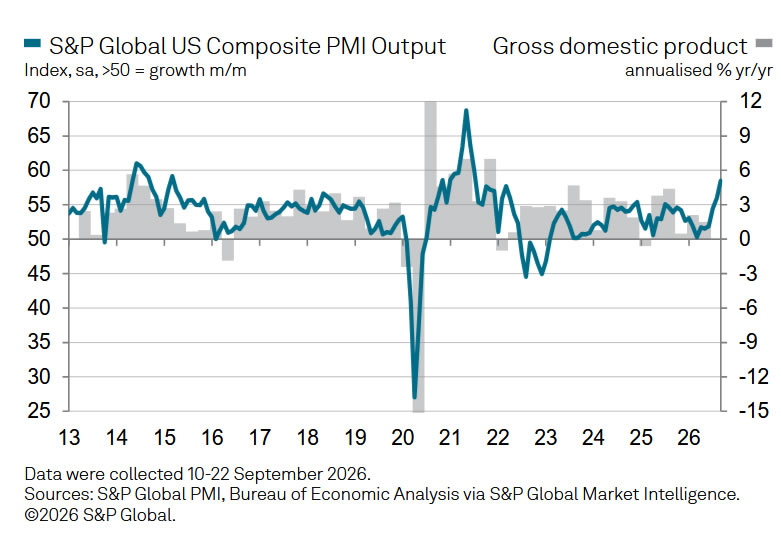
US business activity accelerated sharply in September, with PMI Manufacturing rising from 53.9 to 57.0, PMI Services from 56.5 to 58.7, and PMI Composite from 56.0 to 58.4. The Composite reading was the highest in 62 months, while manufacturing and services reached 52- and 59-month highs respectively. Growth accelerated for a fourth straight month, with services activity expanding at the fastest pace in more than five years and manufacturing output strengthening from 53.1 to 56.7, its best reading since April 2022.
The strength was broad-based. New orders accelerated in both sectors, reaching their fastest pace since March 2022 in services and April 2022 in manufacturing, with domestic demand providing the main support. Capacity pressures also intensified: backlogs rose at the fastest rate since May 2022, while employment increased at the strongest pace since June 2022. Manufacturing payroll growth was particularly strong, reaching its fastest rate since February 2021. S&P Global Chief Business Economist Chris Williamson said US business is “clearly booming now in both manufacturing and services,” with historical comparisons pointing to around 5% annualized growth at the current survey pace and about 4% for Q3 as a whole.
The downside was a renewed intensification of price pressures. Overall input-cost inflation rose to the highest since October 2022 as fuel and transport costs increased sharply, while wage pressures also picked up. Service-sector input costs rose at the fastest pace since November 2022, and manufacturing supply delays were the most widespread since July 2022. Selling-price inflation also accelerated from August, although it remained below the rates seen between March and July. Williamson warned that rising backlogs and capacity constraints were increasing firms’ pricing power, while input costs jumped at the fastest rate in four years.
Data Summary
| Indicator | September | August | Trend |
|---|---|---|---|
| PMI Manufacturing | 57.0 | 53.9 | 52-month high |
| PMI Services | 58.7 | 56.5 | 59-month high |
| PMI Composite | 58.4 | 56.0 | 62-month high |
| Manufacturing Output | 56.7 | 53.1 | 53-month high |
The September flash survey showed a broad acceleration across both manufacturing and services, with the Composite reaching its strongest level since July 2021.
Components
| Component | Trend |
|---|---|
| New orders | Accelerated in both sectors; strongest since March 2022 in services and April 2022 in manufacturing |
| Domestic demand | Main driver of growth |
| Exports | Goods exports continued to fall; services exports rose only modestly |
| Backlogs | Rose at fastest pace since May 2022 |
| Employment | Fastest overall increase since June 2022 |
| Manufacturing jobs | Strongest growth since February 2021 |
| Supply chains | Delivery delays most widespread since July 2022 |
| Input costs | Fastest overall increase since October 2022 |
| Services input costs | Highest since November 2022 |
| Selling prices | Accelerated from August, but remained below March-July rates |
| Business expectations | Unchanged; manufacturing confidence stronger than services |
Demand, hiring and capacity utilization all strengthened together, while cost pressures intensified as fuel, transport and wage costs rose.
Key Takeaways
- US business activity accelerated for a fourth consecutive month, with PMI Composite reaching a 62-month high at 58.4.
- The improvement was broad-based, with both manufacturing and services recording their strongest readings in more than four years.
- Domestic demand was the main engine, while export performance remained much softer.
- Labor demand strengthened materially, with overall employment growth the fastest since June 2022 and manufacturing jobs growth the strongest since February 2021.
- Rising backlogs and worsening supply delays point to tighter operating capacity, increasing firms’ pricing power.
- Overall input-cost inflation reached its highest since October 2022, driven by higher fuel and transport costs alongside stronger wage pressures.
- S&P Global’s Chris Williamson said the survey was consistent with around 5% annualized growth at the latest pace and roughly 4% growth for Q3 as a whole, while warning that capacity constraints are worsening the inflation outlook.





