


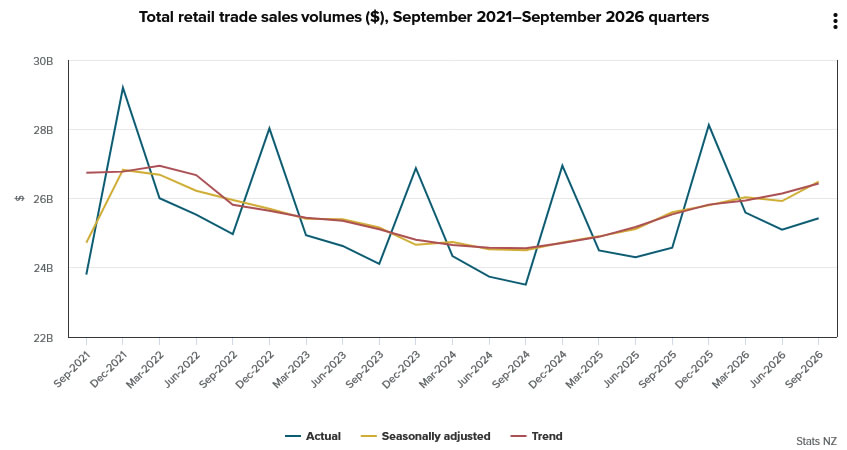
New Zealand’s retail sales volumes surged 2.2% qoq in Q3, rebounding from -0.5% contraction in Q2 and far exceeding market expectations of 0.5% growth. The increase, equivalent to NZD 561m, was the strongest quarterly expansion since Q4 2021, according to Stats NZ. Retail sales excluding motor vehicles also strengthened from 0.7% to 1.4%, beating expectations of 0.8%.
The improvement was broad-based, with sales volumes rising in 11 of 15 retail industries. Fuel retailing recorded the strongest percentage increase at 9.5%, followed by pharmaceutical and other store-based retailing at 6.4% and motor vehicle and parts retailing at 3.8%. Supermarket and grocery sales volumes rose 1.7%, while food and beverage services increased 1.9%. Seasonally adjusted retail sales values also climbed 2.4% to NZD 33bn, with nominal sales increasing across all 16 regions.
The stronger-than-expected rebound points to a substantial improvement in household spending activity during Q3. Growth across most retail categories, together with the solid increase in sales excluding motor vehicles, suggests the expansion was not dependent on a single sector. Importantly, the headline figures measure inflation-adjusted volumes, confirming that the improvement reflected higher real retail activity rather than simply rising prices. While the strength of the quarterly rebound is encouraging, further evidence will be needed to establish whether consumer spending can sustain this momentum.
Data Summary — NZ Retail Sales Q3 2026
| Indicator | Q3 | Exp. | Q2 |
|---|---|---|---|
| Retail sales volume (qoq) | +2.2% | +0.5% | -0.5% |
| Retail sales ex autos (qoq) | +1.4% | +0.8% | +0.7% |
| Retail sales value (qoq) | +2.4% | — | — |
Key Takeaways
- Retail sales volumes recorded their strongest quarterly growth since Q4 2021, significantly exceeding expectations and reversing Q2’s contraction.
- Growth across 11 of 15 industries, alongside stronger sales excluding autos, indicates a broad-based improvement in real retail activity.
- The rebound provides encouraging evidence of firmer household spending, although its sustainability requires confirmation in subsequent quarters.