Sample Category Title
(FED) Minutes of the Federal Open Market Committee October 31-November 1, 2017
A joint meeting of the Federal Open Market Committee and the Board of Governors was held in the offices of the Board of Governors of the Federal Reserve System in Washington, D.C., on Tuesday, October 31, 2017, at 1:30 p.m. and continued on Wednesday, November 1, 2017, at 9:00 a.m.
PRESENT:
Janet L. Yellen, Chair
William C. Dudley, Vice Chairman
Lael Brainard
Charles L. Evans
Patrick Harker
Robert S. Kaplan
Neel Kashkari
Jerome H. Powell
Randal K. Quarles
Raphael W. Bostic, Loretta J. Mester, Mark L. Mullinix, and John C. Williams, Alternate Members of the Federal Open Market Committee
James Bullard, Esther L. George, and Eric Rosengren, Presidents of the Federal Reserve Banks of St. Louis, Kansas City, and Boston, respectively
Brian F. Madigan, Secretary
Matthew M. Luecke, Deputy Secretary
David W. Skidmore, Assistant Secretary
Michelle A. Smith, Assistant Secretary
Mark E. Van Der Weide, General Counsel
Michael Held, Deputy General Counsel
Steven B. Kamin, Economist
Thomas Laubach, Economist
David W. Wilcox, Economist
James A. Clouse, Thomas A. Connors, Daniel G. Sullivan, William Wascher, Beth Anne Wilson, and Mark L.J. Wright, Associate Economists
Simon Potter, Manager, System Open Market Account
Lorie K. Logan, Deputy Manager, System Open Market Account
Ann E. Misback, Secretary, Office of the Secretary, Board of Governors
Matthew J. Eichner, Director, Division of Reserve Bank Operations and Payment Systems, Board of Governors; Michael S. Gibson, Director, Division of Supervision and Regulation, Board of Governors; Andreas Lehnert, Director, Division of Financial Stability, Board of Governors
Daniel M. Covitz, Deputy Director, Division of Research and Statistics, Board of Governors; Rochelle M. Edge and Stephen A. Meyer, Deputy Directors, Division of Monetary Affairs, Board of Governors
Trevor A. Reeve, Senior Special Adviser to the Chair, Office of Board Members, Board of Governors
John M. Roberts, Special Adviser to the Board, Office of Board Members, Board of Governors
Linda Robertson, Assistant to the Board, Office of Board Members, Board of Governors
David E. Lebow, Senior Associate Director, Division of Research and Statistics, Board of Governors
Antulio N. Bomfim and Ellen E. Meade, Senior Advisers, Division of Monetary Affairs, Board of Governors
Shaghil Ahmed and Joseph W. Gruber, Associate Directors, Division of International Finance, Board of Governors; David López-Salido, Associate Director, Division of Monetary Affairs, Board of Governors
Stephanie R. Aaronson, Burcu Duygan-Bump, and Glenn Follette, Assistant Directors, Division of Research and Statistics, Board of Governors; Christopher J. Gust, Assistant Director, Division of Monetary Affairs, Board of Governors
Penelope A. Beattie, Assistant to the Secretary, Office of the Secretary, Board of Governors
David H. Small, Project Manager, Division of Monetary Affairs, Board of Governors
Youngsuk Yook, Principal Economist, Division of Research and Statistics, Board of Governors
Jonathan E. Goldberg, Senior Economist, Division of Monetary Affairs, Board of Governors
Randall A. Williams, Senior Information Manager, Division of Monetary Affairs, Board of Governors
James Narron, First Vice President, Federal Reserve Bank of Philadelphia
David Altig, Kartik B. Athreya, Mary Daly, Jeff Fuhrer, Ellis W. Tallman, and Christopher J. Waller, Executive Vice Presidents, Federal Reserve Banks of Atlanta, Richmond, San Francisco, Boston, Cleveland, and St. Louis, respectively
Marc Giannoni and Paolo A. Pesenti, Senior Vice Presidents, Federal Reserve Banks of Dallas and New York, respectively
Sarah K. Bell, Satyajit Chatterjee, and Jonathan L. Willis, Vice Presidents, Federal Reserve Banks of New York, Philadelphia, and Kansas City, respectively
Selection of Committee Officer
By unanimous vote, the Committee selected James A. Clouse to serve as secretary, effective on November 26, 2017. This selection is effective until the selection of a successor at the Committee's first regularly scheduled meeting in 2018.
Developments in Financial Markets and Open Market Operations
The manager of the System Open Market Account (SOMA) reported on developments in domestic and foreign financial markets since the September FOMC meeting. Broad equity price indexes extended earlier increases, yields on longer-term Treasury securities rose, yield spreads on corporate bonds declined, and the foreign exchange value of the dollar increased. Money market interest rates suggested that market participants did not anticipate a change in the Committee's target range for the federal funds rate at this meeting but saw a high probability of a 25 basis point increase at the Committee's December meeting.
The deputy manager followed with a briefing on money market developments and open market operations. Over the intermeeting period, federal funds continued to trade near the center of the FOMC's target range except on quarter-end. Implementation of the Committee's balance sheet normalization program, which began in October, had proceeded smoothly so far. Take-up at the System's overnight reverse repurchase agreement facility averaged slightly more than in the previous period. A rebalancing of the SOMA's holdings of euro reserves, which reflected instructions provided by the Foreign Currency Subcommittee in September, was completed in October.
By unanimous vote, the Committee ratified the Open Market Desk's domestic transactions over the intermeeting period. There were no intervention operations in foreign currencies for the System's account during the intermeeting period.
Staff Review of the Economic Situation
The information reviewed for the October 31-November 1 meeting indicated that labor market conditions generally continued to strengthen and that real gross domestic product (GDP) expanded at a solid pace in the third quarter despite hurricane-related disruptions. Although the effects of the recent hurricanes led to a reported decline in payroll employment in September, the unemployment rate decreased further. Retail gasoline prices jumped in the aftermath of the hurricanes, but total consumer price inflation, as measured by the 12‑month percentage change in the price index for personal consumption expenditures (PCE), remained below 2 percent in September and was lower than early in the year. Survey‑based measures of longer-run inflation expectations were little changed on balance.
Total nonfarm payroll employment was reported to have decreased in September, consistent with a substantial increase in the number of people who reported themselves as being absent from work due to bad weather and with payroll declines in the hurricane-affected states of Texas and Florida. However, the national unemployment rate moved down to 4.2 percent in September, and the labor force participation rate rose. The unemployment rates for African Americans, for Hispanics, and for whites were lower in September than around the start of the year, while the rate for Asians was roughly flat this year; the unemployment rates for each of these groups were close to the levels seen just before the most recent recession. The overall share of workers employed part time for economic reasons edged down in September, and the rates of private-sector job openings and quits were unchanged in August. The four-week moving average of initial claims for unemployment insurance benefits moved back down to a low level by late October after rising in September following the hurricanes. Recent readings showed a modest pickup in growth of labor compensation. The employment cost index for private workers increased 2-1/2 percent over the 12 months ending in September, a little faster than in the 12-month period ending a year earlier. Increases in average hourly earnings for all employees stepped up to a rate of almost 3 percent over the 12 months ending in September; however, a portion of that acceleration possibly reflected a hurricane-related reduction in the number of lower-wage workers reported as having been paid during the reference week in September.
Total industrial production (IP) increased somewhat in September, reflecting output gains in manufacturing, in mining, and in utilities; the effects of the hurricanes appeared to hold IP down less in September than in August. Automakers' schedules indicated that light motor vehicle assemblies would increase in the fourth quarter. Broader indicators of manufacturing production, such as the new orders indexes from national and regional manufacturing surveys, pointed to an expansion in factory output in the near term.
Real PCE growth slowed in the third quarter, likely reflecting in part temporary effects of the hurricanes. Recent readings on key factors that influence consumer spending--including gains in real disposable personal income and households' net worth--remained supportive of solid increases in real PCE in the near term. Consumer sentiment in October, as measured by the University of Michigan Surveys of Consumers, was at its highest level since before the most recent recession.
Real residential investment declined further in the third quarter. Starts of both new single-family homes and multifamily units moved down in September. However, building permit issuance for new single-family homes--which tends to be a good indicator of the underlying trend in construction of such homes--edged up in September. Sales of new homes increased notably over the two months ending in September, although sales of existing homes decreased somewhat over that period.
Real private expenditures for business equipment and intellectual property continued to rise at a brisk pace in the third quarter. Nominal orders and shipments of nondefense capital goods excluding aircraft rose further over the two months ending in September, and readings on business sentiment remained upbeat. In contrast, real investment spending for nonresidential structures declined in the third quarter, as a further increase in the drilling and mining sector was more than offset by a decline in other sectors, particularly manufacturing.
Total real government purchases were about flat in the third quarter. Real federal purchases rose somewhat, mostly reflecting increased defense expenditures. In contrast, real purchases by state and local governments declined a little, as construction spending by these governments fell.
The nominal U.S. international trade deficit narrowed in August, as exports rose and imports fell. Export growth was driven by higher exports of capital goods and consumer goods, while the import decline was led by lower imports of industrial supplies and capital goods. Advance estimates for September suggested that goods imports grew more than exports, pointing to a widening of the monthly trade deficit. Despite this widening, net exports were reported to have contributed positively to real GDP growth for the third quarter as a whole.
Total U.S. consumer prices, as measured by the PCE price index, increased a bit more than 1-1/2 percent over the 12 months ending in September. Core PCE price inflation, which excludes changes in consumer food and energy prices, was about 1-1/4 percent over that same period. Retail gasoline prices moved up sharply following the hurricanes and put upward pressure on total PCE prices in August and September; gasoline prices subsequently moved down somewhat through late October. The consumer price index (CPI) rose 2-1/4 percent over the 12 months ending in September, while core CPI inflation was 1-3/4 percent. Recent readings on survey-based measures of longer-run inflation expectations--including those from the Michigan survey, the Blue Chip Economic Indicators, and the Desk's Survey of Primary Dealers and Survey of Market Participants--were little changed on balance.
Foreign economic activity continued to expand at a solid pace. Incoming data suggested that in most advanced foreign economies (AFEs), economic growth slowed in the third quarter but remained firm. Economic activity in the emerging market economies (EMEs) also continued to grow briskly for the most part, especially in Asia. The Mexican economy, however, contracted in the third quarter, in part because hurricanes and earthquakes disrupted economic activity. Headline inflation in the AFEs generally remained subdued, but U.K. inflation stayed above the Bank of England's 2 percent target. Low inflation persisted in most EMEs as well, although rising food prices continued to put upward pressure on inflation in Mexico.
Staff Review of the Financial Situation
Movements in domestic financial asset prices over the intermeeting period reflected FOMC communications that were read as slightly less accommodative than expected, economic data releases that were generally better than anticipated, and market perceptions that U.S. tax reform was becoming more likely. On net, Treasury yields increased modestly, U.S. equity prices moved up, and the dollar appreciated. There was no discernible reaction in financial markets to the widely anticipated announcement of the FOMC's change to its balance sheet policy. Meanwhile, domestic financing conditions generally remained accommodative. Corporate bond spreads narrowed modestly, and corporations continued to tap credit markets at a solid pace. Credit also remained readily available to households, except for higher-risk borrowers in some markets.
FOMC communications over the intermeeting period were reportedly viewed by investors as slightly less accommodative than expected. The Committee's decisions at the September FOMC meeting to leave the target range for the federal funds rate unchanged and to announce the start of its balance sheet normalization program in October had been widely anticipated by the public. However, market participants noted that the medians of projections for the federal funds rate in the September Summary of Economic Projections (SEP) were unchanged, whereas some investors had expected slight downward revisions. In addition, market commentaries observed that, despite low inflation readings in recent months, the characterization of the inflation outlook in the September policy statement was little changed and the SEP showed only modest downward revisions to FOMC participants' near-term inflation projections. Communications by FOMC participants were also seen as reinforcing expectations for continued gradual removal of policy accommodation. The probability of an increase in the target range for the federal funds rate occurring at the October-November meeting, as implied by quotes on federal funds futures contracts, remained essentially zero; the probability of an increase at the December meeting rose to about 85 percent by the end of the intermeeting period. Levels of the federal funds rate at the end of 2018 and 2019 implied by overnight index swap rates moved up moderately.
The nominal Treasury yield curve shifted up and flattened somewhat over the intermeeting period. Yields increased following the September FOMC meeting and in response to news regarding proposals for tax reform. They also rose, on net, following domestic economic data releases, which generally came in above investors' expectations. Option-adjusted spreads on current-coupon mortgage-backed securities (MBS) over Treasury yields were little changed. The FOMC's September announcement that it would begin implementing in October its plan for normalizing the Federal Reserve's balance sheet was widely anticipated and appeared to have had little effect on either Treasury yields or MBS spreads. Near-term measures of option-implied volatility on 10-year swap rates remained near historically low levels. Measures of inflation compensation based on Treasury Inflation-Protected Securities declined somewhat following the slightly lower-than-expected September CPI data but were little changed on net.
Broad equity price indexes rose notably, reportedly reflecting in part investors' perceptions that tax reform was becoming more likely. One-month-ahead option-implied volatility on the S&P 500 index--the VIX--remained near historically low levels. Spreads of yields on both investment- and speculative-grade corporate bonds over comparable-maturity Treasury securities narrowed modestly.
Conditions in short-term funding markets remained stable over the intermeeting period. The effective federal funds rate held steady, and rates and volumes in other unsecured and secured overnight and term funding markets continued to be stable aside from quarter-end. At the end of September, changes in money market rates and volumes were short lived and in line with previous quarter-ends.
Financing conditions for large nonfinancial firms remained accommodative. In September, the pace of gross equity issuance was about in line with that observed in recent months, gross issuance of corporate bonds dipped somewhat but stayed high by historical standards, and originations of institutional leveraged loans that raised new funds were robust. The credit performance of bonds issued by, and loans extended to, nonfinancial corporations also remained strong over the intermeeting period. Meanwhile, growth of banks' commercial and industrial (C&I) loans continued to be sluggish, although it picked up a bit in the third quarter. Responses to the October Senior Loan Officer Opinion Survey on Bank Lending Practices (SLOOS) suggested that lackluster demand among banks' business customers was a key factor in this subdued growth. The survey also reported a notable increase in the share of banks that narrowed loan spreads for C&I loans over the previous three months, with many respondents citing more aggressive competition from other bank or nonbank lenders as an important reason for doing so.
Financing flows for commercial real estate (CRE) were more robust in the commercial mortgage-backed securities (CMBS) market than from banks in the third quarter. Issuance of CMBS continued to be robust and in line with last year's pace. Spreads on lower-rated CMBS over Treasury securities widened slightly over the intermeeting period but remained near the lower end of the range seen since the financial crisis. Delinquency rates on loans in CMBS pools continued to decline in September. Meanwhile, CRE loan growth at banks slowed, especially for nonfarm nonresidential loans. In the October SLOOS, banks reported that demand for CRE loans weakened, on net, over the third quarter and that lending standards continued to be somewhat tight.
Credit conditions in the residential mortgage market stayed accommodative in the third quarter for most borrowers. However, credit standards continued to be tight for borrowers with low credit scores or hard-to- document incomes. The October SLOOS suggested that the recent slowdown in mortgage originations for home purchases was partly attributable to weaker demand.
Consumer credit continued to expand at a moderate pace in the third quarter. However, the October SLOOS indicated that banks continued to tighten their credit policies for auto and credit card loans. Credit bureau data on loan originations and credit limits suggested that this tightening was most pronounced in the subprime segment of the market.
The broad index of the foreign exchange value of the dollar rose nearly 3 percent over the intermeeting period amid the rise in U.S. interest rates, market expectations that U.S. tax reform was becoming more likely, and foreign central bank actions and communications. The Canadian dollar depreciated significantly over the period and Canadian yields declined as the Bank of Canada left its policy rate unchanged and comments by the bank's governor were interpreted as more accommodative than expected. The euro also depreciated, despite the European Central Bank's (ECB's) announcement of a step-down in asset purchases next year, reflecting slight declines in investors' expectations for ECB policy rates and in German long-term sovereign yields. EME currencies generally depreciated as well, most notably the Turkish lira and the Mexican peso, the latter of which was held down in part by uncertainty about negotiations on the North American Free Trade Agreement. Most foreign equity indexes increased. In Japan, equity indexes rose notably in advance of parliamentary elections that resulted in a strong victory for Prime Minister Abe's ruling coalition, a development seen by market participants as signaling a continuation of stimulative economic policies.
The staff provided its latest report on vulnerabilities of the U.S. financial system. The staff continued to judge that the overall vulnerabilities were moderate: Asset valuation pressures across markets were judged to have increased slightly, on balance, since the previous assessment in July and to have remained elevated; leverage in the nonfinancial sector stayed moderate; and, in the financial sector, leverage and vulnerabilities from maturity and liquidity transformation continued to be low. In addition, the staff assessed overall vulnerabilities to foreign financial stability as moderate. The staff highlighted specific vulnerabilities in some foreign economies, including--depending on the country--still-weak banks, heavy indebtedness in the corporate or household sector or both, rising property prices, overhangs of sovereign debt, and significant susceptibility to various political developments.
Staff Economic Outlook
The U.S. economic projection prepared by the staff for this FOMC meeting was broadly similar to the previous forecast. Real GDP was expected to rise at a solid pace in the fourth quarter of this year, boosted in part by a rebound in spending and production after the negative effects of the hurricanes in the third quarter. Payroll employment was also expected to rebound during the fourth quarter. Beyond 2017, the forecast for real GDP growth was essentially unrevised. In particular, the staff continued to project that real GDP would expand at a modestly faster pace than potential output through 2019. The unemployment rate was projected to decline gradually over the next couple of years and to continue running below the staff's estimate of its longer-run natural rate over this period.
The staff's forecast for total PCE price inflation was little changed for 2017, as a somewhat higher forecast for consumer energy prices was mostly offset by a slightly lower forecast for core PCE prices. Although total PCE price inflation was forecast to be about the same in 2017 as it was last year, core PCE price inflation was anticipated to be a little lower than in 2016, and consumer food and energy price inflation was expected to be a little higher. Total PCE price inflation was projected to pick up in 2018, as most of the softness in core PCE price inflation this year was expected to be transitory. However, the staff's forecasts for core inflation and, thus, for total inflation were revised down slightly for next year, reflecting the judgment that a bit of the unexplained weakness in core inflation this year may carry over into next year. Beyond 2018, the inflation forecast was unchanged from the previous projection. The staff continued to project that inflation would reach the Committee's 2 percent objective in 2019.
The staff viewed the uncertainty around its projections for real GDP growth, the unemployment rate, and inflation as similar to the average of the past 20 years. On the one hand, many indicators of uncertainty about the macroeconomic outlook continued to be subdued; on the other hand, considerable uncertainty remained about a number of federal government policies. The staff saw the risks to the forecasts for real GDP growth and the unemployment rate as balanced. The risks to the projection for inflation also were seen as balanced. Downside risks included the possibilities that longer-term inflation expectations may have edged lower or that the run of soft readings on core inflation this year could prove to be more persistent than the staff expected. These downside risks were seen as essentially counterbalanced by the upside risk that inflation could increase more than expected in an economy that was projected to move further above its longer-run potential.
Participants' Views on Current Conditions and the Economic Outlook
In their discussion of the economic situation and the outlook, meeting participants agreed that information received since the FOMC met in September indicated that the labor market had continued to strengthen and that economic activity had been rising at a solid rate despite hurricane-related disruptions. Although the hurricanes depressed payroll employment in September, the unemployment rate, which was less affected by the storms, declined further. Household spending had been expanding at a moderate rate, and growth in business fixed investment had picked up in recent quarters. Gasoline prices rose in the aftermath of the hurricanes, boosting overall inflation in September; however, inflation for items other than food and energy remained soft. On a 12-month basis, both inflation measures had declined this year and were running below 2 percent. Market-based measures of inflation compensation remained low; survey-based measures of longer-term inflation expectations were little changed, on balance.
Participants acknowledged that hurricane-related disruptions and rebuilding would continue to affect economic activity in the near term, and they noted that, in October, wildfires in California had displaced many households. Past experience, however, suggested that the economic effects of the hurricanes and other natural disasters would be mostly temporary and unlikely to materially alter the course of the national economy over the medium term. Participants saw the incoming information on spending and the labor market as consistent with continued above-trend economic growth and a further strengthening in labor market conditions, although the hurricanes, in particular, made it more difficult than usual to interpret some of this information. They continued to expect that, with gradual adjustments in the stance of monetary policy, economic activity would expand at a moderate pace and labor market conditions would strengthen somewhat further. Inflation on a 12‑month basis was expected to remain somewhat below 2 percent in the near term but to stabilize around the Committee's 2 percent objective over the medium term. Near-term risks to the economic outlook appeared to be roughly balanced, but participants agreed that it would be important to continue to monitor inflation developments closely.
Participants expected solid growth in consumer spending in the near term, supported by ongoing strength in the labor market, improved household balance sheets, and a high level of consumer sentiment. Robust gains in consumer spending in September were viewed as consistent with that outlook. Light motor vehicle sales had rebounded in September, and District contacts generally expected sales to remain strong in the near term, boosted in part by demand to replace vehicles destroyed by the hurricanes.
Reports on business spending from District contacts were generally upbeat. Participants anticipated appreciable increases in business fixed investment. Improved demand from abroad, rising business profits, and the substitution of capital for labor in response to tightening labor markets were viewed as factors supporting growth in investment. Several participants reported that business contacts appeared to be more confident about the economic outlook and thus more inclined to undertake capital expansion plans. In that context, it was noted that the expansion in business fixed investment could be given additional impetus if legislation involving tax reductions was enacted; a few participants judged that the prospects for significant tax cuts had risen recently. Some firms, especially those operating in industries in which technological advances were spurring competition, were reportedly planning to expand capacity through mergers and acquisitions rather than through investment in new plant and equipment.
Reports from District contacts about both manufacturing and services were generally positive. District contacts in regions affected by the hurricanes reported that the disruptions to production and sales were mostly short lived, including in the energy sector where drilling and refining outages were temporary. However, some homebuilders were reporting shortages of certain building materials in the aftermath of the hurricanes. Farm incomes in some regions were said to remain under downward pressure because of declining crop and livestock prices.
Participants judged that increases in nonfarm payroll employment, apart from the temporary effects of the hurricanes, remained well above the pace likely to be sustainable in the longer run and that labor market conditions had strengthened further in recent months. Changes in payrolls, as measured by the establishment survey, had been temporarily depressed by the storms in September but were expected to bounce back in later months. Data from the household survey, which generally were viewed as not materially affected by the hurricanes, indicated that the unemployment rate ticked down to 4.2 percent in September, falling further below participants' estimates of its longer-run normal level. Participants also cited other indicators suggesting that labor market conditions continued to strengthen, including increases in the labor force participation rates of both prime-age and all individuals. Reports from some Districts pointed to difficulty attracting and retaining labor, but anecdotal information from other Districts suggested that workers with the requisite skills remained reasonably available. Many participants judged that the economy was operating at or above full employment and anticipated that the labor market would tighten somewhat further in the near term, as GDP was expected to grow at a pace exceeding that of potential output.
Participants discussed wage developments in light of the continued strengthening in labor market conditions. A few participants interpreted recent data on aggregate wage and labor compensation as indicating some firming in wage growth; a few others, however, judged wage growth to have been little changed over the past year. Overall, wage increases were generally seen as modest. A couple of participants expressed the view that, when the rate of labor productivity growth was taken into account, the pace of recent wage gains was consistent with an economy operating near full employment. Reports from District contacts indicated that some businesses facing tight labor markets found it more effective to expand their workforces by using a variety of nonpecuniary means, including offering greater job flexibility and training, rather than by increasing wages. Other District contacts, however, reported some increased wage pressure as a result of tightening labor market conditions.
Gasoline prices rose in the aftermath of the hurricanes, boosting overall inflation in September. Still, on a 12‑month basis, PCE price inflation in September, at 1.6 percent, remained below the Committee's longer-run objective; core PCE price inflation, which excludes consumer food and energy prices, was only 1.3 percent. Many participants judged that much of the recent softness in core inflation reflected temporary or idiosyncratic factors and that inflation would begin to rise once the influence of these factors began to wane. Most participants continued to think that the cyclical pressures associated with a tightening labor market were likely to show through to higher inflation over the medium term.
With core inflation readings continuing to surprise on the downside, however, many participants observed that there was some likelihood that inflation might remain below 2 percent for longer than they currently expected, and they discussed possible reasons for the recent shortfall. Several participants pointed to a diminished responsiveness of inflation to resource utilization, to the possibility that the degree of labor market tightness was less than currently estimated, or to lags in the response of inflation to greater resource utilization as plausible explanations for the continued soft readings on inflation. A few noted that secular influences, such as the effect of technological innovation in disrupting existing business models, were likely offsetting cyclical upward pressure on inflation and contributing to below-target inflation.
In discussing the implications of these developments, several participants expressed concern that the persistently weak inflation data could lead to a decline in longer-term inflation expectations or may have done so already; they pointed to low market-based measures of inflation compensation, declines in some survey measures of inflation expectations, or evidence from statistical models suggesting that the underlying trend in inflation had fallen in recent years. In addition, the possibility was raised that monetary policy actions or communications over the past couple of years, while inflation was below the Committee's 2 percent objective, may have contributed to a decline in longer-run inflation expectations below a level consistent with that objective. Some other participants, however, noted that measures of inflation expectations had remained stable this year despite the low readings on inflation and judged that this stability should support the return of inflation to the Committee's objective.
In their comments regarding financial markets, participants generally judged that financial conditions remained accommodative despite the recent increases in the exchange value of the dollar and Treasury yields. In light of elevated asset valuations and low financial market volatility, several participants expressed concerns about a potential buildup of financial imbalances. They worried that a sharp reversal in asset prices could have damaging effects on the economy. It was noted, however, that elevated asset prices could be partly explained by a low neutral rate of interest. It was also observed that regulatory changes had contributed to an appreciable strengthening of capital and liquidity positions in the financial sector over recent years, increasing the resilience of the financial system to potential reversals in valuations.
A few participants mentioned the limited reaction in financial markets to the announcement and initial implementation of the Committee's plan for gradually reducing the Federal Reserve's securities holdings. It was noted that, consistent with that limited response, market participants had characterized the Committee's communications regarding the balance sheet normalization program as clear and effective.
In their discussion of monetary policy, all participants thought that it would be appropriate to maintain the current target range for the federal funds rate at this meeting. Nearly all participants reaffirmed the view that a gradual approach to increasing the target range was likely to promote the Committee's objectives of maximum employment and price stability. Participants commented on several factors that informed their assessments of the appropriate path of the federal funds rate. Several participants noted that the neutral level of the federal funds rate appeared to be quite low by historical standards. Most saw the outlook for economic activity and the labor market as little changed since the September meeting, and participants expected increasing tightness in the labor market to put only gradual upward pressure on inflation. Still, with an accommodative stance of policy, most participants continued to anticipate that inflation would stabilize around the Committee's 2 percent objective over the medium term.
Many participants observed, however, that continued low readings on inflation, which had occurred even as the labor market tightened, might reflect not only transitory factors, but also the influence of developments that could prove more persistent. A number of these participants were worried that a decline in longer-term inflation expectations would make it more challenging for the Committee to promote a return of inflation to 2 percent over the medium term. These participants' concerns were sharpened by the apparently weak responsiveness of inflation to resource utilization and the low level of the neutral interest rate, and such considerations suggested that the removal of policy accommodation should be quite gradual. In contrast, some other participants were concerned about upside risks to inflation in an environment in which the economy had reached full employment and the labor market was projected to tighten further, or about still very accommodative financial conditions. They cautioned that waiting too long to remove accommodation, or removing accommodation too slowly, could result in a substantial overshoot of the maximum sustainable level of employment that would likely be costly to reverse or could lead to increased risks to financial stability. A few of these participants emphasized that the lags in the response of inflation to tightening resource utilization implied that there could be increasing upside risks to inflation as the labor market tightened further.
Participants agreed that they would continue to monitor closely and assess incoming data before making any further adjustment to the target range for the federal funds rate. Consistent with their expectation that a gradual removal of monetary policy accommodation would be appropriate, many participants thought that another increase in the target range for the federal funds rate was likely to be warranted in the near term if incoming information left the medium-term outlook broadly unchanged. Several participants indicated that their decision about whether to increase the target range in the near term would depend importantly on whether the upcoming economic data boosted their confidence that inflation was headed toward the Committee's objective. A few other participants thought that additional policy firming should be deferred until incoming information confirmed that inflation was clearly on a path toward the Committee's symmetric 2 percent objective. A few participants cautioned that further increases in the target range for the federal funds rate while inflation remained persistently below 2 percent could unduly depress inflation expectations or lead the public to question the Committee's commitment to its longer-run inflation objective.
In view of the persistent shortfall of inflation from the Committee's 2 percent objective and questions about whether longer-term inflation expectations were consistent with achievement of that objective, a couple of participants discussed the possibility that potential alternative frameworks for the conduct of monetary policy could be helpful in fulfilling the Committee's statutory mandate. One question, for example, was whether a framework that generally sought to keep the price level close to a gradually rising path--rather than the current approach in which the Committee does not seek to make up for past deviations of inflation from the 2 percent goal--might be more effective in fostering the Committee's objectives if the neutral level of the federal funds rate remains low.
Committee Policy Action
In their discussion of monetary policy for the period ahead, members judged that information received since the Committee met in September indicated that the labor market had continued to strengthen and that economic activity had been rising at a solid rate despite hurricane-related disruptions. Although the hurricanes depressed payroll employment in September, the unemployment rate declined further. Household spending had been expanding at a moderate rate, and growth in business fixed investment had picked up in recent quarters. Gasoline prices rose in the aftermath of the hurricanes, boosting overall inflation in September; however, inflation for items other than food and energy remained soft. On a 12-month basis, both inflation measures had declined this year and were running below 2 percent. Market-based measures of inflation compensation remained low; survey-based measures of longer-term inflation expectations were little changed, on balance.
Members acknowledged that hurricane-related disruptions and rebuilding would continue to affect economic activity, employment, and inflation in the near term. They noted, however, that past experience suggested that the storm-related disruptions were unlikely to materially alter the course of the national economy over the medium term. Consequently, the Committee continued to expect that, with gradual adjustments in the stance of monetary policy, economic activity would expand at a moderate pace, and labor market conditions would strengthen somewhat further. Inflation on a 12-month basis was expected to remain somewhat below 2 percent in the near term but to stabilize around the Committee's 2 percent objective over the medium term. Members saw the near-term risks to the economic outlook as roughly balanced, but, in light of their concern about the ongoing softness in inflation, they agreed to continue to monitor inflation developments closely.
After assessing current conditions and the outlook for economic activity, the labor market, and inflation, members decided to maintain the target range for the federal funds rate at 1 to 1-1/4 percent. They noted that the stance of monetary policy remained accommodative, thereby supporting some further strengthening in labor market conditions and a sustained return to 2 percent inflation.
Members agreed that the timing and size of future adjustments to the target range for the federal funds rate would depend on their assessments of realized and expected economic conditions relative to the Committee's objectives of maximum employment and 2 percent inflation. They noted that their assessments would take into account a wide range of information, including measures of labor market conditions, indicators of inflation pressures and inflation expectations, and readings on financial and international developments. Members reaffirmed their expectation that economic conditions would evolve in a manner that would warrant gradual increases in the federal funds rate, and that the federal funds rate was likely to remain, for some time, below levels that are expected to prevail in the longer run. Nonetheless, they reiterated that the actual path of the federal funds rate would depend on the economic outlook as informed by incoming data. In particular, members noted that they would carefully monitor actual and expected inflation developments relative to the Committee's symmetric inflation goal. Some members expressed concerns about the outlook for inflation expectations and inflation; they emphasized that, in considering the timing of further adjustments in the federal funds rate, they would be evaluating incoming information to assess the likelihood that recent low readings on inflation were transitory and that inflation was on a trajectory consistent with achieving the Committee's 2 percent objective over the medium term. Several other members, however, were reasonably confident that the economy and inflation would evolve in coming months such that an additional firming would likely be appropriate in the near term.
With the balance sheet normalization program under way and with the balance sheet not anticipated to be used to adjust the stance of monetary policy in response to incoming information in the years ahead, members generally agreed that the statement following this meeting needed to contain only a brief reference to the program and that subsequent statements might not need to mention the program. Balance sheet normalization was expected to proceed gradually, following the plan described in the Addendum to the Policy Normalization Principles and Plans that the Committee released in June.
At the conclusion of the discussion, the Committee voted to authorize and direct the Federal Reserve Bank of New York, until it was instructed otherwise, to execute transactions in the SOMA in accordance with the following domestic policy directive, to be released at 2:00 p.m.:
"Effective November 2, 2017, the Federal Open Market Committee directs the Desk to undertake open market operations as necessary to maintain the federal funds rate in a target range of 1 to 1-1/4 percent, including overnight reverse repurchase operations (and reverse repurchase operations with maturities of more than one day when necessary to accommodate weekend, holiday, or similar trading conventions) at an offering rate of 1.00 percent, in amounts limited only by the value of Treasury securities held outright in the System Open Market Account that are available for such operations and by a per-counterparty limit of $30 billion per day.
The Committee directs the Desk to continue rolling over at auction the amount of principal payments from the Federal Reserve's holdings of Treasury securities maturing during each calendar month that exceeds $6 billion, and to continue reinvesting in agency mortgage-backed securities the amount of principal payments from the Federal Reserve's holdings of agency debt and agency mortgage-backed securities received during each calendar month that exceeds $4 billion. Small deviations from these amounts for operational reasons are acceptable.
The Committee also directs the Desk to engage in dollar roll and coupon swap transactions as necessary to facilitate settlement of the Federal Reserve's agency mortgage-backed securities transactions."
The vote also encompassed approval of the statement below to be released at 2:00 p.m.:
"Information received since the Federal Open Market Committee met in September indicates that the labor market has continued to strengthen and that economic activity has been rising at a solid rate despite hurricane-related disruptions. Although the hurricanes caused a drop in payroll employment in September, the unemployment rate declined further. Household spending has been expanding at a moderate rate, and growth in business fixed investment has picked up in recent quarters. Gasoline prices rose in the aftermath of the hurricanes, boosting overall inflation in September; however, inflation for items other than food and energy remained soft. On a 12-month basis, both inflation measures have declined this year and are running below 2 percent. Market-based measures of inflation compensation remain low; survey-based measures of longer-term inflation expectations are little changed, on balance.
Consistent with its statutory mandate, the Committee seeks to foster maximum employment and price stability. Hurricane-related disruptions and rebuilding will continue to affect economic activity, employment, and inflation in the near term, but past experience suggests that the storms are unlikely to materially alter the course of the national economy over the medium term. Consequently, the Committee continues to expect that, with gradual adjustments in the stance of monetary policy, economic activity will expand at a moderate pace, and labor market conditions will strengthen somewhat further. Inflation on a 12-month basis is expected to remain somewhat below 2 percent in the near term but to stabilize around the Committee's 2 percent objective over the medium term. Near-term risks to the economic outlook appear roughly balanced, but the Committee is monitoring inflation developments closely.
In view of realized and expected labor market conditions and inflation, the Committee decided to maintain the target range for the federal funds rate at 1 to 1-1/4 percent. The stance of monetary policy remains accommodative, thereby supporting some further strengthening in labor market conditions and a sustained return to 2 percent inflation.
In determining the timing and size of future adjustments to the target range for the federal funds rate, the Committee will assess realized and expected economic conditions relative to its objectives of maximum employment and 2 percent inflation. This assessment will take into account a wide range of information, including measures of labor market conditions, indicators of inflation pressures and inflation expectations, and readings on financial and international developments. The Committee will carefully monitor actual and expected inflation developments relative to its symmetric inflation goal. The Committee expects that economic conditions will evolve in a manner that will warrant gradual increases in the federal funds rate; the federal funds rate is likely to remain, for some time, below levels that are expected to prevail in the longer run. However, the actual path of the federal funds rate will depend on the economic outlook as informed by incoming data.
The balance sheet normalization program initiated in October 2017 is proceeding."
Voting for this action: Janet L. Yellen, William C. Dudley, Lael Brainard, Charles L. Evans, Patrick Harker, Robert S. Kaplan, Neel Kashkari, Jerome H. Powell, and Randal K. Quarles.
Voting against this action: None.
Consistent with the Committee's decision to leave the target range for the federal funds rate unchanged, the Board of Governors voted unanimously to leave the interest rates on required and excess reserve balances unchanged at 1-1/4 percent and voted unanimously to approve establishment of the primary credit rate (discount rate) at the existing level of 1-3/4 percent.
It was agreed that the next meeting of the Committee would be held on Tuesday-Wednesday, December 12-13, 2017. The meeting adjourned at 10:30 a.m. on November 1, 2017.
Notation Vote
By notation vote completed on October 10, 2017, the Committee unanimously approved the minutes of the Committee meeting held on September 19-20, 2017.
Aussie Dollar Flash
Aussie Dollar Flash
Seller exhaustion was apparent in the lead up to the FOMC minutes, as shorts continued to unwind. While selling pressure has re-emerged this morning at .7620-.7625, one does get the sense that the FOMC minutes was the last kick of can for the Aussie bears heading into 2018. And given the dovish Fed overtones, for those fortunate to have been riding shorts since the convincing downtrend emerged in mid-Sept, traders will now be more inclined to cover shorts which should temper any near-term downside momentum. And while commodity correlations have weakened of late, Dalian Iron ore is up over 3.5 %, as the Pboc continues to inject cash in an attempt fine-tune their deleveraging act, it still underpins the Aussie dollar sentiment to a degree.
FOMC Participants’ Positive Economic Assessment Reaffirms the Case for a December Hike
The minutes of the Federal Open Market Committee's (FOMC) last meeting showed participants looking through the temporary impact of hurricanes, with many seeing "the economy... operating at or above full employment."
Some participants continue to fret about the persistence of weak inflation and worry that ongoing Fed tightening whilst inflation is below target could push inflation expectations down further and make the target harder to achieve.
Interestingly, a few participants considered whether the Fed should adjust its framework for achieving stable inflation to something akin to a price level target, requiring periods of weak inflation to be followed by stronger inflation in order to keep the overall price level growing at around 2%.
Finally, the minutes emphasized FOMC members' satisfaction with the balance sheet normalization program. Further, "members generally agreed that the statement following this meeting needed to contain only a brief reference to the program and that subsequent statements might not need to mention the program."
Key Implications
With economic data showing a firming in growth through the latter half of 2017 and potentially the longest string of quarterly growth over 3% (annualized) since 2004/2005, a December rate hike is close to a sure thing.
The debate continues to rage amongst Fed participants around when and if inflation will move toward target. Participants' willingness to discuss other possible frameworks toward inflation shows that they are taking recent misses seriously and will react to further deviations from their goal.
Including Janet Yellen's resignation, there are now four Federal Reserve board of governor seats up for grabs. This has the potential to dramatically change the tone and composition of the Federal Reserve and the future course of monetary policy and should be watched closely by investors.
In Yellen We Trust
In Yellen we trust
The market spent the better part of Wednesday paring back USD exposure ahead of the FOMC minutes after Dr Yellen soft pedalled the reflation rhetoric all but signalling to the markets that absentee US inflation remains a substantial concern amongst Fed members. This year the Fed’s top dogs have time and time gain restated their confidence that inflation will revive despite their preferred price measure slipping to 1.3 percent, well below the 2-percent target. But this morning release of FOMC October minutes indicates the board’s ship is listing towards inflation concerns or the lack thereof to be more specific.
Speaking of listing ships, the USD price action is echoing the Markets concerns over inflation. But frankly, the minutes did little more than embody what we’ve heard in recent Fedspeak. However the statement does clear the air of one raging debate, and that’s 2018 rate hikes unambiguously depend more pressingly on inflation than on growth.This apparent shift suggests policy normalisation may be less perceptive to US economic performance than the dollar bulls were anticipating.
Despite the fact that the dollar sold off rather aggressively overnight, APAC currency markets have a ” gone fishing ” feel this morning exhibiting few concerns about the slide. However, with few looking to press the USD issue one way or another, the markets have that distinct holiday feel about them.
Not to sound like the eternal USD bull, I can’t help but think the Feds are looking over their shoulder concerned that if asset prices keep going higher the fear of the asset bubble eruption my outweigh concern about inflation.
Speaking of which, US equity markets to continue to surge reaching Amazonian proportions. The high tech-laden Nasdaq notched out another record high after Amazon share rose 1 % after a deal with their cloud-based unit and Cerner was inked. But Wall Street closed mixed in a low volume day. The Dow Jones Industrial Average and the S&P 500 were a tad softer while the NASDAQ was slightly higher.
The Japanese Yen
USDJPY was under pressure in the lead-up tot he FOMC but experience a cascading effect lower as stop-loss selling intensified on a break of the 111.60 support line after the minutes were released. How much liquidity conditions undermined the dollar weakness is tough to gauge, but the dovish FOMC rhetoric is not.
The Euro
Besides the FOMC minutes catalyst, the Euro is getting a bonus bounce from reports that the EU and UK will come to terms with the Brexit divorce bill
Asia FX
Its all aboard the ASEAN party bus USDTWD, USDKRW USDMYR and USDTHB are hitting fresh year lows.
The Korean Won
In addition to the weaker USD narrative, supportive inflows, strong domestic Macro conditions and BoK rate expectations bolstering the Won, the latest bounce comes on the back of long dollar hedge unwinds as geopolitical risk abates.
Malaysian Ringgit
Besides the Macro bounce supporting the MYR the weaker USD post FOMC minutes will continue to support over the short-term
And while the only thing that does matter for oil prices is the month end OPEC meeting, WTI oil prices managed to hang on to yesterday’s gains. Prices were supported by an oil leak in the Keystone pipeline and the EAI report of a decline in US Crude inventories. This does add to the positive MYR narrative
But the primary catalyst for the stronger MYR over the past 24 hours is surging Bond and Equity inflows which are accelerating real demand for the Ringgit
Philippine Peso
Like the regional peers, the Peso is expected to reap the benefits from US inflation dilemma and softening USD. But the core driver remains a boisterous regional equity rally that is benefiting from capital inflows, solid economic fundamentals and the de-escalation of regional geopolitical tension.
USD/CAD Canadian Dollar Rises On Weak US Data
The Canadian dollar appreciated on Wednesday boosted by US dollar weakness. Oil prices rose to a 2 year high with drawdowns in weekly inventories. The US dollar fell after durable goods orders disappointed with a 1.2 percent fall, although the core reading met expectations at 0.4 percent gain.
The main event in the US before the Thanksgiving holiday was the publication of the Federal Open Market Committee (FOMC) minutes from the November meeting. The market is already pricing in a rate hike in December, but further evidence of the internal debates regarding US inflation were expected. The minutes did not disappoint as there seems to be a strong contingent of Fed voting members who are concerned with weak inflation. That anxiety is not likely going to affect the coming rate hike, but will dampen the pace of rate hikes in 2018.
The NAFTA talks ended the fifth round without much progress and US representative called out Mexico and Canada for not engaging on the provisions that will lead to a rebalanced agreement. This rebalancing refers mainly to the US demands to increase the threshold for autos from 62.5 percent to 85 percent. Other US officials were more optimistic and that progress was made, but more on gelling than actually closing.
Oil prices rose on Wednesday as US weekly inventories showed a larger drawdown than expected as well as comments around an extension to the Organization of the Petroleum Exporting Countries (OPEC) agreement that has stabilized prices. Saudi Arabia is said to be pushing for a 9 month extension to the deal that ends in March and will try to rally the other major producers to agree to it on their November 30 meeting. Russia has not committed to such an agreement, but there are rumours that they would prefer a 6 month extension.
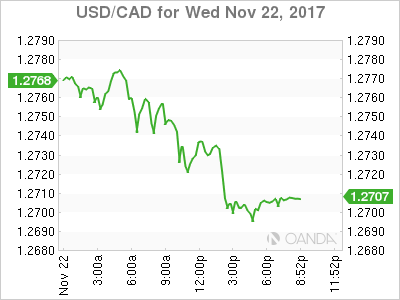
The USD/CAD lost 0.54 percent on Wednesday. The currency is trading at 1.2700 after the release of the November Federal Open Market Committee (FOMC) minutes. Fed voting members are likely to raise US interest rates at the December meeting, but there are concerns that some of them would like to see inflation improve. Given that the market is pricing that eventuality at near 100 percent it already has been fully priced in, so any anxiety about inflation is more likely to affect the future path of rates in 2018.
Fed Chair Janet Yellen will end her term as Chair in February and she will also step down as a Governor of the central bank as was expected when she was the Trump’s administration nominee to remain in the position. Chair Yellen favoured a hike now, inflation later approach that seems to be inline with her successor (appointment pending) Jerome Powell. Dovish voices have risen within the Fed as inflation remains stagnant, but with strong growth data and a central bank willing to normalize monetary policy the Fed is more likely to keep tightening in 2018.
The Bank of Canada (BoC) hiked twice in 2017, but that only put the Canadian benchmark rate back to 1 percent where it was when Governor Poloz cut the rate twice to boost the economy ahead of the fall of oil prices. The loonie will face more pressure as the Fed continues its monetary policy tightening pace, while the BoC will be more cautious as it monitors rising household debt.
The NAFTA renegotiations have not gone according to plan, unless the plan was to not have any progress. The dream of wrapping up negotiations before the end the year is already dead and Mexico and the United States will have to sit down to the table, while electoral noise could disrupt proceedings. Mexico will hold Presidential elections in 2018 and the US primaries will take place next year and if the few elections this year are any indications it could signal a backlash for the Republican establishment.
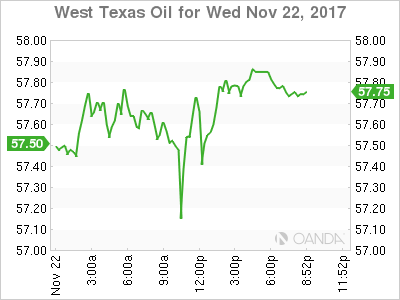
The price of oil rose on Wednesday. The price of West Texas Intermediate is $57.86 as the USD took a tumble ahead of the US Thanksgiving holiday. Oil touched a two year high after the US weekly inventories dropped by 1.9 million barrels. The market was forecasting a lower drawdown, but after the massive drop in API inventories on Tuesday and disruptions in North America, crude continued its way upward. Global supply is lower, thanks to the Organization of the Petroleum Exporting Countries (OPEC) and other major producers agreement to cut production levels and other disruptions to supply around the world.
The OPEC will meet with major producers on November 30 to seek an extension to the deal that takes them beyond the current March deadline.
Market events to watch this week:
Thursday, November 23
4:30 am GBP Second Estimate GDP q/q
8:30 am CAD Core Retail Sales m/m
11:30 am CHF SNB Chairman Jordan Speaks
On The Latest US Dollar Weakness
The main catalyst for US dollar bulls over the past 2 months has been tax reform, but that could also be the catalyst for the bears as Ashraf indicated here and here. The yen was the top performer Wednesday while the US dollar lagged. New Zealand retail sales beat estimates in early Asia-Pacific trading. The Premium Insights took 90-pip gain on 1 of the 2 EURUSD trades. 6 of the existing Premium trades are currently in the green.
For months various markets have been pricing in changes to the US tax code. It's impossible to say exactly what's priced in but it's clear that passing something is more likely than ever. So why the US dollar weakness?
We've been writing this week about the divergence between stock markets and USD/JPY. In the past , there has been a solid correlation between the pair and equity prices. Recently, however, the S&P 500 and Nikkei have soared while USD/JPY has languished.
One theory is that traders are wary of 'selling the fact' and getting out of the way early. Perhaps that's true. Another is that the Fed is increasingly getting worried about low inflation. Today's release of the FOMC minutes showed some members want to hit the pause button after a December hike and wait for inflation to get closer to target. There is probably some truth in that as well.
Back to the tax story. The dollar is selling because of the tax plan. More specifically, the details of the plan. It's increasingly clear this isn't a broad-based tax cut. It's heavily skewed to corporations and the top earners, while offering little to the vast majority of Americans. See Ashraf's notes on the disappointing tax holiday for US multinationals and rising cost of debt in the aforementioned pieces.
Maybe the market is saying that this plan isn't going to boost incomes, wages, investment or growth. Instead it will add to the deficit and lead to spending cuts down the road. What it will do is boost corporate profits and that explains the rosy reaction in stocks.
Whatever the reason for the dollar selling, the USD/JPY chart sent a major signal Wednesday. It broke the 100-day and 200-day moving averages, along with the October low in a 125 pip drop. It was part of a broad dollar rout. It's tempting to brush aside because of the US holidays but this move is too big and long-lasting to ignore.
Looking ahead, the Asia-Pacific calendar is light. Early in trading the Q3 New Zealand retail sales report showed a 0.2% rise excluding inflation. That's better than the +0.1% expected and the kiwi caught a small bid on the release.
Pound Falls after Hammond Downgrades Economic Outlook; Euro Rebounds as Eurozone Consumer Confidence Surprises to the Upside
The British Budget for 2018 was the main focus during today's European trading session, while a strip of economic releases out of the US also attracted some attention. The pound posted short-lived losses after British official budget forecasters downgraded the country's economic outlook, while the dollar dipped into losses after strong flash readings on eurozone confidence activated euro bulls.
The British Finance Minister, Philip Hammond, delivered the UK's budget statement for 2018 in the Parliament on Wednesday, announcing that official GDP forecasts were lowered for the next four years. Particularly, he said that the Office for Budget Responsibility is now estimating that GDP will grow by 1.5% in 2017 compared to the 2.0% expected in March. For 2018, growth forecasts were reduced from 1.6% to 1.4%, while an expansion by 1.3% is projected for both 2019 and 2020, below the previous projections of 1.7% and 1.9%. With the economy growing slowly, Hammond will struggle to raise taxes and support public finances at a time when the country is preparing to exit the EU. Pound/dollar lost ground in the wake of the announcement but managed to rebound to 1.3291 in the face of a weaker dollar. On the day, the pair gained 0.40%.
The euro erased earlier losses after flash estimates on Eurozone confidence surprised to the upside. Eurozone consumer confidence rose to its highest in almost 17 years to stand at 0.1 according to November flash estimates by the European Commission. This is the first positive reading for the index since early 2001 and compares to expectations for a reading of -0.8 and October's downwardly revised -1.1 (from the previous -1.0). Euro/dollar reacted positively following the data release, eventually rising to the day's high of 1.1796. The pair last traded close to the aforementioned high (+0.48% on the day).
On the monetary policy front, the ECB is said to delay any policy movements at its December's meeting according to sources familiar with the matter. The central bank decided in October to scale back economic stimulus by halving its asset purchases and extending the asset purchase scheme by nine months, pushing out any prospect of a rate hike until 2019. Although the ECB chief, Mario Draghi said that some decisions may be left for December, sources claimed that they do not "expect any substantial discussion before March or possibly mid-year".
Meanwhile, in the US, new orders for capital goods made in October, declined unexpectedly for the first time after two months of advancing. Analysts had forecasted a smoother rise of 0.3% m/m, but the actual reading came in negative at -1.2%. In September, new orders increased by 2.2% m/m. Excluding volatile items, durable goods orders expanded by 0.4% m/m, below the 0.5% expected and the 1.1% tracked in September.
In other US data, initial jobless claims for the week ending November 17 declined by 12,000 to 239,000 applicants as expected after two weekly consecutive increases. The four-week average gauge, though, inched up to 239,750 as previous marks were revised upwards. The Michigan Consumer Sentiment index beat expectations, rising by 0.9 points in November to 98.5.
The dollar index slipped to 93.53 (-0.43%) on the back of a stronger euro. Investors were also worried about a flattening yield curve which could be a sign of a possible economic downturn. Dollar/yen and dollar/swissie sank by 0.80% to 111.51 and 0.9824 respectively. Gold surged by 0.83% to $1,291.20 per ounce.
Later in the day, the FOMC meeting minutes due at 1900GMT might bring further volatility to the market.
Looking at energy markets, oil prices pared some of their gains earned during the Asian session after touching a two-year high early on Wednesday despite the EIA report confirming a decline in US crude oil inventories. The EIA numbers showed that US crude oil stocks decreased by 1.855 million barrels compared to a fall of 1.545 million expected by analysts. However, gasoline production rose by 0.580 million barrels, posting the highest increase since February. WTI crude slipped to $57.39 per barrel but remained 1.0% up on the day. Brent moved down to $57.42 a barrel, gaining 0.14%.
Gold Improves on Dismal Durable Goods Orders
Gold has posted considerable gains in the Wednesday session. In North American trading, the spot price for an ounce of gold is $1290.71, up 0.79% on the day. On the release front, durable goods reports were a mix. Core Durable Goods Orders gained 0.4%, matching the forecast. However, Durable Goods Orders declined 1.4%, well of the forecast of a 0.4% gain. The UoM Consumer Sentiment report came in at 98.5, above the forecast of 98.2 points. Later in the day, the Federal Reserve releases the minutes of its November policy meeting.
The markets are keeping an eye on the Federal Reserve, which will release the November minutes later in the day. In October, the Fed announced that it would taper its balance sheet, and those reductions of $10 billion commenced around the time of the November meeting. The odds of upcoming rate hikes remains very high, with fed futures priced in at 91% and 89%, respectively. If the minutes reinforce the market perception that more markets are just around the corner, the US dollar could gain ground.
As President Trump's tax reform bill winds it way through Congress, gold prices have been fluctuating and traders can expect this to continue when the Senate votes on its version of the bill after Thanksgiving. On Monday, gold prices jumped 1.4%, erasing the losses seen on Friday. President Trump won a major legislative victory when the House of Representatives passed a tax reform bill. However, with the vote largely based on party lines, Republicans will have a tougher battle passing the Senate version of the bill, as the Republicans have a slim majority of 52-48. The tax legislation provides major tax relief and cut corporate taxes from 35% to 20%, and if Congress does enact a new tax code, the US dollar could make strong gains, at the expense of gold.
Pound Higher Despite Lower UK Growth Forecast
The British pound has posted gains in the Wednesday session. In North American trade, GBP/USD is trading at 1.3283, up 0.35% on the day. On the release front, the UK presented the Autumn Budget. In the US, durable goods reports were a mix. Core Durable Goods Orders gained 0.4%, matching the forecast. However, Durable Goods Orders declined 1.4%, well of the forecast of a 0.4% gain. The UoM Consumer Sentiment report came in at 98.5, above the forecast of 98.2 points. Later in the day, the Federal Reserve releases the minutes of its November policy meeting.
British Finance Minister Philip Hammond released the August Budget, which was noteworthy for a large contingency fund for Brexit. Hammond announced he was setting aside GBP 3 billion pounds over the next two years, beefing up the contingency fund of GBP 700 million. Meanwhile, the Office for Budget Responsibility (OBR) downgraded Britain's GDP for 2017, from 2% to 1.5%. The OBR also revised downwards productivity growth and business investment, further signs that the economy could be headed for a down-spin.
There was positive news from British CBI Industrial Order Expectations on Monday, an important barometer of activity in the manufacturing sector. The indicator surged to 17 points in October, rebounding from the September release of -2 points. Manufacturing indicators continue to point upwards, boosted by strong global demand and a weak British pound. Export order books are at their highest levels since 1995, and the markets are predicting that the export and manufacturing sectors will continue to shine in the fourth quarter.
The markets are keeping an eye on the Federal Reserve, which will release the November minutes later in the day. In October, the Fed announced that it would taper its balance sheet, and those reductions of $10 billion commenced around the time of the November meeting. The odds of upcoming rate hikes remains very high, with fed futures priced in at 91% and 89%, respectively. If the minutes reinforce the market perception that more markets are just around the corner, the US dollar could gain ground.
Activity Declines Due to Thanksgiving Celebration
The EUR/USD price keeps consolidating thanks to a short trading week in the US due to the Thanksgiving Day celebration. Investors are also reluctant to open new positions ahead of tomorrow's release of the ECB monetary policy meeting minutes. Some pressure on the greenback came from the durable goods orders report in the US, according to which the indicator decreased by 1.2% in October against forecasted growth of 0.4%. At the same time, the core durable goods orders increased by 0.4% which was in line with the expected figure. The attention of the market today will turn to the FOMC meeting minutes' publication at 19:00 GMT. We should note that Janet Yellen will be leaving the chair and the hawkish sentiment on the market will be hit by the uncertainty concerning the future inflation figures forecasts by the Fed, which have become less certain after the last speech by Mrs. Yellen.
The British pound was negatively affected by the finance minister, Philip Hammond's speech during which he announced that forecasts of economic growth in the UK had worsened due to lower labour force productivity. Tomorrow, investors should pay attention to the preliminary report on British GDP growth for the third quarter.
The aussie quotes grew amid investors uncertainty regarding the US dollar. News on the MI leading index increasing by 0.1% in September had little impact on traders. Activity until the end of the week will be low due to the holiday in the US, but we do not exclude sharp moves due to lower trading volumes.
EUR/USD
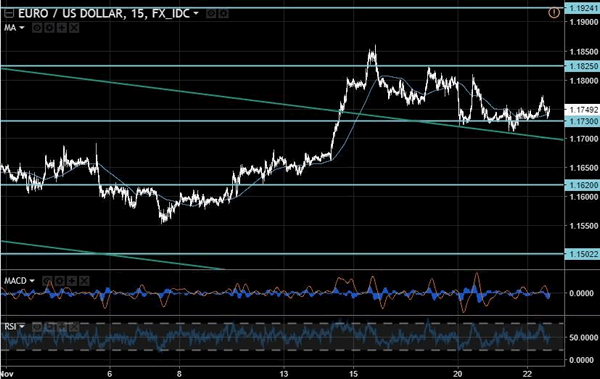
The EUR/USD returned to the support line at 1.1730 but was not able to break through it. The next target in case of rising dynamics will be 1.1825. On the other hand, we do not exclude the price fixing below 1.1730 which may become a trigger for a sharp decline to 1.1620 or even to 1.1500.
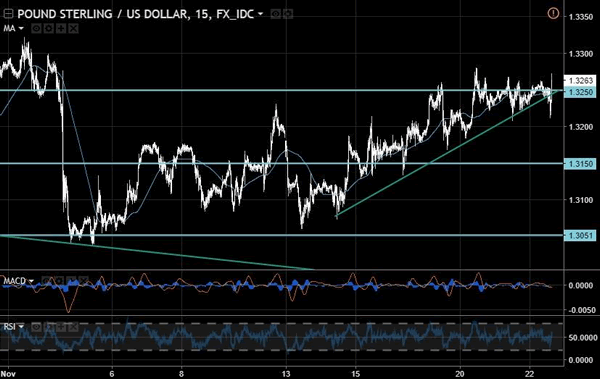
GBP/USD
The GBP/USD has shown a sharp rise in volatility after some consolidation near 1.3250. The gradual decline in the amplitude of price fluctuations, increases the possibility of a powerful impulse in either direction. In case of the price fixing under the inclined support line, the immediate goals will be at 1.3150 and 1.3050. The growth within the next days is likely to be limited at the 1.3400 mark.
AUD/USD
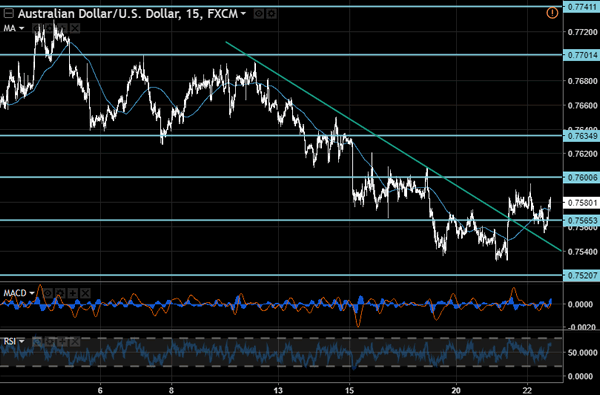
The AUD/USD restored some of the previously lost positions and may continue the rising dynamics to 0.7600 and 0.7635. The RSI on the 15-minute chart is approaching the overbought zone which points to a possible price correction. The MACD signal line on the 15-minute chart just crossed the zero line which is an additional stimulus for the price to continue growing.