Sample Category Title
Theresa May And The European Commission Chief Call For Faster Brexit Talks
For the 24 hours to 23:00 GMT, the GBP declined 0.27% against the USD and closed at 1.3249.
Yesterday, the British Prime Minister, Theresa May and the President of the European Commission, Jean-Claude Juncker, agreed that the pace of negotiations over Britain’s exit from the European Union should be accelerated.
In the Asian session, at GMT0300, the pair is trading at 1.3263, with the GBP trading 0.11% higher from yesterday’s close.
The pair is expected to find support at 1.3221, and a fall through could take it to the next support level of 1.318. The pair is expected to find its first resistance at 1.3308, and a rise through could take it to the next resistance level of 1.3354.
Going ahead, traders would eye a speech by the Bank of England (BoE) Governor, Mark Carney as well as the release of UK’s crucial inflation data for September, due to in a few hours.
The currency pair is trading below its 20 Hr and 50 Hr moving averages.

Japanese Yen Reverses Its Losses In The Asian Session
For the 24 hours to 23:00 GMT, the USD rose 0.12% against the JPY and closed at 112.19.
In the Asian session, at GMT0300, the pair is trading at 112.06, with the USD trading 0.12% lower against the JPY from yesterday’s close.
The pair is expected to find support at 111.70, and a fall through could take it to the next support level of 111.35. The pair is expected to find its first resistance at 112.36, and a rise through could take it to the next resistance level of 112.67.
Amid a lack of macroeconomic releases in Japan today, investor sentiment would be determined by global macroeconomic factors.
The currency pair is trading above its 20 Hr and 50 Hr moving averages.

Swiss Franc Trading Marginally Lower This Morning
For the 24 hours to 23:00 GMT, the USD declined 0.06% against the CHF and closed at 0.9757.
In economic news, Switzerland’s total sight deposits remained steady at a level of CHF578.5 billion in the week ended 13 October.
In the Asian session, at GMT0300, the pair is trading at 0.9762, with the USD trading a tad higher against the CHF from yesterday’s close.
The pair is expected to find support at 0.9738, and a fall through could take it to the next support level of 0.9714. The pair is expected to find its first resistance at 0.9778, and a rise through could take it to the next resistance level of 0.9794.
The currency pair is trading above its 20 Hr and 50 Hr moving averages.

Canadian Businesses Still Bullish: BoC’s Autumn Business Outlook Survey
For the 24 hours to 23:00 GMT, the USD rose 0.28% against the CAD and closed at 1.2520.
Yesterday, the Bank of Canada (BoC), in its autumn business outlook survey, revealed continued positive business sentiment across the country, while noting that business activity is becoming more entrenched. Further, the survey highlighted rising expectations for sustained sales growth across regions. However, it also showed several survey indicators moderated from strong summer results.
In the Asian session, at GMT0300, the pair is trading at 1.2525, with the USD trading slightly higher against the CAD from yesterday's close.
The pair is expected to find support at 1.2477, and a fall through could take it to the next support level of 1.243. The pair is expected to find its first resistance at 1.2565, and a rise through could take it to the next resistance level of 1.2606.
With no economic releases in Canada today, traders would focus on global macroeconomic events for further direction.
The currency pair is showing convergence with its 20 Hr moving average and trading above its 50 Hr moving average.

Market Update – Asian Session: Nikkei On Track For 11th Day Of Gains, NZ Inflation Comes In Hotter Than...
Asia Summary
Asian equity markets have opened generally higher, tracking the gains seen during the US session. These opening gains had put the Nikkei 225 on track for its 11th straight gain, while the Topix index was heading towards its 7th straight advance.
Markets in Japan have since pared gains. Shares of Softbank have underperformed and mixed trading in the Japanese banking sector.
At the same time, shares of Kobe Steel have traded higher, after the over 40% losses seen during the prior week amid the company’s data falsification issue. The company is said to have told analysts that it is not having any current funding issues and that it plans to release its corporate earnings, as scheduled, on Oct 30th, according to a Japanese Press report. Coupled with in the gains in Kobe Steel, the sector is moving broadly higher (Nippon Steel +1.5%, JFE +1.4%).
Australian energy companies are generally higher (Woodside Petroleum +0.7%, Santos +1%), following Mondays gain in oil prices. Rio Tinto’s shares have traded higher after its Q3 iron ore shipments beat estimates and it affirmed its full year shipment guidance. Fellow iron-ore miner, BHP, is due to release its quarterly production report on Oct 18th.
In South Korea, video game companies are moving higher. A Chinese official is said to have noted that the government will do its best to lift restrictions related to various types of Korean media.
In China, the small-cap ChiNext index has extended losses after the over 2% decline seen on Monday’s session, with the Oct 18th start of the Communist Party Congress in focus.
Thus far China’s 10-year bond yield has risen again on today’s session, after rising over 2bps on Monday’s session. An economist from the China State Information Center (think tank) said the government should tighten monetary policy, as the room for policy loosening is seen as limited in 2018.
There has been little initial reaction in the bond market following the release of the Reserve Bank of Australia’s Oct policy meeting minutes. Of note the October policy meeting was held on Oct 3rd, which was ahead of the weaker than expected Aug retail sales data which was released on Oct 5th (AUSTRALIA AUG RETAIL SALES M/M: -0.6% V +0.3%E). Looking ahead, the Australia Sept employment change data is due to be released on Thursday Oct 19th.
In New Zealand, the Kiwi initially gained following the above forecast Q3 CPI data. However, the currency has since pared gains. Inflation is still within the RBNZ’s 1-3% target range and a rate hike is not fully priced in until Nov of 2018. Besides this, the government formation talks in New Zealand continue to linger.
Looking ahead to the US session, corporate earnings are starting to pick up with results expected out of companies including Goldman Sachs, Morgan Stanley, Harley Davidson and J&J. UnitedHealth earlier reported better than expected Q3 earnings and in line revenues. Additionally, the company raised its FY17 EPS forecast.
Key economic data
(NZ) NEW ZEALAND Q3 CPI Q/Q: 0.5% V 0.4%E; Y/Y: 1.9% V 1.8%E
(SG) SINGAPORE SEPT NON-OIL DOMESTIC EXPORTS M/M: -11.0% V -2.2%E; Y/Y: -1.1% V 12.7%E;ELECTRONIC EXPORTS Y/Y: -7.9% V 15.0%E
(AU) Australia Sept New Motor Vehicle Sales m/m: -0.5% v 0.0% prior; y/y: -0.8% v 1.7% prior
(NZ) New Zealand RBNZ Q3 Sectoral Factor Model Inflation Index y/y: 1.4% v 1.4% prior
Speakers and Press
Japan
(JP) Japan and US reach agreement to boost cooperation on infrastructure development, financing, maintenance and transport technology - press
(JP) Japan Government Official: No discussion of FX at meetings between US and Japan officials
Korea
(KR) US North Korean envoy Joseph Yun reportedly to travel to Seoul this week – Axios
(KR) North Korea govt reportedly rejects any diplomacy with United States at this point - CNN
China
(CN) State Information Center Economist Zhu Baoliang: China should tighten monetary policy and strengthen property controls - Chinese press
(CN) S&P Comments: China is running unconventional monetary policy
Australia/New Zealand
(AU) RESERVE BANK OF AUSTRALIA (RBA) MEETING MINUTES OCT 3RD: Any rate changes would be dependent on domestic economy; Appreciation in A$ expected to contribute to subdued pricing pressures
(AU) RBA Assistant Gov Ellis (economic): Starting to see spillover effect from public infrastructure spending on non-mining private sector
Asian Equity Indices/Futures (00:00ET)
Nikkei +0.2%, Hang Seng +0.1%; Shanghai Composite +0.1%; ASX200 +0.8%, Kospi +0.2%
Equity Futures: S&P500 -0.0%; Nasdaq100 +0.0%, Dax +0.1%; FTSE100 -0.0%
FX ranges/Commodities/Fixed Income (00:00ET)
EUR 1.1797-1.1775; JPY 112.31-112.04; AUD 0.7857-0.7835;NZD 0.7198-0.7163
Dec Gold -0.6% at $1,295/oz; Nov Crude Oil -0.1% at $51.80/brl; Dec Copper -0.3% at $3.23/lb
(CN) China PBOC injects CNY190B in combined 7-day and 14-day reverse repos v CNY20B in 7-day prior
USD/CNY (CN) PBOC SETS YUAN REFERENCE RATE AT 6.5883 V 6.5839 PRIOR
(JP) Japan MoF sells ¥800.1B in 0.6% (prior 0.6%) 2-yr JGBs; avg yield 0.5900% v 0.5600% prior; bid-to-cover 4.05x v 4.15x prior
(AU) Australia MoF sells A$2.1B in 3% 2047 bonds, yield 3.565%
Equities notable movers
Australia/New Zealand
RIO.AU Reports Q3 Pilbara iron ore production 85.0Mt (100% basis), 83.2Mt y/y; shipments 85.8Mt (100% basis) v 85.2Mte v 80.9Mt y/y; +1.4%
ANZ.AU IOOF to acquire One path pension business for A$975M cash; IOOF has also entered into a 20 year Strategic Alliance Agreement with ANZ
OSH.AU Reports Q3 Rev $380.8M v $332.5M q/q; production 7.91 MMBOE (record high) v 7.2 q/q; +0.8%
CIA.AU Completes series of previously announced financing arrangements raising C$300M; +15%
Japan
5406.JP Told investors that it is not having funding issues at the current time - Japanese Press; +6%
US/Canada
BBD.B.CA Airbus to acquire majority stake in the C Series Aircraft Limited Partnership; +1.3% after hours
UNH Reports Q3 $2.66 adj v $2.58e, Rev $50.3B v $50.3Be, Raises FY17 $10.00 adj v $9.88e (prior $9.75-9.90); +0.7%
Elliott Wave View: AUDUSD Short Term
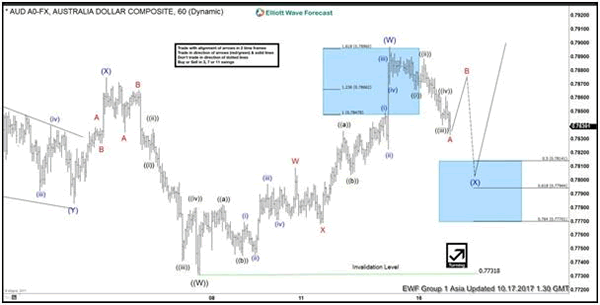
AUDUSD Short term Elliott Wave analysis suggests decline to 0.7731 ended Primary wave ((W)) on 10/6 low. Bounce in Primary wave ((X)) is proposed to be unfolding as a double three Elliott Wave structure. Intermediate wave (W) of ((X)) ended at 0.7897 and Intermediate wave (X) of ((X)) pullback is in progress as a zigzag Elliott Wave structure. Down from 0.7897 high, Minor wave A is proposed complete at 0.7832. While Minor wave B bounce stays below 0.7897, pair should turn lower in Minor wave C of (X) to correct cycle from 10/6 low. Afterwards, as far as pivot at 10/6 low (0.7731) stays intact, expect pair to resume higher.
AUDUSD 1 Hour Elliott Wave Chart
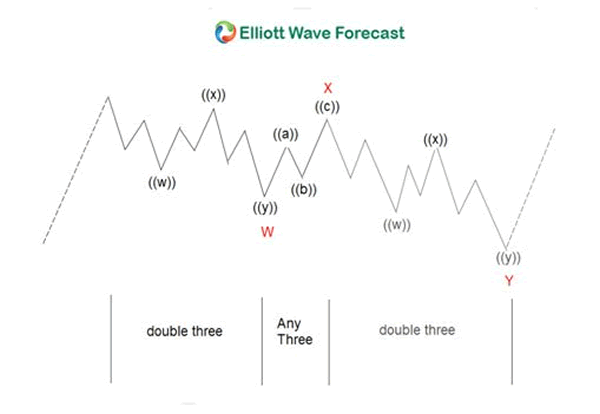
Double three ( 7 swings) is the most important pattern in Elliott wave’s new theory. It is also probably the most common pattern in the market these days. Double three is also known as a 7-swing structure. It is a very reliable pattern that gives traders a good opportunity to trade with a well-defined level of risk and target areas. The image below shows what Elliott Wave Double Three looks like. It has labels (W), (X), (Y) and an internal structure of 3-3-3. This means that all 3 legs has corrective sequences. Each (W) and (Y) is formed by 3 wave oscillations and has a structure of A, B, C or W, X, Y of smaller degrees.
RBA Shrugged Off Global Normalization Trend, Maintaining Neutral Stance
The RBA minutes for the October meeting reaffirmed the market that the central bank is in no hurry to increase interest rates. Policymakers stressed that rate hikes, or other kinds of monetary policy normalization, in other major economies do not necessarily imply that the RBA would follow suit anytime soon. The RBA remained upbeat in the domestic economic outlook, staying confident in the employment market conditions. Yet, it was still weary of subdued inflation. As usual, the central bank continued to warn of the strength in Australian dollar.
Notwithstanding rate hikes by other major central banks, including the Fed, BOC and BOE (likely in November), the RBA affirmed that its monetary policy would not be affected by others. As suggested in the minutes, the RBA acknowledged that 'a number of major central banks had either started to reduce the degree of monetary stimulus or were considering doing so' and 'that moves towards higher interest rates in other economies were a welcome development'. However, it emphasized that those moves 'did not have mechanical implications for the setting of policy in Australia, where the timing of any changes in interest rates would be dependent, as always, on developments in domestic economic conditions'.
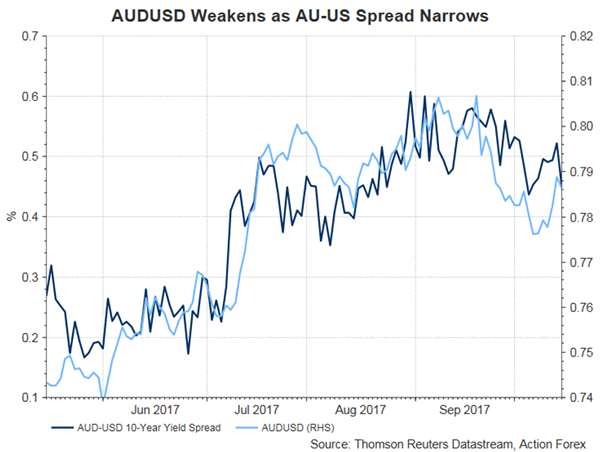
The members were confident over the employment market situation, noting that 'both full-time and part-time employment had recorded solid growth in August'. Such growth had been 'well above that required to absorb increases in the labour force owing to population growth'. They expected the strength in employment growth to support household spending in the period ahead, although wage growth remained subdue.
Policymakers remained concerned about the inflation outlook as 'recent data had pointed to subdued price pressures across the economy in the June quarter'. Going forward, they projected retail electricity prices 'to increase significantly in the September quarter' while 'liaison with businesses had suggested that a number of firms, particularly in the retail and manufacturing sectors, were largely absorbing increases in energy costs into margins rather than passing them through to final prices'. Aussie’s pullback during the intermeeting period has made the members less concerned about currency appreciation. Yet, they still mildly warned that 'a material further appreciation of the exchange rate would be expected to result in a slower pick-up in economic activity and inflation than currently forecast'.
Besides weak inflation, the less severe increase in property prices has also diminished the urgency of a rate hike. The minutes suggested that 'established housing market conditions had continued to ease in Sydney and Melbourne, but had been broadly unchanged in other cities. This pattern was evident in revised housing price data released by CoreLogic in September, as well as in auction clearance rates. Housing prices had continued to decline gradually in Perth. Nationwide measures of housing prices had increased by around +9% over the year to September'. The RBA likely believes that low interest rates have been less stimulative to properties prices with the help of macro-prudential measures. Should the economic growth continues to evolve as the central bank expected, the policy rate would probably stay unchanged at least until 2H18.
EUR/USD Daily Outlook
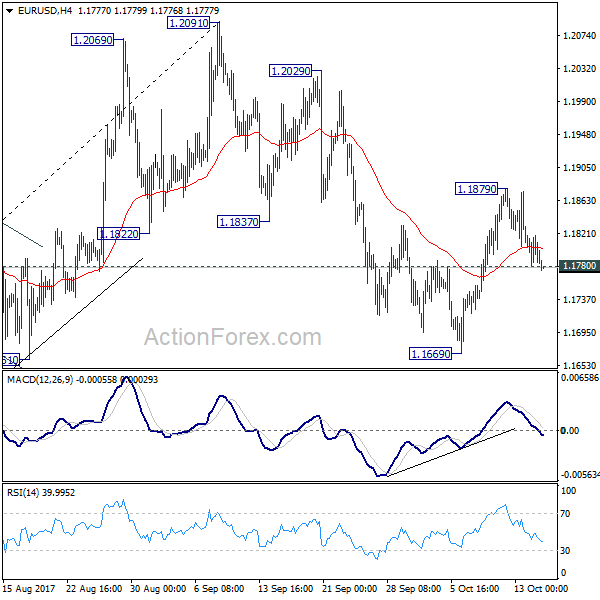
Daily Pivots: (S1) 1.1777; (P) 1.1799 (R1) 1.1817; More...
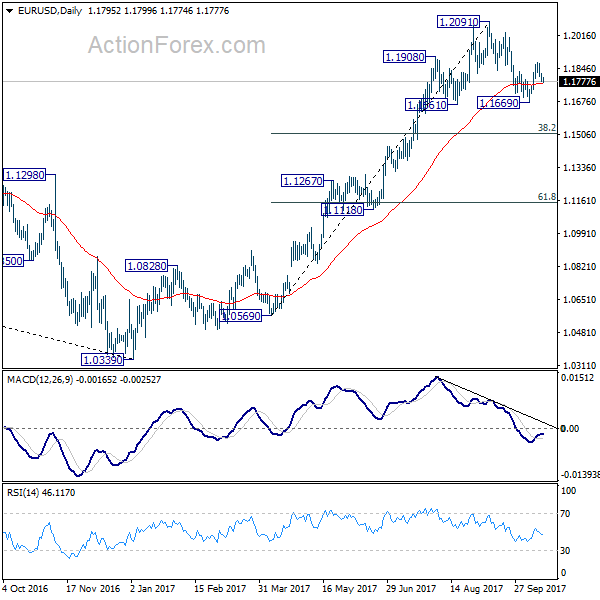
The break of 1.1780 minor support argues that rebound from 1.1669 is completed. Also, correction from 1.2091 is still in progress. Intraday bias is turned back tot he downside for 1.1669 first. Break will target 38.2% retracement of 1.0569 to 1.2091 at 1.1510. Strong support is expected there to complete the correction. On the upside, above 1.1879 will turn bias back to the upside for retesting 1.2091 high.
In the bigger picture, rise from medium term bottom at 1.0339 is not finished yet. It's expected to continue after pull back from 1.2091 completes. And, next target will be 38.2% retracement of 1.6039 (2008 high) to 1.0339 (2017 low) at 1.2516. However, it should be noted that there is no confirmation of trend reversal yet. That is, such rebound from 1.0399 could be a correction. And the long term fall from 1.6039 (2008 high) could resume. Hence, we'd be cautious on strong resistance from 1.2516 to limit upside.
GBP/USD Daily Outlook
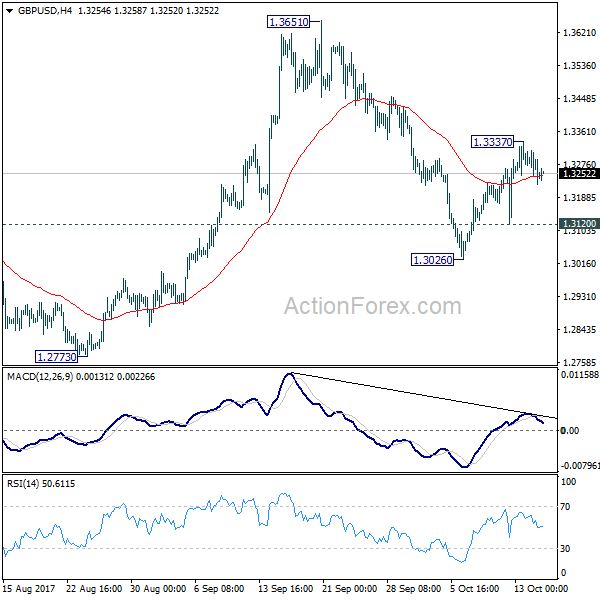
Daily Pivots: (S1) 1.3212; (P) 1.3261; (R1) 1.3299; More....
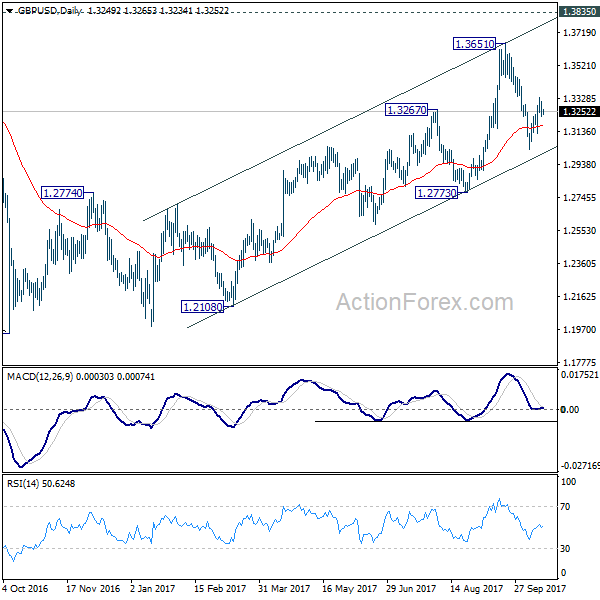
A temporary top is in place at 1.3337 in GBP/USD and intraday bias is turned neutral first. Another rise is mildly in favor as long as 1.3120 minor support holds. Above 1.3337 will target a test on 1.3651 high. Break there will resume medium term rise from 1.1946 and target 1.3835 key resistance next. On the downside, below 1.3120 minor support will resume the fall from 1.3651 through 1.3026 instead.
In the bigger picture, while the medium term rebound from 1.1946 was strong, GBP/USD hit strong resistance from the long term falling trend line. Outlook is turned a bit mixed and we'll turn neutral first. On the downside, decisive break of 1.2773 key support will argue that rebound from 1.1946 has completed. The corrective structure of rise from 1.1946 to 1.3651 will in turn suggest that long term down trend is now completed. Break of 1.1946 low should then be seen. On the upside, break of 1.3835 support turned resistance will revive the case of trend reversal and target 38.2% retracement of 2.1161 (2007 high) to 1.1946 (2016 low) at 1.5466.
USD/CHF Daily Outlook
Daily Pivots: (S1) 0.9732; (P) 0.9751; (R1) 0.9772; More....
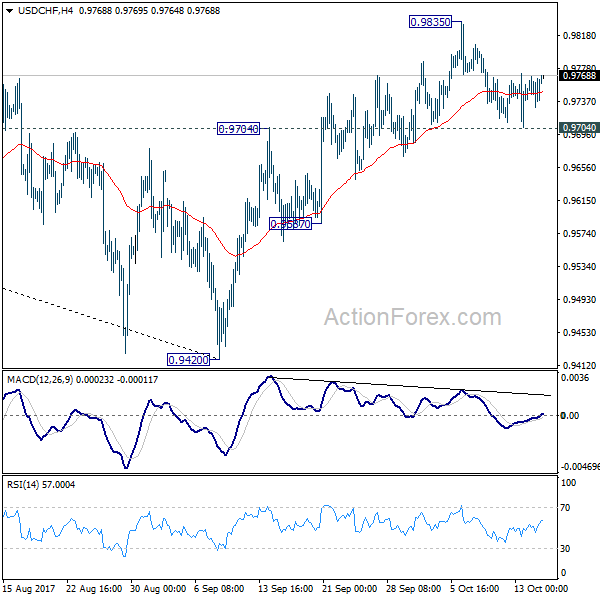
USD/CHF is still staying in range of 0.9704/9835 and intraday bias remains neutral first. As noted before, considering bearish divergence condition in 4 hour MACD, break of 0.9704 will argue that rebound from 0.9420 has completed. This will also mixed up the near term outlook and turn bias back to the downside for 0.9587 support. On the upside, break of 0.9835 will extend the rebound to 61.8% retracement of 1.0342 to 0.9420 at 0.9990.
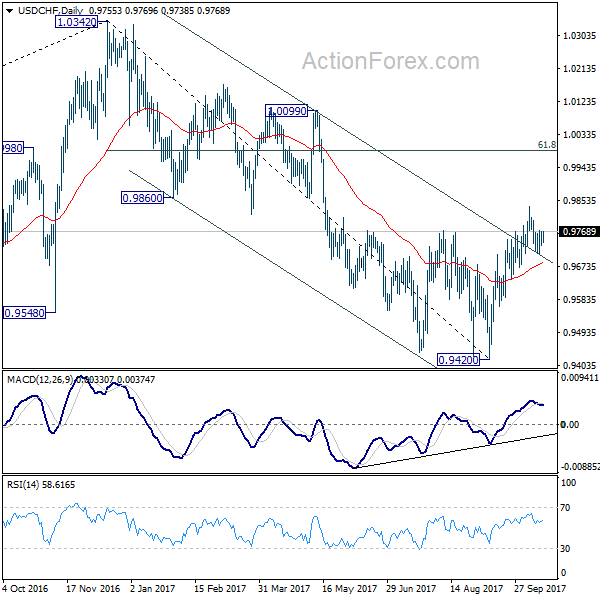
In the bigger picture, current development suggests that USD/CHF has defended 0.9443 (2016 low) key support level again. Rise from 0.9420 could develop into a medium term move and target a test on 1.0342 high. This represents the upper end of a long term range that started back in 2015. On the downside, break of 0.9587 support is now needed to indicate completion of the rise from 0.9420. Otherwise, further rally will remain in favor in medium term.