Sample Category Title
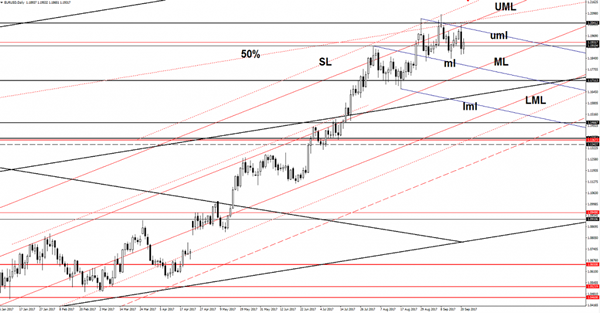
EUR/USD Narrowing
The EUR/USD has managed to rebound and to climb much higher again. Price continues to move in range on the short term, but I hope that we’ll have a significant move very soon. Technically, it was expected to decrease further on the short term, but seems like will develop a minor chart pattern. The pair increased a little as the USDX slipped lower after another false breakout above the 92.49 static resistance.
The dollar index move somehow sideways as well, but he still needs a bullish spark to be able to climb much higher on the short term. The USD wasn’t impressed by the good United States data, the Unemployment Claims plunged from 282K to 259K in the previous week, has come in much better versus the 302K estimate, while the Philly Fed Manufacturing Index increased from 18.9 to 23.8 points, beating the 17.3 estimate.
The Consumer Confidence was reported at -1 points, much below the -2 estimate, while the CB Leading Index rose by 0.4%, beating the 0.3% estimate.
Price increased after a failure to approach and reach the median line (ml) of the minor descending pitchfork. It could come higher to retest the upper median line (uml) of the descending pitchfork before will decide what to do on the short term.
The price action could develop a minor symmetrical triangle on the Daily chart, a breakout from this pattern will bring us a great trading opportunity. EUR/USD managed to stay above the 1.1910 static support.
USD/CAD Canadian Dollar Higher As USD Loses Fed Boost
The Canadian dollar is higher against its US counterpart on Thursday. The USD surged on Wednesday after the Fed’s September policy meeting left hawkish estimates for the path of rate hikes in the US. The US lost some of the momentum when Canadian data was released. Wholesale trade in Canada improved 1.5 percent in July adding another positive sign of a strong economy.
CAD traders will set their sights on retail sales and inflation data to be published on Friday, September 22 at 8:30 am EDT. Both indicators are expected to improve putting pressure on the US dollar. NAFTA negotiations will enter its third round on Saturday as the talks head to Ottawa. Canadian officials were on the record today saying that a deal by the end of 2017 or early 2018 was within reach. Mexico and the United States would be happy to hear as both have pushed for speedy negotiations to avoid the debate to last until the Mexican presidential elections and US primaries.
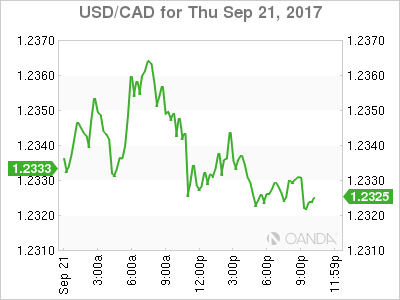
The USD/CAD fell 0.11 percent on Thursday. The pair is trading at 1.2333 and has been trading in a tight range. The USD is losing some of the momentum from the hawkish Fed economic projections on Wednesday. 11 out of 16 policymakers still forecast a rate hike in US interest rates before the end of the year. The Canadian dollar started the session losing ground to the greenback as oil prices fell only to recover as the day wore on.
Canadian inflation and retail sales data due on Friday will close the week for CAD traders. The consumer price index (CPI) is expected to rise 0.2 percent and retail sales is forecasted to have risen by 0.4 percent. Both indicators could validate the strength of the Canadian economy and signal a third rate hike before the end of the year by the Bank of Canada (BoC).
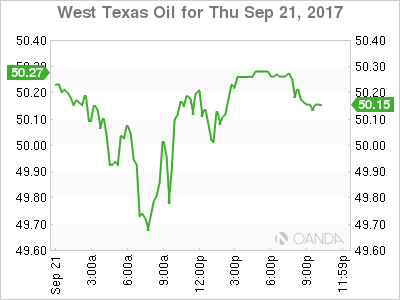
Energy gained 0.096 percent in the last 24 hours. The price of West Texas Intermediate is trading at 50.23 ahead of the Organization of the Petroleum Exporting Countries (OPEC) meeting in Vienna on Friday. The group will meet with non-OPEC members to discuss the production cut agreement and sources have indicated a possible extension beyond the March 2018 could be in the works.
The Energy Information Administration (EIA) report of weekly US crude inventories on Wednesday showed a higher than expected rise at 4.6 million barrels. The glut is seen as a positive given the disruptions in American production and proof of the flexibility and speed of shale output. Shale producers and the OPEC have been engaged in both sides of a supply strategy. OPEC members tried a market share strategy that increased production to drive US shale operations out of business, but that approach backfired as oil prices tanked and has taken a coordinated effort with other major non-OPEC members.
Market events to watch this week:
Wednesday, September 20
6:45pm NZD GDP q/q
11:50pm JPY Monetary Policy Statement
Thursday, September 21
Tentative JPY BOJ Policy Rate
2:30am JPY BOJ Press Conference
8:30am USD Unemployment Claims
Friday, September 22
8:30am CAD CPI m/m
8:30am CAD Core Retail Sales m/m
8:30am All Day NZD Parliamentary Elections
Will S&P’s China Downgrade Matter?
The US dollar gave back some of its gains on Thursday but risks in China are rising after S&P downgraded its sovereign rating to A+ from AA-. The pound was the top performer while the Australian dollar lagged. Japan is on holiday. British PM Theresa May's speech about the EU on Friday followed by German elections on Sunday. A new Premium video was posted following the post-Fed moves in FX, indices and metals.
China undoubtedly has a debt problem but it's had one for years without causing any real spillovers or consequences. It's one of those looming problems that's impossible to ignore but equally impossible to bet against.
A rarely-talked-about driver of western growth in the past 30 years is credit. It's a magical wealth creator until exhausted and that's what happened in the US financial crisis. China has been endlessly extending credit to companies and individuals and it's helped to pull hundreds of millions out of poverty.
So far bumps in the road have been handled by central planners but virtually everyone believes there will one day be a true hiccup. Whether that's next month or next decade is the impossible question to answer. Other catalysts are needed.
When trouble erupts, it's not likely to be from a downgrade or even a shift in the market. Like we saw two years ago, it's likely to come on some kind of change in policy. For every percentage point higher in growth or incremental rise in credit, the stakes are raised for regulators and economic planners.
That's why we will be watching the once-every-five years Congress that opens on Oct 18. Murmurs from China are that a theme will be stability. That's something we've heard many times before and lends itself to mitigating problems, rather than tackling them.
In other news, the USD rally failed to follow through Thursday. That was despite a fall in initial jobless claims to 259K from 302K in the aftermath of Harvey. The Philly Fed also improved to 23.8 from 17.1.
Perhaps the most-telling indicator was eurozone consumer confidence. It rose to -1.2 from -1.5 – that's the best since 2001. After falling as low as 1.1853 Wednesday, the euro slowly climbed to 1.1938.
Expect a quiet wind down to the week in Asia with Japan on holiday.
Increased Chance of Fed Raising Rates Supports USD
The EUR/USD restored some positions that were lost yesterday on the background of hawkish rhetoric by the Fed's chief Janet Yellen yesterday. Following the Fed's statement on monetary policy it has become clear that 12 of the 16 FOMC members still support three rate hikes for 2017 which increases the chance of another round of monetary tightening in the US by this December. At the same time it was announced that the balance sheet reduction will start in October. Some pressure on the pair also came in from the better than expected unemployment claims in the US which were 259,000 versus the 302,000 expected and the Philly manufacturing index increased to 23.8 in September compared to 18.9 in August.
The USD/JPY quotes are consolidating after confident growth during yesterday's trading session. The statement of the Bank of Japan on monetary policy had little influence on the mood of traders. The All Industries Activity index declined by 0.1% in August which was in line with the forecast.
The Light sweet crude oil quotes rolled back under pressure of US dollar appreciation and due to the recent crude oil inventories report which showed an increase of 4.6 million barrels in the US against the forecasted growth of 2.8 million barrels. Production levels also returned to levels seen before the hurricanes hit the American oil rigs. The OPEC meeting will be held tomorrow where oil production cuts will be discussed between most OPEC members and some other major oil producing countries, including Russia. News from this meeting may significantly influence the mood of traders.
EUR/USD
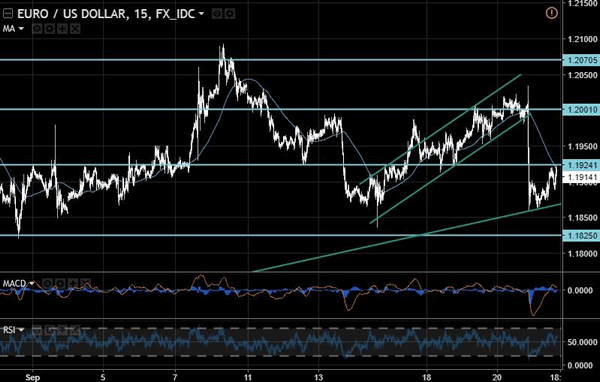
The EUR/USD quotes were not able to break through the inclined support line and returned to the resistance at 1.1925 due to profit taking after the strong descending movement. In case of further growth, the nearest targets will be 1.2000 and 1.2070. On the other hand, fixing under the inclined support line may lead to continued drops with potential targets at 1.1700 and 1.1620.
USD/JPY
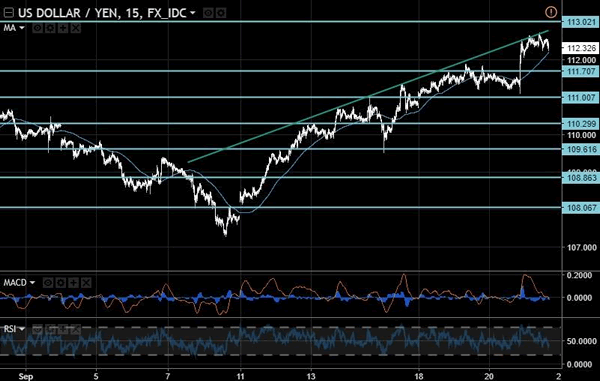
The USD/JPY has stopped growing after touching the inclined resistance line. In case of growth resuming along this line, the next targets will be 113.00 and 114.70. In case of a downward correction, the price may fall to 111.00 and breaking through that may become a signal to sell with potential goals at 110.30 and 109.60.
USD/WTI
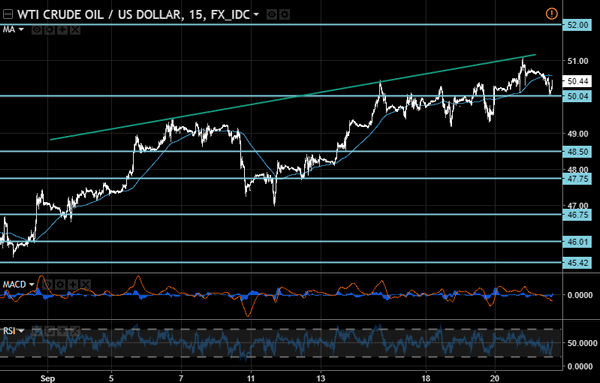
The American crude oil benchmark, WTI, is falling after testing the 51.00 mark. In case of a decline below the 50.00 mark we are likely to see further drops with the potential to hit 48.50 and even 47.75. The RSI on the 15-minute chart rebounded from the oversold zone which in turn indicates that the descending movement is not yet exhausted. The immediate target in case of growth resuming will be 52.00.
NZDUSD Elliott Wave View: Zigzag Correction
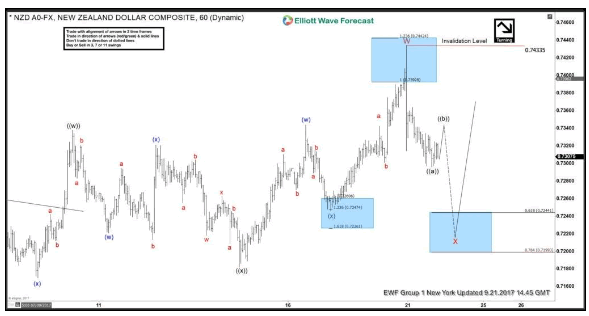
NZDUSD 1 Hour Elliott Wave Chart
Zigzag is a 3 waves corrective pattern which is labelled as ABC. The subdivision of wave A is in 5 waves, either as impulse or diagonal. The subdivision of wave B can be any corrective structure. Finally, the subdivision of wave C is also in 5 waves, either as impulse or diagonal. Thus, zigzag has a 5-3-5 structure. Wave C typically ends at 100% – 123.6% of wave A.
Trade Idea Wrap-up: USD/CHF – Stand aside
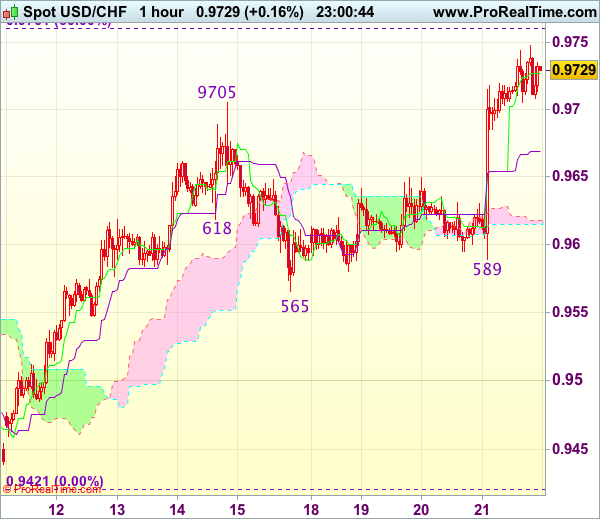
USD/CHF - 0.9715
Most recent candlesticks pattern : N/A
Trend : Near term up
Tenkan-Sen level : 0.9727
Kijun-Sen level : 0.9669
Ichimoku cloud top : 0.9618
Ichimoku cloud bottom : 0.9615
New strategy :
Stand aside
Position : -
Target : -
Stop : -
The greenback only fell to 0.9589 yesterday before staging another rally (after Fed) above resistance at 0.9705, suggesting recent rise from 0.9421 low is still in progress and may extend gain towards 0.9761-66 (50% Fibonacci retracement of 1.0100-0.9421 and previous resistance) but reckon another previous resistance at 0.9773 would hold on first testing due to near term overbought condition, risk from there is seen for a retreat later.
In view of this, would not chase this rise here and would be prudent to stand aside for now. Below 0.9685 would bring test of the Kijun-Sen (now at 0.9669) but break there is needed to signal an intra-day top is formed, bring retracement to 0.9635-40 but said support at 0.9589 should remain intact.
Trade Idea Wrap-up: GBP/USD – Stand aside
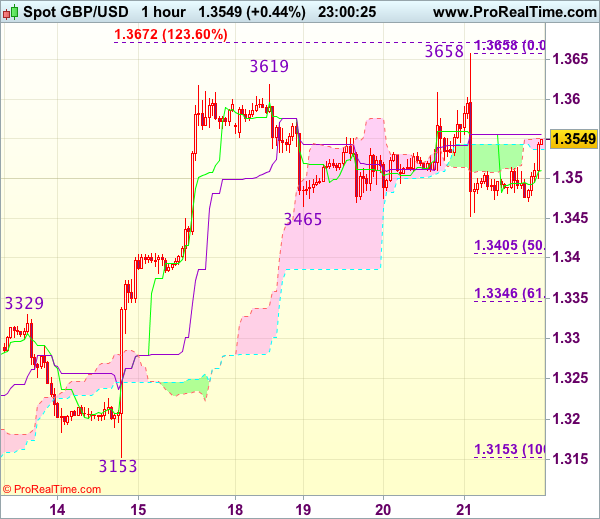
GBP/USD - 1.3561
Most recent candlesticks pattern : N/A
Trend : Up
Tenkan-Sen level : 1.3520
Kijun-Sen level : 1.3555
Ichimoku cloud top : 1.3550
Ichimoku cloud bottom : 1.3537
Original strategy :
Sell at 1.3595, Target: 1.3480, Stop: 1.3630
Position : -
Target : -
Stop : -
New strategy :
Stand aside
Position : -
Target : -
Stop : -
Current cross-inspired rebound suggests near term upside risk remains for the bounce from 1.3452 (yesterday’s low) to extend gain to 1.3590-00, still reckon upside would be limited to 1.3630-35 and resistance at 1.3658 would hold from here, bring retreat later. Only a break above said resistance at 1.3658 would signal recent upmove has resumed and extend gain to 1.3690-00 later.
In view of this, would not chase this rise here and stand aside for now. Below the Tenkan-Sen (now at 1.3520) would bring weakness to 1.3500 but only break of 1.3470-75 would revive near term bearishness and bring test of yesterday’s low at 1.3452, below there would confirm temporary top has been formed at 1.3658, bring retracement of recent rise towards 1.3400-05 (50% Fibonacci retracement of 1.3153-1.3658).
German Election: Not as Boring as You Think
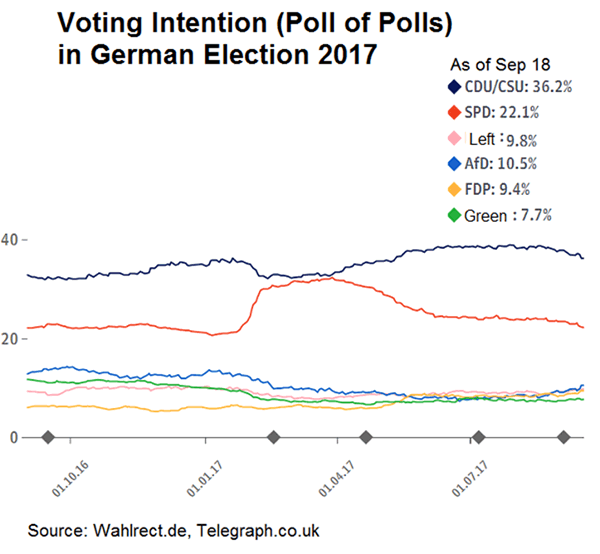
Despite the comfortable lead of Chancellor Angela Merkel's Christian Democratic Union (CDU) and its sister party, the Christian Socialist Union (CSU), in polls, Germany, as well as the EU, would never be the same again after upcoming German election on September 24. Merkel is on the course to pursue her fourth, and the last term, as the Chancellor. Her party is unlikely to form a government without forming coalition other party(ies). While the Grand Coalition (CDU/CSU+SPD as the junior partner), just like the one we have had since 2013 and between 2005-2009, is the most favorable to the economy and the financial markets, it cannot be seen as a done deal. Meanwhile, rising supports for the populist Alternative for Germany (AfD) signal that a far-right party would enter the parliament for the first time since WWII. AfD has pledged to promote its anti-EU and anti-immigrants rhetoric in the parliament as it might probably become the biggest opposition party in case of a Grand Coalition. Moreover, the parliament is prone to be more fragmented with six parties in 2017-term, compared with four previously. This article aims to prepare investors in interpreting the election results. Beginning with the reasons for Merkel's apparent lead, we would take a look at how different coalition combinations would affect EU integration. We would also see how AfD might slow the progress of integration, despite its limited number of seats in the parliament.
Why Merkel?
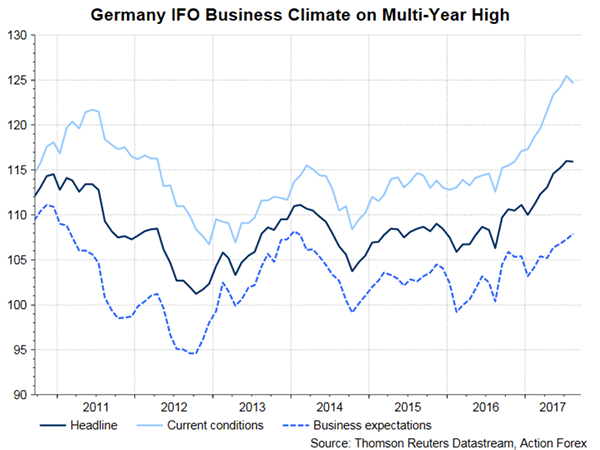
Merkel's popularity hinges on the strong economic performance of Germany, German people generally feel good about the country, both in economic and political terms. Pew Research's survey reveals that 86% of the interviewees believe their economy is doing well, up from 75% last year, thanks to the quick recovery from the global financial crisis.
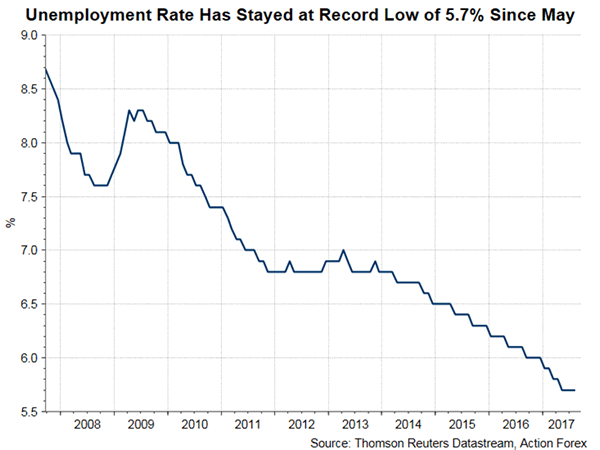
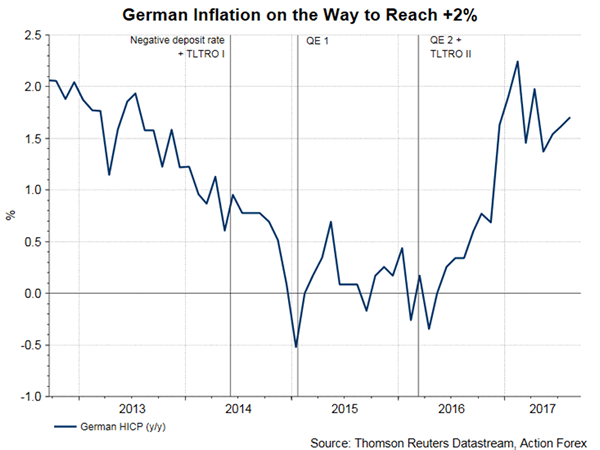
The survey also shows that 58% has a favorable opinion of the center-right CDU, although that for centre-left SPD is 68%. Meanwhile, 81% of the interviewees "feel good" about Merkel's capacity "to do the right thing on the world stage". Indeed, she has been nicknamed "mutti" (meaning "mother" in German) as she is like a kind mother of the nation. Despite a short-term decline in popularity after the temporary open-door policy for Syrian refugees in 2015, the tensions were eased quickly as she promised it would not repeat.
German people are more risk-averse, when compared to the US and other European countries. It is evidenced by the country's low debt-to-GDP ratio and the huge surplus figures. This trait probably led to the fact that two of the most longest-serving leaders in post-war Europe were from Germany. This has also anchored their support for Merkel who has served as the Chancellor since 2005. Maintaining the status quo, meaning unchanged economic policies, together with prudent increase spending and tax cut, and conditional progress in EU integration, is probably the safest choice. .
Possible Coalitions
Grand Coalition
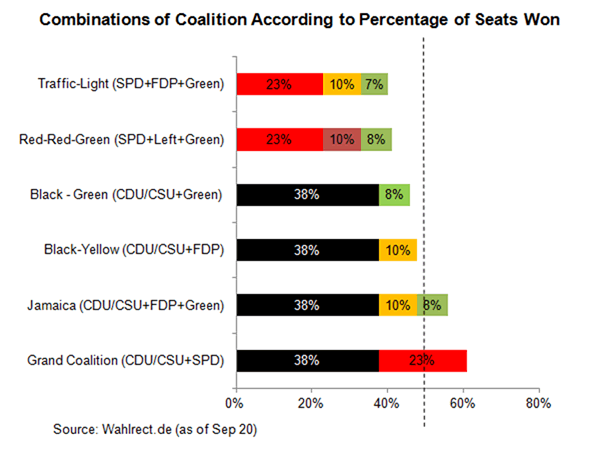
According to current polls on two combinations - Grand Coalition and Jamaica, are possible. CDU/CSU would be able to secure about 38% of the seats in the Parliament. However, it remains short of the 50% threshold for the formation of a majority government. Therefore, CDU/CSU would have to form an alliance with other parties. A Grand Coalition would likely be the most positive for the market. This combination does not only brings the least uncertainty, but also allows polices to be implemented in a smooth manner. The parties share similar views on a wide range of policy issues.
Both parties propose to increase government spending and cut tax. Yet, they might diff in how to carry out. While CDU/CSU favors to increase child allowance, SPD opts for higher spending on education and publish infrastructure. While CDU/CSU proposes to reduce income tax by 15B euro over 4 year and phase out reunification surcharge from 2020, SPD proposes to cut tax (worth of 10B euro) for small and medium group but raise for high income group (annual income over 76 200 euro).The details can be negotiated. The most important is that both parties are thinking in the same direction.
Both parties would endeavor on deeper EU integration. While SPD has indicated preference to transform the European Stability Mechanism (ESM) to a European Monetary Fund (EMF) for cross border investment and counter-cyclical spending, but not euro bonds, CDU/CSU might agree on the EMF so as to incentivize further reform. The SPD favors creating a common financial budget (to enable investment and stabilising mechanism in crises) and establish a euro area economic government. This might go too far for CDU/CSU. Yet, CDU/CSU might consider depending on size and purpose. On taxation, while CDU/CSU seeks to reduce and harmonise corporation taxes with France, the SPD goes further to harmonise the taxation across Europe and fight tax evasion
Both parties support the idea of European Defense Union and European Army, complementary to NATO. However, while CDU/CSU supports increasing defense spending to 2% of GDP by 2024, SPD has complained this requirement by NATO as unnecessary and unrealistic.
However, one should not see this as a done deal!
SPD has attributed its decline in popularity to the coalition government since 2013. However, its leader Martin Schulz has not refused to confirm that there will not be a re-run, though. Meanwhile, CDU/CSU has expressed its concerns that the SPD has not ruled out the possibility of forming coalition of the Left Party, descendents of the former dictatorship of communist East Germany. Merkel has long announced that she would not work with the Left and AfD to form government.
Indeed, CDU/CSU's most preferred partner is the liberal Free Democratic Party (FDP), as the parties have similar views on a number of policy issues, ranging from property tax reduction to continuation of labor leasing, from an increase in military spending to sponsorship of projects against right-wing extremism, etc. However, polls suggest that the Black-Yellow coalition won't have sufficient seats to form a government.
Jamaica
As mentioned previously, CDU/CSU would choose to work to FDP if they can pass 50% together. Polls suggest that this could happen if the Green Party is included. However, it is not easy for FDP and Greens, the historical rivals, to work together. The parties are divided in a number of issues, from economics to environment. Jamaica coalition might indeed drag the progress of EU integration.
While CDU/CSU and FDP have more common views, FDP and Greens are divided in several aspects. For instance, FDP is in support of fiscal discipline and economic reform. It also proposes to strengthen the no-bailout clause and sovereign insolvency procedures and proposes to create exit procedures from EMU. By contrast, Greens opposes austerity measures. It suggests that Europe of different speeds should be an option. These differences also mark their opposing views on the creation of a common EU budget.
On the domestic issues, FDP proposes a cut of 30B euro in tax and social contribution, while Greens introduces tax on the "super-rich". Meanwhile, FDP proposes to increase government spending on education, while Greens favors more expense of R&P and environmental protection. Contrary to both CDU/CSU and FDP, Greens rejects to increase defense spending to2% of GDP.
AfD
While unlikely to be part of the establishment, it might be the largest opposition party if there is a re-run of the current coalition. The far-right, populist party would then chair the parliament budget committee and open debate during budget consultation. AfD has pledged to use the parliamentary speeches to spread its anti-immigrants and anti EU ideas. Its founder Alexander Gualand has noted that his party would call for a committee to investigate Merkel on her "policy of bringing 1 million people into this country" and she should be "punished for that". AfD is prone to increase the difficulty of passing any legislation particularly related to EU integration.
While, in first sight, the German parliamentary election appears to be a boring game with Merkel certain to be the Chancellor for a fourth term, a number of tweaks might the final outcome surprising. The predictability of opinion polls might have diminished this time, as almost 50% of the German voters are "undecided", the most in two decades. We believe the market has fully priced in CDU/CSU's victory and Merkel's Chancellorship. It might have mostly priced in another term of Grand Coalition. Therefore, the outcome of a re-run might only have mildly positive impact, if any, on the European stock markets and the euro. Other outcomes should be more negative. The more seats AfD get would be more negative to the single currency.
Trade Idea Wrap-up: EUR/USD – Sell at 1.1970
EUR/USD - 1.1927
Most recent candlesticks pattern : N/A
Trend : Sideways
Tenkan-Sen level : 1.1903
Kijun-Sen level : 1.1948
Ichimoku cloud top : 1.1998
Ichimoku cloud bottom : 1.1972
Original strategy :
Sell at 1.1950, Target: 1.1850, Stop: 1.1985
Position : -
Target : -
Stop : -
New strategy :
Sell at 1.1970, Target: 1.1870, Stop: 1.2005
Position : -
Target : -
Stop : -
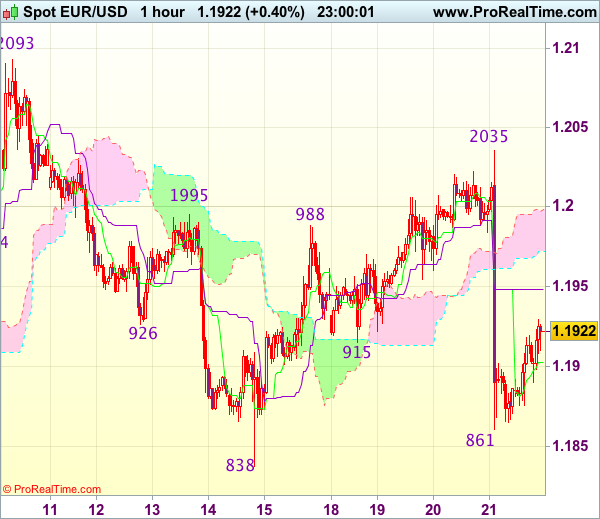
Although the single currency rose to as high as 1.2035 late yesterday, euro ran into strong selling pressure there and has dropped sharply after Fed, suggesting early rebound from 1.1838 has ended there and downside bias is seen for retest of said support, break there would signal another leg of corrective decline from 1.2093 top is underway and extend weakness to 1.1800-05 but near term oversold condition would limit downside to 1.1770 and reckon 1.1750 would hold.
In view of this, we are looking to sell euro on further recovery as the lower Kumo (now at 1.1972) should limit upside and bring another decline later. Above the upper Kumo (now at 1.1998) would defer and risk a stronger rebound but said resistance at 1.2035 should remain intact.
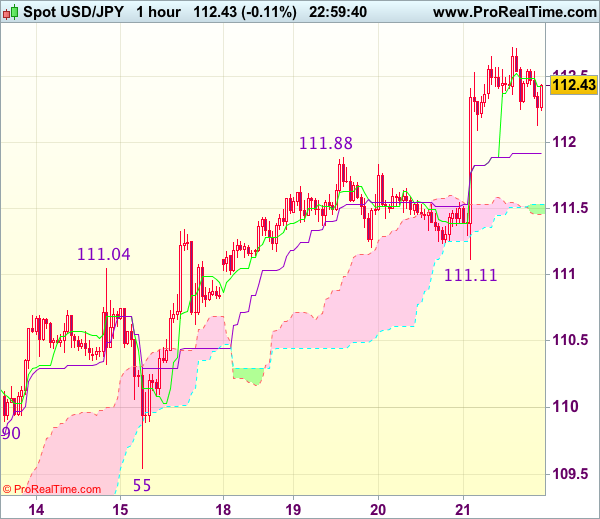
Trade Idea Wrap-up: USD/JPY – Buy at 111.70
USD/JPY - 112.41
Most recent candlesticks pattern : N/A
Trend : Up
Tenkan-Sen level : 112.42
Kijun-Sen level : 111.92
Ichimoku cloud top : 111.53
Ichimoku cloud bottom : 111.45
Original strategy :
Buy at 111.90, Target: 112.90, Stop: 111.55
Position : -
Target : -
Stop : -
New strategy :
Buy at 111.70, Target: 112.70, Stop: 111.35
Position : -
Target : -
Stop : -
The greenback rallied after finding renewed buying interest at 111.11 yesterday (after Fed), adding credence to our bullish view that recent upmove is still in progress and may extend further gain to 112.90-00, however, loss of near term upward momentum should prevent sharp move beyond 113.25-30 (1.236 times projection of 107.32-111.04 measuring from 109.55) and previous chart resistance at 113.58 would hold from here, bring retreat later.
In view of this, would not chase this move here and would be prudent to buy dollar on subsequent pullback as previous resistance at 111.88 should turn into support and 111.60-70 should contain hold, bring another upmove. Below the Ichimoku cloud bottom (now at 111.45) would defer and suggest a temporary top is possibly formed, risk weakness towards support at 111.11.