Sample Category Title
Markets Digest Fed Message as Dollar Corrects; Aussie Drops on Chinese Downgrade
The US dollar gave back some of its gains versus its major counterparts such as the euro, the yen and the British pound after the Fed signaled the previous day it was planning to raise interest rates one more time this year. The Fed also announced that in October it would start to slowly roll back some of the stimulus it injected in the form of Quantitative Easing; the first major central bank to do so since the financial crisis of 2008.
The euro rose back above the 1.19 level against the dollar after dipping below that level in the aftermath of the Fed's announcement. The pair was last trading at 1.1916. A speech by Mario Draghi in Frankfurt mostly made reference to possible financial imbalances and less on monetary policy. Tomorrow's Eurozone flash PMI numbers are likely to prove the highlight of the week for the euro.
Dollar/yen also gave back some of its Fed-related gains but managed to still trade above the 112 mark at 112.30. The Bank of Japan kept its QE policy unchanged today but there was a slightly dovish surprise as one of the two new board members advocated doing more stimulus so that the 2% inflation would be hit in future years.
The pound also did well as it reclaimed the 1.35 mark against the greenback. Pound traders are eagerly waiting for an important policy speech by the UK Prime Minister Theresa May on Brexit tomorrow. The euro gained slightly against the pound to reach 0.8821.
One of the currencies that failed to bounce back against the dollar from its post-FOMC losses was the Australian dollar. A downgrade of China by S&P seemed to hurt the aussie, despite promises of higher interest rates by the RBA governor earlier in the day during a speech. The aussie was at 0.7922 versus the US dollar against 0.81 before Wednesday's Fed announcement.
There was relatively upbeat economic news out of the United States as weekly jobless claims declined to 259 thousand compared with 282 thousand the previous week, while the Philly Fed manufacturing index for September climbed to 23.8 compared to expectations it would decline to 17.2 from 18.9 in August.
In commodities, gold continued to decline after breaking below the psychologically important $1300 level as it dropped to $1290 an ounce; a near 4-week low. A stronger dollar and the prospect of higher interest rates hurt the yellow metal, while risk assets were also unfazed by the prospect of tighter policy, mitigating the demand for safe havens. Oil gained and the front-month US futures contract was trading around $50.50 a barrel.
No Follow Through Gains for the Dollar
- European equities eked out modest to moderate gains after WS held up well post FOMC and as the euro weakened versus the dollar (yesterday eve). US stock markets open with tiny losses.
- S&P has cut its rating on China by one notch to A+ weeks before the country is expected to launch a rare dollar bond, with the ratings agency citing rising economic and financial risks after a long period of heavy credit growth. The decision brings S&P's rating in line with those of Moody's and Fitch. No immediate impact on markets is expected.
- Norway's central bank kept its key deposit rate unchanged at 0.50%, but indicated it could raise interest rates sooner than earlier anticipated after taking stock of the country's improved economic outlook and growing signs of tightening by its counterparts around the world. EUR/NOK fell to 9.32 from 9.37 before the decision.
- The ECB announced plans to launch a new reference point for overnight interest rates, opening up a new alternative to the private-sector benchmarks that have been hit by scandal and are in the process of reform. Its new transaction-based overnight rate will serve as backstop to private sector benchmark rates and finalized before 2020.
- The Minutes of the Polish central bank meeting showed that the majority of its members were comfortable with keeping rates stable in coming quarters. Inflationary pressures remained limited despite favourable economic conditions, good labour market conditions and gradual wage growth. There were no imbalances building. Some members suggested any rise in inflation might be met with a rate hike, fearing the effects of negative real rates.
- Applications for unemployment benefits in the US unexpectedly declined last week, from 282k to 259k, as the Hurricane Harvey-related surge in Texas filings continued to reverse. The September Philly Fed Business outlook also beat forecasts, rising from 18.9 to 23.8 (vs 17.1 expected).
Rates
Lack of follow-through action after FOMC
Lack of follow-through selling characterized today's trading session. Market participants aren't convinced yet to buy into yesterday's hawkish FOMC message. They probably want evidence from the inflation front first before taking up additional bets on higher rates. Technical considerations could be at play as well given the US Note future's 9 straight day decline. Weekly jobless claims and Philly Fed Business outlook both printed on the positive side of expectations, but couldn't change the direction of core bonds which is marginally upward.
At the time of writing, US yields decline about 0.8 bps across the curve. German yields rise up to 1.8 bps (5-yr). The underperformance of the 30-yr yield (+6 bps) is due to a BB benchmark change. On intra-EMU bond markets, 10-yr yield spread changes versus Germany are nearly unchanged with an underperformance of the periphery (+2/3 bps).
France and Spain concluded this week's scheduled EMU bond supply. The French Treasury tapped two OAT's (€0.99B 0% Feb2020 & €2.45B 1.75% Nov2024) and launched a new one (€3.55B 0% Mar2023) for a combined €7B, the maximum on offer. The auction bid cover was strong (2.32). Additionally, France raised €1.85B via tapping three inflation-linked notes. The Spanish debt agency auctioned a 3-yr Bono (€ 1.15B 0.05% Jan2021) and tapped three Obligacions (€1.3B 1.3% Oct2026), €1B 5.15% Oct2028 & €1.22B 5.15% Oct2044). The total amount sold (€4.67B) was in the upper end of the eyed €4- 5B. The auction bid cover (1.79) looks solid on first sight, but excluding demand for the short term bono, it drops to 1.52. Tensions between Madrid and Barcelona over the Catalan secession referendum probably hampered demand somewhat today
Currencies
No follow through gains for the dollar
Dollar bulls will be rather disappointed in the greenback's inability to build out yesterday's post FOMC gains. Investors clearly didn't buy into the Fed's "hawkish" stance on policy normalisation. Strong US eco data couldn't give the dollar a push in the back either. Admittedly, the US yield rally fell apart too with US yields marginally lower (<1bp). Prices changes were small though, meaning the jury is still out about the near term direction of the Greenback. EUR/USD trades around 1.1910, 20 ticks above opening levels, while USD/JPY changes hands around 112.40 from a 112.20 opening.
Overnight, the BOJ, as expected, left its policy (target rates and asset purchases) unchanged. A new member, Kataoka, dissented as he saw little chance of the BOJ reaching its target in 2019. So, there was a soft note in the policy decision. USD/JPY made only modest additional gains after yesterday's Fed-inspired rally. USD/JPY set a post FOMC high at 112.72, but eased afterwards. EUR/USD cautiously went for a test of the FOMC lows, but never really tested it.
European FX trading (EUR/USD) was confined to a tight range, but on the upside of opening levels. Also European investors weren't ready to embrace the FOMC message and buy the dollar against the euro. There were no eco releases and we didn't see quotes of ECB members Smets and Praet, who figured on the event calendar. During the US session, the initial claims surprised sharply on the downside (259K versus 302K) and the Philly Fed business confidence exceeded consensus by a large margin (23.8 versus 18.9 in August and a 17.1 consensus). However, EUR/USD made a knee-jerk reaction to below 1.19 on the release and immediately rebounded again to levels closer to 1.1920. We wouldn't make too much of the positive US eco surprises as the claims consensus estimate incorporated hurricane effects and the Philly Fed is notoriously volatile. At the margin though the knee-jerk react should be seen as a dollar negative.
Sterling consolidates
Sterling couldn't repeat yesterday's strong performance when it rallied versus the euro and stabilized versus the dollar despite the dollar rally. Overnight, EUR/GBP tested yesterday's lows, but sterling missed the power to steam ahead. After a stabilization, EUR/GBP made some marginal gains during European technical-oriented trading. There were better than expected UK public finance results for August, but these played no role in trading. Afterwards, EUR/GBP stabilized again to trade at 0.882 from 0.884 at the opening. Cable consolidated too and trades at 1.3504, barely off opening levels.
Trade Idea Wrap-up: USD/JPY – Buy at 111.70
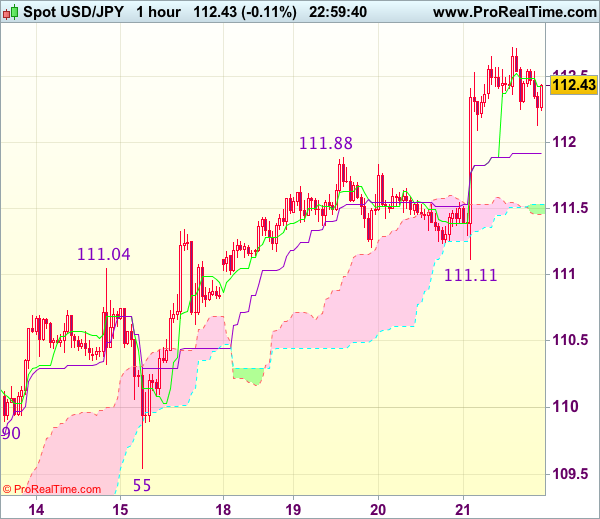
USD/JPY - 112.41
Most recent candlesticks pattern : N/A
Trend : Up
Tenkan-Sen level : 112.42
Kijun-Sen level : 111.92
Ichimoku cloud top : 111.53
Ichimoku cloud bottom : 111.45
Original strategy :
Buy at 111.90, Target: 112.90, Stop: 111.55
Position : -
Target : -
Stop : -
New strategy :
Buy at 111.70, Target: 112.70, Stop: 111.35
Position : -
Target : -
Stop : -
The greenback rallied after finding renewed buying interest at 111.11 yesterday (after Fed), adding credence to our bullish view that recent upmove is still in progress and may extend further gain to 112.90-00, however, loss of near term upward momentum should prevent sharp move beyond 113.25-30 (1.236 times projection of 107.32-111.04 measuring from 109.55) and previous chart resistance at 113.58 would hold from here, bring retreat later.
In view of this, would not chase this move here and would be prudent to buy dollar on subsequent pullback as previous resistance at 111.88 should turn into support and 111.60-70 should contain hold, bring another upmove. Below the Ichimoku cloud bottom (now at 111.45) would defer and suggest a temporary top is possibly formed, risk weakness towards support at 111.11.
Oil Pulls Back ahead of Producers’ Meeting
Oil pulled back somewhat on Thursday, giving back some of the gains it posted this month, perhaps due to the strengthening US dollar following the "hawkish" Fed yesterday. Oil traders will probably have a busy end to the week as well, as OPEC and non-OPEC producers are set to meet in Vienna on Friday in order to discuss the effectiveness of their production-cut deal so far, ahead of the big OPEC meeting in November. Even though we may get some optimistic comments from the various officials regarding a further extension or even an expansion of the current deal, we doubt that anything will be decided tomorrow. Indeed, Kuwait's oil minister noted recently that this committee won't make a recommendation on whether to change the deal.
Therefore, we see the prospect for oil prices to rebound somewhat on any bullish comments from officials, but we do not expect a major surge in prices, as could happen if something was actually decided. Our view is reinforced by the fact that we are very close to the $51-$55 zone in WTI, where we believe that further price gains may be capped by US shale producers increasing their production notably due to rising profitability.
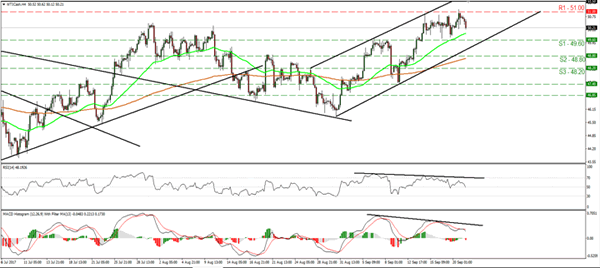
WTI traded lower on Thursday, after it hit resistance near the 51.00 (R1) line. The price structure continues to suggest a short-term uptrend, marked by the trend line taken from the low of the 31st of August. Having said that though, given the negative divergence between both our short-term oscillators and the price action, as well as the proximity to the key obstacle of 51.50 (R2), we prefer to stand pat for now, as the current slide may evolve into something more than just the correction it looks like now.
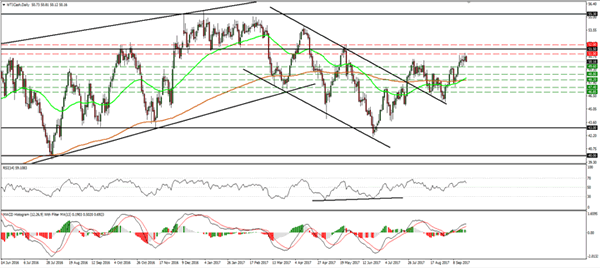
Switching to the daily chart, it's much easier for someone to understand why we decided to remain sidelined despite the short-term uptrend. As noted above, we believe that the the range between 51.50 (R2) and 55.00 is the area where US shale producers may be attracted to increase production. Thus, our proximity to the lower end of that range, increases the possibility of a short-term reversal, as was the case back in May. Even if the price breaks above 51.50 (R2) and enters the aforementioned range, we don't expect any such gains to lead into a major healthy uptrend.
Trade Idea: EUR/GBP – Sell at 0.8940
EUR/GBP - 0.8835
Original strategy :
Sell at 0.8975, Target: 0.8800, Stop: 0.9015
Position : -
Target : -
Stop : -
New strategy :
Sell at 0.8940, Target: 0.8800, Stop: 0.8980
Position : -
Target : -
Stop : -
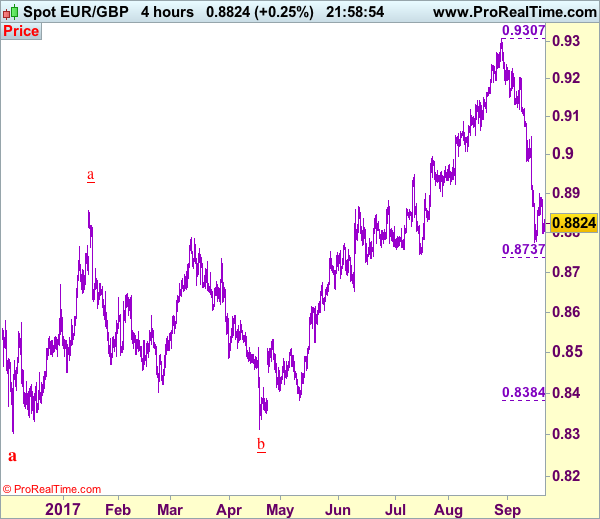
Although the single currency retreated after faltering below resistance at 0.8899, reckon recent decline is not ready to resume yet and further consolidation above recent low at 0.8774 would take place, hence another corrective bounce to said resistance at 0.8899 cannot be ruled out, however, upside should be limited to 0.8940-50 and bring another decline, below 0.8795-00 would bring retest of said support at 0.8774 but break there is needed to confirm recent decline from 0.9307 top has resumed and extend weakness towards 0.8737-43 (61.8% Fibonacci retracement of 0.8384-0.9307 and previous support) but near term oversold condition should limit downside to 0.8719 support and reckon another previous chart support at 0.8652 would hold.
In view of this, would not chase this fall here and we are looking to sell euro on further recovery as 0.8940-50 should limit upside and bring another decline later. Above previous support at 0.8982 would abort and signal a temporary low has been formed, bring retracement of recent decline to 0.9000 but price should falter below resistance at 0.9048 and bring another selloff next week.
Our preferred count is that, after forming a major top at 0.9805 (wave V), (A)-(B)-(C) correction is unfolding with (A) leg ended at 0.8400 (A: 0.8637, B: 0.9491 and 5-waver C ended at 0.8400. Wave (B) has ended at 0.9413 and impulsive wave (C) has either ended at 0.8067 or may extend one more fall to 0.8000 before prospect of another rally. Current breach of indicated resistance at 0.9043 confirms our view that the (C) leg has ended and bring stronger rebound towards 0.9150/54, then towards 0.9240/50.
Trade Idea: USD/CAD – Buy at 1.2285
USD/CAD - 1.2350
New strategy :
Buy at 1.2285, Target: 1.2450, Stop: 1.2225
Position: -
Target: -
Stop:-
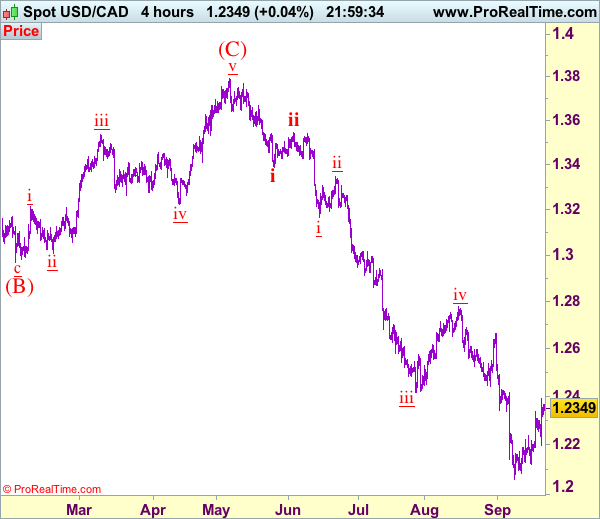
As the greenback found renewed buying interest at 1.2197 yesterday and has staged another rebound, suggesting a temporary low has been made at 1.2061 earlier this month and consolidation with upside bias is seen for the corrective rise from there to bring retracement of recent decline, above 1.2395-00 would encourage for further gain to resistance at 1/2425-30. then 1.2450, however, near term overbought condition should limit upside and reckon 1.2500 would hold from here, bring retreat later.
In view of this, we are looking to turn long on pullback as 1.2270-80 should limit downside and bring another rebound. Only below said support at 1.2197 would abort and signal top is formed instead, bring weakness to 1.2160-65, then towards support at 1.2121, break there would confirm the rebound from 1.2061 has ended and bring retest of this level later, We are keeping our count that wave v as well as wave (C) ended at 1.3794 and impulsive wave (i ii, i ii) is now unfolding with minor wave iii ended at 1.2414, followed by wave iv correction ended at 1.2778, wave v has reached our indicated downside target at 1.2100 and may extend to 1.2000.
To recap, wave B from 1.3066 is unfolding as an a-b-c and is sub-divided as a: 1.2192, b: 1.2716 and wave c is a 5-waver with i: 1.1983, ii: 1.2506, extended wave iii with minor iii at 1.0206, wave iv ended at 1.0781 and wave v as well as wave iii has ended at 0.9931, hence the subsequent choppy trading is the wave iv which is unfolding as (a)-(b)-(c) with (a) leg of iv ended at 1.0854, followed by (b) leg at 1.0108 and (c) leg as well as the wave iv ended at 1.0674. The wave v is sub-divided by minor wave (i): 0.9980, (ii): 1.0374, (iii): 0.9446, (iv): 0.9913 and (v) as well as v has possibly ended at 0.9407, therefore, consolidation with upside bias is seen for major correction, indicated target at 1.3700 and 1.4000 had been met and further gain to 1.4700 would be seen later.
EUR/USD Mid-Day Outlook
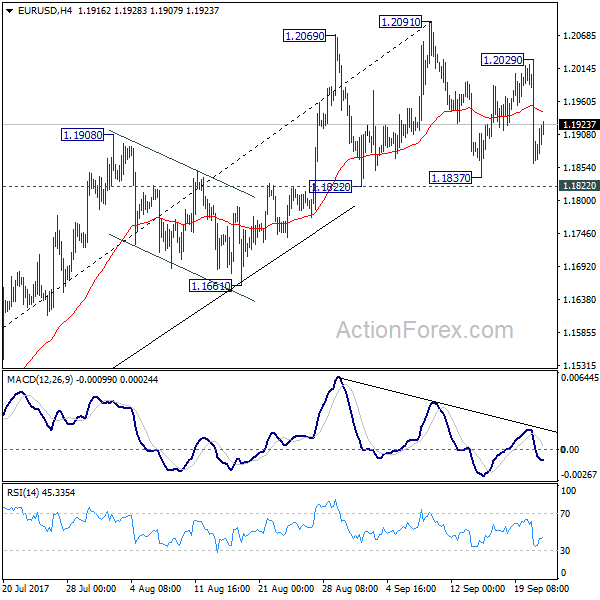
Daily Pivots: (S1) 1.1826; (P) 1.1929 (R1) 1.1998; More...
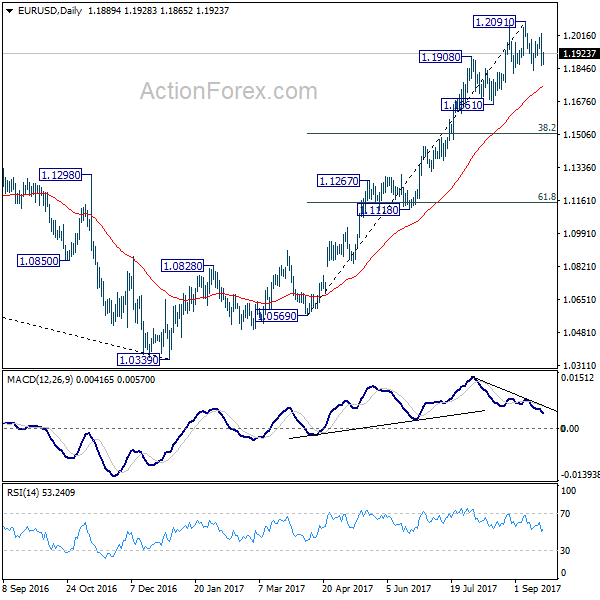
Intraday bias in EUR/USD remains neutral for the moment. on the downside, break of 1.1822/1837 support zone will complete a head and should top reversal pattern (ls: 1.2069, h: 1.2091, rs: 1.2029). That will confirm near term reversal, on bearish divergence condition in 4 hour MACD. In the case, intraday bias will be turned back to the downside through 1.1661 support. EUR/USD should then correct whole rise from 1.0569 and target 38.2% retracement of 1.0569 to 1.2091 at 1.1510. However, rebound from 1.1822/1837 and break of 1.2029 will resume the larger up trend to next key fibonacci level at 1.2516.
In the bigger picture, rise from medium term bottom at 1.0339 is still in progress for 38.2% retracement of 1.6039 (2008 high) to 1.0339 (2017 low) at 1.2516. However, it should be noted that there is no confirmation of trend reversal yet. That is, such rebound from 1.0399 could be a correction. And the long term fall fro 1.6039 (2008 high) could resume. Hence, we'd be cautious on strong resistance from 1.2516 to limit upside. But after all, break of 1.1661 is needed to indicate medium term topping. Otherwise, outlook will remain bullish in case of pull back.
GBP/USD Mid-Day Outlook
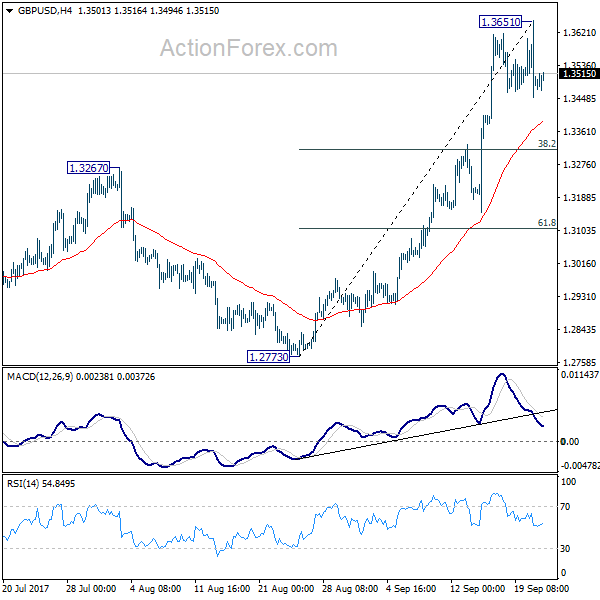
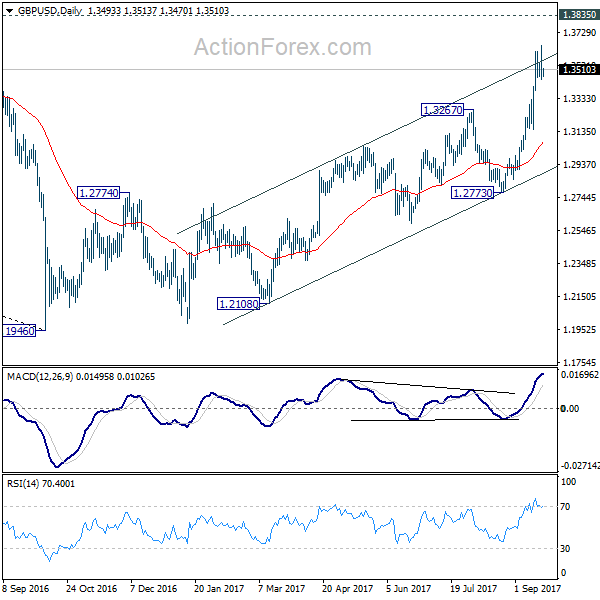
Daily Pivots: (S1) 1.3412; (P) 1.3533; (R1) 1.3616; More....
Intraday bias in GBP/USD remains neutral for consolidation below 1.3651 temporary top. In case of deeper fall, downside should be contained by 38.2% retracement of 1.2773 to 1.3651 at 1.3316 and bring rise resumption. Above 1.3651 will turn bias back to the upside for 1.3835 support turned resistance next. Break there will target 55 month EMA (now at 1.4405).
In the bigger picture, the strong break of 1.3444 key resistance now argues that the long term trend in GBP/USD has reversed. That is a key bottom was formed back in 1.1946 on bullish convergence condition in monthly MACD. Current rise from 1.1946 will target 38.2% retracement of 2.1161 (2007 high) to 1.1946 (2016 low) at 1.5466 next. In any case, medium term outlook will now stay bullish as long as 1.2773 support holds.
USD/CHF Mid-Day Outlook
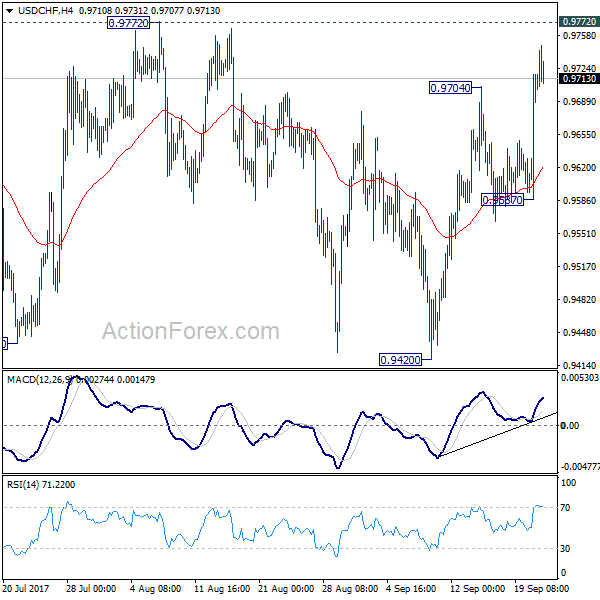
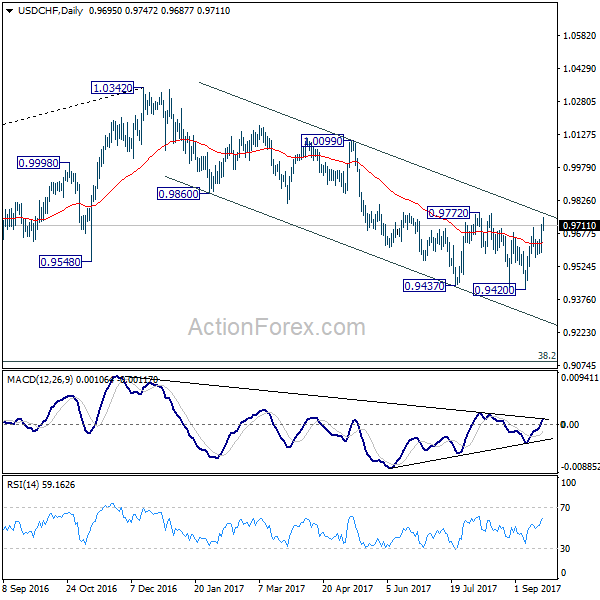
Daily Pivots: (S1) 0.9617; (P) 0.9667; (R1) 0.9747; More....
Intraday bias in USD/CHF remains on the upside as rebound from 0.9420 is targeting 0.9772 key resistance. Decisive break there will suggest that whole down trend form 1.0342 has completed. In that case, near term outlook will be turned bullish for 0.9860/1.0099 resistance zone. Nonetheless, with 0.9772 resistance intact, outlook remains bearish. Below 0.9587 minor support will turn bias back to the downside for 0.9420 low.
In the bigger picture, current development suggests that 0.9443 key support (2016 low) could be taken out firmly as down trend form 1.0342 extends. There are various interpretation of the price actions. But in any case, medium term outlook will stay bearish as long as 0.9772 resistance holds. Current down trend could extend to 38.2% retracement of 0.7065 (2011 low) to 1.0342 (2016 high) at 0.9090. However, break of 0.9772 will indicate that USD/CHF has successfully defended 0.9443 again and turn outlook bullish for 1.0099 resistance.
Trade Idea Update: USD/CHF – Stand aside
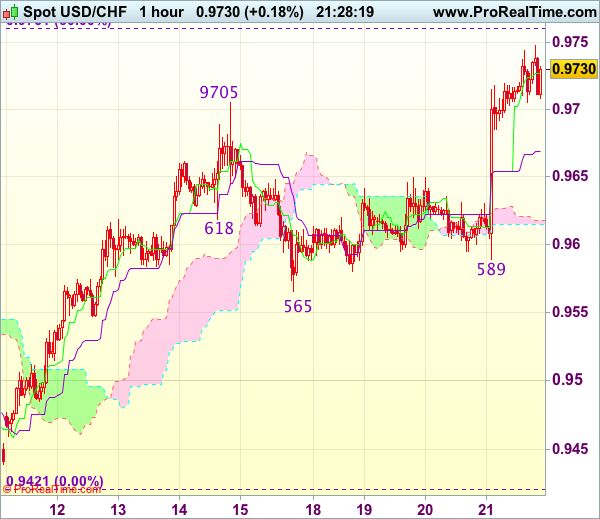
USD/CHF - 0.9727
New strategy :
Stand aside
Position : -
Target : -
Stop : -
The greenback only fell to 0.9589 yesterday before staging another rally (after Fed) above resistance at 0.9705, suggesting recent rise from 0.9421 low is still in progress and may extend gain towards 0.9761-66 (50% Fibonacci retracement of 1.0100-0.9421 and previous resistance) but reckon another previous resistance at 0.9773 would hold on first testing due to near term overbought condition, risk from there is seen for a retreat later.
In view of this, would not chase this rise here and would be prudent to stand aside for now. Below 0.9685 would bring test of the Kijun-Sen (now at 0.9667) but break there is needed to signal an intra-day top is formed, bring retracement to 0.9635-40 but said support at 0.9589 should remain intact.