Sample Category Title
Market Update – European Session: Could Make BOE Hawks More Vocal
Notes/Observations
Risk-on sentiment remains intact as concerns over Hurricane Irma and North Korea subside
UK Parliament cleared its 1st hurdle of the Brexit process where the House voted against opposition labor party attempt to block EU withdrawal; avoided any potential 'chaotic' EU exit for the time being.
UK Aug CPI at highest level since Jun 2013 (2.9% v 2.8%e) ahead of Thursday’s BOE rate decision
Overnight
Asia:
UN Security Council voted unanimous in favor of increasing sanctions against North Korea. Sanctions now impact more than 90% of all reported exports
China Premier Li: Global economy showing positive signs but still looks fragile. Countries cannot rely on QE to support growth and should implement structural reforms. Countries should maintain free trade and reiterates view that China would not boost exports though yuan depreciation and not resort to competitive currency devaluation
China PBOC fixed yuan weaker at 6.5277 per USD (snapping 11-day streak of firmer fixings)
Europe:
UK Parliament voted against opposition labor party attempt to block EU withdrawal bill; passes first parliamentary hurdle
EU's Juncker said to set out plans for more thorough vetting of foreign investments in his State of the Union speech to the European Parliament on Wed, Sept 13th
Norway right-wing govt projected to win re-election in general election with majority; PM Solberg wins second term
Energy:
OPEC Sec Gen Barkindo: Reiterates view that clearly the oil market rebalance is in progress; output growth is now slightly decelerating. OECD commercial oil stocks were 195M bbl above the 5 year average in July
Economic data
(RO) Romania Aug CPI M/M: -0.2% v 0.0%e; Y/Y: 1.2% v 1.5%e
(SE) Sweden Aug CPI M/M: -0.2% v -0.3%e; Y/Y: 2.1% v 2.2%e
(SE) Sweden Aug CPI CPIF M/M: -0.1% v -0.2%e; Y/Y: 2.3% v 2.2%e
(NO) Norway Aug Region Survey; Output Past 3 Months: 1.23 v 1.11 prior, Output Next 6 Months: 1.11 v 1.29 prior
(IT) Italy Q2 Unemployment Rate Q/Q: 11.2% v 11.3%e (lowest quarterly reading since 2012)
(UK) Aug CPI M/M: 0.6% v 0.5%e; Y/Y: 2.9% v 2.8%e; CPI Core Y/Y: 2.7% v 2.5%e (9th straight month annual inflation above BOE target and highest level since Jun 2013)
(UK) Aug RPI M/M: 0.7% v 0.6%e; Y/Y: 3.9% v 3.8%e, RPI-X (ex-mortgage interest payment) Y/Y: 4.1% v 4.0%e
(UK) Aug PPI Input M/M: 1.6% v 1.3%e; Y/Y: 7.6% v 7.3%e
(UK) Aug PPI Output M/M: 0.4% v 0.1%e; Y/Y: 3.4% v 3.1%e
(UK) Aug PPI Output Core M/M: 0.2% v 0.1%e; Y/Y: 2.5% v 2.3%e
Fixed Income Issuance:
(FI) Finland opened its book to sell $1.0B in 3-year notes; guidance seen -6bps to mid-swaps
(AT) Austria Debt Agency (AFFA) opened its book to sell EUR-denominated 5-year and 100-year RAGB bonds
(NL) Netherlands Debt Agency (DSTA) sold €2.2B vs. €2.0-3.0B indicated range in 0.75% 2027 DST Bonds; Avg Yield: 0.475% v 0.474% prior
(ES) Spain Debt Agency (Tesoro) sold total €5.09B vs. €4.5-5.5B indicated range in 6-month and 12-month Bills
(ID) Indonesia sold total IDR7.0T in 6-month Islamic Bills and 2-year, 4-year, -year and 15-year Project-based Sukuk (PBS)
(IT) Italy Debt Agency (Tesoro) sold €6.5B vs. €6.5B indicated in 12-month Bills; Avg yield: -0.326% v -0.337% prior; Bid-to-cover: 1.86x v 1.63x prior
(ZA) South Africa sold total ZAR2.65B vs. ZAR2.65B indicated in 2030, 2040 and 2044 bonds
SPEAKERS/FIXED INCOME/FX/COMMODITIES/ERRATUM
Equities
Indices [Stoxx600 +0.5% at 381.5, FTSE -0.1% at 7405, DAX +0.5% at 12539, CAC-40 +0.5% at 5204, IBEX-35 +0.3% at 10355, FTSE MIB +0.2% at 22169, SMI +0.6% at 9034, S&P 500 Futures +0.1%]
Market Focal Points/Key Themes:
European Indices continue their advance with the exception of the FTSE100 which has turned negative after stronger CPI readings and subsequently stronger Sterling. In Switzerland, Dorma+Kaba and Partner Group reported strong results with shares rising sharply while in the UK strong results from Sports retail JD Sports, as well as Ashtead Group sees shares higher. Redrow trades sharply lower following the sale of 25.9M shares by the Chairman and Founder and AA Plc trades higher after confirming talks with Hastings. Auto are in focus this morning with various commentary out from the Frankfurt Autoshow, with VW pledging to invest over €20B on 80 new electric vehicles by 2025.
Equities
Consumer discretionary [Ashtead Group [AHT.UK] +8.2% (Earnings), JD sports [JD.COM] +3.3% (Earnings), AA [AA.UK] +1.4% (Confirms media speculation on potential tie up with Hasting Group), Goals Soccer Centres [GOAL.UK] -6% (Earnings)]
Industrials: [Dorma+Kaba [DOKA.CH] +10% (Earnings)]
Financials: [Partners Group [PGHN.CH] +5.8% (Earnings)]
Energy: [Premier Oil {PMO.UK] +2.6% (Sells interests in Licences PL089 and P534)]
Real Estate: [Redrow [RDW.UK] - 8.4% (Placing)]
Speakers
France Fin Min Le Maire reiterated pledge to meet 3% budget deficit to GDP target
EU Brexit Negotiator Verhofstadt: UK PM May should addres the full EU parliament
South Korea Fin Min Kim: No changes to government's position on property ownership. Not considering raising home ownership tax. Monitoring effects of recent real estate measures while considering various additional policy means and not just loan regulations
Currencies
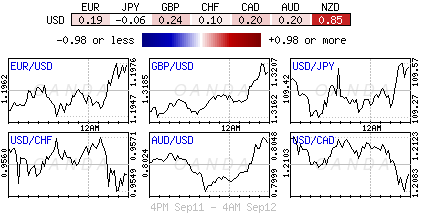
The risk-on sentiment remained intact for a 2nd straight day as concerns over Hurricane Irma and North Korea subsided. US Treasury yields have bounced back from their lows and this is aiding the USD. The question is whether any USD rebound could be sustained?
USD/JPY was higher by 0.3% to test 109.70 area. EUR/USD was steady at 1.1965 area.
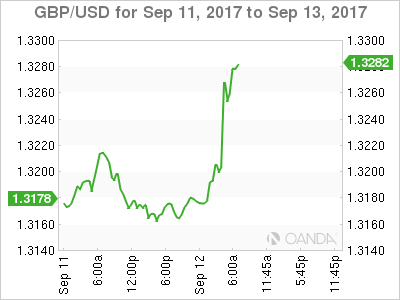
GBP was firmer in the session after the UK Parliament cleared its 1st hurdle of the Brexit process where the House voted against opposition labor party attempt to block EU withdrawal. Passage paves the way for greater powers to handed to ministers through the first major piece of Brexit legislation and avoided any potential 'chaotic' EU exit for the time being. Cable extended its gains after Aug CPI data beat expectations and saw its 9th straight month annual inflation above BOE target and highest level since Jun 2013). GBP/USD at 1.3280 ahead of the NY morning.
The SEK currency (Krouna) was firmer as Swedish Aug CPIF inflation (Riksbank new gauge) came in higher than expected. EUR/SEK was lower by 0.4% to test the lower end of the 9.53 range.
Fixed Income
Bund futures trade at 162.42 down 32 ticks trading lower as markets await ECB VP Vitor Constancio’s speech in Frankfurt. Continued downside targets 161.42 while upside resistance stands initially at 163.27.
Gilt futures trade at 127.89 down 39 ticks extending their decline following data that showed UK core inflation rose more than expected. Continued downside eyeing 127.25, then 126.88. Upside targets 128.90 then 129.24.
Tuesday's liquidity report showed Monday’s excess liquidity fell to €1.766T from €1.778T and use of the marginal lending facility rose to €275M from €142M.
Corporate issuance saw $11.1B last week via13 issuers headlined BOC Aviation $1B 2-part senior unsecured note offering and General Dynamics $1B in a 2part senior unsecured note offering
Looking Ahead
(IL) Israel Central Bank (BOI) Aug Minutes
(PT) Bank of Portugal Reports Aug ECB financing to Portuguese Banks: No est v €23.5B prior
05.30 (UK) Weekly John Lewis LFL sales data
05:30 (HU) Hungary Debt Agency (AKK) to sell in 3-month Bills
05:30 (EU) ECB allotment in 7-day Main Financing Tender (MRO)
05:30 (DE) Germany to sell €500M in Apr 2046 I/L bonds (Bundei)
05:30 (BE) Belgium Debt Agency (BDA) to sell €2.1-2.5B in 3-Month and 12-Month Bills
06:00 (US) Aug NFIB Small Business Optimism: 104.8e v 105.2 prior
06:00 (PT) Portugal Aug CPI M/M: No est v -0.7% prior; Y/Y: No est v 0.9% prior
06:00 (PT) Portugal Aug CPI EU Harmonized M/M: No est v -0.6% prior; Y/Y: No est v 1.0% prior
06:00 (IE) Ireland July Property Prices M/M: No est v 1.4% prior; Y/Y: No est v 11.6% prior
06:00 (TR) Turkey to sell 2022 and 2027 Bonds
06:45 (US) Daily Libor Fixing
06:30 OPEC Sept Monthly Report
07:00 (BR) Brazil Central Bank COPOM Sept Minutes
07:30 (CL) Chile Central Bank Economist Survey
07:45 (US) Weekly Goldman Economist Chain Store Sales
08:00 (BR) Brazil CONAB Crop Report
08:00 (PL) Poland Aug CPI Core M/M: -0.1%e v -0.1% prior; Y/Y: 0.8%e v 0.8% prior
08:00 (IN) India Aug CPI Y/Y: 3.2%e v 2.4% prior
08:00 (IN) India July Industrial Production Y/Y: +1.6%e v -0.1% prior
08:00 (BR) Brazil July Retail Sales M/M: 0.1%e v 1.2% prior; Y/Y: 3.2%e v 3.0% prior
08:00 (BR) Brazil July Broad Retail Sales M/M: -1.0%e v +2.5% prior; Y/Y: 3.9%e v 4.4% prior
08:05 (UK) Baltic Dry Bulk Index
08:55 (US) Weekly Redbook Sales
09:00 (EU) Weekly ECB Forex Reserves
09:00 (RU) Russia announces weekly OFZ bond auction
09:50 (UK) BOE to buy £1.125B in in APF Gilt purchase operation (over 15 years)
10:00 (US) July JOLTS Job Openings: 6.00Me v 6.163M prior
10:00 (MX) Mexico weekly International Reserves
10:35 (UK) Chancellor of Exchequer Hammond (Fin Min) questioned by Lords Committee
11:00 (UR) Ukraine to Sell Bonds
11:30 (US) Treasury to sell 4-Week and 52-Week Bills
12:00 (US) DOE Short-Term Crude Outlook
12:00 (US) USDA World Agricultural Supply and Demand Estimate (WASDE) Crop Estimate
13:00 (US) Treasury to sell 10-Year Notes Reopening
15:00 (AR) Argentina Aug National CPI M/M: 1.6%e v 1.7% prior
16:30 (US) Weekly API Oil Inventories
Sterling Soars As UK Inflation Jumps
Sterling bulls were out of control on Tuesday, after official figures showed that inflation in Britain jumped to its highest level for more than five years in August.
The Consumer Price Index rose to 2.9% in August, up from 2.6% in July, thanks to rising prices for clothing and petrol. With UK inflation rates finding comfort well above the Bank of England’s 2% target, as the Brexit-fueled Pound weakness boosts import costs, BoE hawks may make an appearance during Thursday’s policy meeting. While rising inflation is likely to support expectations over the Bank of England raising UK interest rates, it still unclear as to when and how this will occur.
It should be kept in mind that elevated inflation levels have pressured households this year, and this will continue to negatively impact the outlook of the economy. With wage growth still struggling to keep up with inflation, concerns are mounting over the sustainability of the UK’s consumer-driven economic growth. BoE policy makers are under fresh pressure to take action, and Wednesday’s UK labour market data, which will be in sharp focus, could act as a catalyst for an unexpected surprise this year.
The big question is, will the jump in UK consumer prices prompt the BoE to raise rates quicker than anticipated? While there is an argument for higher rates taming inflation, this could end up impacting business confidence and may punish the fragile UK economy.
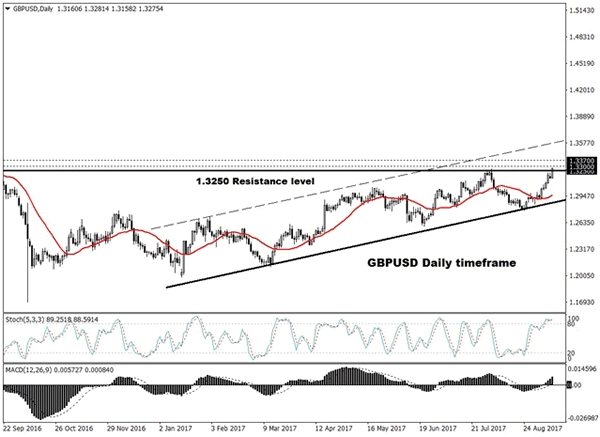
From a technical standpoint, the GBPUSD is turning increasingly bullish on the daily charts. The breakout above the 1.3250 resistance should encourage a further appreciation towards 1.3300 and 1.3370, respectively.
Euro Dips Below 1.20 As Risk Appetite Returns
The euro is almost unchanged in the Tuesday session, after recording considerable losses on Monday. Currently, the pair is trading at 1.1962, up 0.06% on the day. On the release front, it’s a data-light day, with no eurozone events. In the US, today’s key event is JOLT Jobs Openings, which is expected to slow to 5.96 million. On Wednesday, the US releases PPI, with an estimate of 0.3%.
The US dollar suffered broad losses last week, as tensions rose in the Korean peninsula after North Korea tested a hydrogen bomb. This weighed on risk appetite, and the euro jumped on the bandwagon, gaining 1.3 percent against the greenback. With North Korea celebrating its 69th anniversary of independence, there were concerns that Pyongyang would use the occasion to flex some muscle and test a nuclear bomb or missile. North Korea marked last year’s anniversary by exploding its fifth nuclear test. There were no incidents over the weekend, although the US, along with its allies Japan and South Korea, remain on alert for further provocations from the north. The dollar responded with gains on Monday, as EUR/USD dipped below the symbolic 1.20 level.
The US economy has been performing well in the second quarter. Preliminary GDP came in at a sizzling 3.0%, and the labor market remains close to capacity. Still, the Achilles heel of the economy remains stubbornly low inflation levels. Wage pressure has been limited, despite the fact that many businesses cannot fill job openings. Weak inflation has hampered the Fed’s plans to raise interest rates a third time this year, and the odds of a December hike have dipped to just 31%, as the markets are increasingly doubtful that the Fed will make a move before next year. Will the inflation picture improve? We could see better numbers this week for August inflation – PPI is expected to improve to 0.3% on Tuesday, and the same gain is forecast for CPI on Wednesday. Both estimates are higher than the July readings.
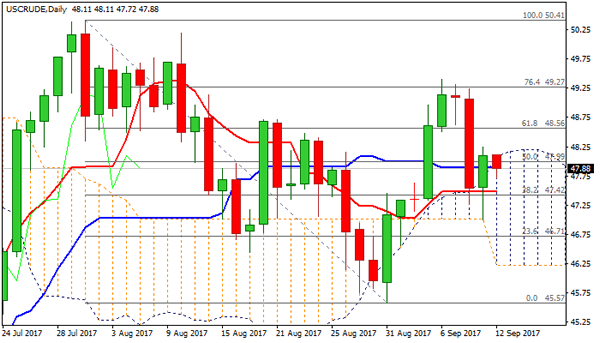
Technical Outlook: WTI Oil – Rising Daily Cloud Top Continues To Limit Upside Attempts
WTI oil price shows initial signs of stall as bulls were so far unable to extend above top of thickening daily cloud (48.07).
Oil is failing to capitalize from bullish signal on Monday’s rally which closed above daily cloud top / Kijun-sen ($47.89), suggesting that further consolidation is needed before renewed attempts higher.
Bullish setup of daily studies supports scenario, with dips being so far contained by rising 10SMA and allowed down to 20SMA ($47.62) ahead of fresh rally.
Bullish scenario requires sustained break above daily cloud to open way towards double-Fibonacci barriers at $48.48/56 (Fibo 61.8% of $49.40/$46.99 and Fibo 61.8% of $50.41/$45.57 descend) which marks next pivotal barrier.
Otherwise, loss of these supports would increase downside pressure towards pivotal support at $47.48 (daily Tenkan-sen) and risk extension towards Monday’s low at $46.99 on break.
Res: 47.89, 48.11, 48.56, 48.83
Sup: 47.62, 47.48, 47.26, 46.99
Unwinding Safe Haven Buying
Tuesday September 12: Five things the markets are talking about
The U.S dollar is finding it difficult to build on yesterday's strong start to the week as investor concerns about lackluster inflation stateside continues to linger ahead of key data this week.
The market will be keeping a close watch on Thursday's U.S consumer price data and Friday's U.S retail sales as it tries to gauge whether the U.S economy is strong enough to allow the Fed to hike rates a third time this year. The current CME FedWatch tool projects a +27% probability of one +25 bps rate hike in December.
The overnight appetite for riskier assets is being supported by a lack of further confrontational developments from North Korea. Safe-haven assets such as U.S Treasuries and gold have managed to give back most of their recent gains.
Note: The UN Security Council approved a watered-down proposal to punish the nation for its latest missile and nuclear tests, omitting an oil embargo and a freeze of Kim Jong's personal assets.
1. Stocks hit record highs as Irma weakens
Global equities have climbed to record highs overnight as easing tensions over North Korea and signs that Hurricane Irma was causing less damage than feared.
In Japan, stocks climbed to their highest in a month with financials leading the way mirroring S&P's record close yesterday. The Nikkei rose +1.2%, the highest closing level since Aug. 8, while the broader Topix added +0.9%, with 32 of its 33 subsectors in positive territory.
In South Korea, the Kospi index rose +0.3%, while down-under, Australia's S&P/ASX 200 Index added +0.6%.
In Hong Kong, equities skip the bullish global move and hover atop of their two-year highs. The Hang Seng index inched up +0.1%, while the China Enterprises Index climbed +0.2%.
In China, shares inched higher with the blue-chip CSI300 index rallying +0.3%, while the Shanghai Composite Index added +0.1%.
In Europe, Germany's DAX Index climbed +0.4%, reaching its highest print in two-months on its sixth consecutive advance, while in the U.K, the FTSE 100 Index is under pressure after today's stronger inflation numbers (see below) and a stronger pound (£1.3250).
U.S equities are set to open in the black (+0.1%).
Note: Apple Inc. reveals its newest products later today.
Indices: Stoxx600 +0.5% at 381.5, FTSE -0.1% at 7405, DAX +0.5% at 12539, CAC-40 +0.5% at 5204, IBEX-35 +0.3% at 10355, FTSE MIB +0.2% at 22169, SMI +0.6% at 9034, S&P 500 Futures +0.1%
2. Oil steady as market assess U.S hurricane impact
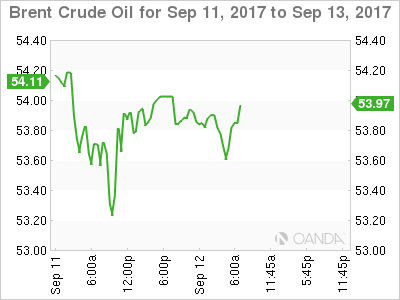
Oil prices are steady as the market weighs up the dampening effect on demand of Hurricane Irma versus refinery restarts in the wake of Hurricane Harvey that should lead to more crude oil processing.
Brent crude futures are down -4c, or -0.07% at +$53.80 per barrel, while U.S West Texas Intermediate (WTI) crude is down -3c, or -0.06% at +$48.04 a barrel.
U.S crude inventories likely rose last week following the hurricane impact, while refined product stockpiles are forecasted to have declined.
The API and the EIA data last week are expected to show that crude stocks likely rose in the week ended Sept. 8.
Note: The API is due to release its data for last week at 4:30 pm EDT today and the EIA report is scheduled at 10:30 am EDT Wednesday.
Note: OPEC Secretary General Barkindo reiterated the view that the oil market rebalances remains in progress with output growth slightly decelerating – OECD commercial oil stocks were +195m barrels above the five-year average in July.
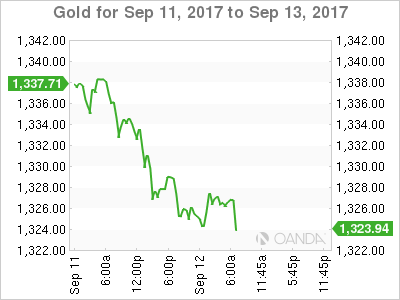
Ahead of the U.S open, gold has hit its lowest price in more than a week as receding concerns over N. Korea's nuclear ambitions and the impact of Hurricane Irma supports further gains in equities, softening demand for the ‘yellow' metal as a haven from risk. A steadier tone to the dollar is managing to take some pressure off the metal. Spot gold is trading atop of its two week lows at +$1,322.85.
3. Sovereign yields back up
Hurricanes Harvey and Irma are likely to trigger near-term weakness in U.S economic data leading to a challenge for the Fed regarding the appropriate stance of monetary policy.
The market expects the Fed to proceed with caution and this likely means postponement of any rate hike in December – the odds for a December rate hike have now fallen to a +27% probability.
Risk on trading has sovereign yields backing up a tad overnight. The yield on 10-year Treasuries gained +1 bps to +2.14%, the highest in more than a week.
In Germany, the 10-year Bund yield gained +1 bps to +0.35%, while in the U.K 10-year Gilt yield advanced +2 bps to +1.045% supported by this morning's inflation data ahead of Thursday's Bank of England (BoE) monetary policy decision.
In Japan, 10-year JGB's bond yield rallied to a three-week high, backing up +3 bps to +0.025%.
4. Sterling's stellar performance
With risk-on sentiment remaining intact for a second consecutive day as concerns over Hurricane Irma and North Korea subsides has U.S Treasury yields backing up and tentatively supporting the U.S dollar, but is it sustainable?
Ahead of the open stateside, USD/JPY is higher by +0.3% at ¥109.70, a three week high while EUR/USD is steady at €1.1965.
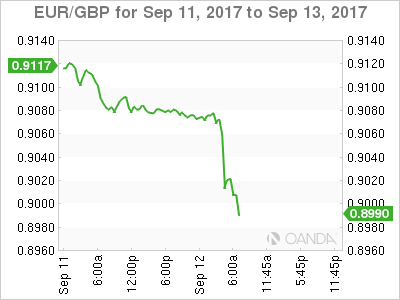
The standout currency is GBP – the pound (£1.3262) has rallied aggressively after U.K consumer inflation data this morning came in better than expected (see below). EUR/GBP is down -0.6% at €0.9021.
A stronger-than-expected inflation report would be something that the BoE would have to consider at Thursday monetary policy meeting. The data may possibly bring more members in support of a raise in interest rates.
However, inflation is thought to be rising due to a weaker pound, not due to fundamentals. The pound has also found support from the U.K Parliament yesterday voting against opposition Labor party's attempt to block E.U withdrawal bill, effectively passing its first parliamentary hurdle.
5. UK Inflation Speeds Up in August
Data this morning showed that U.K annual inflation rose to +2.9% (+2.8% e) in August, driven higher by the rising price of clothing and petrol.
Other data from the U.K's Office for National Statistics also revealed a rise in the producer price index – +1.6% (+1.2% e) in August, supported by the higher price of fuel – the first gain in six-months.
Increasing concerns about the squeeze on the cost of living will make Thursday's Bank of England (BoE) interest rate decision a tad more interesting.
Record Highs Expected As North Korea Fears Subside
- Should we be more concerned about North Korea retaliation to UN sanctions?
- UK inflation spikes again ahead of BoE meeting;
- US labor market should be primed for wage growth.
US indices are poised to open in, or close to, record territory on Tuesday as North Korean fears continue to subside.
Once again we find ourselves in a scenario in which no news is good news and while underlying risks remain, the longer we go without another nuclear or missile test, the more positive investors will become. The only problem with this is that, with the UN having just agreed on new sanctions against North Korea – spearheaded by the US – I wonder how long we will have to wait for an act of provocation in response.
With that in mind, I expect an element of caution to remain, at least until after the weekend at which point investors may decide that such a response isn't imminent. Should we get a response, then I would expect to see a similar response as we've seen in recent weeks, with traders once again favouring safe havens such as Gold, which despite having come off its highs, currently remains elevated.
In the meantime, attention will turn back to the fundamentals and this week, that is focused primarily around the UK, with data releases earlier in the week followed by the Bank of England monetary policy meeting on Thursday. Today we got the first of the releases – CPI and core CPI data – which showed prices in the UK rising at a faster pace than expected and a much faster pace than the BoE targets.
This has created a dilemma in the past for the BoE – as demonstrated by the lack of consensus in the voting in recent months – with policy makers being torn between raising interest rates in order to bring inflation back towards target and protecting the economy and hoping it naturally finds its way back to target. The latter of these strikes me as the most sensible, with price rises having largely been driven by the depreciation of the pound, the bulk of which should now be behind us. Clearly though, some policy makers are not convinced this is the case. With labor market data still to come before Thursday's monetary policy decision, it will certainly be an interesting week for the UK economy and the pound, which rallied after the inflation data on the expectation that the it adds to the case for a hike.
The bulk of the US data isn't due until later in the week, at which point we'll get inflation and retail sales figures, both of which will closely monitored. Today's we'll get JOLTS job openings data for July which is expected to have come slightly off its June high but remain just below 6 million, a sign that the labour market remains extremely healthy and primed for stronger wage growth which has so far proved elusive.
WTI Oil Futures Risk Seeing More Downside
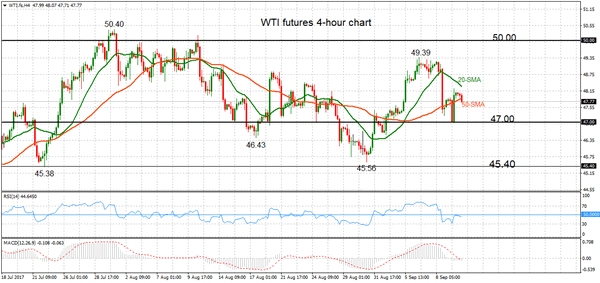
WTI oil futures have been trading around the pivotal 47- level and keeping within a range between 45.40 and 50.40 since July.
Trading during the last few sessions has been very choppy. The recent rally from the 45-area to the September 6 high of 49.39 fizzled out after the market became overbought as was indicated by the RSI rising above 70 on the 4-hour chart. A subsequent drop found strong support at 47 from where prices bounced off.
Near-term risk is tilted to the downside based on bearish signals from technical indicators. The 20-period moving average is pointing down while momentum oscillators RSI and MACD are now in their respective bearish territory.
Should key support at 47 breaks down, this would increase downside pressure for a move towards the August 31 low of 45.56. A further extension lower would see WTI push outside the broader range and begin to shift out of the neutral phase to a more bearish one and turn the focus to the 42-level.
The odds for a push higher from current levels in the near term have diminished based on the reversal of the 20-period SMA and of the momentum oscillators. A rise above yesterday’s high of 48.24 would signal more upside potential with scope to reach the September 6 high of 49.39. From here, the key 50 level comes into view.
Only a move above the August 1 high of 50.40 would push prices out of the 6-week range. Then the short-term trend would shift to bullish. For now, the near-term bias is bearish while the medium-term is neutral.
Technical Outlook: Spot Gold – Bears May Extend Towards $1317 Support While 10SMA Caps
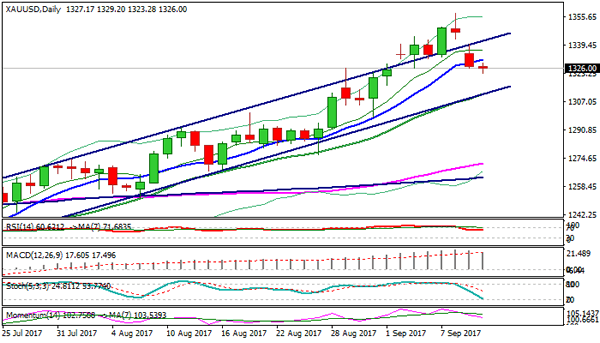
Spot Gold remains in red on Tuesday and met its target and strong support at $1323 (Fibo 38.2% of $1267/$1357 upleg), where temporary footstep was found. Near-term action is in narrow consolidation above $1323 handle and holds below broken 10SMA ($1331), maintaining bearish near-term bias. Relief from North Korea/Hurricane Irma's impact concerns reduced safe-haven demand and keep gold price under pressure. Bears may extend towards next pivotal support at $1317 (Fibo 38.2% of $1251/$1357 upleg) loss of which would expose another strong support at $1304 (daily Kijun-sen). Scenario is expected to remain in play while the price holds below 10SMA, otherwise, strong downside pressure would ease on break and close above 10 SMA.
Res: 1329, 1331, 1336, 1340
Sup: 1323, 1317, 1312, 1304
PBOC Removes Capital Control. Yet, Renminbi Internationalization Remains Distant
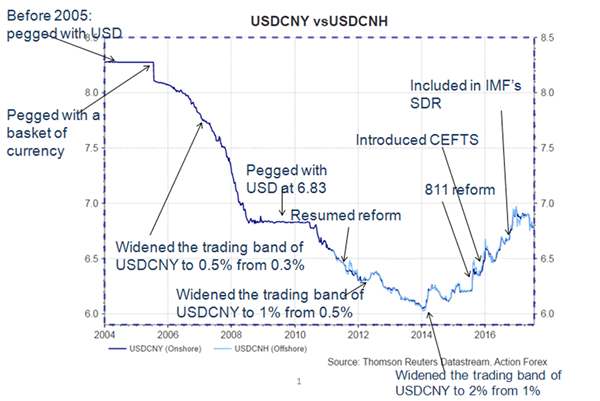
USDCNY continues to recover after the pair slumped to the lowest level since December 2015 last Friday. The rebound, long-awaited as the broad-based USD weakness has caused the pair to decline over the past 4 months, is facilitated by PBOC’s announcement to remove the requirement for banks to hold the equivalent of 20% of clients' FX forward positions as reserve for a year at 0% interest. For more than a decade, China has been implementing reforms in its currency, with the ultimate goal of achieving a floating exchange rate regime and convertibility for renminbi – a movement widely described as renminbi internationalization. However, this report seeks to explain that the government has only been moving back and forth, without making significant progress in transforming renminbi into a market-oriented exchange rate.
'811-Reform'
On August 11, 2015, PBOC abruptly devaluated renminbi by -2%. On trading, CNY plunged -1.8% against USD, the biggest one-day decline since 1994. Besides, PBOC announced a new renminbi fixing mechanism, suggesting that the components used in setting that daily fixing rate include previous’ day’s close, FX demand and supply conditions and movement of major currencies. The market believed that the new mechanism had paved the way for renminibi to join IMF’s special drawing right (SDR). PBOC explained that it had to devaluate the currency as the midpoint had been diverging from the market rate for some time. However, we believe it was a means to rescue the slowdown in economic growth.
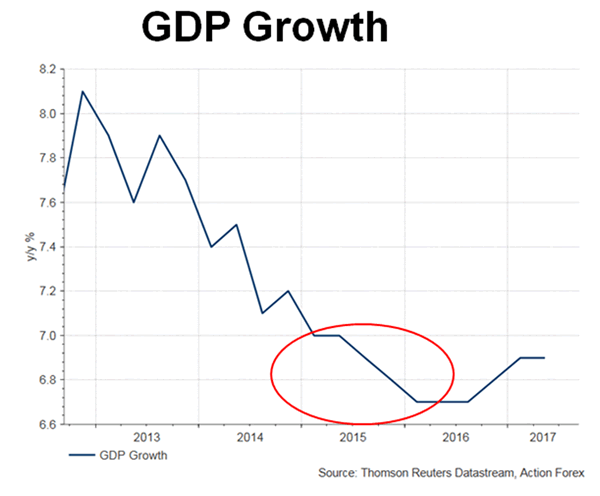
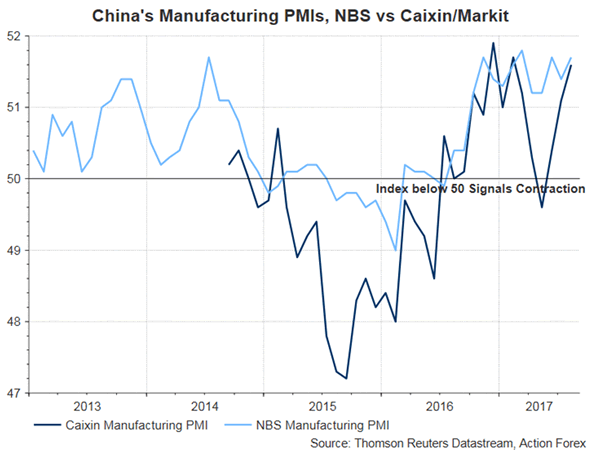
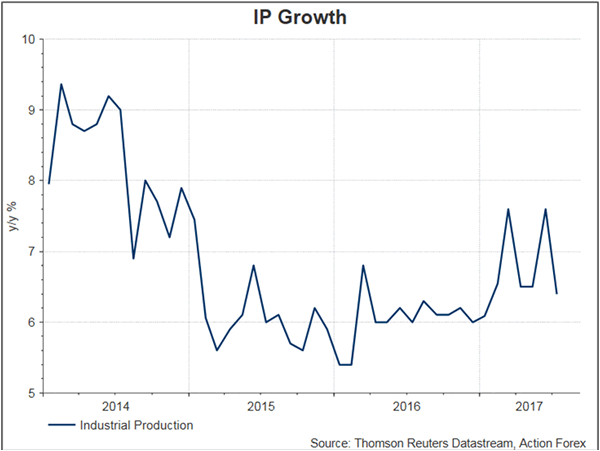
While inclusions of demand/supply conditions, as movement of major currencies in its calculation marked an effort to make renminbi more market-oriented, the surprising devaluation had dampened market confidence on the currency and evidenced that the currency remained under manipulation to the authority despite the rhetoric of market-orientation.
Panic selling of renminbi following the so-called '811-reform' triggered the government adopt a series of capital control measures, including the abovementioned 20% FX reserve ratio effective from October 2015. Other capital control measures include strengthening supervision of foreign exchange purchases by foreign-held non-resident accounts (NRA), monitoring firms’ foreign exchange buying and tightening supervision of bank clients’ foreign exchange deals.
FX Reserve
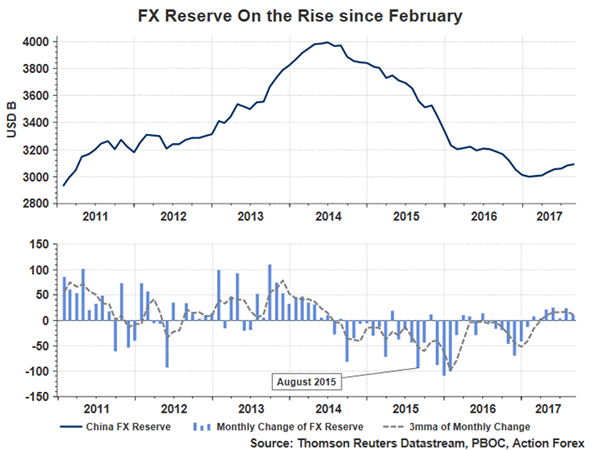
Another prominent feature of China’s defense of renminibi depreciation is the massive selloff of FX reserve. US$630B of FX reserve was evaporated from Aug-2015 to Dec-2016. During the period, renminbi deprecated -10% against US dollar. PBOC aggressive selling sent FX reserve below US$ 3 trillion in January this year. There is no coincidence for the consecutive monthly rise in FX reserve and USDCNY’s decline since February.
CEFTS index
Remaining under pressure for the rest of 2015 and in 2016, renminbi’s weakness had been a result of concerns over further government devaluation in light of soft economic growth and a strong US dollar amidst rising expectations of Fed funds rate hike and reflation trade upon Donald Trump’s victory as the US president. Renminbi depreciation despite stringent capital control measures led to the 're-introduction' of the CEFTS index in December 2016. Attempting to shift the market’s focus from renminbi vs US dollar to renminbi vs a basket of currencies, the government expanded the number of currencies in the CFETS basket to 24 from 13 in January 2017.
Counter-Cyclical Factor
Less than four months ago, the government indicated that it considered adding a 'counter-cyclical factor' in its fixing mechanism. As such, components in the daily fixing calculation would include previous day’s close+ changes in renminbi’s value against a basket of currencies+ counter cyclical factor. The authority explained that the new component would help prevent renminbi from being excessively affected by external volatility. Yet, it revealed no details about how the countercyclical factor would be computed or its weight in the new fixing mechanism. Introduction of the counter-cyclical factor evidenced that the government has chosen to control the currency movement, instead of increasing its transparency and taking a step forward in currency internationalization.
Indeed, we doubt whether the Chinese government is committed to achieving a floating exchange rate regime and convertibility for renminbi. Over the past decade, it has been moving one step forward and then several steps backward in its internationalization process. We are not hopeful that renminbi would become a global currency in the next decade, let alone a major reserve currency.
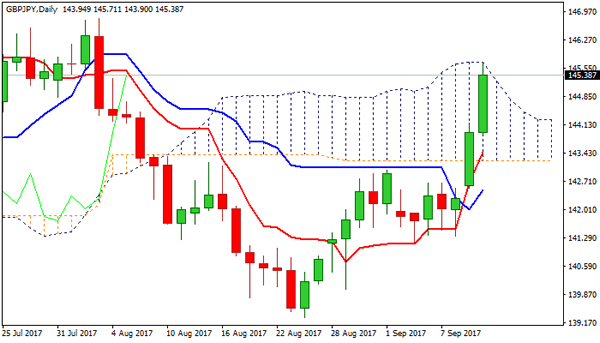
Technical Outlook: GBPJPY – Extended Bullish Acceleration Faced Strong Headwinds At Daily Cloud Top
The pair extends strong rally into second straight day, as fading concerns over North Korea / Hurricane Irma’s impact drastically reduced safe-haven demand and pound got additionally inflated by upbeat UK inflation numbers.
The cross dented target at 145.70 (daily cloud top) on today’s strong acceleration higher and may extend recovery rally on sustained break above the cloud.
The price is currently riding on the wave C (from 141.18 trough) of five-wave cycle from 139.30 (24 Aug low) which could extend towards its Fibo138.2% Expansion at 146.18 and 146.80 (03 Aug lower top) in extension.
Daily studies turned into full bullish setup and are supportive for further advance.
However, overbought conditions suggest corrective action in the near term (no signal yet), as daily cloud is narrowing and will twist next week that may also attract for stronger pullback.
Initial support lies at 114.79 (broken FE 100.0%), followed by session low /55SMA at 143.90 and rising daily Tenkan-sen at 143.45.
Key near-term support lies at 143.25 (daily cloud base/Fibo 38.2% of 139.30/145.71 ascend).
Res: 145.70, 146.18, 146.80, 147.05
Sup: 144.79, 144.19, 143.90, 143.45