Sample Category Title
What CPI Is and How to Trade Inflation Data
Consumer Price Index, CPI for short is a measure of the change in the weighted average of prices from a basket of consumer goods and services considered essential.
CPI is calculated by tracking the price changes for each of the items in the basket of goods and weighted in importance.
Inflation data is primarily comprised of two measures:
- Headline inflation: This inflation reading tracks the overall changes and includes energy prices which are volatile
- Core inflation: This inflation reading strips out the volatile energy prices and food and gives a clearer picture of the price changes in the basket of goods
The headline inflation data is usually more volatile compared to the Core inflation rate and has the ability to predict core inflation. The headline inflation is designed to be a best measure of inflation and it is this headline inflation which is usually targeted by Central Bankers.
CPI or inflation data is an important economic release which has the potential to move the short term markets as well as shape monetary policy decisions. After all most central banks have an inflation-targeting mandate.
CPI or Inflation data is released on a monthly basis with some countries releasing flash or preliminary inflation data ahead (EU) of their time.
Typically CPI data released is for the month gone by and is also measured annually for both the core and the headline inflation data.
Countries such as New Zealand and Australia prefer to keep the inflation data on a quarterly basis which offers a less volatile and clearer view on changes in consumer prices.
Some countries also tend to use their own measure of inflation. For example in the Eurozone, HICP or Harmonized Index of Consumer Prices is used, while the US besides the CPI, PCE or Personal Consumption Expenditure data is also used.
Although the terms may sound different, they track the same underlying changes in consumer prices with differences in the way the prices are measured.
Why is Consumer Price Index an important economic report?
The CPI or consumer price index report is an important economic indicator as it signals how quickly prices are rising or falling. When consumer prices rise, it signals inflation, but when prices fail to rise or drop, it signals a period of deflation.
Central bankers use consumer inflation as a gauge to raise/cut/hold interest rates, which acts as a lever to stimulate or hold back consumer spending which in turn influences inflation.
As a result, CPI data is closed watched as strong or prolonged increase or decline in inflation usually results in some Central Bank acting on monetary policy.
Most central banks today build their monetary policy around inflation targeting. This means that the Central Banks have a specific target inflation rate to achieve, which is usually 2%, or in some cases, within a band of 2% – 3%.
Interest rates and monetary policy tools are used in accordance with maintaining the price stability.
Impact of CPI data release on the forex markets
In the currency or forex markets, CPI data is closed watched. This report has gained a lot more significance ever since oil prices started a steady decline making it more difficult for Central Banks to target the 2.0% mandated inflation growth.
Many banks have had to cut interest rates, some into negative as well as having to use other tools such as quantitative easing in efforts to stoke consumer spending and thus push inflation higher.
A good example of the importance of inflation data can be the Bank of Japan and the European Central Bank, which struggled to push inflation back to the mandated target.
When monthly a quarterly inflation report shows a spike or declines further, the markets are quick to speculate what policy action the Central Banks could take based on the information available.
Example of trading the CPI release
Eurozone CPI (2014 & 2015)
The Eurozone's annual inflation rate was in a steady decline for most of 2014, at one point falling below zero. The ECB vowed to bring inflation back to its 2.0% target and prepared the markets thereafter that it would consider cutting interest rates to historic lows, cut rates on bank deposit rates and purchase sovereign bonds via the QE program to spur lending.
The chart below shows the Eurozone inflation rate between 2014 January and 2015 December. It was in January 2015 that the ECB announced a massive €60 billion monthly bond purchase program to stoke inflation.
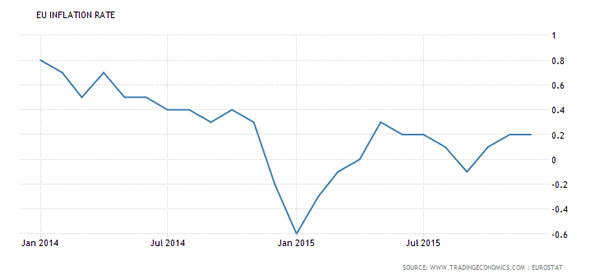
Eurozone Inflation Rate 2014 – 2015
The Euro fell sharply since the ECB announced its intentions, falling from highs of $1.39 to hit $1.12 before the ECB officially announced the dovish monetary policy decision.
To summarize the key points about CPI and how to trade the report:
- Inflation is a measure of the price change in a basket of goods. Inflation is measured as a headline and core inflation which strips the volatile food and energy components
- CPI is released on a monthly and quarterly basis, in some cases as a preliminary estimate. The data is released for the previous month
- While monthly dispersions occur, the annualized inflation rate is what matters
- CPI might have strong or negligible impact depending on the monetary policy conditions
- On the very short term, a surprise in inflation can lead to some intraday trading opportunities
Demo Trading vs. Live Trading
No matter how hard you try, it will be impossible for you to climb up the trading ladder until you've learned how to risk live money.
Trading in the live market draws in psychological elements that are generally not experienced in a simulated environment. This, as you'll see throughout the article, is the key difference…
Demo trading - to trade or not to trade?
As a new trader entering into the wonderful world of currency trading, you will have undoubtedly come across several traders promoting the benefits of using a demo account before transitioning over to a live account. We happen to agree with this, and believe that trading a demo account is incredibly helpful.
Although a practice account typically mitigates the psychological side of things, simulated trading provides a stage in which to develop and hone your trading method, begin creating a trading journal and familiarise yourself with how a platform functions.
It is often recommended that once you are recording consistent profits on demo, you can then begin thinking about taking the leap over to a live account. To begin with, we would not advise opening a live account with a huge sum of money. Why? Well, although you're able to pin down consistent profits on demo, live trading is a completely different animal altogether! Think lion and tame house cat - that's how much of a difference there is, traders!
Why is demo and live trading so different then?
Switching over from demo to live is often an exciting, yet slightly daunting, prospect for most. The typical trader often sees no reason why their demo results cannot be replicated on a live account. The trouble with this is that having your hard-earned money on the line will cause stronger emotions to materialize, which were masked when trading simulated funds. Sweaty palms, a dry mouth, a pounding heart beat and a swarm of butterflies in your stomach are common symptoms when one first experiences live trading. After all, it is never easy, especially in the earlier stages, watching real money fluctuate from positive to negative.
Live trading will also teach you things about yourself that you never knew existed! You may believe that you are a disciplined patient person now (and you may well have been on demo), but wait until there is real money on the line. This changes a lot of people!
In addition to the above, you may find yourself breaking trading rules once live money enters the equation. Things like moving stop losses, prematurely taking profits before the target is achieved and revenge trading are just some of the trading sins you may commit. Furthermore, in an attempt to prove that you can replicate your demo results, this could lead to overtrading, and sometimes even ignoring your trading plan altogether.
Ultimately, the method that you used to successfully trade on demo should not change. It's the psychological side of things that will require work in live trading.
Ways of making the transition from demo to live easier
While there is never a guarantee that you'll mirror your demo results, the following points should make the transition easier:
- Resist the urge to rush in and prove yourself! Take your time and trade according to your plan.
- Begin trading with a small amount that you would be happy to lose. Familiarise yourself with the new risk profile and demonstrate competence at this level, before considering moving up the ladder. Only add new funds to your account once you've achieved some level of consistency.
- Money management is crucial at this stage. For example, set maximum daily losses and do not deviate.
- Do not panic if your first, second or even third trade is a disaster. Losses happen - it's simply the cost of doing business. Thinking in probabilities will help alleviate this: Thinking in Probabilities.
- Keep a log of all trades so that you can review any mistakes.
- Trade the plan. Without a plan you're effectively going to be trading from a reactionary state i.e. emotional trading.
The above, of course, is not the be-all and end-all, but each point should help avoid emotionally-driven mistakes linked with live trading.
Making Use of Your Demo Account
Imagine for a moment that you're a newly appointed trainee chef. Eager, excited and ready to get in the kitchen, the head chef unexpectedly throws you a curve ball. He asks that you begin preparations to cook five-star meals at their finest restaurant in town that evening. We'd be surprised if this didn't raise an eyebrow, or two! A trainee chef, especially one that's new to the industry, would surely need time to hone his/her skills before being let loose in a restaurant kitchen! Not knowing how to properly slice an onion or even read a recipe would, as you can imagine, likely end in a culinary catastrophe.
Just like our trainee chef, a trader needs time to develop and mature. Fortunately, a simulated practice account offers one the opportunity to experience the market before placing your hard-earned money on the line. So, without further ado let's look at how one can take advantage of their demo account.
Risk free
This is perhaps the most appealing feature of a demo account: it is risk free!
Traders, especially those new to the business, often rush into live trading longing for riches. Unfortunately, many of these traders end up paying the price! Unlike doctors or lawyers, who have to go through rigorous training before considered a competent specialist, a trader, with a few clicks of a mouse button, can trade using real money. The barriers to entry are incredibly (some would say dangerously) low!
A demo account provides one entry to the live market at no cost. This allows the trader to become familiar with the platform's features in a risk-free environment. Determining lot sizes, knowing how an order is placed, how to close a position and how to alter stop-loss and take-profit orders are things best learnt on a demo account, as mistakes will happen.
An additional point to consider is the testing capability a demo account offers, WITHOUT the fear of losing real money if the method turns out to be a flop. A great deal of traders open live accounts without fully testing the strength of a method. Without knowing the historical statistics, it'll be difficult not to panic when a string of losses occur.
Another feature, which is often overlooked, is how receptive the support team is. The last thing you want is an uncooperative support team when you need them most. Therefore, testing the response with a demo account before considering a live platform is important.
A trading journal
Trading the financial markets will forever be a learning process. Even for the most experienced traders, a trading journal is crucial. Memorizing the subtle nuances of each trade is of the utmost importance. It is how we recognize mistakes and ultimately mature as traders. By keeping a journal, it'll enable you to identify mistakes and weaknesses made in demo trading account before transitioning over to live trading.
Also, in order to keep a trading journal realistic, we'd advise starting with an account balance similar to what you intend to begin with in live trading. There's little point in trading a $100,000 account, if you're planning to trade with only $1,000. The goal is to keep it as real as possible.
Fortunately, IC markets allow you to select the opening balance. What's more, there's no expiry date on the account, thus making it easy to track your progress.
The psychological aspect
The main difference in demo trading and live trading is that the latter has more pain involved when one suffers a loss. Not only was you wrong in your trading outlook/idea, but you also lost money in the process.
While you'll never effectively feel the psychological stress of trading a live account in a simulated environment, there are two methods which may help.
The first is to think of demo trading as a license needed to trade live funds. In order to receive this license, you need to maintain a certain consistency using demo dollars. By design, this places you in a setting in which you need to respect risk and money management principles.
The second method is simply setting real-life penalties for when you lose a trade. For instance, you place a dollar in a jar following a losing trade. You could even donate this money to a charity as this will help remind you that a trade has a real money aspect to it.
Final word...
Other than diminishing the psychological aspect, trades take on a demo platform will also not be subject to slippage. This is something that can occur in the live trading environment, so do take this into account.
Opening a demo account with IC markets couldn't be easier. What's more, we have MT4, MT5 and cTrader platforms available to choose from, as well as a wide range of currency pairs, metals and CFDs, all trading with attractive spreads. To get started click here: IC Markets Demo Account.
Once you're familiar with the platform functions and have a tested method in hand, you will likely be looking to open a live account. With IC markets, you can open an account with as little as $200 (Open a Live Account). That way, assuming you risk no more than 2% on each trade, making your very first live trade need not break the bank should you make a mistake.
Manage and Master the Expected Emotions of Forex Trading
For optimal performance, it is important to learn the top emotions to expect from forex trading. By becoming familiar with these emotions, forex traders can better equip themselves with the right strategy and the most suitable mindset. Whether you are experiencing stress or excitement, emotions can greatly influence forex trading results. For continued profitability and strong mental health, take control of your well being and become aware of the inevitable emotions of forex trading.
Emotions play a great role in forex trading performance, mindset and results.
Emotions and forex trading
The psychology of forex trading has much to do with a trader's instinctual reaction to the market. In a changeable trading environment, uncontrollable emotions are possible especially during market movement. Oftentimes, the emotions that go unchecked can lead to unpredictable results. Whether your strategy dictates you to hold on or close a trade, emotions can trigger different reactions that might affect output. With plenty of information coming in, forex traders must master how to manage emotions especially when challenged.
To stay focused on your trades and learn how to manage emotions, track and apply good emotional management. By being conscious of your reactions and applying a stable mindset, you can execute strategies while overseeing emotions. Eventually, this will lead to disciplined trading and higher efficiency. One of the best ways to become aware of your emotions is to take advantage of a forex trading journal. This will not only help you with emotional management, but also for tracking results from trades.
Master and manage expected emotions
Traders can greatly benefit from foreseeing the emotions that can boost performance or jeopardize trades. By learning your reactions to different trading scenarios, you can efficiently manage emotions. To successfully deliver great trades, learn the top emotions to expect out of forex trading and how to manage them:
Forex trading jitters
Nervousness is a common feeling when being a forex trader. Even if you have a great strategy, the idea of risking capital in forex trading can oftentimes be nerve-racking. During these times, it is important to remain confident and disciplined until you close a trade. Make sure to back any decision with a reliable trading system and a positive mental attitude for whatever the result may be. To overcome feeling nervous when trading, here are the most effective ways you can conquer forex trading jitters:
- Always optimize your trading systems to gain trust in yourself and your strategy.
- Remain highly disciplined to achieve a conscious effort for efficiency and minimize nerves.
- Do not focus too much every trade. Learn to see the bigger picture for your trading journey.
- Practice your strategy and refine your skills with a demo account.
- Be mindful of your mental well being. Doing this can allow you to plan a healthy outlet for uncontrollable nerves.
Market excitement
Excitement is a common emotion experienced by most new traders. With infinite ways to succeed from trading, excitement can inspire traders to take advantage of the potential to earn from the forex market. This is a great emotion to experience when planning a strategy or especially when going through challenges. Market excitement can motivate traders to do well and enjoy the journey. In the end, the possibilities of the forex market should stimulate both excitement and ambition for success.
Be sure steer market excitement for motivation and efficiency. But sometimes, excitement can also distract traders from sticking to the planned strategy. If excitement overpowers the strategy, you may get into a risky trade. To ensure that market excitement does not disrupt your trading systems, practice disciplined trading. One of the things you can do is to approach every trade by using business disciplines. Find out how to achieve this by applying business disciplines into your trading strategy.
Do not trade with your emotions. Be aware of the top emotions of forex trading.
A Rush of Anxiety
Anxiety can be a weakening emotion for some forex traders. Whether you are a beginner or an expert, anxiety is a common emotion triggered by the nature of the forex market. According to A to Z Forex, the possibility of loss when trading will always part of the journey. The best way to prepare is to plan ways to overcome anxiety and direct it in a more productive way.
How to manage anxiety
Anxiety is a emotion familiar to most traders. To fight anxiety in a forex trading career, try these simple solutions:
- Make sure to develop a reliable strategy and practice!
- Focus on a market analysis that works for you. This helps you gather information to positively make decisions without added stress.
- Keep track and stay updated with your trades, news or analysis.
- Go into trades with confidence and complete knowledge. Avoid treading in "unfamiliar territory".
- Reach out to other traders for support and further knowledge.
Regret from past trades
Regret in forex trading describes feelings of guilt or disappointment from previous trades. Because trading exposes you to losses, the aspiration to continuously do well can often lead to regret. This can be from personal impression of under performance, missed opportunities or trading losses. To an extent, the feeling of regret can hinder traders from moving forward. But when viewed in a more positive light, regret can greatly inspire traders to optimize. This is what differentiates successful trades from mediocre results. When forex traders look at emotions like regret in a more positive outlook, the drive to do better can powerfully influence both performance and profit.
The desire for more
Once traders profit from a trade, it is easy to desire for more the next time around. In a market full of possibilities, greed can oftentimes go unnoticed. Without the right information to back up your decisions, the desire for profit more can lead to misleading and risky trades.
In any trading scenario, the drive to profit more from a trade should be backed up with a calculated strategy and discipline. Do not trade larger volumes if you do not have enough market analysis or experience to support it. When you feel that a trade can profit more than your expected target, make sure this is supported by correct statistics or data.
To ensure optimal trading, overcome disrupting emotions through patience and practice.
Fear of the market
Fear is an emotion caused by the unknown. Because trading is a volatile market, fear of the unknown market movement can cause more stress than necessary. In the long run, fear can cause traders to be apprehensive and possibly miss the opportunities of the forex market. Fear can also come from the consequences of past trades. Because of this, it is important for traders to master the ways to emotionally detach from a trade.
Facing your fear of the market is key to a gratifying and successful forex trading career. Learn the 3 best ways to conquer your fears for both work and personal life:
- Know what you can and cannot handle. Once you point these out, you can ease into scenarios with the correct mindset.
- Though fear can initiate a flight response, fear also enables traders to be more cautious and stay away from high risk trades. Make sure to find the right balance between fight and flight.
- Since fear can be caused by past experiences, always look at the positive and never dwell on the negative.
Always see the positive!
It is important for traders to experience the emotions of forex trading to fully enjoy the journey. But no matter what emotions you are feeling, make sure to approach all of them with optimism and mindfulness. Especially for feelings of disappointment or pessimism, forex traders must be mindful of the way they view their emotions. The feeling of anxiety should be addressed with the same mindset as the feeling of excitement or joy. This means traders should not suppress negative emotions. Instead, traders need to confront any pessimism and move forward. By doing this, you are in control of your emotions while being mindful towards your mental health.
Whether you are new to trading or not, it is vital to always manage emotions to avoid risky trades. Doing this will prevent traders from making impulsive choices. To flawlessly execute your trades, practice disciplined trading to control your emotions. To minimize errors made from emotional trading, traders must rely on the calculated strategy while keeping emotions at bay.
EUR/USD Weekly Outlook
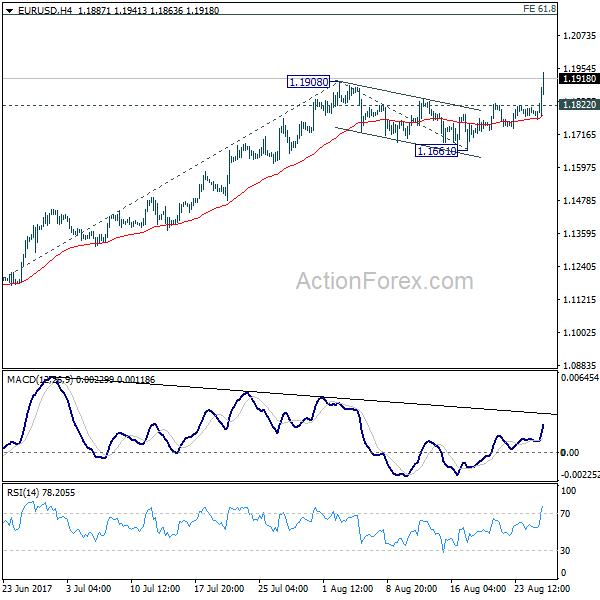
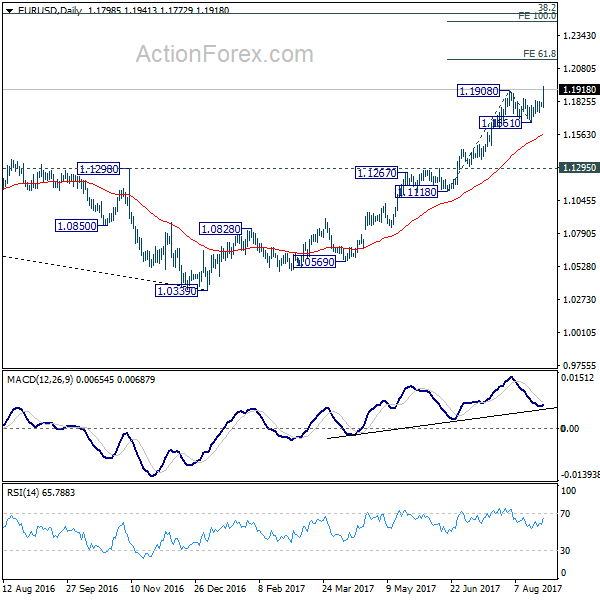
EUR/USD 's up trend resumed last week by breaking 1.1908 resistance and reached as high as 1.1941. Initial bias is back on the upside this week. Current rally should target 61.8% projection of 1.1118 to 1.1908 from 1.1661 at 1.2149 first. Break there will target 100% projection at 1.2451 next. On the downside, below 1.1822 minor support will turn intraday bias neutral first. But retreat should be contained above 1.1661 support and bring rise resumption.
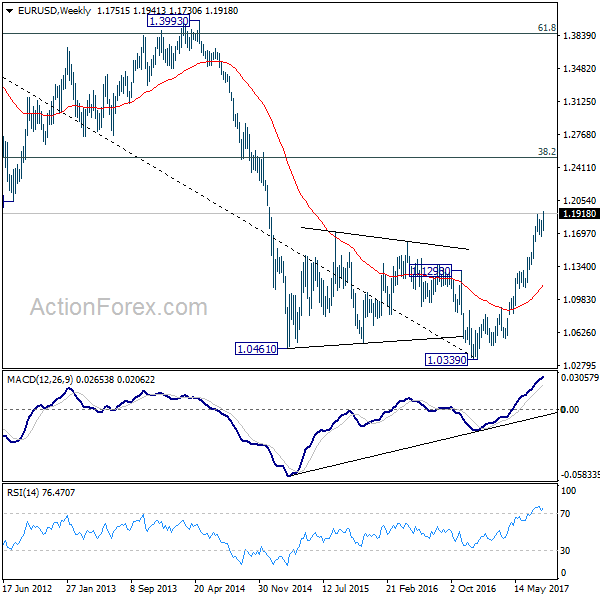
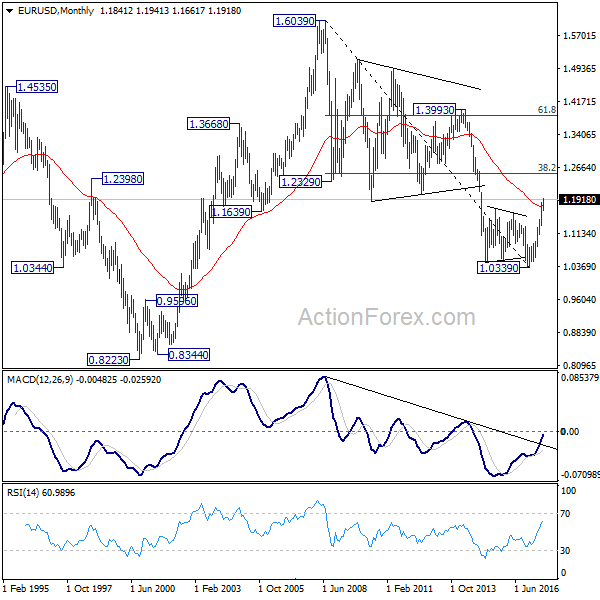
In the bigger picture, an important bottom was formed at 1.0339 on bullish convergence condition in weekly MACD. Sustained trading above 55 month EMA (now at 1.1768) will pave the way to key fibonacci level at 38.2% retracement of 1.6039 (2008 high) to 1.0339 (2017 low) at 1.2516. While rise from 1.0339 is strong, there is no confirmation that it's developing into a long term up trend yet. Hence, we'll be cautious on strong resistance from 1.2516 to limit upside. For now, medium term outlook will remain bullish as long as 1.1295 support holds, in case of pull back.
In the long term picture, 1.0339 is now seen as an important bottom as the down trend from 1.6039 (2008 high) could have completed. It's still early to decide whether price action form 1.0339 is developing into a corrective or impulsive move. But in either case, further rally would be seen to 38.2% retracement of 1.6039 to 1.0339 at 1.2516
USD/JPY Weekly Outlook
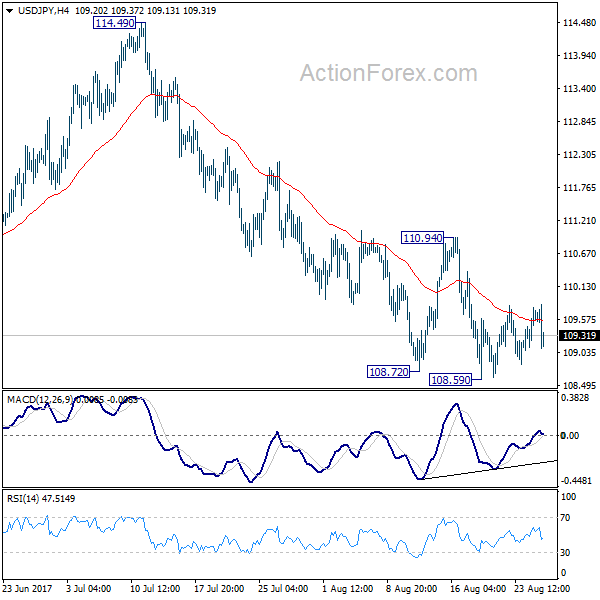
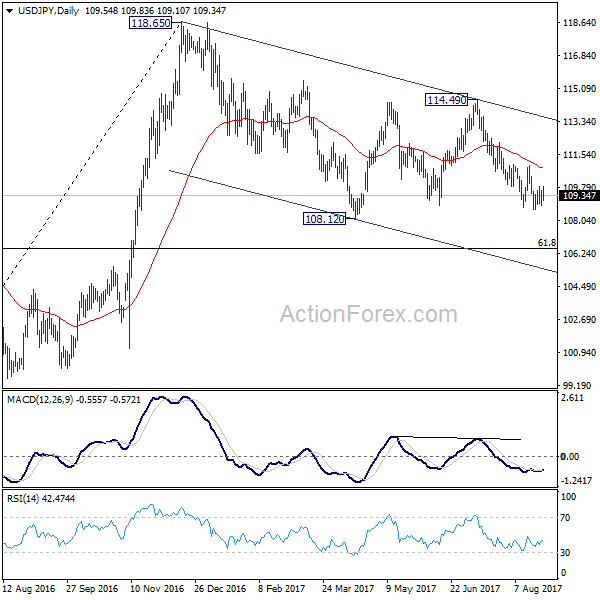
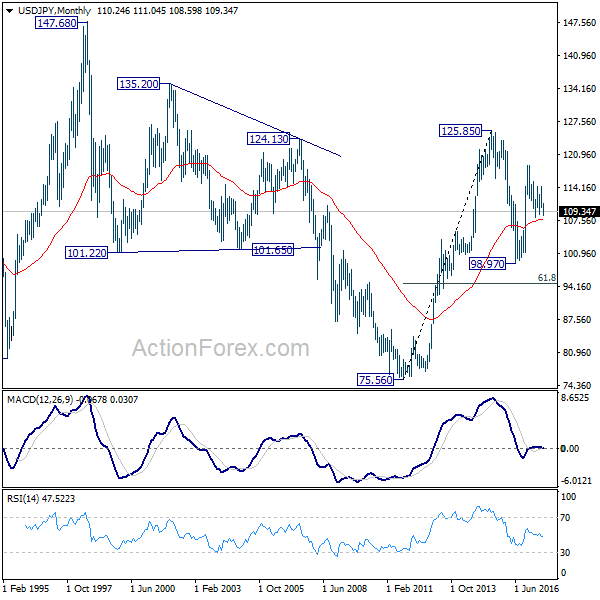
USD/JPY stayed in consolidation above 108.59 temporary low last week and outlook is unchanged. Initial bias is neutral this week first. Upside of recovery should be limited below 110.94 resistance and bring fall resumption. Break of 108.59 will target a test on 108.12 low. Whole corrective decline from 118.65 is possibly resuming and break of 108.12 will target 61.8% retracement of 98.97 to 118.65 at 106.48. Nonetheless, firm break of 110.94 will indicate short term bottoming and turn bias back to the upside.
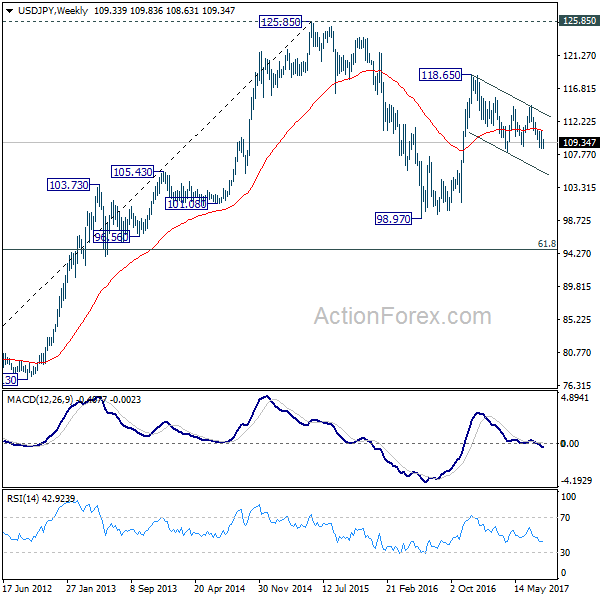
In the bigger picture, the corrective structure of the fall from 118.65 suggests that rise from 98.97 is not completed yet. Break of 118.65 will target a test on 125.85 high. At this point, it's uncertain whether rise from 98.97 is resuming the long term up trend from 75.56, or it's a leg in the consolidation from 125.85. Hence, we'll be cautious on topping as it approaches 125.85. If fall from 118.65 extends lower, downside should be contained by 61.8% retracement of 98.97 to 118.65 at 106.48 and bring rebound.
In the long term picture, the rise from 75.56 long term bottom to 125.85 top is viewed as an impulsive move. Price actions from 125.85 are seen as a corrective move which could still extend. But, up trend from 75.56 is expected to resume at a later stage for above 135.20/147.68 resistance zone.
GBP/USD Weekly Outlook
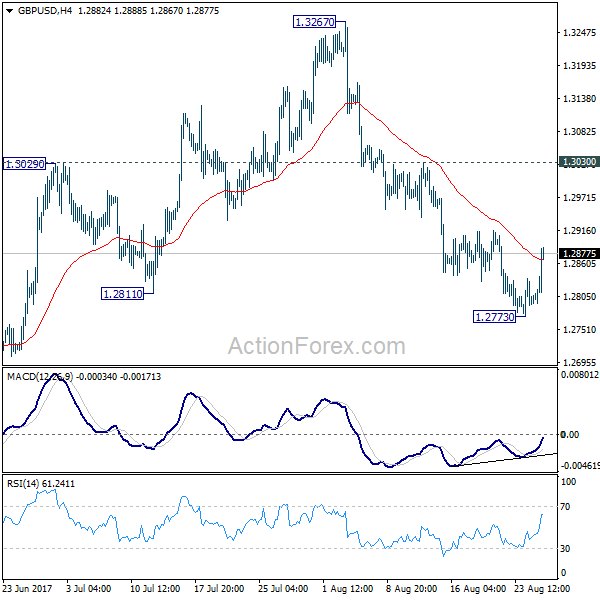
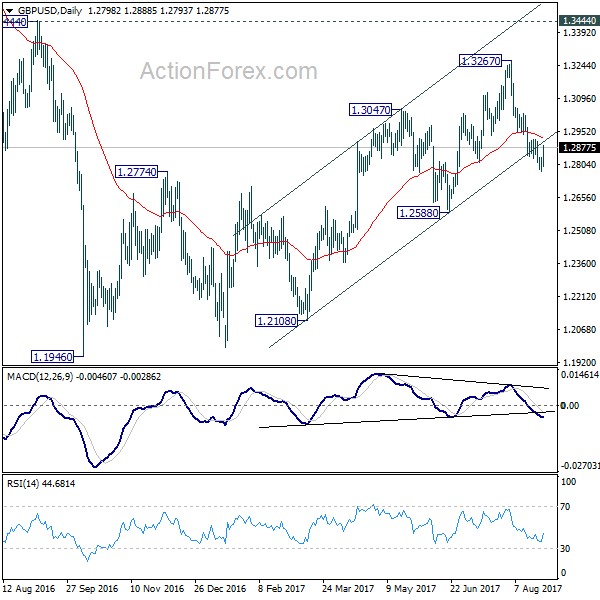
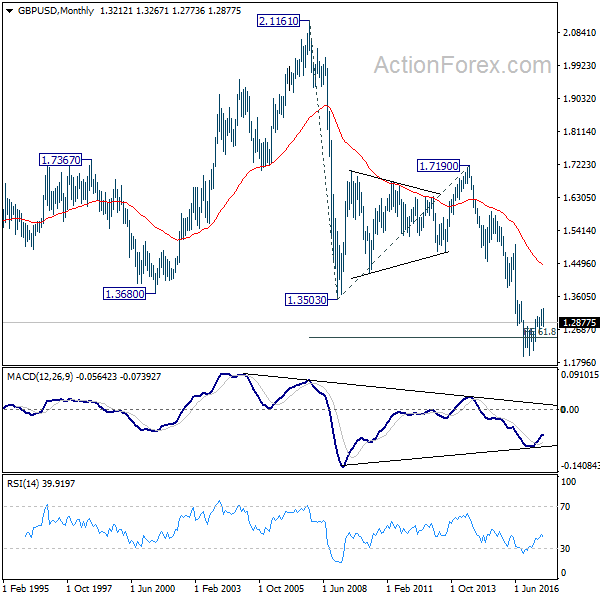
GBP/USD edged lower to 1.2773 last week but recovered since then. Initial bias is neutral this week first. Deeper decline would be mildly in favor as long as 1.3030 resistance holds. We're favoring the case that correction from 1.1946 is completed at 1.3267. Below 1.2773 will target 1.2588 key near term support first. Decisive break of 1.2588 will confirm our view and target a test on 1.1946 low. Though, break of 1.3030 will dampen this bearish view and turn bias back to the upside for retesting 1.3267.
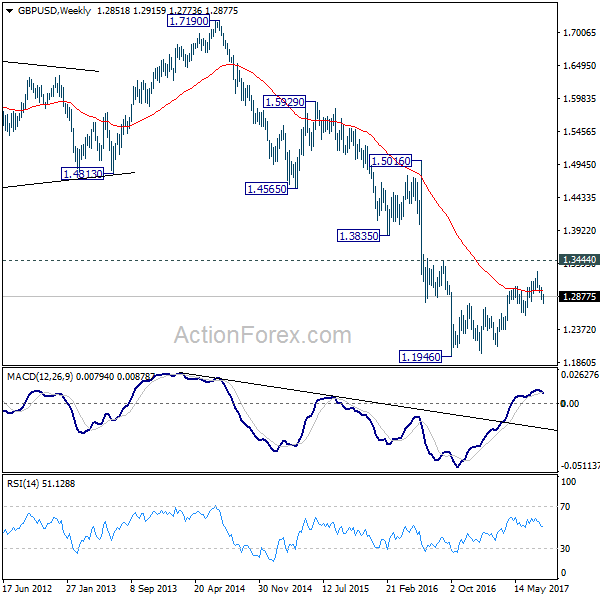
In the bigger picture, overall, price actions from 1.1946 medium term low are seen as a corrective pattern. While further rise cannot be ruled out, larger outlook remains bearish as long as 1.3444 key resistance holds. Down trend from 1.7190 (2014 high) is expected to resume later after the correction completes. And break of 1.2588 will indicate that such down trend is resuming.
In the longer term picture, no change in the view that down trend from 2.1161 (2007 high) is still in progress. On resumption, such decline would extend deeper to 100% projection of 2.1161 to 1.3503 from 1.7190 at 0.9532. However, firm break of 1.3444 should confirm reversal and turn outlook bullish.
USD/CHF Weekly Outlook
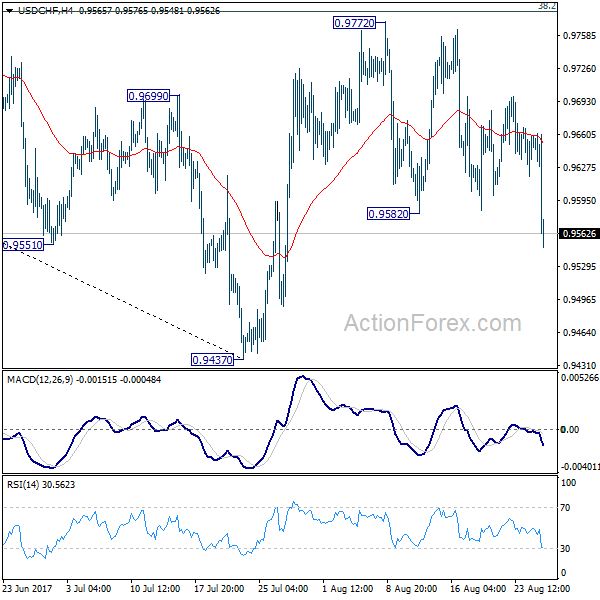
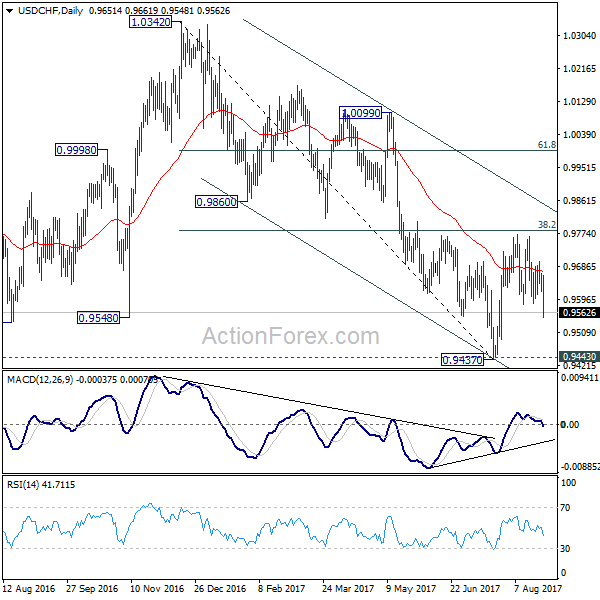
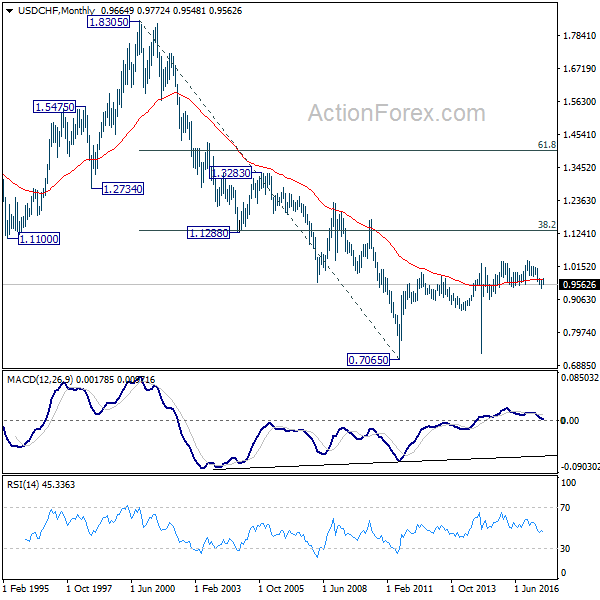
USD/CHF's sharp decline last week and break of 0.9582 suggests that fall from 0.9772 has resumed. Initial bias remains is back on the downside for 0.9437 low. Note again that the pair is bounded in medium falling channel and limited below 38.2% retracement of 1.0342 to 0.9437 at 0.9783. Break of 0.9427 will extend the whole decline from 1.0342 and carries larger bearish implications.
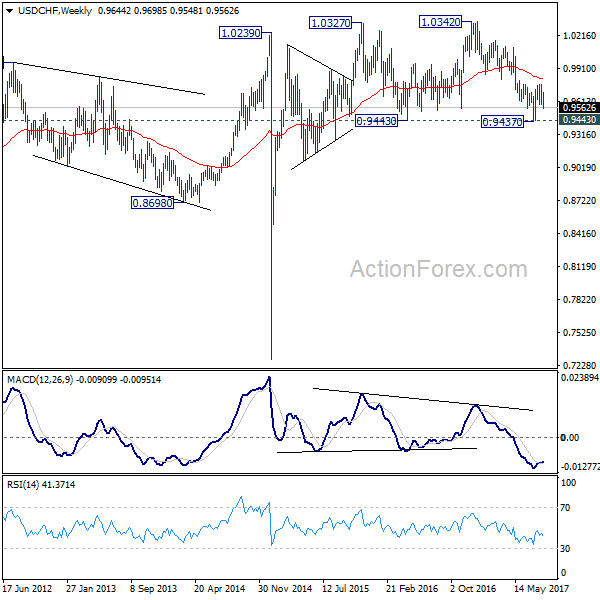
In the bigger picture, we're slightly favoring the case that USD/CHF has successfully defended 0.9443 key support level. And long term range trading in 0.9443/1.0342 is extending with another rise. At this point, there is no sign of an up trend yet. Hence, while further rise is expected in USD/CHF, we'll start to be cautious on loss of momentum above 61.8% retracement of 1.0342 to 0.9437 at 0.9996. However, firm break of 0.9443 will carry larger bearish implication and would target next key support at 0.9072.
AUD/USD Weekly Outlook
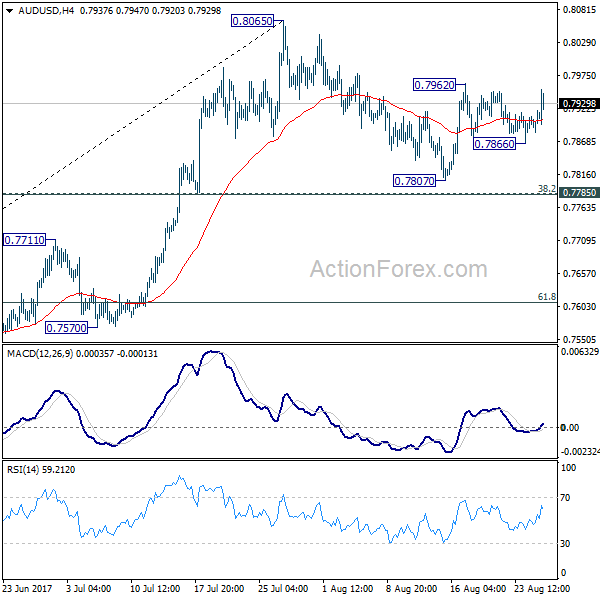
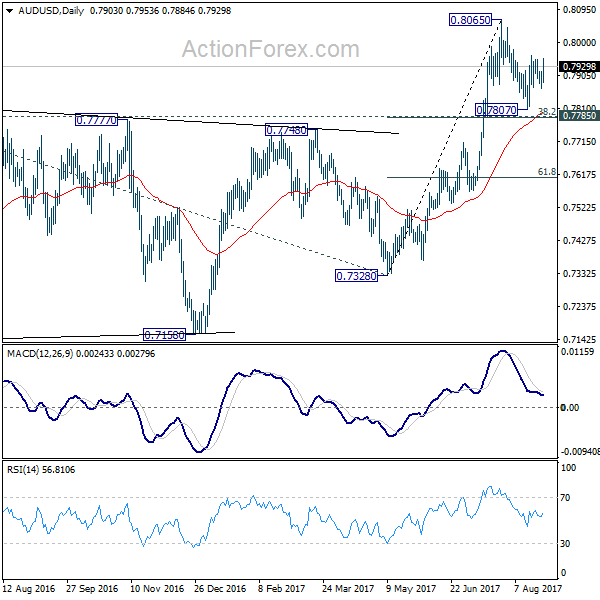
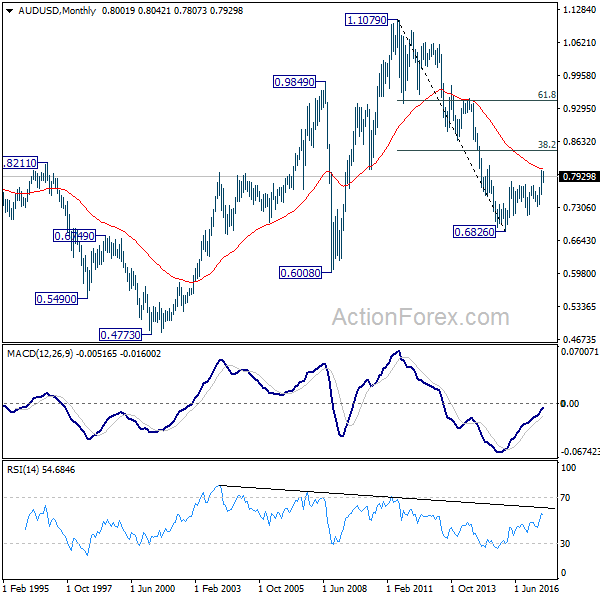
AUD/USD engaged in sideway trading below 0.7962 last week and outlook is unchanged. Initial bias remains neutral this week first. As noted before, correction from 0.8065 might extend and another fall cannot be ruled out. But downside should be contained by 0.7785 cluster support (38.2% retracement of 0.7328 to 0.8065 at 0.7783) to bring rebound. Above 0.7962 will target a test on 0.8065 resistance first. Firm break of 0.8065 will resume the medium term rise and target 100% projection of 0.6826 to 0.7833 from 0.7328 at 0.8335.
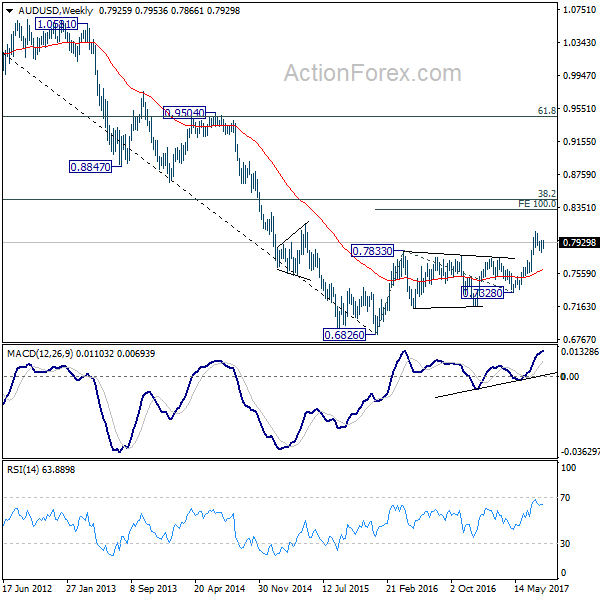
In the bigger picture, rise from 0.6826 medium term bottom is still in progress. At this point, there is no confirmation of trend reversal yet and we'll continue to treat such rebound as a corrective pattern. But in any case, break of 55 month EMA (now at 0.8097) will target 38.2% retracement of 1.1079 to 0.6826 at 0.8451. Break of 0.7328 support is needed to confirm completion of the rebound. Otherwise, further rise is now in favor.
In the longer term picture, 0.6826 is seen as a long term bottom. Rise from there could either reverse the down trend from 1.1079, or just develop into a corrective pattern. At this point, we're favoring the latter. And, as long as 38.2% retracement of 1.1079 to 0.6826 at 0.8451 holds, we'd anticipate another decline through 0.6826 at a later stage.
USD/CAD Weekly Outlook
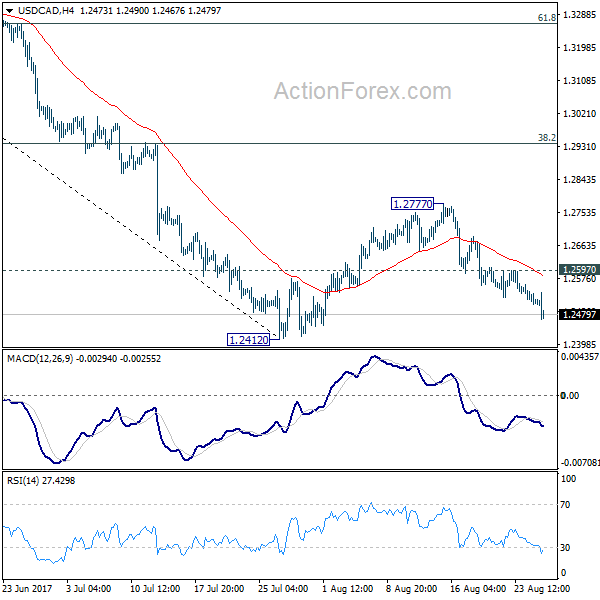
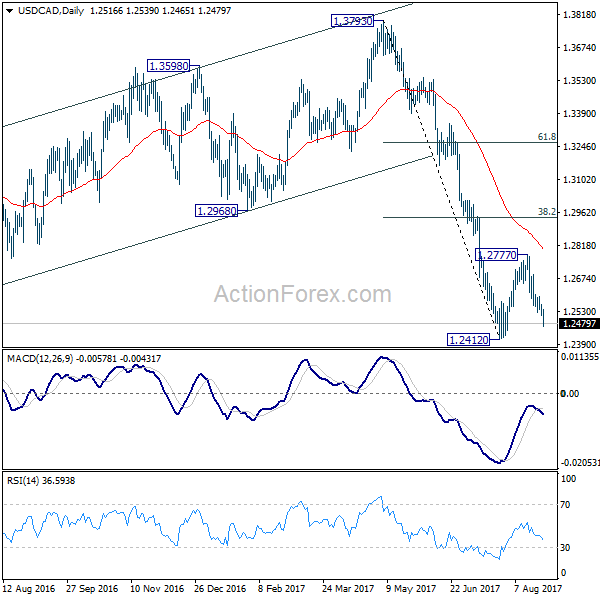
USD/CAD's decline from 1.2777 extended lower last week. The development affirmed the case that correction from 1.2412 has already completed and larger fall is resuming. Initial bias stays on the downside this week for 1.2412 first. Decisive break there will target next long term fibonacci level at 1.2048. On the upside, above 1.2597 minor resistance will extend the correction from 1.2412 with another rise. But we'd expect upside to be limited by 38.2% retracement of 1.3793 to 1.2412 at 1.2940 to bring fall resumption eventually.
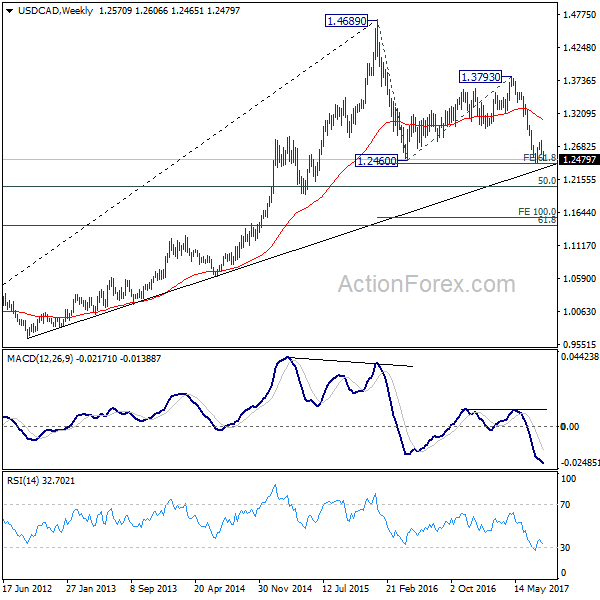
In the bigger picture, price actions from 1.4689 medium term top are seen as a correction pattern. Such corrective fall is still expected to extend to 50% retracement of 0.9406 to 1.4869 at 1.2048. At this point, we'd look for strong support from there to contain downside and bring rebound. Nonetheless, on the upside, sustained break of 1.2968, 38.2% retracement of 1.3793 to 1.2412 at 1.2940 will be the first sign of completion of the correction and will turn focus back to 1.3793 key resistance.
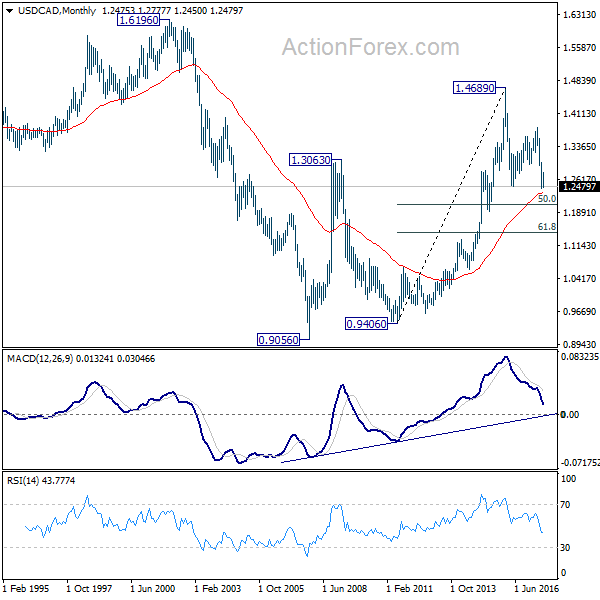
In the longer term picture, rise from 0.9056 (2007 low) is viewed as a long term up trend. It's taking a breath after hitting 1.4689. But such rise is expected to resume later to test 1.6196 down the road. But firm break of 50% retracement of 0.9406 to 1.4869 at 1.2048 will raise doubt over this view. In that case, the long term trend could have reversed.