The market narrative has flipped again—and the stakes are rising. The abrupt shift in the Strait of Hormuz—from briefly “open” to once again under strict military control within 24 hours—has underscored just how fragile the current ceasefire is. What initially looked like the beginning of de-escalation has quickly reverted to uncertainty, forcing investors to reassess whether the “peace trade” was premature, just as a critical deadline approaches.
After Iranian officials initially declared the Strait fully open for commercial shipping, the situation reversed sharply. Military control has been reimposed, and reports of direct confrontation—including incidents involving commercial vessels—have effectively ended any near-term assumption of safe passage.
At the core of the standoff is a breakdown in trust between Washington and Tehran. The U.S. has maintained its naval blockade on Iranian ports, insisting it will remain in place until a broader agreement is reached. Iran, in turn, has framed the blockade as a violation of ceasefire conditions and responded by tightening control over the Strait, linking any reopening to the restoration of “complete freedom of navigation.”
This dynamic has created a precondition deadlock that complicates the prospects for upcoming talks. While reports suggest another round of negotiations could take place on Monday, there is still no formal confirmation. Even if talks proceed, they are likely to unfold under significant tension, with both sides entering from hardened positions.
The broader risk is that time is running out. If no progress is made before the ceasefire expires on April 22, the probability of renewed hostilities rises sharply. That could include a return to direct military confrontation or escalation at strategic chokepoints like Hormuz.
For markets, this makes the coming days critical—not just for geopolitics, but for the direction of oil, inflation expectations, and global risk sentiment.
In this environment, oil remains the ultimate signal. Its ability—or failure—to break decisively lower will determine whether markets continue to lean toward diplomacy or begin to price in a return to conflict. With the ceasefire cliff approaching, that signal will become increasingly important. At the same time, key technical levels across major assets will help guide traders in assessing whether underlying market sentiment is truly shifting, or simply reacting to headline volatility.
Oil: Still the Ultimate Signal for Global Sentiment
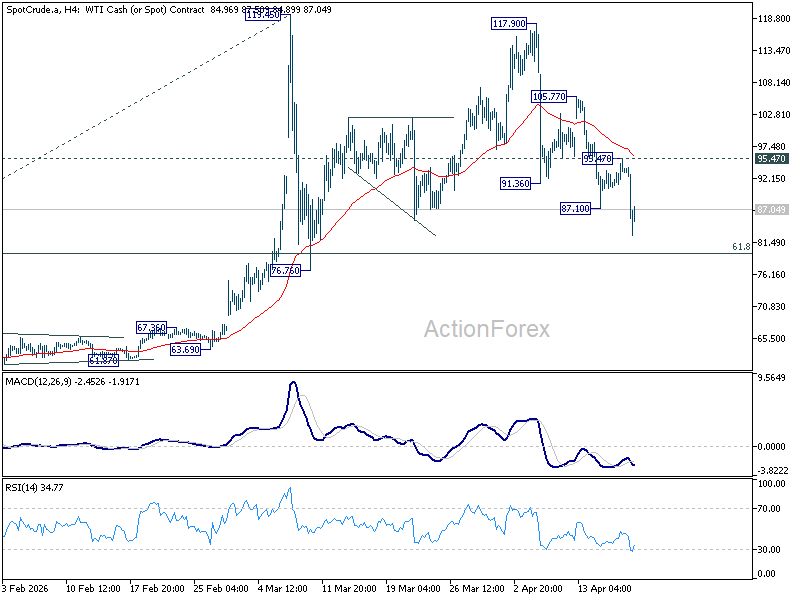
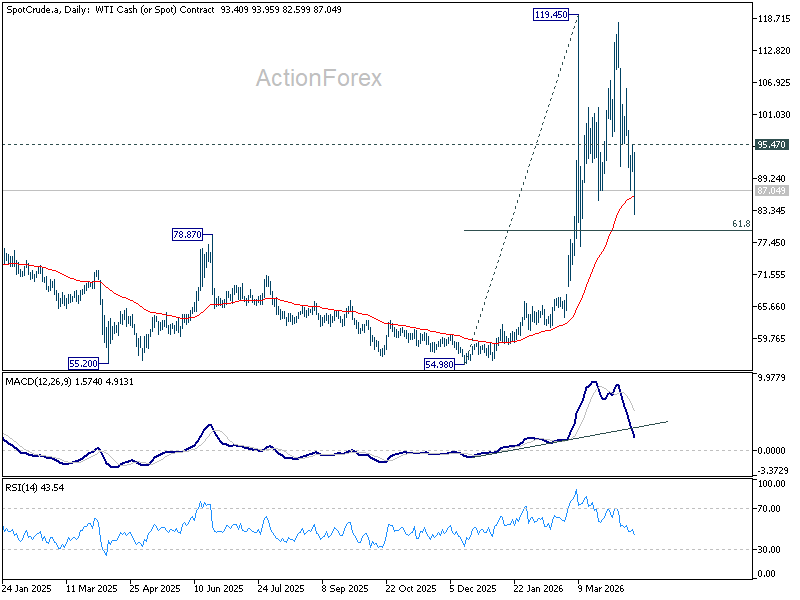
Oil remains the most important driver of global market sentiment. WTI’s decline from 117.90 resumed last week, extending sharply lower to as low as 82.59. While further downside is favored in the near term, a decisive break of the 61.8% retracement of 54.98 to 119.45 at 79.60 would likely require a more durable de-escalation in the Middle East—potentially including a confirmed and sustained normalization of the Strait of Hormuz. Absent that, the psychological 80 level should act as a near-term floor.
Meanwhile, as long as 95.47 resistance holds, the bias remains to the downside. In other words, while volatility may persist, there is no clear signal of a renewed US-Iran escalation as long as this cap remains intact.
Equities: New Records as Uptrend Reumes
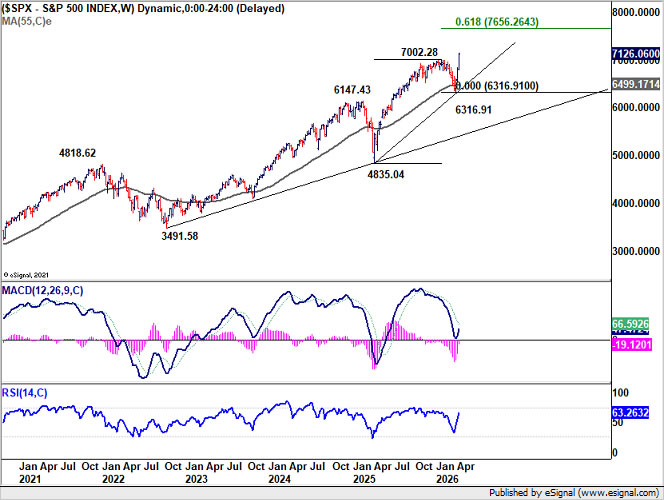
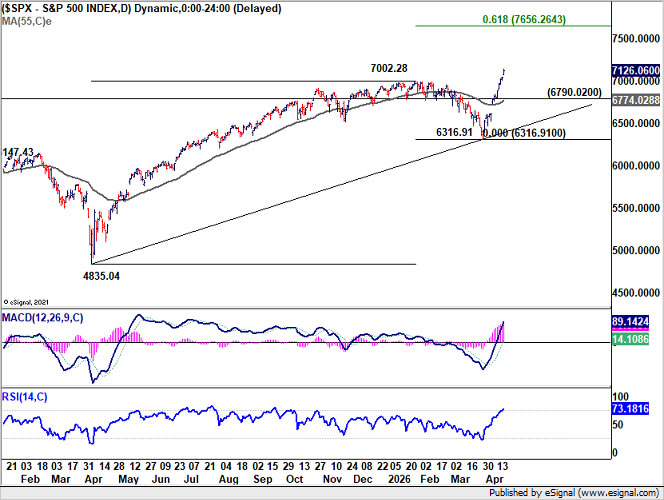
S&P 500 resumed its uptrend last week, breaking above 7,002.28 resistance and closing at a fresh record high of 7,126.06. While near-term volatility or a pullback cannot be ruled out given geopolitical uncertainty, the outlook remains bullish as long as 6,790.02 support holds. The current advance continues to target 61.8% projection of 4,835.04 to 7,002.28 from 6,316.91 at 7,656.26.
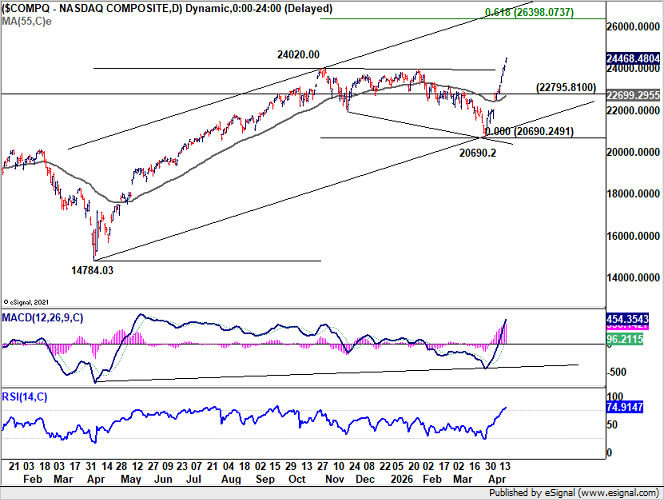
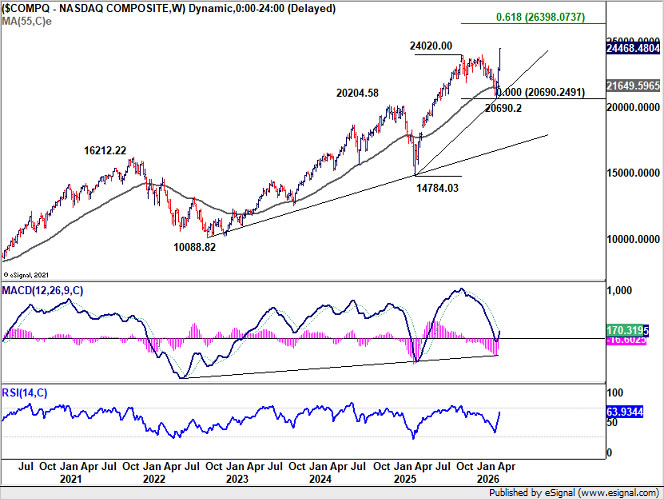
NASDAQ shows a similar structure, ending the week at a new record of 24,468.48. Near-term outlook remains bullish as long as 22,795.81 support holds, even in the event of a retreat. The broader uptrend targets 61.8% projection of 14,784.03 to 24,020.00 from 20,690.2 at 26,398.07 next.
Yields: At Key Support, Rebound or Breakdown Ahead
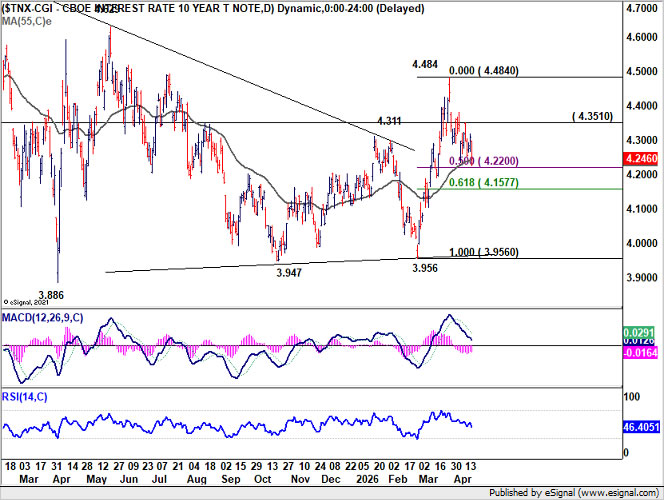
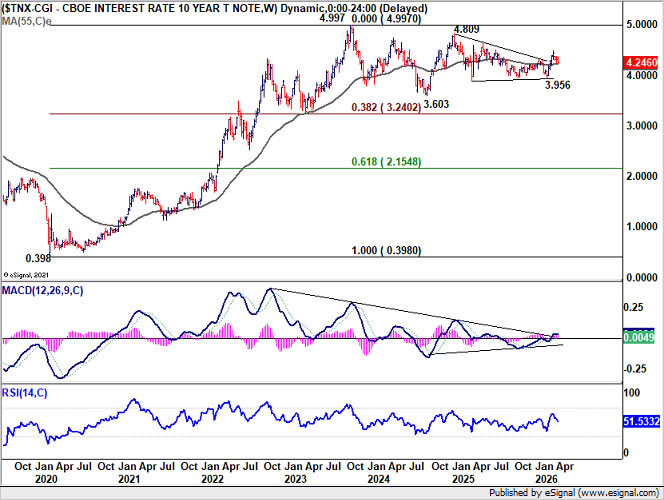
US 10-year yield’s pullback from the 4.484 short-term top remains corrective so far, suggesting that the rise from 3.956 is not yet complete. Yields are now testing a key support cluster, including 55 D EMA (now at 4.240), 50% retracement of 3.956 to 4.484 at 4.220, and 55 W EMA (now at 4.219).
A strong rebound from this zone, followed by a break above 4.351 resistance, would signal that the rise from 3.956 is ready to resume through 4.484 high. On the downside, firm break below 4.220 would open the way for a deeper pullback toward 61.8% retracement at 4.157 and below.
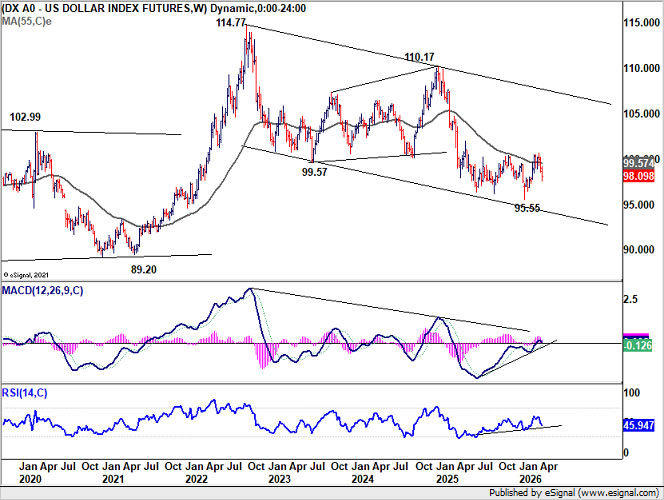
Dollar Index: Bearish Bias Intact Below Key EMA
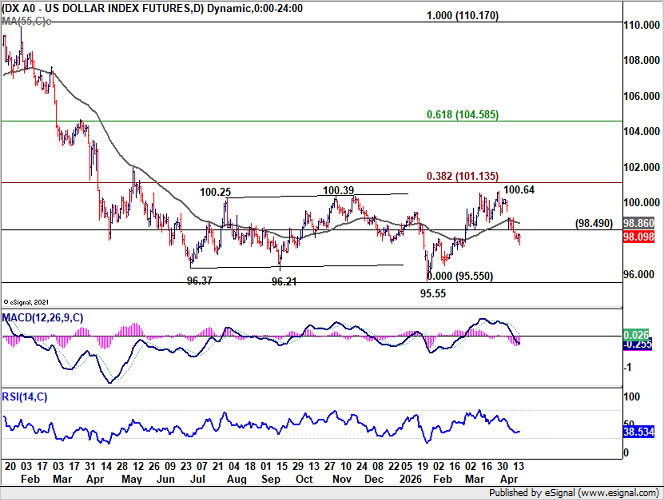
Dollar Index’s break below 98.49 support last week suggests that the rebound from 95.55 has already completed. More importantly, rejection below 38.2% retracement of 110.17 to 95.55 at 101.13, combined with failure at the 55 W EMA (now at 99.57), keeps the medium-term outlook bearish.
Further downside is favored as long as 55 D EMA (now at 98.86) caps any recovery, with focus on a retest of the 95.55 low. While a break below that level is not yet the base case, it will depend on the momentum of the next leg lower.
Conversely, sustained move above 55 D EMA would suggest that the rebound from 95.55 is not yet complete, opening the way for another test of 100.64 and potentially the 101.13 Fibonacci level.
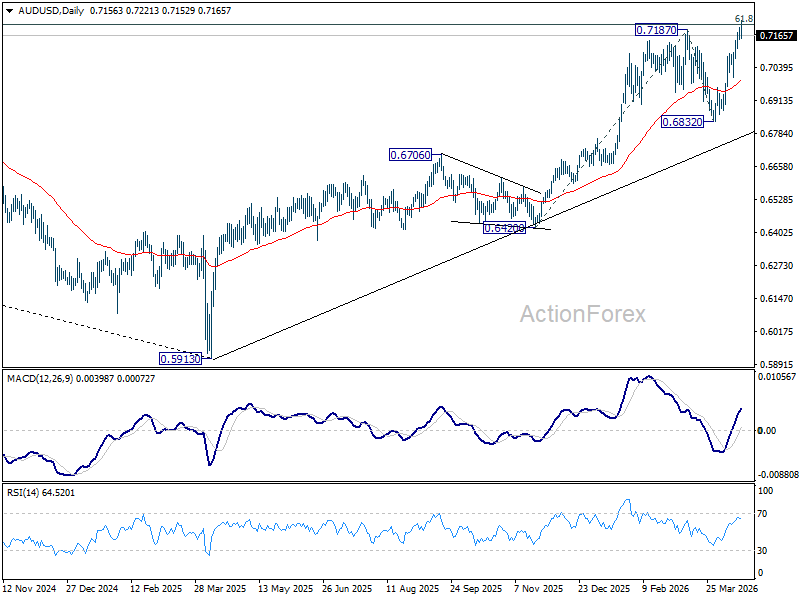
AUD/USD: Breakout Structure to Build Above 0.72
AUD/USD was the top performer last week, gaining 1.46%. While some near-term consolidation is possible after rejection at 0.72 handle on the first attempt, the broader outlook remains bullish as long as 55 D EMA (now at 0.6985) holds.
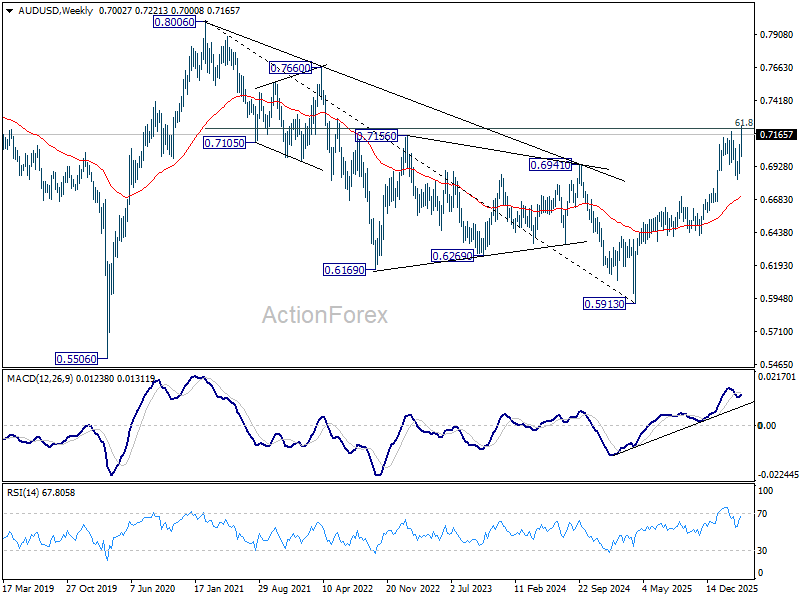
More importantly, decisive break of 61.8% retracement of 0.8006 to 0.5913 at 0.7206 will solidify the case that it’s reversing the down trend from 0.8006 (2021 high), rather than correcting it. That should pave the way to retest 0.8006 at least.
EUR/USD Weekly Outlook
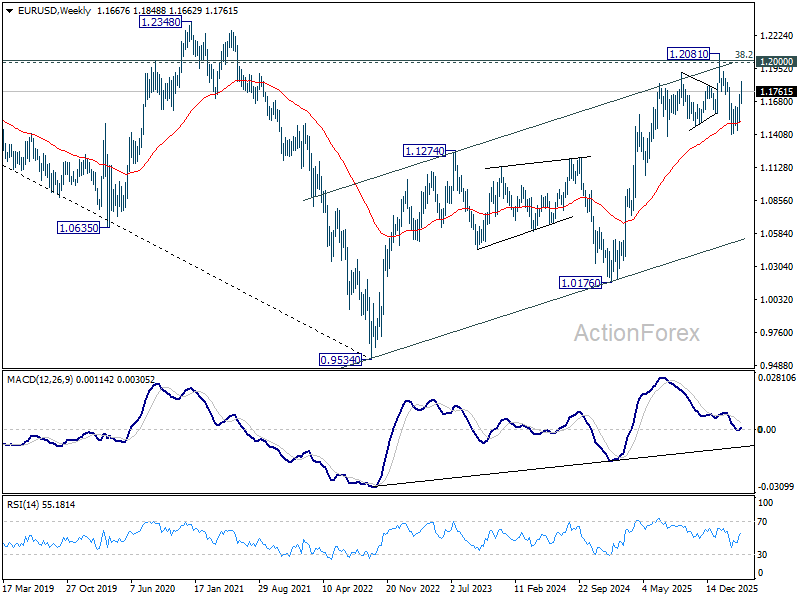
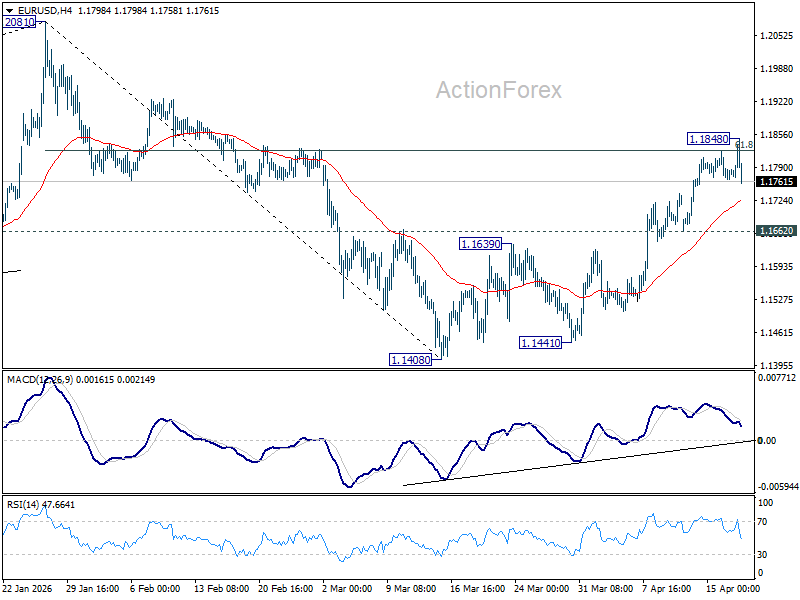
EUR/USD’s rise from 1.1408 extended higher to 1.1848 last week, but failed to take out 61.8% retracement of 1.2081 to 1.1408 at 1.1824 decisively. Initial bias is turned neutral this week first. On the upside, sustained trading above 1.1824 will pave the way to retest 1.2081 high. However, firm break of 1.1662 support will bring deeper decline back towards 1.1408 low instead.
In the bigger picture, the strong support from 38.2% retracement of 1.0176 to 1.2081 at 1.1353 suggests that the pullback from 1.2081 is more likely a corrective move. Strong support was also found in 55 W EMA (now at 1.1507). Focus is back on 1.2 key cluster resistance level. Decisive break there will carry long term bullish implications. Nevertheless, break of 1.1408 support will revive the case of medium term bearish trend reversal.
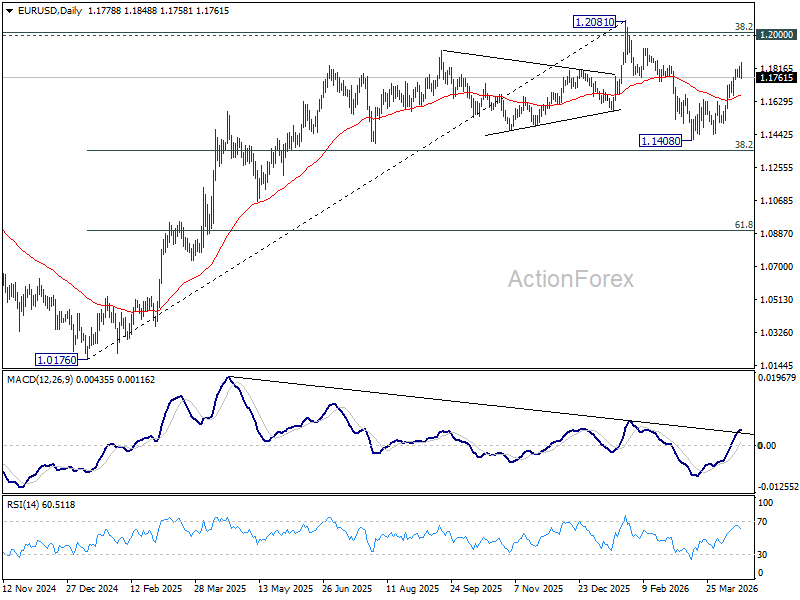
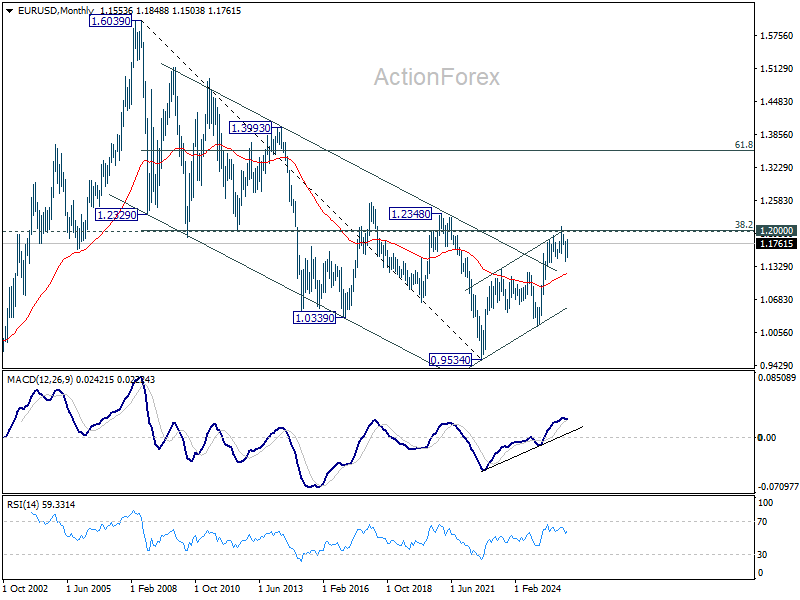
In the long term picture, 38.2% retracement of 1.6039 to 0.9534 at 1.2019, which is close to 1.2000 psychological level is the key for the outlook. Rejection by this level will keep the multi decade down trend from 1.6039 (2008 high) intact, and keep outlook neutral at best. However, decisive break of 1.2000/19, will suggest long term bullish trend reversal, and target 61.8% retracement at 1.3554.