

Sample Category Title
EUR/USD Bull Flag Breakout
If you're a market addict who needs to unwind on the weekend, then let's just say that Jackson Hole weekend isn't for you!
While Fed Chair Janet Yellen chose to avoid any discussion around US monetary policy (well, what did we really expect to be honest…), markets were still disappointed. Yellen instead took the time to speak about post-GFC financial reforms, going head to head with Trump's views on deregulation and the the US Dollar took a hit as a result. Central banking v politicians at it's finest.
Keep in mind that a December rate hike remains in play, but the Fed policymakers have sounded lukewarm about another hike in 2017. Futures markets are pricing it in at below 50%, so it's the short USD trade where your monetary policy risk lays if the Fed decides to go the other way.
Moving onto markets and a further look at the EUR/USD bull flag that we had been eyeing off to end the week:
EUR/USD 4 Hourly:
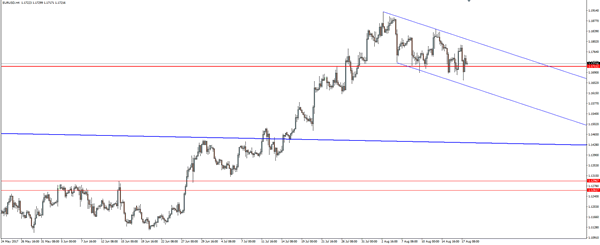
Price really had set up for the Fed's position over the weekend and boy did the pattern deliver:
EUR/USD 4 Hourly:
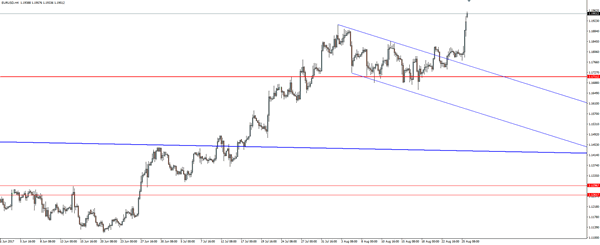
Let's wait and see how price reacts to the swing high resistance level that's now been broken and if it pulls back to retest it today. This is the make or break level for a bullish continuation to start the week.
What is the US Nonfarm Payrolls or NFP?
The United States nonfarm payrolls report is probably one of the most important economic releases every month. The nonfarm payrolls or NFP for short has a strong influence on the markets, even if it's just short-term.
Released every month on the first Friday at 0830 EST, the nonfarm payrolls report that accounts for the number of jobs. In particular, the NFP accounts for jobs in the goods, services, construction and manufacturing sectors.
Farming jobs and not for profit organizations are exempt from the report.
The Nonfarm payroll report is released the US Bureau of Labor Statistics (BLS). The report helps statisticians, economists and monetary policy makers to determine the state of the economy. The data is also used to predict the future levels of the economy.
Did you know? The Bureau of Labor Statistics was created by the US Congress with the Bureau of Labor Act, in 1884.
If you want to learn more about the Bureau of Labor Statistics, read here.
The BLS is also responsible for collecting other key statistics including the Consumer price index (CPI), Producer price index (PPI), and so on.
The nonfarm payrolls report shows the sectors that are creating employment and the sectors that are losing jobs.
What are the components of the nonfarm payrolls?
The official name of the jobs report is called the Employment Situation.
The primary components of the nonfarm payrolls report are:
- The number of jobs created during the month
- The monthly unemployment rate
- The average hours worked during the week
- The average wages earned per hour
- The labor force participation rate
While the number of subpoints in the Employment Situation report might seem a bit too overwhelming, there are only two key data points of interest. The markets mostly react to the headline numbers, which is the number of jobs created and the prevailing unemployment rate.
The BLS also revises the numbers for the past payrolls as well, and this also tends to influence the markets.
Below is a sample of how the official release of the Employment Situation looks like.
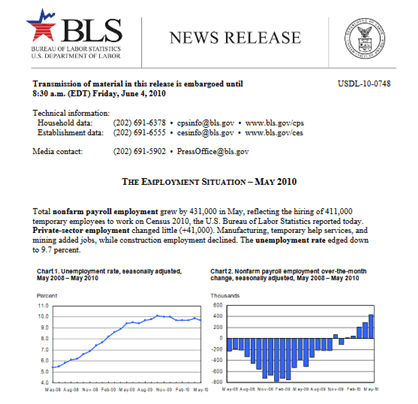
The Employment Situation report. Source: U.S. Bureau of Labor Statistics
The rather lengthy report covers all aspects of the labor market. It also goes into much deeper details such as the major worker groups, long-term unemployed and so on.
In the main jobs report, however, there are only three categories.
- Employed (People who are working)
- Unemployed (People who were laid off or looking for a job)
- Not in labor force (people who are not looking for a job)
How is the Nonfarm payrolls report used by traders?
The nonfarm payrolls report can begin to get more complex when you dig deeper. However, for the markets, the main headline numbers are the ones that matter.
That said, traders should also bear in mind on what the Fed officials are concerned about. For example, despite a strong jobs numbers, if wage growth stagnation is a risk flagged by officials, then that data point matters to the markets.
Therefore, at times you will see that despite a blockbuster report, the markets fall.
For traders, the nonfarm payrolls report is important because it brings a lot of volatility and trading opportunities.
There are many high-frequency trading algorithms dedicated to tracking the NFP release. While this may be frowned upon by some, it brings more liquidity to the markets.
Nonfarm payrolls report - Something for everyone!
What's interesting to note is that the NFP report influences all types of traders.
From the retail forex day traders to stock traders as well. There is always something for everyone watching the NFP report.
For example, a forex day trader will probably look at the NFP report to trade currency pairs such as the EURUSD, USDJPY or GBPUSD. A futures day trader, on the other hand, would be able to trade futures contracts such as the dollar futures, or even interest rate futures.
Stock traders also look to the payrolls report to see which sectors in the stock market are performing the most, by looking at the job creation data.
Finally, bonds traders can assess the economic situation based on the payrolls report and can trade the 10-year, or the Fed funds rate futures accordingly.
To conclude this brief of what is the nonfarm payrolls report; it is one of the monthly occurring events that is important for the markets across all assets. The nonfarm payrolls report released by the US Bureau of Labor statistics shows the number of jobs created during the month as well as the unemployment rate and wage statistics.
The nonfarm payrolls report is important to all, from the retail trader to central bank policymakers.
Tricks of the Trade – The Head and Shoulders Pattern, Part 2
In the previous article, Tricks of the trade - The Head and Shoulders pattern, Part 1, we look at how a few simple tweaks can increase the hit rate when trading the head and shoulders pattern. In this second part, we look at some advanced techniques which can alert you in pre-positioning your trades long before the rest of the crowd.
A with all such methods, due to the early entry the strategy does not offer great results, but when combined with other methods taking the early trade into an evolving head and shoulders pattern can result in some very good profits and in effect keeps your trades at a safer level than having to enter the head and shoulders trade along with everyone else.
Trade Entry at the right shoulder!
Another way to improve the odds and to maximize the profit potential is to identify an evolving head and shoulders pattern. This means, attempting to enter at the reversal near the right shoulder or anywhere between the right shoulder high (or low) and the decline (or rally) to the neckline support (or resistance).
The trick to catching this early entry in the head and shoulder pattern is to keep an eye on a potential neckline support or resistance level that is evolving.
The next chart below describes this visually.
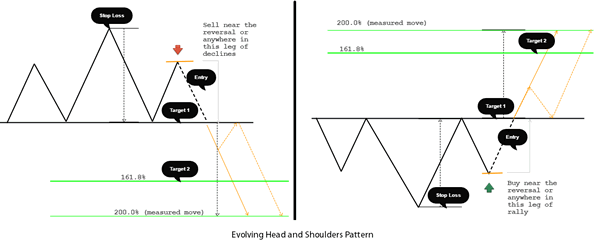
Evolving Head and Shoulders pattern
What you see here is basically buying or selling near the reversal of the right shoulder. This is of course subject to price continuing to the neckline. When the pattern is validated, you are better positioned and your profit levels are also maximized.
Risks of trading the evolving head and shoulders pattern
Catching a pattern at the early stages can be risky without a doubt. But this can be overcome by using good risk management principles and not give in to the greed and go all out on hopes that price will continue to validate the Head and Shoulders pattern.
In terms of stops, they are placed near the low or the high of the head and shoulders, which in itself should offer a fairly good risk reward, set up.
Another way to minimize the risks is to look for the right shoulder's low or high reversing near the 61.8% - 78.6% retracement of the previous wave or the head.
Example:
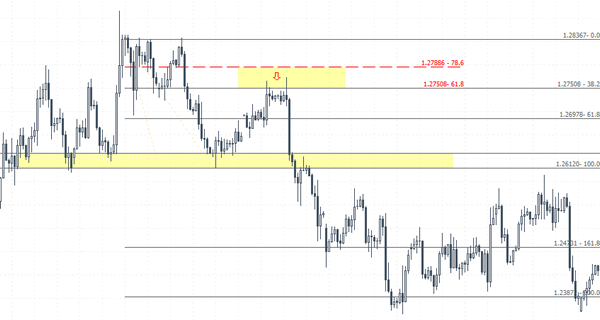
Evolving Head and Shoulders Example with entry near the right shoulder
In the above chart, you can see how Fibonacci can help to identify the reversal area. Price spiked into the 61.8% - 78.6% reversal zone before posting a strong and steady decline.
Now, if you had traded this pattern on the breakout from the neckline at 1.2612 and set your target to 161.8% at 1.2473 as the first target and the full measured move target at 1.2387, your pips in profit would have been 139 pips and 225 pips. On the flip side, your risk would be placing the stops near the right shoulder, which goes without saying vastly reduces the risk reward factor in your trade.
But had you entered anywhere after the reversal of the right shoulder, for example at 1.2697 with three targets of neckline, 161.8% and full measured move, your pips in profit would have been 85, 224 and 310 pips respectively. On the flip side, your risk would be limited to the peak of the head at 1.2836 or 139 pips.
Final Thoughts!
The head and shoulders pattern is one of the reliable reversal patterns. Using the tips outlined in this trading tutorial, you are able to trade more confidently. As they say, the early bird catches the worm. The trick is in catching a head and shoulders pattern that is still evolving which can help you to maximize your trade's potential to the fullest.
Give this strategy some practice and in due time, you won't really need to look at any other strategies or indicators.
Tricks of the Trade – The Head and Shoulders Pattern, Part 1
How to catch better entries with the Head and Shoulders Pattern? In this series of articles learn the different ways you can trade the head and shoulders chart pattern. The first part of this article deals with setting more realistic target levels on the head and shoulders pattern.
Among chart watchers and technical analysts, the head and shoulders pattern ranks among one of the top chart patterns that indicates a reversal (or rare cases a continuation) to the previous trend.
Any trader who has done a bit of studying of chart patterns would have no doubt been drawn to the allure of the head and shoulders pattern. The importance of this pattern is further accentuated by the fact that many analysts in the financial media often refer to this pattern.
The reliability of the head and shoulders pattern (which is bearish) and the bullish inverse head and shoulders pattern is further validated by Tom Bulkowski of the famed thepatternsite.com. It is not surprising therefore to note that the Head and Shoulders top is ranked 1 out of 21, meaning 'the best.' Bulkowski further goes on giving more stats such as a 4% break even failure rate and a 55% probability of price meeting its target.
You can read Bulkowski's deeper analysis on the head and shoulders pattern (along with tons of other patterns).
Anatomy of the Head and Shoulders Pattern
The Head and Shoulders pattern is very easy to spot and can be a caution for traders especially when the pattern occurs at the top end of a rally or its bearish counterpart, the inverse head and shoulders that occurs at the trough of a downtrend.
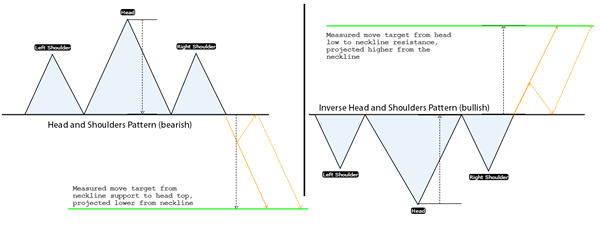
H&S and Inverse H&S Pattern Basic Structure
In the chart above, you can see the basic structure and the set up of the head and shoulders pattern (bullish and bearish). The neckline support (or resistance) is the key as a breakout from this level indicates a shift in the trend.
The most basic way to trade the head and shoulders pattern is to wait for the breakout from the neckline. Some traders prefer to wait for a retest back to the neckline while others simply buy or sell on the breakout. The target is set to a measured move, measured from the head (high or low) to the neckline (support or resistance) and projected from there on.
Drawback of the Head and Shoulders pattern
The head and shoulders pattern is more ideally suited to trade stocks or assets where volume is reliable. Typically, low volume during the formation of the right shoulder is used as one of the markers and prepares traders for the impending breakout. Volume in forex is not as reliable compared to stocks due to the OTC nature. Even if volume were to be used somehow, there is no guarantee that price will reach the target (despite more than 50% probability according to stats).
So how can a trader effectively position themselves to better make use of this reversal pattern? The following ideas can help traders.
Using a 161.8% Fibonacci Extension as the first target
Instead of a full projection in the head and shoulders, using a 161.8% Fibonacci extension as the first target, measured from the head (high or low) to the neckline (support or resistance) can beneficial for traders. The chance of price reaching the 161.8% target is much higher than the full measured move (which is basically a 200% extension). So after the first target is reached, your trade has already taken the reward off the table while leaving the remainder of the position to trade risk-free at the very least.
Example:
In the chart below you can see the relative ease at which the 161.8% Fib extension level of the head and shoulders pattern was reached. In comparison, you can notice that the full measured move of the head and shoulders pattern, prices consolidated briefly and reversed back higher.
If you account for spreads and other factors, there is a very good chance of price falling short of the full measured move target and instead of reversing.
You can also gauge that by setting the price target to 161.8% Fib extension, the initial probability of 55% can be further improved.
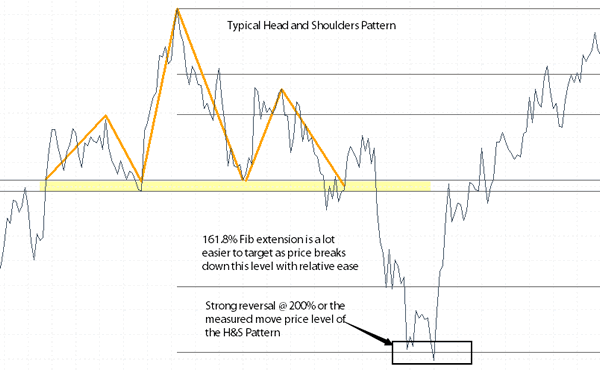
Head and Shoulders Example (161.8% and 200% Fib extension levels)
In the next article, we take a look at how to anticipate the head and shoulders pattern in advance before the pattern is formed.
Making use of a Trading Journal
Operating in the financial markets will forever be a learning process.
Even for the most experienced traders, the above is still true. For that reason, memorizing the subtle nuances of each trade is of the utmost importance, as this is how we recognize mistakes and ultimately mature as traders. How we do this is simple: keep a trading journal.
Keeping a trading journal is, if you think about it, akin to an athlete reviewing previous competitions. Too often, small, yet crucial, details are missed when trying to recall from memory. Therefore, recording your trades in a systematic fashion may reveal strategies or tendencies that can lead to improvements.
The workings of a trading journal
Unfortunately, there is no 'one size fits all' here. Some prefer to journal their trades by simply jotting a few important notes down; others, however, take it much, much further.
While there's absolutely nothing wrong with a minimalist approach here, we personally favour a more in depth profile which includes, but is certainly not limited to, the following:
- Pre-trade analysis (supported with images).
- Trade management analysis (supported with images).
- Post-trade analysis with images (supported with images).
Pre-trade report:
This section should clearly detail your reasoning BEFORE you enter into a trade. In addition, instead of just blindly writing what the market conditions were at the time, why not consider adding a chart or two to complement this, as they do say, 'a picture is worth a thousand words.' This should not really be a big deal since the chart(s) should have already been marked up.
Also just as important in this section is to determine one's exit strategy. Will you trail the position, is the risk/reward ratio favourable, are there levels of significance nearby etc.? Basically, you want to try and avoid surprise and have a plan in place for every eventuality that the market may throw your way, which includes noting any scheduled news events.
Trade management:
It is here that you have the opportunity to note your emotional state during the course of a trade. It is also recommended to supplement this section with in-trade images, as even with notes it's sometimes difficult to picture the scenario from memory.
Was the trade executed in accordance with the pre-trade report? Over and over again, we hear about traders 'jumping the gun' and entering a trade before the entry level is in play. Generally, traders enter the market too soon for fear of missing a move. Not only does this distort the initial risk/reward ratio, but it's also bad practice. Recording timing, therefore, is important to track your patience.
Other than prematurely entering a trade, do you consider deviating from the initial plan once the trade is in motion, or ever think of adding additional risk or take profits before your designated target levels? The information gleaned from trades will help provide an accurate illustration of the strengths and weaknesses of both the trader and trader's methodology. Descriptions of errors and recurring mistakes highlight the areas you need to pay heed to.
The best trading gift you can give to yourself in this section (all three sections actually) is HONESTY.
Post-trade report:
Following trade completion, it's advisable to log the outcome, win or lose. Also, as with the two sections above, adding chart images of the completed trade is beneficial to create a before-and-after scenario.
Was the trading plan followed? If it was not, dig in and find out what the reason was for abandoning your trading rules. If you committed a recurring mistake, note what your thoughts were and how you can improve on the next trade.
In closing:
At the end of each trade, save and file it. Once that is completed you can review the notes at your convenience.
Why is it that so many traders do not bother with trading journals, and likewise so many do not reach consistency in this business? Is that a coincidence? We think not! Without the historical data taken from past trades, how can one expect to grow and improve? We would say it is nearly an impossible feat as our brains can only remember so much! Therefore, do yourself a big favour today and begin a trading journal today.
The above information is, of course, not the be-all and end-all. There are likely other things one can add to their journals that may prove beneficial. It's all down to personal preference.
Is it Possible to Trade Part Time?
'But out of limitations comes creativity'. Debbie Allen.
Every endeavour has its own set of difficulties, with trading being no different! Trading the markets, even if only on a part-time basis, is incredibly challenging, and will, despite what your favourite guru may claim, take time and require a great deal of dedication.
However, the good news is that trading part time is possible!
Once you have a strategy in place as well as a written trading plan, all one then needs is a little creative planning and the discipline to follow your schedule and rules or engagement. Unfortunately, research shows that a lot of traders enter the markets with unrealistic expectations and little preparation.
Don't confuse part-time trading with 'hobby' trading!
A lot of traders, particularly those who are new to the business, mistakenly view trading as a hobby. Trading is a serious business and should always be treated as such, be it as a part-time venture or as one's day job. If you intend on using the markets as a place for amusement or somewhere to have a bet every now and then, you may as well chuck whatever funds you have in your account in the garbage. Better still, send it to a noteworthy charity!
Part-time trading, in our humble view, is not so different to many other businesses in terms of the preparation and planning required. If we think about it rationally for a minute, can you imagine a part-time doctor, lawyer or businessman approaching their business as a hobby? Highly unlikely! So, why should it be any different for trading?
How do I approach part-time trading?
For those with limited time and resources due to work or life commitments, you're going to need to develop a trading schedule that fits your lifestyle. Obviously, each trader has different time constraints, so we felt it'd be best to look at three individual traders to help illustrate how one could look to schedule their trading days:
Trader A has a full-time job and absolutely despises the lower timeframes. He believes, rightly or wrongly, that the lower timeframes are nothing more than noise and should be avoided at all costs.
His job involves him being away from the screen for most of the day (8am-6pm). Thus, he focuses his efforts on the H4 charts and above. An hour before work, he sits down and analyses his chosen markets, altering any positions he may have on, and placing new orders. Upon returning home, he'll scan the market once again for any developments for an hour or so before dinner, and then call it a day. So, all in all, he spends approximately two hours a day behind the screens.
Trader B also has a full-time job, but is lucky enough to be an I.T engineer. This enables him to have the trading platform running in the background. Although he is not at his desk all of the time, he is able to comfortably watch the H1 timeframes (and above) regularly throughout the day.
However, his schedule involves him analysing the charts an hour before work, as well. The reason being is that he likes peace and quiet when exploring the markets for opportunities. Once his levels are marked for the day, he can simply monitor the market using trade alerts from his work station.
Trader C works a part-time job and favours the M15 charts and lower i.e. the lower timeframes. She lives in Asia and finishes her morning shift two hours prior to the London open. Fortunately, she is able to be at the screen for the entire London segment and usually finishes trading by London's lunchtime.
As you can see from the above examples, it's important to select which timeframe(s) to trade and organise a time to analyse the markets when trading part time. You may have also noticed that all three traders use a manual trading methodology, but there are some that focus on automated trading. As far as we're aware, there's a variety of automated trading programs with a full spectrum of functions available on the market. Some may be able to monitor currency prices in real time, place market orders, recognize spreads and automatically place the trade. So, this could be an avenue you may want to investigate if automation is what you're seeking.
Finding the right markets to trade
In addition to arranging a time to be at the screens and choosing the timeframes to base your trades from, appointing which markets to focus on is just as important.
For instance, Trader C only trades the GBP/USD and the EUR/USD pairs as they not only have tight spreads, but also tend to be most active during the London segment. Trader A on the other hand, watches ten currency pairs and also the US dollar index for correlation purposes. Given that he trades much slower timeframes, this enables him to watch more markets. Trader B, nevertheless, chooses to focus on only four currency pairs. He could watch more pairs, but prefers it this way as he also likes to keep up with the fundamental influences surrounding the currencies he trades.
Final word…
Having a full or part-time job, we believe, helps alleviate the stresses that come with trading full time. Not having to rely on your trading profits lessens the psychological impact which is an aspect a great deal of traders struggle with. So, with that being said, does trading part time, with the safety net of a full-time salary, give one a greater chance of success? Certainly something to think about!
What Is the GDP Report and How It Impacts Forex Markets
GDP or Gross Domestic Product represents the total monetary value of goods and services produced over a specified period of time in a country. In other words, GDP measures the overall productivity of a country's economy and is used to measure the level of growth and the economy's health in general.
The GDP report is one of the many macroeconomic indicators which are used to measure the performance of a country's economy. In the forex markets, there are many GDP reports released which measure the GDP at different time periods. The most common of GDP reports are:
- GDP m/m or month over month: This report measures the GDP performance in comparison to the previous month
- GDP q/q or quarter over quarter: This report measures the GDP performance on a quarterly (3 months) period
- GDP y/y or year over year: This report measures the GDP performance on a yearly basis, comparing to the previous year
Most GDP reports are released during the first week of the month if they are measured on a month over month basis. The most common GDP reports are however quarterly, which is released after the end of a quarter. Quarterly GDP reports are usually subjected to three revisions:
- Quarterly GDP Preliminary estimates
- Quarterly GDP 2nd estimates
- Quarterly GDP 3 estimates
Generally, there is a considerable change between the first and second revisions as more data is accounted for. The third GDP revision is very rarely revised, and the deviations aren't as much significant. Also, by the time the third GDP revision is released, the markets would have very well gauged the health of the economy.
Most important GDP reports for the forex markets
- US, Australia, New Zealand quarterly GDP reports tend to affect their respective currencies
- Canada releases GDP data on a monthly basis as well as quarterly and annualized basis
- Eurozone releases GDP data on a quarterly basis and also includes GDP flash estimates which is same as the initial or preliminary GDP release
Impact of the GDP reports on the forex markets
The GDP report is considered a Tier 1 report, meaning it is a high impact release. Markets tend to move strongly when the report is released, and the volatility surges depending on how strong the actual result comes in from the forecasted estimates.
The impact a GDP report has on currency, or a currency pair depends on a lot of factors. Therefore, more often than not, do not expect markets to behave in a similar fashion every time a GDP report beats or falls below estimates.
The first factor to consider when trading the GDP report is whether the markets have already priced in a better or a worse number. In most cases, the sub-components that feed into the GDP such as the Manufacturing, Construction and Services PMI tend to reflect on what the GDP outlook might be. The way the markets behave on the GDP release eventually comes down to how strongly the actual number has deviated.
Seasonality also plays a big role in shaping the GDP reports. For example, in the US the first quarter GDP often tends to be the weakest, with the second and third quarter GDP usually the strongest. Especially harsh winter periods tends to drag down the Q1 GDP data even more.
Example of trading the GDP report
US Q4 2015 GDP - 2nd estimates
- The fourth quarter 2015 GDP report from the US was released on 26/02/2016
- This was the second revision to the report
- The first GDP estimates was at 0.70%
- Estimates for the 2nd GDP revision was 0.40%
- Actual data released showed a revised quarterly US GDP at 1.0%, beating the forecasts and rising above the first estimates
EURUSD - Price Action on the GDP release
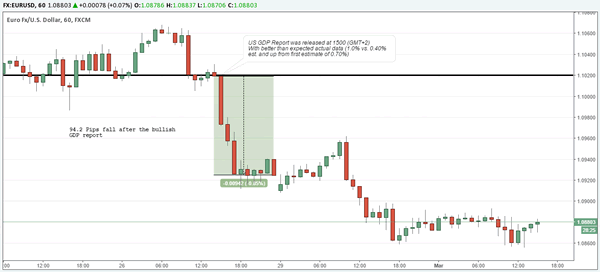
EURUSD Price Action on US Q4 GDP (2nd estimate release)
To conclude, the GDP reports are one of the high impact economic indicators/reports which have the likelihood to shape not just the exchange rates but also holds sway over monetary policy decisions.
Traders should not view the GDP numbers in isolation but consider how the report will impact the broader market context such as monetary policy expectations.
What CPI Is and How to Trade Inflation Data
Consumer Price Index, CPI for short is a measure of the change in the weighted average of prices from a basket of consumer goods and services considered essential.
CPI is calculated by tracking the price changes for each of the items in the basket of goods and weighted in importance.
Inflation data is primarily comprised of two measures:
- Headline inflation: This inflation reading tracks the overall changes and includes energy prices which are volatile
- Core inflation: This inflation reading strips out the volatile energy prices and food and gives a clearer picture of the price changes in the basket of goods
The headline inflation data is usually more volatile compared to the Core inflation rate and has the ability to predict core inflation. The headline inflation is designed to be a best measure of inflation and it is this headline inflation which is usually targeted by Central Bankers.
CPI or inflation data is an important economic release which has the potential to move the short term markets as well as shape monetary policy decisions. After all most central banks have an inflation-targeting mandate.
CPI or Inflation data is released on a monthly basis with some countries releasing flash or preliminary inflation data ahead (EU) of their time.
Typically CPI data released is for the month gone by and is also measured annually for both the core and the headline inflation data.
Countries such as New Zealand and Australia prefer to keep the inflation data on a quarterly basis which offers a less volatile and clearer view on changes in consumer prices.
Some countries also tend to use their own measure of inflation. For example in the Eurozone, HICP or Harmonized Index of Consumer Prices is used, while the US besides the CPI, PCE or Personal Consumption Expenditure data is also used.
Although the terms may sound different, they track the same underlying changes in consumer prices with differences in the way the prices are measured.
Why is Consumer Price Index an important economic report?
The CPI or consumer price index report is an important economic indicator as it signals how quickly prices are rising or falling. When consumer prices rise, it signals inflation, but when prices fail to rise or drop, it signals a period of deflation.
Central bankers use consumer inflation as a gauge to raise/cut/hold interest rates, which acts as a lever to stimulate or hold back consumer spending which in turn influences inflation.
As a result, CPI data is closed watched as strong or prolonged increase or decline in inflation usually results in some Central Bank acting on monetary policy.
Most central banks today build their monetary policy around inflation targeting. This means that the Central Banks have a specific target inflation rate to achieve, which is usually 2%, or in some cases, within a band of 2% – 3%.
Interest rates and monetary policy tools are used in accordance with maintaining the price stability.
Impact of CPI data release on the forex markets
In the currency or forex markets, CPI data is closed watched. This report has gained a lot more significance ever since oil prices started a steady decline making it more difficult for Central Banks to target the 2.0% mandated inflation growth.
Many banks have had to cut interest rates, some into negative as well as having to use other tools such as quantitative easing in efforts to stoke consumer spending and thus push inflation higher.
A good example of the importance of inflation data can be the Bank of Japan and the European Central Bank, which struggled to push inflation back to the mandated target.
When monthly a quarterly inflation report shows a spike or declines further, the markets are quick to speculate what policy action the Central Banks could take based on the information available.
Example of trading the CPI release
Eurozone CPI (2014 & 2015)
The Eurozone's annual inflation rate was in a steady decline for most of 2014, at one point falling below zero. The ECB vowed to bring inflation back to its 2.0% target and prepared the markets thereafter that it would consider cutting interest rates to historic lows, cut rates on bank deposit rates and purchase sovereign bonds via the QE program to spur lending.
The chart below shows the Eurozone inflation rate between 2014 January and 2015 December. It was in January 2015 that the ECB announced a massive €60 billion monthly bond purchase program to stoke inflation.
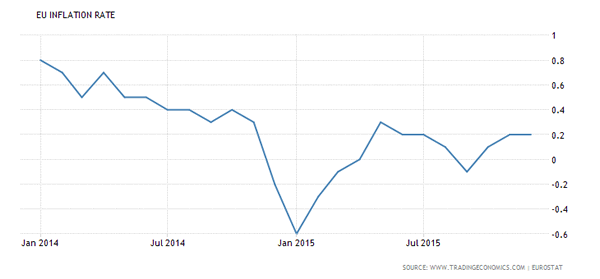
Eurozone Inflation Rate 2014 – 2015
The Euro fell sharply since the ECB announced its intentions, falling from highs of $1.39 to hit $1.12 before the ECB officially announced the dovish monetary policy decision.
To summarize the key points about CPI and how to trade the report:
- Inflation is a measure of the price change in a basket of goods. Inflation is measured as a headline and core inflation which strips the volatile food and energy components
- CPI is released on a monthly and quarterly basis, in some cases as a preliminary estimate. The data is released for the previous month
- While monthly dispersions occur, the annualized inflation rate is what matters
- CPI might have strong or negligible impact depending on the monetary policy conditions
- On the very short term, a surprise in inflation can lead to some intraday trading opportunities
Demo Trading vs. Live Trading
No matter how hard you try, it will be impossible for you to climb up the trading ladder until you've learned how to risk live money.
Trading in the live market draws in psychological elements that are generally not experienced in a simulated environment. This, as you'll see throughout the article, is the key difference…
Demo trading - to trade or not to trade?
As a new trader entering into the wonderful world of currency trading, you will have undoubtedly come across several traders promoting the benefits of using a demo account before transitioning over to a live account. We happen to agree with this, and believe that trading a demo account is incredibly helpful.
Although a practice account typically mitigates the psychological side of things, simulated trading provides a stage in which to develop and hone your trading method, begin creating a trading journal and familiarise yourself with how a platform functions.
It is often recommended that once you are recording consistent profits on demo, you can then begin thinking about taking the leap over to a live account. To begin with, we would not advise opening a live account with a huge sum of money. Why? Well, although you're able to pin down consistent profits on demo, live trading is a completely different animal altogether! Think lion and tame house cat - that's how much of a difference there is, traders!
Why is demo and live trading so different then?
Switching over from demo to live is often an exciting, yet slightly daunting, prospect for most. The typical trader often sees no reason why their demo results cannot be replicated on a live account. The trouble with this is that having your hard-earned money on the line will cause stronger emotions to materialize, which were masked when trading simulated funds. Sweaty palms, a dry mouth, a pounding heart beat and a swarm of butterflies in your stomach are common symptoms when one first experiences live trading. After all, it is never easy, especially in the earlier stages, watching real money fluctuate from positive to negative.
Live trading will also teach you things about yourself that you never knew existed! You may believe that you are a disciplined patient person now (and you may well have been on demo), but wait until there is real money on the line. This changes a lot of people!
In addition to the above, you may find yourself breaking trading rules once live money enters the equation. Things like moving stop losses, prematurely taking profits before the target is achieved and revenge trading are just some of the trading sins you may commit. Furthermore, in an attempt to prove that you can replicate your demo results, this could lead to overtrading, and sometimes even ignoring your trading plan altogether.
Ultimately, the method that you used to successfully trade on demo should not change. It's the psychological side of things that will require work in live trading.
Ways of making the transition from demo to live easier
While there is never a guarantee that you'll mirror your demo results, the following points should make the transition easier:
- Resist the urge to rush in and prove yourself! Take your time and trade according to your plan.
- Begin trading with a small amount that you would be happy to lose. Familiarise yourself with the new risk profile and demonstrate competence at this level, before considering moving up the ladder. Only add new funds to your account once you've achieved some level of consistency.
- Money management is crucial at this stage. For example, set maximum daily losses and do not deviate.
- Do not panic if your first, second or even third trade is a disaster. Losses happen - it's simply the cost of doing business. Thinking in probabilities will help alleviate this: Thinking in Probabilities.
- Keep a log of all trades so that you can review any mistakes.
- Trade the plan. Without a plan you're effectively going to be trading from a reactionary state i.e. emotional trading.
The above, of course, is not the be-all and end-all, but each point should help avoid emotionally-driven mistakes linked with live trading.
Making Use of Your Demo Account
Imagine for a moment that you're a newly appointed trainee chef. Eager, excited and ready to get in the kitchen, the head chef unexpectedly throws you a curve ball. He asks that you begin preparations to cook five-star meals at their finest restaurant in town that evening. We'd be surprised if this didn't raise an eyebrow, or two! A trainee chef, especially one that's new to the industry, would surely need time to hone his/her skills before being let loose in a restaurant kitchen! Not knowing how to properly slice an onion or even read a recipe would, as you can imagine, likely end in a culinary catastrophe.
Just like our trainee chef, a trader needs time to develop and mature. Fortunately, a simulated practice account offers one the opportunity to experience the market before placing your hard-earned money on the line. So, without further ado let's look at how one can take advantage of their demo account.
Risk free
This is perhaps the most appealing feature of a demo account: it is risk free!
Traders, especially those new to the business, often rush into live trading longing for riches. Unfortunately, many of these traders end up paying the price! Unlike doctors or lawyers, who have to go through rigorous training before considered a competent specialist, a trader, with a few clicks of a mouse button, can trade using real money. The barriers to entry are incredibly (some would say dangerously) low!
A demo account provides one entry to the live market at no cost. This allows the trader to become familiar with the platform's features in a risk-free environment. Determining lot sizes, knowing how an order is placed, how to close a position and how to alter stop-loss and take-profit orders are things best learnt on a demo account, as mistakes will happen.
An additional point to consider is the testing capability a demo account offers, WITHOUT the fear of losing real money if the method turns out to be a flop. A great deal of traders open live accounts without fully testing the strength of a method. Without knowing the historical statistics, it'll be difficult not to panic when a string of losses occur.
Another feature, which is often overlooked, is how receptive the support team is. The last thing you want is an uncooperative support team when you need them most. Therefore, testing the response with a demo account before considering a live platform is important.
A trading journal
Trading the financial markets will forever be a learning process. Even for the most experienced traders, a trading journal is crucial. Memorizing the subtle nuances of each trade is of the utmost importance. It is how we recognize mistakes and ultimately mature as traders. By keeping a journal, it'll enable you to identify mistakes and weaknesses made in demo trading account before transitioning over to live trading.
Also, in order to keep a trading journal realistic, we'd advise starting with an account balance similar to what you intend to begin with in live trading. There's little point in trading a $100,000 account, if you're planning to trade with only $1,000. The goal is to keep it as real as possible.
Fortunately, IC markets allow you to select the opening balance. What's more, there's no expiry date on the account, thus making it easy to track your progress.
The psychological aspect
The main difference in demo trading and live trading is that the latter has more pain involved when one suffers a loss. Not only was you wrong in your trading outlook/idea, but you also lost money in the process.
While you'll never effectively feel the psychological stress of trading a live account in a simulated environment, there are two methods which may help.
The first is to think of demo trading as a license needed to trade live funds. In order to receive this license, you need to maintain a certain consistency using demo dollars. By design, this places you in a setting in which you need to respect risk and money management principles.
The second method is simply setting real-life penalties for when you lose a trade. For instance, you place a dollar in a jar following a losing trade. You could even donate this money to a charity as this will help remind you that a trade has a real money aspect to it.
Final word...
Other than diminishing the psychological aspect, trades take on a demo platform will also not be subject to slippage. This is something that can occur in the live trading environment, so do take this into account.
Opening a demo account with IC markets couldn't be easier. What's more, we have MT4, MT5 and cTrader platforms available to choose from, as well as a wide range of currency pairs, metals and CFDs, all trading with attractive spreads. To get started click here: IC Markets Demo Account.
Once you're familiar with the platform functions and have a tested method in hand, you will likely be looking to open a live account. With IC markets, you can open an account with as little as $200 (Open a Live Account). That way, assuming you risk no more than 2% on each trade, making your very first live trade need not break the bank should you make a mistake.