

Sample Category Title
Canada’s Manufacturing Sector Activity Declined To A 4-Month Low In June
For the 24 hours to 23:00 GMT, the USD declined 0.52% against the CAD and closed at 1.2937.
On the macro front, Canada's Markit manufacturing PMI eased to a four-month low level of 54.7 in June, suggesting a slowdown in the nation's economic momentum. The PMI had registered a reading of 55.1 in the preceding month.
In the Asian session, at GMT0300, the pair is trading at 1.2936, with the USD trading slightly lower against the CAD from yesterday's close.
The pair is expected to find support at 1.2895, and a fall through could take it to the next support level of 1.2853. The pair is expected to find its first resistance at 1.2996, and a rise through could take it to the next resistance level of 1.3055.
The currency pair is trading below its 20 Hr and 50 Hr moving averages.

AUD/USD Daily Outlook
Daily Pivots: (S1) 0.7569; (P) 0.7626; (R1) 0.7660; More...
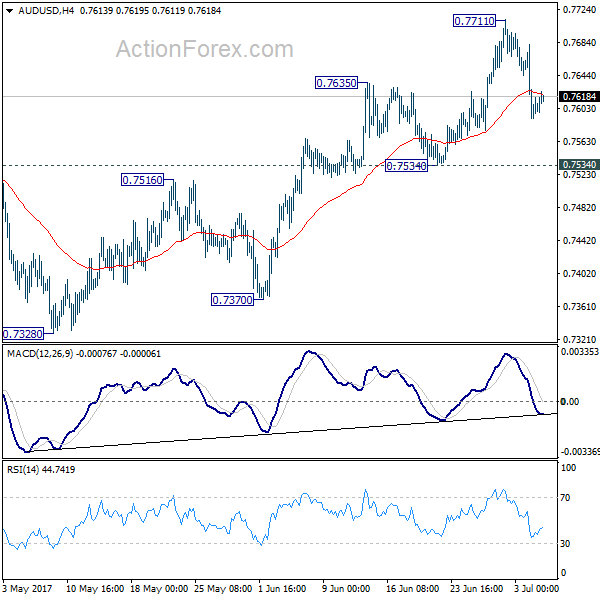
AUD/USD is staying in consolidation below 0.7711 and intraday bias remains neutral. With 0.7534 minor support intact, another rise is mildly in favor. Break of 0.7711 will target 0.7748 resistance and above. At this point, there is no clear sign of range breakout yet. Hence, we'd be cautious on topping again as it approaches medium term fibonacci level at 0.7849. On the downside, break of 0.7534 will indicate near term reversal and turn bias back to the downside for 0.7370 support.
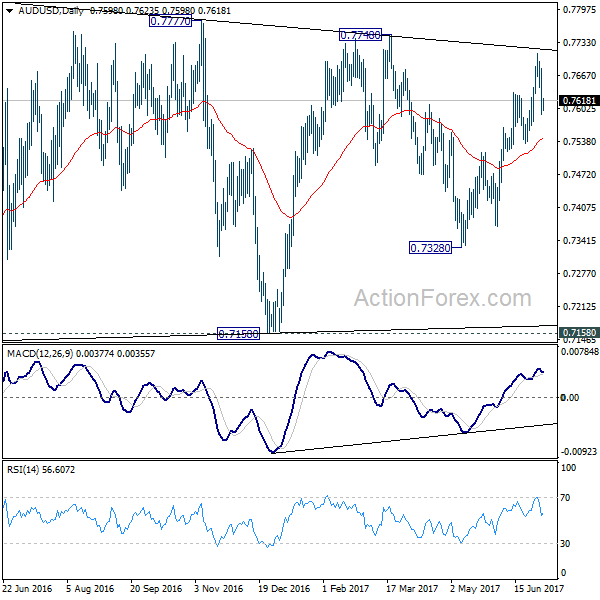
In the bigger picture, we're still treating price actions from 0.6826 low as a corrective pattern. And, as long as 38.2% retracement of 0.9504 to 0.6826 at 0.7849 holds, long term down trend from 1.1079 is expected to resume sooner or later. Break of 0.6826 low will target 0.6008 key support level. However, firm break of 0.7849 will indicate that rise from 0.6826 is developing into a medium term rebound, rather than a sideway pattern. In such case, stronger rise should be seen to 55 month EMA (now at 0.8096) and above.
Is Gold Making A Beeline For The 1180.00 Handle?
Key Points:
- The long-term trendline seems to be broken.
- A corrective ABC wave could be seen in the coming weeks.
- Losses could extend to the 1180.00 handle.
As a result of a breakout below its long-term trendline, gold has ostensibly confirmed recent fears that the metal's trajectory is going to be rather bearish moving ahead. Indeed, Monday's nearly 2% slip has cemented the bias of numerous technical readings that had been suggesting that the metal was in need of a corrective movement. However, exactly what form our corrective decline will take and how far losses will extend is up for debate and is worth taking a closer look at.
First and foremost, the sharp downturn and subsequent reversal tends to indicate that we are going to see an ABC wave over the coming weeks. As shown below, the historical reversal zone around the 1219.10 handle has struck again and looks as though it is going to remain intact – a sign that the ‘A' leg has completed. Of course, this means we are now moving into the second leg of the pattern which we expect to bring gold prices back to around the 1244.25 handle. This bias is reinforced by the fact that stochastics remain oversold and are in sore need of being relieved.
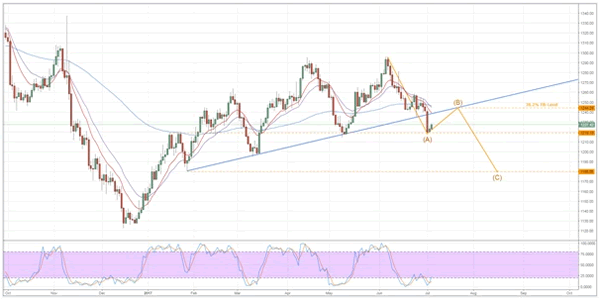
However, just because we are moving into a near-term uptrend doesn't mean we are necessarily going to see the metal make the required reversal to start the ‘C' leg of the pattern. This is where the old trend line comes back into the picture as it is likely to be a source of resistance moving forward. Importantly, this should limit upsides and force gold to retreat at that 1244.25 handle – marking the start of the final leg of the ABC wave.
Once the final leg is underway, the highly bearish EMA bias is likely to be felt once again and encourage the metal to move into a rather steep decline. Furthermore, the 100 day moving average will be providing substantial dynamic resistance as gold retreats which will limit chances of an intra-day sentiment swing disrupting the overall downtrend. Ultimately, this corrective structure should see the metal move back to around the 1180.00 mark – the lowest point in the first trough seen in during the recent uptrend.
USD/CAD Daily Outlook
Daily Pivots: (S1) 1.2892; (P) 1.2953; (R1) 1.2994; More....
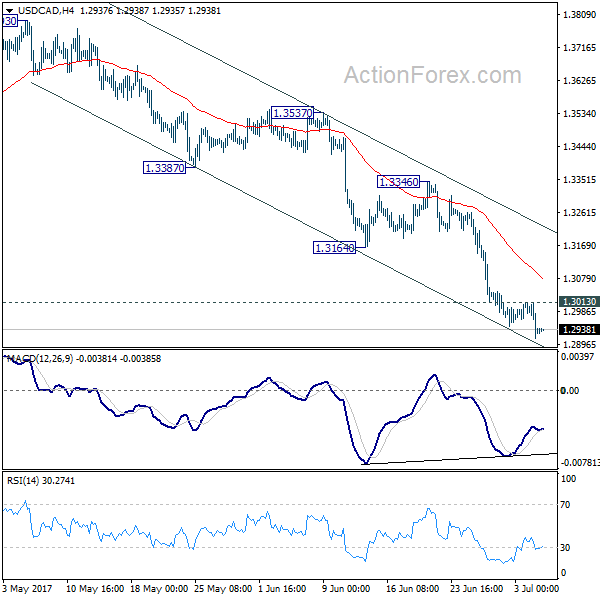
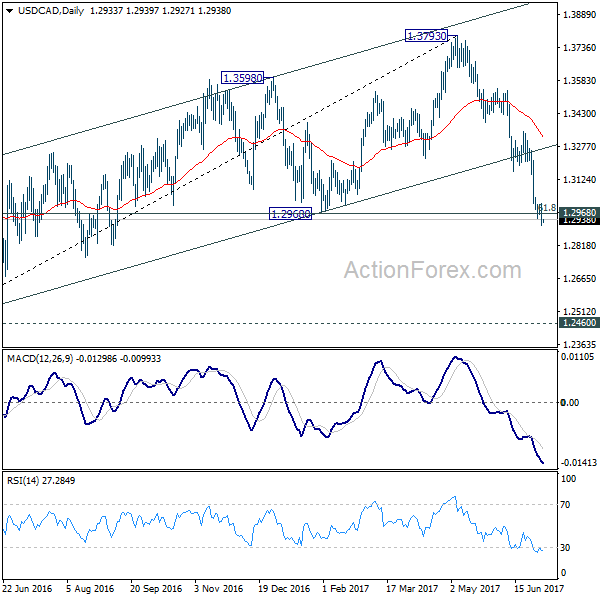
USD/CAD edges lower to 1.2911 as recent decline continues. Intraday bias stays on the downside. Sustained trading below 1.2968 cluster support, 61.8% retracement of 1.2460 to 1.3793 at 1.2969 will pave the way to retesting 1.2460 low. On the upside, above 1.3013 minor resistance will indicate short term bottoming, on bullish convergence condition in 4 hour MACD. In such case, stronger rebound would be seen back to 1.3164/3346 resistance zone first, before staying another fall .
In the bigger picture, price actions from 1.4689 medium term top are seen as a correction pattern. The second leg should have finished at 1.3793. Break of 1.2460 will extend such correction to 50% retracement of 0.9406 to 1.4869 at 1.2048. At this point, we'd look for strong support from there to contain downside and bring rebound. However, firm break there will target 100% projection of 1.4689 to 1.2460 from 1.3793 at 1.1564.
Canadian Dollar Rises on Hawkish BoC again, Little Reaction to Korea Tensions
Dollar recovers this week but momentum isn't too strong so far. Indeed, the greenback is overwhelmed by the strength in Canadian Dollar, which follows high oil prices and hawkish BoC comments. Dollar is still holding well below near term resistance against Euro, Pound and even Aussie, and maintains bearishness. Meanwhile, Yen also tried to recover on news of geopolitical tensions in Korea but no follow through buying is seen. US markets will be back from holiday today with major focus on FOMC minutes. Sterling will look into PMI services for inspirations.
US and South Korea conducted missile drill
The US and South Korea jointly conducted a missile drill after North Korea's missile launch yesterday. Pentagon said that "together with the Republic of Korea, we conducted a combined exercise to show our precision fire capability." And the US Army said that's an exercise to counteract North Korea's "destabilizing and unlawful actions." Meanwhile, the US also confirmed that North Korea's claim that the one tested was an intercontinental ballistic missile. North Korea head Kim Jong-un said that the launch was a July 4 "gift" to the Trump administration. Forex markets' reaction to the news was rather muted. Also about US, Fed chair Janet Yellen was hospitalized over the weekend to treat a urinary tract infection while she was on holiday in London. Yellen was released on Monday and is returning to work as planned this week.
BoC Poloz reiterated hawkish comments
Bank of Canada Governor Stephen Poloz was interviewed by a German newspaper Handelsblatt. He said that while core inflation is "fair soft" recently, the central back has to look through the near term reading and anticipate the picture 18 to 24 months ahead. He said that "if we only watched inflation and reacted to inflation, we would never reach our inflation target, we'd always be two years behind in the reaction." Hence, "we have to look at the rest of our indicators in the models that predict inflation." He noted that output gap would close some time in first half of 2018 and inflation will then be well into an up trend. Thus, it's appropriate to start removing some of the monetary stimulus. Meanwhile, Poloz sounded unconcerned with recent volatility in oil price and said that the fall from around 50 to 40 was "not a big issue". Markets are pricing in over 50% chance of a 25bps rate hike by BoC to 0.75% on July 12 next week.
BoE hawks stay hawkish
There were three BoE policy makers who voted for a rate hike last month. Two of them maintained their hawkish stance as they spoke yesterday. Michael Saunders said that "households should prepare for interest rates to go higher at some point". But he noted that if rates do go up, "it will be in the context of the economy doing OK and unemployment being low and probably falling". Meanwhile, he is "reasonably confidence" that investments and exports would offset the slowdown in consumer spending. Ian McCafferty said in a newspaper interview that on the balance of monetary policy, "there is a need for change". And a rate hike would be "justified" and "the prudent thing to do at this stage".
ECB Praet called for patience
ECB chief economist and Executive Board member Peter Praet called for patience regarding stimulus exit as "inflation convergence needs more time to show through convincingly in the data". And he emphasized that "we need to be persistent, because the baseline scenario for future inflation remains crucially contingent on very easy financing conditions which, to a large extent, depend on the current accommodative monetary policy stance." Looking at the current outlook, Praet said that "measured inflation remains exceedingly volatile and metrics of underlying price pressures continue to be subdued. The entire distribution of inflation expectations still needs to shift a fair distance to the right."
ECB Governing Council member Ewald Nowotny also urged that a "steady hand" is needed for monetary policy. He said that "we again have a revival in investment, and together with the recovery of exports that's a significant reason for the clear upturn that we now see in Europe." Another Governing Council member Yves Mersch said that there will be "compositional discussion" on QE in ECB. And, the central bank will "in the not too distant future have to review the specific role of ABS in the context of the broader issue of QE beyond 2017."
In the economic calendar
UK BRC shop prices dropped -0.3% yoy in June. China Caixin PMI services dropped to 51.6 in June. UK PMI services will be the main focus in European session. Eurozone will release PMI services final and retail sales. Later in the day, US will release factory orders. But main focus will be on FOMC minutes. Markets will look into the discussions between policy makers. The key question will be whether Fed will hike again in September and start shrinking balance sheet in December. Or Fed will start cutting the balance sheet first and hike in December. Or, Fed will just do one of them this year.
USD/CAD Daily Outlook
Daily Pivots: (S1) 1.2892; (P) 1.2953; (R1) 1.2994; More....
USD/CAD edges lower to 1.2911 as recent decline continues. Intraday bias stays on the downside. Sustained trading below 1.2968 cluster support, 61.8% retracement of 1.2460 to 1.3793 at 1.2969 will pave the way to retesting 1.2460 low. On the upside, above 1.3013 minor resistance will indicate short term bottoming, on bullish convergence condition in 4 hour MACD. In such case, stronger rebound would be seen back to 1.3164/3346 resistance zone first, before staying another fall .
In the bigger picture, price actions from 1.4689 medium term top are seen as a correction pattern. The second leg should have finished at 1.3793. Break of 1.2460 will extend such correction to 50% retracement of 0.9406 to 1.4869 at 1.2048. At this point, we'd look for strong support from there to contain downside and bring rebound. However, firm break there will target 100% projection of 1.4689 to 1.2460 from 1.3793 at 1.1564.
Economic Indicators Update
| GMT | Ccy | Events | Actual | Forecast | Previous | Revised |
|---|---|---|---|---|---|---|
| 23:01 | GBP | BRC Shop Price Index Y/Y Jun | -0.30% | -0.40% | ||
| 1:45 | CNY | Caixin PMI Services Jun | 51.6 | 52.9 | 52.8 | |
| 7:45 | EUR | Italy Services PMI Jun | 54.6 | 55.1 | ||
| 7:50 | EUR | France Services PMI Jun F | 55.3 | 55.3 | ||
| 7:55 | EUR | Germany Services PMI Jun F | 53.7 | 53.7 | ||
| 8:00 | EUR | Eurozone Services PMI Jun F | 54.7 | 54.7 | ||
| 8:30 | GBP | Services PMI Jun | 53.5 | 53.8 | ||
| 9:00 | EUR | Eurozone Retail Sales M/M May | 0.30% | 0.10% | ||
| 14:00 | USD | Factory Orders May | -0.50% | -0.20% | ||
| 18:00 | USD | FOMC Meeting Minutes |
Elliott Wave View: USDX Correction In Progress
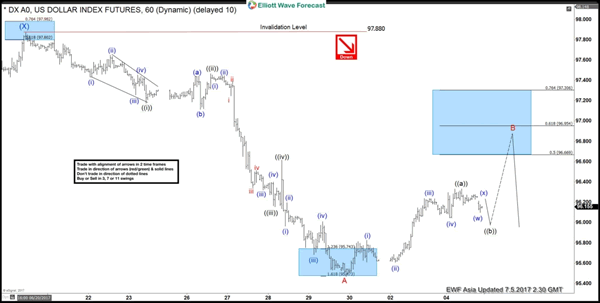
Short term USDX (USD Index) Elliott Wave view suggests the rally to 97.88 high on 6/20 ended Intermediate wave (X). Decline from there is unfolding as an impulse Elliott Wave structure with extension and ended at 95.47 low on 6/29. This 5 wave move could be Minor wave A of an Elliott wave zigzag structure structure, where Minute wave ((i)) ended at 97.17 and Minute wave ((ii)) ended at 97.47. Minute wave ((iii)) ended at 96.15, Minute wave ((iv)) at 96.61 and Minute wave ((v)) of A ended at 95.47.
Minor wave B bounce is currently in progress to correct cycle from 6/20 peak. The subdivision of Minor wave B is unfolding as an Elliott wave zigzag structure. Minute wave ((a)) ended at 96.33 and near term, Minute wave ((b)) pullback is in progress to correct cycle from 6/29 low in 3, 7, or 11 swing before turning higher again. While the pullback stays above pivot at 6/29 low (95.47), USDX has scope to extend higher one more leg towards 96.66 – 96.95 area to end Minor wave ((c)) of B. Afterwards, while bounces stay below pivot at 6/20 high (97.88), expect USDX to resume lower again. We don’t like buying the proposed bounce.
USDX 1 Hour Elliott Wave Chart
Market Morning Briefing: Aussie Has Been Hurt By The RBA Maintaining Status Quo
STOCKS
Dow (21479.27, +0.61%) rose towards 21600 but came off sharply to close at lower levels. Immediate hurdle could be faced near 21600-21750 levels before targeting 22000 on the upside. Further upside could be limited just now and a sharp corrective fall is on the cards for the medium term. We need to be cautious near current levels.
Dax (12437.13, -0.31%) came off last week from important resistance near 13000 and could possibly come down to test 12000 in case it breaks below 12400. Movement looks bearish for the current week.
Shanghai (3191.94, +0.29%) continues to remain in the sideways consolidation mode as expected. Immediate resistance is seen near 3200 which seems to be holding quite well for now.
Nikkei (19928.79, -0.52%) is trading lower. There is some chance that it may test 19700 on the downside before again trying to move up towards 20250. On the weekly charts, the index is in a sideways consolidation mode within 19700-20250 levels.
Nifty (9613.30, -0.02%) tested 9650 yesterday but came down to close at 9613. While it manages to sustain above 9615-9625 levels, there could be some chances that it moves up towards 9700 in the next couple of sessions but at the same time it could also come off below 9600 just now. There is no directional clarity just now. We would like to wait and watch.
COMMODITIES
Gold (1222) is trading within the range of 1190-1230 and Silver (16.16) is within 15.80-16.50. On 27th June, we had clearly mentioned that 'If 1233 for gold and 16.45 for silver fail to hold for the current week then gradual selling for the target of 1195 and 15.93 can't be ruled as seller will take every bounce as a further opportunity for selling'. We will remain bearish on Bullion while gold and silver are trading below 1250 and 16.50 levels respectively.
No directional movement had been seen in Copper (2.68) as it is trading within the range of 266-2.78.If 2.66 holds then we might see 2.82 within few days of time. We will remain bullish on copper while it is trading above 2.55 levels.
Although Brent (49.56) and WTI (47.01) are trading near their resistances of 50 and 48.50 levels but this recent bounce hasn't affected their midterm bearishness much and we will remain bearish while Brent and WTI are trading within 54 and 51 regions respectively. We have U.S weekly crude oil inventory data tomorrow, which could be a decisive factor to determine the future course of action.
FOREX
All eyes will be on the Fed minutes from its Jun'17 policy meeting to find clues about the rate path in the coming months which may move Dollar tonight.
Neither Euro (1.1361) has declined below the support of 1.1320-1.1290 nor Dollar Index (96.13) has broken above the resistance of 96.50-65 to provide us the confirmation for the preferred scenario of continued Dollar strength in the coming days. Repeat - We expect Dollar to stage a turnaround to the upside soon but we are still waiting for confirmation. Till now, most of the majors are in a normal correction and further break of major supports are required before the downtrend can be confirmed.
Dollar Yen (112.96) is in a sideways corrective mode for the last 2 sessions but as long as the support of 112.60 holds, the chances of further upside to 114.30-115.00 remain open.
Pound (1.2938) has managed to stay above the support of 1.2880 so far, keeping the near term trend up so far and the possibilities of resuming the uptrend in the coming sessions open.
Aussie (0.7619) has been hurt by the RBA maintaining status quo and the upside momentum is gone. If the next support of 0.7580 holds, it may attempt a recovery but the bears may return at the higher levels.
Dollar Rupee (64.74) tried to rally above 64.90 but failed to sustain the upside momentum, as frequently seen in the recent days. It corrected to close below 64.80 but as long as the support of 64.60 holds, the chances of another rise to 64.90-65.00 remain open.
INTEREST RATES
The US yields have risen sharply since last week. The 5Yr (1.91%), 10Yr (2.32%) and the 30YR (2.84%) are all up from previous levels near 1.85%, 2.25% and 2.82% respectively. The 30Yr is heading towards resistance near 2.92% while the 10YR could rise to 2.4% before coming off again by the end of the week.
The German-Japan 10Yr (0.39%) is trading just below resistance levels and could come off sharply from there in the near term. this could indicate that the EUR/JPY (128.32) could also come off in the near term maybe towards 127 or even lower.
The German yields are rising and could face long term resistance above current levels. While the resistances hold, the yields could come off in the near term.
USDCHF – Bullish, Retains Upside Pressure
USDCHF - With the pair continuing to hold on to its recovery higher, more strength is envisaged. On the downside, support lies at the 0.9600 level. A turn below here will open the door for more weakness towards the 0.9550 level and then the 0.9500 level. On the upside, resistance resides at the 0.9700 level where a break will clear the way for more strength to occur towards the 0.9750 level. Further out, resistance comes in at the 0.9800 level. All in all, USDCHF faces further recovery threats.

Unexpected 4th Of July Fireworks
Unexpected 4th of July Fireworks
With the US markets closed for Fourth of July festivities, it was a somewhat directionless overnight session due to lack of participation, but the overriding tone is cautionary with a touch of risk off in the wake of a highly provocative North Korean test of an intercontinental ballistic missile. A topic that will be atop of the G-20 agenda which begins on Friday as North Korea attempts to puts their ICBM and Nuclear-tipped bargaining chips on the table.
The escalation in geopolitical tensions was quickly tempered after Russia and China led the global outcry for both US and South Korea to agree to a Chinese-led de-escalation plan.With cooler heads prevailing, the market quickly retraced the original headline panicked clamouring for scarcely offered haven assets in holiday thinned-trading conditions.But given the immensity of this latest crisis and G20 looming we've not heard the last on this front.
On the currency markets, there were pockets of interest as the CAD remained the markets darling thanks to both surging oil prices and the Bank of Canada's hawkish tone. While the Aussie fell out of favour after the RBA baulked at stepping in line with the chorus of hawkish central banks and issued more dovish than expected statement
Australian dollar
The Aussie remains on its back after a heavy sell-off when the RBA failed to live up to expectations and join the policy convergence club that had traders clamouring for top side exposure in G-10 currencies believing formal policy coordination was afoot. While the global policy convergence narrative will eventually play out the RBA has quashed the notion of a consorted rate rise amongst global central banks.While the RBA stuck to their neutral guidance, there appears to be not one primary catalyst that has convinced the bank to alter that view and refused to remove the downside risk to interest rates which seem to be the popular narrative amongst other central banks.
It's evident the short term market was disappointed after speculators succumbed to the allure of riding a wave of shifting policy, but regardless of the RBA latest musing the tide is turning on global easy money policy, and it might be too early to give up on the Aussie dollar just yet.
Euro
The Forex market is taking a breather conscious of some potentially bullish US$ risk events on the horizon; primarily FOMC minutes and US payroll data this Wednesday and Friday respectively. So we expect the EUR to remain rather rangy.
Japanese Yen
With risk aversion lingering, headline risk, and no shortage of, will dominate USDJPY flow as we head towards Friday's G20 summit keeping topside risk in check
Friday is looking l is looking like a very actionable day.
USD/CAD Canadian Dollar Rises After BoC Governor Reiterates Hawkish Comments
The Canadian dollar appreciated on the Fourth of July trading session on the back of comments from Bank of Canada (BoC) Governor Stephen Poloz to a German newspaper where he once again reiterated that he is concentrating on where the economy will be 18 to 24 months from now. The BoC came out of left field in June with a couple of statements from senior policy makers that surprised the market which had not priced in a rate hike this year for Canadian interest rates. The market is now considering a 50 percent probability of a rate hike during the July 12.
Governor Poloz told the Handelsblatt that Canadian inflation should be well into an uptrend by the first half of 2018. The timeline sheds some light on the change in tone from the Central bank that is now dropping heavy hints of upcoming monetary policy changes. Previously Mr. Poloz did not broach the subject of inflation as energy prices have dampened the Canadian CPI to 1.3 percent on an annual basis and far from the central bank’s target of 2 percent.
Inflationary growth is a major concern, not only for the BoC but for all major central banks. The economies of Europe, Japan, the United States and England appear to be on the mend by most indicators, the missing link inflation. The U.S. Federal Reserve has said that it won’t let inflation get in a the way of tighter monetary policy as it gets ready to hike once again and reduce the massive balance sheet it accumulated during the quantitive easing program. The European Central Bank (ECB) and Bank of England (BoE) have started the hawkish rhetoric, but will have to first sort out the tapering of their stimulus programs. The Bank of Japan (BOJ) is holding the rear as some political turmoil after the Tokyo elections could signal a fracture of old dynamics and reduce the power of Prime Minister Shinzo Abe. The Japanese central bank has mentioned the possibility of ending its QE program, but as it stands it won’t happen in the short term.
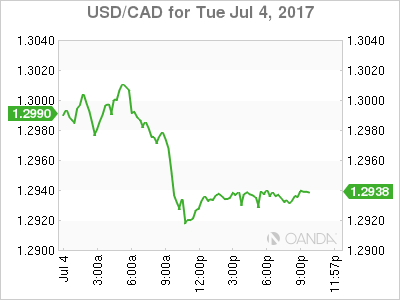
The USD/CAD lost 0.493 in the last 24 hours. The currency pair is trading at 1.2936 during the Fourth of July holiday in the United States has reduced liquidity. The CAD kept rising despite a holiday on Monday due to Canada Day, with the extra long weekend limiting the action on the currency pair. Governor Poloz is making sure the market receives the July 12 signal loud and clear. Prior to June 11 the market was not considering a change in monetary policy this year. The BoC was proactive in 2015 with two rate cuts to ease the impact of the impending drop in oil prices. Now the central bank has deemed those cuts served their purpose and with energy enjoying some stability and the U.S. Federal Reserve already up to a 100–125 basis points range with at least another to come, the BoC quickly put on the table a rate hike that could come as early as the next meeting on July 12.
The loonie has risen on solid energy prices but also a lack of traction from the USD. The Trump administration is still struggling to pass the divisive healthcare reform that is now clogging the path of more pro-growth policies that were promised. The Canadian dollar
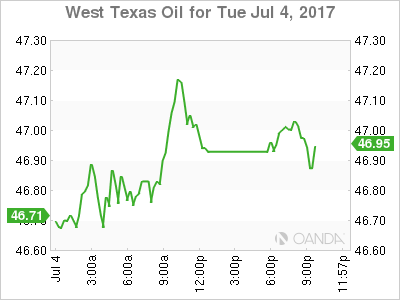
Oil rose 0.611 percent on Tuesday. The price of West Texas Intermediate is trading at $46.93 after a 8 session rally continues into a 9th with one of the best performances of crude prices since 2010. US crude inventories are usually published on Wednesday at 10:30 am EDT, but this week the Fourth of July holiday will push back the release date to Thursday. Forecasts are pointing to another drop in crude inventories.
The Organization of the Petroleum Exporting Countries (OPEC) production cut agreement has stabilized prices, but rising US production has cancelled out more positive effects. Nigeria and Libya although OPEC members are exempt from the deal as disruptions had hit their output, but are now back at normal levels putting some pressure on energy prices.
Oil markets will be awaiting the numbers form the Energy Information Administration (EIA) on Thursday as the supply battle between the OPEC and US shale producers continues with low evidence of a recovery of global demand.
Market events to watch this week:
Wednesday, July 5
4:30 am GBP Services PMI
2:00 pm USD FOMC Meeting Minutes
9:30 pm AUD Trade Balance
Thursday, July 6
8:15 am USD ADP Non-Farm Employment Change
8:30 am CAD Trade Balance
8:30 am USD Unemployment Claims
10:00 am USD ISM Non-Manufacturing PMI
11:30 am USD Crude Oil Inventories
Friday, July 7
4:30 am GBP Manufacturing Production m/m
8:30 am CAD Employment Change
8:30 am CAD Unemployment Rate
8:30 am USD Average Hourly Earnings m/m
8:30 am USD Non-Farm Employment Change