

Sample Category Title
Technical Outlook: AUDUSD Faces Strong Headwinds At 0.7470/0.7500 Zone
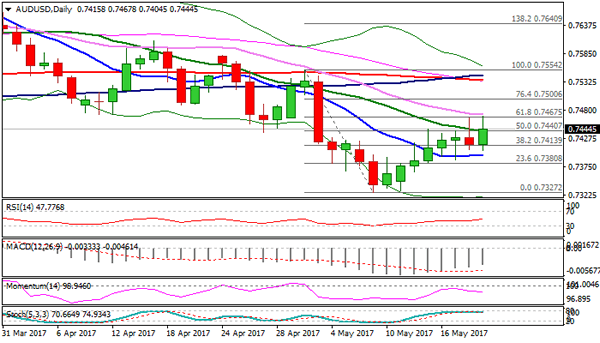
The Aussie regained traction and retested recovery high at 0.7467 after Thursday's trading ended in red on strong upside rejection.
Higher prices of metals support AUD, however, fresh rally faces strong headwinds at 0.7470 zone (Fibo 61.8% of 0.7554/0.7327 / 55SMA) and 0.7500 (Fibo 76.4% / weekly cloud top.
Risk of repeated rejection here comes from bearishly aligned daily studies, with the pair expected to spend some time in consolidation between 10SMA support (0.7397) and 0.7470 resistance.
Fresh direction will be established on break of either boundary.
Res: 0.7467, 0.7500, 0.7544, 0.7554
Sup: 0.7424, 0.7397, 0.7387, 0.7364
Technical Outlook: USDJPY – Break Above 55SMA To Trigger Stronger Recovery
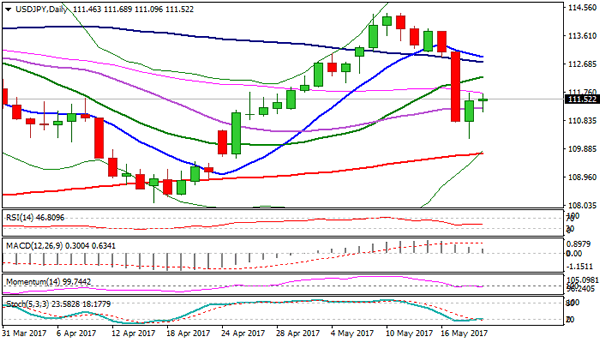
The USDJPY pair is consolidating within daily cloud and holding above broken Kijun-sen (111.23) which now acts as good support.
Immediate downside risk has been sidelined after Thursday’s bounce from fresh three-week low at 110.23 that left long-tailed bullish daily candle (positive signal).
However, recovery stays capped by 55SMA (111.74) for the second day, which, together with 111.80 (Fibo 38.2% of 114.36/110.22) marks pivotal barrier.
Firm break here would trigger stronger correction of the downleg from 114.36 towards next barriers at 112.26 (20SMA) and 112.75 (100SMA / Fibo 61.8% retracement.
Daily studies are in mixed setup but slow stochastic is emerging from oversold territory and may lend fresh support to the pair for further advance.
Alternative scenario sees increased downside risk on return and close below daily Kijun-sen / cloud base (111.23/12).
Res: 110.74, 112.00, 112.26, 112.75
Sup: 111.23, 111.12, 110.50, 110.23
Brazil Rocked By Renewed Political Crisis
Brazil was thrown into a fresh political crisis yesterday after fresh corruption charges hit President Michel Temer. The President has been accused in one of the biggest Brazilian newspapers of endorsing the payment of money to the imprisoned former speaker of the lower house of Congress, Eduardo Cunha, to 'silence' him in the ongoing corruption probe. On Thursday afternoon, the paper's website posted an audiotape that purports to be of Temer discussing the alleged payoff. Yesterday, President Temer responded on Brazilian television that he vows to hold onto his power and prove his innocence. The opposition parties have called for Temer to step down and a public protest took place in several Brazilian cities.
The fresh political crisis in Brazil could not come at a worse time for the Brazilian economy. The Temer government is in the midst of carrying out extensive fiscal reforms to address the significant fiscal challenges that have been accumulating over the past decade with the Lula-Rousseff governments, with the fiscal deficit hovering close to 9% of GDP and public debt levels at 70% of GDP. Late last year, the government adopted a spending gap and extensive pension reforms are currently being discussed in parliament. On the back of the government's reform, a fragile recovery has started to take hold as business and household confidence have rebounded.
The outlook for the BRL and Brazilian assets depends on the ability of the President to fend off the allegations over the next few days. The opposition parties will certainly maintain pressure on Temer to step down or start an impeachment process against him. The problem for the Temer government is that it is struggling with low approval ratings and eight of his cabinet ministers have been forced to resign over allegations of misconduct. Investors have bought into the ability of the Temer government to push through reforms and generally hold his economic team in high regard. However, although the market is still long the Brazilian real, it is not at the same stretched positions as a few months ago. However, the latest bout of political uncertainty creates upside risk to our forecast for USD/BRL of 3.30 by end-June.
Dollar Carnage Pauses, But Is It Over?
The greenback rebounded yesterday helped by a video clip of former FBI Director Comey's testimony on the 3rd of May. Under oath, Comey suggested that there had been no obstructions to FBI investigations. Following recent reports that President Trump asked the former FBI Director to drop an investigation regarding ties between Trump's prior security advisor Michael Flynn and Russia, this video was passed around as a proof that Trump didn't pressured him. The result was a rebound in the dollar, a retreat in safe havens and a recovery in equity markets.
However, if someone listens to the clip more carefully, he should notice that Comey was asked specifically if someone at the Department of Justice or the Attorney General had ever asked him to halt an investigation. In our view, this disregards the video as an evidence of Comey not being pressured by the White House and thus, we don't expect any material change in market sentiment in the absence of any stronger evidence. Risk aversion may prevail again, at least for the next few days, supporting safe havens and bringing equity markets under renewed selling interest. The dollar could also resume its latest tumble.
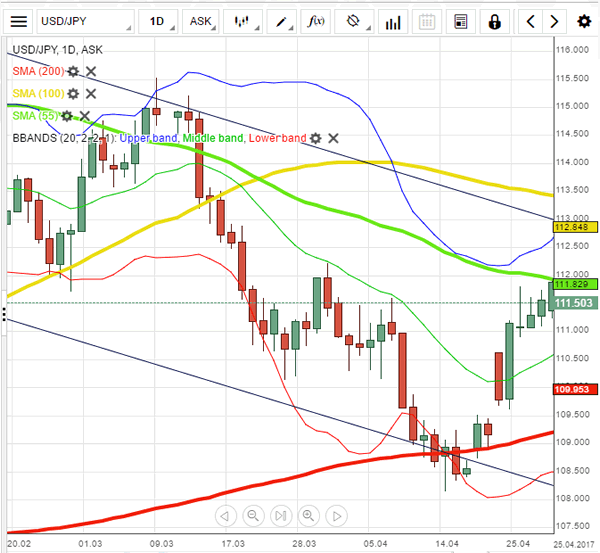
USD/JPY edged north after it hit support below the 110.50 (S2) level. The pair emerged back above 111.10 (S1), but it was stopped slightly below the resistance hurdle of 111.90 (R1). Bearing in mind that the pair remains within the channel that has been in place since December, we still see the likelihood for the bears to take the reins again soon and perhaps aim for another test near 110.50 (S2).
Canada's CPIs take center stage today
The main event today will probably be the release of Canada's CPI data for April. The forecast is for both the headline and the core CPI rates to have ticked up, following notable tumbles in March. The forecast is supported by the nation's Markit manufacturing PMI for April, which showed another robust increase in factory gate prices.
A rebound in these rates would likely be an encouraging development for BoC officials as it could confirm that the softness in March was only transitory, and may thereby support CAD. Nevertheless, we doubt that it will lead to a material change in the Bank's dovish bias. The BoC made it clear that it is going to maintain a cautious stance until uncertainties around trade clear up, something we don't see happening anytime soon given the recent tariffs from the US government.
USD/CAD has been trading in a consolidative manner in the last couple of days, oscillating around the key support obstacle of 1.3600 (S1). We believe that the rate may continue to trade at those levels today, waiting for Canada's CPI data. If indeed we get a rebound in the nation's inflation rates, sellers may take the opportunity and drive the battle below the aforementioned obstacle. Something like that may initially pave the way for our next support of 1.3530 (S2).
As for the rest of today's events:
During the European day, the economic calendar is very light. The most noteworthy data we get is Germany's PPI for April and Eurozone's current account balance for March. However, neither of these indicators is usually a major market mover for EUR.
From Canada, besides the CPI data, we also get retail sales for March.
We have three speakers on the agenda: ECB Vice President Vitor Constancio, ECB Executive Board member Peter Praet and St. Louis Fed President James Bullard.
USD/JPY
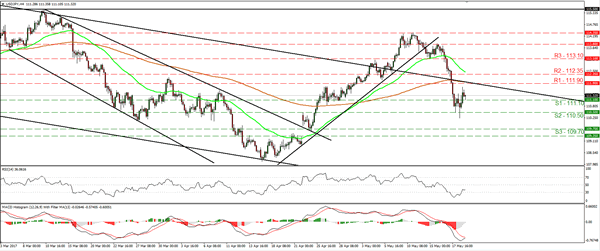
Support: 111.10 (S1), 110.50 (S2), 109.70 (S3)
Resistance: 111.90 (R1), 112.35 (R2), 113.10 (R3)
USD/CAD
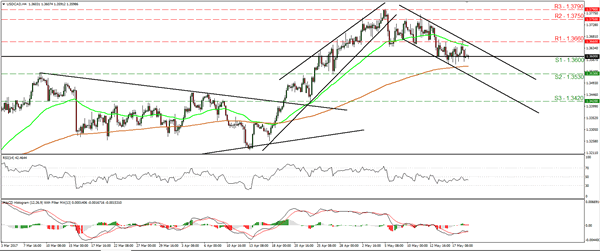
Support: 1.3600 (S1), 1.3530 (S2), 1.3420 (S3)
Resistance: 1.3660 (R1), 1.3750 (R2), 1.3790 (R3)
DAX Registers Slight Gains As German Inflation Report Beats Estimate
The DAX index has recorded slight gains in the Friday session, gaining 0.31%. Currently, the DAX is trading at 12,637.50. Financial stocks are broadly higher, led by Commerzbank, which has gained 0.59%. In economic news, German PPI improved to 0.4%, beating the estimate of 0.2%. Later, the eurozone releases current account and consumer confidence.
Stock markets were down this week, and the DAX index fell 1.5%, courtesy of the political chaos in Washington, which has made investors jittery. The Trump administration has not had much success in damage control, and there is no sign of the political firestorms letting up any time soon. It was a week of true political drama on Capitol Hill and in the White House. The Justice Department, under strong bilateral pressure, has appointed a former FBI director as a special prosecutor to investigate possible Russian involvement in the US presidential election as well as any connection between Trump and the Russians during the election campaign. President Trump fired back on Thursday, angrily denouncing this move as a “witch hunt”. The media and the Democrats have had a field day with Trump's troubles, and even Republicans are expressing unease with an administration that appears rudderless and is staggering from crisis to crisis. Trump has been relentlessly dogged by accusations of being cozy with the Russians, and his meeting with the Russian foreign minister last week was a public relations disaster, as the president came under heavy criticism for releasing classified information at the meeting. The latest string of controversies has had a chilling effect on global stock markets, and the downward trend could continue if the crisis in Washington worsens.
German and eurozone inflation indicators remain solid in 2017. German inflation figures were stronger in the first quarter, but inflation numbers continue to meet or exceed the forecasts in the second quarter. Producer Prices posted a gain of 0.4% in April, and the Wholesale Price Index gained 0.3% in April. The news was not as good from Final CPI, which dipped to 0.0%, marking a 3-month low. Still, this figure matched the estimate. In the eurozone, Final CPI for April matched the forecast with a strong gain of 1.9% in April, considerably higher than last month's gain of 1.5%. Eurozone inflation is once again closing in on the ECB's target of 2.0%, which could increase pressure on the ECB to consider tapering its ultra-loose monetary policy. However, the ECB seems content to hold course on interest rates and its quantitative easing program, and the central bank will be reluctant to make any moves with key elections coming up in France and Germany.
EUR/USD Analysis: Remains Above 1.11 Level
'Price action suggested stop-loss sell orders were tripped.' – Alexandria Arnold and Dennis Pettit, Bloomberg
Pair's outlook
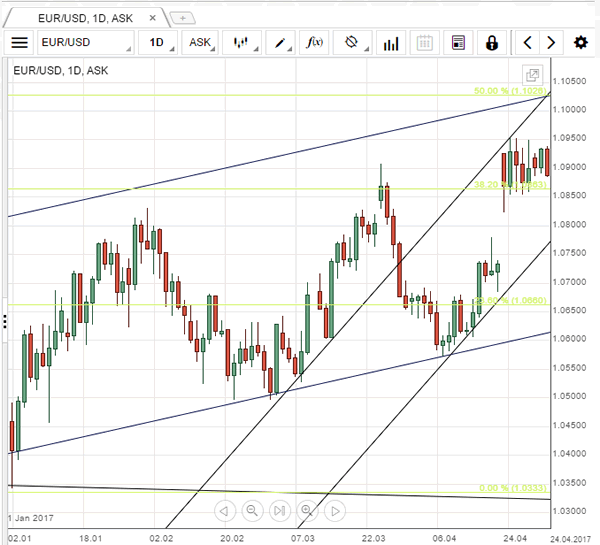
During Thursday's trading session the currency exchange rate had retreated down to the 1.1075 mark, where it found support. After the change in the direction of the pair the currency pair had broken pass the weekly R2 at 1.1115 on Friday morning. Due to that it can be expected that the rate will surge up to the resistance of the monthly R2 at 1.1187, which is strengthened by the 61.80% Fibonacci retracement level at 1.1190.
Traders' sentiment
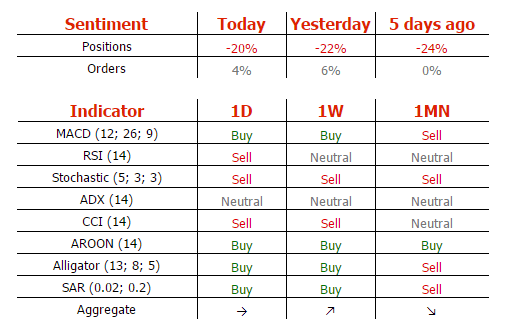
Traders have turned bearish on the pair, as 52% of open positions are short. However, 55% of pending orders are to buy the Pound.
GBP/USD Analysis: Recovers Yesterday’s Losses
'The reversal appears to be purely a function of a recovering US Dollar which has been under pressure all week as the US Trump administration bats allegation after allegation of wrongdoings and incompetence.' – Joaquin Monfort (based on PoundSterlingLive)
Pair's outlook
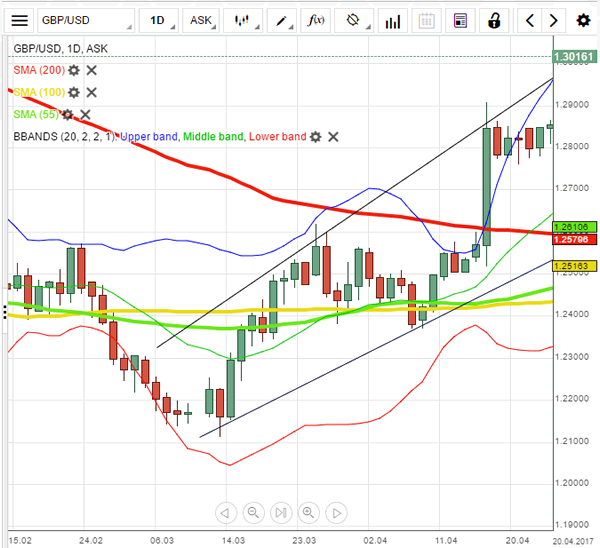
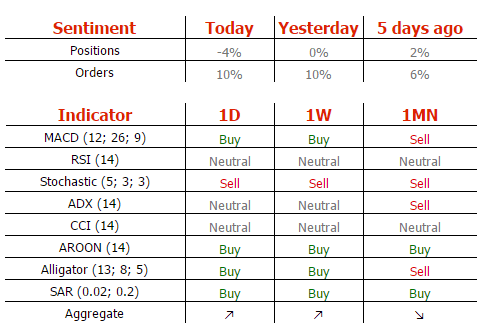
The morning session started rather calmly for GBP/USD with no strong market movers pushing the pair to either side. The Pound closed Thursday's session in the red area, thus leaving upside potential for the pair to reach the upper channel boundary today. Up to now, the rate has been appreciating gradually, suggesting that bulls may prevail to lead the currency towards the weekly R1 or even the channel boundary at 1.2970 and 1.3000, respectively. GBP/USD changing to the downside is not very likely today, taking into account bullish indicators that favour the above scenario over the Pound pushing back down to the 20-day SMA.
Traders' sentiment
Traders have turned bearish on the pair, as 52% of open positions are short. However, 55% of pending orders are to buy the Pound.
USD/JPY Analysis: Steady In This Trading Session
'While the dailies still point lower, the 4 hour charts are recovering after having become oversold and further short term gains would not surprise. On the downside, minor support will be seen at 111.00 and 110.70 ahead of the session low of 110.23.' – Jim Langlands, FX Charts (based on FX Street)
Pair's outlook
Yesterday, the US Dollar managed to regain some losses after the massive plummet on Wednesday. However, it seems that traders are once again looking in the direction of the save-haven currency. The nearest support formed by the weekly S2 at 111.41 may hinder the rate from trading lower; however, it may not be strong enough to halt it, thus leading the pair to the 111.30 territory. In case the Greenback manages to push north, a penetration of the 100-day at 111.77 might indicate that the currency has finally recovered from the latest political turmoil. This scenario is confirmed by bullish short-term technical indicators.
Traders' sentiment
Market sentiment remains bearish, as 56% of open positions are short. Meanwhile, 51% of pending orders are to buy the US Dollar.
Gold Analysis: Finds Support Below 1,250
'The gold rally was overdone and there was a correction on Thursday.' – Brian Lan, GoldSilver Central (based on Reuters)
Pair's outlook
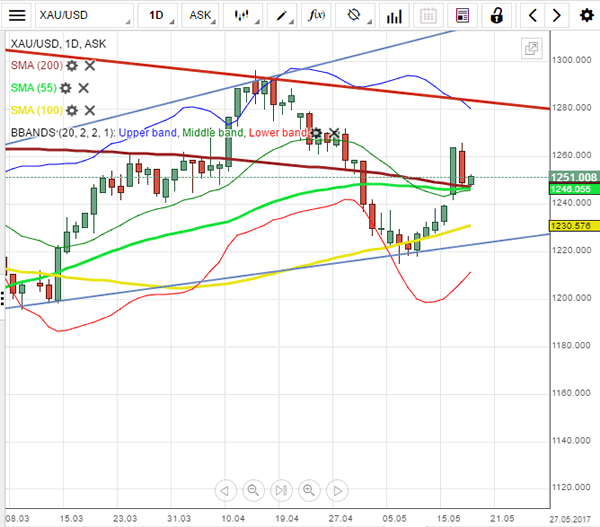
On Friday morning, the yellow metal's price was regaining some of the losses, which were suffered during Thursday's trading session. During that day the bullion retreated down to the levels below the 1,250 mark, where the 20, 55 and 200-day SMAs are located at. The combined support of these levels of significance managed to stop the fall of the commodiy price. Afterwards a rebound began, which has passed the resistance of the 50.00% Fibonacci retracement level at 1,249.16 level. Due to these factors combined it can be assumed that the bullion will attempt to reach the weekly R3 at 1,261.72 once more.
Traders' sentiment
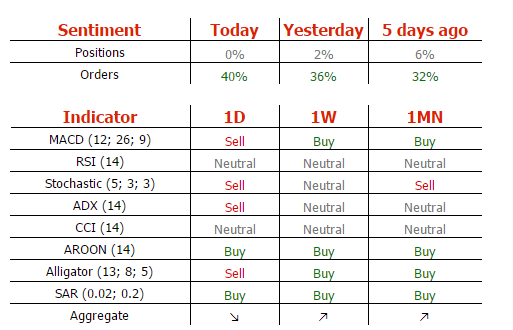
Traders are neutral in regard to the metal. However, 70% of pending commands are to buy the bullion.
BRL Tumbles Amid Political Uncertainty
Brazilian assets fell sharply yesterday at the market opening in São Paulo as the political uncertainty rose by another notch. The Brazilian real fell more than 7% against the greenback with USD/BRL rising at around 3.3760 compared to Wednesday's close of 3.1349 after Brazilian newspaper reports about President Michel Temer.
On the equity side, the situation is not bright either as sell-off in Brazilian equities triggered a circuit-breaker that halted trading after futures on the Bovespa crashed 10% at the Thursday open. In one day, the Brazilian stock market erased almost entirely the gains accumulated since the New Year as the Bovespa closed at 61,597 yesterday.
Investors were caught by surprise as the political situation seemed to settling down as the business-friendly Brazilian President successfully managed to ease foreign investors' concerns. Traders' panicked reaction sent option's implied volatility on USD/BRL through the roof with the 1m measure spiking to 24% from 13.5% a day earlier. The 1m 25 delta risk reversal measure, which is the difference between the price of a call and a put, spiked to 5.74%. Despite the fact that Michel tried to reassure markets, financial indicators continued to move in the other direction with treasury yields and CDS exploding.
Investors reacted aggressively to the news therefore we may see a temporary stabilisation of Brazilian assets morning, especially since the global risk-off sentiment is easing with global equities recovering this morning. However, investors are more than accustomed with the Brazilian political landscape and they know that it may take months before an equilibrium may be reached again. Therefore we would remain cautious regarding the BRL's outlook, even though there will be some opportunities in the short-term.
Greece: Tsipras negotiates on new austerity policies
It has been a while since Greece was at the top of the market news. We consider this is as a key issue for the European Union so we are still monitoring the country. It is now back into recession (printing two consecutive growth negative quarters) despite the massive austerity policies over the last few years.
Pension cuts or the increase in taxes do not seem to be sufficient and the cost of servicing the debt is way too massive so we do not see any positive issue on that. Greece cannot devalue its currency and so it is then forced to devalue internally, for instance its public aid (pensions in particular).
Since February 2015, Greece has repaid €35.4 billion and by the end of 2018 Greece must repay €28 billion (including €2.7 billion of interest). To put that into perspective, the 2016 nominal GDP was €176 billion. The economy must then expand by at least more than 1.5% next year. And next year repayments are less than half of what Greece will need to pay in 2019.
We don't see how Greece will be able to reimburse this debt as it is clear that the country won't be able to print a growth above the cost of servicing its debt. In the short-term, everything looks decent on the single currency side but what will happen when Portugal or Spain have issues as deep as Greece. Uncertainties are far from over on the euro side.