

Sample Category Title
Australian Unemployment Decline Surprises Market
Key Points:
- Australian unemployment rate declines to 5.7%.
- Part time employment numbers rising.
- Watch for the RBA to hold rates steady at the next meeting.
The latest release of Australian Unemployment data has largely caught economists, and by extension the market, sharply by surprise. In fact, rather than coming in at the forecasted 5.9% the unemployment rate actually declined to 5.7% in April. Subsequently, the labour market appears to be going through resurgence but just how robust the current gains are remains to be seen.
The employment change figures for April showed a gain of around 37.4k jobs, which followed on from a rise of 60k in March. Obviously, this is a welcome strengthening of the labour market and should lead to some inflationary gains over the medium term. However, the headline rate was a little less impressive with full time positions declining by nearly 11.6k in April. Subsequently, the rise in part-time employment is a relatively concerning trend in the Australian economy.
In fact, the total hours worked metric declined by around 0.3% whilst part time employment has risen by over 111,300 positions in the past year. This all highlights the underlying reasons why the unemployment rate and job gain figures can be somewhat misleading. It also goes some of the way to explaining why there has been little in the way of systemic inflation over the past year, despite some strong gains in the employment numbers.
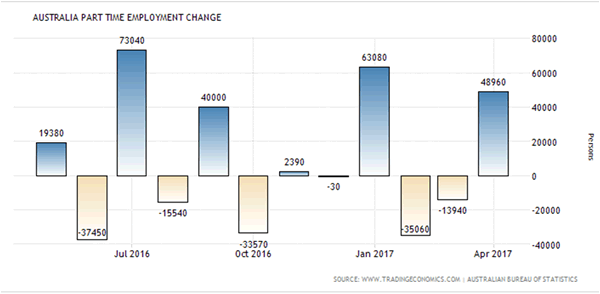
However, despite the employment figures being somewhat unreliable as an macroeconomic indicator, the results are likely to be noticed by the Reserve Bank of Australia (RBA). In fact, there is a view that the recent gains may actually see the central bank delaying a potential cut to interest rates given the risk of inflationary pressures arriving down the line.
Subsequently, the next RBA meeting is likely to see the central bank holding rates at 1.50% for the tenth consecutive meeting. Lending further support to this view is the increasing domestic debt levels, largely to do with the housing bubble, that the central bank are very clearly concerned with. Subsequently, cutting rates further, and by extension, providing a looser credit environment is likely to not be particularly high on the RBA’s agenda.
Ultimately, although the falling unemployment rate is likely to be relatively welcome news to the Australian public. It hides deeper issues around the appropriateness of part time employment and what impact this will have on inflation in the medium term. Subsequently, don’t expect any action from the RBA at the next meeting as the central bank will, again, sit on their hands.
Market Morning Briefing: The US Yields Have Risen Slightly
STOCKS
Overall global stocks are in a temporary downward correction phase and could test lower levels in the near term before resuming the upward rally later on.
Dow (20606.93, -1.78%) has risen from levels just below 20600. Overall broad trade within 21170-20410 may continue for the coming sessions, keeping the index in a sideways consolidation in the near term.
Dax (12590.06, -0.33%) is in a short term correction phase and could come off towards 12400-12300 in the near term before bouncing back later. That could create some more room on the upside for the long term.
Shanghai (3090.26) is almost stable and could bounce back from levels near 3070-3050. We may expect a trade within 3050-3170 in the near term.
Nikkei (19523.27, -0.16%) is trading lower as expected and could fall further towards 19296-19200 in the near term before bouncing back towards 19600. But looking at the rise in Dollar Yen, the fall in Nikkei could be limited.
Nifty (9429.45, -1.01%) came off from levels near 9530 and could see a small dip today also towards 9300 before bouncing back from there again. There is scope of falling towards 9300-9265 in the coming sessions before resuming the upward rally.
COMMODITIES
We were doubtful about the sustainability of gold beyond 1260 levels and the same was correct. Gold (1249) could not hold its ground and fell towards its crucial support of 1249, which could be a level where the price action has to be checked to assess the chances of further bounce to 1260-80 regions. A failure to hold 1249 could keep the price range-bound in the 1220-1250 regions.
Similar kind of trading pattern has been seen in silver (16.63) also. The recent trading range could be 15.80-16.90 and we will remain bearish while it is trading below 17.50 levels.
Copper (2.53) has found support at 2.46 levels and trading within the narrow range of 2.45-2.55 levels. Only above 2.55, higher resistances of 2.65-72 can come into consideration. In the medium term 2.44 are going to be a strong support now but a close below that could open up 2.40-35 levels as well.
Brent(52.89) and WTI (49.71) are holding their respective supports of 52.70 and 49.22 which imply strength in in extreme short term time frame. We are not yet fully convinced with this upward rally due to overbought condition thus the bulls will be assured of strength of Brent and WTI only when a firm and sustainable closing above 53.50 and 51.20 are made by both Brent and WTI respectively.
FOREX
Along with the uncertainty over the US politics, the latest Brazilian corruption scandal with the possibility of an impeachment of the President has spooked the markets but better than expected jobless claims and regional manufacturing data in the US have helped Dollar to take a breather.
Dollar Index (97.83) has taken a pause after the sharp fall in the last few sessions. Immediate resistance comes near 98.15-25 and then 98.60 with the trend remaining firmly down in all the time frames. Hence a sudden decline may emerge despite the pause.
Euro (1.1107) is taking a similar pause but the high of 1.1174 may be crossed next week after this brief consolidation ends. Immediate support comes at 1.1070-50. The higher target of 1.1200-1.1300 remains unchanged.
Dollar Yen (111.16) has made a minor bottom at 110.21, just in the middle of our support zone of 110.50-00 as expected and now a consolidation can be expected in 110-112 for 1-3 sessions as discussed yesterday.
Pound (1.2954) has failed to capitalize so far on the breakout above the resistance of 1.3000 as it returned in the range of 1.2850-1.3000 but as long as the rising support of 1.2870 holds, the trend remains up with the possibility of 1.3200 still open.
Aussie (0.7423) has been rejected from the higher levels as expected as it tried to test the major resistance of 0.7500. Now the high of 0.7467 registered yesterday becomes the immediate resistance but it will take some heavy buying before a breakout can be expected. Repeat - only a successful break above 0.7470-0.7500 may negate the possibility of seeing the downside targets of 0.7300-0.7290 and bring bullish options on the table.
Contrary to expectations of the bounce being limited to 64.45-55, leading to a sideways consolidation in 64.00-70, Dollar Rupee (64.84) has surged above the resistance of 64.70. It may rise further to 65.00-10 very soon. The price action near 65.10-20 may decide the next course of action. Immediate support comes at 64.70.
INTEREST RATES
The US yields have risen slightly. There could be some near term upmove within an overall long term bearish outlook.
The US-Japan 10Yr (2.19%) is bouncing from support levels and while it moves up, Dollar-Yen could move up too, impacting a higher move on Dollar-Index too. The yield spread could rise towards 2.25-2.30% in the near term.
The UK-US 10Yr (-1.18%) came off from previous levels and is finding difficulty in sustaining at higher levels just now. In case there is an upmove left just now, it would be slow taking more time than expected.
The German-US 10Yr (-1.88%) came off slightly and could test -1.90% before again trying to move up.
Commodities: U.S. Data Puts Risk-Off, Back In Its Box.
Strong U.S. data takes the edge of this week's political turmoil, as equities and oil rally and gold unwind some of its safe haven buying.
Oil managed to dodge the chaos in the FX and equity markets overnight to post solid gains and start the Asian session on a positive note. Brent and WTI no doubt took some heart from the U.S. equities which seems to have dampened the risk off flames, that were burning much brighter 24 hours ago, as we head into the weekend.
We have the OPEC meeting next Thursday and an extension to the production cut is probably completely priced in. It really comes down to whether it is extended by six or nine months. The former implying compromise and some dissension internally within the OPEC and Non-OPEC grouping and possibly sending out a bearish message on oil.
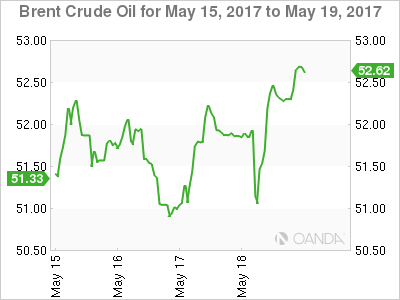
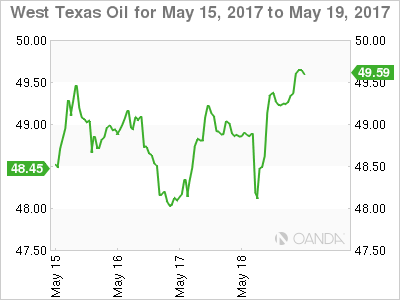
Turning to the here and now, both crude contracts have traded on a very positive note in Asia with Brent and WTI spot contracts up 50 cents at 52.70 and 49.70 respectively.
Brent has traded above its daily resistance at 52.60 and is eyeing a run at the 100-day moving average at 53.40. Intra-day support sits at 52.20.
WTI has finally closed above its 200-day moving average, this morning at 49.15 and initial support. Resistance is just above market levels in the 49.85/50.00 region with a break targeting its 100-day moving average at 50.85.
Both contracts will, however, continue to be at the mercy of headline driven moves, as have most markets been this week.
Gold is delicately poised this morning, having given up much of its previous day's gains following the U.S. stock markets rally overnight. Having closed at its lows at 1246.50 however, it has enjoyed a sprightly start in Asia, trading four dollars higher to 1250.20. With the weekend ahead and the potential event risk that this may bring, it appears traders are happy to buy dips in today's session as a safe haven hedge.
From a technical perspective, and despite the poor price action overnight, gold has held just above its 200-day moving average at 1246.00 marking its 2nd successive close above. A break would target a move to the 1240 level with key support today at 1230, the 100-day moving average.
Gold has initial resistance at 1255.00, followed by the previous day's 1265.00 high. A break targeting a move above the 1270.00 regions.
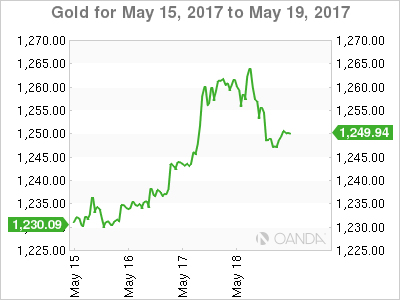
Gold will continue to be at the mercy of the nuances of politically driven headlines throughout the day, suggesting that traders should remain nimble throughout the session. The downside, however, should be somewhat limited as traders hedge political risk into the weekend.
SP500 Gap Filled
Our S&P 500 bonus chart from yesterday's blog featured a daily gap that price was stalking before the futures open.
S&P 500 Daily:
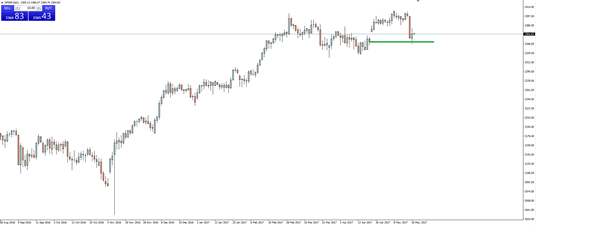
I've featured only a daily chart above, but if you're an indices trader on MT4 then you can open up your own charts and check the intraday price action yourself.
After a brief rally throughout Asia, price then dumped down into the gap where it found immediate support and buyers along with it.
The Beat Goes On
The Beat Goes on
Most asset classes have recouped their Trump inspired shake out, but this could be little more than markets coming up for air, short covering extreme positions along with dealers digging in for the long haul as, by historical accounts, this Special Counsel' investigation is likely to be an agonisingly long process of discovery. Predictably, this notion has tempered the markets animated response to the Trump inspired panic seen Wednesday. However given the heightened level of uncertainty, I suspect traders will remain in a kind of Investor Purgatory where risk aversion dominates and fear mounts that the investigation could open up a whole new can of worms which will do little more than compound the markets current panic syndrome.
This politically charged risk averse market took a further hit when Brazil spiralled into turmoil after bribery allegations involving current President Michel Temer surfaced. While I view this as a Brazil-centric affair, there has been a higher level of chatter and debate about the MXN peso role in this incident and to what extent investors could or should use it to hedge LATAM exposure. During the initial panic, USDMXN traded to 19.20 when the BRL panic was raging but has since recovered. Jury is out on this one
Overall USDJPY and EURUSD continue to dominate the highlight reels where volumes are running well above average on both pairs
US Dollar
Dealers mustered up the courage to rally the dollar when the street started sharing a dated CSPAN videos( May 3) of a Comey testimony. When under oath he suggests there was no inappropriate coverup made by the president. But the markets were quick to accept the video was dated and that the Attorney General has already viewed it before nominating the special counsel. Nonetheless, it's another ball in the air for traders to juggle deciphering an outcome that quite frankly is little more than a guessing game.
The US remains completely engulfed in the Trump Comey storyline, and the USD will continue to be unalluring until further clarity is forthcoming on the special investigation
Japanese Yen
The market is stabilising on USDJPY which would appear contradictory for those positioned for the world's haven currency to further strengthen on the Trump noise. The small reprieve was likely due to the murmur around Japanese equities that bounced on a positive domestic GDP print and some profit taking. While there will continue to be some scope of influence from both US and Japan economic data, it's more likely dollar rallies will be capped until the US political storm clouds dissipate and some semblance of risk re- appears
Euro
Asset rotation into Europe should continue to provide support while US political decay plays into the Euro as a haven poxy We should expect lots of choppiness as the risk complex will likely bounce from stable to unsettle on any given day. But the key for and additional push higher in the Euro will require a hawkish shift in ECB forward guidance.The latest ECB minutes failed to accomplish that task
Australian dollar
With US political factors weighing on risk sentiment, it's unlikely dealer will muster up the courage to make any serious attempt higher in this risk off environment. The market appears to be viewing the Aussie dollar as a flat out commodity play, but dealers will continue to monitor the Fed June interest rate hike probabilities as the current market turmoil will not go unnoticed by Dr Yellen and company
Asia FX
Far too much uncertainty in the short term market which will see dealers either keeping inventory light or head the sidelines awaiting the next catalyst. Risk sentiment is simply not there to support EM, but if the US political angst morphs into a US-centric focus, then the opportunistic flow will gradually return.Currently, the markets remain in risk-averse mode but are acting quite orderly.
Gold Dips As US Posts Strong Inflation, Manufacturing Reports
Gold has reversed directions in the Thursday session and posted losses. In the North American session, spot gold is trading at $1251.18 per ounce. On the release front, US numbers were solid, as unemployment claims dropped to 232 thousand, lower than the forecast of 240 thousand. As well, the Philly Fed Manufacturing Index soared to 38.8, crushing the forecast of 19.9 points. In Washington, Treasury Secretary Steven Mnuchin testifies before the Senate Banking Committee on the rollback of the Dodd-Frank finance regulations.
Gold has gained 1.5% this week, as the safe-haven commodity has benefited from the political chaos which has gripped Washington. The beleaguered Trump administration appears to be rudderless as it staggers from crisis to crisis. The latest development is that the Justice Department has agreed to appoint a former FBI director as special counsel to investigate possible Russian involvement in the US presidential election as well as any connection between Trump and the Russians during the election campaign. On Tuesday, reports surfaced that Trump had asked former FBI director James Comey to close an investigation into ties between Russia and Trump's former security adviser, Michael Flynn, leading some lawmakers to question whether Trump had committed obstruction of justice. As if this wasn't enough for Trump's aides to deal with, the president is under fire for passing classified intelligence to the Russian foreign minister. Trump initially denied the claim, but has since admitted that he did share intelligence with the Russians, arguing that he had acted within his rights. With the Trump administration frantically trying to douse political fires, investors are concerned that Trump will have more difficulty passing into law his plans for increased stimulus and tax reform. If the crisis mode in Washington continues, we could see gold make further gains against the dollar.
The Post-Truth Trade
Maybe the dollar rally late Thursday had nothing to do with politics, maybe it was an obscure fundamental headline, or flows or a fat finger in cable that morphed into a broad USD bid. 5 straight daily declines in the currency of the world's strongest economy may have a been excessive. Any of that would be a comforting explanation because the alternative is that an Infowars/Zerohedge fake news story was responsible for the move, and that would mean that markets have now been enveloped by the post-truth world.
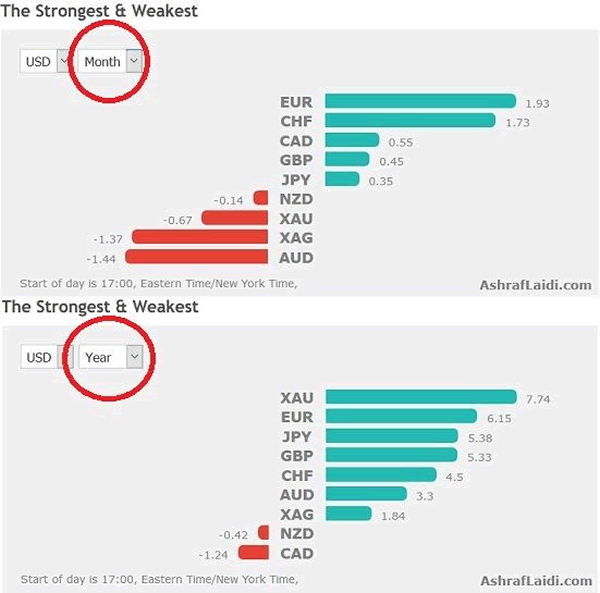
The US dollar was the top performer while the New Zealand dollar lagged. The Asia-Pacific calendar is light. Above is the chart of strongest and weakest currencies vs the USD since the start of the year and the month.
There has been a push-and-pull between politics and fundamentals since the election but fundamentals were winning out. On Wednesday, however, politics took over and it continued Thursday. It started with a gotcha story from Reuters saying Trump's campaign team had at least 16 more undisclosed contacts with Kremlin associates. That set off a round of risk aversion but it slowly faded because the story indicated that the calls were about the kind of things that politicians should be discussing– China, general relations and North Korea.
Skip ahead a few hours and the Infowars/ZeroHedge story begins to circulate. The headlines stated Comey had indicated no one had tried to pressure him to end an investigation on May 3. At the same time, cable flash crashed 100 pips, the dollar started to catch a broad bid and stocks rallied.
Delving deeper the actual clip, Comey was asked if anyone at the Department of Justice had asked the FBI to end an investigation. He wasn't talking about the White House.
It's unfair to lump Reuters with the other sources but the effects were the same. That says something profound about markets.
Untruth is nothing new to markets. There is always a rumour about a corporate takeover or bankruptcy but when you chase a rumour and it's wrong, you're punished. With political rumours it doesn't matter if they turn out to be true or false.
We're confident that fundamentals will ultimately win out – they always do. In the meantime, we're all stuck reading fringe political websites trying to figure out what the average voter will believe is true and false.
Pound Punches Above 1.30 as UK Retail Sales Sparkles
GBP/USD has recorded slight gains in the Thursday session. In North American trade, GBP/USD is trading at the 1.30 line, for the first time since September 2016. On the release front, UK Retail Sales jumped 2.3%, well above the forecast of 1.2%. Over in the US, jobless claims and manufacturing numbers were strong, as unemployment claims dropped to 232 thousand, lower than the forecast of 240 thousand. As well, the Philly Fed Manufacturing Index soared to 38.8, crushing the forecast of 19.9 points. In Washington, Treasury Secretary Steven Mnuchin testifies before the Senate Banking Committee on the rollback of the Dodd-Frank finance regulations.
British consumer spending has been soft in recent weeks, so the April retail sales report was welcome news. The indicator posted a sharp gain of 2.3%, its strongest monthly gain since January 2016. The British economy has performed fairly well since the Brexit vote last June, but gray clouds remain on the not-too-distant horizon. Analysts expect the economy to lose steam once the thorny negotiations over Britain's exit from the European Union begin. The Bank of England has been saying that Britons will have to get used to a lower standard of living, and the warning has become reality with the release of the latest wage growth report on Wednesday. Wages rose 21% year-on-year in the first quarter, resulting in real wages dropping for the first time since 2014, after adjusting for inflation. CPI, the primary gauge of consumer inflation, continued to move upwards, posting a sharp gain of 2.7% in April, matching the BoE forecast for inflation in the first quarter. This reading marked the strongest gain in CPI since September 2013. The BoE is expecting inflation to hit 3 percent, raising speculation that the central bank may raise interest rates to keep inflation under control. The weak pound, which is still down 13% since the Brexit vote, has contributed to higher inflation, which has hurt wage growth and caused consumers to scale back on spending, a key component of economic growth.
The political chaos which has gripped Washington has led to nervous investors dumping US dollars, in favor of its rivals, such as the British pound. The beleaguered Trump administration appears to be rudderless as it staggers from crisis to crisis. The latest development is that the Justice Department has agreed to appoint a former FBI director as independent counsel to investigate possible Russian involvement in the US presidential election as well as any connection between Trump and the Russians during the election campaign. On Tuesday, reports surfaced that Trump had asked former FBI director James Comey to close an investigation into ties between Russia and Trump's former security adviser, Michael Flynn, leading some lawmakers to question whether Trump had committed obstruction of justice. As if this wasn't enough for Trump's aides to deal with, the president is under fire for passing classified intelligence to the Russian foreign minister. Trump initially denied the claim, but has since admitted that he did share intelligence with the Russians, arguing that he had acted within his rights. With the Trump administration frantically trying to douse political fires, investors are concerned that Trump will have more difficulty passing into law his plans for increased stimulus and tax reform. If the crisis mode in Washington continues, we could see the dollar lose more ground.
Oil Market and US Turmoil Biggest Driver as Loonie Awaits Sales and Inflation Data
The Canadian dollar has had a volatile week. On Wednesday afternoon the loonie broke through the USD/CAD 1.36 price level but a sudden drop during the Asian session on Thursday put the CAD under pressure. The Canadian currency depreciated and the pair touched 1.3670, the daily high, before it appreciated to current levels (1.3605).
The USD dollar is mixed against major pairs. The pound, loonie and Aussie are gaining, while the Swiss franc, kiwi, euro and yen are in negative territory. With little fundamental data to go on the greenback has been traded on political risk and the potential damage to the American economy. Global stock markets have lost momentum as the developing story on the Trump administration continues to unfold.
The political turmoil in Washington is making it less likely that the pro-growth policies promised after the election will be enacted. Tax reform and infrastructure spending were top of the economic agenda, but were pushed down in favor of immigration and healthcare reform which proved to be too divisive. The Trump administration is running out of political capital and scandals will sap it even more.
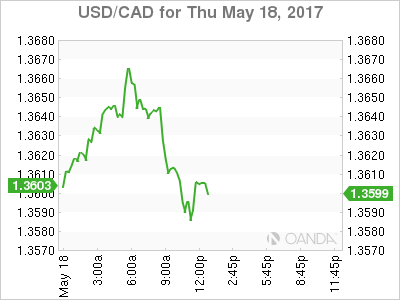
The USD/CAD lost 0.074 in the last 24 hours. The pair is trading at 1.3605 after the oil rally lost momentum but US political drama has the USD on the back foot. The U.S. Federal Reserve was probably counting on strong reforms in the first half of the year with a Republican president in the White House and a Republican majority in the House and Senate. Fed officials are still optimistic about multiple rates hikes as per their comments, but the markets have begun to price out a move but the central bank in June. Last week the probability calculated by the CME in their FedWatch tool was 83.1 percent and today it stands just below 70 percent.
Retail sales and inflation data will be released on Friday, May 19 at 8:30 am. The latest economic data out to Canada has disappointed and the warning signs of an overheated real estate market have cause downgrades to the otherwise solid Canadian banks. Manufacturing sales were close to the forecast with a 1 percent growth and are preparing the market for an improvement on the retail numbers. Retail sales are forecasted to have gained 0.4 percent and the core data 0.2 percent. Inflation numbers are also expected higher at 0.5 percent. The biggest Canadian economy question that remains for the most part unanswered is its future trade relationship with the United States. Which more than three quarters of products going to the US there is a lot riding on the NAFTA negotiations. The Trump administration has been on the offensive since taking office and America first will be something that Canada will have to negotiate down from.
Prime Minister Justin Trudeau was in Seattle to attend a Microsoft CEO summit. Finance Minister Bill Morneau and Bank of Canada (BoC) Governor Stephen Poloz met with their counterparts during the G7 meeting in Italy last week and the topic is sure to have been brought up. Canada has also added more communication with Mexico in order to create a united front when negotiating with the US in last August.
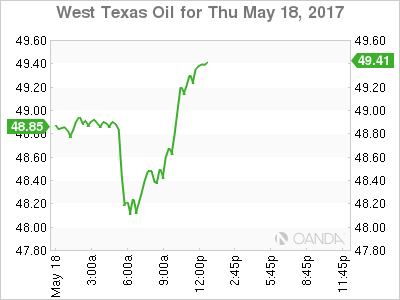
Oil is down 0.68 in the last 24 hours. The price of West Texas Intermediate is trading at $48.66 after investors remain unconvinced the efforts of the Organization of the Petroleum Exporting Countries (OPEC) to extend its production cut agreement will be enough to rebalance the energy market. US production in particular has soared as current price levels are high enough for shale operations.
The price of crude is suffering as the political drama in Washington has investors are uncertain on the outcome and the far reaching implications for the growth of the US economy.
Market events to watch this week:
Thursday, May 18
- 4:30 am GBP Retail Sales m/m
- 8:30 am USD Unemployment Claims
Friday, May 19
- 8:30 am CAD CPI m/m
- 8:30 am CAD Core Retail Sales m/m
Yen Climbs as Japanese GDP Beats Estimate
USD/JPY has steadied in the Thursday session, after the yen posted strong gains in Wednesday trade. In the North American session, the pair is trading at the 111 level. On the release front, Japanese Preliminary GDP in the first quarter improved to 0.5%, edging above the forecast of 0.4%. US numbers were strong, as unemployment claims dropped to 232 thousand, lower than the forecast of 240 thousand. As well, the Philly Fed Manufacturing Index soared to 38.8, crushing the forecast of 19.9 points. In Washington, Treasury Secretary Steven Mnuchin will testify before the Senate Banking Committee on the rollback of the Dodd-Frank finance regulations.
It's been an excellent week for the Japanese yen, which has recorded strong gains of 2.0 percent. The safe-haven yen has become a favorite for nervous investors, as the political turmoil which has gripped Washington has soured investors on the stock markets and the greenback. The yen's gains mirror continuing trouble for the Trump administration, which is lurching from crisis to crisis. The latest development is that the Justice Department has agreed to appoint a former FBI director as independent counsel to investigate possible Russian involvement in the US presidential election as well as any connection between Trump and the Russians during the election campaign. On Tuesday, media reports surfaced that Trump asked former FBI director James Comey to end an investigation into ties between Russia and Trump's former security adviser, Michael Flynn. Adding to Trump's troubles, the president is under fire for passing classified intelligence to the Russian foreign minister. Trump initially denied the claim, but has since admitted that he did share intelligence with the Russians, arguing that he had acted within his rights. With the Trump administration frantically trying to douse political fires, investors are growing increasingly nervous that Trump's plans for a stimulus package and tax reform will stall, and these jitters have sent stock markets downwards.
What's next for the Bank of Japan? More of the same, according to BoJ Governor Haruhiko Kuroda. On Wednesday, Kuroda said that he was confident that the central bank could smoothly exit from its huge monetary stimulus at a time of its choosing, but noted that wages and inflation remained sluggish, despite a stronger economy. Kuroda added that the central bank had no plans to revise its monetary stance, and said that the Federal Reserve's tightening stance would not affect the monetary stance of the BoJ. Stronger global demand has boosted Japan's manufacturing and export sectors, but inflation is stuck around zero percent and consumer spending remains soft. We'll get a look at Tokyo Core CPI and other inflation indicators next week. If the economy continues to improve and inflation numbers exceed expectations, the BoJ may have to revisit its ultra-loose monetary stance.