

Sample Category Title
Breaking Point
We learned this year that financial markets can tolerate a great deal of political dysfunction; Tuesday showed this also has a limit. The yen soared while the Canadian dollar lagged as risk aversion hit hard. Japanese GDP and Australian jobs are due up next. The Premium short in the DOW30 hit its final target for 330-pt gain.
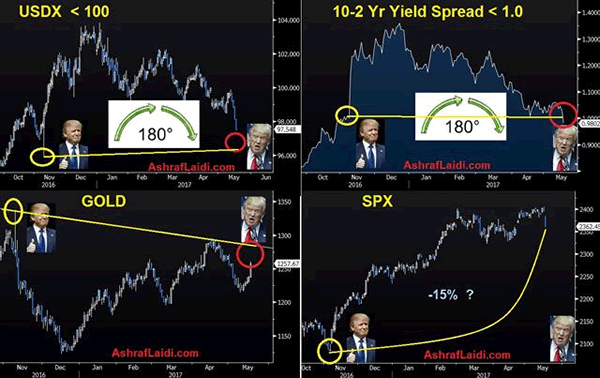
The trigger for the meltdown in sentiment Tuesday was a revelation that Trump asked FBI Director Comey to drop his investigation of Mike Flynn. Legal and constitutional circles have been debating on whether it could be obstruction of justice but markets didn't wait for the answer.
USD/JPY fell more than 200 pips in the worst decline since July 2016, US 10-year yields dropped 9 bps and the S&P 500 fell nearly 40 points. The selling was relentless.
The next move is to take a step back and search for perspective. It seems highly unlikely this is enough to impeach a President. This isn't Watergate. The Republican agenda also probably isn't in peril. If anything, Congressional Republicans will want to get to work and accomplish something in order to help change the conversation.
But maybe the message from markets isn't about impeachment or the Republican agenda. Maybe it's about governance. The breaking point might be that the market has determined that the new administration is so gaffe prone and the President so impulsive that he will never be able to lead effectively. That's the kind of instability that grates on business and sentiment.
It doesn't mean this is the start of a bear market or a recession but it could dial back expectations. The odds of a June 14 Fed hike are down to 66% from 88%, according to the CME's Fedwatch tool. That's not just about politics, it's also a reflection of sluggish economic data.
What's also instructive is that troubles in the present always seem bigger than they are, especially with geopolitics. The market freaked out about Ebola, Russia's incursion into Ukraine, dozens of things that will never appear in history books. There's a good chance that's what will happen next.
Ultimately, the economy is what will guide markets so we look next to key data from Japan and Australia. Up first at 2350 GMT, Japanese Q1 preliminary GDP data is due. The market is expecting 0.5% y/y growth, or 1.7% annualized.
For Australia, the jobs report is at 0130 GMT and forecast to show 5.0K new jobs and 5.9% unemployment. Given the negative rumblings from China, we will be watching Australian data closely in the coming months.
USD/CAD Canadian Dollar Lower After Trump Turmoil Triggers Risk Aversion
The Canadian dollar is trading lower even as the price of oil is close to 1 percent higher on Wednesday.Safe havens such as gold, the Japanese yen and the Swiss franc trade higher against the US dollar after the crisis engulfing the Trump administration. The loonie could not capitalize on USD weakness as the newly appointed US Trade representative set the groundwork for the NAFTA renegotiation. Robert Lighthizer, briefed a Senate Finance Committee on the trade agreement overhaul. The renegotiation talks are expected in late August with representatives of Canada and Mexico. The Trump administration needs to present a letter before congress 90 days before starting trade talks. Senator Ron Wyden mentioned that the US is seeking a currency manipulation clause to be used in future trade agreements the United States enters into.
A Reuters survey that took in the opinions of economists was caught off guard as much as the rest of the market when back in February there were no reasons to be concerned about a NAFTA renegotiation. The same panel of economists is now warning that the trade talks could have material impact on Canada as it exports three quarters of its exports south of the border.
Canadian manufacturing sales rose 1 percent in March but the February data was revised downward to a 0.6 contraction. Canadian retail sales will be released on Friday, May 19 at 8:30 am alongside inflation data.
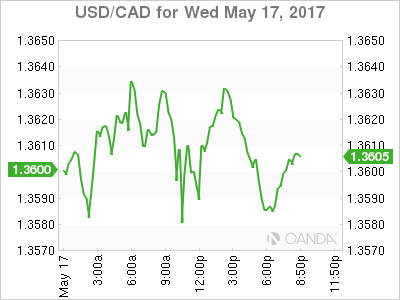
The USD/CAD gained 0.416 percent in the last 24 hours. The currency pair is trading at 1.3632 near daily highs after the turmoil surrounding the White House has triggered a wave of risk aversion that has pulled investors away from the Canadian dollar in search of safe havens.
The rise of oil prices could not offset the pressure on the Canadian dollar as the White House regardless the current drama with Trump’s disclosure of classified information in the aftermath of the dismissal of FBI Director James Comey.
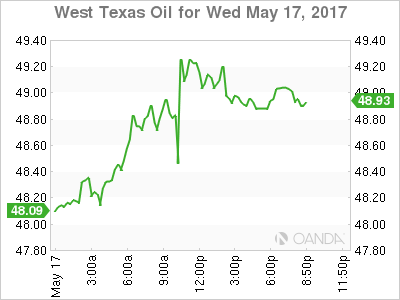
Crude is 0.952 percent higher on Wednesday. The price of West Texas Intermediate is trading at $49.08 after US crude inventories confirmed the forecast of 1.8 million barrels drawdown last week. The softness in the US dollar following the political turmoil in Washington has also helped WTI climb towards the $50 price level.
US inventories recorded their sixth straight drawdown a day after Organization of the Petroleum Exporting Countries (OPEC) members were voicing their support for the extension to their production cut agreement. Russia and Saudi Arabia issued a joint statement on Monday almost guaranteeing an extension to be announced on the scheduled meeting May 25.
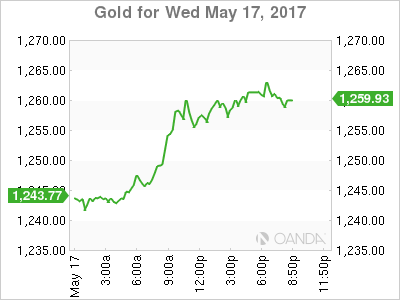
Gold has gained 1.656 percent in the last 24 hours. The price of the yellow metal is trading at $1,259.21 continuing to climb higher as the political situation in the United States has given way to a rise in risk aversion by investors. The difficulties facing the Trump administration raise serious doubts about the pro-growth policies that were promised last year being enacted this year. Tax reform and infrastructure spending were behind the USD rally earlier as Trump took office, but as immigration, trade and health battles took their toll in the President’s political capital. The US economic data has also been mixed of late adding more uncertainty into the next meeting of the U.S. Federal Reserve in June. The CME FedWatch tool has reduced the probability of a rate hit to 64.6 percent after reaching 87.7 percent a week ago.
Market events to watch this week:
Thursday, May 18
4:30 am GBP Retail Sales m/m
8:30 am USD Unemployment Claims
Friday, May 19
8:30 am CAD CPI m/m
8:30 am CAD Core Retail Sales m/m
Trump Troubles Boost Gold Prices
Gold has posted strong gains in the Wednesday session, as the metal trades at 2-week highs. Currently, spot gold is trading at $1256.32 in the North American session. On the release front, there was only one US release, as Crude Oil Inventories declined 1.8 million barrels, compared to the estimate of a decline of 2.5 million barrels. On Thursday, there are two key events – unemployment claims and the Philly Fed Manufacturing Index.
Gold has been a big winner from the ongoing political turmoil in Washington, as the Trump administration lurches from crisis to crisis. President Trump and his aides have preoccupied with damage control, as the fallout from Trump's dismissal of FBI director James Comey continues. On Tuesday, reports swirled that Trump had asked Comey to close an investigation into ties between Russia and Trump's former security adviser, Michael Flynn. The Democrats have been quick to attack, with some lawmakers claiming that Trump may have committed obstruction of justice. Another brewing controversy is Trump's passing of classified intelligence to the Russian foreign minister earlier this week. Trump initially denied the claim, but has since backtracked, admitting that he did share intel with the Russians, but that he had full authority to do so. With the Trump administration busy putting out political fires, investors are growing increasingly nervous that the president's agenda for a stimulus package and tax reform will stall, and gold, a safe-haven asset, is shining brighter as market jitters intensify.
Weak US numbers since last week have also contributed to higher gold prices, as the US economy has slowed in 2017. On Tuesday, construction data was softer than expected. Building Permits dropped to 1.23 million, short of the forecast of 1.26 million. The news wasn't any better from Housing Starts, which slipped to 1.17 million, compared to the estimate of 1.26 million. This marked the smallest number of housing starts since November 2016. Despite the weak numbers, demand for housing remains high, fueled by a labor market that is close to capacity and an unemployment of just 4.4 percent.
Will Falling Real Incomes Affect the UK Consumer?
Consumer Revival Needed After Disappointing First Quarter
As cracks start to appear in the economic data, the Bank of England downgrades its growth and inflation forecasts and the country heads to the polls to vote for the government that will lead the Brexit negotiations with the EU, it's clear that an interesting period lies ahead for the UK.
For almost a year now - since the EU referendum - we've heard a lot about the surprisingly resilience of the UK economy, while the BoE and other experts have been berated for their gloomy outlook for Brexit Britain. And while many of those will accept that the country has performed better than they anticipated, the cracks are starting to appear and the data so far this week has clearly highlighted where.
The retail sales report on Thursday should offer further insight into the consumer following a dire start to the year for spending and at a time when real incomes are now officially falling. The data released earlier in the week showed inflation hit 2.7% in April - albeit largely driven by the timing of Easter this year - while earnings rose by only 2.4%, or 2.1% excluding bonuses.
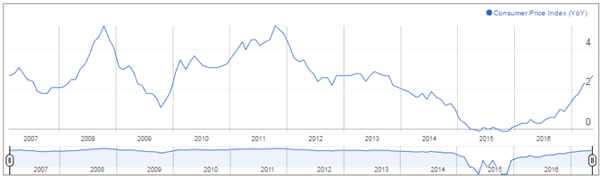
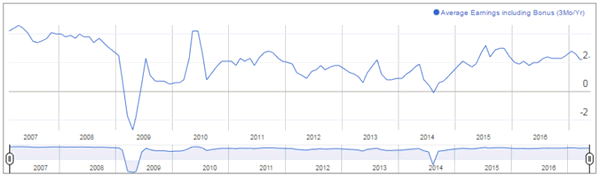
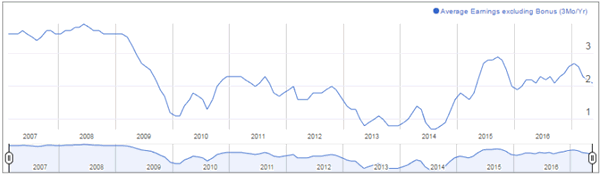
With at least the near-term outlook for real wage growth looking bleak - as the weaker pound keeps inflation elevated and the uncertainty surrounding Brexit weighs on wage growth - the coming months may be quite challenging for retailers. While the UK consumer is not particularly averse to spending on credit, which at times is what's kept the economy ticking along, there is a clear correlation between real wage growth and spending and it doesn't look good. The chart below shows real wage growth (earnings growth minus inflation) in orange and retail sales in purple, compared to a year ago.
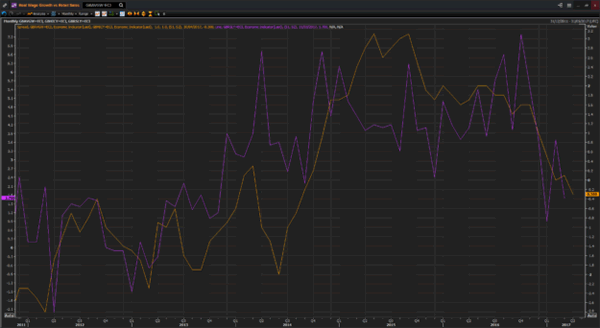
Given how valuable the consumer is to the UK economy and the trend over the last few months, it's no wonder that the BoE downgraded its growth forecasts last week. Should we see a revival in the consumer in the coming months and the first quarter prove to be a blip, then the outlook could look a little brighter. Given the latest data on inflation and wages though, it's not looking great.
A mini spending revival is expected for April, with overall and core retail sales seen rising 1% from a month earlier, and 2% and 2.5%, respectively, from the same month a year earlier. While this may give reason for some optimism, it is worth remembering again that Easter fell in April this year and March last year which will flatter the numbers in much the same way that it made them appear worse last month. We may need to see more evidence of a consumer revival if we're truly going to see the resilience that we've heard so much about.
Pound Rises on Strong UK Wage Growth Report
GBP/USD has posted gains in the Wednesday session. In North American trade, GBP/USD is trading at 1.2950. On the release front, British employment numbers were mixed. Wage growth climbed 2.4%, matching the forecast, and the unemployment rate dipped to 4.6%, below the estimate of 4.7%. The news was not as good from unemployment claims, which rose 19.4 thousand, well above the estimate of 7.5 thousand. In the US, there are no major releases on the schedule. On Thursday, the UK releases Retail Sales, which is expected to rebound with a gain of 1.2%. The US will release unemployment claims and the Philly Fed Manufacturing Index.
The Bank of England has been saying that Britons will have to get used to a lower standard of living, and the warning has become reality with the release of the latest wage growth report. Wages rose 21% year-on-year in the first quarter, resulting in real wages dropping for the first time since 2014, after adjusting for inflation. CPI, the primary gauge of consumer inflation, continued to move upwards, posting a sharp gain of 2.7% in April, matching the BoE forecast for inflation in the first quarter. This reading marked the strongest gain in CPI since September 2013. The BoE is expecting inflation to hit 3 percent, raising speculation that the central bank may raise interest rates to keep inflation under control. The weak pound has contributed to higher inflation, which has hurt wage growth and caused consumers to scale back on spending, a key component of economic growth.
The political turmoil which has gripped Washington appears to be spreading. The US media is having a field day, as the Trump administration lurches from scandal to scandal. On Tuesday, reports surfaced that President Trump asked former FBI director James Comey to end an investigation into ties between Russia and Trump's former security adviser, Michael Flynn. Another brewing controversy is Trump's passing of classified intelligence to the Russian foreign minister earlier this week. Trump initially denied the claim, but has since backtracked, admitting that he did share intel with the Russians, but that he had acted within his rights. With the Trump administration busy putting out political fires, investors are growing increasingly nervous that the president's agenda for a stimulus package and tax reform will stall.
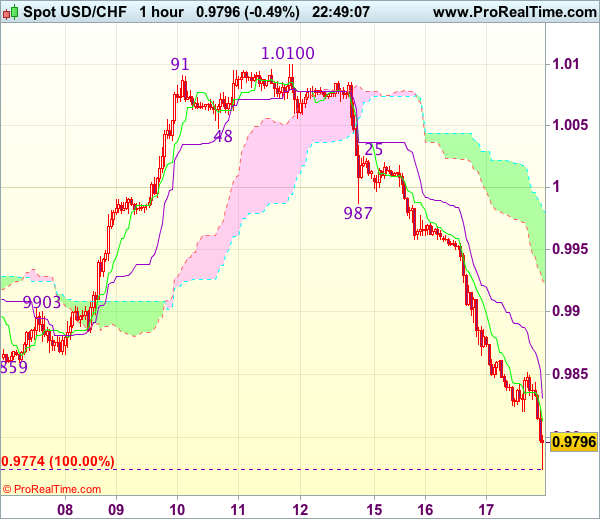
Trade Idea Wrap-up: USD/CHF – Sell at 0.9870
USD/CHF - 0.9790
Most recent candlesticks pattern : N/A
Trend : Near term down
Tenkan-Sen level : 0.9813
Kijun-Sen level : 0.9831
Ichimoku cloud top : 0.9980
Ichimoku cloud bottom : 0.9922
Original strategy :
Sell at 0.9910, Target: 0.9800, Stop: 0.9945
Position : -
Target : -
Stop : -
New strategy :
Sell at 0.9870, Target: 0.9770, Stop: 0.9905
Position : -
Target : -
Stop : -
As dollar has continued heading south and broke below indicated previous support at 0.9813, confirming our bearish view that the decline from 1.0344 top is still in progress, hence bearishness remains for this move to extend further weakness to 0.9770, then towards 0.9735-40 (76.4% retracement of 0.9550-1.0344), however, near term oversold condition should prevent sharp fall below 0.9700, risk from there is seen for a rebound to take place later.
In view of this, would not chase this fall here and would be prudent to sell dollar on recovery as 0.9870 should limit upside. Above 0.9900 would defer and risk rebound to the lower Kumo (now at 0.9922) but upside should be limited to 0.9950 and price should falter well below previous support at 0.9987, bring another decline.
Trade Idea Wrap-up: GBP/USD – Stand aside
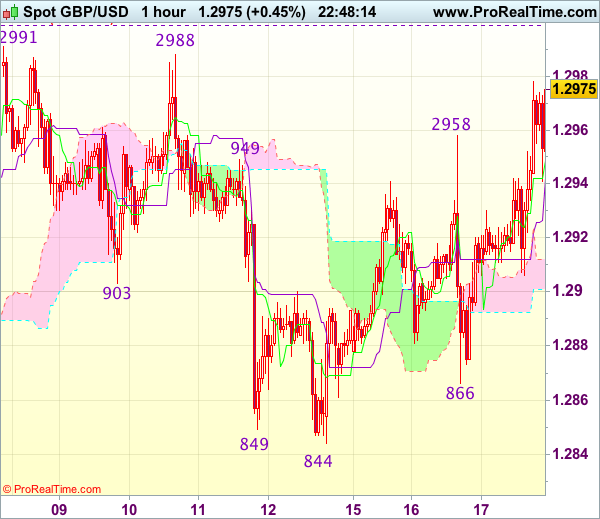
GBP/USD - 1.2971
Most recent candlesticks pattern : N/A
Trend : Near term up
Tenkan-Sen level : 1.2949
Kijun-Sen level : 1.2943
Ichimoku cloud top : 1.2912
Ichimoku cloud bottom : 1.2901
New strategy :
Stand aside
Position : -
Target : -
Stop : -
Cable’s rally after breaking indicated resistance at 1.2958 confirms the correction from 1.2991 has ended at 1.2844 earlier and retest of this level would be seen, however, above indicated level of 1.2999-00 (1.236 times projection of 1.2109-1.2616 measuring from 1.2365 and psychological resistance) is needed to retain bullishness and signal early upmove has resumed for headway to 1.3040-50, then 1.3075-80.
In view of this, would not chase this rise here and would be prudent to stand aside for now. Below 1.2940 would bring weakness to 1.2900-10 but only break of latter level would prolong consolidation and risk weakness towards support at 1.2866, however, price should stay above said support at 1.2844.
Trade Idea Wrap-up: EUR/USD – Buy at 1.1065
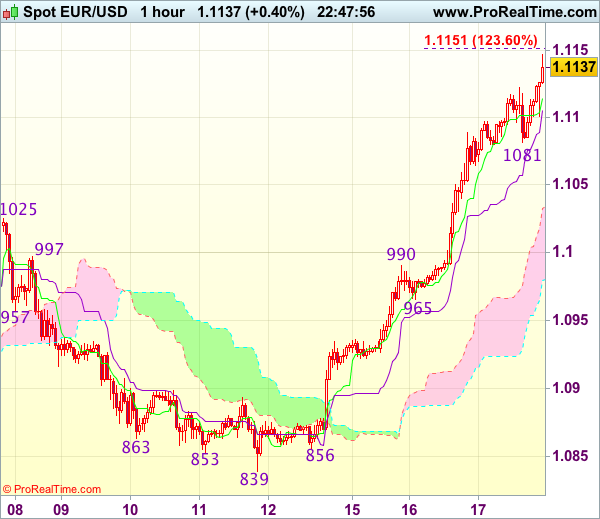
EUR/USD - 1.1147
Most recent candlesticks pattern : N/A
Trend : Near term up
Tenkan-Sen level : 1.1115
Kijun-Sen level : 1.1106
Ichimoku cloud top : 1.1034
Ichimoku cloud bottom : 1.0980
Original strategy :
Buy at 1.1050, Target: 1.1150, Stop: 1.1015
Position : -
Target : -
Stop : -
New strategy :
Buy at 1.1065, Target: 1.1185, Stop: 1.1030
Position : -
Target : -
Stop : -
As the single currency has continued moving higher after recent rally above previous resistance at 1.1025 (now support), adding credence to our view that recent upmove has resumed and bullishness remains for further gain to 1.1150-55 (1.236 times projection of 1.0839-1.0990 measuring from 1.0965), then towards 1.1175-80, however, near term overbought condition should limit upside to 1.1205-10 (1.618 times projection) and reckon 1.1250 would hold from here, bring retreat later.
In view of this, would not chase this rise here and we are looking to buy euro on pullback as 1.1065-70 should limit downside. Below previous resistance at 1.1025 (now support) would defer and suggest top is possibly formed instead, risk test of another previous resistance at 1.0990 first.
Trade Idea Wrap-up: USD/JPY – Sell at 112.50
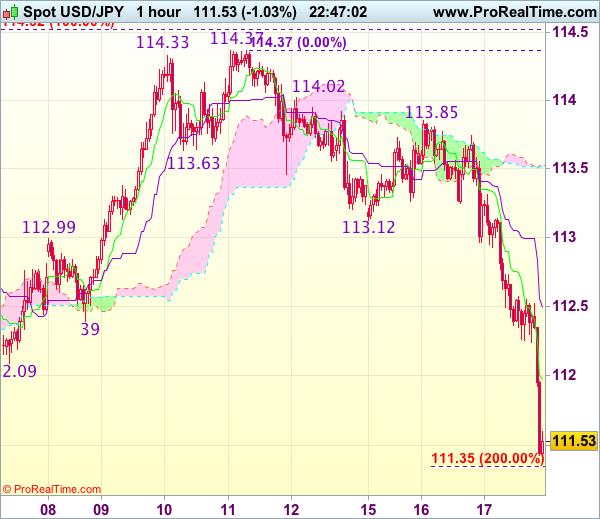
USD/JPY - 111.54
Most recent candlesticks pattern : N/A
Trend : Near term down
Tenkan-Sen level : 111.98
Kijun-Sen level : 112.49
Ichimoku cloud top : 113.52
Ichimoku cloud bottom : 113.52
New strategy :
Sell at 112.50, Target: 111.30, Stop: 112.85
Position : -
Target : -
Stop : -
As the decline from 114.37 has accelerated on dollar’s broad-based weakness, suggesting early rise from 108.13 has ended at 114.37 and downside bias is seen for the selloff from 114.37 to extend weakness to 111.20-25 (50% Fibonacci retracement of 108.13-114.37), then towards 110.87 support, however, reckon previous resistance at 110.60 would limit downside and 110.50 (61.8% Fibonacci retracement) would hold from here due to near term oversold condition.
In view of this, would not chase this fall here and would be prudent to sell dollar on recovery as 112.40-50 should limit upside and bring another decline. Above 112.80-85 would defer and risk rebound to 113.00 but previous support at 113.12 should turn into resistance and limit dollar’s upside, bring another selloff later.
US Political Risk Triggers Safe Haven Flows
European stock markets lose around 1% as US political drama created risk aversion. US stock markets currently drop by 0.5%to 0.75%. The main barometer tracking expectations for US equities market tumult (Vix) climbed by the most since before the November election, highlighting the rising market jitters over the Trump administration.
The UK unemployment rate dropped to its lowest in more than four decades last quarter (4.6%), but UK workers saw their real earnings fall for the first time in 2 1/2 years, data from the ONS showed. Employment growth was strong in March, rising by 122k 3M/3M vs 21k consensus.
The ECB should begin unwinding its ultra-loose monetary policy soon if it wants to avoid damaging side-effects, German Deputy FM Spahn said. He added that there was too much public and private debt in the world and called for an acceleration of structural reforms, saying monetary policy could not solve structural problems.
Theresa May has said she is "happy" to endorse Philip Hammond, but failed twice to say he would remain chancellor after the election. Mrs May, responding to questions about tensions between the chancellor and Number 10, declined to say that he would still be in post if she wins the election.
BoJ governors Kuroda told Japanse PM Abe that Japan's economy is steadily recovering and will continue to grow above its potential. Under these conditions, prices will rise, but inflation is still far from the BoJ's 2% target. Therefore, the BoJ will continue with its monetary easing programme, Kuroda said.
The Polish central bank kept its policy rate unchanged at a record low of 1.5% , but an economic surge last quarter, compounded by faster-than-forecast core inflation and months of gains in the zloty, is putting the spotlight on the Monetary Policy Council's commitment to its longest-ever pause in interest rates.
Iceland's central bank cut its 7-day term deposit rate by 0.25% to 4.75% amid krona appreciation. Sedlabanki said the outlook is for stronger GDP growth this year than previously forecast. The deviation stems mainly from stronger-than-expected growth in tourism, while there is also the prospect of more fiscal easing in 2017.
Ford said it aims to reduce its salaried workforce in North America and Asia by 10%, a cost-cutting move aimed at shoring up profits amid cooling sales in the once-booming U.S. and Chinese auto markets.
Emmanuel Macron has appointed Bruno Le Maire, a member of rival rightwing Les Republicains party as economy minister as France's centrist president seeks to maximise his chances to win a majority in parliament in June.
Rates
US political risk triggers safe haven flows
Global core bonds profited from safe haven flows. US political risk took the upper hand amid empty eco calendars in EMU and the US. At the time of writing, the US yield curve shifts 4..1 bps (2-yr) to 6.8 bps (5-yr) lower. The German yield curve bull flattens with yields 2.1 bps (2-yr) to 5.4 bps (30-yr) lower. On intra-EMU bond markets, 10-yr yield spread changes versus Germany are nearly unchanged with Portugal outperforming (-4 bps) and Greece underperforming (+5 bps). Tonight, Greek parliament is expected to vote on additional reform measures necessary to unlock the next aid tranche.
Intraday, the Bund opened stronger on the back of Asian risk aversion. US media reported that President Trump asked former FBI-director Comey to back off the investigation into former National Security Adviser Flynn after the latter resigned. It's the latest development related to the enquiry into ties between Trump's administration/campaign team and the Russian government. Markets conclude that Democrat/Republican resistance against Trump will increase further, possibly harming his ambitious reform agenda. After a weaker European equity market opening, markets steadied and even returned some of the initial losses. As US investors entered dealings, a second risk-off move occurred. The US Note future broke above 125-26+ resistance, suggesting return action towards the contract high (126-20) even if the Fed is about to hike rates at its June meeting. US stock markets lose up to 1% in the opening.
The German Finanzagentur tapped the on the run 30-yr Bund (€1B 2.5% Aug2046). Demand was significantly stronger than the average total bids at the previous 4 very long Bund auctions (€1.91B vs €1B). The Bundesbank retained €0.19B of the amount on offer for secondary market operations, resulting in an official bid cover of 2.3. The auction yield (1.24%) was the highest since September 2015.
Currencies
USD/JPY and EUR/JPY tumble in risk-off trade
Markets pondered the impact of the new press articles accusing Donald Trump having tried to influence an FBI investigation against his former security adviser. The dollar initially held near Asian lows against the euro and the yen, but European investors awaited guidance from their US colleagues. During the US session, risk sentiment deteriorated further. This triggered a standard risk-off trade in the FX market. USD/JPY (currently 111.50) was aggressively sold and also dragged EUR/JPY sharply lower. EUR/USD was in good shape of late, but heavy selling from EUR/JPY currently caps further EUR/USD gains (low 1.11 area).
Overnight, sentiment turned risk-off on headlines that president Trump asked FBI director Comey to stop an investigation against Trump's former national security adviser. Asian equity losses were modest, but the decline in US equity futures suggested that this case might have more impact than recent ones. USD/JPY declined to the mid 112 area. Dollar weakness propelled EUR/USD north of 1.11.
EUR/USD touched a new correction top in the 1.1122 area before the European market opening. USD/JPY filled bids in the 112.25/30 area. European equities opened with losses of 0.5%+, but the damage was limited and most indices soon recouped a substantial part of the initially losses. Interest rate differentials between the dollar and the euro narrowed a few bps compared to yesterday, but the trend didn't push through as trading proceeded and the USD decline slowed (temporary). Investors awaited more guidance from the US.
Early in US dealings, US investors also reacted in a guarded way to the overnight up-tick of Trump uncertainty. However, tensions rose in the run-up to the cash open of the US equity markets. In the FX market, the risk-off trade weighs both on USD/JPY (111.50) bit also on EUR/JPY (124.00) area. For now, the decline of EUR/JPY prevents a further rise of EUR/USD. The pair stabilizes in the low 1.11 area. So, despite recent constructive sentiment, the euro still isn't able to take up the role of a full-sized safe haven currency. Admittedly, the gains of the Swiss franc (EUR/CHF 1.0910) is not that convincing yet.
EUR/GBP stabilizes as focus turns to the dollar
The April UK labour market report was solid. Employment grew a stronger than expected 122 000 in the 3 months through April and the unemployment rate declined from 4.7% to 4.6%, the lowest level in almost 42 years. However, wage growth was again the missing link. Pay rises ex bonuses slowed from 2.2% Y/Y to 2.1%, making real wage growth negative with yesterday's (April) CPI inflation of 2.7% Y/Y in mind. Sterling's reaction was limited. Chance are low that the BoE will raise its policy rate any time soon as long as low/negative wage growth is at risk to further slow UK spending/growth. Trading in EUR/GBP was mostly driven by the gyrations of the euro and the dollar. EUR/GBP touched an intraday top of 0.8615 early this morning, but lost slightly ground as the overall euro rally ran into resistance. EUR/GBP trades in the 0.8685 area. Cable also slightly outperformed EUR/USD after the recent underperformance. GBP/USD came close to the recent highs, but trades currently again in the mid 1.29 area. A real test of the 1.30 barrier didn't occur yet.