Sample Category Title
Japanese Yen Jumps on Political Turmoil in US, GDP Next
USD/JPY has recorded considerable losses in the Wednesday session, after a quiet start to the week. In North American trade, the pair is trading at 111.60. On the release front, Japanese Revised Industrial Production posted a decline of 1.9%, just above the estimate of a 2.1% decline. Later in the day, Japan releases Preliminary GDP for the first quarter, with an estimate of 0.4%. There are no major US releases on the schedule. On Thursday, the US releases unemployment claims and the Philly Fed Manufacturing Index.
The Japanese yen has recorded considerable gains on Wednesday, buoyed by the growing political turmoil which has engulfed Washington. Media reports on Tuesday said that Trump asked former FBI director James Comey to end an investigation into ties between Russia and Trump's former security adviser, Michael Flynn. This has led to speculation that Trump may have committed an obstruction of justice. Another brewing controversy is Trump's passing of classified intelligence to the Russian foreign minister. Trump initially denied the claim, but has since backtracked, admitting that he did share intel with the Russians, but that he had acted within his rights. With the Trump administration busy putting out political fires, investors are growing increasingly nervous that the president's agenda for a stimulus package and tax reform will stall.
Bank of Japan Governor Haruhiko Kuroda said on Wednesday that he was confident that the central bank could smoothly exit from its huge monetary stimulus when appropriate, but noted that wages and inflation remained sluggish, despite a stronger economy. Kuroda added that the central bank had no plans to revise its monetary stance, and said that the Federal Reserve's tightening stance would not affect the decisions of the BoJ. Stronger global demand has boosted Japan's manufacturing and export sectors, but inflation is stuck around zero percent and consumer spending remains soft. We'll get a look at Tokyo Core CPI and other inflation indicators next week.
Canadian Manufacturing Sale Volumes Up Solidly in Q1
Highlights:
- Nominal manufacturing sales jumped 1.0% but largely reflecting a (broadly based) increase in prices.
- Sale volumes increased 0.2% despite a sharp 11% pullback in the volatile aerospace component.
- Nominal inventories rose 1.2% to reach a record high in March but the inventory-to-sales ratio held steady at a still relatively modest level by historical comparison.
Our Take:
Higher prices accounted for the bulk of the 1% monthly manufacturing sales gain in March (reflecting widespread price gains outside of an expected pull-back in petroleum prices) but volumes were still up 0.2% that, combined with earlier strength, left the measure up 7.9% (at an annualized rate) in Q1/17, marking the strongest quarterly increase since Q2/14. The underlying details are pointing to a slightly larger gain in the manufacturing component of monthly GDP in March to leave data to-date still broadly consistent with our forecast that overall GDP jumped 3.8% in Q1 to build on strong gains in each of the two prior quarters. One of the encouraging details in recent manufacturing reports has been stronger machinery sale volumes, which have now increased in four of the last five months and were up a whopping 17.4% (annualized rate) in Q1. That increase coincided with an earlier reported jump in machinery and equipment imports and stronger engineering construction activity with the data together making it look increasingly likely that business investment posted a sizeable increase in the quarter after steady declines over the last two years. The monthly/quarterly data is often volatile but U.S. manufacturing activity - which itself is a large customer for Canadian manufactured output - has also shown signs of life and survey based measures (eg. the Markit Canada Manufacturing PMI and CFIB's Business Barometer) of Canadian manufacturing activity have also generally improved in 2017 to-date to suggest at least part of recent improvement reflects a stronger fundamental growth path that can be sustained going forward.
Canadian Manufacturing Sales Rise in March
Canadian manufacturing sales were up 1.0% in March. This was just shy of the 1.2% gain expected by economists but came atop of a downward revision to February sales which declined 0.6% (prev. reported as -0.2%). After accounting for price swings the volume of sales was up a respectable 0.2% on the month, but again, this came atop of downward revisions to the previous months.
Both durables and non-durables contributed to the headline gain, up 1.3% and 0.7% respectively. The gains in durables were broad-based, but led by transportation equipment (+2.1%), wood (+3.1%), electronics (+5.1%), and electrical equipment (+3.1%). Amongst non-durables, food manufacturing (+2.6%) and plastics & rubber products (+1.5%) accounted for most of the gains while petroleum (-1.7%) and chemicals (-0.8%) declined on the month.
Regionally, manufacturing sales were up in all but four provinces, falling in Newfoundland (-5.1%), Manitoba (-1.9%), and Saskatchewan (-1.1%). Sales were little changed in Quebec (-0.2%), but rose in Ontario (+1.3%), Alberta (+1.6%), B.C. (+2.9%), and surged in Atlantic Canada (+4.8%).
Inventories were up 1.2% on the month, with the inventory-to-sales ratio unchanged at 1.35. Forward looking indicators were encouraging, with new orders up 2.6% and unfilled orders up 1.8% in March.
Key Implications
There is little doubt that this is a mildly disappointing report given the miss on the headline and downward revisions to previous months' performance. Having said that, despite the revisions, the Canadian manufacturing sector momentum remains quite robust, with most of the strength from late-2016 carrying over into the first quarter of 2017. In fact, first quarter manufacturing sales were up 1.9% in real terms – the fastest pace of growth in nearly three years. As such, we remain of the view that the Canadian economy expanded by about 3.5% during the first quarter of the year.
Moreover, the report offers some encouraging bits as far as future activity, with leading indicators remaining solid. Coupled with resurging U.S. manufacturing production, which was up 1% in April on the back of strong transport equipment activity, and a competitive loonie, these should support Canadian manufacturing activity over the coming months.
Having said that, the outlook is not without uncertainties, as the Canadian manufacturing and export sectors face increasingly protectionist trade rhetoric. This poses downside risk as far as investment and net exports over the longer-run. Alongside a cooling in housing activity and still soft inflationary pressures, these risks will likely see the Bank of Canada remain on the sidelines through early-2018.
CAC Ticks Lower as Uneasy Markets Eye Trump Woes
It's been an uneventful week for the CAC, which has inched lower in the Wednesday session. Currently, the CAC is trading at 5370.80, down 0.65 percent. On the release front, the spotlight remains on key consumer indicators. Eurozone Final CPI climbed 1.9%, matching the forecast. Final Core CPI improved to 1.2%, also matching the estimate. On Thursday, the president of the ECB, Mario Draghi, will speak at an event at the University of Tel Aviv.
European stock markets are lower due to the political uncertainty which continues to rock the United States. The American media is having a field day, as the Trump administration tries to douse the political firestorms that have engulfed Washington. On Tuesday, reports surfaced that President Trump asked former FBI director James Comey to end an investigation into ties between Russia and Trump's former security adviser, Michael Flynn. Another brewing controversy is Trump's passing of classified intelligence to the Russian foreign minister earlier this week. Trump initially denied the claim, but has since backtracked, admitting that he did share intel with the Russians, but that he had acted within his rights. With the Trump administration preoccupied with damage control, investors are growing increasingly nervous that the president's agenda for a stimulus package and tax reform will stall, and the euro has taken advantage, gaining 1.5% against the greenback.
The markets were right on target in forecasting euro-area inflation data. Eurozone Final CPI matched the forecast with a strong gain of 1.9% in April, considerably higher than last month's gain of 1.5%. Eurozone inflation is closing in on the ECB's target of 2.0%, which could increase pressure on the ECB to consider tapering its ultra-loose monetary policy. Germany, for one, is finding that ultra-low interest rates is hampering growth, and wants Brussels to adopt a tighter monetary policy. On Tuesday, Eurozone Flash GDP was unrevised from the April forecast, posting a gain of 0.5% in the first quarter. The eurozone continues to show improved numbers in 2017, boosted in no small part by the German economy, which expanded 0.6% in the first quarter.
The French economy has been struggling, and all eyes are on new president Emmanuel Macron to make substantive changes that will kick-start the weak French economy. Inflation slipped to 0.1% in April, after an unexpectedly strong showing in March, which showed a gain of 0.6%. Meanwhile, the spotlight remains on the French political front, with President Emmanuel Macron choosing Edouard Philippe, a conservative lawmaker, as his new prime minister. Macron has pledged to dismantle the left-right divide which has characterized French politics for decades, and his choice of Macron, who has support on both sides of the aisle, is an important first step in his goal of unifying the country.
Technical Outlook: Spot Gold Accelerated Further Up
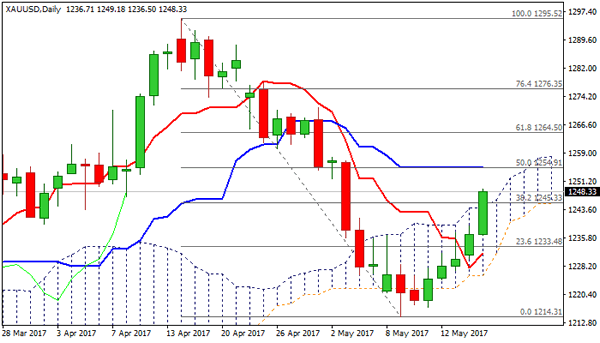
Spot Gold accelerated further up on Wednesday, driven by weaker dollar and political uncertainty in the US, extending recovery leg off $1214 low into fifth consecutive day.
Today's bullish acceleration probes through a cluster of strong barriers at $1245/47 zone, consisting of daily cloud / Fibo 38.2% of $1295/$1214 descend and converging 55 / 200 and 20SMA's.
Sustained break higher is expected to generate strong bullish signal for extension towards next targets at $1250 and $1254 (daily Kijun-sen / 50% retracement).
Daily technical studies are turning into firmer bullish mode, complemented by dollar-negative fundamentals and rising demand for safe haven assets on political crisis in the US that may further inflate gold's price.
However, hesitation at key $1245/47 resistance zone could be expected, with the notion supported by overbought slow stochastic (without firmer bearish signal for now).
Top of thick 4-hr cloud top at $1242 marks immediate support, followed by 4-hr Tenkan-sen at $1240 and session low at $1236, reinforced by rising 4-hr Kijun-sen line, above which corrective dips should be contained.
Res: 1250; 1254; 1260; 1264
Sup: 1245; 1242; 1240; 1236
Trade Idea: EUR/GBP – Buy at 0.8530
EUR/GBP - 0.8571
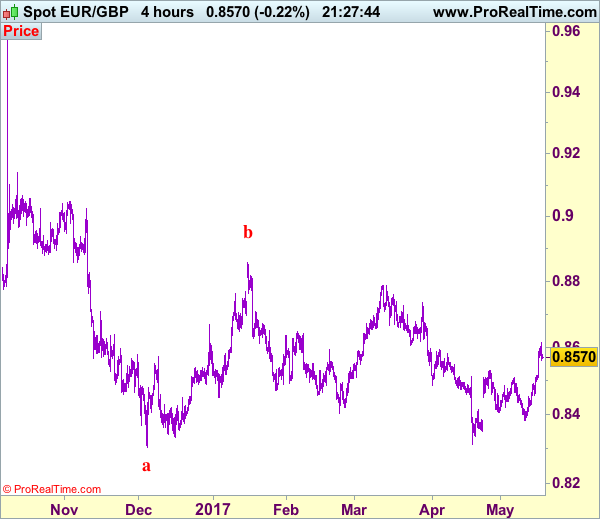
Recent wave: Major double three (A)-(B)-(C)-(X)-(A)-(B)-(C) is unfolding and 2nd (A) has possibly ended at 0.6936.
Trend: Near term down
Original strategy :
Buy at 0.8530, Target: 0.8630, Stop: 0.8490
Position : -
Target : -
Stop : -
New strategy :
Buy at 0.8530, Target: 0.8630, Stop: 0.8490
Position : -
Target : -
Stop : -
As the single currency has eased after rising to 0.8615, suggesting minor consolidation below this level would be seen and pullback to 0.8550 is likely, however, reckon 0.8525-30 would contain downside and bring another rise later, above said resistance would extend the erratic upmove from 0.8312 low to 0.8630 but as this move is viewed as retracement of recent decline, reckon upside would be limited to 0.8650-60, risk from there is seen for a retreat later.
In view of this, we are still looking to buy euro on pullback as 0.8531 (previous resistance) should limit downside and bring another rise. Below 0.8500-05 would defer and suggest top is possibly formed, bring weakness to support at 0.8457 but break of previous resistance at 0.8452 is needed to confirm and bring test of support at 0.8423 first.
Our preferred count is that, after forming a major top at 0.9805 (wave V), (A)-(B)-(C) correction is unfolding with (A) leg ended at 0.8400 (A: 0.8637, B: 0.9491 and 5-waver C ended at 0.8400. Wave (B) has ended at 0.9413 and impulsive wave (C) has either ended at 0.8067 or may extend one more fall to 0.8000 before prospect of another rally. Current breach of indicated resistance at 0.9043 confirms our view that the (C) leg has ended and bring stronger rebound towards 0.9150/54, then towards 0.9240/50.
USD/JPY Mid-Day Outlook
Daily Pivots: (S1) 112.76; (P) 113.27; (R1) 113.62; More...
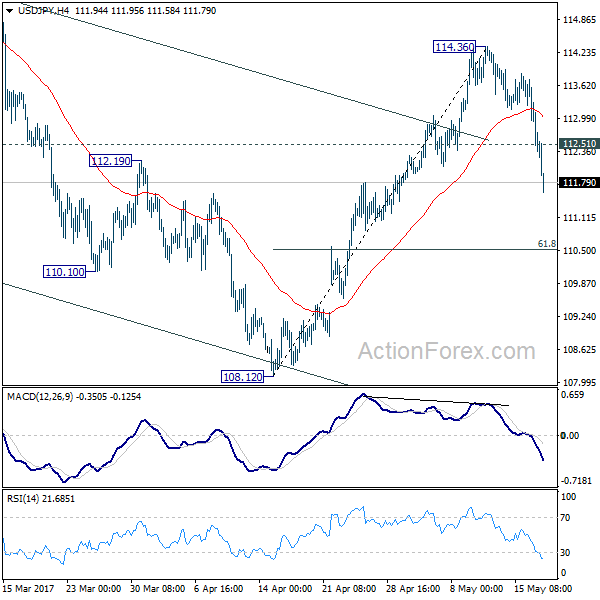
USD/JPY's decline accelerates to as low as 111.58. 112.08 cluster support (38.2% retracement of 108.12 to 114.36 at 111.97) was taken out without hesitation. Intraday bias remains on the downside and deeper fall would be seen to 61.8% retracement at 110.50. The development also dampen the bullish case that correction from 118.65 has completed at 108.12. We'll asses that part of the outlook later. For now, above 112.51 minor resistance will turn bias neutral and bring consolidations first.
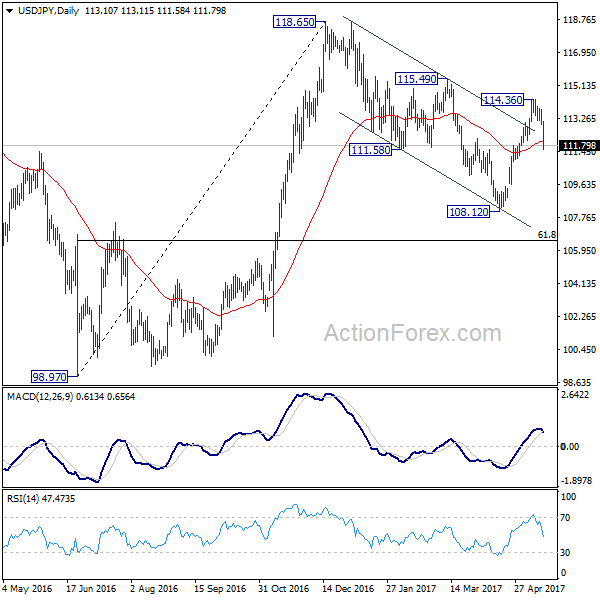
In the bigger picture, price actions from 125.85 high are seen as a corrective pattern. It's uncertain whether it's completed yet. But in case of another fall, downside should be contained by 61.8% retracement of 75.56 to 125.85 at 94.77 to bring rebound. Meanwhile, break of 115.49 resistance will extend the rise from 98.97 to retest 125.85. Overall, rise from 75.56 is still expected to resume later after the correction from 125.85 completes.
USD/CHF Mid-Day Outlook
Daily Pivots: (S1) 0.9942; (P) 0.9980; (R1) 1.0003; More.....
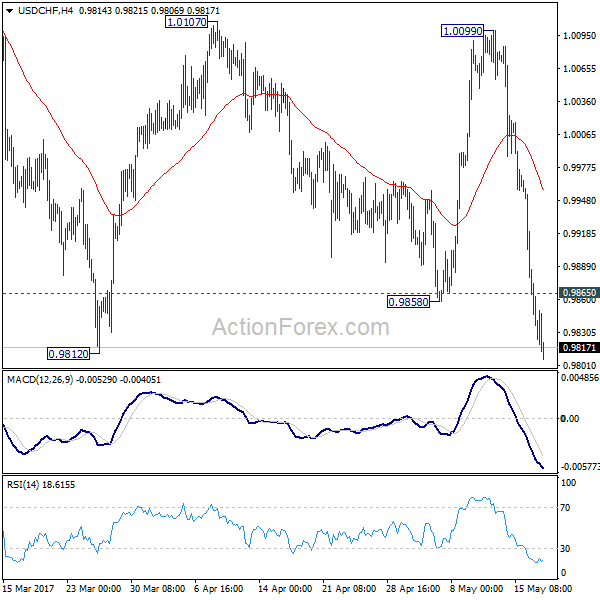
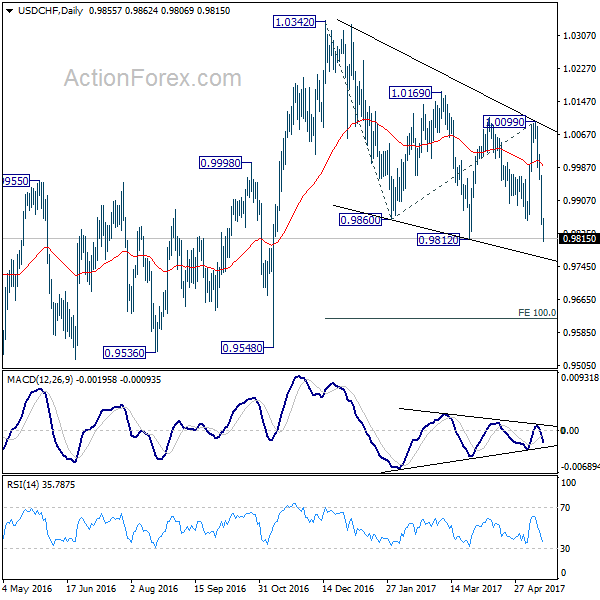
USD/CHF's decline is still in progress and breaches 0.9812 support. Current fall is seen as part of the decline from 1.0342. Next target will be target lower trend line support (now at 0.9762) and below. At this point, such decline from 1.0342 is still seen as a correction. Therefore, we'd expect strong support above 100% projection of 1.0342 to 0.9860 from 1.0099 at 0.9617 to contain downside. On the upside, above 0.9865 minor resistance will turn bias neutral and bring recovery before staging another fall.
In the bigger picture, USD/CHF is bounded in medium term range of 0.9443/1.0342 for the moment. Consolidative trading would likely continue and medium term outlook remains neutral. Break of 1.0342 key resistance is needed to confirm underlying bullish momentum in the pair. Meanwhile, downside attempts should be contained by 0.9443 key support level.
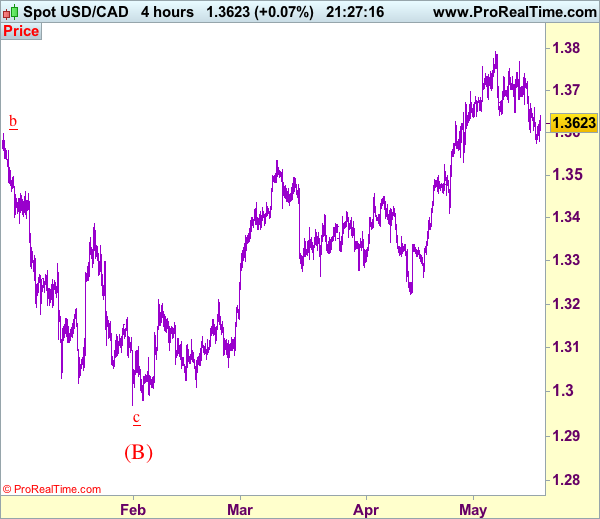
Trade Idea: USD/CAD – Buy at 1.3535
USD/CAD - 1.3623
Recent wave: Only wave v of c has ended at 0.9407 and wave C of major A-B-C correction is underway for headway to 1.4700
Trend: Near term up
Original strategy :
Buy at 1.3535, Target: 1.3735, Stop: 1.3475
Position: -
Target: -
Stop: -
New strategy :
Buy at 1.3535, Target: 1.3735, Stop: 1.3475
Position: -
Target: -
Stop:-
This week’s decline has retained our view that near term downside risk remains for the fall from 1.3794 top to bring retracement of recent rise, hence weakness to 1.3575-80 would be seen, however, reckon downside would be limited to support at 1.3530 and bring rebound later, above 1.3665-70 would bring rebound to 1.3700 but break of 1.3740-45 is needed to signal the pullback from recent high at 1.3794 has ended, bring test of 1.3770 resistance first, then towards 1.3794. Looking ahead, only a break above there would confirm recent upmove has resumed and extend further gain to 1.3840-50, then towards 1.3900.
In view of this, would not chase this rise here and would be prudent to buy again on pullback as 1.3530-35 should limit downside and bring another rise later. A firm break below 1.3530 would abort and suggest a temporary top is formed, bring retracement of recent upmove to 1.3500 and later towards 1.3450-60 but support at 1.3411 should remain intact, bring another upmove later.
To recap, wave B from 1.3066 is unfolding as an a-b-c and is sub-divided as a: 1.2192, b: 1.2716 and wave c is a 5-waver with i: 1.1983, ii: 1.2506, extended wave iii with minor iii at 1.0206, wave iv ended at 1.0781 and wave v as well as wave iii has ended at 0.9931, hence the subsequent choppy trading is the wave iv which is unfolding as (a)-(b)-(c) with (a) leg of iv ended at 1.0854, followed by (b) leg at 1.0108 and (c) leg as well as the wave iv ended at 1.0674. The wave v is sub-divided by minor wave (i): 0.9980, (ii): 1.0374, (iii): 0.9446, (iv): 0.9913 and (v) as well as v has possibly ended at 0.9407, therefore, consolidation with upside bias is seen for major correction, indicated target at 1.3700 and 1.4000 had been met and further gain to 1.4700 would be seen later.
GBP/USD Mid-Day Outlook
Daily Pivots: (S1) 1.2870; (P) 1.2913; (R1) 1.2962; More...
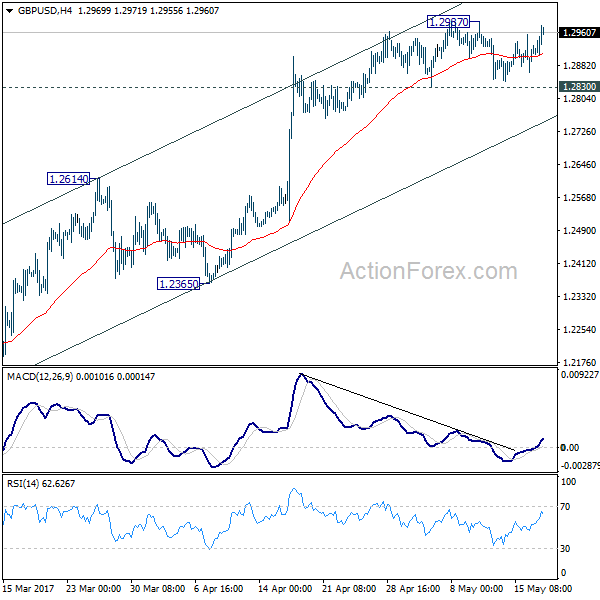
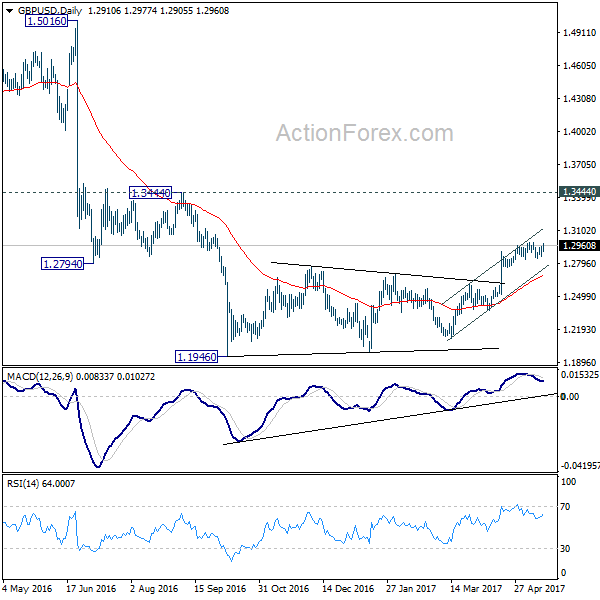
GBP/USD recovers today but it's still staying in range of 1.2830/2987. Intraday bias remains neutral for the moment. With 1.2830 minor support intact, another rise cannot be ruled out. However, price actions from 1.1946 are viewed as a corrective pattern. Therefore, in case of another rise, we'd start to look for reversal signal again above 1.2987. Meanwhile, break of 1.2830 will indicate short term topping. In such case, intraday bias is turned back to the downside for 1.2614 resistance turned support first.
In the bigger picture, fall from 1.7190 is seen as part of the down trend from 2.1161. There is no sign of medium term reversal yet. Sustained trading below 61.8% projection of 2.1161 to 1.3503 from 1.7190 at 1.2457 will target 100% projection at 0.9532. Overall, break of 1.3444 resistance is needed to confirm medium term bottoming. Otherwise, outlook will remain bearish.