Sample Category Title
Risk Aversion Remains on Front Burner Due to Geo-Political Concerns
Notes/Observations
- Geo-political concerns of potential expanded US involvement in regional hot spots (Korea, Mid-East)
- Focus centered on North Korea as it approaches the key Apr 15th birthday of its founder Kim Il-sung for potential nuclear test
- Market participation non-existent in wake of holidays in Far East, Europe and US
Overnight:
Asia:
- PBoC resumed its open market operations for the 1st time in 13 sessions and injected CNY110B combined in 7, 14, and 28-day reverse repos
Europe:
- France IFOP daily presidential poll: Second round poll: Macron 58.5, Le Pen 41.5% (unchanged)
Americas:
- Canadian Government: introduces legislation to legalize recreational Marijuana; intends to provide regulated, restricted access to Cannabis no later than July 2018
Energy:
- Weekly Baker Hughes US Rig Count: 847 v 839 w/w (+1%)(13th straight weekly rise)
Economic Data
- (CN) China Mar M2 Money Suppy Y/Y: 10.6% v 11.1%e; M1 Money Supply Y/Y: 18.8% v 19.3%e, M0 Money Supply Y/Y: 6.1% v 4.0%e
- (CN) China Mar New Yuan Loans (CNY): 1.020T v 1.200Te
- (CN) China Mar Aggregate Financing (CNY): 2.120T v 1.50Te
Fixed Income Issuance:
- None seen
SPEAKERS/FIXED INCOME/FX/COMMODITIES/ERRATUM
Equities
- Closed for Good Friday holiday
Speakers
- Italy said to be considering a deficit higher than the 1.2% of GDP forecasted in its 2018 budget draft
- Bank of Japan (BOJ) said to be offering a more upbeat view of economy and exports
Currencies
- FX markets were at a standstill with most of Europe closed for Good Friday holiday. The USD still unable to shrugged off recent comments from President Trump on his concern of a too strong of a greenback.
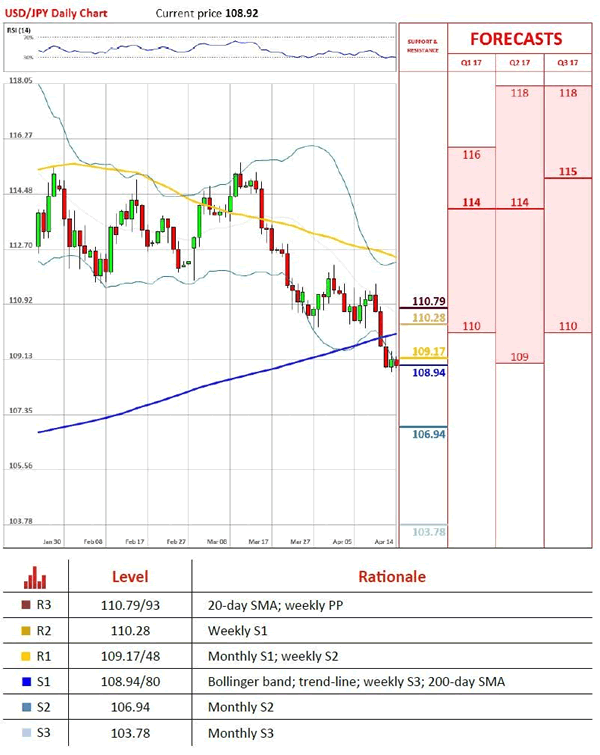
- USD/JPY hovered near its recent 5-month low and again tested its 200-day moving average. The pair holding below the 109 level. The 200-day MA has not be breeched since Trump won the US election back in early Nov.
Looking Ahead
- 07:00 (IL) Israel Mar CPI M/M: 0.1%e v 0.0% prior; Y/Y: 0.7%e v 0.4% prior
- 07:30 (IN) India Weekly Forex Reserves
- 08:00 (PL) Poland Mar M3 Money Supply M/M: 0.8%e v 0.3% prior; Y/Y: 8.6%e v 8.2% prior
- 08:30 (US) Mar CPI M/M: 0.0%e v 0.1% prior; Y/Y: 2.6%e v 2.7% prior
- 08:30 (US) CPI Ex Food and Energy M/M: 0.2%e v 0.2% prior; Y/Y: 2.3%e v 2.2% prior
- 08:30 (US) Mar CPI Index NSA: 244.237e v 243.603 prior; CPI Core Index SA: 251.651e v 251.299 prior
- 08:30 (US) Mar Advance Retail Sales M/M: -0.2%e v +0.1% prior; Retail Sales Ex Auto M/M: 0.1%e v 0.2% prior, Retail Sales Ex Auto and Gas: 0.3%e v 0.2% prior, Retail Sales Control Group: 0.3%e v 0.1% prior
- 08:30 (US) Mar Real Avg Weekly Earnings M/M: No est v -0.3% prior; Real Avg Hourly Earnings Y/Y: No est v 0.0% prior
- 10:00 (US) Feb Business Inventories: 0.3%e v 0.3% prior
- (LU) Luxembourg Sovereign Debt to be rated by Fitch
Weekend
- Sunday (TR) Turkey holds referendum on presidential system
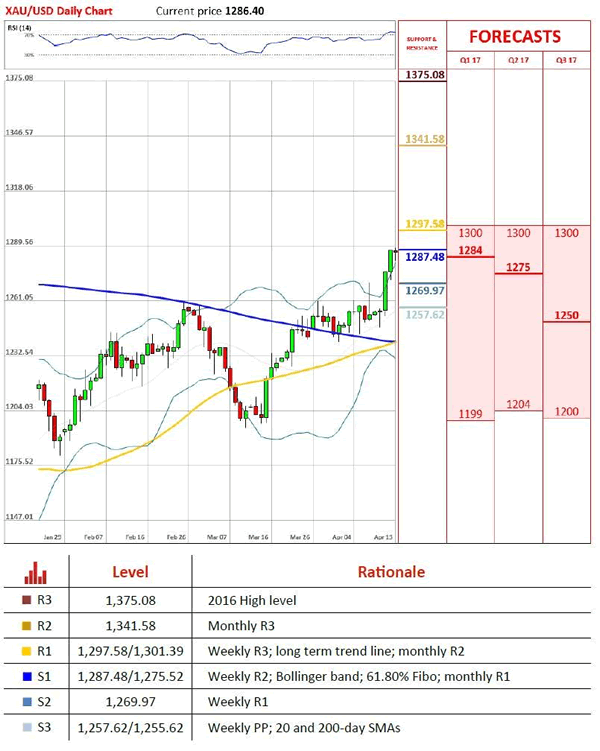
Gold Analysis: Remains below 1,290 Level
"The U.S. dollar still rules as the most important currency in the world's markets, which has in recent history created an inverse relationship between gold and the greenback."
– Dani Burger and Julie Verhage, Bloomberg
Pair's Outlook
On Friday morning the yellow metal's price remained unchanged, as it was not traded due to Easter Holidays. However market participants have the information of the later hours of Thursday to analyze. The bullion initially declined as a consolidation occurred on Thursday. However, the metal managed to regain strength and even score gains by the end of the day, as the day's trading ended at the 1,288.40 level. Gold was stopped on its way to the 1,300 level, which is most likely going to be reached after the holidays.
Traders' sentiment
Trader positions have not changed and remain 53% bearish. Meanwhile, 56% of trader set up orders are to buy the metal.
USD/JPY Analysis: Attempts to Remain above 109.00
"We hope the BoJ uses the upcoming meeting as an opportunity to remove this confusion, a factor that should help to stabilise the ¥. We remain neutral until then."
– Westpac (based on FXStreet)
Pair's Outlook
Rather mixed fundamental data on Thursday caused the US Dollar not only to avoid losses, but also to refrain from posting any substantial gains. As a result, the USD/JPY currency pair provided the descending channel's support line with an additional confirmation, indicating that price might soon rebound and begin its journey towards the 112.00 level. Although daily technical indicators are unable to confirm a recovery, the longer timeframe ones can. Moreover, the 200-day SMA is bolstering the channel's lower border, which should be sufficient for the Buck to bounce back from the 109.00 mark. In case the given support area fails to hold, risks of plunging towards 105.00 would arise.
Traders' sentiment
Nearly three quarters (73%) of all open positions are now long. At the same time, the number of buy orders edged up from 56 to 61%.
GBP/USD Analysis: Anchored around 1.25
"In view rising geopolitical risk and Brexit uncertainties, we expect limited upside potential in GBPUSD this week."
– BMO Capital Markets (based on PoundSterlingLive
Pair's Outlook
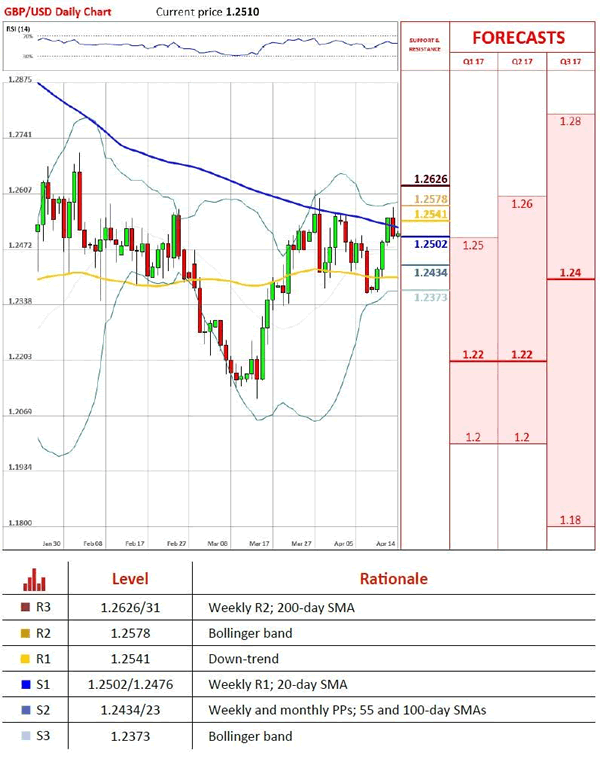
On Thursday, the British currency suffered a relatively serious loss against the US Dollar, having almost completely erased Wednesday's gains. Nevertheless, this decline prolonged the bearish trend-line, while the immediate support, namely the weekly R1, managed to prevent the Cable from falling deeper, thus, causing trade to close above 1.25. No significant development is expected today, mostly due to Easter holidays. However, technical studies keep giving bullish signals, suggesting another leg up is possible. The down-trend is likely to keep the Sterling at bay, but another bearish development would somewhat confirm the Cable's short-term consolidation trend.
Traders' sentiment
Today 56% of traders are long the Pound (previously 54%), while 52% of all pending orders are to sell the Sterling, down from 55% yesterday.
EUR/USD Analysis: Retreats Back to 1.06 Level
"I think our dollar is getting too strong, and partially that's my fault because people have confidence in me."
– Donald Trump (based on Bloomberg)
Pair's Outlook
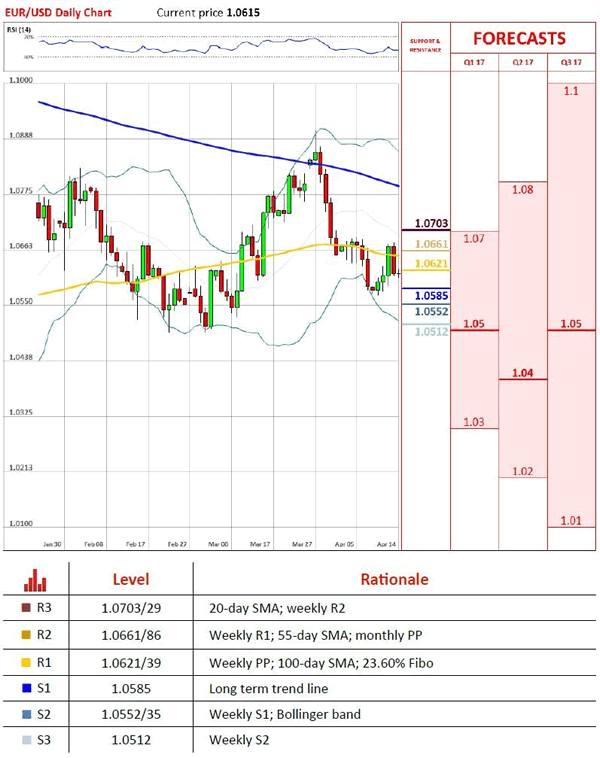
During the early hours of Friday's trading session the common European currency traded near the 1.06 level against the US Dollar, and the pair was positioned for a decline during the day's trading. The rate had almost erased all the gains of Wednesday, as it fell below the combined support of the 100-day SMA at 1.0626 and the weekly PP at the 1.0621 mark. These levels of significance on Friday were providing resistance, which the pair had failed to break. Due to that reason it is possible that the currency exchange rate will after all decline to the weekly S1, which is located at the 1.0552 level. However, it might stop at the long term channel's lower trend line near 1.0585 level.
Traders' sentiment
SWFX traders remain neutral bullish, as 52% of open positions are long. Meanwhile, 52% of set up orders are to sell the Euro.
Technical Outlook: USDJPY Bias Remain Bearish
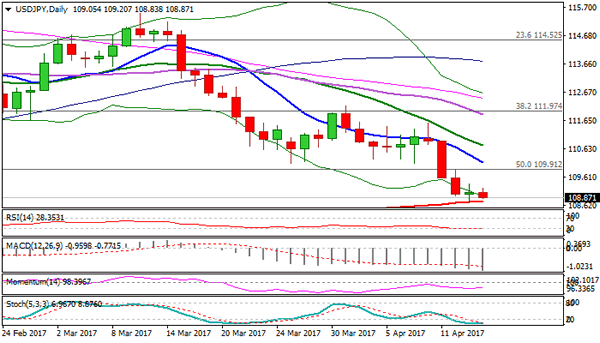
The pair ended Asian trading in red after threading water for the most of the session. Bias remain bearish, keeping key supports at 108.77/70 (200SMA/Thursday's low) under pressure. Firm break here would trigger fresh acceleration towards 107.84 (Fibo 61.8% of 101.17/118.65 rally). Bearish studies maintain pressure, with thick hourly cloud (spanned between 109.12/71) heavily weighing on near-term action and guarding upper pivot at 110.00 zone (former base/daily Tenkan-sen). Extended holiday weekend suggests the pair would remain range-bound, however, geopolitical tensions and release of US CPI and Retail Sales data may affect the pair during thin-volumes holiday trading.
Res: 109.12; 109.71; 110.00; 110.76
Sup: 108.77; 108.70; 108.53; 107.84
Canadian Dollar Quiet as Canadian Markets Closed on Good Friday
USD/CAD has edged lower in the Friday session, as the pair trades slightly above the 1.33 line. Canadian banks and stock markets are closed for Good Friday and there are no Canadian events on the schedule. We're likely to see thin trading in the currency markets as we wrap up the trading week. In the US, it's a busy day, with the release of CPI and Retail Sales reports. CPI is expected to tread water at 0.0%, while the forecast for retail sales stands at 0.2%. We'll also get a look at the Treasury Currency Report, which details currency practices of the United States's major trading partners. Earlier this week, President Trump said that China was not guilty of currency manipulation, contradicting what he had repeatedly declared on the campaign trail.
As expected, the BoC held rates at 0.50% on Wednesday. Following the rate decision, BoC Governor Stephen Poloz sounded a bit more hawkish than in previous statements, saying that the central bank was "decidedly neutral" regarding monetary policy. The BoC raised its growth forecast for 2017, as employment numbers have improved in recent months. The markets are not expecting the BoC to raise rates in 2017, but further rate hikes from the Federal Reserve could complicate things, as wider divergence between interest rates in Canada and the US could hurt the Canadian dollar and put pressure on the BoC to respond by raising rates.
US consumer behavior has been perplexing, displaying a "hard/soft discrepancy" with regard to consumer indicators. Consumer confidence levels have failed to translate into stronger consumer spending, a key driver of economic growth. Confidence levels are considered "soft" data, compared to actual spending numbers, which are termed "hard" data. Will this pattern continue in the March releases? On Thursday, UoM Consumer Sentiment improved to 98.0, beating expectations and hitting a 3-month high. However, the markets are expecting retail sales reports, the primary gauges of consumer spending, to remain at weak levels. Core Retail Sales and Retail Sales are expected to remain unchanged in March, with gains of 0.2% and 0.1%, respectively. On the business front, surveys are pointing to a similar trend, with weak orders despite high confidence levels. The Fed will be closely monitoring consumer spending reports, and if these numbers remain soft, it's unlikely that the Federal Reserve will press that trigger more than two more times in 2017.
DAX Quiet as German Markets Closed for Good Friday
The DAX is steady on Friday, as the index trades at 12,109.00. German stock markets and banks are closed for the Good Friday holiday, and there are no eurozone releases on the schedule. In the US, it's a busy day, with the release of CPI and Retail Sales reports. CPI is expected to tread water at 0.0%, while the forecast for retail sales stands at 0.2%.
The DAX has enjoyed strong gains in the first quarter of 2017, buoyed by stronger growth data in Germany and the eurozone. However, the DAX has reversed directions in April, dropping 2.1 percent. North Korea and Syria have become flash-points for geopolitical tensions, and there is increasing speculation that the US and North Korea could find themselves at war if China does not succeed in de-escalating tensions and stabilizing a dangerous situation in the Far East. These events are weighing on jittery investors, many who have dumped their holdings in exchange for safe-assets such as gold, which is trading at 5-month highs.
The ECB appears in no hurry to make any changes to its loose monetary policy prior to 2018, or even later. Eurozone inflation levels have picked up in the first quarter, but March levels were softer than expected. This has eased the pressure on the ECB, which is not scheduled to reduce its asset-purchase program until December. In Germany, Wholesale Price Index dropped to a flat 0.0%, compared to 0.5% a month earlier. This was well short of the forecast of 0.4%. The downward trend continued with Final CPI, which dropped to 0.2%, down from 0.6% in February. Eurozone CPI made a big splash in February, when it hit the ECB's target of 2.0%, and raising speculation that the ECB might need to respond by tightening monetary policy. However, the key index softened in March to 1.5%, short of the forecast of 1.8%.
US consumer behavior has been perplexing analysts, displaying a "hard/soft discrepancy" with regard to consumer indicators. Consumer confidence levels have failed to translate into stronger consumer spending, a key driver of economic growth. Confidence levels are considered "soft" data, compared to actual spending numbers, which are termed "hard" data. Will this pattern continue in the March releases? On Thursday, UoM Consumer Sentiment improved to 98.0, beating expectations and hitting a 3-month high. However, the markets are expecting retail sales reports, the primary gauges of consumer spending, to remain at weak levels. Core Retail Sales and Retail Sales are expected to remain unchanged in March, with gains of 0.2% and 0.1%, respectively. On the business front, surveys are pointing to a similar trend, with weak orders despite high confidence levels. The Fed will be closely monitoring consumer spending reports, and if these numbers remain soft, it's unlikely that the Federal Reserve will press that trigger more than two more times in 2017.
Dollar Rebounds on Strong Jobless Claims, German Markets Closed for Holiday
EUR/USD is unchanged in Friday's European session, as the pair trades slightly above the 1.06 line. On Thursday, the euro lost ground as US unemployment claims were unexpectedly strong. In economic news, German banks and stock markets are closed for Good Friday, so we can expect thin trading in the currency markets as we wrap up the trading week. In the US, it's a busy day, with the release of CPI and Retail Sales reports. CPI is expected to tread water at 0.0%, while the forecast for retail sales stands at 0.2%. We'll also get a look at the Treasury Currency Report, which details currency practices of the United States's major trading partners. Earlier this week, President Trump said that China was not guilty of currency manipulation, contradicting what he had repeatedly declared onthe campaign trail.
The ECB appears in no hurry to make any changes to its loose monetary policy prior to 2018, or even later. Eurozone inflation levels have picked up in the first quarter, but March levels were softer than expected. This has eased the pressure on the ECB, which is not scheduled to reduce its asset-purchase program until December. In Germany, Wholesale Price Index dropped to a flat 0.0%, compared to 0.5% a month earlier. This was well short of the forecast of 0.4%. The downward trend continued with Final CPI, which dropped to 0.2%, down from 0.6% in February. Eurozone CPI made a big splash in February, when it hit the ECB's target of 2.0%, and raising speculation that the ECB might need to respond by tightening monetary policy. However, the key index softened in March to 1.5%, short of the forecast of 1.8%.
US consumer behavior has been perplexing analysts, displaying a "hard/soft discrepancy" with regard to consumer indicators. Consumer confidence levels have failed to translate into stronger consumer spending, a key driver of economic growth. Confidence levels are considered "soft" data, compared to actual spending numbers, which are termed "hard" data. Will this pattern continue in the March releases? On Thursday, UoM Consumer Sentiment improved to 98.0, beating expectations and hitting a 3-month high. However, the markets are expecting retail sales reports, the primary gauges of consumer spending, to remain at weak levels. Core Retail Sales and Retail Sales are expected to remain unchanged in March, with gains of 0.2% and 0.1%, respectively. On the business front, surveys are pointing to a similar trend, with weak orders despite high confidence levels. The Fed will be closely monitoring consumer spending reports, and if these numbers remain soft, it's unlikely that the Federal Reserve will press that trigger more than two more times in 2017.
The Weekly Bottom Line
HIGHLIGHTS OF THE WEEK
United States
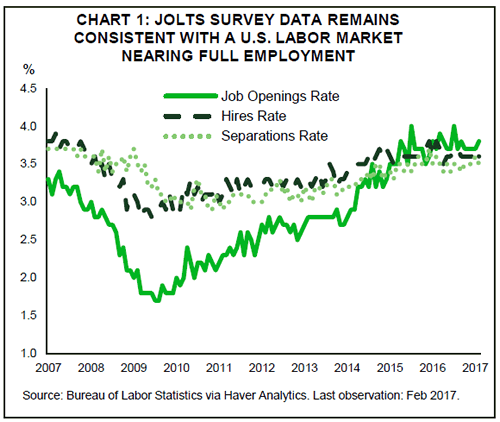
- Economic data this week remained consistent with the theme of an economy nearing full employment.
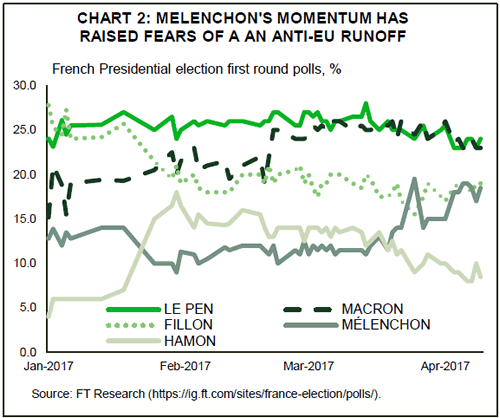
- Headlines were dominated this week by rising tensions with North Korea and the increased odds that the French Presidential elections could result in the victory of an anti-EU candidate.
- Comments from President Trump's interview with the Wall St. Journal imply that tax reform is now secondary in importance to health care reform. Less scope for fiscal stimulus may imply a more gradual process of monetary policy normalization than previously anticipated.
Canada
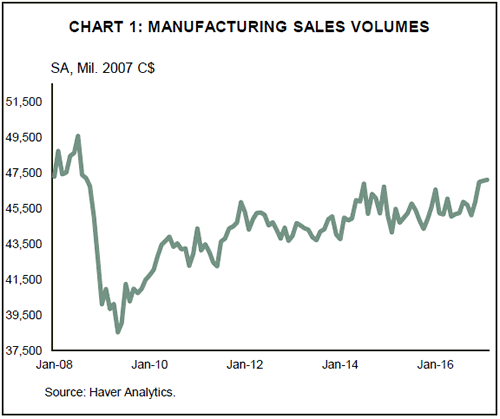
- Manufacturing sales beat expectations in February, with volumes rising 0.1% to the highest level since September 2008.
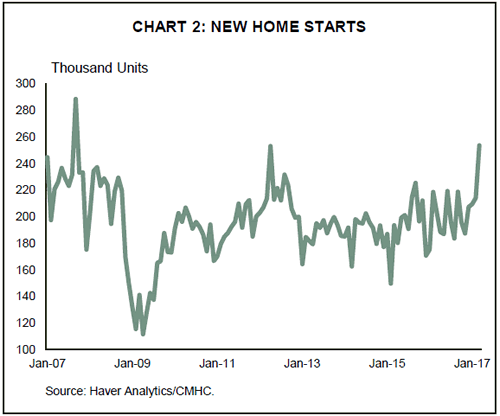
- Housing starts surged to over 250k units (annualized) in March, marking the fastest pace of building activity in nearly a decade.
- The Bank of Canada left the overnight rate unchanged at 0.50% and upgraded its growth outlook for this year to 2.6% (previously 2.1%). Notwithstanding the upward revision to the numbers, its language emphasized downside risks and caution on the outlook for the Canadian economy.
UNITED STATES - REFLATION TRADE FIZZLES AS GEOPOLITICAL RISKS RISE
There was little in terms of data this holiday week to move financial markets. February data from the job opening and labor turnover survey (JOLTS) showed an uptick in job openings, a downtick in new hires, and a reversal of previous month's strength in the separations rate. Similarly, initial claims data for last week held near historic lows, further corroborating the theme of a healthy labor market. The key message permeating the data is that the job market is nearing full employment, yet more reason to look past last week's disappointing payrolls number.
In addition to the labor market data, updates on small business sentiment and producer prices were released. The NFIB's optimism index cooled for the second consecutive month, but small business remains highly optimistic by historical standards. Growth in core producer prices meanwhile, remains consistent with gradually rising price pressures. Although producer prices in March fell on a month-on-month (m/m) basis, the move was largely driven by energy prices, leaving prices for the final demand goods excluding food and energy category rising by a firm 0.4% m/m.
Overall, there was little change in economic fundamentals this week to motivate the shifts in financial markets, which were drowned out by geopolitical developments and apparent shifts in domestic policy.
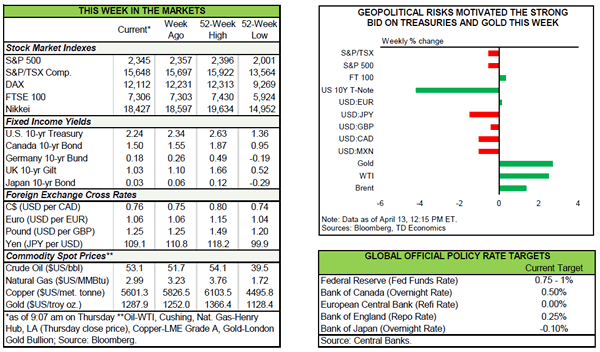
News out of North Korea dominated headlines early this week, with fears of an imminent confrontation between the U.S. and the pariah state contributing to a selloff in risk assets and a strong bid on safe havens such as Treasuries and gold. There was initially hope that the meeting between the Presidents of China and the U.S. last week would reduce tensions, but the subsequent bolstering of America's military presence in the Korean peninsula has resulted in the opposite.
Markets also became concerned with the French Presidential election, which has seen a surge in another populist, anti-EU candidate in polls for the first round of elections set to take place in ten days. Jean-Luc Mélenchon, a far-left socialist candidate, is nipping at the heels of third placed Francois Fillon, and his momentous rise in the polls has raised the odds of a presidential runoff election in early May between two anti-EU candidates.
On this side of the Atlantic, President Trump's comments in an interview with the Wall St. Journal suggest a shift toward more conventional policy. For one, President Trump advocated for the need to accomplish healthcare reform before tax reform. President Trump also backed off on plans to label China a currency manipulator, and expressed concern that the strong U.S. dollar has been hurting American exporters. He also reversed his view of the Export-Import bank, suggesting that it was "... a very good thing. And it actually makes money, it could make a lot of money". Lastly, he appeared to soften his stance on the Federal Reserve's policy of low interest rates.
These statements altogether suggest that stimulus from tax cuts is less likely in the near term. Less scope for fiscal stimulus may imply a more gradual process of monetary policy normalization than previously anticipated. Add into the mix elevated geopolitical uncertainty and it looks more and more like the reflation trade's days are numbered.
CANADA - CENTRAL BANK STILL CAUTIOUS ON OUTLOOK
There were two Canadian data releases and a Bank of Canada announcement this week, which, combined with rising oil prices and remarks from Trump that the USD is too high, sent the loonie up to a 6-week high of 75½ US cents.
Both of the key data releases continued the trend of better-than-expected activity at the start of this year. Manufacturing sales beat expectations, with volumes rising by 0.1% in February. This marks the 4th consecutive increase and brings volumes to the highest level since 2008. Forward looking indicators suggest that this momentum could continue going forward. Combined with a strong hand off from the end of 2016, manufacturing output is on track to add favourably to growth during the first quarter of the year.
Ditto for residential construction. Housing starts surged to over 250k units (annualized) in March - the fastest pace of building activity in nearly a decade. For the quarter as a whole, construction was up by a whopping 15% q/q. This pace of building is unlikely to be sustained, however, with some payback likely in store in the coming months. Still, overall economic growth for the first quarter is set to come in quite strong, tracking a robust 3.4% annualized.
Perhaps the highlight of the week was Wednesday's Bank of Canada announcement and accompanying Monetary Policy Report. The remarkable performance of the Canadian economy in recent months, combined with the Federal Reserve in tightening mode stateside, had prompted some expectations for a more hawkish tone from the Bank of Canada. However, despite an improved outlook, Canada's central bank remains quite cautious.
As expected, the overnight rate was left unchanged at 0.50%. However, growth forecasts were indeed upgraded for this year, with the Bank now forecasting economic activity to advance by 2.6% (previously 2.1%). Accordingly, it also expects the output gap to close in the first half of 2018 - slightly earlier than the mid-2018 expected previously.
Despite these improvements, the Bank is clearly not convinced that the Canadian economy is out of the woods just yet. The communique struck a somber tone, noting that 'material slack' still exists in the economy, that soft spots remain - notably, hours worked, uneven export growth and challenges related to business investment - and that it is simply too early to declare the economy on a sustainable growth path. What's more, the Bank's growth profile suggests that it views the near term growth drivers - consumer spending and residential investment - as transitory and likely to slow in the coming quarters, while it awaits a more consistent improvement from exports and business investment. The cautious approach also reflects risks to the outlook, particularly those outside Canada's borders such as the implications from any new policy actions south of the border.
All told, the Bank has clearly not forgotten that the Canadian economy has endured a couple of false starts in recent years. While some pullback from the exceptionally strong start to the year is likely, we expect economic activity to chug along at a healthy clip of around 2% over the remainder of this year. This is unlikely to be enough to entice the Bank of Canada to pull the trigger on higher rates; however, it will allow economic slack to be absorbed and should pave the way for a rate hiking cycle to begin in 2018.