Sample Category Title
Summary 4/17 – 4/21
Monday, Apr 17, 2017
[php_everywhere] [/php_everywhere]
Tuesday, Apr 18, 2017
[php_everywhere] [/php_everywhere]
Wednesday, Apr 19, 2017
[php_everywhere] [/php_everywhere]
Thursday, Apr 20, 2017
[php_everywhere] [/php_everywhere]
Friday, Apr 21, 2017
[php_everywhere] [/php_everywhere].
Turkey’s Constitutional Referendum, Key Data in Focus
Next week's market movers
- In Turkey, citizens will head to the polls to decide whether to grant their government additional powers. The outcome could have a notable impact on the Turkish lira.
- In New Zealand, CPI data for Q1 are expected to show inflation returning to the midpoint of the RBNZ's target range, which could greatly diminish the likelihood for any further easing.
- From Australia, we get the minutes from the latest RBA meeting, where the Bank remained on hold and shifted to a somewhat more dovish tone.
- We also get key economic data from Eurozone, the UK, China, and Canada.
Major events begin early next week. On Sunday, Turkish citizens will head to the polls to vote on constitutional changes that could greatly expand the executive powers of President Erdogan. The referendum will ask the question of whether to turn Turkey from a parliamentary to a presidential republic. The government and the President argue that a "yes" vote would reduce political deadlocks, thereby accelerating the pace of future reforms. On the other hand, critics of these changes argue that too much power would be concentrated in the hands of one person, which could increase the risk for an authoritarian government in the future. Opinion polls suggest that this race is too close to call. A "yes" outcome is seen by most polls as being more likely, but marginally so. Importantly, the majority of polls show a high percentage of undecided voters, so surprises are definitely possible.
With regards to the Turkish lira, we see the case for the currency to strengthen under a "yes" outcome, and to weaken if the Turkish public votes against these reforms. Ever since the failed military coup last year, Turkey has remained in a state of emergency, which is still ongoing. Media reports suggest that in a "yes" scenario, the government could lift this state of emergency, which in our view could prove positive for the lira in the short-term, as some political uncertainty dissipates. On the other hand, a "no" vote could heighten political uncertainty even further. The state of emergency could stay in place, and there seems to be no clear plan about what happens next. Some reports suggest that the nation could even go into early elections as soon as this year.
On Monday, markets will remain closed in most G10 nations, in celebration of Easter Monday
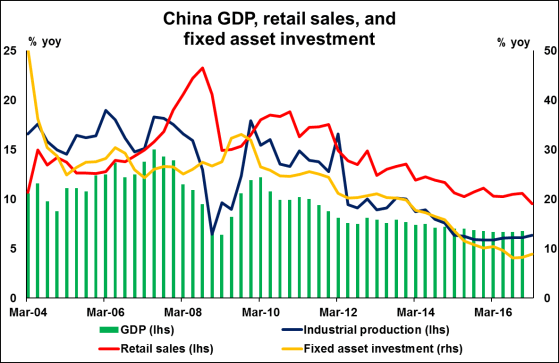
Nevertheless, during the Asian morning, we will get China's GDP data for Q1. Expectations are for the Chinese economy to have grown at the same pace as previously. We see the risks surrounding that forecast as tilted somewhat to the downside. Our view is based on the nation's trade data for the quarter, where imports skyrocketed throughout Q1, whereas exports only began to pick up in March. This may have weighed on net exports and thereby, GDP growth. The fact that yearly retail sales have slowed notably in January and February compared to those same months in 2016, enhances this view. We also get the nation's industrial production, fixed asset investment and retail sales, all for March. Retail sales are expected to have accelerated slightly, industrial production is forecast to have risen at the same pace as previously, while fixed asset investment is expected to have slowed somewhat.
On Tuesday, during the Asian day, the RBA will release the minutes from its April policy meeting, where the Bank remained on hold, and shifted to a somewhat more dovish tone. Policymakers indicated that some labor market indicators have softened recently, while they noted that the recently announced supervisory measures with regards to lending could ease financial stability risks. At the time, this suggested to us that once these measures take effect, the Bank would be more flexible to cut rates again if needed, without being concerned that its actions would amplify risks to the economy. We will examine the minutes for any clues on how concerned the Bank was regarding the labor market, and whether the officials would indeed cut rates without much hesitation in case the outlook deteriorates. Having said that though, following the remarkable jobs report for Marc, released after that meeting, we think that the probability for any further RBA easing is pretty low. We think this is also likely to be reflected in the Bank's tone at the next policy meeting.
On Wednesday, we have a relatively quiet day, with no major events or indicators due to be released.
On Thursday, during the Asian morning, we get New Zealand's CPI data for Q1. The forecast is for the CPI rate to have surged to +2.0% yoy from +1.3% yoy in Q4. We think that such an acceleration is likely to be very encouraging for RBNZ policymakers, as it would bring the rate exactly in line with the midpoint of the Bank's target range. At its latest gathering, the Bank kept the door open for further easing, and noted that it expects inflation to return to the midpoint over the "medium-term". As such, we think that a sooner-than-expected return to that point is likely to diminish the likelihood for any further rate cuts by the RBNZ and may even lead policymakers to close the door for any further easing. This view is amplified by the fact that the nation's 2-year inflation expectations have risen recently, and are now almost in line with that midpoint as well.
On Friday, we get the preliminary Markit manufacturing and services PMIs for April from several European nations and the Eurozone as a whole. Most of these indices are expected to tick down, but to remain at very healthy levels. Even though these are likely to be more pleasant news for ECB policymakers, we think that they are unlikely to lead to a material change in the Bank's dovish rhetoric, at least not at the upcoming meeting in late April. The ECB has made it absolutely clear that it is too early to discuss any reduction in stimulus and thus, despite the continued strength in forward-looking indicators such as the PMIs. The case for the Bank to remain dovish for a while is enhanced by the latest pullback in the bloc's core CPI rate, as well as the looming elections in France, which could trigger a surge in the bloc's government bond yields.
In the UK, retail sales data for March are coming out. The forecast is for sales to have fallen somewhat from the previous month. The case for a decline in sales is supported by the nation's consumer sentiment indices for the month. The TR/IPSOS figure declined while the Gfk index remained unchanged within the negative area. What's more, the BRC retail sales monitor for the month declined as well. Moving forward, we think that retail sales are likely to play a key role regarding how BoE policy evolves. The Bank has repeatedly stressed that it expects a slowdown in demand this year, as a consequence of lower real income growth. A considerable slowdown in retail sales over coming months could confirm the Bank's concerns and thereby, eliminate any surviving speculation regarding a tightening move in the foreseeable future.
From Canada, we get CPI data for March. The forecast is for the headline rate to have declined somewhat, while no forecast is available for the core rate. The case for a pullback in the headline rate is supported by the yearly change of oil prices, as well as the latest BoC meeting statement, which indicated that the Bank expects CPI inflation to dip in the months ahead as some temporary factors unwind. As for the core rate, our own view is that it may have remained unchanged. We base this hypothesis on the nation's Markit manufacturing PMI for the month, which indicated that manufacturers raised the prices on final products at the steepest rate for three years. So, although temporary factors may have dragged down the headline rate, the core rate may have held firm, we think.
CPI Falls in March on Gasoline and Cheap Talk
The CPI fell 0.3 percent in March. While a drop in energy was expected, core inflation fell 0.1 percent following a 7.0 percent drop in wireless telephone services and resumed weakness in core goods.
Energy Weighs on Headline, While Food Inflation Offers Respite
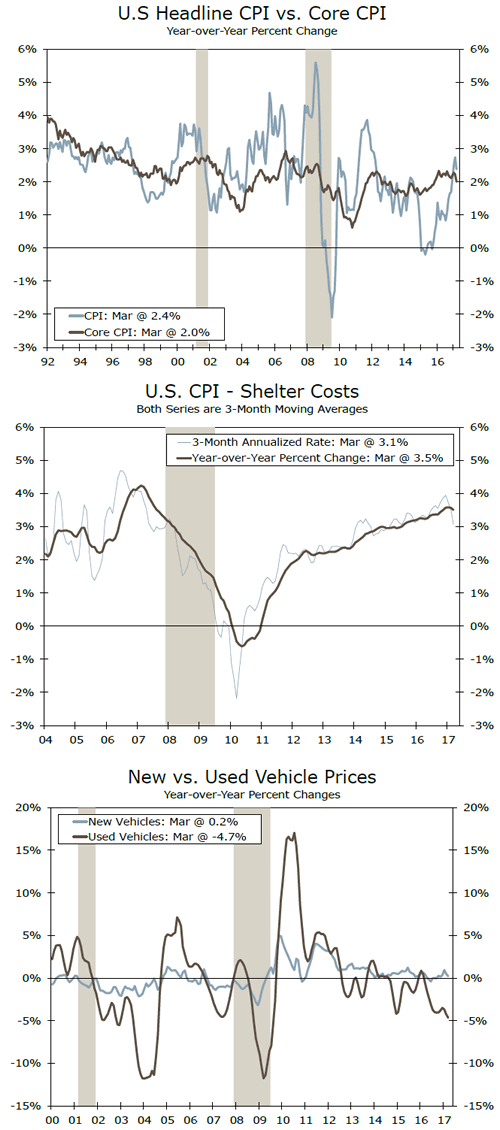
Consumer prices fell in March for the first time in more than a year. The CPI declined 0.3 percent versus expectations that price levels would remain flat. The drop last month brought the year-over-year pace down to 2.4 percent, which is still up meaningfully from the 0.9 percent pace registered this time last year.
A drop in gasoline prices was the biggest contributor to the headline's decline. Since, historically, gasoline prices rise in March (the last time they fell was in 2001), last month's 1.1 percent increase translated to a seasonally adjusted decline of 6.2 percent. The cost of energy services, including electricity and utility gas services also declined in March.
Excluding energy, prices slipped 0.1 percent despite a rebound in food prices. Prices for food rose 0.3 percent last month, the strongest monthly gain since mid-2014. The recovery in food prices has been driven by a turnaround in food at home, which after falling for nearly every month since late 2015, have increased at a 2.8 percent annualized pace the past three months.
Drop in Core CPI: Talk Is Cheap
Also contributing to the soft March reading was a 0.1 percent drop in the core index, the first monthly decline in more than six years. A 7.0 percent decline in the cost of wireless telephone services alone shaved off 0.1 percentage point from the headline's reading and led to a 0.1 percent decline in core services inflation last month. Shelter inflation also eased up a bit, increasing less than 0.2 percent for the first time in nearly three years. The slowdown stemmed from a drop in the relatively volatile lodging away from home component (down 2.4 percent last month), but also an easing in owners' equivalent rent growth, which increased only 0.2 percent. Medical care services also slowed, rising 0.1 percent.
As we have previously written, the recent gains in core goods inflation looked unlikely to be sustained given what seemed to be some difficulty with seasonal adjustment at the start of the year. Core goods prices fell 0.3 percent in March, in part due to a 0.7 percent decline in apparel prices which look to be payback for strong gains at the start of the year. That said, new and used vehicle prices also fell last month and are likely to remain a source of weakness given the glut of vehicles coming off lease this year.
We suspect that the weakness in today's core CPI print is not the start of a new trend given the curiously large drop in wireless services and some payback in the core goods component. Although the core index slipped to 2.0 percent year-over-year, we believe the Fed will look past this month's weakness and continue to focus on the core PCE, which continues to drift higher.
Steady Gains in Business Inventories in February
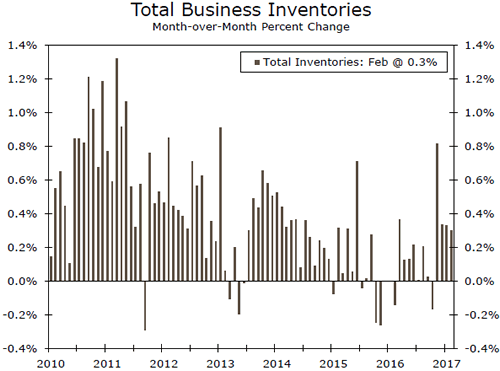
The moderate pace of inventory building continued in February, with businesses boosting stocks 0.3 percent. Sales are proceeding at a similar clip, keeping the inventory-to-sales ratio steady.
Steady as She Goes
Business inventories rose 0.3 percent for a third straight month in February, with manufacturers, retailers and wholesalers all adding to stocks.
The inventory build looks warranted given the steady pace of sales at manufacturers and wholesalers. Retailers saw sales slip in February, but core sales looked to have rebounded in March according to a separate report released this morning.
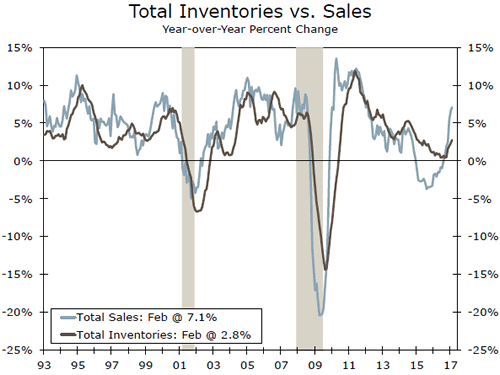
Inventories Better Aligned with Sales
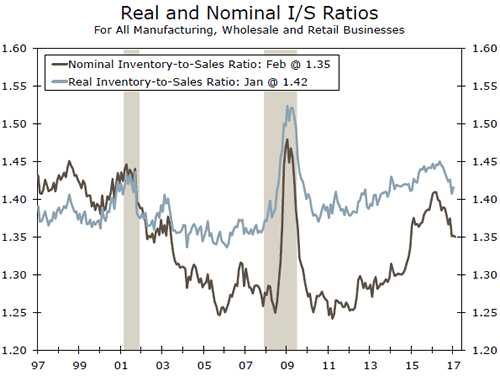
The inventory-to-sales ratio was unchanged in February at 1.35, but has improved markedly over the past year, even when adjusting for inflation effects.
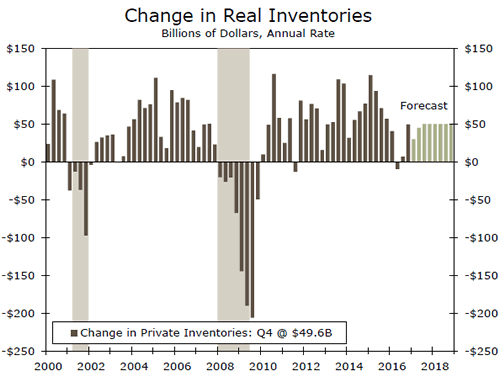
Although inventories have been rising in line with their recent trend, rising inflation in the business sector suggests that real inventory growth is likely to have slowed in the first quarter and will likely be a drag on Q1 GDP.
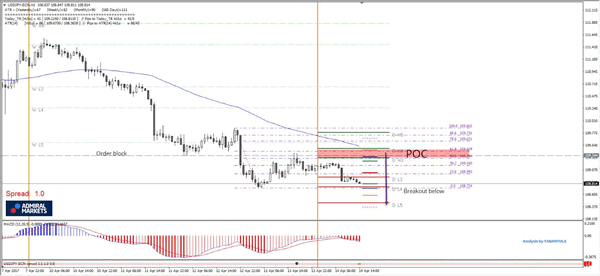
USD/JPY Continuing Towards 108.35
In the midst of bank holiday, the currencies are waiting for US data today. The USD/JPY, popular "Ninja" is in downtrend and it is targeting 108.35. If we see a retracement towards 109.30-45 POC, (W L5, D H4, 61.8, Order block, Historical sellers, EMA89) now moment sellers could wait and price should reject the price towards 108.72. If we don't see any retracement to the upside, a momentum break of 108.70 could tank the price lower to ATR/L5 projection 108.35.