

Sample Category Title
US ADP Reports 263,000 Job Gain In March, Services Activity Slows Last Month, Crude Oil Inventories Rise Unexpectedly
'The labour market is tight and it will get tighter. The labour shortage might be exacerbated by immigration issues.' - Mark Zandi, Moody's Analytics
US private companies created more jobs than markets expected last month, suggesting further tightening of the labour market. According to the ADP National Employment Report released on Wednesday, the US private sector added 263,000 new jobs to the economy in March, following the preceding month's downwardly revised gain of 245,000 and surpassing analysts' expectations for an increase of 184,000. The ADP data come ahead of the US Department of Labour's more comprehensive report on non-farm employment due on Friday. Yesterday's better-than-expected figures ratchet up analysts' expectations for Friday's numbers, who initially expected the NFP report to show a gain of 174,000 jobs. Other data released by the ISM on Wednesday revealed that US services activity slowed more than expected last month, with the ISM Non-Manufacturing PMI coming in at 55.2, down from the prior month's 57.6, while analysts anticipated a slight decrease to 57.0 points. In the meantime, the EIA reported US crude oil inventories climbed 1.6M barrels in the week ended March 31, missing expectations for a 0.1M barrel decrease, following the preceding week's gain of 0.9M barrels and raising concerns over the production cut agreement.
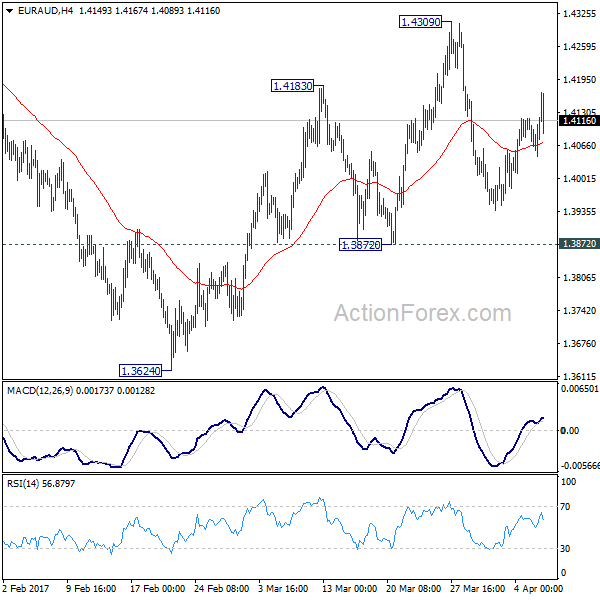
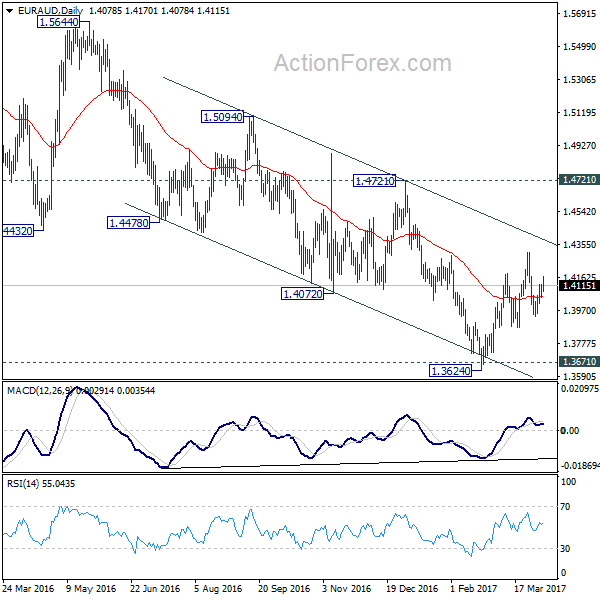
EUR/AUD Daily Outlook
Daily Pivots: (S1) 1.4049; (P) 1.4084; (R1) 1.4123; More...
EUR/AUD is staying in range of 1.3872/4309 and intraday bias remains neutral. We're holding on to the view of trend reversal after defending key support level at 1.3671. Another rise is expected as long as 1.3872 minor support holds. Break of 1.4309 will extend the rebound from 1.3624 to 1.4721 key resistance level next. Break should confirm larger trend reversal. However, firm break of 1.3872 support will dampen our bullish view. In such case, intraday bias will be turned back to the downside for 1.3624 low instead.
In the bigger picture, price actions from 1.6587 medium term top are viewed as a corrective pattern. Such correction could be completed after testing 1.3671 support. Break of 1.4721 cluster resistance (38.2% retracement of 1.6587 to 1.3624 at 1.4756) should confirm this case and target 61.8% retracement at 1.5455 and above. Overall, we'd expect the up trend from 1.1602 to resume later. However, sustained break of 1.3671 will invalidate our bullish view and would turn extend the fall from 1.6587 towards 1.1602 long term bottom.
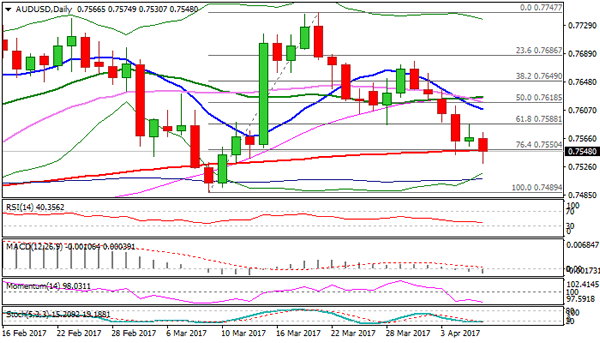
Technical Outlook: AUDUSD – Strong Bearish Signal On Probe Below 200SMA
The Aussie resumed lower after brief consolidation on Wednesday and is probing below 200SMA pivot at 0.7549 which held the action of past two days.
The pair currently riding on the wave C (from 0.7677) of five-wave cycle from 0.7747 peak that reached its 100% Fibonacci expansion at 0.7530 today.
The pair may extend weakness towards next supports at 0.7508 (100SMA) and 0.7489 (09 Mar trough) in strong bearish environment of technical studies, with close below 200SMA seen as strong bearish signal.
Extended wave C could travel to its FE138.2% at 0.7472, on break below 0.7508/0.7489 pivots.
The pair may spend some time in consolidation before resuming downtrend, as slow stochastic is oversold on daily chart.
South-moving daily Tenkan-sen (0.7604) is expected to cap extended upticks.
Res: 0.7574, 0.7585, 0.7604, 0.7618
Sup: 0.7530, 0.7508, 0.7489, 0.7472
EUR/CHF Daily Outlook
Daily Pivots: (S1) 1.0693; (P) 1.0709; (R1) 1.0731; More...
Intraday bias in EUR/CHF remains neutral for the moment. As long as 1.0734 resistance holds, deeper decline is expected in the cross. Below 1.0668 will target 1.0620/29 key support zone. Decisive break there will resume the larger fall from 1.1198. Nonetheless, break of 1.0734 will turn bias back to the upside for 1.0823 resistance instead.
In the bigger picture, the decline from 1.1198 is seen as a corrective move. Current development suggests that it's not completed yet. sustained trading below 38.2% retracement of 0.9771 to 1.1198 at 1.0653 will target 50% retracement at 1.0485. In any case, break of 1.0823 resistance is needed to be the first indication of reversal. Otherwise, deeper fall is still expected even in case of recovery.


USD/JPY De-Risking Ahead Of Trump-Xi Meeting
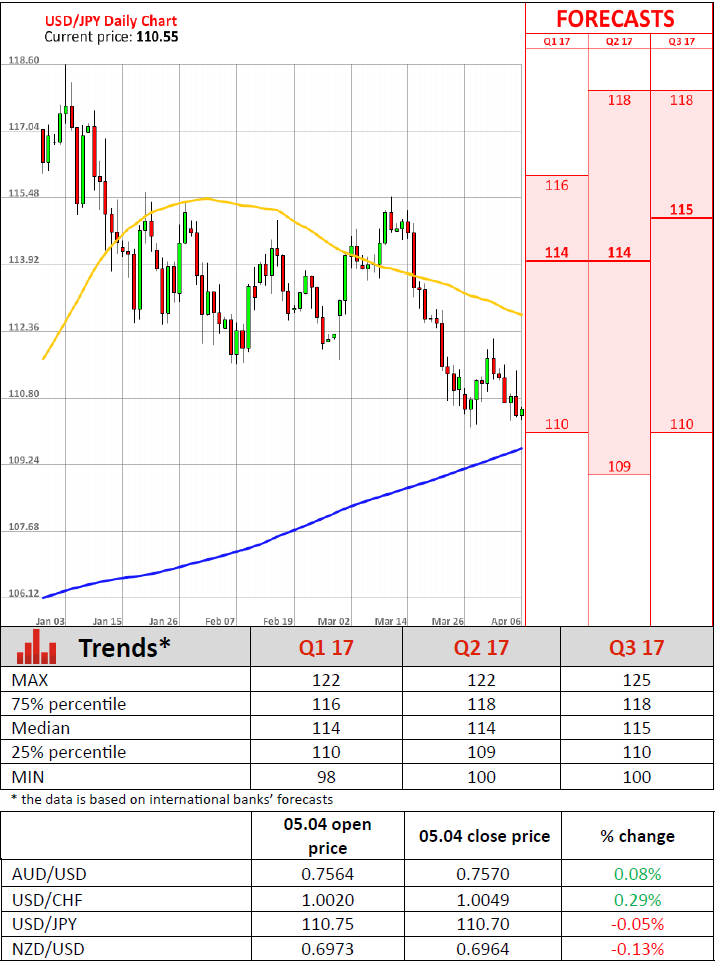
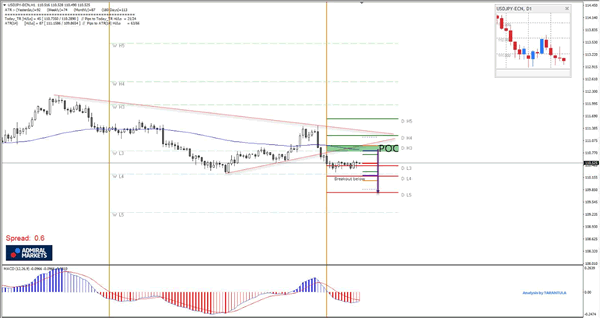
As shown on Live Trading Session yesterday, the USD/JPY fell as expected due by overnight sell off in equities. Equities dropped due to de-risking ahead of Trump-Xi meeting, so we might see another bearish rejection on retracement. The POC 110.80-95 ( D H3, EMA89, ATR Pivot, trend line) could reject the price towards 110.18. Break below it should target 109.77 - the strongest daily support.
D H3 - Daily Camarilla Pivot (Daily Resistance)
POC - Point Of Confluence (The zone where we expect price to react - aka entry zone)
D L5 - Daily Camarilla Pivot (Strongest Daily Support)
W L4 - Weekly L3 Camarilla (Very Strong Weekly Support)
W L5 - Weekly L4 Camarilla (Strongest Weekly Support)
Markets Eye On The Trump-Xi Meeting
US President Trump and Chinese president Xi Jinping, are scheduled to meet today at Trump's Mar-a-Lago resort in Florida. This is the first meeting between the leaders of the two biggest economies in the world so markets will be looking for any comments made between these 2 world leaders.
There are some sensitive issues between the US and China, such as trade protectionism, currency manipulation, South China Sea claims and North Korea's nuclear program. President Trump stated that 'if China doesn't take actions to rein in the development of nuclear strength in North Korea then the US will act alone'.
President Xi has expressed his stance in March that the two countries should 'co-operate for mutual benefits'. Xi is now facing a big challenge to show his people that he can cope with the relationship with US well. Unlike Trump's frankness, Xi seems to be taking a more cautious stance on his comments. For both presidents, the outcome of the meeting will likely influence their prestige. Be aware that this political event will likely cause volatility for USD and outweigh the economic data performance.
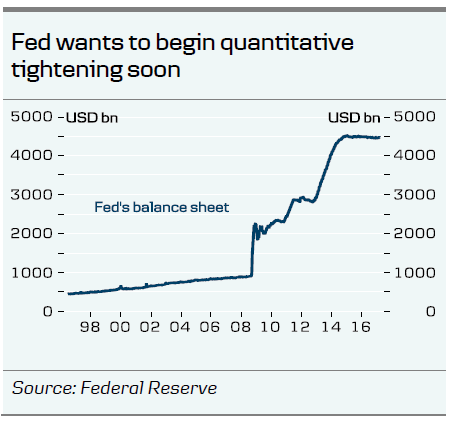
The Federal Open Market Committee (FOMC) released the minutes from its mid-March meeting yesterday. The FOMC is considering shrinking its $4.5 trillion balance sheet later this year for monetary policy normalisation.
The FOMC stated that 'global economic growth has increased and global economic risks were balanced, the US economy continues to perform well and close to maximum employment and inflation has reached the Fed's target of 2% in February for the first time in five years'.
Most FOMC officials support gradual pace rate hikes. However, the fiscal stimulus is still viewed as an upside risk, therefore the FOMC will likely accelerate the pace to raise rates if they see the economy overheating. Some FOMC officials views stock prices as being too high. Per the CME's FedWatch tool; the probability of a rate hike in June has risen from 59% to 63.1% after the release of the minutes.
The dollar index hit a 3-week high of 100.95 ahead of the release of the minutes. Nevertheless, it fell around 70 points after the minutes as the pressure at the significant resistance level at 101.00 is heavy. This morning USD rallied from the support line at 100.30 hitting the intra-day high of 100.64.
US initial jobless claims (the week ending March 31) will be released at 13:30 BST, it will likely affect USD and USD crosses. FOMC non-voting member Williams will make a speech at 14:30 BST.
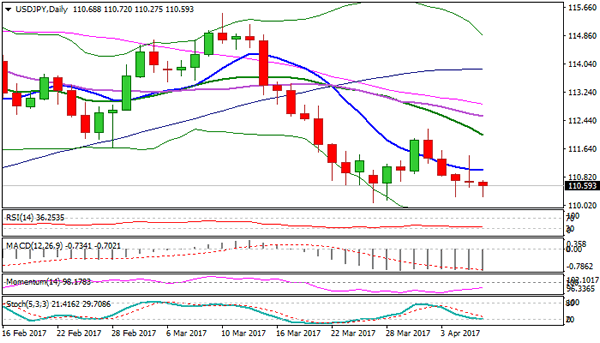
Technical Outlook: USDJPY – Key 110.00 Support Under Pressure After Strong Upside Rejection
The pair remains under strong pressure and eyes 110.00 support zone, after Wednesday's recovery attempts were capped by weekly cloud top (111.36) and subsequent strong bearish acceleration turned near-term focus lower again.
Probes above daily Tenkan-sen (111.14) were short-lived, keeping it as strong resistance, as Wednesday's daily candle with long upper shadow, heavily weighing on near-term action.
Strong bearish setup of daily studies maintains negative tone, however, hesitation ahead of pivotal 110.00 zone could be anticipated as slow stochastic is entering oversold territory.
Daily Tenkan-sen is expected to ideally cap, with Friday's close being in focus for stronger signals.
Close below weekly cloud top will be seen as strong bearish signal.
Res: 110.71, 111.02, 111.14, 111.36
Sup: 110.25, 110.09, 109.91, 109.30
FOMC Minutes: Quantitative Tightening Is Moving Closer
In terms of the economic development there was not much new in the FOMC minutes, as the FOMC members have already been quite outspoken since the meeting. The overall message from the meeting was that the Fed is on track and delivered one of the three hikes it projected back in December 2016 - the Fed has not become more hawkish, see FOMC Review: Fed says it is on track, not more hawkish, 15 March. The Fed signalled a total of three Fed hikes both this year and next year, more or less in line with our expectations. We expect the Fed to hike in July and December and 3-4 times next year.
However, as Yellen had hinted at, the FOMC participants discussed when to change their current reinvestment strategy (which states that the Fed will continue to reinvest principal payments until the normalisation of the Fed funds rate is 'well under way'). The minutes say that 'a change to the Committee's reinvestment policy would likely be appropriate later this year'. We still expect the Fed to begin shrinking its balance sheet in Q1 18 (what we call quantitative tightening), while consensus among both primary dealers and analysts is mid-2018, but risk is skewed towards already by the end of this year (perhaps December). We think an announcement on what could trigger quantitative tightening is likely in connection with the June meeting. The FOMC members still want quantitative tightening to be 'conducted in a passive and predictable manner'.
We have written intensively on quantitative tightening recently. Rising demand for currency, change in US treasury cash balance policy and financial regulation limit the scope for a reduction of the balance sheet. The risk is that quantitative tightening could lead to an unwarranted tightening of USD liquidity. For more see also Research US: Fed's regulatory hurdle for starting quantitative tightening, 13 March.
The participants also discussed whether the timing of quantitative tightening should be based on a quantitative threshold or on a qualitative judgement. Based on the minutes, 'several' participants prefer the former while 'some' prefer the latter, meaning that quantitative tightening would likely depend on the Fed funds target range or the level of an economic variable (possibly the PCE inflation rate or the unemployment rate, as was the case with the Evans rule).
The minutes indicate that the FOMC members 'generally preferred to phase out or cease reinvestments of both Treasury securities and agency MBS'. This is slightly new, as the Fed has previously indicated it preferred to reduce its holding of MBS. The FOMC members also discussed pros and cons about whether to phase out or cease reinvestments all at once without being specific about what they prefer.
Also interesting, the Fed staff still expects the Trump administration to ease fiscal policy but has 'pushed back the timing of when those policy changes were anticipated to take effect'. We have also become more pessimistic on the outlook for Trumponomics after the Republicans' failure to change Obamacare. Changes to US economic policy are likely to come later and be smaller than previously expected due to the uncertainty within the Republican Party. For more details see also Strategy: Trumponomics postponed further, 24 March.
Daily Technical Analysis: EURUSD, GBPUSD, USDJPY, USDCHF
EURUSD
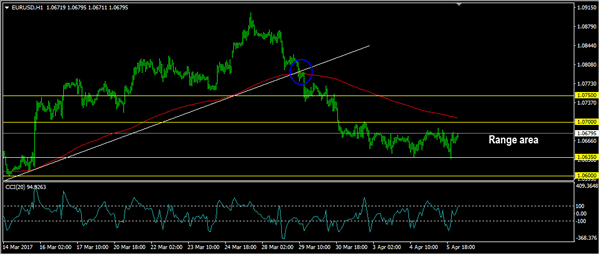
The EURUSD had another indecisive movement yesterday. The bias remains neutral in nearest term. Price has been moving sideways between 1.0635 – 1.0700 range area as you can see on my H1 chart below suggests a consolidation phase. That said, price is still in a bearish short-term trend after formed a 'shooting star' formation on daily chart last week and broke below the trend line support as you can see on my H1 chart below, targeting 1.0600 region. Immediate resistance is seen around 1.0700. A clear break above that area could trigger further bullish pressure but only a clear break and daily close above 1.0750 would end the current bearish short-term bias. Fundamental focus will be on the US NFP on Friday. Overall I remain neutral.
GBPUSD
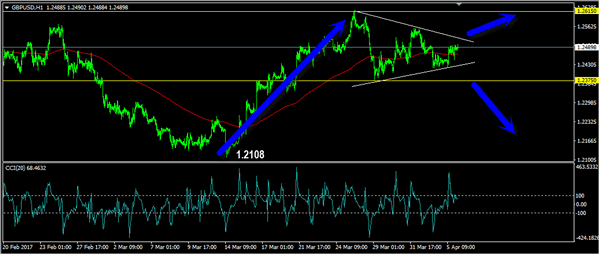
The GBPUSD failed to continue its bearish momentum yesterday topped at 1.2497 and hit 1.2501 earlier today in Asian session. The bias is neutral in nearest term. As you can see on my H1 chart below, price is moving inside a triangle formation suggests a consolidation phase after a bullish run from 1.2108 on March 14. Price needs to break above the triangle (1.2525) to continue this bullish run retesting 1.2615 region. On the downside, the lower line of the triangle located around 1.2425 and 1.2375 are key supports at this phase. Fundamental focus will be on the US NFP on Friday. Overall I remain neutral.
USDJPY
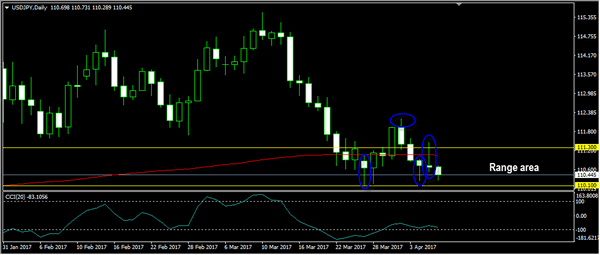
The USDJPY attempted to push higher yesterday but whipsawed to the downside and closed lower at 110.67 after a rejection to break above 111.30 key resistance. The bias is bearish in nearest term but note that we need a clear break and daily close below 110.10 key support to establish a new and longer bearish trend with nearest target seen around 108.50 area. On the upside, a clear break and daily close back above 111.30 would expose 112.00 or higher. Fundamental focus will be on the US NFP on Friday.
USDCHF
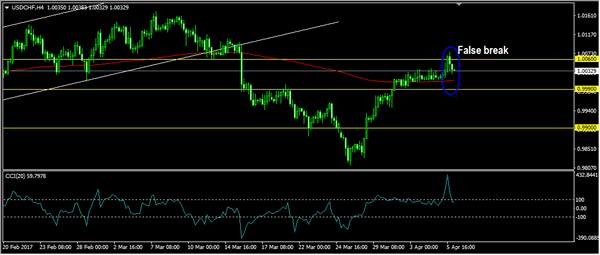
The USDCHF had a bullish momentum yesterday topped at 1.0076 but closed lower at 1.0049 and hit 1.0026 earlier today in Asian session. For me this is a false breakout above 1.0060 resistance. The bias is bearish in nearest term testing 0.9990. On the upside, any sustained movement above 1.0060 would expose 1.0120 or higher. Fundamental focus will be on the US NFP on Friday. Overall I remain neutral.
APAC Session: North Korea Worries Weigh On Yen/Nikkei
USD/JPY trades heavier along with the Korean Won as North Korea tensions also weigh on Japan stocks.
North Korea tensions were the highlight of the Asia session, eclipsing last night's blockbuster ADP Employment Change, and the FOMC minutes Federal Reserve balance sheet unwind bombshell. President Trump spoke with Prime Minister Abe about the situation ahead of his meeting with China's President Xi, reiterating it seems nothing is off the table. Unsurprisingly, the USD/KRW has traded higher throughout the session, up 9 Won or 0.80% to 1133.
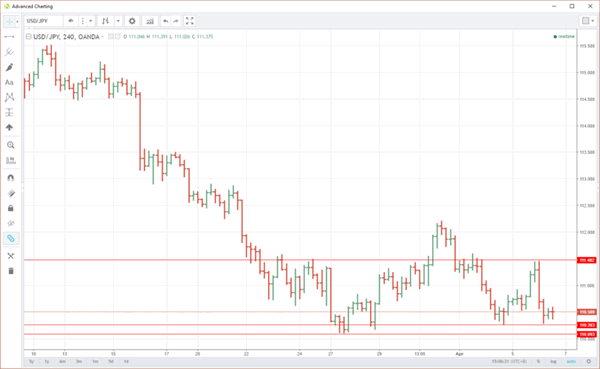
USD/JPY has also traded heavily, down 40 points to 110.30 at one stage before settling at 110.50 as the Nikkei dropped one percent on safe-haven flows. This is in exception to most of the G-10 where the USD has been flat to small up on the day. Clearly, regional worries are taking precedence over a massive ADP figure of 263,000 and the news that the FOMC are looking at a balance sheet run down to start later in the year. The latter in particular is significant, as to my mind it adds up to a potentially 3rd effective tightening to come making it four for the year.
The focus will now be on the important 110.00/110.10 support level on USD/JPY where we expect to see a lot of two-way interest with the possibility of stop-losses behind setting a new trading range. Ahead of this, there is support at 110.25, with resistance at yesterday's high at 110.75 and then 111.50. As equities and metals rolled over last night on the FOMC news, it was surprising that USD yields in fact fell.
As equities and metals rolled over last night on the FOMC news, it was surprising that USD yields in fact fell. A catch-up correction higher is possibly the only thing that could prevent at least a test of the 110 area. Tonights Non-Farm Payrolls becomes even more important in this context with estimations marked higher materially following the ADP overnight.
AUD/USD
The Aussie Dollar has been the other main mover in the Asian session with a double whammy from the banking regulator and China data. APRA, the Australian Banking Regulator, intends to make banks hold more capital against risky mortgage lending. Housing Capital: source AFR This followed already announced limits to interest-only lending recently announced.
The March China CaixinPMI Services then came in at a six-month low of 52.2.
CHINA MAR CAIXIN PMI SERVICES: 52.2 (6-month low and 3rd straight sequential decline) V 52.6 PRIOR,
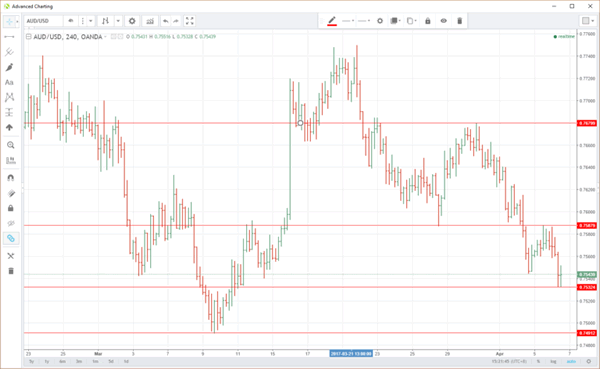
The AUD dropped 40 points to a low of 7530 before a slight recovery to 7542. Having broken down on the AUD/JPY cross the AUD/USD is now eyeing the important support zone of 7490/7500. A daily close below suggests a new and lower trading range is on the card. Up above AUD now has resistance at 7590 and then 7680.