

Sample Category Title
GBP/USD Daily Outlook
Daily Pivots: (S1) 1.2955; (P) 1.3007; (R1) 1.3036; More...
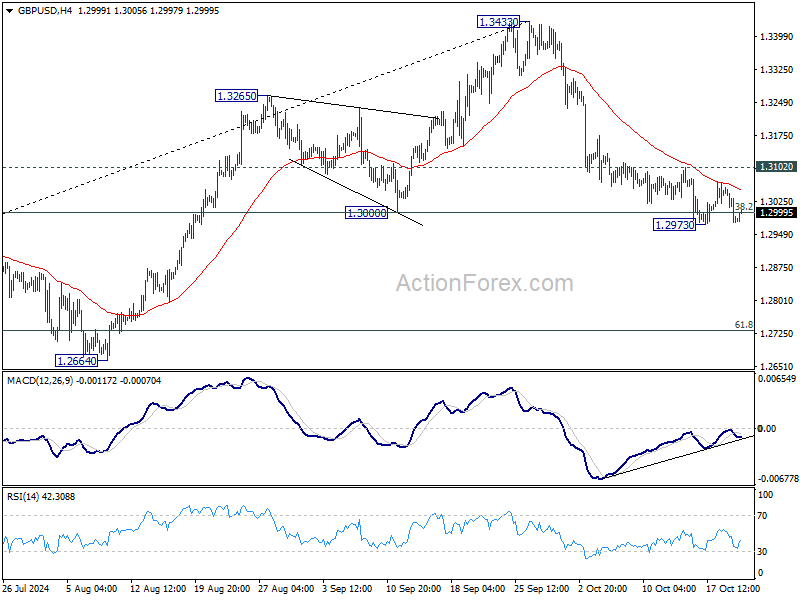
GBP/USD is still bounded in consolidations above 12973 temporary low. Intraday bias remains neutral at this point. On the upside, firm break of 1.3102 resistance will argue that pullback from 1.3433 has completed, and turn bias back to the upside for stronger rebound. On the downside, however, sustained break of 1.3000 cluster support (38.2% retracement of 1.2298 to 1.3433 at 1.2999) will argue that whole rise from 1.2298 has completed and bring deeper fall to 61.8% retracement at 1.2732.
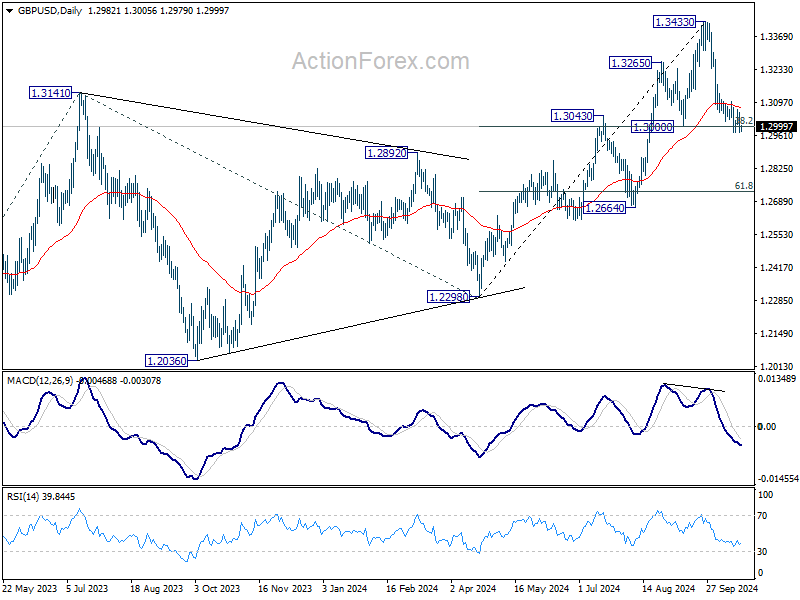
In the bigger picture, as long as 1.3000 support holds, the up trend from 1.0351 (2022 low) is still in progress. Next target is 61.8% projection of 1.0351 to 1.3141 from 1.2298 at 1.4022. However, considering mild bearish divergence condition in D MACD, decisive break of 1.3000 will argue that a medium term top is already in place, and bring deeper fall back to 1.2664 support next.
USD/CHF Daily Outlook
Daily Pivots: (S1) 0.8642; (P) 0.8653; (R1) 0.8673; More…
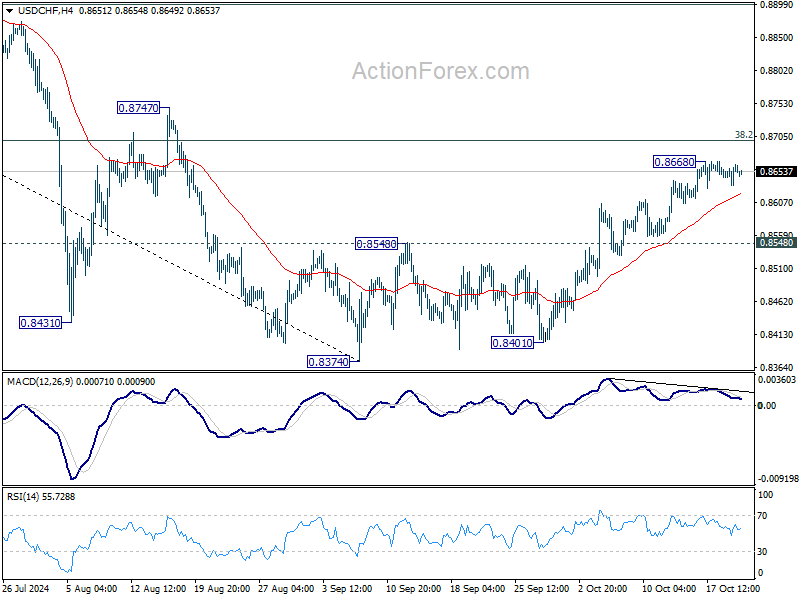
USD/CHF is staying in consolidation below 0.8668 temporary top and intraday bias stays neutral. Further rally is expected as long as 0.8548 resistance turned support holds. Above 0.8668 will target 38.2% retracement of 0.9223 to 0.8374 at 0.8698. Sustained break there will argue that fall from 0.9223 has completed at 0.8374, after defending 0.8332 low. Further rally should then be seen to 61.8% retracement at 0.8899 next.
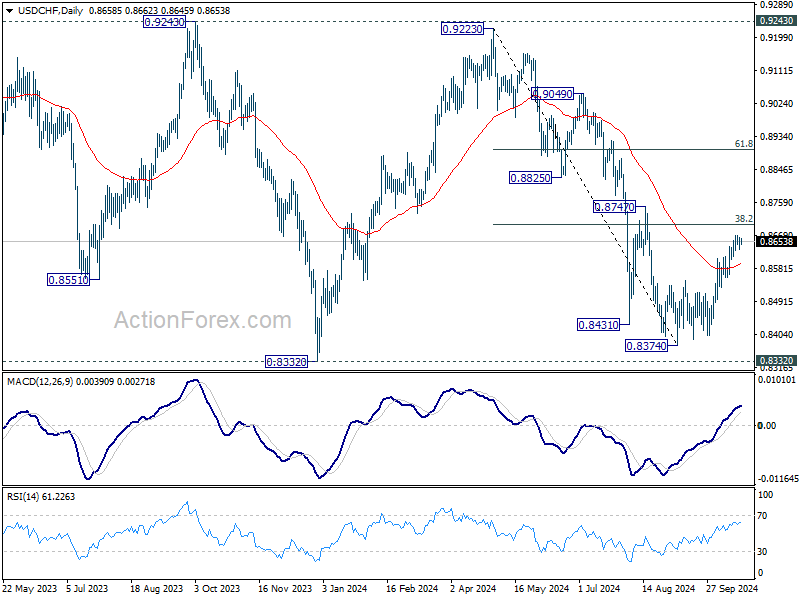
In the bigger picture, price actions from 0.8332 (2023 low) are currently seen as a medium term corrective pattern, with fall from 0.9223 as the second leg. Strong support could be seen from 0.8332 to bring rebound. Yet, overall outlook will continue to stay bearish as long as 0.9243 resistance holds. Firm break of 0.8332, however, will resume larger down trend from 1.0146 (2022 high).
USD/JPY Daily Outlook
Daily Pivots: (S1) 149.66; (P) 150.27; (R1) 151.46; More...
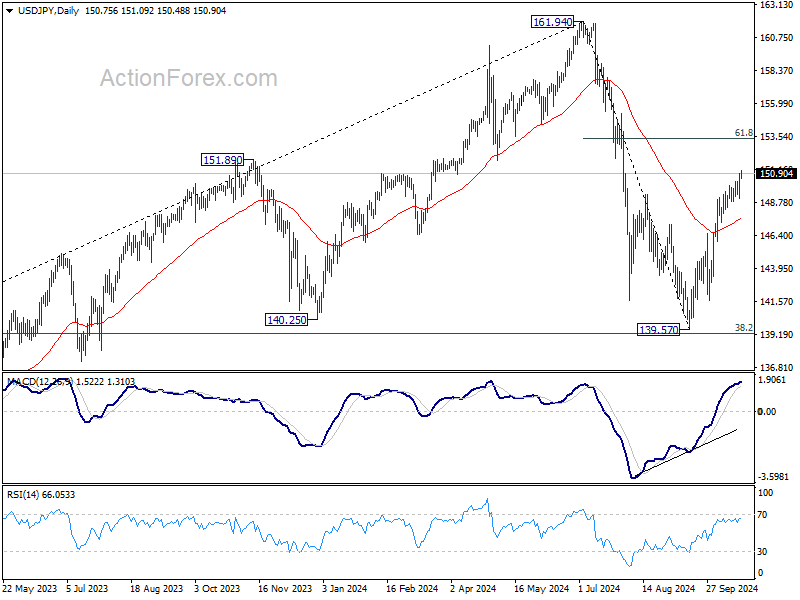
USD/JPY's rally from 139.57 resumed after brief consolidations, and re-accelerates. Intraday bias is back on the upside for 61.8% retracement of 161.94 to 139.57 at 153.39. On the downside, below 149.08 minor support will turn intraday bias neutral again. But still, further rally is in favor as long as 146.48 resistance turned support holds, in case of retreat.
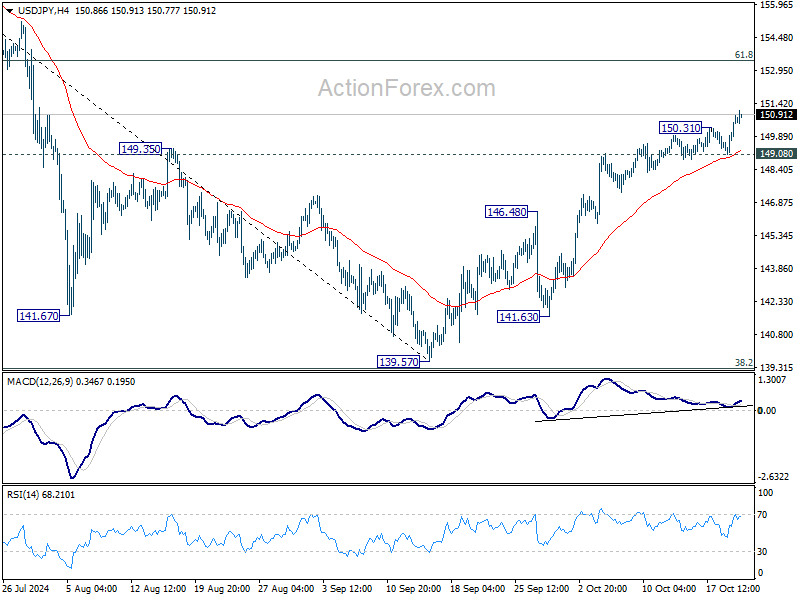
In the bigger picture, price actions from 161.94 are seen as a corrective pattern to rise from 102.58 (2021 low). The range of medium term consolidation should now be set between 38.2% retracement of 102.58 to 161.94 at 139.26 and 161.94. Nevertheless, sustained break of 139.26 would open up deeper medium term decline to 61.8% retracement at 125.25.
Rising US Yields Push Dollar Higher, While Yen and Euro Struggle
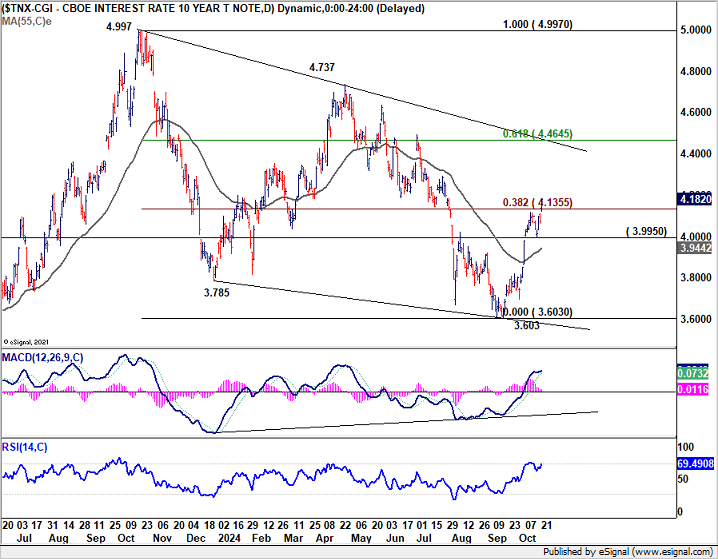
Dollar strengthened broadly overnight, propelled by the extended rally in US Treasury yields. 10-year yield soared to its highest level since late July, breaching 4.2% mark during Asian trading session. The move reflects growing market expectations that Fed's monetary policy easing will proceed more slowly than initially hoped. Importantly, there is an increasing belief that the terminal rate for this cycle will be higher, as the neutral rate is now generally estimated to exceed pre-pandemic levels.
In addition, some speculations are mounting that 10-year yield could advance toward 5% handle, driven by resurging inflation expectations due to Fed's measured pace in reducing rates, as well as concerns over escalating US fiscal spending and the associated increase in bond issuance.
Technically, 10 year yield's break of 38.2% retracement of 4.997n to 3.603 at 4.135 is significant, as it reinforces the case that correction from 4.997 has already completed with three waves down to 3.603. Further rally is now expected as long as 3.995 support holds (or in short 4% mark). Next target is 61.8% retracement at 4.464. While it's still early to draw any conclusions, decisive break of 4.464 would open the path for a retest of 4.997 high or even resumption of the long-term uptrend.
Overall in the currency markets, Japanese Yen is the worst performer, notably breaking its recent negative correlation with Nikkei Index. Yen is now reacting more sensitively to rising US yields rather than domestic risk aversion. Additionally, Japanese officials appear to be refraining from verbal intervention as USD/JPY breaches the critical 150 mark this time.
Euro is the second weakest currency, followed by the British Pound. Sterling is poised for movements pending comments from BoE Andrew Bailey today, particularly regarding whether he will reaffirm the possibility of adopting a more "activist" approach to rate cuts.
Swiss Franc is following behind Dollar as the second strongest currency of the week so far, with Loonie also showing strength. Australian and New Zealand Dollars are positioned in the middle.
In Asia, at the time of writing, Nikkei is down -1.41%. Hong Kong HSI is up 0.36%. China Shanghai SSE is up 0.53%. Singapore Strait Times is down -0.32%. Japan 10-year JGB yield is up 0.018 at 0.980. Overnight, DOW fell -0.80%. S&P 500 fell -0.18%. NASDAQ rose 0.27%. 10-year yield rose 0.109 to 4.182.
Fed’s Kashkari sees modest rate cuts ahead to neutral
Minneapolis Fed President Neel Kashkari stated at an event overnight that he expects "some more modest cuts" in interest rates over the coming quarters, to bring rates closer to a neutral level. However, Kashkari emphasized that the pace and size of future cuts will be heavily dependent on incoming data.
The concept of a "neutral" rate refers to the point where borrowing costs neither accelerate nor hinder economic growth. According to Kashkari, the economy’s current resilience suggests that the neutral rate may be higher than previously estimated.
However, Kashkari also highlighted a key risk that could alter this outlook. If significant weakness were to emerge in the labor market, Fed might need to lower rates faster than currently anticipated.
“If we saw real evidence that the labor market is weakening quickly, that would tell me, as one policymaker, that maybe we ought to bring down our interest rate more quickly than I currently expect,” he explained.
Fed’s Schmid favors gradual rate cuts, avoid outsized moves
Kansas City Fed President Jeffrey Schmid emphasized a measured approach to monetary policy, stating that while he supports reducing the restrictiveness of current rates, his preference is to "avoid outsized moves."
“Lowering rates in a gradual fashion would provide time to observe the economy's reaction to our interest rate adjustments and give us the space to assess at what level interest rates are neither restricting nor boosting the economy,” Schmid explained.
He also highlighted that the neutral rate, the level where interest rates neither stimulate nor restrict economic growth, is likely to be "well above" the levels seen during the pre-pandemic period.
Schmid also warned that aggressive rate cuts could foster an expectation of continued rapid cuts, which could amplify financial market volatility. "My belief is that a cautious and gradual approach to policy adjustments would be best suited for this uncertain environment," he said.
Fed's Daly: Rate reductions on track, no signs to change course
San Francisco Fed President Mary Daly stated at a conference that she sees no indications that would prompt a halt in the gradual reduction of interest rates. Daly emphasized that the current rate remains "very tight" for an economy steadily progressing toward 2% target, adding that " I don’t want to see the labor market go further.”
Reflecting on Fed’s September decision to cut rates by 50bps, Daly noted that it was a “close call” between opting for a half-point or quarter-point reduction. However, she stood firmly behind the larger cut.
Although she did not give clear guidance on the pace of future cuts, Daly affirmed that the Fed would “continue to adjust policy to make sure it fits the economy that we have and the one that’s evolving."
New Zealand's exports rise 5.2% yoy in Sep, imports fall -0.9% yoy
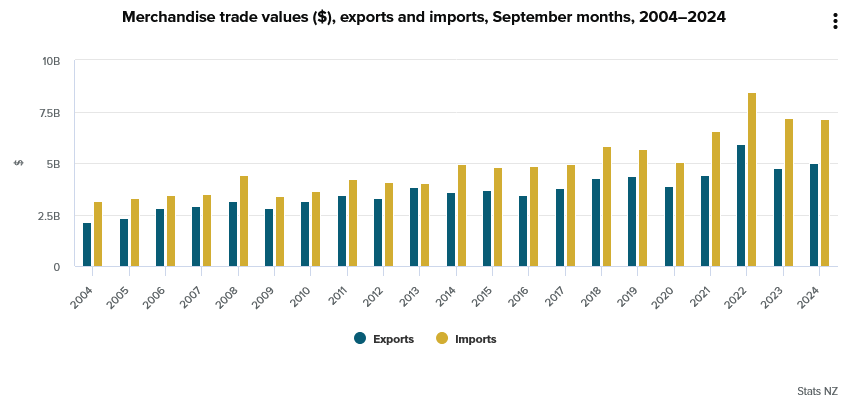
New Zealand's trade balance in September 2024 showed a deficit of NZD -2.1B. Goods exports rose by NZD 246m, or 5.2% yoy, reaching NZD 5.0B. Meanwhile, goods imports fell by NZD -67m, or -0.9% yoy, to NZD 7.1B.
Export data showed mixed performance across key trading partners. Exports to China dropped significantly by NZD -109m (-8.8%), and Japan saw a decline of NZD -22m (-8.2%). Exports to Australia also fell NZD -7m or -0.9%. However, exports to the EUR surged by NZD 183m (67%), while exports to the US also increased by NZD 11m (1.9%).
On the import side, the decline was driven by a significant drop in imports from China, down by NZD -158m (-9.8%). Imports from the US surged, rising NZD 330m (51%), while imports from Australia and the EU saw marginal gains of 0.9% and 1.1% respectively. South Korea’s imports fell by NZD -45m (7.3%).
Looking ahead
UK will release public sector net borrowing in European session. Later in the day, Canada will release IPPI and RMPI.
USD/JPY Daily Outlook
Daily Pivots: (S1) 149.66; (P) 150.27; (R1) 151.46; More...
USD/JPY's rally from 139.57 resumed after brief consolidations, and re-accelerates. Intraday bias is back on the upside for 61.8% retracement of 161.94 to 139.57 at 153.39. On the downside, below 149.08 minor support will turn intraday bias neutral again. But still, further rally is in favor as long as 146.48 resistance turned support holds, in case of retreat.
In the bigger picture, price actions from 161.94 are seen as a corrective pattern to rise from 102.58 (2021 low). The range of medium term consolidation should now be set between 38.2% retracement of 102.58 to 161.94 at 139.26 and 161.94. Nevertheless, sustained break of 139.26 would open up deeper medium term decline to 61.8% retracement at 125.25.
Gold Hits New High: Can The Momentum Continue?
Key Highlights
- Gold started a fresh surge and traded to a new high above $2,740.
- It cleared a major bearish trend line with resistance at $2,660 on the 4-hour chart.
- Oil prices corrected gains and traded below the $71.20 support zone.
- EUR/USD remains at risk of more losses below 1.0825.
Gold Price Technical Analysis
Gold prices formed a base above $2,650 against the US Dollar. The price started a fresh surge and cleared many hurdles near $2,700 to set a new all-time high.
The 4-hour chart of XAU/USD indicates that the price cleared a major bearish trend line with resistance at $2,660 to move into a positive zone. There was a sharp increase above the $2,715 and $2,720 levels.
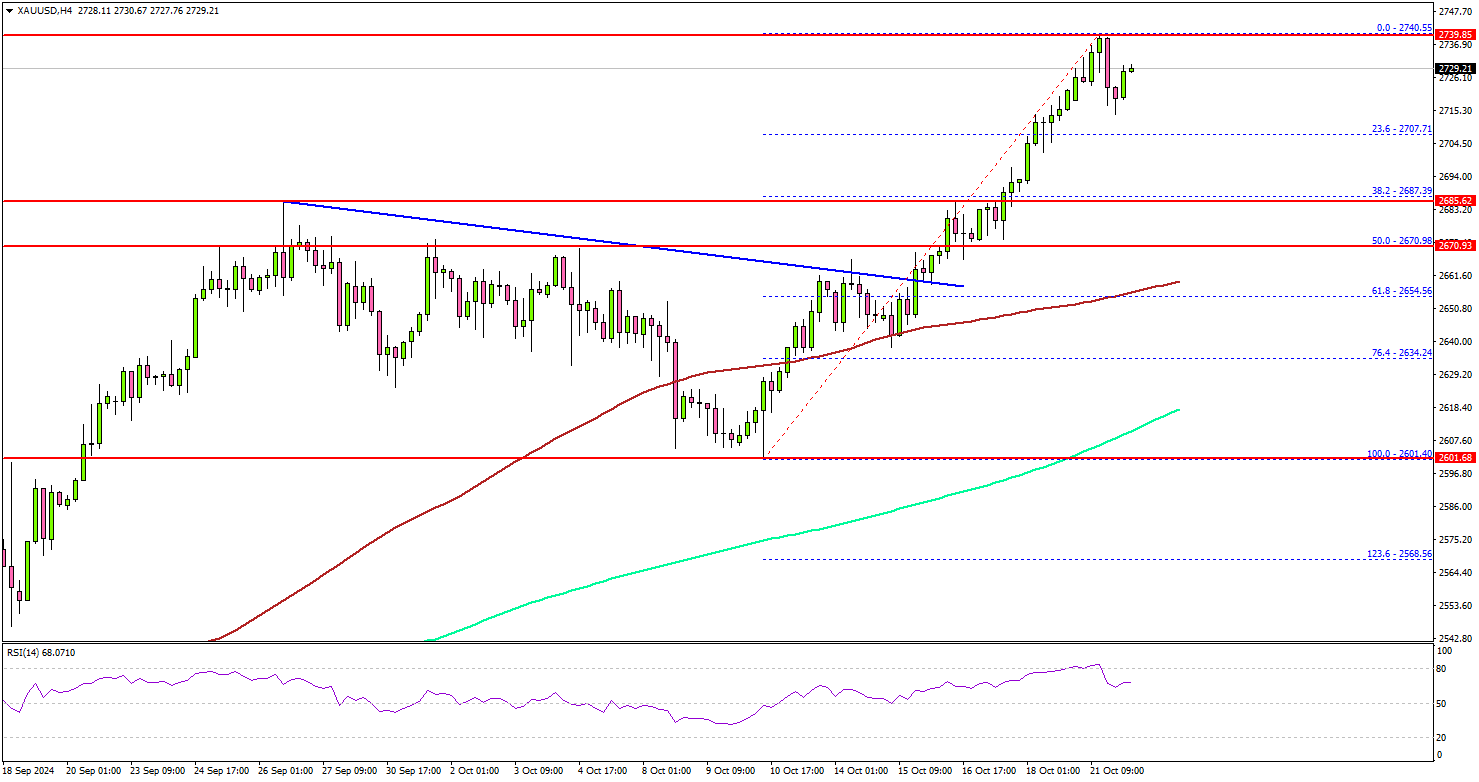
The price even traded above $2,735 to set a new all-time high. The price is now consolidating gains and trading well above the 23.6% Fib retracement level of the upward move from the $2,601 swing low to the $2,740 high, the 100 Simple Moving Average (red, 4 hours), and the 200 Simple Moving Average (green, 4 hours).
On the downside, initial support is near the $2,710 level. The first major support is near the $2,688 level. It is close to the 38.2% Fib retracement level of the upward move from the $2,601 swing low to the $2,740 high.
The main support is now $2,650. A downside break below the $2,650 support might call for more downsides. The next major support is near the $2,620 level.
On the upside, immediate resistance is near the $2,740 level. The first major resistance sits near the $2,750 level. A clear move above the $2,750 resistance could open the doors for more upsides. The next major resistance could be near $2,765, above which the price could rally toward the $2,780 level.
Looking at Oil, the price struggled near the $72.50 resistance and now remains at risk of more losses below the $70.00 level.
Economic Releases to Watch Today
- Fed's Harker speech.
New Zealand’s exports rise 5.2% yoy in Sep, imports fall -0.9% yoy
New Zealand's trade balance in September 2024 showed a deficit of NZD -2.1B. Goods exports rose by NZD 246m, or 5.2% yoy, reaching NZD 5.0B. Meanwhile, goods imports fell by NZD -67m, or -0.9% yoy, to NZD 7.1B.
Export data showed mixed performance across key trading partners. Exports to China dropped significantly by NZD -109m (-8.8%), and Japan saw a decline of NZD -22m (-8.2%). Exports to Australia also fell NZD -7m or -0.9%. However, exports to the EUR surged by NZD 183m (67%), while exports to the US also increased by NZD 11m (1.9%).
On the import side, the decline was driven by a significant drop in imports from China, down by NZD -158m (-9.8%). Imports from the US surged, rising NZD 330m (51%), while imports from Australia and the EU saw marginal gains of 0.9% and 1.1% respectively. South Korea’s imports fell by NZD -45m (7.3%).
Fed’s Daly: Rate reductions on track, no signs to change course
San Francisco Fed President Mary Daly stated at a conference that she sees no indications that would prompt a halt in the gradual reduction of interest rates. Daly emphasized that the current rate remains "very tight" for an economy steadily progressing toward 2% target, adding that " I don’t want to see the labor market go further.”
Reflecting on Fed’s September decision to cut rates by 50bps, Daly noted that it was a “close call” between opting for a half-point or quarter-point reduction. However, she stood firmly behind the larger cut.
Although she did not give clear guidance on the pace of future cuts, Daly affirmed that the Fed would “continue to adjust policy to make sure it fits the economy that we have and the one that’s evolving."
Fed’s Schmid favors gradual rate cuts, avoid outsized moves
Kansas City Fed President Jeffrey Schmid emphasized a measured approach to monetary policy, stating that while he supports reducing the restrictiveness of current rates, his preference is to "avoid outsized moves."
“Lowering rates in a gradual fashion would provide time to observe the economy's reaction to our interest rate adjustments and give us the space to assess at what level interest rates are neither restricting nor boosting the economy,” Schmid explained.
He also highlighted that the neutral rate, the level where interest rates neither stimulate nor restrict economic growth, is likely to be "well above" the levels seen during the pre-pandemic period.
Schmid also warned that aggressive rate cuts could foster an expectation of continued rapid cuts, which could amplify financial market volatility. "My belief is that a cautious and gradual approach to policy adjustments would be best suited for this uncertain environment," he said.
Fed’s Kashkari sees modest rate cuts ahead to neutral
Minneapolis Fed President Neel Kashkari stated at an event overnight that he expects "some more modest cuts" in interest rates over the coming quarters, to bring rates closer to a neutral level. However, Kashkari emphasized that the pace and size of future cuts will be heavily dependent on incoming data.
The concept of a "neutral" rate refers to the point where borrowing costs neither accelerate nor hinder economic growth. According to Kashkari, the economy’s current resilience suggests that the neutral rate may be higher than previously estimated.
However, Kashkari also highlighted a key risk that could alter this outlook. If significant weakness were to emerge in the labor market, Fed might need to lower rates faster than currently anticipated.
“If we saw real evidence that the labor market is weakening quickly, that would tell me, as one policymaker, that maybe we ought to bring down our interest rate more quickly than I currently expect,” he explained.
USDCAD Eyes 1.39: Bullish Momentum Builds in Linear Regression Channel
Fundamental Analysis
The Canadian dollar (CAD) is under significant pressure due to the drop in Canada’s annual inflation rate, which fell to 1.6% in September 2024, well below the Bank of Canada's (BoC) 2% target. This price slowdown, primarily driven by the decline in gasoline and transportation costs, has fueled expectations of a 50-basis-point rate cut at the BoC’s next meeting. Additionally, oil prices, which play a key role in the CAD’s value, plummeted more than 7% last week, further impacting the Canadian dollar, which heavily depends on crude export revenues.
In contrast, the US dollar has gained ground, driven by a more resilient economy, reducing the likelihood of aggressive rate cuts by the Federal Reserve. This strengthening of the USD and the expectation of more relaxed monetary policies in Canada have pushed the USDCAD pair above the 1.3800 level. As investors anticipate the BoC rate cut, the CAD will likely weaken in the short term, especially if oil prices remain low and inflation stays below target.
Technical Analysis
USDCAD, H4
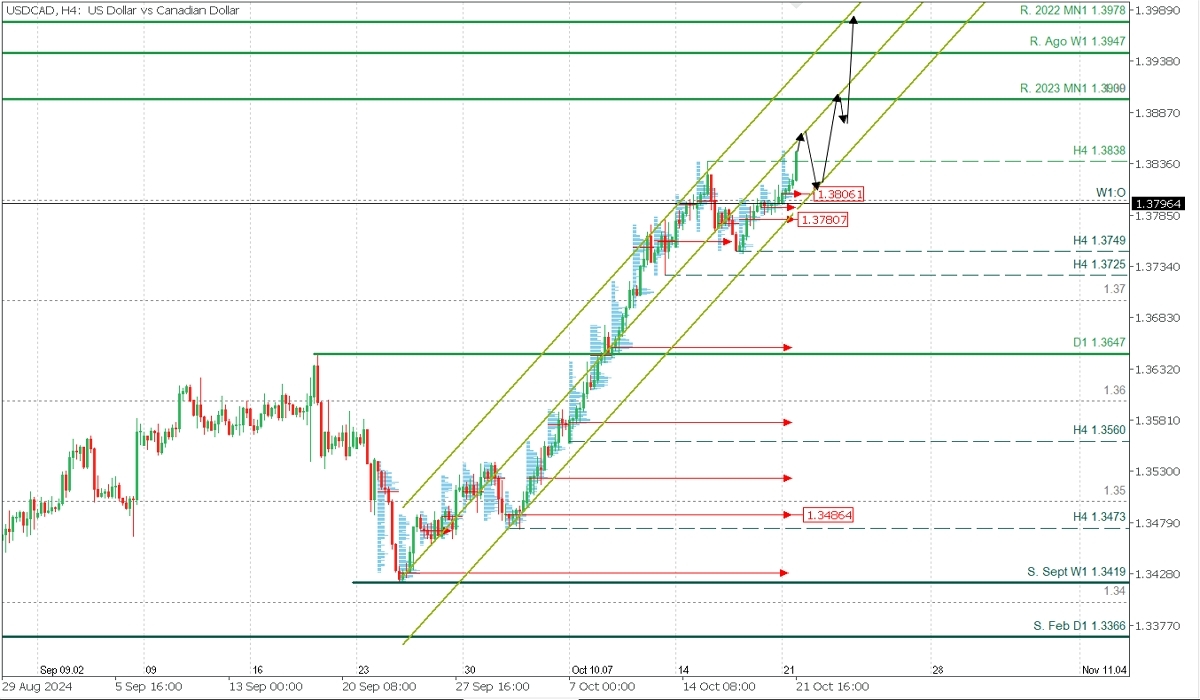
Supply Zones (Sell): 1.39
Demand Zones (Buy): 1.3806, 1.3793, and 1.3780
The pair extends its strength within the bullish linear regression channel, although it is trading near the lower band, which represents the lowest deviation from the regression line (central line) and indicates the minimum expected value within the trend. This suggests that prices have the potential to extend the bullish trend after surpassing the midline towards the 2023 resistance at 1.39 in the short term and breaking the August and 2022 resistances in the medium term.
Additionally, the bullish opening of the week responds to three key demand zones from 1.3780 (uncovered POCs*) up to the opening around 1.3806, implying a broad buying block that will prevent the price from falling below.
The last validated intraday support is at the 1.3749 level, meaning that as long as the price does not break this level in the next correction, the bullish trend will remain active.
Technical Summary
Bearish corrective scenario:
Intraday sells below 1.3855 (after the formation and confirmation of a PAR*) with TP at 1.3825, 1.3815, and 1.3810 on extension. Use a 1% SL of your capital.
Bullish continuation scenario:
Buys above 1.3810/1.3815 (where a PAR* forms and confirms) with TP at 1.3850, 1.39, 1.3950, and 1.3980 on extension. Use a 1% SL of your capital with a low lot size to allow room for movement.