

Sample Category Title
EUR/GBP: Accelerates Higher on Brighter German Investor Morale and Weak UK Pay Growth Data
EURGBP jumped almost 0.4% in European session on Tuesday, as pound came under increased pressure on below forecast UK pay growth data, which further decreased bets for BoE rate hike in Nov 2 policy meeting.
On the other hand, German investor morale (ZEW report – Oct -1.1 vs Sep -11.4 and -9.3 f/c) improved well above expectations, providing strong boost to the single currency.
However, caution is still required as markets do not rule out possible stall of fresh advance, as economic situation in Germany remains fragile and economists expect further decline in inflation, which may negatively impact demand for Euro.
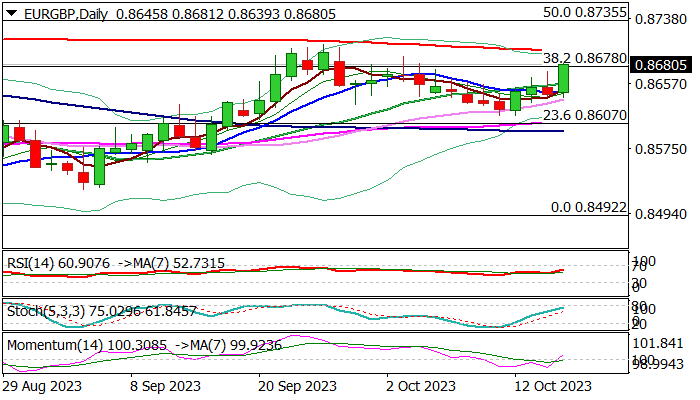
Improving conditions on daily chart (14-momentum broke into positive territory and MA’s turned to bullish setup) underpinning fresh advance, though bulls need clear break above cracked Fibo barrier at 0.8678 (38.2% of 0.8978/0.8492 descend, where recent attacks repeatedly failed to register firm break) to open way towards next key levels at 0.8697 (200 DMA) and 0.8705 (Sep 26 high).
Near-term bias is expected to remain with bulls while the action stays above rising 20DMA (0.8657).
Res: 0.8697; 0.8705; 0.8735; 0.8792.
Sup: 0.8657; 0.8639; 0.8616; 0.8607.
The Crypto Market Went Uphill
Market picture
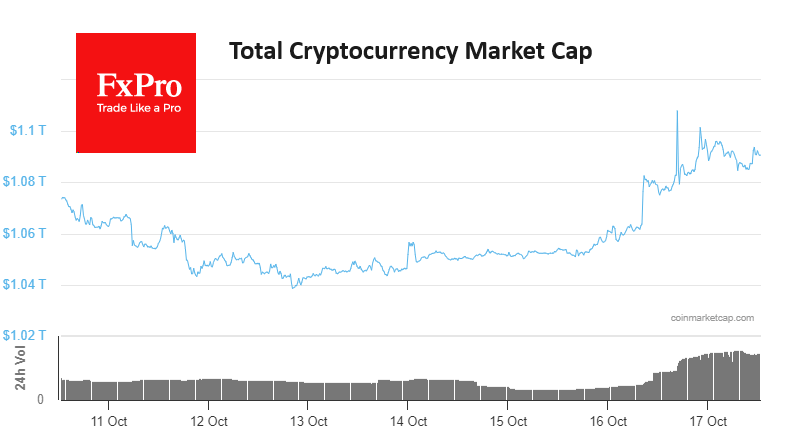
The crypto market cap rose 1.5% over the last 24 hours to $1.091 trillion. Yesterday, the market surged briefly on the false news of Bitcoin spot ETF approval. But interestingly, the ensuing market tide did not derail the short-term upward trend. That said, we continue to see continued elevated trading volumes. We view this as good news, given that the price is not high by historical standards. It is an influx of fresh buyers rather than an active exit from the market.
That said, buyer interest is concentrated around Bitcoin, whose share of total capitalisation is adding in territory above 50%. These are highs since April 2021. This is probably due to the special status of the first cryptocurrency that the SEC is willing to recognise as a commodity while not recognising the rest of the crypto as commodities. But it’s also possible that the remaining coins are under pressure due to reduced developer activity as funding has become more complex.
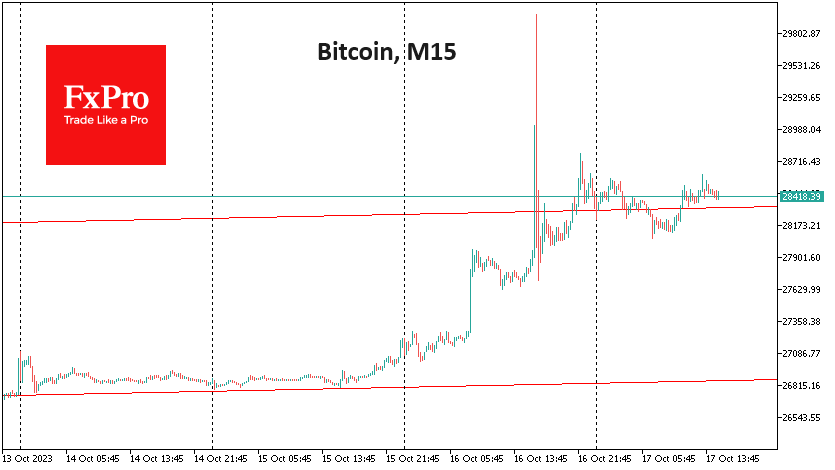
Bitcoin was bouncing towards $30K on Monday, starting at $27.2K. Although we did see a significant pullback, the Bears got busted. BTCUSD closed Monday’s trading above the 200-day average, with the intraday trend gaining momentum. Current positions near $28.5K indicate bullish dominance and confirm the existence of an upward channel since early September with a sequence of more than three higher highs and lows. The market could quickly move to the $29.4K level, recovering from the mid-August sell-off.
News background
According to CoinShares, investments in crypto funds increased by $15 million last week; the inflow of funds continues for the third week. Bitcoin investments were up $16 million, while Ethereum investments were down $7 million. Investments in funds allowing bitcoin shorts were up $1.7 million. Investments in Solana were up $3.7 million, again significantly outperforming all altcoins.
Grayscale Investments (GBTC) bitcoin trust’s discount to net asset value (NAV) narrowed to its lowest since December 2021 at 15.9%. The SEC will not appeal Grayscale’s lawsuit, potentially paving the way for spot ETFs to be approved in the country, CoinShares noted.
Ethereum miners (over 1,000 ETH) have reduced positions by 12 million ETH since the beginning of the year, while bitcoin miners (over 1,000 BTC) have accumulated coins, Cryptoslate noted. Since 2020, large investors have emptied their wallets by 20 million ETH. Swan has encountered many customers who want to exchange Ethereum for Bitcoin.
U.S. authorities have joined the ranks of the largest holders of Bitcoin. Thanks to several significant asset seizures related to the Bitfinex hack and the Silk Road platform, about 200k BTC has been deposited into US federal accounts.
U.S. Retail Sales Post Sixth Straight Month of Growth in September, Defying Expectations
Retail sales rose by 0.7% month-on-month (m/m) in September, down slightly from the upwardly revised 0.8% (previously 0.6%) reading in August. This was notably above the median consensus forecast calling for a more muted gain of 0.3%.
Trade in the auto sector strengthened on the month rising by 1.0% m/m, relative to a 0.4% m/m gain in August. This reflected growth in sales at both automotive parts and accessory stores, which rose 0.3% (erasing a -0.1% decline last month) and at motor vehicle dealers (up 1.1%).
Sales at gasoline stations was much more muted this month. Gas station sales were up 0.9% m/m relative to the 6.7% jump recorded in August. The deceleration largely reflects the pullback in gas prices. The building materials and equipment category declined by -0.2% m/m.
Sales in the retail sales "control group", which excludes the above volatile components (autos, building materials and gas) and is used to estimate personal consumption expenditures (PCE) came in at 0.6% m/m – this was significantly above consensus expectations which called for a flat reading. August's figure was also revised upwards to show an increase of 0.2% instead of the previously reported 0.1%.
- Among the control group, the largest contribution came from sales at miscellaneous stores retailers (+3.0% m/m), non-store retailers (+1.1% m/m) and health and personal care (+0.8% m/m).
- The main categories posting declines were clothing and accessories stores (-0.8% m/m) and furniture and electronics stores (-0.4% m/m).
Food services & drinking places – the only services category in the retail sales report – was up 0.9% m/m.
Key Implications
Despite mounting obstacles facing consumers, retail sales still managed to carve out a gain, finishing the third quarter in positive territory. Monthly sales rose at a relatively fast pace adding to similarly strong gains earlier in the quarter. Sales in the key control group also continued to defy the odds, rebounding from the relatively slower pace of growth in August. All said, with today's numbers, sales for the third quarter were strong at 6.9% annualized – significantly above the 0.4% annualized gain recorded in Q2.
Even so, the strong posting in Q3 retail spending is probably the last hurrah for consumers as growing pressures are likely to constrain spending in Q4. Falling but still above target inflation, tightening credit, resumption of student loan payments and even heightened economic uncertainty due to geopolitical tensions are all likely to weigh on consumers in the months ahead. As such, spending is expected to decelerate for the remainder of the year.
Canada: Inflation Surprises to the Downside, Cooling to 3.8% in September
Consumer price inflation edged down in September to 3.8% on a year-on-year (y/y) basis, down from 4.0% in August. In month-on-month terms, prices fell 0.1%. This month's print registered below consensus expectations.
Food prices continued to track lower, rising 5.8% y/y, led by slowdowns in meat and dairy products. The food component of the Consumer Price Index (CPI) basket has now been overtaken by shelter (+6.0%) as the fastest rising components on an annual basis.
Shelter inflation held flat in September at 6.0% y/y. An increase in rented accommodation (up to 7.1% from 6.4%), was offset by deceleration in owned accommodation (falling to 6.3% from 6.4%).
Gasoline prices retreated by 1.3% on a monthly basis, reversing the large 4.7% gain last month. Year-over-year, gasoline prices are up 7.5% at the national level in September, following a 0.8% increase in August. Notably, September's strong annual price print is buoyed by a soft reference period last year.
The transportation basket rose to 3.2% y/y. The gain was moderated by a substantial decline in air transportation (-21.1%), as airlines increased flight offerings over the last twelve months.
Prices for the purchases of new passenger vehicles (1.7% y/y) helped slow the pace of durable goods price gains, up only 0.4% y/y in September compared to 1.4% y/y in August.
The Bank of Canada's underlying inflation measures also took a step back in September. CPI-trim fell two-tenths to 3.7% y/y from 3.9% y/y in August and CPI-median dropped by three-tenths to 3.8% y/y from 4.1% y/y in August.
Inflation for core goods appears to be behind the deceleration in core inflation measures in September. Core goods inflation fell to 2.4% y/y from 2.9% in August.
Key Implications
Today's inflation print is another small step towards tackling the last leg of the inflation battle. Core inflation measures, in particular, taking a step back are a welcome development after heating up for consecutive months. On a three-month annualized basis, the CPI-trim and median core measures average fell from 4.3% to 3.7%.
Markets have significantly reduced their pricing of the probability of an interest rate hike at next week's meeting. Bond yields also slid by 8 basis points (bps) and 4 bps for the 2 and 10-year yield, respectively. With today's inflation print, the BoC is now equipped with all relevant data before making their policy decision next week. Alongside other measures that have shown momentum is cooling in Canada's economy, we see enough evidence for the BoC to stand on the sidelines next week, holding the policy rate at 5.00%.
EUR/USD Mid-Day Outlook
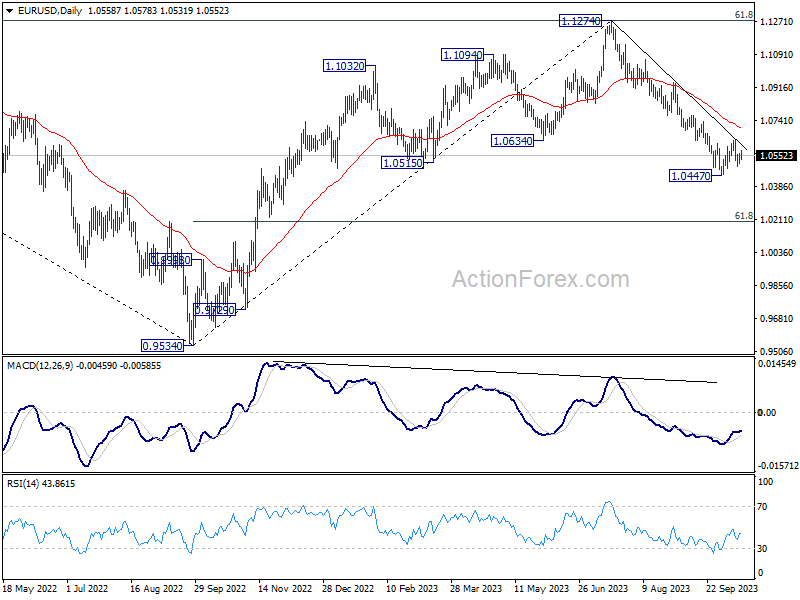
Daily Pivots: (S1) 1.0526; (P) 1.0544; (R1) 1.0578; More...
Intraday bias in EUR/USD stays neutral and outlook remains bearish with 1.0639 resistance intact. On the downside, firm break of 1.0447 will resume whole fall from 1.1274 and target 1.0199 fibonacci level. On the upside, however, break of 1.0639 will resume the rebound from 1.0447 to 55 D EMA (now at 1.0697).
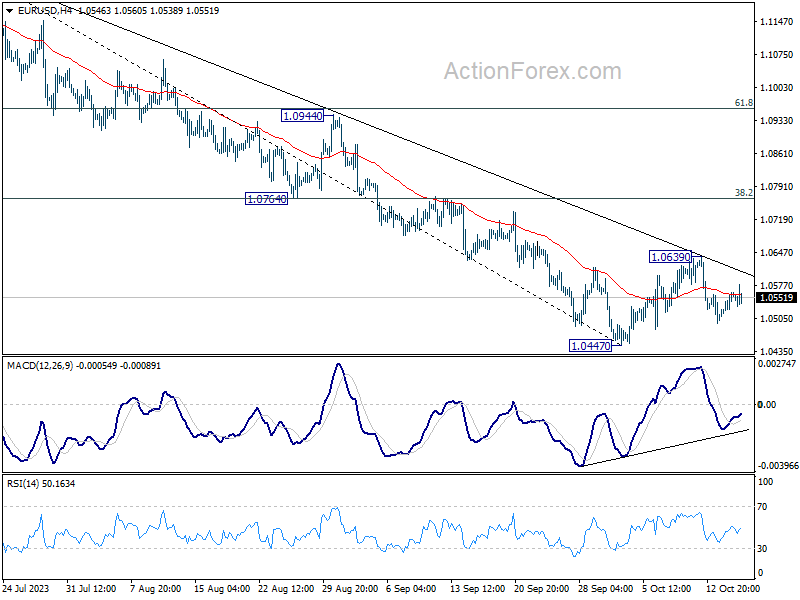
In the bigger picture, fall from 1.1274 medium term top could still be a correction to rise from 0.9534 (2022 low). But chance of a complete trend reversal is rising. In either case, current fall should target 61.8% retracement of 0.9534 to 1.1274 at 1.0199 next. For now, risk will stay on the downside as long as 55 D EMA (now at 1.0697) holds, in case of rebound.
GBP/USD Mid-Day Outlook
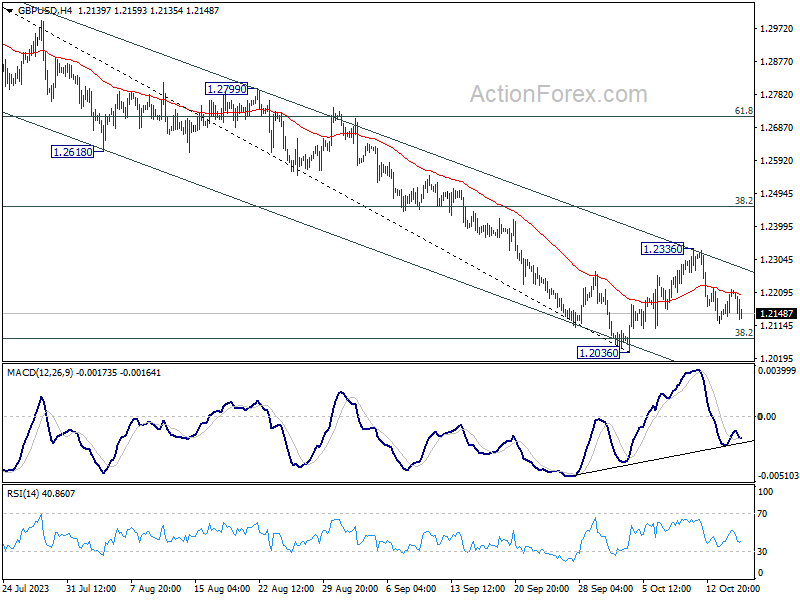
Daily Pivots: (S1) 1.2161; (P) 1.2190; (R1) 1.2247; More
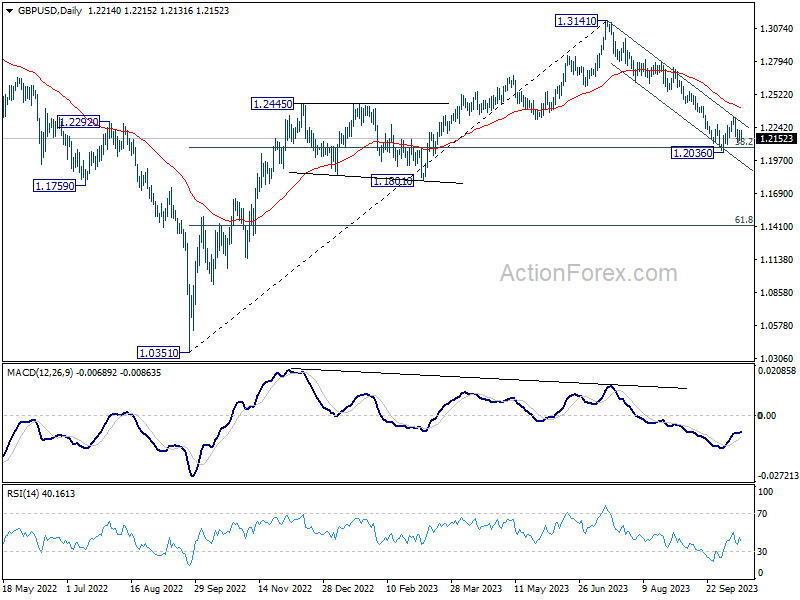
Intraday bias in GBP/USD stays neutral and outlook remains bearish with 1.2336 resistance intact. On the downside, decisive break of 1.2036 will resume whole decline from 1.3141 for 1.1801 support next. However, break of 1.2336 will resume the rebound from 1.2036 to 55 D EMA (now at 1.2410).
In the bigger picture, fall from 1.3141 medium term top could still be a correction to up trend from 1.0351 (2022 low) only. But risk of complete trend reversal is rising. Sustained break of 38.2% retracement of 1.0351 to 1.3141 at 1.2075 will pave the way to 61.8% retracement at 1.1417. For now, risk will stay on the downside as long as 55 D EMA (now at 1.2410) holds, in case of rebound.
USD/CHF Mid-Day Outlook
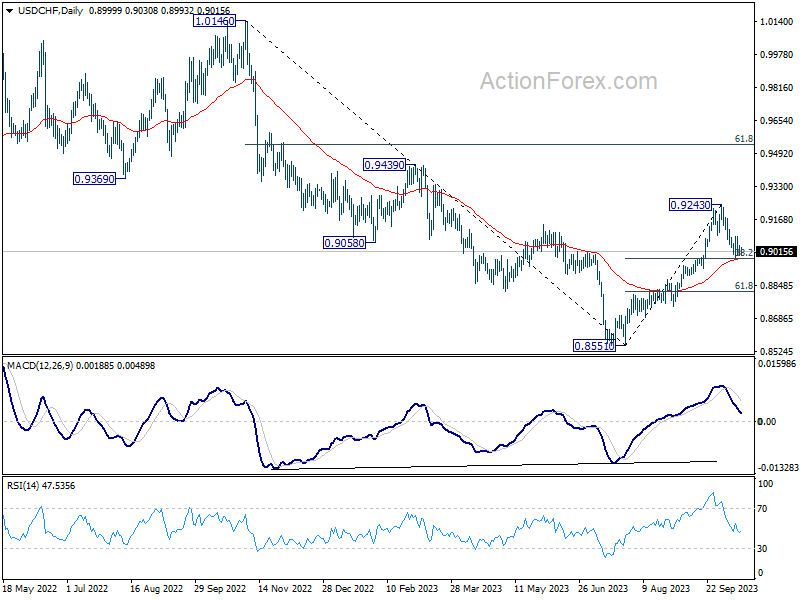
Daily Pivots: (S1) 0.8984; (P) 0.9014; (R1) 0.9031; More....
Intraday bias in USD/CHF remains neutral at this point. More sideway trading could be seen. On the upside, break of 0.9086 resistance will indicate that pull back from 0.9243 has completed, and turn bias to the upside for retesting this high. However, sustained break of 38.2% retracement of 0.8551 to 0.9243 at 0.8979 will argue that deeper fall is under way to 61.8% retracement at 0.8815.
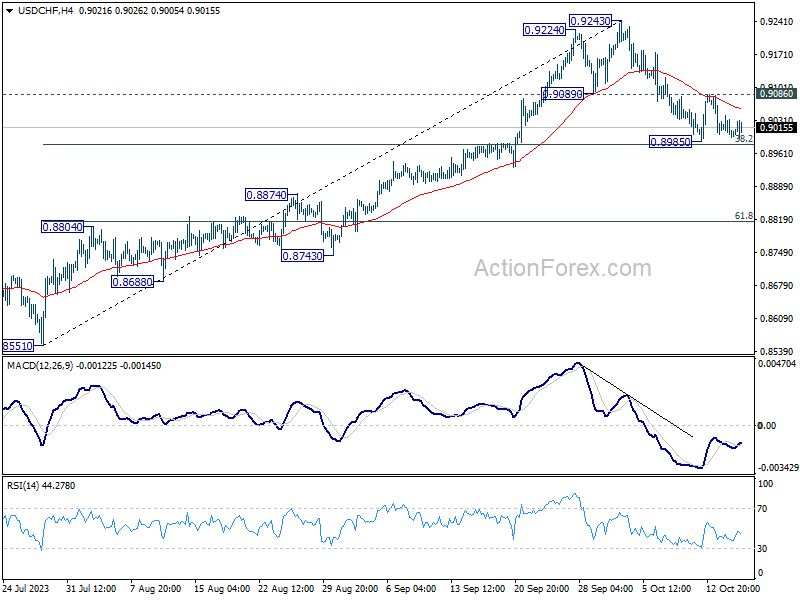
In the bigger picture, as long as 55 D EMA (now at 0.8976) holds rise from 0.8551 is viewed as reversing whole down trend from 1.0146 (2022 high). On resumption, further rise should be seen to 61.8% retracement of 1.0146 to 0.8551 at 0.9537 and above. However, sustained break of 55 D EMA will revive medium term bearishness, for retesting 0.8551 low at a later stage.
USD/JPY Mid-Day Outlook
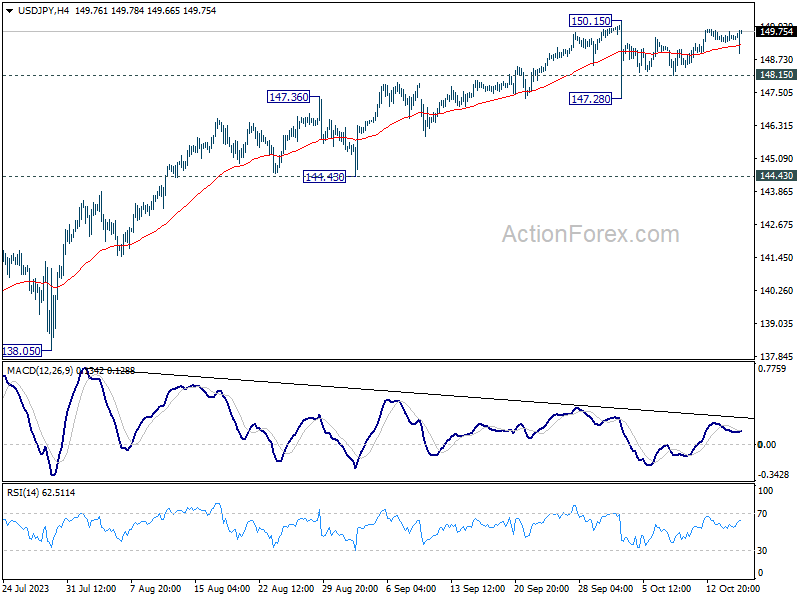
Daily Pivots: (S1) 149.33; (P) 149.54; (R1) 149.74; More...
Despite some volatility, USD/JPY is still staying in range below 150.15. Intraday bias remains neutral for the moment. On the downside, below 148.24 minor support will turn bias to the downside for another down leg through 147.28. On the upside, firm break of 150.15 will resume larger up trend to test 151.93 high.
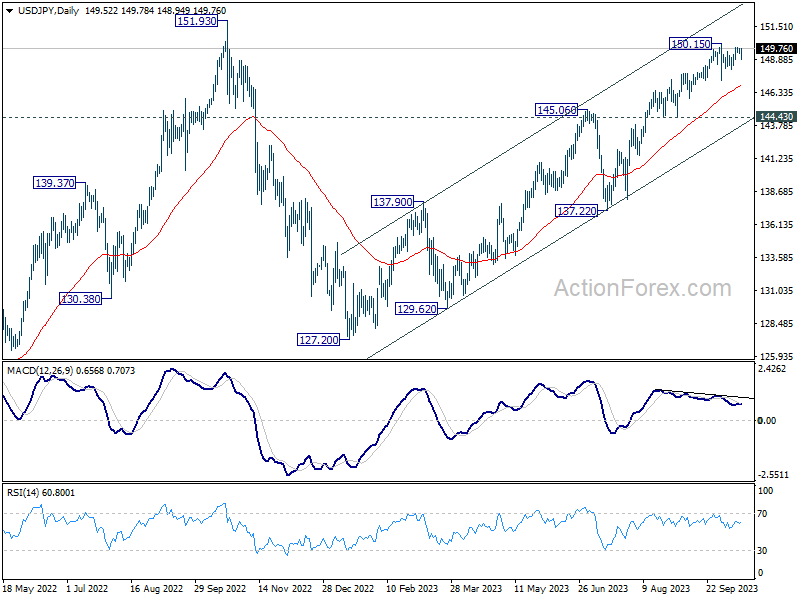
In the bigger picture, while rise from 127.20 is strong, it could still be seen as the second leg of the corrective pattern from 151.93 (2022 high). Rejection by 151.93, followed by sustained break of 145.06 resistance turned support will be the first sign that the third leg of the pattern has started. However, sustained break of 151.93 will confirm resumption of long term up trend.
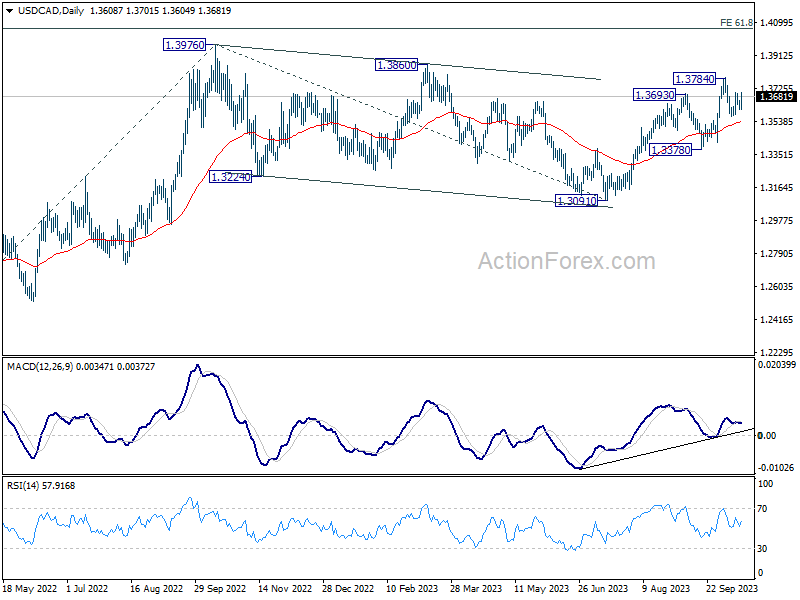
USD/CAD Mid-Day Outlook
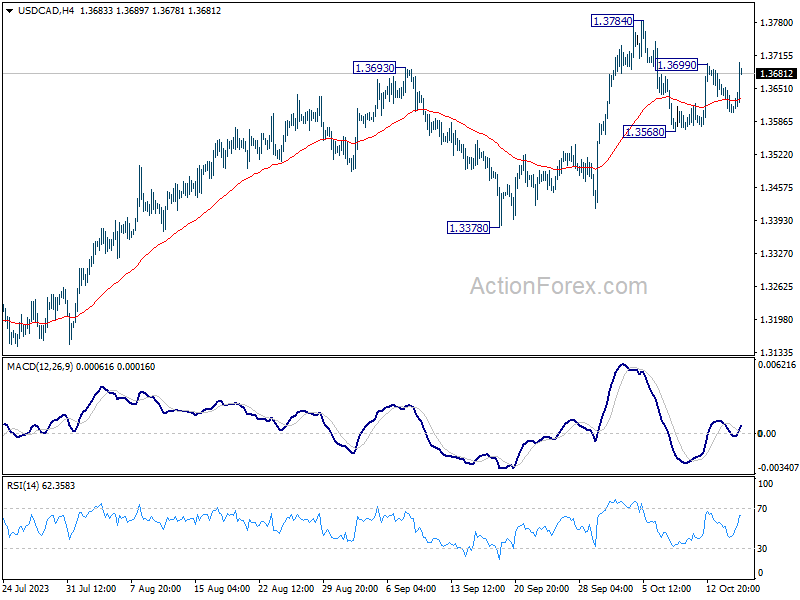
Daily Pivots: (S1) 1.3589; (P) 1.3627; (R1) 1.3648; More....
USD/CAD rebounds notably today and focus is back on 1.3699 resistance. Firm break there will target 1.3784 first. Break there will resume larger rise from 1.3091 to retest 1.3976 high. On the downside, below 1.3568 will bring another falling leg to extend the near term corrective pattern from 1.3784 instead.
In the bigger picture, current development revives the case that corrective pattern from 1.3976 (2022 high) has completed with three waves down to 1.3091. Decisive break of 1.3976 high will confirm resumption of up trend from 1.2005 (2021 low). Next target will be 61.8% projection of 1.2401 to 1.3976 from 1.3091 at 1.4064. This will now remain the favored case as long as 1.3378 support holds.
Retail Sales Lifts Dollar Higher; Canadian Faces Headwinds After CPI
Today's economic data releases are steering the markets, though it is uncertain how sustained their influence will be. Dollar emerges as the day's strongest performer, buoyed by robust retail sales figures. Australian Dollar trails as the initial lift from RBA minutes dissipates, leaving it in the second spot. Euro is firmer after German economic sentiment data showed Eurozone has passed the lowest point.
Meanwhile, Yen experienced a brief surge following reports suggesting an upward revision of inflation forecasts by BoJ. Despite the initial excitement, the currency's climb receded once it became evident that this was not fresh news. Nonetheless, Yen still retains a portion of its gains, displaying a mixed performance.
Conversely, New Zealand Dollar plummeted earlier in Asia following the release of softer-than-anticipated inflation figures. Sterling faced pressure due to uninspiring wage growth data, and Canadian Dollar was not spared either, experiencing a downturn due to a faster cooling in inflation than anticipated. These statistics bolster the argument for the central banks of these nations to hit the pause button again on any imminent policy shifts.
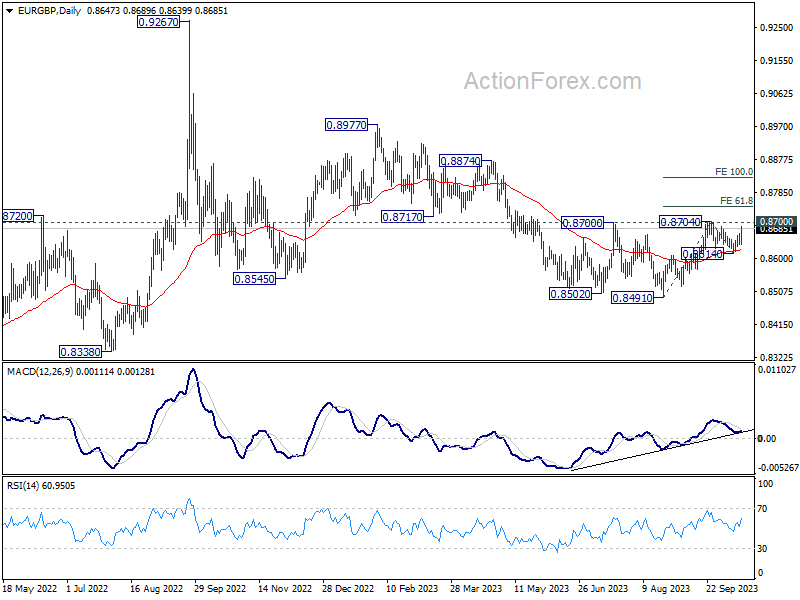
In the technical arena, all eyes are on EUR/GBP over the next 24 hours, especially with the release of UK CPI data looming. Prior strong rebound from 55 D EMA affirms near term bullishness. Firm break of 0.8700/4 resistance zone will resume the rebound from 0.8491. More importantly, that would strengthen the case the it's reversing whole down trend from 0.9267. Next near term target will be 61.8% projection of 0.8491 to 0.8704 from 0.8614 at 0.8746.
In Europe, at the time of writing, FTSE is up 0.32%. DAX is down -0.53%. CAC is down -0.41%. Germany 10-year yield is up 0.0782 at 2.867. Earlier in Asia, Nikkei rose 1.20%. Hong Kong HSI rose 0.75%. China Shanghai SSE rose 0.32%. Singapore Strait Times rose 0.25%. Japan 10-year JGB yield rose 0.0295 to 0.785.
US retail sales rose 0.7% mom in Sep, ex-auto sales up 0.6% mom
US retail sales rose 0.7% mom to USD 704.9B in September, above expectation of 0.3% mom. Ex-auto sales rose 0.6% mom to USD 469.7B, above expectation of 0.2% mom. Ex-gasoline sales rose 0.7% mom to USD 648.2B. Ex-auto, gasoline sales rose 0.7% mom to USD 513.0B.
Total sales for July through September period were up 3.1% from the same period a year ago.
Canada's inflation cools more than expected in Sep
In September, Canada's CPI deceleration surpassed expectations. The annual inflation rate receded to 3.8% yoy, falling short of the anticipated 4.0% and marking a downtick from August's 4.0% yoy. Gasoline prices, affected by the base-year effect, showed an escalation, recording a 7.5% yoy ascent compared to August's 0.8% yoy . Nevertheless, when gasoline was excluded, CPI realized a slowdown to 3.7% yoy from the previous month's 4.1% yoy.
On a monthly basis, CPI was down by -0.1% mom, contradicting the expected 0.1% mom incline. A -1.3% monthly decline in gasoline prices significantly influenced this downturn.
In the examination of the core inflation measures, which BoC meticulously observes, all three - CPI median, CPI common, and CPI trimmed - fell short of expectations. CPI median receded from 4.1% to 3.8% yoy, against the projected 4.0% yoy. CPI common retreated from 3.9% yoy to 3.7% yoy, not meeting 3.8% yoy expectation. Similarly, CPI trimmed dwindled from 4.8% yoy to 4.4% yoy, undermining the anticipated 4.7% yoy rate.
German ZEW rose to -1.1, passed the lowest points
German and Eurozone economic sentiments are seeing a revival, as indicated by the notable improvement in ZEW Economic Sentiment Indicators for October. In Germany, Economic Sentiment rose significantly from -11.4 to -1.1, outperforming the anticipated -9.5. Despite this uplift in sentiment, Current Situation Index experienced a minor decline, moving from -79.4 to -79.9, although it still exceeded the expected -80.5.
Eurozone isn't lagging, either. The region's ZEW Economic Sentiment rebounded from negative terrain, ascending from -8.9 to 2.3 and surpassing -8 forecast. Concurrently, Current Situation Index experienced a dip of -9.8 points, resting at -52.4.
ZEW President Professor Achim Wambach expressed optimism, indicating a potential turnaround in economic sentiment. "It seems that we have passed the lowest point," Wambach noted, highlighting a positive shift in expectations, driven partly by anticipation of declining inflation rates.
More than three-quarters of survey participants expect short-term interest rates in Eurozone to stabilize, reinforcing optimistic economic outlook. Despite concerns related to negative factors influencing growth forecasts, such as the Israel conflict, their impact appears limited, ensuring the overall economic perspective remains tilted towards optimism.
UK regular pay growth matches expectations at 7.8%
UK's annual growth in regular pay, excluding bonuses, stood in line with market expectations, clocking in at 7.8% in the three months to August. However, when accounting for bonuses, the total pay's annual growth was slightly tepid at 8.1%, missing the market forecast of 8.3%.
When adjusted for inflation using CPI including owner occupiers' housing costs (CPIH) - the real terms annual growth showcased a rise of 1.3% for total pay from June to August. Similarly, the regular pay's real terms annual growth registered a 1.1% increase.
A sector-wise dissection revealed that finance and business services led the pack with the most robust annual regular growth rate at 9.6%. Manufacturing sector followed closely with an impressive 8.0% growth rate. This surge in the manufacturing sector's pay growth is noteworthy, marking one of its highest annual regular growth rates since the inception of comparable records in 2001.
RBA minutes reveal hawkish tilt, another hike in Nov?
Minutes of RBA's October meeting surprised market participants with a more hawkish tone than anticipated. The board seriously contemplated a rate hike at the meeting, but opted to hold due to a lack of "sufficient new information.
Additionally, the central bank underscored its "low tolerance" for a delayed return of inflation to target. It suggested that "some further tightening" might be imminent if inflation proves to be more persistent than current expectations.
As RBA steers ahead, its forthcoming November meeting is expected to be crucial. The board will be equipped with additional economic data on factors such as inflation, labour market dynamics, and overall economic activity. Additionally, they will have at their disposal revised staff forecasts
The minutes highlighted, "members considered two options for monetary policy at this meeting: raising the cash rate target by a further 25 basis points; or holding the cash rate target steady." However, the decision to maintain the status quo was reached as "members agreed that the case to leave the cash rate target unchanged at this meeting was the stronger one." This consensus was influenced by the absence of "sufficient new information over the preceding month from economic data or financial markets to necessitate an adjustment in the stance of monetary policy."
However, the upcoming November meeting might paint a different picture. The board is set to receive "additional data on economic activity, inflation and the labour market, as well as a set of revised staff forecasts."
"In reaching their decision, members noted that some further tightening of policy may be required should inflation prove more persistent than expected. The Board has a low tolerance for a slower return of inflation to target than currently expected," the minutes detailed.
New Zealand CPI slowed to 5.6% yoy in Q3, dimming prospects of RBNZ hike
New Zealand's CPI recorded a decline in its annual inflation rate, dropping from 6.0% yoy to 5.6% yoy in Q3. This figure not only fell short of the anticipated 5.9% yoy but was also well below RBNZ's own forecast of 6.0% yoy for the quarter. Such a deceleration would curb the likelihood of another interest rate hike in November.
A breakdown of the inflation contributors indicates that food prices played a dominant role in driving the annual inflation rate. Following closely were the costs associated with housing and household utilities, with the inflation in this sector being attributed to escalating expenses of construction and rental services.
Nicola Growden, the senior manager of consumer prices, stated, "Prices are still increasing, but are increasing at rates lower than we have seen in the previous few quarters."
On a quarterly perspective, Q3 CPI reflected a growth of 1.8% qoq, marking an upturn from Q2's 1.1% qoq. However, it missed the estimated rise of 1.9% qoq. An analysis of sector-wise performance shows that the transport sector experienced significant inflationary pressures. Specifically, the costs of petrol and new motor vehicles surged by 16.5% and 4.6%, respectively.
USD/CAD Mid-Day Outlook
Daily Pivots: (S1) 1.3589; (P) 1.3627; (R1) 1.3648; More....
USD/CAD rebounds notably today and focus is back on 1.3699 resistance. Firm break there will target 1.3784 first. Break there will resume larger rise from 1.3091 to retest 1.3976 high. On the downside, below 1.3568 will bring another falling leg to extend the near term corrective pattern from 1.3784 instead.
In the bigger picture, current development revives the case that corrective pattern from 1.3976 (2022 high) has completed with three waves down to 1.3091. Decisive break of 1.3976 high will confirm resumption of up trend from 1.2005 (2021 low). Next target will be 61.8% projection of 1.2401 to 1.3976 from 1.3091 at 1.4064. This will now remain the favored case as long as 1.3378 support holds.
Economic Indicators Update
| GMT | Ccy | Events | Actual | Forecast | Previous | Revised |
|---|---|---|---|---|---|---|
| 21:45 | NZD | CPI Q/Q Q3 | 1.80% | 1.90% | 1.10% | |
| 00:30 | AUD | RBA Minutes | ||||
| 06:00 | GBP | Average Earnings Including Bonus 3M/Y Aug | 8.10% | 8.30% | 8.50% | |
| 06:00 | GBP | Average Earnings Excluding Bonus 3M/Y Aug | 7.80% | 7.80% | 7.80% | 7.90% |
| 09:00 | EUR | Germany ZEW Economic Sentiment Oct | -1.1 | -9.5 | -11.4 | |
| 09:00 | EUR | Germany ZEW Current Situation Oct | -79.9 | -80.5 | -79.4 | |
| 09:00 | EUR | Eurozone ZEW Economic Sentiment Oct | 2.3 | -8 | -8.9 | |
| 12:30 | CAD | CPI M/M Sep | -0.10% | 0.10% | 0.40% | |
| 12:30 | CAD | CPI Y/Y Sep | 3.80% | 4.00% | 4.00% | |
| 12:30 | CAD | CPI Median Y/Y Sep | 3.80% | 4.00% | 4.10% | |
| 12:30 | CAD | CPI Common Y/Y Sep | 3.70% | 3.80% | 3.90% | |
| 12:30 | CAD | CPI Trimmed Y/Y Sep | 4.40% | 4.70% | 4.80% | |
| 12:30 | USD | Retail Sales M/M Sep | 0.70% | 0.30% | 0.60% | |
| 12:30 | USD | Retail Sales ex Autos M/M Sep | 0.60% | 0.20% | 0.60% | |
| 13:15 | USD | Industrial Production M/M Sep | -0.10% | 0.40% | ||
| 13:15 | USD | Capacity Utilization Sep | 79.60% | 79.70% | ||
| 14:00 | USD | Business Inventories Aug | 0.30% | 0.00% | ||
| 14:00 | USD | NAHB Housing Market Index Oct | 45 | 45 |