Sample Category Title
Sterling Bolsters on UK Gas Price Surge; Dollar Waivers on Complex Yield Dynamics
Sterling has emerged as the predominant force in today's currency market, a surge attributed to the dramatic escalation in UK gas prices, which have ascended to their peak since June. Concerns about potential sabotage exacerbating supply constraints are rife, especially after a leak was detected in the Balticconnector pipeline—a crucial conduit for gas transmission between Estonia and Finland. Finland's Prime Minister Petteri Orpo's indication that "external action" is likely behind the leak amplifies concerns. These developments spell trouble for BoE's efforts to tame inflation. The sudden jolt in energy prices, if sustained, could trickle down into broader inflation metrics, complicating the central bank's policy calculus.
On the other side of the Atlantic, Dollar is languishing at the lower echelons of the weekly chart, a situation reflecting the ongoing pullback. Global unrest stemming from the Middle East conflict has temporarily taken a backseat. At the same time, attention shifted to anticipations of an extended pause in Fed's tightening cycle. Both developments buoyed US stocks while optimism spilled over positively into the Asian session.
A chorus of Fed officials have begun to sing a similar tune, suggesting that elevated Treasury yields could potentially alleviate the necessity for accelerated rate hikes. However, the plot thickens as 10-year yield underwent a significant pullback, fueled by a safe-haven rush to bonds amid geopolitical tensions. Market participants are now casting their gaze towards upcoming data releases, including US PPI and FOMC minutes today, as well as the pivotal CPI figures due tomorrow, for clearer directional cues.
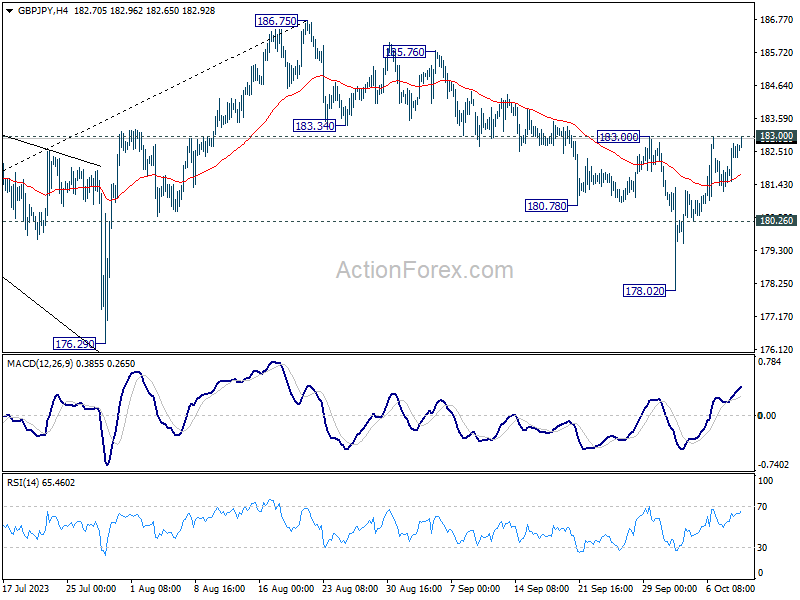
In the technical arena, a noteworthy development is the surge in GBP/USD, breaking the 1.2270 resistance and indicating short-term bottoming at 1.2036. Concurrently, EUR/GBP pierced through 0.8629 support, resuming the choppy decline from 0.8704. The spotlight now falls on 183.00 resistance in GBP/JPY; decisive break could pave the way for a retest of 186.75 high.
In Asia, at the time of writing, Nikkei is up 0.78%. Hong Kong HSI is up 1.44%. China Shanghai SSE is up 0.19%. Singapore Strait Times is down -0.27%. Japan 10-year JGB yield is down -0.002 at 0.772. Overnight, DOW rose 0.40%. S&P 500 rose 0.52%. NASDAQ rose 0.58%. 10-year yield dropped -0.142 to 4.655.
Fed's Kashkari expresses perplexity over rising treasury yields
Minneapolis Fed President Neel Kashkari expressed a sense of bewilderment regarding recent surge in 10-year Treasury yields. He noted yesterday, "The 10-year Treasury yield has gone up quite a bit. It's a little bit perplexing what is driving them to go up as much as they have in recent months."
He outlined a spectrum of possible explanations, from growing investor optimism about long-term economic strength to expectations of a more aggressive Fed stance on curbing inflation. Additionally, the rise in debt issued by the federal government could be another influencing factor.
"It is that combination of factors that is a little bit puzzling right now," Kashkari commented, reflecting the multifaceted nature of the economic signals currently at play.
The relationship between inflation and long-term yields was another topic Kashkari addressed. He acknowledged the potential of elevated long-term yields to aid in reining in inflation, saying, "It's certainly possible that higher long-term yields may do some of the work for us in terms of bringing inflation back down."
However, he introduced a caveat - if these yields are reflective of changed expectations about the Fed's actions, a conformity to these anticipations might be necessary to sustain the yields.
"But if those higher long-term yields are higher because their expectations about what we're going to do has changed, then we might actually need to follow through on their expectations in order to maintain those yields," he added.
Looking to the immediate future, Kashkari reiterated what he shared last month, suggesting there's a 60% chance Fed would implement one more rate hike this year.
Fed's Daly: Risks of over- and under-tightening roughly balanced
San Francisco Fed President Mary Daly noted overnight that the risks of over-tightening versus under-tightening are currently "roughly balanced".
The tightening of financial conditions, as indicated by surging treasury yields, may influence the extent of Fed's policy adjustments.
Daly noted, "If that's tight, maybe the Fed doesn't need to do as much. That's why I said, depending on whether it unravels, or whether the momentum in the economy changes, that could be equivalent to another rate hike."
However, Daly remains watchful, indicating that depending on economic momentum and other variables, "that could be equivalent to another rate hike."
Beyond domestic considerations, Daly expressed concerns about "geopolitical uncertainty," noting its potential impact on the US economy.
The repercussions of international events on elements like oil prices and export demand are being closely monitored by the Fed. She encapsulated the Fed's vigilant stance by stating, "It's part of a large dashboard of data"
RBA's Kent: Some further tightening may be required
In a speech, RBA Assistant Governor, Chris Kent, indicated that while the effects of previous monetary tightening have not yet been fully realized, "some further tightening " might be on the horizon to keep inflation in check.
Kent asserted that the policies currently in place are beginning to stymie demand growth, a crucial step towards mitigating inflation.
"The lags of transmission mean that some further effects of rate increases to date are still to be felt through the economy, which will provide further impetus to lower inflation in the period ahead," he added.
However, with inflation persisting at elevated levels, Kent hinted at the necessity for additional measures. "The Board is paying close attention to economic developments here and overseas, and some further tightening of monetary policy may be required to ensure that inflation, which is still too high, returns to target in a reasonable timeframe."
Looking ahead
European calendar is empty. Main focuses are US PPI and FOMC minutes.
GBP/USD Daily Outlook
Daily Pivots: (S1) 1.2235; (P) 1.2263; (R1) 1.2314; More
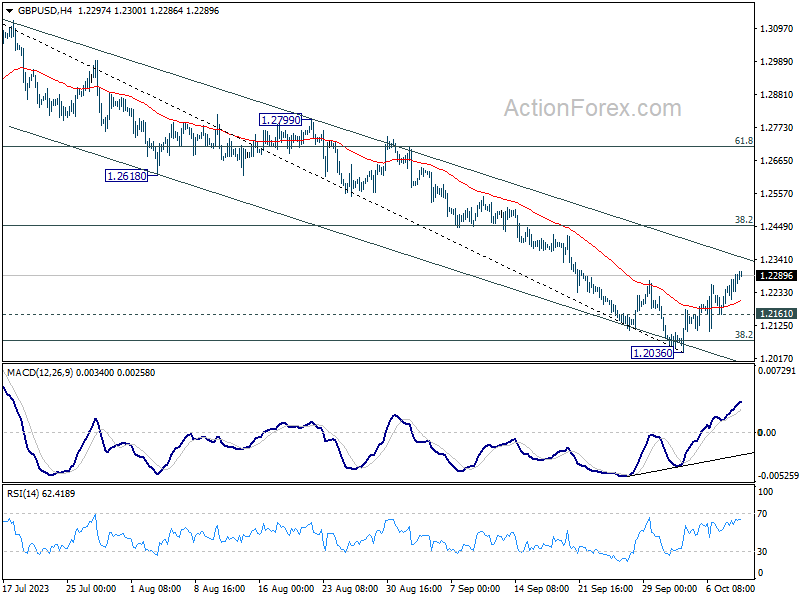
GBP/USD's break of 1.2270 resistance suggests that a short term bottom was already formed at 1.2036, after hitting 1.2075 fibonacci level. Intraday bias is back on the upside. Firm break of near term channel resistance (now at 1.2347) will target 38.2% retracement of 1.3141 to 1.2036 at 1.2458 next. Nevertheless, break of 1.2161 minor support will revive near term bearishness and bring retest of 1.2036 low.
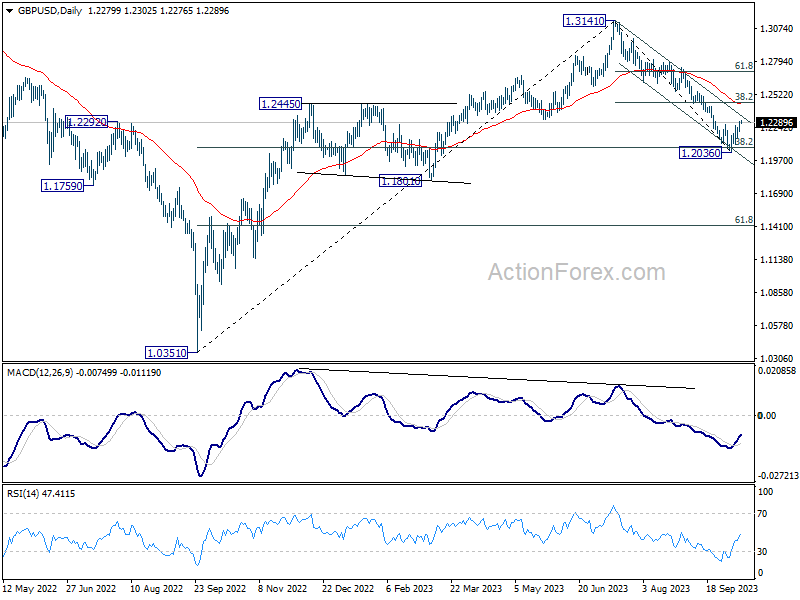
In the bigger picture, fall from 1.3141 medium term top could still be a correction to up trend from 1.0351 (2022 low) only. But risk of complete trend reversal is rising. Sustained break of 38.2% retracement of 1.0351 to 1.3141 at 1.2075 will pave the way to 61.8% retracement at 1.1417. For now, risk will stay on the downside as long as 55 D EMA (now at 1.2440) holds, in case of rebound.
Economic Indicators Update
| GMT | Ccy | Events | Actual | Forecast | Previous | Revised |
|---|---|---|---|---|---|---|
| 06:00 | EUR | Germany CPI M/M Sep F | 0.30% | 0.30% | ||
| 06:00 | EUR | Germany CPI Y/Y Sep F | 4.50% | 4.50% | ||
| 06:00 | JPY | Machine Tool Orders Y/Y Sep F | -17.60% | |||
| 12:30 | CAD | Building Permits M/M Aug | -1.50% | |||
| 12:30 | USD | PPI M/M Sep | 0.40% | 0.70% | ||
| 12:30 | USD | PPI Y/Y Sep | 1.60% | |||
| 12:30 | USD | PPI Core M/M Sep | 0.20% | 0.20% | ||
| 12:30 | USD | PPI Core Y/Y Sep | 2.20% | |||
| 18:00 | USD | FOMC Minutes |
Gold Price Could Surge Amid Rising Israeli–Palestinian Tensions
Key Highlights
- Gold price opened higher this week amid rising Israeli–Palestinian tensions.
- It broke a major bearish trend line with resistance near $1,850 on the 4-hour chart.
- Crude oil prices also soared and retested the $87.00 resistance zone.
- The VIX index saw a bearish reaction below the 17.00 level.
Gold Price Technical Analysis
Gold price remained well-bid above the $1,810 level. The price started a steady increase after Hamas militants marched into Israel on Saturday, bringing gunbattle for the first time in decades.

The 4-hour chart of XAU/USD indicates that the price gained pace above the $1,825 and $1,830 resistance levels. More importantly, the price opened with a gap higher this week and tested the $1,862 resistance.
The price also tested the 38.2% Fib retracement level of the downward move from the $1,947 swing high to the $1,810 low.
More Gains If Tensions Escalate?
Yesterday, the Israeli army bombarded the Gaza Strip. The attack reduced buildings to rubble and sent hundreds of people to hospitals. Commenting on the attack, Vladimir Putin blamed the US for the Israel-Gaza conflict.
If the war escalates further, it could push investors to the safe havens, including Gold. The price is now facing resistance near the $1,862 level.
An upside break above the $1,862 level could send the price soaring toward the $1,880 resistance or the 100 Simple Moving Average (red, 4 hours). It is close to the 50% Fib retracement level of the downward move from the $1,947 swing high to the $1,810 low.
The next major resistance is near the $1,900 level and the 200 Simple Moving Average (green, 4 hours), above which Gold could revisit the key $1,920 resistance zone.
On the downside, the price might find support near the $1,840 level. The next key support is near the gap area at $1,832. If the bulls fail to protect the $1,832 support, there is a risk of a major decline. In the stated case, the price could decline toward the $1,810 level.
Looking at crude oil prices, there was a strong move up from the $82 zone, but bears are facing hurdles near $87 and $88.
Economic Releases to Watch Today
- US Producer Price Index for Sep 2023 (YoY) – Forecast +2.3%, versus +2.2% previous.
- FOMC Meeting Minutes.
RBA’s Kent: Some further tightening may be required
In a speech, RBA Assistant Governor, Chris Kent, indicated that while the effects of previous monetary tightening have not yet been fully realized, "some further tightening " might be on the horizon to keep inflation in check.
Kent asserted that the policies currently in place are beginning to stymie demand growth, a crucial step towards mitigating inflation.
"The lags of transmission mean that some further effects of rate increases to date are still to be felt through the economy, which will provide further impetus to lower inflation in the period ahead," he added.
However, with inflation persisting at elevated levels, Kent hinted at the necessity for additional measures. "The Board is paying close attention to economic developments here and overseas, and some further tightening of monetary policy may be required to ensure that inflation, which is still too high, returns to target in a reasonable timeframe."
Fed’s Daly: Risks of over- and under-tightening roughly balanced
San Francisco Fed President Mary Daly noted overnight that the risks of over-tightening versus under-tightening are currently “roughly balanced”.
The tightening of financial conditions, as indicated by surging treasury yields, may influence the extent of Fed's policy adjustments.
Daly noted, "If that's tight, maybe the Fed doesn't need to do as much. That's why I said, depending on whether it unravels, or whether the momentum in the economy changes, that could be equivalent to another rate hike."
However, Daly remains watchful, indicating that depending on economic momentum and other variables, “that could be equivalent to another rate hike.”
Beyond domestic considerations, Daly expressed concerns about “geopolitical uncertainty,” noting its potential impact on the US economy.
The repercussions of international events on elements like oil prices and export demand are being closely monitored by the Fed. She encapsulated the Fed's vigilant stance by stating, “It’s part of a large dashboard of data”
Fed’s Kashkari expresses perplexity over rising treasury yields
Minneapolis Fed President Neel Kashkari expressed a sense of bewilderment regarding recent surge in 10-year Treasury yields. He noted yesterday, "The 10-year Treasury yield has gone up quite a bit. It's a little bit perplexing what is driving them to go up as much as they have in recent months."
He outlined a spectrum of possible explanations, from growing investor optimism about long-term economic strength to expectations of a more aggressive Fed stance on curbing inflation. Additionally, the rise in debt issued by the federal government could be another influencing factor.
"It is that combination of factors that is a little bit puzzling right now," Kashkari commented, reflecting the multifaceted nature of the economic signals currently at play.
The relationship between inflation and long-term yields was another topic Kashkari addressed. He acknowledged the potential of elevated long-term yields to aid in reining in inflation, saying, "It's certainly possible that higher long-term yields may do some of the work for us in terms of bringing inflation back down."
However, he introduced a caveat - if these yields are reflective of changed expectations about the Fed's actions, a conformity to these anticipations might be necessary to sustain the yields.
"But if those higher long-term yields are higher because their expectations about what we're going to do has changed, then we might actually need to follow through on their expectations in order to maintain those yields," he added.
Looking to the immediate future, Kashkari reiterated what he shared last month, suggesting there's a 60% chance Fed would implement one more rate hike this year.
GBPCHF Wave Analysis
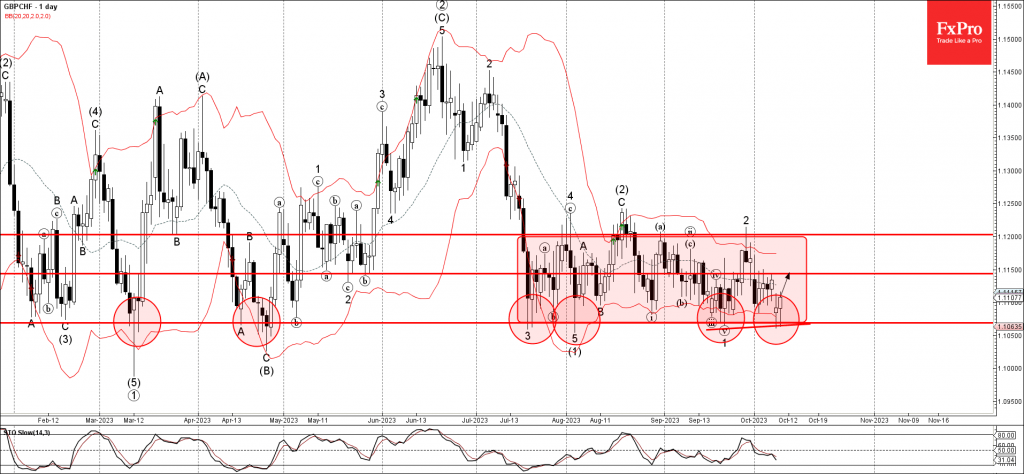
- GBPCHF reversed from support level 1.1070
- Likely to rise to resistance level 1.1150
GBPCHF currency pair recently reversed up from the pivotal support level 1.1070 (lower border of the narrow price range, which has been reversing the price from the start of March), intersecting with the lower daily Bollinger Band.
The upward reversal from the support 1.1070 stopped the previous short-term impulse wave 3 from the end of September.
Given the bullish divergence on the daily Stochastic, GBPCHF can be expected to rise further toward the next resistance level 1.1150.
AUDNZD Wave Analysis
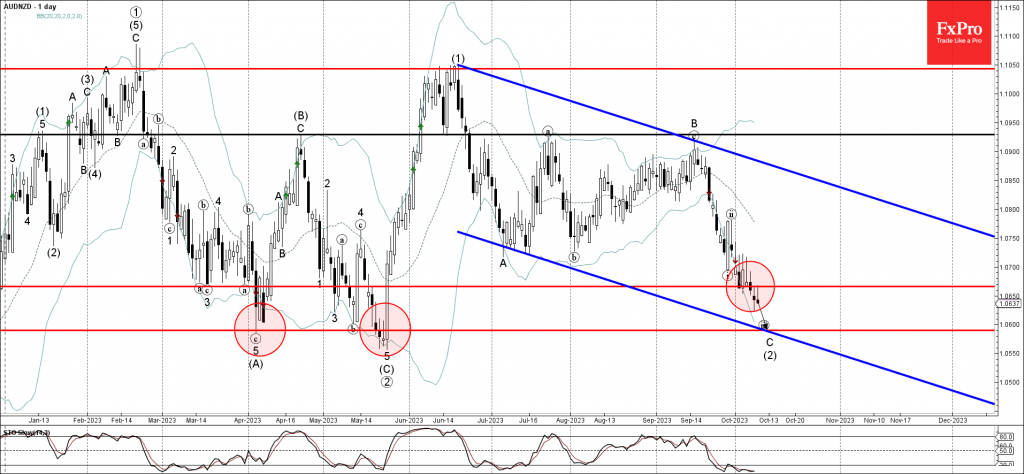
- AUDNZD reversed from resistance level 1.0665
- Likely to fall to support level 1.0600
AUDNZD currency pair recently reversed down from the resistance level 1.0665 (former support from the start of October).
The downward reversal from the resistance level 1.0665 continues the C-wave of the active intermediate ABC correction (2) from the middle of June.
Given the strength of the active impulse wave C, AUDNZD can be expected to fall further toward the next support level 1.0600 (target for the completion of the active C-wave).
Fed’s Bostic: Current policy rate sufficient to curb inflation
Atlanta Fed President Raphael Bostic made a clear stance today, expressing confidence in the prevailing policy rate's ability to bring inflation down to the desired 2% mark. In his words, "I think that our policy rate is at a sufficiently restrictive position to get inflation down to 2%." Contrary to some speculations about further hikes, he stated, "I actually don't think we need to increase rates anymore."
Bostic's comments come at a crucial juncture when the market is closely monitoring the bond market dynamics, especially recent sharp rise in Treasury yields. Responding to queries about the possible impact of rising Treasury yields on the Fed's policy approach, Bostic highlighted that the present rates are "clearly" on the restrictive side, hinting at a visible slowdown in economic activities. He also hinted at more repercussions from the Fed's past hikes that might manifest in the near future.
In addition to domestic economic indicators, Bostic also touched upon the geopolitical developments, particularly the recent violent episodes in Israel. Recognizing the potential of such geopolitical events to infuse further uncertainty in the global economic landscape, Bostic underscored the need for the Federal Reserve to remain agile. He emphasized the importance of being nimble and ready to adapt in light of rapidly evolving global scenarios.
Oil Bounces Back, Set for More Declines
Oil’s bounce at the start of the week’s trading was an essential step in correcting the short-term oversold condition, but it may only fuel the interest of new sellers.
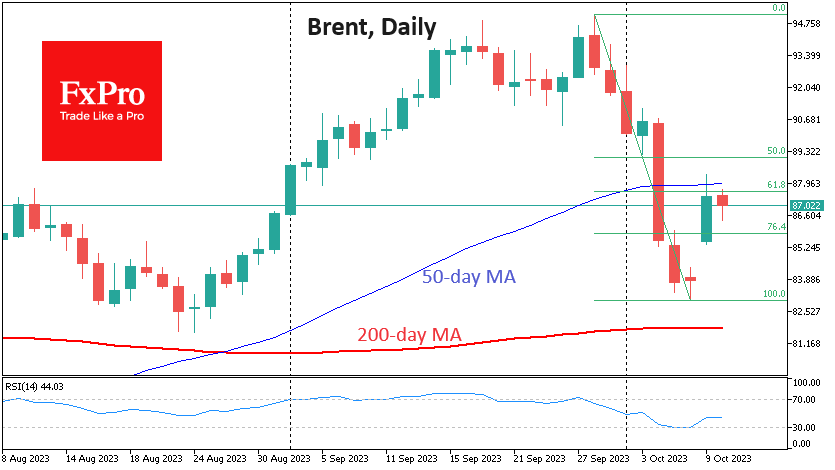
The oil price is down 12.8% in the six trading sessions since 28 September. A local low was recorded immediately after the release of the labour market data. However, interest in oil was soon fuelled by speculation that, along with a strong labour market in the US, there was no increase in inflationary pressure. On Monday, investors speculated about the risks of energy supply reduction due to the involvement of other Muslim countries in the conflict, which will put oil and gas supplies at risk.
But let’s look at the situation without emotion and speculation – purely from a tech analysis perspective. From this point of view, the latest bounce was a critical correction that could clear the way for a subsequent decline.
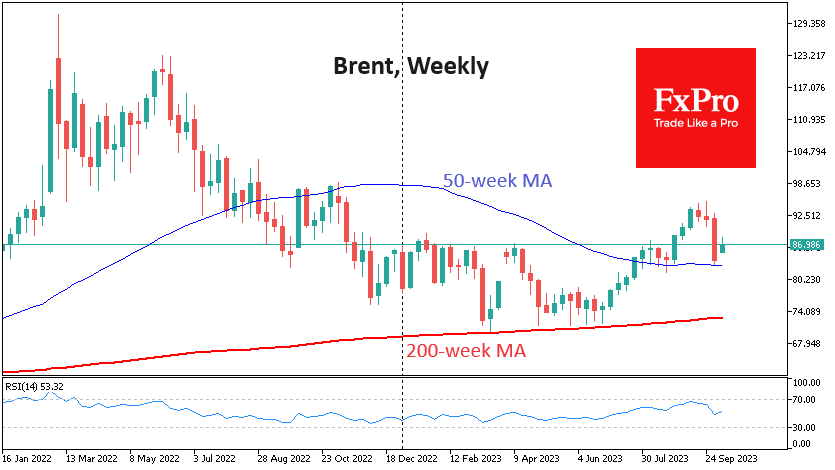
Brent oil turned downwards from $95 and quickly reached $83, falling sharply under the 50-day moving average. Last Wednesday’s dip signals that the bears are firmly in market control.
By Friday, the RSI on the daily charts began to flirt with the oversold area. Since the end of 2020, this signal has consistently triggered a reversal. The same thing happened this time around.
Thanks to the US data and the military conflict in the Gaza Strip on Monday, the price made a classic rebound to the 61.8% area from the initial decline. But its recovery stalled there. We also note that on Monday, the price tried to return above the 50-day average but closed the day lower.
There was no upward momentum in oil for most of the day on Tuesday despite the strengthening of stock indices, indicating a recovery in risk appetite.
If the bears keep an upper hand over the oil market, we could see a gap close at the start of the week’s trading in the next couple of days. The following support line in oil looks to be the 200-day moving average, now just below $82.
A more ambitious downside target is $75, where the most crucial separator of market cycles in the form of the 200-week average and the 161.8% level of the last downside impulse may cross by the end of the year.