Sample Category Title
Bank of England Decision Could Spell Bad News for Sterling
- Bank of England set to raise interest rates this week
- Mixed economic data, so commentary could be cautious
- Risks for British pound seem tilted to the downside
- Decision expected at 11:00 GMT on Thursday
Weaker data pulse
The United Kingdom economy seems to be losing steam, with recent data releases showcasing a severe slowdown in growth and a softer labor market. Economic growth was stagnant in July from a year earlier and business surveys warn the situation will get worse, putting the risk of a minor recession on the radar.
Employment data have already started to reflect this weakness. The labor market lost jobs in July, pushing the unemployment rate higher. Open job vacancies declined as well, which is a sign that labor demand has started to soften. Hence, employment trends are moving in the wrong direction and this phenomenon is likely to persist according to leading indicators.
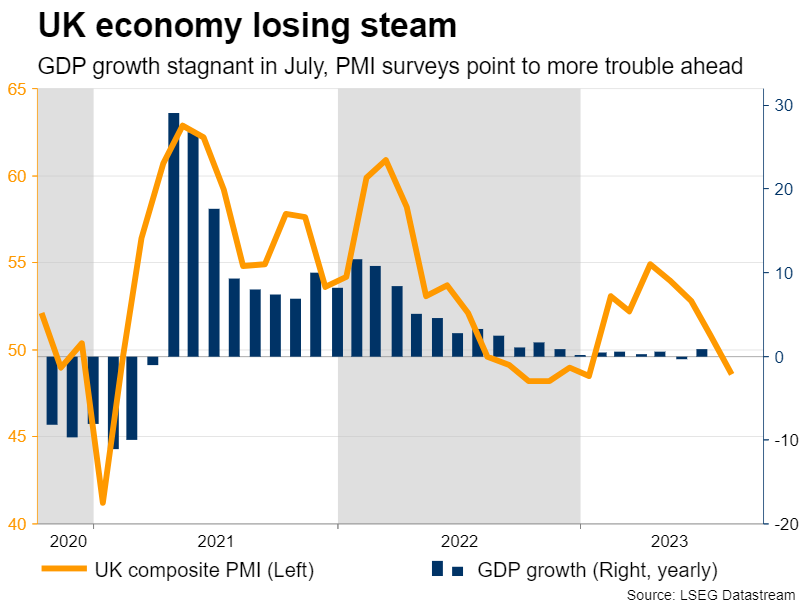
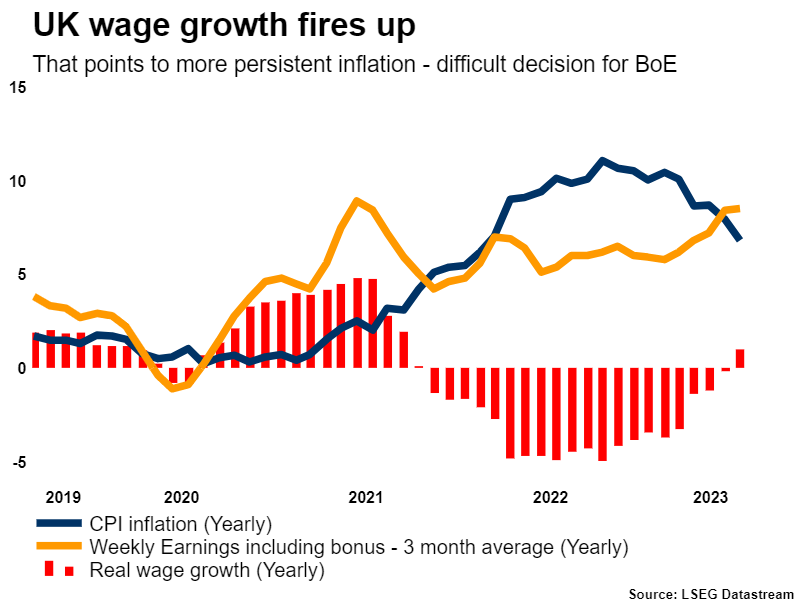
The problem for the Bank of England is that wage growth is already hot and continues to accelerate. Including bonuses, wage growth is running at 8.5% in annual terms. That suggests inflationary pressures are unlikely to cool anytime soon, and the recent rally in oil prices reinforces this notion.
BoE dilemma
As such, the BoE has a difficult decision to make. Raising rates even higher would help to bring inflation under control, but it would also dampen economic growth further, pushing the economy off the cliff towards a recession.
Market pricing points to an 80% probability of a rate increase this week, which is justified since recent remarks by BoE officials reveal a preference for further tightening. Nonetheless, it could be a closer call than investors expect. The vote count is likely to be split, with some policymakers favoring no action instead, following the streak of worrisome data.
Most importantly, the forward guidance might not include a commitment to any further action. There's a strong possibility the BoE signals this is the peak in interest rates already, similar to what the ECB did last week. Several policymakers including chief economist Huw Pill have indicated they would rather keep rates steady for a longer period of time, rather than raise them much further.
Therefore, the statement is likely to strike a cautious tone. Since this is one of the smaller meetings without updated economic forecasts or a press conference, this is where the market action will come from. Note that the nation's inflation numbers for August will be released on Wednesday ahead of the meeting and could influence the decision. The latest business surveys will follow on Friday.
Lose-lose scenario for sterling?
Turning to the market reaction, the risks surrounding the British pound from this meeting seem tilted to the downside. If the BoE raises rates, the currency could initially spike higher. However, any upside reaction might be relatively small since this is the market's baseline scenario already, and reverse quickly if there's no clear commitment to any further hikes.
That's what happened to the euro after last week's ECB decision, and the pound could suffer a similar fate as traders begin to speculate that the tightening cycle is over. And if the BoE doesn't raise rates, that would come as a shock given current market pricing, pushing the pound lower immediately.
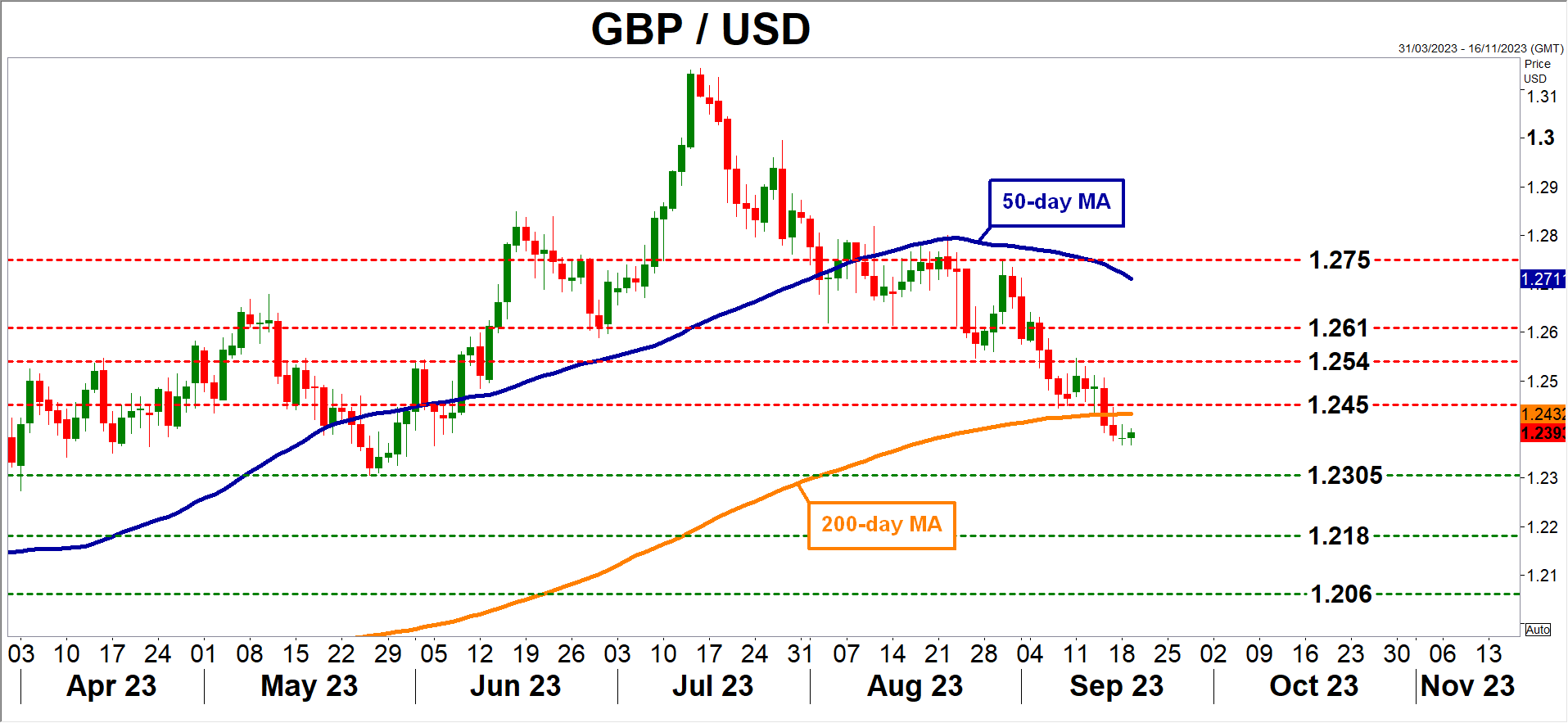
Looking at the charts, Cable has been moving lower for two months now, falling below some key moving averages. The most important area to watch on the downside is 1.2300, as any violation of this region could turn the technical picture more negative. On the upside, any advances could stall near the 1.2450 zone, which has served both as support and resistance this year.
Beyond the BoE decision, the overall trajectory of the pound will also depend on how stock markets perform, given the currency's sensitivity to global risk sentiment.
Silver Remains Stuck Inside Triangle Pattern
- Silver trades between trendlines that form a triangle
- Outlook is neutral, moving averages have flattened
- Break on either side of triangle will reveal next big move
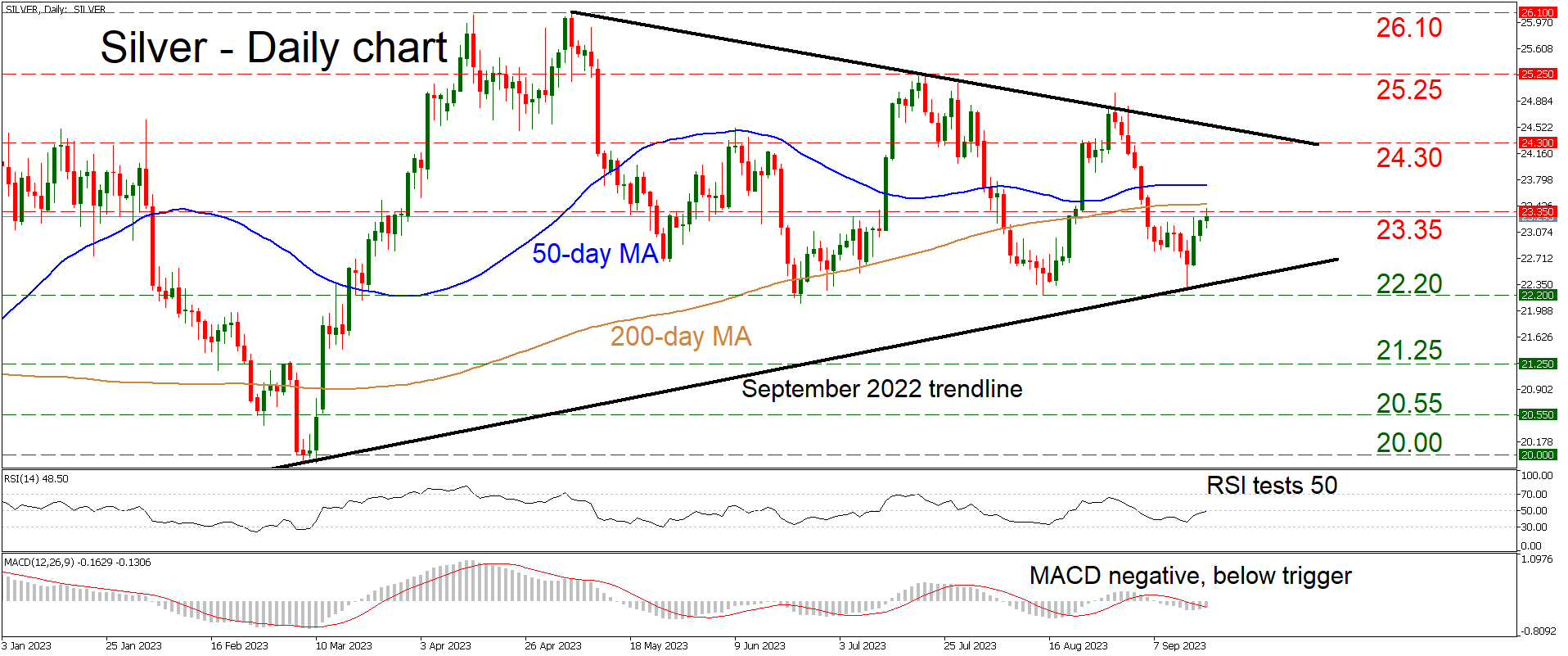
Silver prices continue to trade within a symmetrical triangle pattern, formed by a longer-term uptrend line drawn from the lows of September 2022 and a downtrend line connecting the peaks of May. Hence, the picture seems neutral for now. A break on either side of the triangle is required to signal the next directional move.
The fact that the 50- and 200-day moving averages (MAs) have converged and have also flattened is a testament to this neutral outlook. Similarly, the RSI is near its midpoint of 50, reaffirming the absence of any momentum.
Should buyers remain in control, the first barrier to overcome would be the 23.35 zone. The 200-day MA is just above at 23.45, and can be considered part of the same zone. If violated, the next major obstacle would be the intersection of the 24.30 region and the downtrend line that’s part of the triangle.
If sellers take back the reins instead, there isn’t much support until the 22.20 territory and the uptrend line that forms the lower boundary of the triangle. A clean break below this crossroads would shift the picture to negative, opening the doors for extensions towards the 21.25 area.
Summarizing, the outlook seems neutral as long as silver continues to trade within the triangle.
Sunset Market Commentary
Markets
Investors positioned for a ‘hawkish pause’ over the previous days, with Fed Chair Powell/the governors’ summary of economic projections tomorrow seen cementing the higher for longer narrative while at the same time keeping the door open for a final rate hike in one of the two remaining meetings of the year. The ‘by default’ uptrend in yields unabatedly continues today (US 2-y yield +3 bps, 10-y +5 bps). US yields across all tenors are within striking distance of cycle peak levels (5-y testing highest level since 2007). One would expect a push beyond key technical references to be delayed till after tomorrow’s Fed meeting. However, momentum remains remarkably strong. German/EMU yields initially held near unchanged levels, but finally also joined the US momentum (+ 2-4 bps across the curve, with the 30-y (2.88%) reaching the highest level since end 2011). Recent talk on more ‘technical, non-interest rate ECB tightening’ (higher reserve ratio, faster reduction of CB balance sheet) supported the rend. In this context, UK Gilts’ outperformance did catch the eye even as a yields’ decline of 5 bps + evaporated in US trading (UK 10-y currently minus 2.5 bps). Markets still see a 80% chance of a 25 bps BoE rate hike on Thursday. However, the odds of an additional step further out have diminished to <50%. This is quite an aggressive call. Concerns on overtightening always have been an important factor in the internal BoE debate. That said, August headline inflation scheduled for release tomorrow morning is expected to reaccelerate to 0.7% M/M and 7.0% Y/Y (was -0.4% M/M and 6.8% Y/Y in July). Core inflation is seen only marginally lower at 6.8% from 6.9%. The BoE will continue to look forward when assessing the need for further tightening. Even so, only one additional inflation release will be available before the Bank will (have to) reevaluate its policy with a new in extenso Policy Report at the November 2 meeting. Persistent high inflation and the BoE sticking to only a conditional commitment to raise rates further might be a further headwind for sterling. EUR/GBP yesterday jumped above 0.86, but with no follow-through gains for now (EUR/GBP 0.8625). In other major FX cross rates the euro gains slightly further on the debate of the ECB potentially further reducing excess liquidity (1.0695). USD/JPY (147.8) is again near the 147.95 recent ceiling. An unexpected jump both in Canadian headline (4.0% from 3.3%) and core inflation (3.9% from 3.6%) propelled yields (2-y + 11 bps) and the loonie (USD/CAD 1.3400 from 1.3485 close yesterday). Maybe the current BoC pause isn’t the end of the cycle yet.
News & Views
Czech National Bank vice governor Frait said that the central bank will almost certainly keep its benchmark rate unchanged at 7% next week, while discussing the strategy for future rate cuts in depth. Even if the board agreed to lower rates in a following meeting (November and/or December), Frait thinks that money-market bets for about 70 bps of cuts this year are very unlikely to materialize. When policy easing starts, it will be slow and gradual unlike the National Bank of Poland’s 75 bps rate cut kick-off. A “fairly tight” labor market, combined with a weaker-than-expected koruna and more expensive oil are inflationary risks that warrant later and more cautious easing than implied by the central bank’s forecast, the vice governor said. CNB board member Holub in separate remarks stressed that risks to the baseline (rate cut) scenario are significant and tilted to the upside given the threat of inflation expectations becoming unanchored, risks of a wage-price spiral and longer effects of the expansionary fiscal policy. CNB governor Michl yesterday pushed back against early rate cuts as well, hinting to keep a restrictive policy until it will be certain that inflation will stay around 2%, not only in H1 2024 but also thereafter. CZK manages to hold on to yesterday’s gains, trading just north of 24.40.
The Flemish Community today raised €2.75bn in 2-part debt offering consisting of a short 9y regular benchmark (€1.25bn Jun2032) and a 19y sustainable benchmark (€1.5bn Sep2042). The 9y bond was priced to yield 37 bps above the Belgian OLO curve, down from revised guidance at +39 bps and initial price takings in the +41 bps area. The 19y bond was squeezed 5 bps from early guidance in the OLO +35 bps area to eventually + 30 bps. Order books were respectively above €5bn and above €12.7bn highlighting especially interest in the sustainable deal. The Flemish community now raised maximum objectives for both regular (€2.75bn) and sustainable benchmarks (€1.5bn) as set out on its funding plan. Short term financing and private placements (max €1.25bn) will be used to bridge the remainder of this year’s €8bn funding need.
Canadian Inflation Pressures Accelerated in August
Headline CPI rose to 4.0% year-over-year as surging oil prices pushed energy costs higher. The increase was above market expectations for a 3.8% reading with growth in broader 'core' measures also accelerating more than expected.
Most of the acceleration in year-over-year price growth came from rising energy costs - gasoline prices edged above year-ago levels for the first time since January with oil prices boosted by supply caps from key major oil producers.
And higher mortgage costs (a direct lagged result of Bank of Canada interest rate hikes over the last year and a half) are still accounting for about a quarter of year-over-year CPI growth.
But broader inflation pressures showed signs of reaccelerating in August. The BoC's preferred CPI-trim and CPI-median measures rose more than expected on a year-over-year basis (to 3.9% and 4.1%, respectively) and the closely-watched more recent 3-month run rate accelerated to a 4 1/2% annualized rate for both.
CPI trim services ex-shelter (sometimes called BoC 'supercore') rose 4.3% at an annualized rate over the last three months (by our calculation), in line with the July increase.
One silver lining was that grocery price growth showed further signs of easing. Grocery prices were still up 6.9% year-over-year, but that was smaller than the 8.5% increase in July and the 11%+ readings last winter. Food price growth should continue to ease in the near-term as lower raw food commodity prices and easing domestic supply chain pressures pass through to retail prices with a lag.
The BoC will be happy to see some signs of easing in food price growth. Higher mortgage interest costs are part of the central bank's plan to help cool off consumer demand and there is not much the BoC can do about global energy prices. But the acceleration in 'core' measures is concerning and will be watched closely.
Bottom line: The economic backdrop has been showing clear signs of slowing (with a decline in GDP in Q2 and drift higher in unemployment in recent months.) And that should signal that inflation pressures will ease going forward. But the BoC has one mandate, and that is to target a 2% inflation rate. And the August CPI data took a significant step away from that target rather than towards it. We expect the economic backdrop will continue to soften, and don't look for more interest rate hikes this year. But the central bank won't hesitate to hike interest rates further if inflation pressures don't show signs of easing.
Canada: Inflation Mercury Spikes to 4% in August
Consumer price inflation heated up again in August to 4.0% on a year-on-year (y/y) basis, up from 3.3% in July, largely thanks to higher prices at the pump.
Gasoline prices rose 4.6% on a monthly basis, thanks to higher prices for crude oil. Prices at the pump are only up 0.8% versus a year ago, but base year effects – or the swing from -12.9% y/y in July – drove the acceleration in headline CPI.
Shelter was another key source of upward pressure on inflation in August, heating up to 6.0% y/y, up from 5.1% y/y in July, and 4.8% in June. The acceleration was led by rents which were up 6.5% y/y in August, up from 5.5% in July.
Food inflation took a step down in August to 6.9% y/y from 8.5% in July, as prices for groceries fell 0.4% m/m in August. However, that is still the highest pace of inflation of the eight main CPI categories.
Scratching beneath the surface, our measure of "supercore" inflation, or services inflation excluding shelter costs cooled to 1.2% y/y from 2.1% y/y in July, thanks to a massive drop in travel services costs.
Somewhat surprisingly, the Bank of Canada's underlying inflation measures also heated up in August. CPI-trim increased to 3.9% y/y from 3.6% y/y in July and CPI-median was 4.1% y/y, up from 3.7% y/y in July.
Inflation for core goods appears to be behind the surprise in core inflation measures in August. Core goods inflation rose to 2.9% y/y from 2.6% in July. Notably, prices accelerated for clothing and footwear to 1.7% y/y in august from 1.0% in July.
Key Implications
Headline inflation moving back up to 4% on higher energy prices would likely be tolerated by the Bank of Canada. But, core inflation measures heating back up to 4% y/y, and 4.5% on a three month annualized basis is going to ring some alarm bells at the Bank.
August's inflation reading stands in contrast to other measures that have shown momentum cooling in Canada's economy. The housing market, and new home construction cooled in August, and the unemployment rate has risen half a percentage point over the past few months. Fortunately, the Bank of Canada will see another inflation report before it's next rate decision on October 25th. We expect further signs of slowing will help the Bank to continue to stand on the sidelines, as outlined in our recent forecast. However, today's inflation report has raised the odds they may need to make another move.
EUR/USD Mid-Day Outlook
Daily Pivots: (S1) 1.0666; (P) 1.0682; (R1) 1.0710; More...
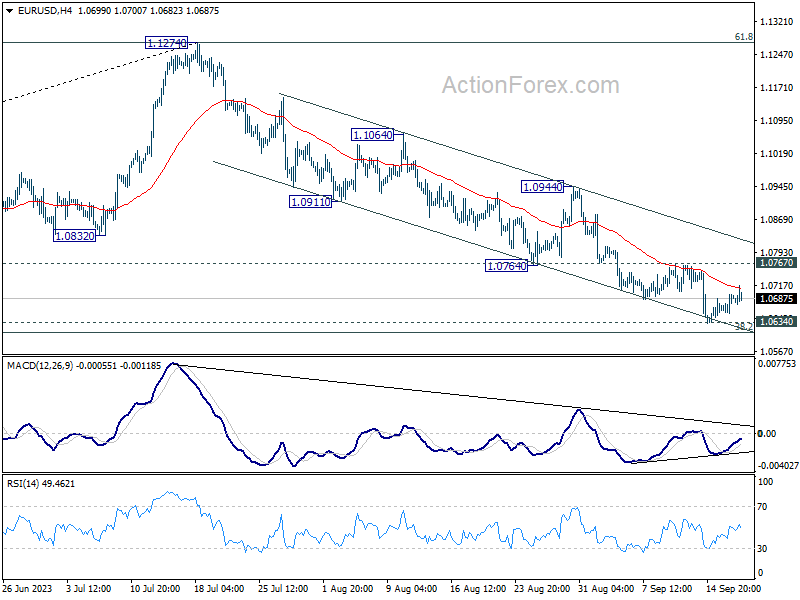
No change in EUR/USD's outlook and intraday bias stays neutral. Strong rebound from current level, followed by break of 1.0767 resistance, should confirm short term bottoming. Intraday bias will be back on the upside for 1.0944 resistance. However, sustained break of 1.0609/34 support zone will carry larger bearish implication, and target 1.0515 support next.
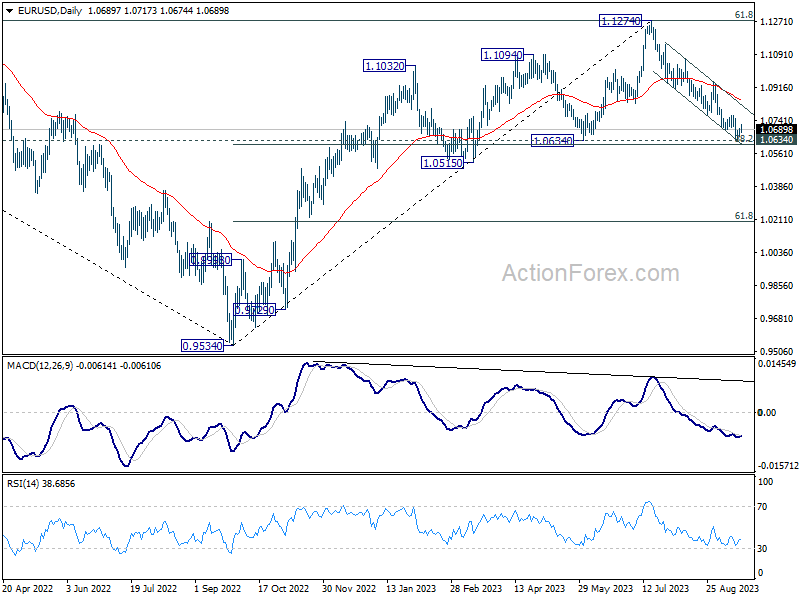
In the bigger picture, fall from 1.1274 medium term top is seen as a correction to up trend from 0.9534 (2022 low). Strong support could be seen from 1.0634 cluster support (38.2% retracement of 0.9534 to 1.1274 at 1.0609) to bring rebound, at least on first attempt. However, sustained break of 1.0609/0634 will raise the chance of bearish trend reversal, and target 61.8% retracement at 1.0199.
GBP/USD Mid-Day Outlook
Daily Pivots: (S1) 1.2367; (P) 1.2389; (R1) 1.2407; More...
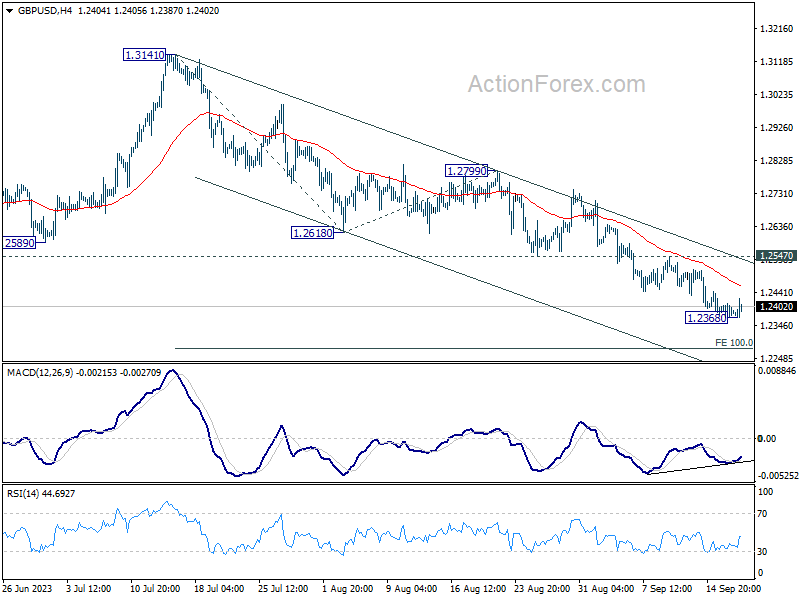
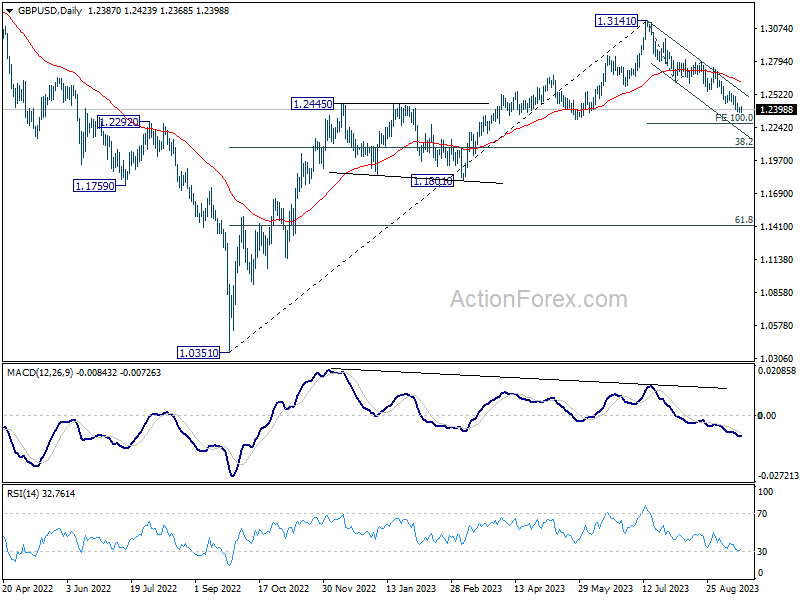
Intraday bias in GBP/USD is turned neutral with current recovery. Some consolidations could be seen but further decline is expected as long as 1.2547 resistance holds. Below 1.2368 will resume the fall from 1.3141 to 100% projection of 1.3141 to 1.2618 from 1.2799 at 1.2276. On the upside, though, firm break of 1.2547 resistance will now indicate short term bottoming, and bring stronger rebound.
In the bigger picture, fall from 1.3141 medium term top is seen as a correction to up trend from 1.0351 (2022 low). Deeper decline would be seen to 38.2% retracement of 1.0351 to 1.3141 at 1.2075. Strong support would be seen there to bring rebound on first attempt. However, sustained break of 1.2075 will raise the chance of bearish trend reversal.
USD/CHF Mid-Day Outlook
Daily Pivots: (S1) 0.8955; (P) 0.8969; (R1) 0.8984; More....
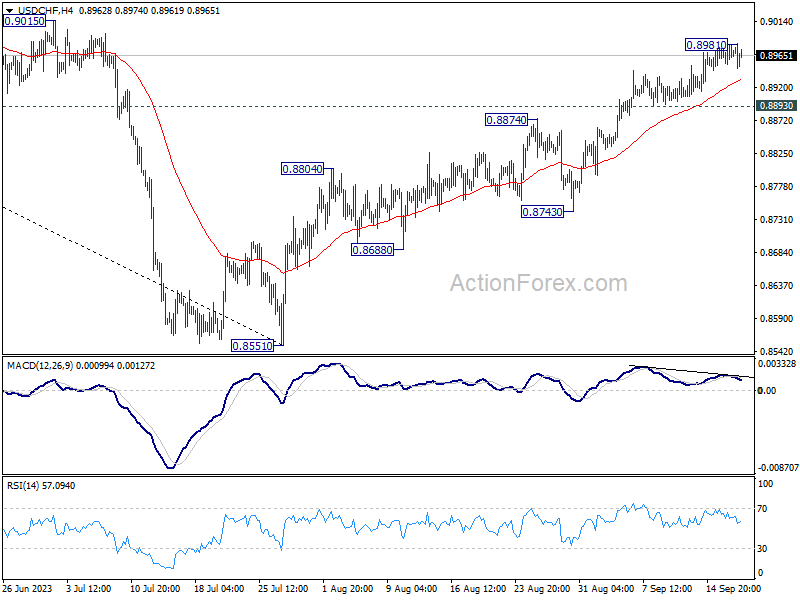
Intraday bias in USD/CHF is turned neutral with current retreat and some consolidations could be seen. But further rally is expected as long as 0.8893 support holds. Above 0.8981 will resume the rally from 0.8551 to 0.9146 cluster resistance. However, firm break of 0.8893 will argue that a short term top is possibly formed, and turn bias back to the downside for 55 D EMA (now at 0.8858).
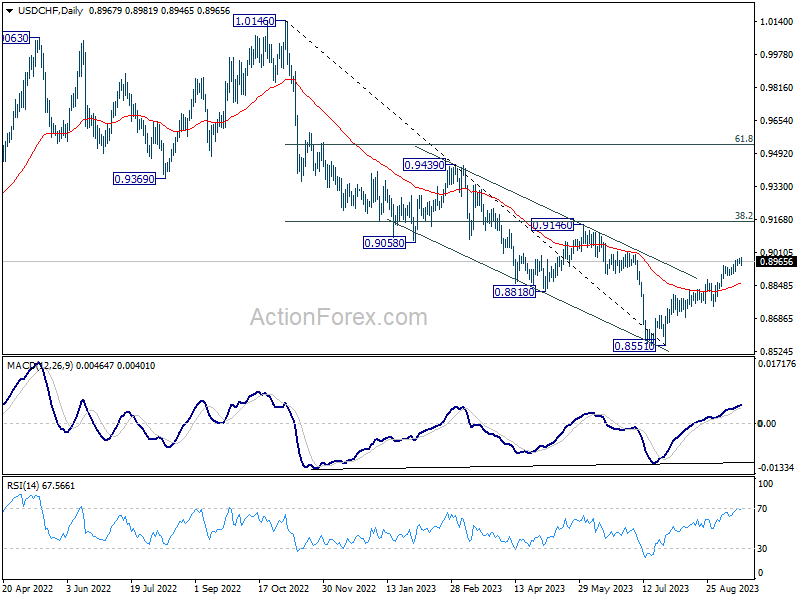
In the bigger picture, rebound from 0.8551 medium term bottom is currently seen as a correction to the downtrend from 1.0146 (2022 high). Further rally would be seen to 0.9146 cluster resistance (38.2% retracement of 1.0146 to 0.8551 at 0.9160). Strong resistance could be seen there to limit upside, at least on first attempt.
USD/JPY Mid-Day Outlook
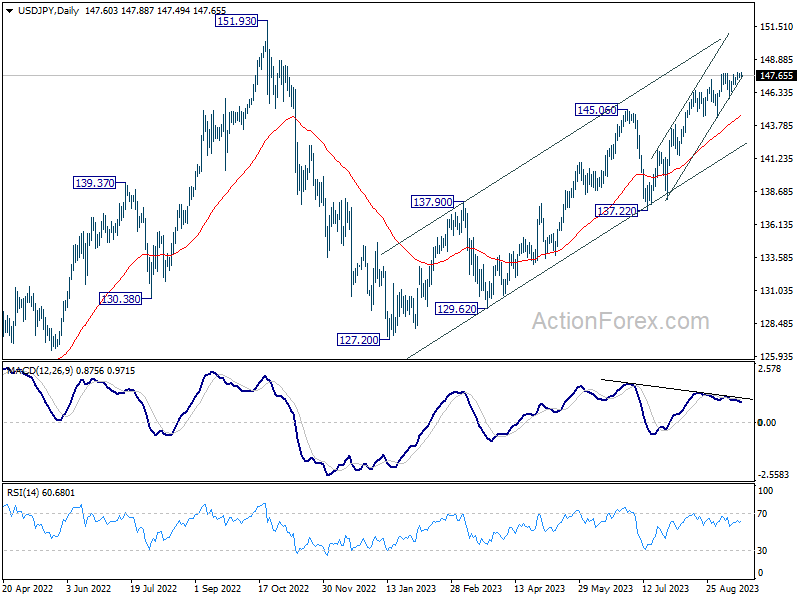
Daily Pivots: (S1) 147.48; (P) 147.68; (R1) 147.80; More...
Intraday bias in USD/JPY is turned neutral first as it continues to lose upside moment. Some consolidations could be seen, but further rally is expected as long as 145.88 support holds. Break of 147.94 will resume larger rise from 127.20 to retest 151.93 high.
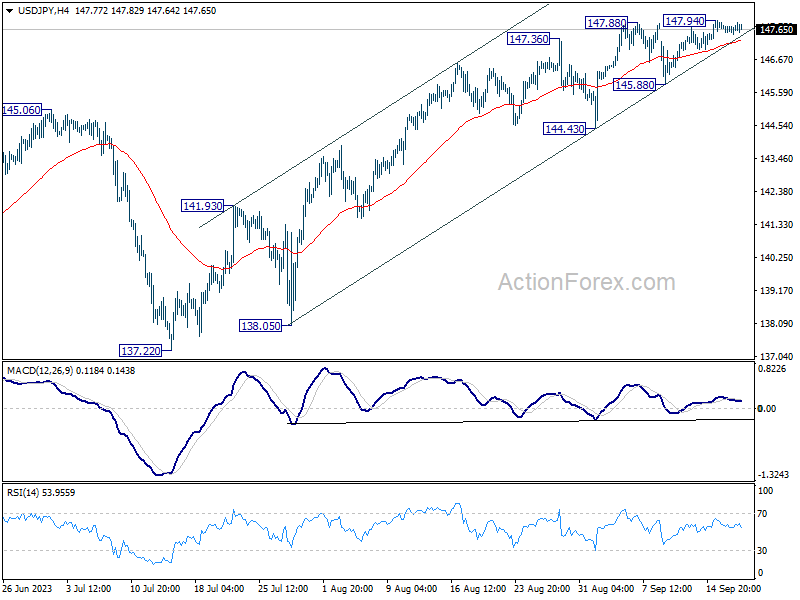
In the bigger picture, while rise from 127.20 is strong, it could still be seen as the second leg of the corrective pattern from 151.93 (2022 high). Rejection by 151.93, followed by break of 137.22 support will indicate that the third leg of the pattern has started. However, sustained break of 151.93 will confirm resumption of long term up trend.
USD/CAD Mid-Day Outlook
Daily Pivots: (S1) 1.3462; (P) 1.3496; (R1) 1.3519; More....
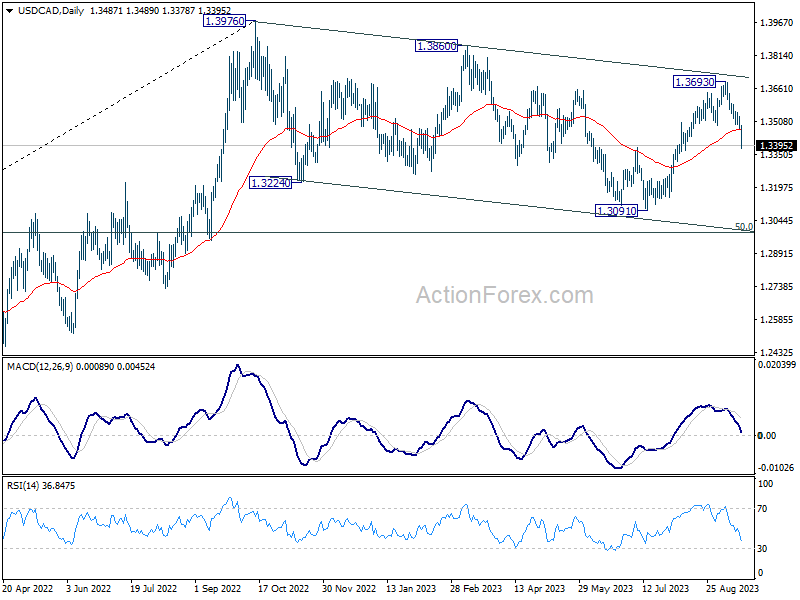
Intraday bias in USD/CAD stays on the downside at this point. Current fall from 1.3693 is seen as another falling leg in the corrective pattern from 1.3976. Deeper decline would be seen to 61.8% retracement of 1.3091 to 1.3693 at 1.3321. Sustained break there will target 1.3091 support next. On the upside, above 1.3492 minor resistance will turn intraday bias neutral and bring consolidations first, before staging another decline.
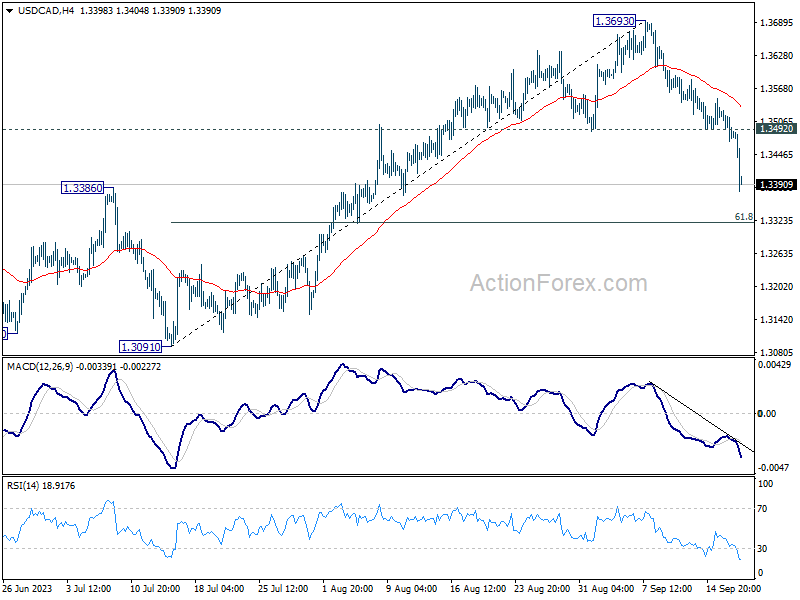
In the bigger picture, price actions from 1.3976 are viewed as a corrective pattern to the up trend from 1.2005 (2021 low). Deeper decline could be seen as the pattern is now extending. But downside should be contained by 50% retracement of 1.2005 to 1.3796 at 1.2991. Rise from 1.2005 is still expected to resume after the correction completes.