

Sample Category Title
ECB de Guindos: Decision is open for Sep
In a cautious tone, ECB Vice President Luis de Guindos said yesterday that "For September, the decision is open," dropping no hint on whether the central bank would deliver another rate hike, or pause.
Nevertheless, de Guindos was clear about the new economic projections to be published at the September meeting. He noted, "forecasts for economic growth are worse than we had projected in June, while inflation projections are similar to what we had in June."
De Guindos added that the ECB is "entering the final stretch" of its tightening cycle. He put emphasis on second-round effects and inflation expectations as the factors for any future monetary policy decisions.
USD/JPY Eyes Fresh Increase Above 147.00
Key Highlights
- USD/JPY is consolidating above the 145.50 support.
- A key bullish trend line is forming with support near 145.50 on the 4-hour chart.
- EUR/USD struggled to clear the 1.0940 and trimmed gains.
- The US nonfarm payrolls could increase by 170K in August 2023.
USD/JPY Technical Analysis
The US Dollar started a short-term downside correction from the 147.40 zone against the Japanese Yen. USD/JPY declined below the 147.00 and 146.50 levels.
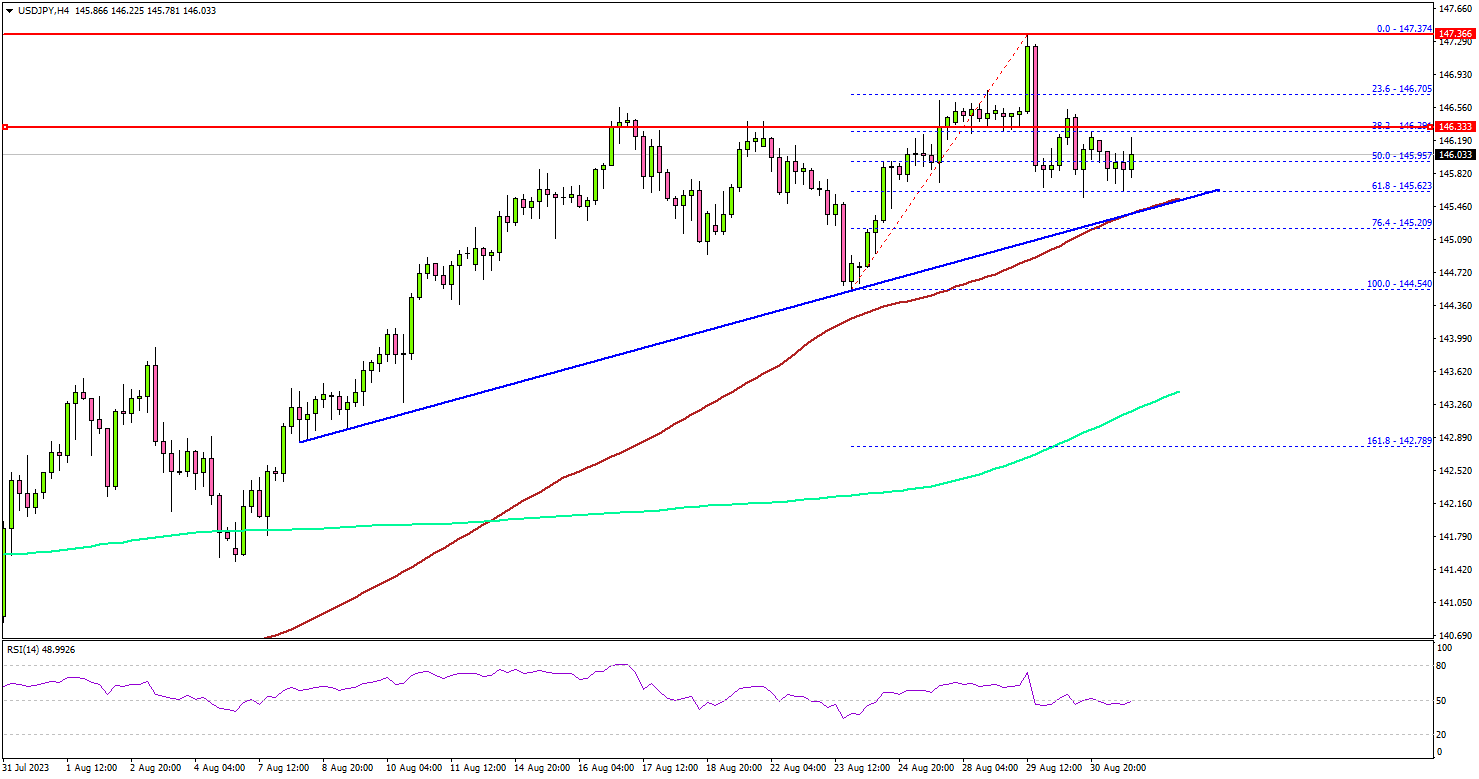
Looking at the 4-hour chart, the pair is still trading well above the 145.00 support, the 100 simple moving average (red, 4 hours), and the 200 simple moving average (green, 4 hours).
It is now consolidating and might attempt a fresh increase. On the upside, an initial resistance is near the 146.35 level. The first major resistance is near the 146.50 level.
A close above 146.50 could start a decent increase. In the stated case, the pair could rise toward the 147.40 level. Any more gains could send the pair toward the 148.00 level.
If not, the pair might start a fresh decline below the 145.65 support. The next key support is seen near the 145.50 level. There is also a key bullish trend line forming with support near 145.50 on the same chart.
If there is a move below 145.50, the pair could dive toward 145.20. Any more losses might send the pair toward the 144.50 level.
Looking at EUR/USD, the pair struggled to recover above the 1.0940 zone, faced rejection, and started a fresh decline.
Economic Releases
- Germany’s Manufacturing PMI for August 2023 - Forecast 39.1, versus 39.1 previous.
- Euro Zone Manufacturing PMI for August 2023 – Forecast 43.7, versus 43.7 previous.
- UK Manufacturing PMI for August 2023 – Forecast 42.5, versus 42.5 previous.
- US ISM Manufacturing PMI for August 2023 – Forecast 47.0, versus 46.4 previous.
- US nonfarm payrolls for August 2023 – Forecast 170K, versus 187K previous.
- US Unemployment Rate for August 2023 - Forecast 3.5%, versus 3.5% previous.
EURJPY Wave Analysis
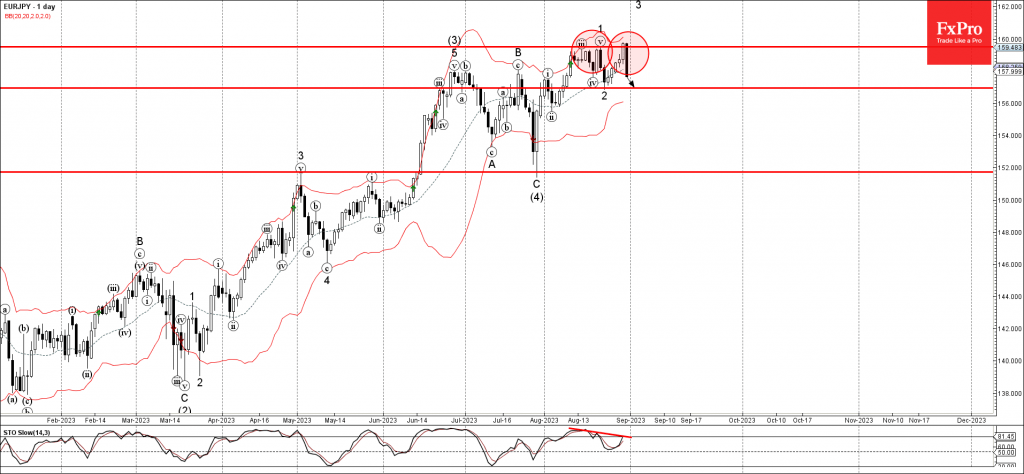
- EURJPY reversed from resistance level 159.50
- Likely to fall to support level 156.95
EURJPY currency pair recently reversed down from the key resistance level 159.50 (top of the previous minor impulse wave 1) intersecting with the upper daily Bollinger Band.
The downward reversal from the resistance level 159.50 is likely to form the daily Japanese candlesticks reversal pattern Bearish Engulfing.
Given the clear bearish divergence on the daily Stochastic indicator, EURJPY currency pair can be expected to fall further toward the next support level 156.95 (low of the previous wave 2).
WTI Crude Oil Wave Analysis
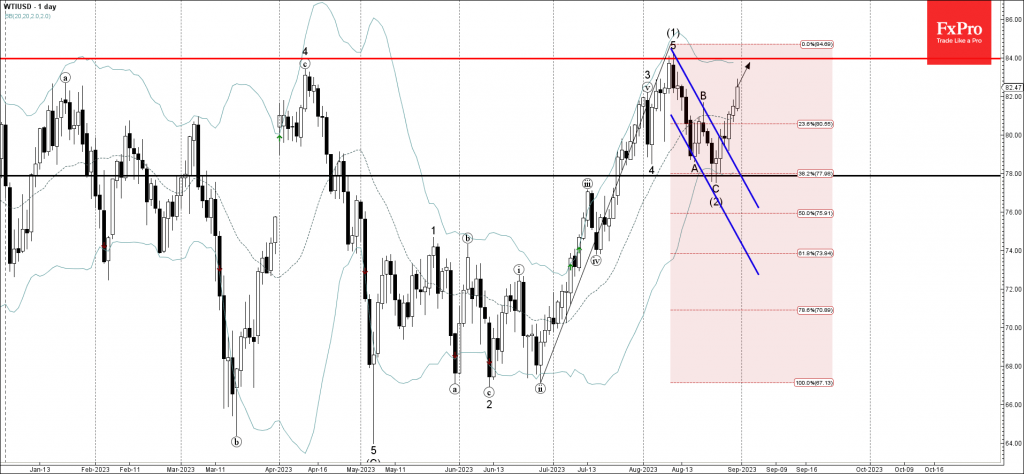
- WTI crude oil rising inside impulse wave (3)
- Likely to test resistance level 84.00
WTI crude oil continues to rise inside the intermediate impulse wave (3), which previously broke the daily down channel from the start of August (enclosing the earlier ABC correction (2)).
The breakout of this down channel strengthened the bullish pressure on WTI crude oil.
Given the strength of the active impulse wave (3), WTI crude oil can be expected to rise further toward the next resistance level 84.00 (which stopped the previous impulse wave (1)).
A Jump in Consumer Spending May Be Bad News for US Indices
Personal spending by Americans in July points to increased risks of a return to inflation. Consumer spending rose 0.8% in July, following a 0.7% increase a month earlier. Meanwhile, incomes rose 0.2% in July and 0.3% in June. Disposable personal income was unchanged in July after increasing 0.2% a month earlier.
As a result, personal savings fell to 3.5% of income, the lowest since last October, down from 4.7% two months ago.
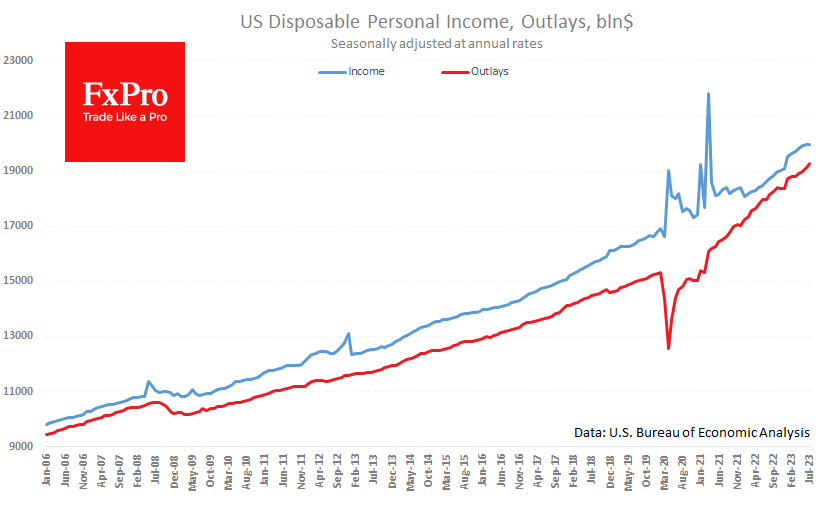
These are signs of inflationary pressures in the US, contrary to the slump in many commodity prices that fuelled inflation last year. The price index accelerated growth from 3.0% to 3.3% in July. The core index accelerated from 4.1% to 4.2%— a turn upward from double the levels of the Fed’s 2% target.
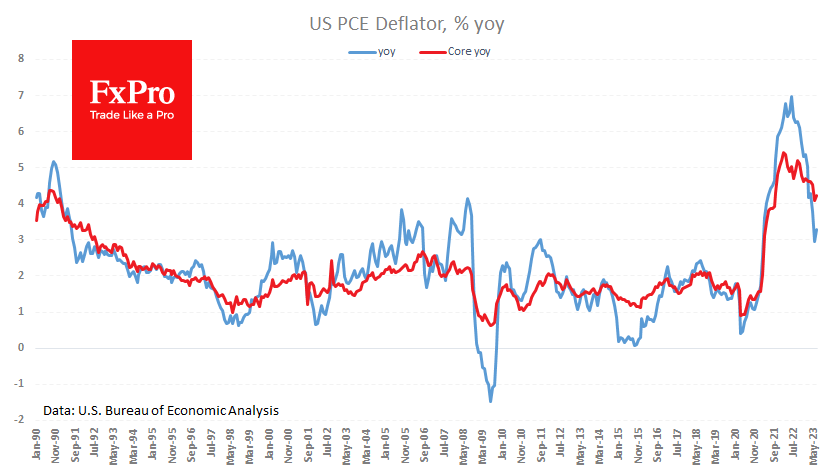
The conventional wisdom is that stronger-than-expected spending growth is good news for the dollar and (often) the stock market, demonstrating buyer confidence. For the dollar, that rule of thumb remains valid. But it could be bad news for the stocks, pressing down expectations that the Fed Funds rate has already peaked.
USD/CHF Rises as Swiss Retail Sales Fall, Swiss CPI Next
- Swiss retail sales decline by 2.3%
- Swiss inflation expected to dip to 1.5%
- US unemployment claims drop to 228,000
- US PCE Price Index rises by 3.3%
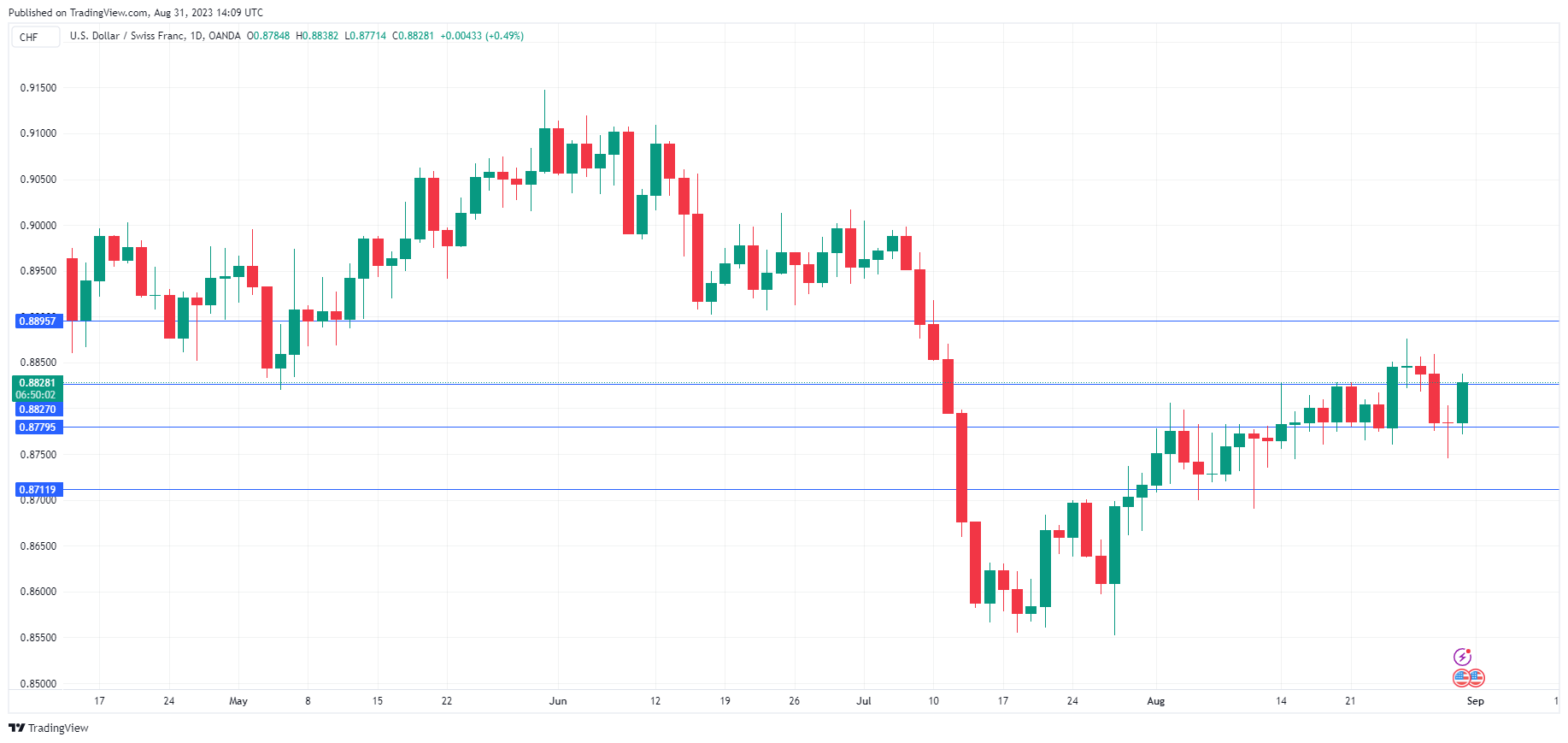
The Swiss franc has lost ground on Thursday. In the North American session, USD/CHF is trading at 0.8835, up 0.59%.
Thursday’s Swiss retail sales for July looked awful, falling 2.3% m/m. This follows a revised gain of 1.5% in June. Market attention has now shifted to Swiss inflation, which will be released on Friday. Swiss inflation dropped to 1.6% in July, the lowest level since July 2022. The downtrend is expected to continue in August with a consensus estimate of 1.5%.
Policy makers at the Swiss National Bank have to be pleased with the inflation rate. Switzerland boasts the lowest inflation rate in the developed world and both headline and core inflation are comfortably nestled in the central bank’s inflation target range of 0%-2%. Still, the SNB remains wary about inflation, with concerns that increases in rents and electricity prices could push inflation back up to 2%. Food inflation remains high and rose from 5.1% to 5.3% in July.
Unlike other major central banks, the SNB meets quarterly, which magnifies the significance of each rate decision. At the June meeting, the central bank raised rates to 1.75% from 1.50% and hinted that further hikes were coming. The SNB has projected inflation will hit 2.2% in 2023 and 2024, above its target. That means the SNB expects to have to continue raising rates, although, as is the case with many other central banks, the peak rate appears to be close at hand.
In the US, unemployment claims dropped to 228,000 last week, down from a revised 232,000 and below the estimate of 236,000. All eyes will be on Friday’s job report, with nonfarm payrolls expected to dip to 170,000, down from 187,000.
The Fed’s favourite inflation gauge, the PCE Price Index, increased in July by 0.2% for a second straight month, lower than the estimate of 0.3%. On an annualized basis, the PCE Price Index climbed 3.3% in July, up from 3.0% in June. Service prices rose by 0.4% in July, up from 0.3% from the previous month. The numbers indicate that the Fed’s battle with inflation is far from over, and the final phase of pushing inflation down to 2% may prove the most difficult.
USD/CHF Technical
- USD/CHF is testing resistance at 0.8827. Above, there is resistance at 0.8895
- 0.8779 and 0.8711 are providing support
US: Consumer Spending Expands, Even as Prices Tick Higher in July
Personal income grew 0.2% month-on-month (m/m) in July, which was below market expectations for a gain of 0.3%. This marked a slight deceleration from the prior month's 0.3% gain. The increase primarily reflected a rise in compensation to employees that was partly offset by a decrease in personal current transfers.
Accounting for inflation and taxes, real personal disposable income fell -0.2% m/m, relative to the flat figure recorded the previous month.
Personal consumption expenditures rose 0.8% m/m, accelerating from the upwardly revised 0.6% posted in June (previously 0.5%). July's reading came in just above market expectations for 0.7% growth.
- Expenditures on services grew 0.8% m/m, up from 0.6% in June. Spending on financial services and insurance, housing and utilities, food services and health care were the primary contributors to movements in the services category.
- There was also an increase in goods spending. Goods spending rose by 0.7% m/m, an acceleration from the 0.6% posted in June. Both durables and non-durable goods spending advanced by 0.7% on the month.
Adjusting for inflation, real spending grew 0.6% for the month, coming in just above the consensus estimate for a 0.5% gain. In real terms, goods spending was up 0.9% m/m, while services were up 0.4%.
The personal consumption expenditure (PCE) price deflator rose 0.2% m/m, and 3.3% on a year-on-year (y/y) basis – bang-on the consensus forecast (3.3% y/y) but above June's reading (3.0% y/y).
The core PCE price deflator (which excludes food and energy and is the Fed's preferred measure of inflation) rose 0.2% m/m for the second consecutive month and was in line with the consensus forecast. On an annual basis, core PCE inflation accelerated to 4.2% y/y from 4.1% y/y the month prior.
The personal savings rate fell to 3.5% in July, down 0.8%-pts from June's reading of 4.3%. This is the first time the measure has fallen below 4% since the start of the year.
Key Implications
With the labor market slowly coming back into better balance, easing wage pressures helped to cool income growth last month. However, with excess savings still available, U.S. households were able to keep spending, resulting in a pullback in the personal savings rate. July's personal consumption expenditure number provided a solid start to Q3, with real PCE expected to accelerate from 1.7% annualized in Q2 to 4% in Q3.
As the Fed chair reminded us at the Jackson Hole Symposium last week, the fight against inflation is far from over. Today's core PCE inflation reading brought that back into focus with the measure still notably above the Fed's 2% target. Recent labor market data suggest things are cooling, which should continue to ease wage pressures and lead to further downward pressure on inflation. Should this trend persists, it will abate the need for further rate increases. The Central Bank will have more opportunities to gauge the temperatures of both inflation and the labor market before the September meeting, but current market pricing suggests the Fed will skip the September meeting but potentially hike in November should the data continue to surprise to the upside.
BTCUSD Rebounds Strongly But 200-SMA Caps Upside
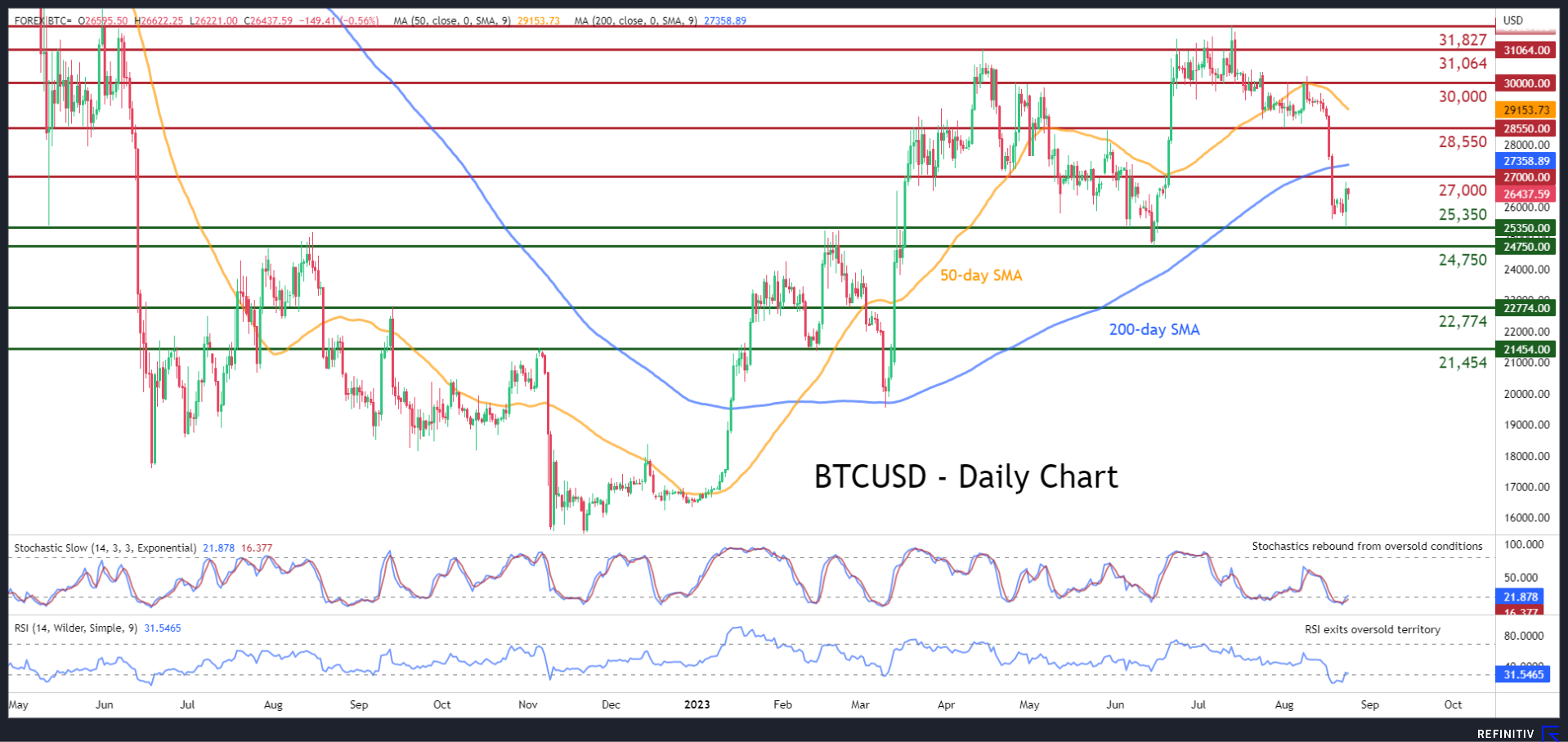
BTCUSD (Bitcoin) broke aggressively above its rangebound pattern on Tuesday, temporarily jumping above the 28,000 mark. However, the bulls lost the battle around the 200-day simple moving average (SMA), with the price slipping before entering a tight range in the last couple of sessions.
The momentum indicators currently suggest that near-term risks remain tilted to the upside. Specifically, the MACD is strengthening above both zero and its red signal line, while the stochastic oscillator is advancing steeply.
If buying interest intensifies, the king of cryptos could initially test the recent resistance of 28,140. Should that barricade fail, the spotlight could turn to 28,550, which acted both as support and resistance in August and May, respectively. Slicing through that region, the price may then advance towards the crucial 30,000 psychological mark.
On the flipside, bearish actions could send the price to challenge the March support of 26,520. Further declines could then cease at the recent two-month low of 25,350 ahead of the June bottom of 24,750. A violation of the latter could open the door for the 21,454 hurdle.
Overall, BTCUSD seems to be entering a consolidation phase as the 200-day SMA has so far repelled all upside attempts. Thus, a clear break above that barrier is needed for the rebound to resume.
Sunset Market Commentary
Markets
German ECB governing council member Schnabel set the tone for trading today immediately after the European opening bell. Her nationality makes her monetary hawk both by nature and by nurture. The observation that she kept options open for the September policy meeting took part of a divided market by surprise and tempered those expecting a 25 bps rate hike, including ourselves. Should the ECB’s assessment be that the transmission of monetary policy suggest that the pace of disinflation is proceeding as desired, then they may afford to wait until the next (October) meeting to gather more evidence. Schnabel admitted that underlying price pressures remain stubbornly high with domestic factors being the main drivers, but put a lot of onus of the weaker growth outlook compared to June ECB forecasts. Back then, the central bank prognosed 0.9%, 1.5% and 1.6% GDP growth for the 2023-2025 period. The timing of Schnabel’s comments added to the astonishment for some given that they came as EMU inflation numbers were about to print on the upside of expectations following several national releases. Headline CPI effectively accelerated to 0.6% M/M (vs 0.4% expected) with the annual figure stabilizing at 5.3% Y/Y (vs 5.1% expected). Underlying core CPI moderated as forecast from 5.5% Y/Y to 5.3% Y/Y. EMU money markets yesterday attached a 50 bps probability to a September move with a 25 bps hike fully discounted by the end of the year. After today’s comments and CPI data, those dropped to respectively 25% and 50%. In today’s momentum, markets also spotted some more “pause” signals in the Minutes of the July ECB gathering. These included a reference to the contained risk of a wage-price spiral and an initial preference for not hiking even though all members eventually supported the July 25 bps rate hike. However, Minutes concluded that “Taken together, the September projections, the evolution of underlying inflation and incoming information on monetary transmission would help the GC update its assessment of the appropriate monetary policy stance.” So the jury remains out on the issue and we don’t alter our 25 bps rate hike call.
The repricing on money markets was visible further down the curve as well. German Bunds outperform US Treasuries today. German yields lose 2.5 bps (30-yr) to 6.5 bps (2-yr). US yields changes vary between +0.4 bps (2-yr) and -1.7 bps (30-yr) but US Treasuries obviously outperformed the past two sessions on slightly disappointing US data. The loss of interest rate support pulls EUR/USD back below 1.09 (1.0860 currently) while stock markets record small gains (+0.25% in both Europe and the US).
News & Views
Polish inflation flatlined in August (0.0% M/M), bringing the yearly figure further down from 10.8% to 10.1%, data from Statistics Poland released today showed. The near-consensus outcome is the lowest print since February last year. Food again dipped at a solid -1% monthly pace but fuels for personal transport rose by 1.9% amid a powerful oil price rise in recent weeks. National Bank of Poland governor Glapinski has repeatedly cited single-digit inflation as a prerequisite for (beginning the debate on) rate cuts, provided price pressures maintained a downward trend. This is likely to be the case next month. The central bank meets next week (September 6). At the meeting thereafter (October 4) it will have the September inflation print (29/09) at its disposal, potentially allowing the NBP to make a dovish U-turn ahead of important parliamentary elections on October 15. The Polish zloty reacted muted to the numbers. EUR/PLN is going nowhere near its recently found equilibrium around 4.47.
The Turkish economy topped estimates by growing 3.5% Q/Q in the second quarter of the year. Analysts had penciled in 2.3%. GDP is now 3.8% bigger than in the same quarter last year. The expansion was fueled by higher consumer demand and government spending, in particular in the run-up to the May election. Re-elected president Erdogan amongst others had distributed one month of free natural gas to woo voters. Household consumption shot up 15.6% while government expenditures rose by 5.3%. Exports tumbled 9%, highlighting weaker global demand. In terms of sectors, value added in the construction sector rose 6.2% as the country’s infrastructure recovery continued going into Q2 after the February earthquake. Looking ahead, Turkish growth is expected to ease following, amongst others, the sharp increase in central bank interest rates. The CBRT last week lifted the policy rate from 17.5% to 25%.