

Sample Category Title
EUR/USD: Extends Pullback on Weaker than Expected EU/German Manufacturing PMI’s
EURUSD remains in red for the fifth straight day and accelerated lower on Monday morning, as weaker than expected German / EU manufacturing PMI data (hit the lowest in three years in July) further soured the sentiment.
Downbeat PMI numbers hurt expectations for rate hike in September, as the Fed is expected to raise rates by 25 basis points in the policy meeting due later this week.
Although inflation in the Eurozone dropped significantly (down to 5.5% in June from last October’s peak at 10.6%) it is still well above 2% target and requires further action from the central bank, but high borrowing cost already hurt the economy, warning of further slowdown in economic growth if the ECB opts for more aggressive approach to monetary policy.
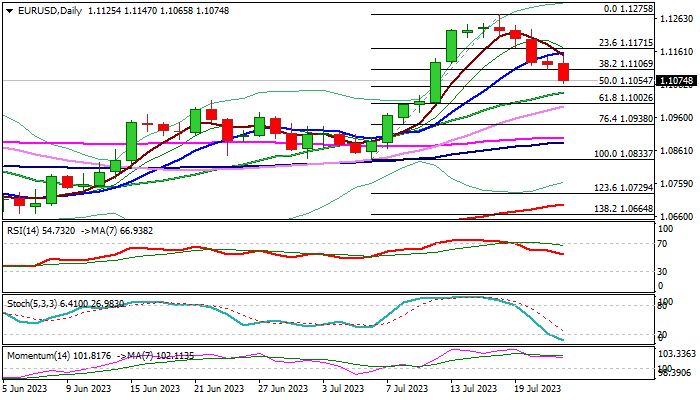
Today’s break of pivotal supports at 1.1106/00 (Fibo 38.2% of 1.0833/1.1275 / round-figure) generated fresh bearish signal for attack at next key support at 1.1054 (50% retracement / daily Kijun-sen).
Bears may face solid bids at this zone, as stochastic is deeply oversold and bullish momentum is still strong on daily chart but break here would risk test of 1.1026/1.1000 (Fibo 61.8% / psychological) violation of which to confirm reversal.
Only bounce and close above 10DMA (1.1150) would neutralize bears and signal an end of corrective phase.
Res: 1.1106; 1.1150; 1.1171; 1.1229.
Sup: 1.1054; 1.1026; 1.1000; 1.0938.
Yen Rebounds After Rough Week, US Manufacturing PMI Next
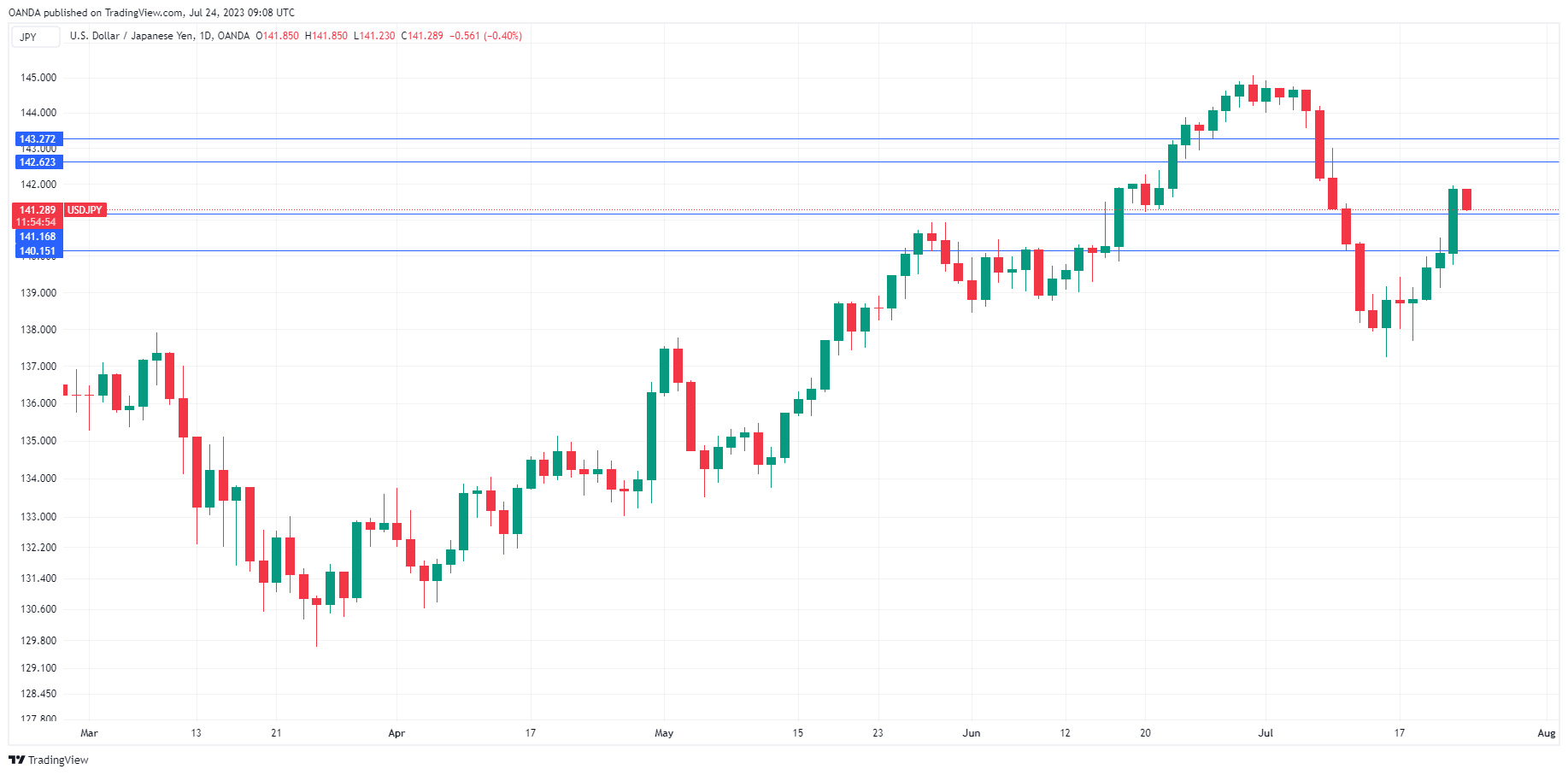
The Japanese yen has bounced back on Monday. In the European session, USD/JPY is trading at 141.27, down 0.40%. The yen declined on Friday by 1.2%, capping an awful week, with the yen falling 2.2%.
Reuters – BoJ decision could be a close call
Traders are keeping a close eye on the Bank of Japan, which holds a policy meeting on Friday. The BoJ made it to the headlines on Friday, after a Reuters report that the BoJ is leaning towards keeping its yield control policy unchanged. This was not major news, as expectations are that the BoJ will maintain current policy settings. What was noteworthy in the report was that the BoJ had not reached a consensus and the decision could be a close call.
The BoJ has insisted that inflation is temporary and there is no need to tighten policy, but with inflation at high levels, there is speculation that a shift in policy is only a question of time. Last week, Japan’s core inflation rose to 3.3%, the 15th straight time that inflation exceeded the BoJ’s target of 2%.
If the BoJ were to surprise the markets and tweak its yield control policy, the yen would likely post sharp gains. Traders will be on their toes for any developments related to the BoJ meeting, which could make it a busy week for USD/JPY.
The US starts the week with manufacturing and services PMIs. The two sectors have been moving in opposite directions, with manufacturing in decline and services showing growth. This trend is expected to continue on Monday – Manufacturing PMI is projected to inch higher to 46.4, up from 46.3, while the Services PMI is expected to rise to 54.4, up from 54.0. The 50.0 level separates contraction from expansion.
USD/JPY Technical
- USD/JPY has pushed past resistance at 1.4067 and 141.28. There is weak resistance at 142.12, followed by 142.62
- There is support at 139.68 and 138.52
Crypto Market Poised for Deeper Correction
Market picture
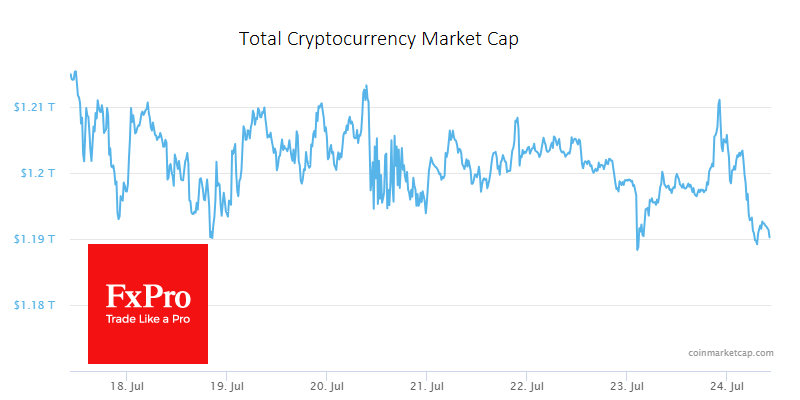
The crypto market lost 1.8% to last week’s level of $1.192 trillion, spending most of its time within the $1.190-1.210 trillion range and near its lower boundary on Monday morning. The market has found its temporary equilibrium as it awaits the decisions of three major central banks – the Fed, the ECB, and the Bank of Japan – later this week. Their actions and comments will likely complete the market consolidation and set the trend for the coming weeks.
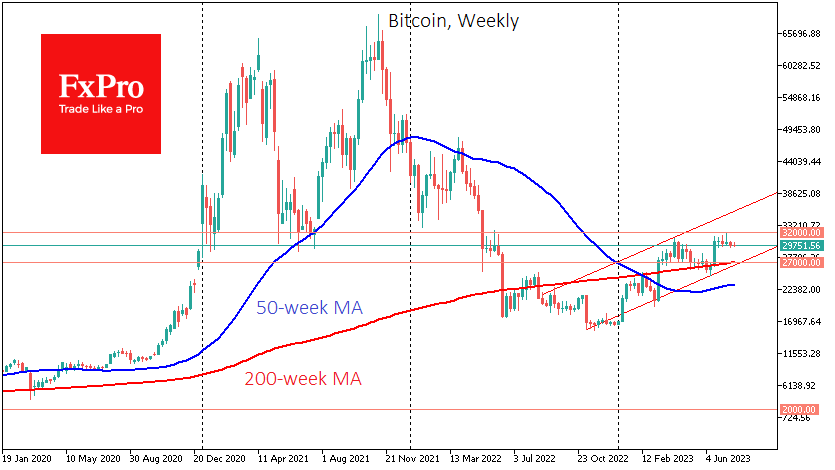
Bitcoin continues to test the lower end of the range, trading at $29.8K, but a closer look reveals a downtrend, with periods of weakness occurring at slightly lower levels. On the other hand, the bulls still manage to buy back BTCUSD on dips below $29.7K. Nevertheless, be prepared for Bitcoin to fall to $28.9K as part of a typical correction to 61.8% of the initial rise since mid-June and the 50-day MA.
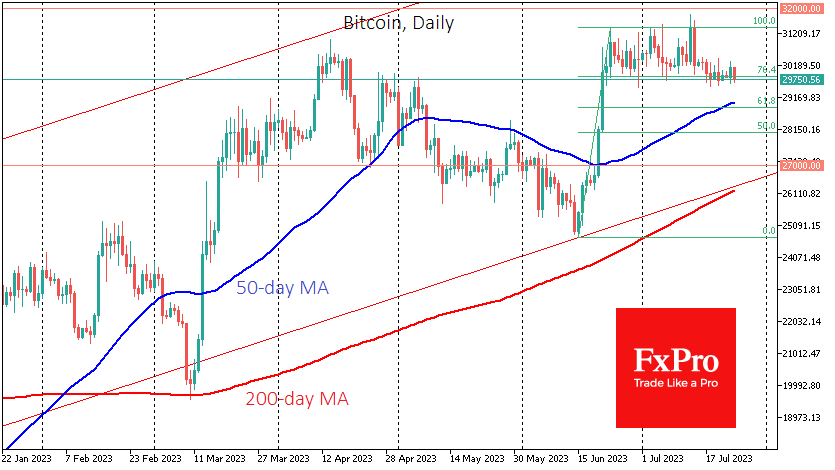
If bearish pressure intensifies, the next significant support level would be $27K, the lower boundary of the rising channel from the November lows and the 200-week moving average.
News background
Bitcoin will soon fall to almost nothing, says Spencer Schiff, a former BTC backer and son of prominent crypto critic Peter Schiff. He has become disillusioned with cryptocurrency and now believes that the most attractive projects will be those based on artificial intelligence.
Republicans in the US House of Representatives released a draft bill to regulate the digital asset industry, requiring the SEC and CFTC to develop rules.
Cryptocurrency exchange Coinbase closes its Borrow lending programme. The programme allowed customers of the largest US exchange to borrow up to $1 million against crypto assets.
MicroStrategy co-founder Michael Saylor said Argentina’s economy can only recover thanks to cryptocurrencies, especially Bitcoin. Argentina is leading the way in cryptocurrency adoption in Latin America amid high inflation.
GBP/JPY Daily Outlook
Daily Pivots: (S1) 180.61; (P) 181.57; (R1) 183.22; More...
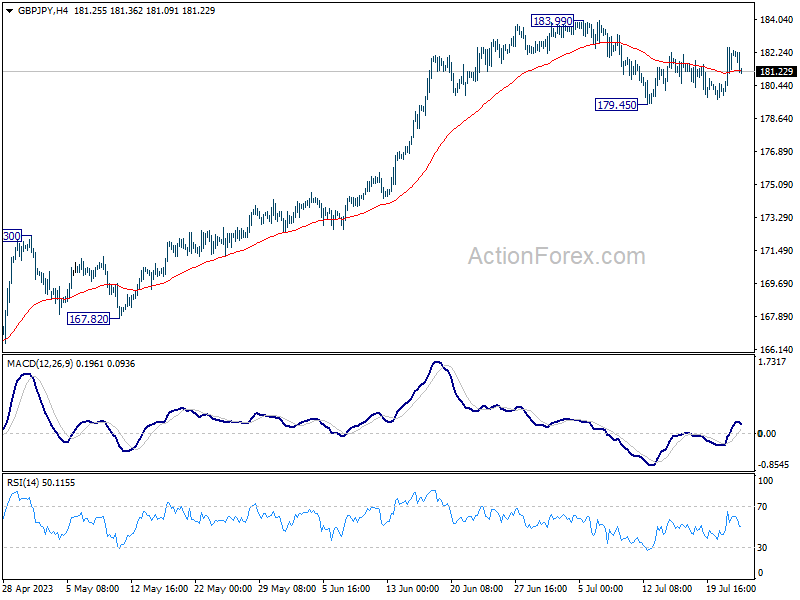
Intraday bias in GBP/JPY remains neutral and outlook is unchanged. On the downside, break of 179.45 will resume the correction from 183.90 to 55 D EMA (now at 177.70). On the upside, firm break of 183.99 high will resume larger up trend to 187.36 projection level.
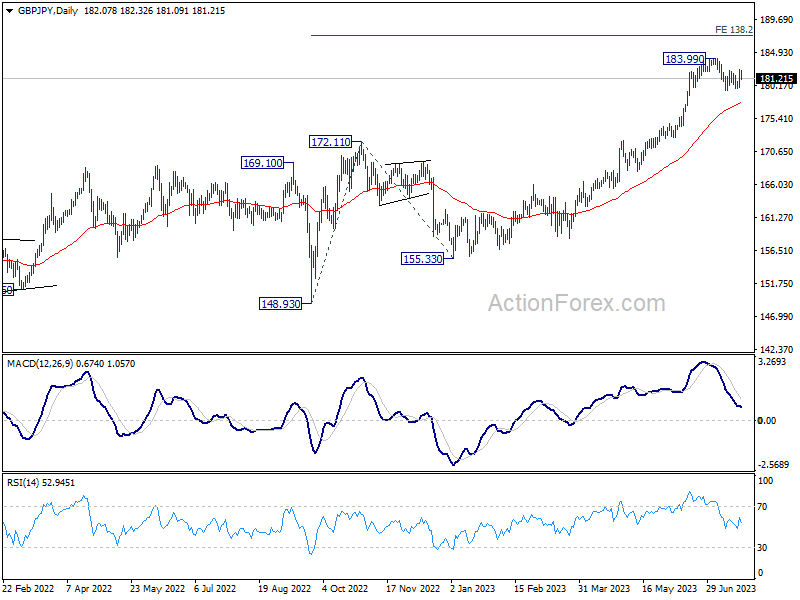
In the bigger picture, as long as 172.11 resistance turned support holds, up trend from 123.94 (2020 low) is expected to continue. On resumption, next target is 138.2% projection of 148.93 to 172.11 from 155.33 at 187.36, and then 195.86 (2015 high). Nevertheless, firm break of 172.11 will argue that larger correction is already underway.
EUR/JPY Daily Outlook
Daily Pivots: (S1) 156.21; (P) 157.12; (R1) 158.66; More....
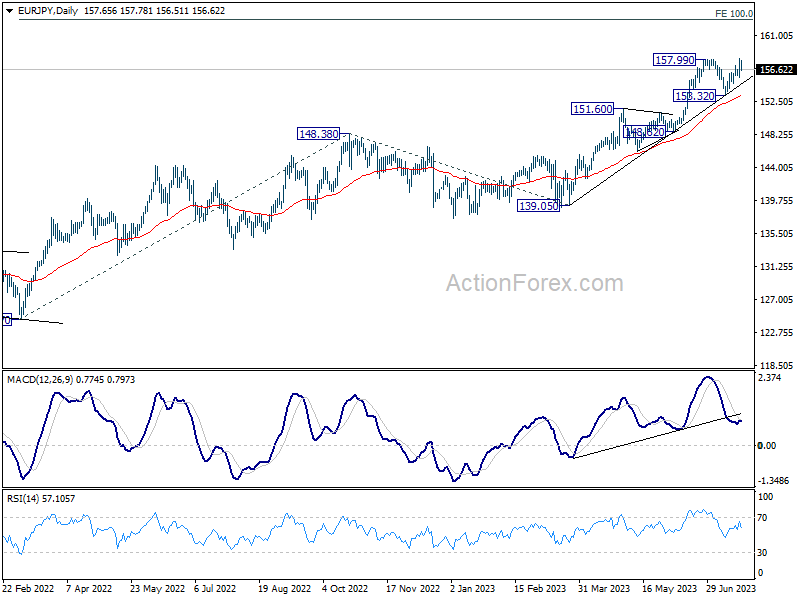
Intraday bias in EUR/JPY stays neutral as it retreated after failing to break through 157.99 high decisive break. On the upside, sustained break of 157.99 will confirm resumption of larger up trend, and target 162.82 projection level next. Nevertheless, break of 155.57 minor support will bring deeper decline to extend the corrective pattern from 157.99.
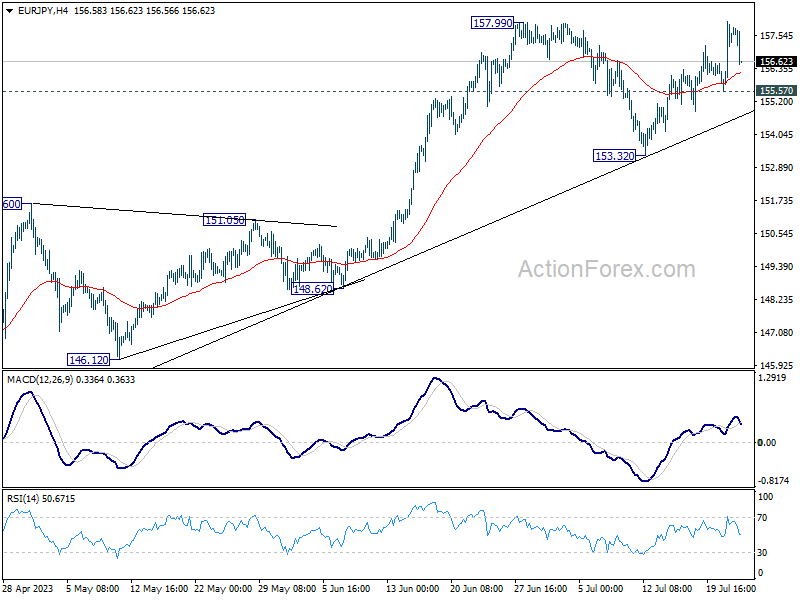
In the bigger picture, as long as 151.60 resistance turned support holds, rise from 114.42 (2020 low) is in progress. On resumption, next target is 100% projection of 124.37 to 148.38 from 138.81 at 162.82. Nevertheless, sustained break of 151.60 will argue that larger correction is already underway.
EUR/GBP Daily Outlook
Daily Pivots: (S1) 0.8633; (P) 0.8657; (R1) 0.8679; More...
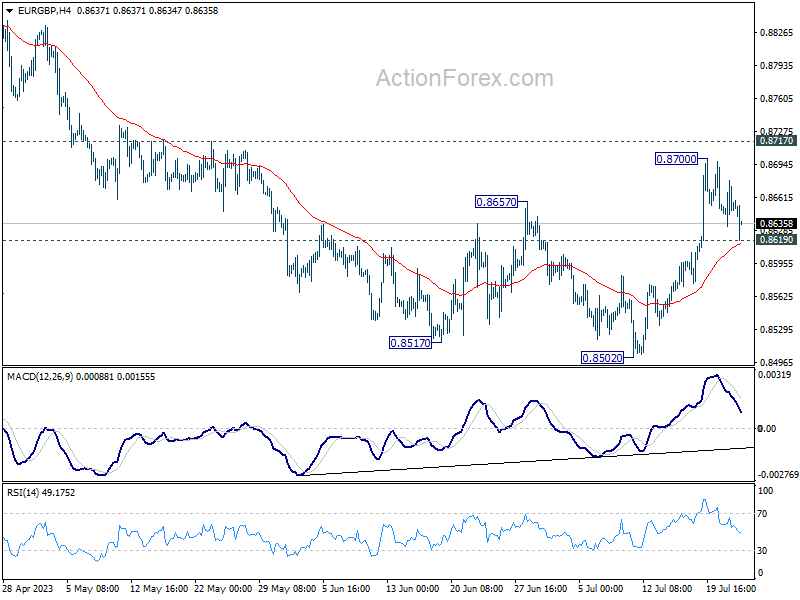
Intraday bias in EUR/GBP stays neutral and further rally is expected with 0.8619 minor support intact. On the upside, decisive break of 0.8717 support turned resistance will solidify that fall from 0.8977 has completed a five-wave decline. Further rally should then be seen to 0.8977 resistance next. On the downside, though, below 0.8619 minor support will mix up the outlook and turn bias back to the downside for retesting 0.8502 low.
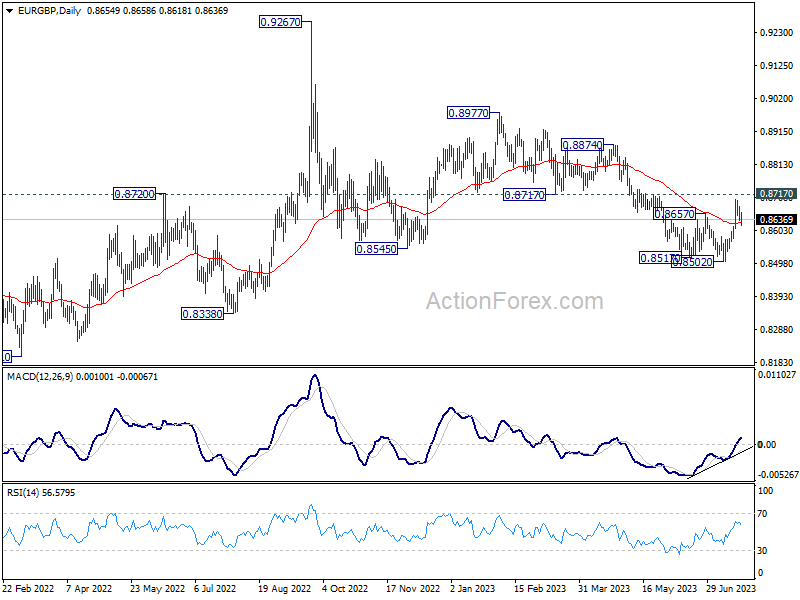
In the bigger picture, the down trend from 0.9267 (2022 high) is seen as part of the long term range pattern from 0.9499 (2020 high). Firm break of 0.8717 support turned resistance will argue that it has completed with three waves down to 0.8502. Further break of 0.8977 will bring retest of 0.9267 high. Nevertheless, break of 0.8502 will resume the decline towards 0.8201 (2022 low).
EUR/AUD Daily Outlook
Daily Pivots: (S1) 1.6446; (P) 1.6493; (R1) 1.6574; More...
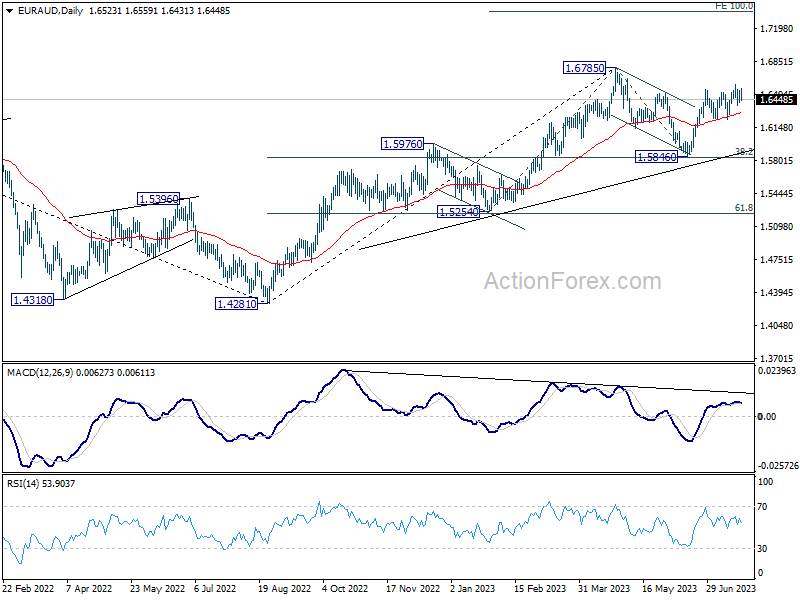
Intraday bias in EUR/AUD stays neutral at this point, for consolidation below 1.6601. Near term outlook stays cautiously bullish as long as 1.6231 support holds. On the upside, break of 1.6601 will target 1.6785 high next. However, firm break of 1.6231 will bring deeper fall to extend the corrective pattern from 1.6785.
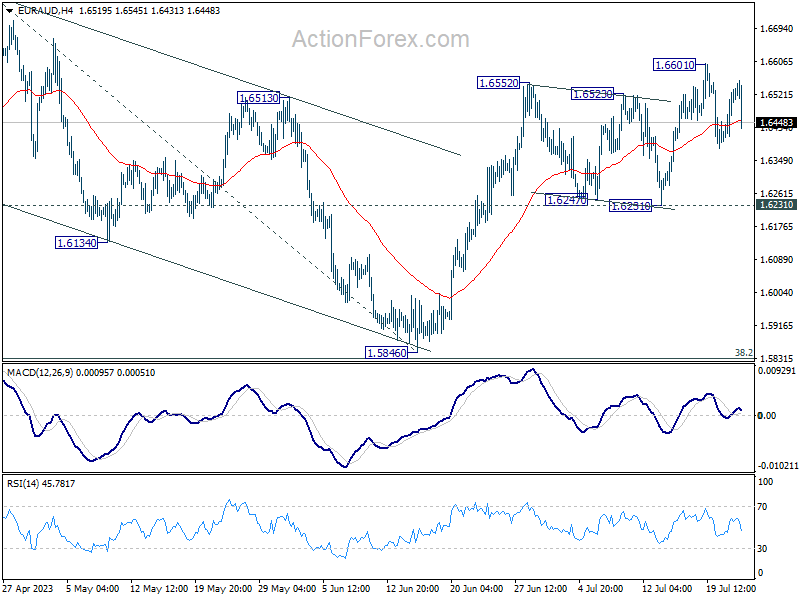
In the bigger picture, with 38.2% retracement of 1.4281 to 1.6785 at 1.5828 intact, rally from 1.4281 is still in progress. Firm break of 1.6785 will confirm rise resumption. Next target is 100% projection of 1.5254 to 1.6785 from 1.5846 at 1.7377. On the other hand, rejection by 1.6785 will extend the corrective pattern with another fall leg. But outlook will stay bullish as long as 1.5828 holds.
EUR/CHF Daily Outlook
Daily Pivots: (S1) 0.9615; (P) 0.9637; (R1) 0.9655; More...
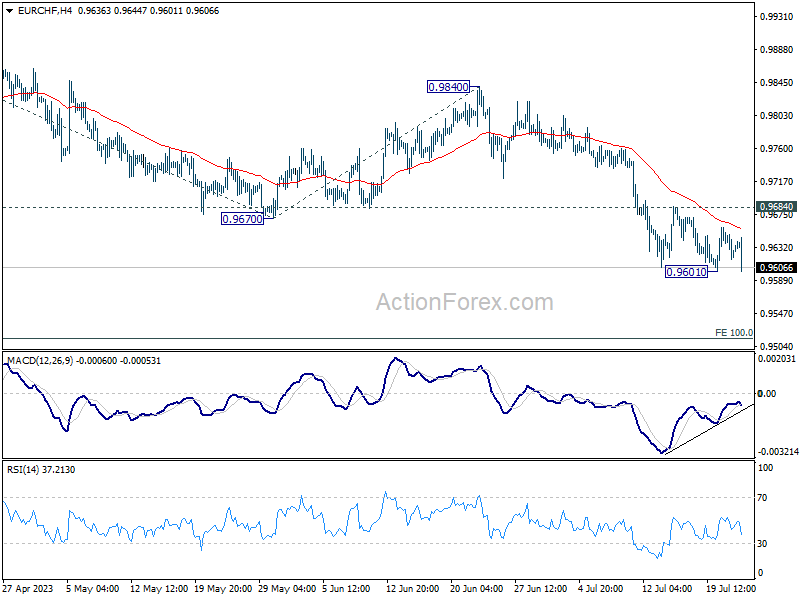
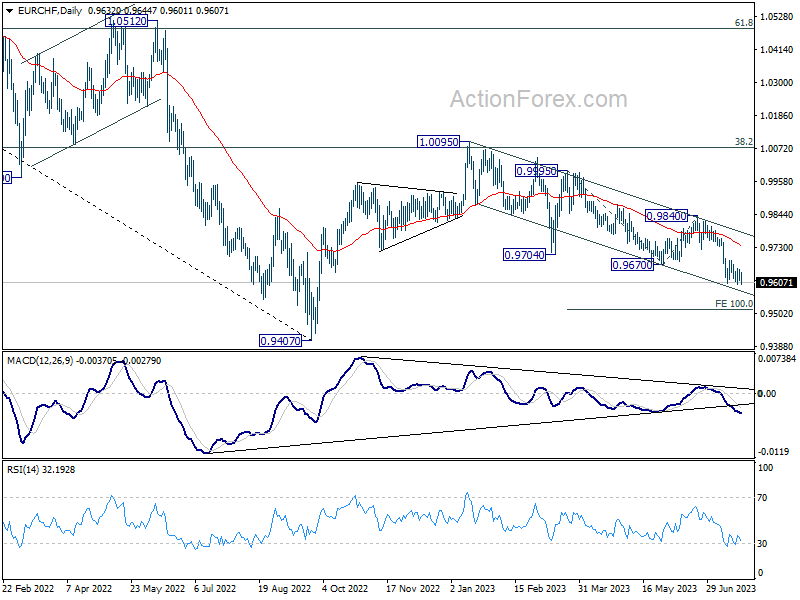
Intraday bias in EUR/CHF stays neutral and outlook remains bearish. On the downside, break of 0.9601 will resume larger decline from 1.0095, and target 100% projection of 0.9995 to 0.9670 from 0.9840 at 0.9515. On the upside, however, break of 0.9684 will indicate short term bottoming, and bring stronger rebound.
In the bigger picture, medium term outlook is staying bearish as the pair is capped well below falling 55 W EMA (now at 0.9889). Down trend from 1.2004 (2018 high) is in favor to extend through 0.9407 at a later stage. Nevertheless, decisive break of 38.2% retracement of 1.1149 to 0.9407 will raise the chance of bullish trend reversal.
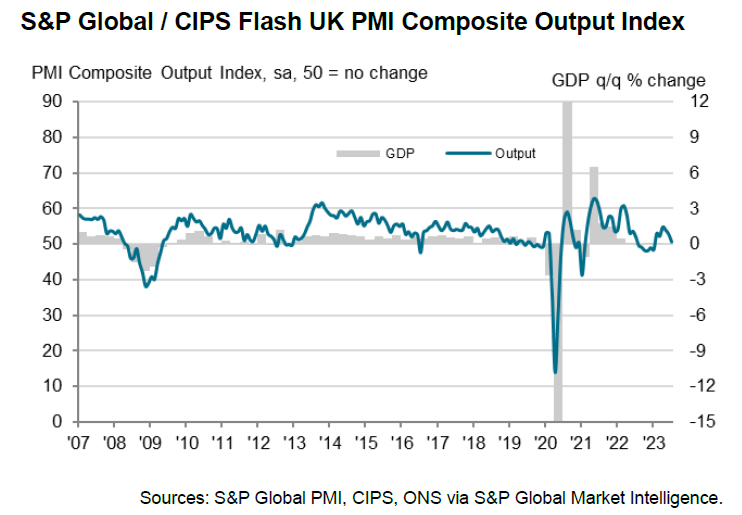
UK PMI composite fell to 50.7, reigniting recession fears
UK's economic landscape appears increasingly precarious, as evidenced by disappointing July PMI readings. Manufacturing PMI plunged to a 38-month low of 45.0, from 46.5 and underperforming expectation of 46.1. the Services PMI dipped to a 6-month low of 51.5, falling short of the anticipated 53.1, and down from 53.7. Composite PMI, encapsulating both sectors, dropped to a 6-month low of 50.7 from 52.8.
Chris Williamson, Chief Business Economist at S&P Global Market Intelligence, expressed significant concern over these figures. "The UK economy has come close to stalling in July which, combined with gloomy forward-looking indicators, reignites recession worries," he noted. "July's flash PMI survey data revealed a deepening manufacturing downturn accompanied by a further cooling of the recent resurgence of growth in the service sector."
Further bolstering this pessimistic outlook, forward-looking indicators, such as order book inflows, levels of work-in-hand, and future business expectations, suggest a potential weakening of growth in the coming months. Williamson warned, "these all point to growth weakening further in the months ahead, adding to a risk of GDP falling in the third quarter."
While this decline in growth and demand paints a gloomy picture, there's a silver lining in the form of cooling inflationary pressures. "Although ongoing upward wage pressures mean service sector price growth remains elevated, the survey data signal further, potentially marked, falls in consumer price inflation in the months ahead," added Williamson.
Eurozone PMI manufacturing down o 38-mth low, PMI services at 6-mth low
Eurozone's economic outlook appears increasingly gloomy as latest PMI readings for manufacturing and services sectors disappoint, suggesting further contraction may lie ahead. Manufacturing PMI declined to 42.7 in July from 43.4, a 38-month low and below expectations of 43.5. Simultaneously, Services PMI dropped to a 6-month low of 51.1, short of the projected 51.5, and down from 52.0. Composite PMI, reflecting both sectors, sank to an 8-month low of 48.9, down from 49.9.
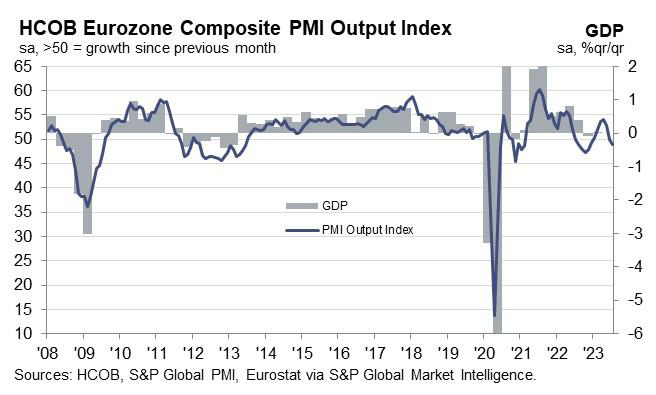
Cyrus de la Rubia, Chief Economist at Hamburg Commercial Bank, expressed his concern, stating, "Manufacturing continues to be the Achilles heel of the eurozone. Producers have cut their output again at an accelerated pace in July, while the services sector's activity is still expanding, though at a much slower rate than earlier in the year." He further warned, "The eurozone economy will likely move further into contraction territory in the months ahead, as the services sector keeps losing steam."
This less than encouraging data will surely unsettle ECB, as cost pressures in the private sector remain persistent, particularly in the substantial services sector. "The latest PMI reading is not going to please ECB officials...Thus, ECB president Christine Lagarde will certainly stick to her guns and hike interest rates by 25 bp at the next monetary meeting at the end of July," de la Rubia explained.
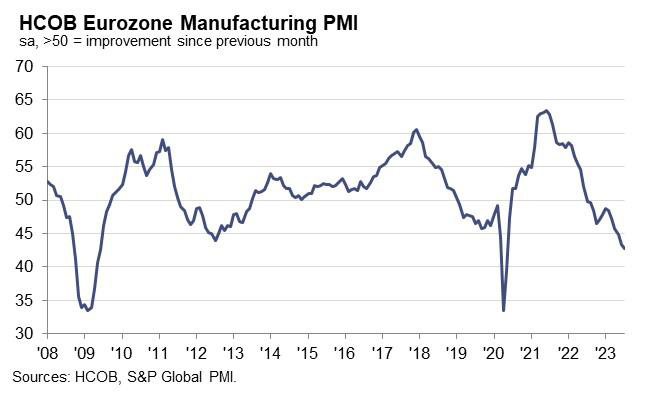
Meanwhile, France's manufacturing PMI slid to a 38-month low at 44.5, down from 46.0, while its services PMI fell to 47.4, a 29-month low, from 48.0. The composite PMI followed suit, dropping to a 32-month low at 46.6, dowm from 47.2.
Germany's manufacturing PMI took a dive from 40.6 to 38.8, also a 38-month low. Services declined to a 5-month low at 52.0 from 54.1, and the composite PMI fell to an 8-month low of 48.3, down from 50.6.