Sample Category Title
June Flashlight for the FOMC Blackout Period
To Hike or Not to Hike, That Is the Question
Summary
- After raising rates by 500 bps since March 2022, the FOMC signaled at the conclusion of its previous meeting on May 3 that the tightening cycle may be coming to an end. That said, the Committee was careful to keep its options open regarding further tightening.
- Economic data that have been released after the previous FOMC meeting have generally been stronger than expected. In addition, financial conditions have been little changed since the May meeting. Consequently, some Committee members have indicated their preference to raise rates further on June 14.
- However, some key FOMC members, including Chair Powell, FOMC Vice Chair Williams and Governor Jefferson, seem content to leave policy unchanged at next week's meeting to allow more time for past rate hikes to filter through to the economy.
- We see the most likely outcome for next week's meeting as the FOMC making no change to its policy rate, but making clear that another hike at its July 26 meeting remains a distinct possibility. This combination would allow a compromise between officials who believe further tightening is necessary and those who believe it is time to be patient and let the medicine of the past year fully take hold.
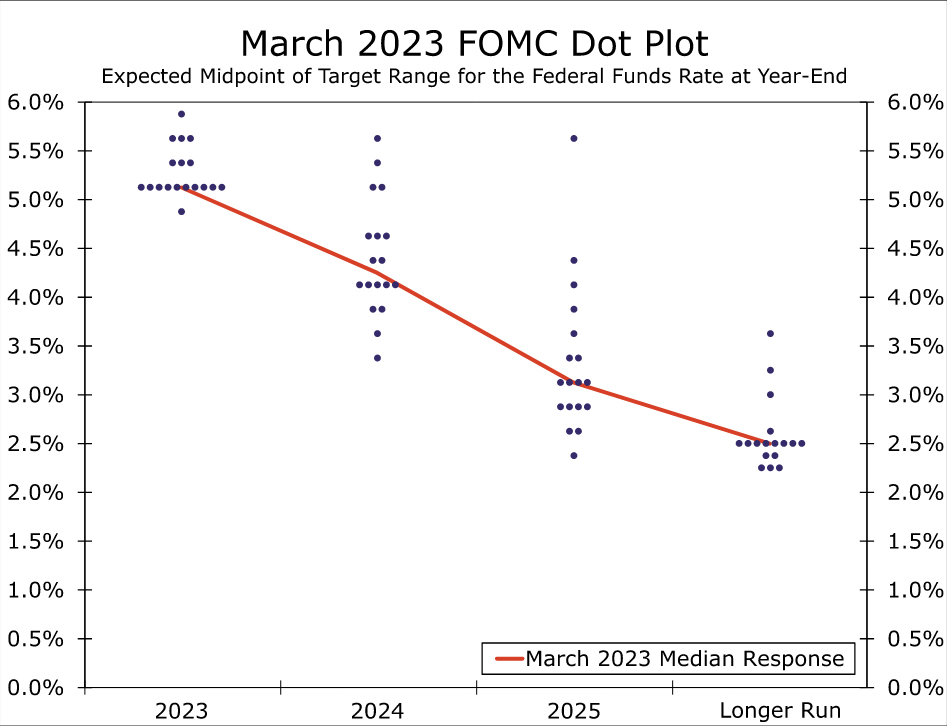
- The FOMC will release its quarterly Summary of Economic Projections (SEP) at the conclusion of its meeting on June 14. We think the median "dot" for year-end 2023 will shift up by 25 bps relative to the March SEP. If so, then most FOMC members would be indicating that the target range for the federal funds rate needs to go at least 25 bps higher from its current setting of 5.00%-5.25%. We think the median dots for 2024 and 2025 will also rise by 25 bps each to reflect a similar pace of eventual policy easing, as was the case in the March projections.
- We think most Committee members will bring down their forecasts of where they think the unemployment rate will end 2023, while nudging up their outlooks for GDP growth this year. We do not expect meaningful changes to the Committee's inflation projections.
Take a Breath
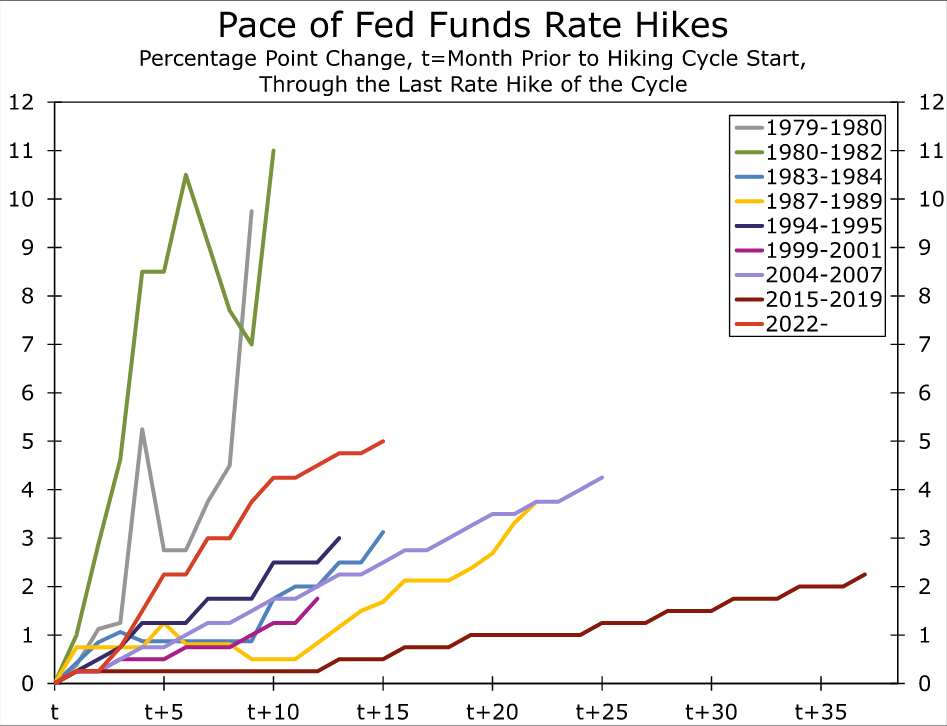
At the conclusion of the FOMC's meeting on May 3, there were signs that the most aggressive tightening cycle since the 1980s was nearing its end (Figure 1). Policymakers voted unanimously to raise the fed funds rate by 25 bps to 5.00-5.25%, a 15-year-high. Yet, the Committee was careful to keep its options open about additional rate hikes. Rather than noting that it anticipated "ongoing increases" or even "some additional policy firming," the post-meeting statement merely laid out the factors the FOMC would consider in determining how much additional tightening "may be appropriate" (emphasis ours). The change in language implied that Fed policy may have already arrived at a point where the FOMC could wait and see how the cumulative amount of tightening this cycle—a 500 bps increase in the fed funds rate and a $550B reduction in its balance sheet—is impacting the economy given the lagged effects of monetary policy.
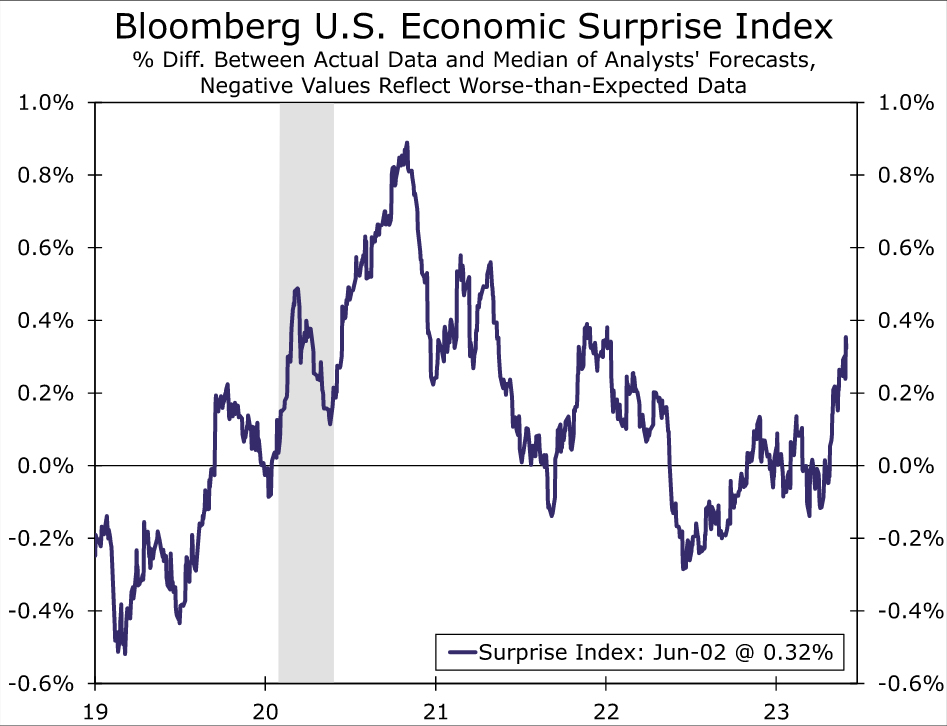
Because of these uncertain lags, the FOMC remains dependent on incoming data to guide its next steps. Since the FOMC's most recent meeting, the economic data have come in stronger than expected, driving the Bloomberg U.S. Economic Surprise Index to a 17-month high (Figure 2). Consumers stepped up spending on both goods and services in April, putting real personal consumption expenditures on track to grow at a 1%-2% annualized rate in Q2. Business investment looks a little stronger as core capital goods orders in April rose by the most in more than a year, and spending on private nonresidential construction has increased more than 10% year to date. Meanwhile, the dearth of existing homes for sale is supporting a modest rebound in residential investment, with single-family permits increasing for three straight months and homebuilder confidence rebounding to a 10-month high.
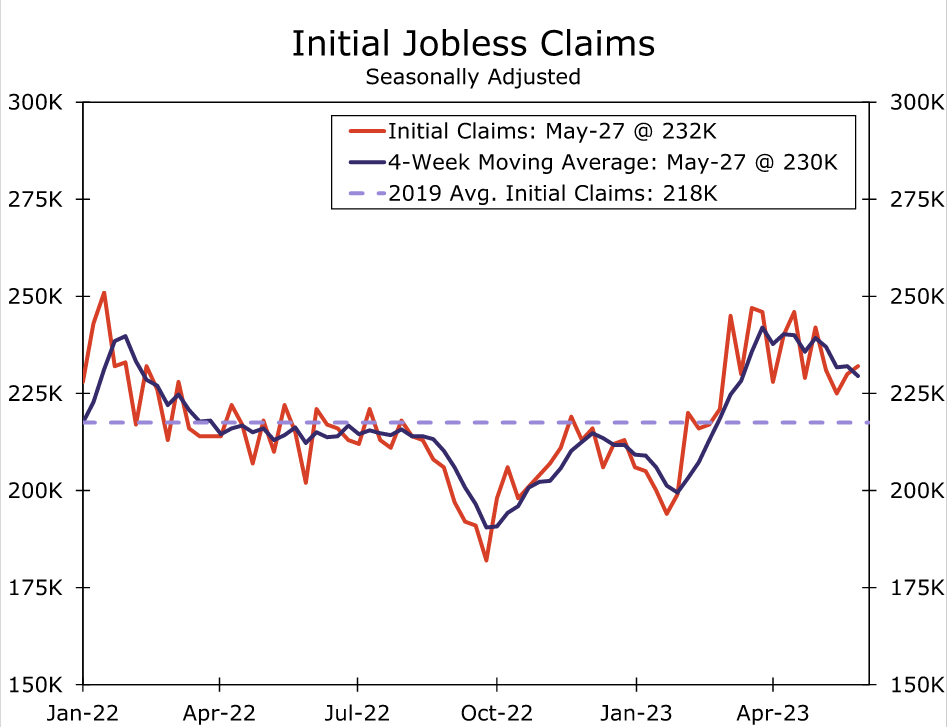
The labor market data have been equally strong. Nonfarm payrolls increased a robust 339K in May and have grown at an average pace of 283K over the past three months. Wage growth has cooled a bit but remains above what would be consistent with the Fed's 2% inflation target. Layoffs have moved sideways in recent months whether measured by initial jobless claims, the JOLTS data or Challenger job cuts announcements (Figure 3). Supply and demand are coming into better balance in the labor market, but only gradually.
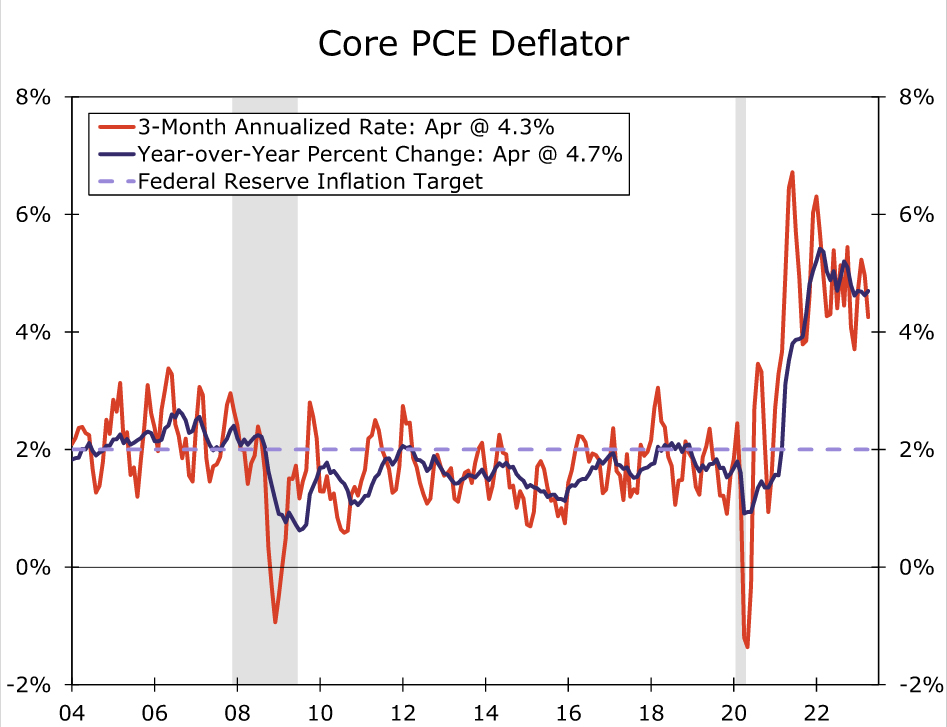
The corollary to resilient activity, however, is sticky inflation. The trend in inflation has yet to convincingly bend. The core Consumer Price Index has advanced 0.4% or more for five consecutive months, while April's above-consensus increase in the core PCE deflator keeps the Fed's preferred inflation gauge running two-times higher than the Committee's target when measured on a three-month annualized or 12-month basis (Figure 4). The FOMC will get another important look at recent inflation trends with the May CPI report scheduled to be released on June 13, the day the FOMC kicks off its meeting. Tamer commodity prices should leave overall consumer prices in May little changed. However, the core CPI index is on track for a 0.3%-0.4% monthly rise by our estimates, furthering the notion that inflation remains stubbornly high.
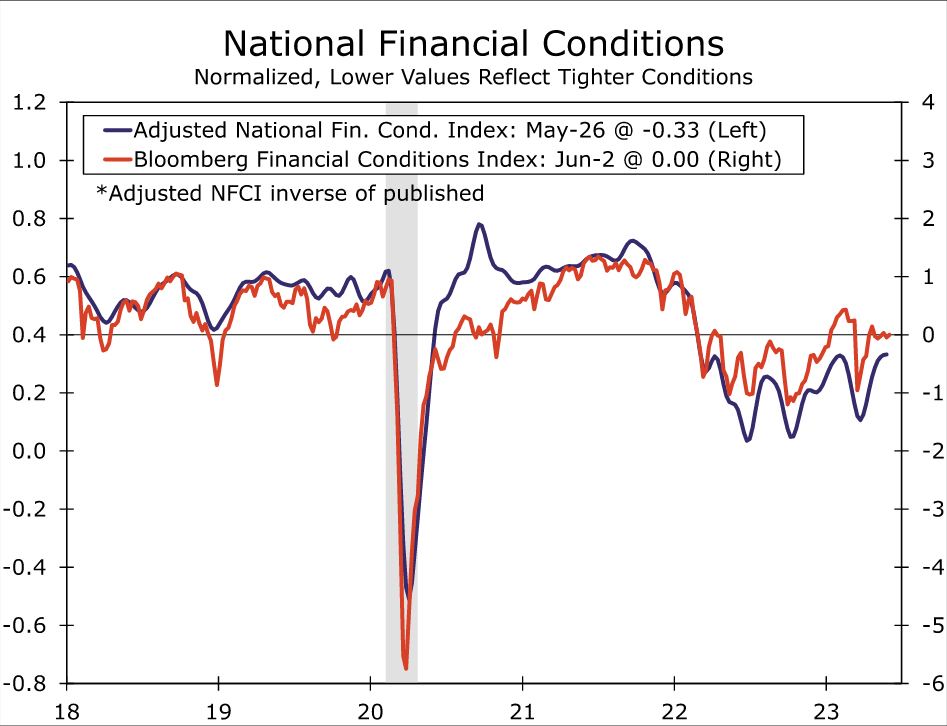
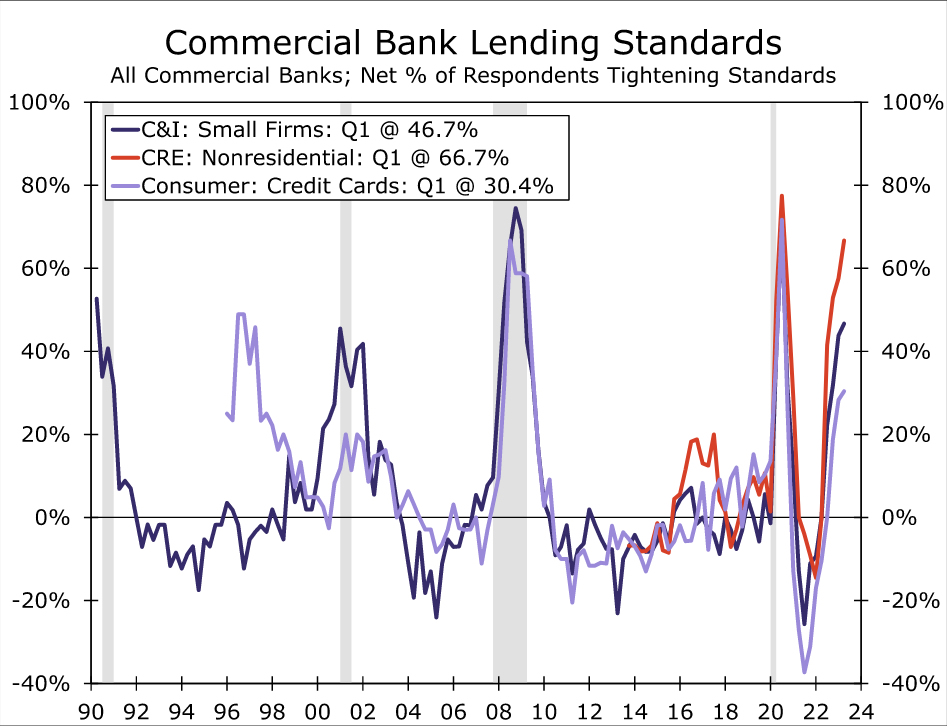
Meanwhile, financial conditions—the channel through which Fed policy affects the real economy—have been little changed since the FOMC's May meeting and are easier than a year ago when the Fed's tightening campaign was in its early months (Figure 5). The S&P 500 index has risen by nearly 12% since the last trading day of 2022, and corporate bond spreads are little changed on balance over the same period for both investment grade and high yield debt securities. Private lending conditions are more difficult to measure in real time and may be tightening more than public markets suggest. Unsurprisingly given the turmoil in the banking sector in March, credit standards at commercial banks tightened over the first quarter, though not materially more than the prior quarter (Figure 6). The KBW regional bank index has risen roughly 4% since the previous FOMC meeting on May 3, although it remains down significantly on the year.
The strength in the latest economic and financial market data has led to a meaningful number of Fed officials expressing their opinions that a bit more tightening likely will be needed to rein in inflation. Between data beats and a chorus of Fed officials sharing they are unconvinced monetary policy is significantly restrictive, the market-implied probability that the FOMC would hike another 25 bps at its June meeting rose to nearly 70% in late May.
Yet, key Fed officials, including Chair Powell, FOMC Vice Chair Williams and Board of Governors Vice Chair-nominee Jefferson, seem content to leave policy unchanged at the upcoming meeting to give more time for the past year's policy changes to filter through to the economy. On May 19, Chair Powell noted that "having come this far, we can afford to look at the data and the evolving outlook to make careful assessments." A day earlier, Governor Jefferson stressed the lags of monetary policy and that "a year is not a long enough period for demand to feel the full effect of higher interest rates." In what seemed like a pointed rebuke to markets pricing in a June increase, Governor Jefferson said just a few days before the blackout period began that "skipping a rate hike at a coming meeting would allow the Committee to see more data before making decisions about the extent of additional policy firming." The small amount of fiscal tightening in the recent debt ceiling bill may also provide wavering FOMC participants some comfort that fiscal policy is at least modestly pulling on the same side of the rope as monetary policy.
Therefore, we see the most likely outcome for next week's meeting as the FOMC making no change to its policy rate but making clear that another hike at its July 26 meeting remains a distinct possibility. This would allow a compromise between officials who believe further tightening is necessary and those who believe it is time to be patient and let the medicine of the past year fully take hold. We think this balanced approach will be enough to stave off any dissenting votes, but the uncertain outlook and increasingly fractured views within the FOMC have increased the odds that one or more dissents could occur at one of the upcoming meetings.
The timing at which to first take a step back and leave more time to assess the effects of policy seems a bit odd to us given the surprising strength of recent data and leads us to wonder if some Committee members are weary about the effect of even higher rates on the banking system. However, a "skip" would hardly be unprecedented. In the most recent tightening cycle of 2015-2018, the FOMC never hiked rates at back-to-back meetings. Even in the 1994-95 cycle when the FOMC was raising rates in 50 bps or 75 bps increments, it did so at every other meeting.
If the Committee does decide to leave the fed funds rate unchanged, we would expect the statement to emphasize the significant amount of policy tightening undertaken in a little over a year. But to keep the door open to potentially more tightening, the statement would likely maintain the reference to possible additional policy firming being appropriate. The clearest indication that FOMC participants believe some further tightening is more-likely-than-not probably will come from the Summary of Economic Projections (SEP), to which we now turn.
SEP: Modestly Higher Dots, More Resilient Economy
The upcoming FOMC meeting will include an update to the Committee's SEP, which summarizes the macroeconomic forecasts that each FOMC member provides on a quarterly basis. In the previous SEP released at the March FOMC meeting, the median projection for the federal funds rate at year-end 2023 was 5.125%, which is the midpoint of the current fed funds target range. However, the "dots" for year-end 2023 had a clear upward bias; seven projections were above 5.125%, while just one was below (Figure 7). As a result, it would not take much to nudge the 2023 median dot a little higher, and accordingly we look for the 2023 median dot to be 5.375% in the updated projections. This could serve as an olive branch to the more hawkish members of the Committee who are concerned that more monetary policy tightening is still warranted. We think the median 2024 and 2025 dots will also rise by 25 bps each to reflect a similar pace of eventual policy easing, as was the case in the March projections.
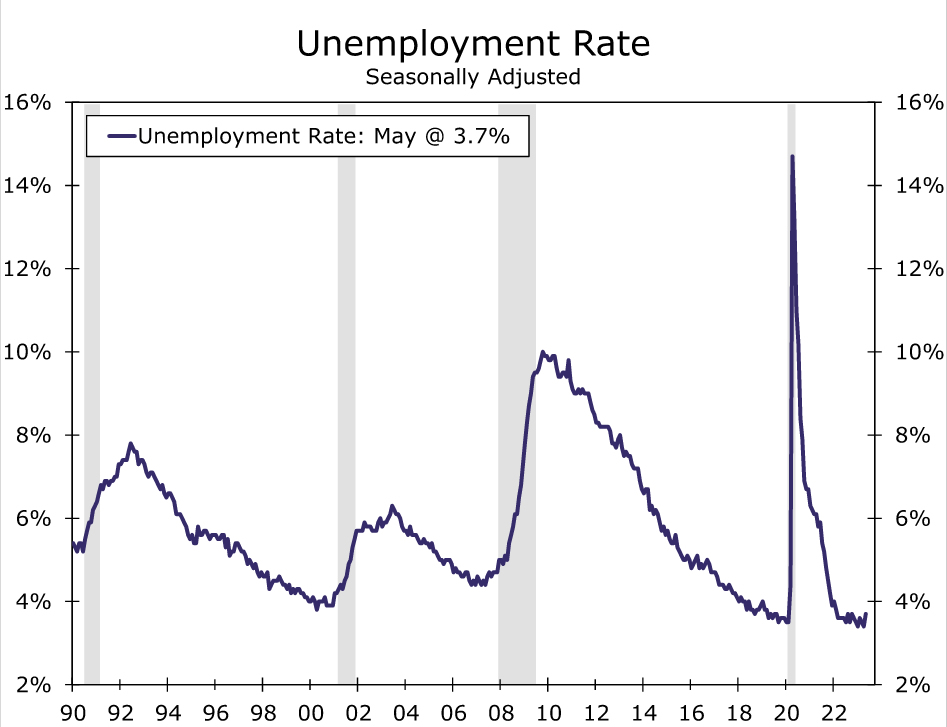
As we discussed earlier, the economy has outperformed expectations in recent months, and we believe the SEP will be updated to reflect this rosier near-term outlook. The current unemployment rate is a low 3.7% (Figure 8), but the March SEP included a median year-end projection for the unemployment rate of 4.5% in 2023. If realized, this would signal a rapid deterioration of the labor market in a short period of time. We think the Committee will revise its projections for this year's unemployment rate down, with a median estimate of 4.1% or so plausible in our view. We doubt the 2024 or 2025 unemployment rate projections will change materially.
Similarly, the median projection for real GDP growth in 2023 looks too low at 0.4%. Real GDP growth registered a 1.3% annualized pace in Q1, and it appears to be on track to grow at least that fast in Q2. We think the median 2023 growth projection will rise by at least a few tenths of a percentage point, although the 2024 and 2025 projections may drift lower to reflect the lagged effect from past tightening.
Despite these changes, the Fed's inflation projections probably will not change very much. The median core inflation projections might be nudged higher by a tenth of a percentage point or so, similar to the changes made in the March SEP. Headline PCE inflation could be revised lower by a similar amount given recent downward pressure on food and energy prices. On balance, however, we do not expect major changes to the Committee's inflation projections.
Euro Extends Losses After Sizzling Nonfarm Payrolls
- ECB’s Lagarde hints at further rate hikes
- US nonfarm payrolls surges to 339,000
- US unemployment rises to 3.7%
The euro has extended its losses on Monday and is trading at 1.0686, down 0.21%.
It was a brutal month of May for the euro, which plunged 2.98%. The euro started the month above the 1.10 line but a hawkish Federal Reserve and solid US numbers have boosted the US dollar. The debt ceiling crisis also buoyed the greenback, as investors were nervous about a US default. This dampened risk appetite and pushed the safe-haven US dollar higher.
Lagarde stays hawkish
The ECB meets on June 15th and President Lagarde reiterated her hawkish stance earlier today. Lagarde noted that “price pressures remain strong”. She added that “there is no clear evidence that underlying inflation has peaked”, repeating what she said last week. An improvement in the eurozone inflation picture doesn’t seem to have softened Lagarde’s stance – last week’s April inflation report showed headline inflation falling from 7.0% to 6.1% and the core rate eased from 5.6% to 5.3%.
Lagarde said that future rate decisions would be data-dependent and strongly hinted that more rate hikes were coming. There are no tier-1 releases prior to the June meeting, and barring some unusual developments, the ECB is likely to raise rates by 25 basis points, which would bring the benchmark cash rate to an even 4.0%.
Nonfarm payrolls surge, but unemployment climbs as well
Last week ended with a scorching nonfarm payrolls report, a reminder that hiring and job growth remain resilient. Payrolls surged by 339,000 in May, crushing the estimate of 195,000. The April reading was revised upwards to 294,000 from 253,000, another sign of strong growth. However, there was more to the story. The unemployment rate surprised to the upside, rising from 3.4% to 3.7%, while wage growth ticked lower to 0.3%, down from 0.4%.
The mixed job report shows that job growth remains robust but the labour market is also showing signs of cooling down, which is what the Fed desperately needs to wind up the current rate-tightening cycle. If the Fed chooses to focus on the softer portions of the employment report, it could be enough for the Fed to take a pause at the meeting next week, after ten consecutive rate increases.
EUR/USD Technical
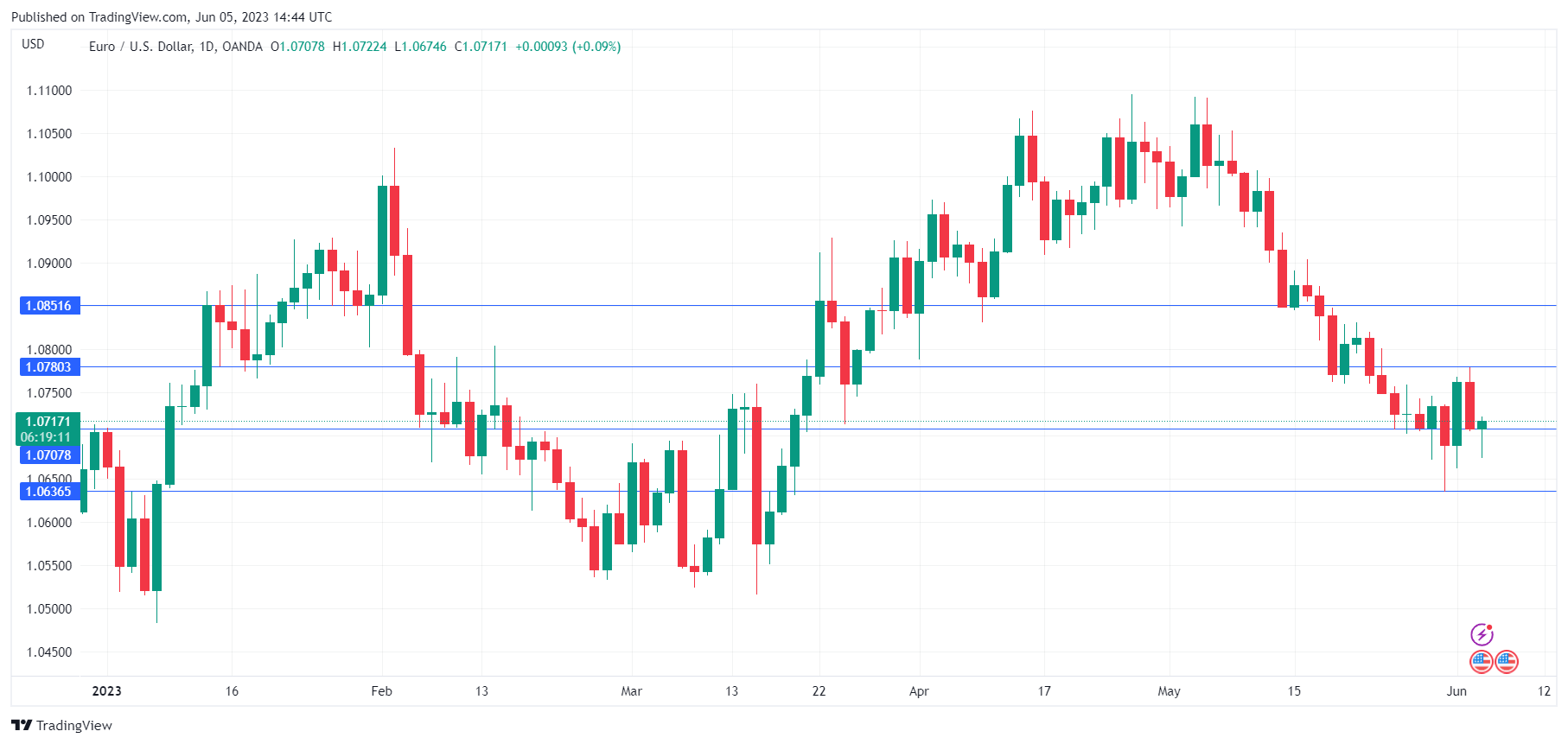
- 1.0707 is a weak support line. Below there is support at 1.0636
- 1.0780 and 1.0851 are the next resistance lines
US: ISM Shows Services Sector Growth Slowed in May
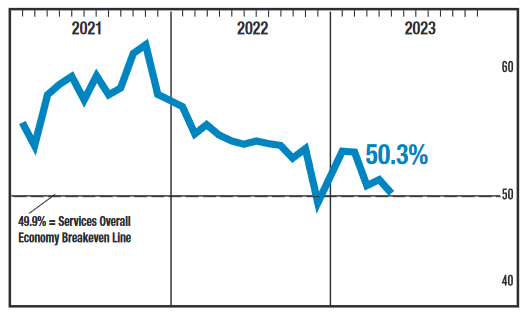
The ISM Services PMI index pulled back to 50.3 in May from 51.9 in April. This falls well short of the 52.4 percent reading consensus was expecting. This is the fifth consecutive month of expansion for the services sector, but optimism has been steadily eroding since late 2022.
In line with the headline measure, the business activity sub-index cooled to 51.5, down from 52.0 in April.
The new orders fell 3.2 percentage points (pp) to 52.9, giving back most of April's gains and is now slightly higher than the 52.2 print in March. The new orders index is well below its 62.6 peak from February and reflects a significant moderation in growth.
The prices paid component fell again to 56.2 in May. This is the lowest reading since May 2020 and even below the average prints recorded in the 2017-2019 period before the pandemic.
Supplier delivery times registered 47.7, down from 48.6 in April, while the backlog of orders index plummeted 8.8 points to 40.9.
The employment sub-component tumbled into contractionary territory, and at 49.2 is at its lowest level since October 2022.
Eleven out of 18 industries expanded in May, down from fourteen in April.
Key Implications
May's services sector update reflects an economy that is gradually slowing down. Similar to the manufacturing sector's update last week, backlogs and supplier delivery times continue to improve as demand growth slows. The degree of improvement in supplier delivery times since February were last seen at the tail end of the recession during the Global Financial Crisis.
Taken with the ISM Manufacturing report from last week, businesses are signaling slowing demand growth. Combining this with improving supply chain conditions and easing price pressures, the Fed has some reassurance that the fight against inflation is gradually progressing – despite persistently strong jobs growth in the Nonfarm Payrolls Report.
ECB Lagarde: No clear evidence underlying inflation has peaked
Christine Lagarde, President of ECB, acknowledged the persistence of robust price pressures in her recent speech. She pointed out that both headline and core inflation continue to face "upside pressures... from the pass-through of past energy cost increases and supply bottlenecks."
Speaking on the current state of underlying inflation, Lagarde said, "The latest available data suggest that indicators of underlying inflationary pressures remain high and, although some are showing signs of moderation, there is no clear evidence that underlying inflation has peaked."
Lagarde also highlighted the intensifying wage pressures, noting that "wage pressures have strengthened further as employees recoup some of the purchasing power they have lost as a result of high inflation."
Lagarde also drew attention to the forceful impact of the central bank's rate hikes on financial conditions. "Our rate hikes are being transmitted forcefully to financing conditions for firms and households, as can be seen in rising lending rates and falling lending volumes," she stated.
Notably, she mentioned that "the full effects of our monetary policy measures are starting to materialise," adding that future ECB decisions are geared towards ensuring a "timely return of inflation to our 2% medium-term target." She asserted, "Our future decisions will ensure that the policy rates will be brought to levels sufficiently restrictive... and will be kept at those levels for as long as necessary."
US ISM services dropped to 50.3, corresponds to 0.2% annualized GDP growth
US ISM Services PMI dropped from 51.9 to 50.3 in May, below expectation of 52.6. Looking at some details, business activity/production dropped from 52.0 to 51.5. New orders dropped from 56.1 to 52.9. Employment dropped from 50.8 to 49.2. Prices dropped from 59.6 to 56.2.
ISM said, the May Services PMI indicates the overall economy is growing for the fifth consecutive month after one month of contraction in December.
The past relationship between the Services PMI and the overall economy indicates that the Services PMI for May (50.3 percent) corresponds to a 0.2-percent increase in real gross domestic product (GDP) on an annualized basis.
Sunset Market Commentary
Markets
With only the US services ISM as a really market relevant data series to be published after finishing this report, markets today mainly build the Friday’s post-payrolls narrative. Yields in the US, in Europe, but also in the UK are rebounding further. Ongoing labour market strength suggests that it’s premature to position for a (demand-driven) recession. To put it otherwise, (consumer) demand might stay stronger for longer than what is necessary for (core) inflation to quickly return to the central banks’ targets. Follow-though price action on Friday’s jump lifts US rates about 7.0/3.5 bps with the curve inverting further. The end of May peak yields (4.64% for the US 2-y vs 4.55% currently, 3,86% for the US 10-y yield vs 3.74% now) are again on the radar. Still a break won’t be that easy as the Fed’s ‘skip’ of a June rate hike still leaves plenty of eco data to finetune both the markets’ and the Fed’s assessment on what to do in July. European/German markets underperform. In a hearing before the EU Parliament, ECB Chair Lagarde reiterates that there is no clear evidence that underlying inflation has peaked, even as the effects of ECB policy start to materialize. German yields are gaining between 8 bps (2-y) and 6 bps (10-y). Similar narrative for UK markets (+8 bps 2-y, + 4bps 30-y). If the Saudi oil production cut would succeed to put the oil price again on an upward trajectory, over time it might also slow the decline of headline inflation. Admittedly, the jury is still out whether the trick will work this time. At $78 p/b, brent moves away from the low $70 p/b area. In this respect, also keep an eye at the rebound in the European reference Dutch natural Gas contract, jumping more than 15% from Friday’s cycle low. US and European equities are trading little changed (EuroStoxx -0.10%, S&P + 0.2%). After Friday’s substantial gains, this still might be labelled as ‘constructive’ price action.
On FX markets, the dollar outperforms most other majors. DXY trades near 104.3 (from 104.04) with last week’s correction top at about 104.7. EUR/USD is drifting below the 1.07 big figure (1.0685) with the correction low at 1.0635. USD/JPY regains the 140 barrier (140.25). For now, oil/commodity related currencies hardly profit from the Saudi oil production cut. USD/CAD trades marginally lower near 1.3435. EUR/NOK rises marginally to 11.82. The Aussie dollar (AUD/USD 0.6605) trades little changed as investors look out for tomorrow’s RBA policy decision. The Swedish krone (EUR/SEK 10.65) struggles to avoid returning to recent lows as markets continue to ponder the impact of real estate stress on Riksbank policy. Sterling is falling prey to profit taking with EUR/GBP returning to the 0.863 area. CE currencies remain in excellent shape (EUR/CZK 23,55, EURHUF 369,2). The zloty is even touched the strongest against the euro since June 2021.
News & Views
Turkish headline CPI in May fell from 43.68% to 39.59%, a little above the 39.2% consensus estimate. Inflation nearly flatlined M/M (0.04%), a direct consequence from president Erdogan offering natural gas to households for free last month in the run-up to the elections. The component ‘housing, water, electricity, gas and other fuels” dropped a whopping 13.79% m/m. Core inflation for the second months straight topped headline inflation and even reaccelerated from 45.48% to 46.62%,(43.70% expected). The data remain extremely troubling for a country reeling from a currency crisis amid very easy CB policy. President Erdogan appointed Mehmet Simsek as the new Treasury and Finance minister. In his first remarks, he signaled a return to conventional policies but market doubts remain. The Turkish Lira opened at a record low and extended losses after the data. USD/TRY trades near 21.24.
Czech wages grew by 8.6% y/y in the first quarter of this year. That’s an acceleration from a downwardly revised 6.6% in the final quarter of last year. It is, however, slower than the 9.1% the Czech central bank forecasted. In addition, real wages fell by -6.7%, a little over the -6% consensus estimate. The numbers serve as critical input to the CNB meeting June 21 and could ease hawkish policy makers’ concerns about the emergence of a wage-price spiral somewhat. The previous gathering was a close 4-3 call between the status quo (7%) and a rate hike. In combination with the Czech government’s determination to get the budget under control and disappointing growth details last week, it may settle the debate. Instead, the CNB could opt for keeping the policy rate at 7% for longer. One wildcard still remaining in the run-up to the meeting are Czech CPI numbers, due June 12. The Czech crown erased kneejerk losses shortly after today’s publication. EUR/CZK is trading around 23.54.
USD/JPY Mid-Day Outlook
Daily Pivots: (S1) 139.03; (P) 139.55; (R1) 140.49; More...
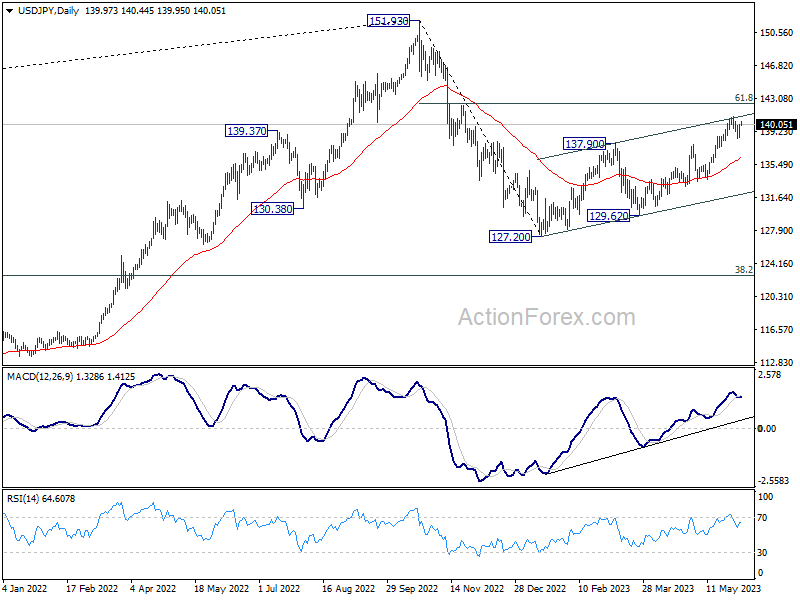
USD/JPY is staying in consolidation below 140.90 and intraday bias remains neutral. Further rally is expected as long as 138.22 minor support holds. On the upside, break of 140.90 will resume larger rise from 127.20 to 142.48 fibonacci level. However, considering bearish divergence condition in 4 hour MACD, break of 138.22 will confirm short term topping, and turn bias back to the downside for 55 D EMA (now at 136.27).
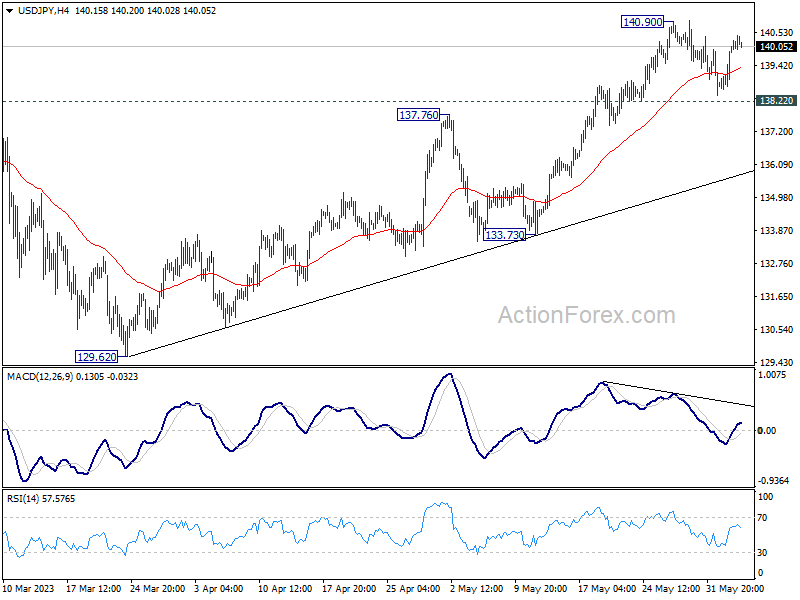
In the bigger picture, rise from 127.20 is seen as the second leg of the corrective pattern from 151.93 high. Stronger rally would be seen to 61.8% retracement of 151.93 to 127.20 at 136.34. Sustained break there will pave the way back to retest 151.93. On the downside, however, break of 133.73 support will argue that the pattern could have started the third leg through 127.20 low.
USD/CHF Mid-Day Outlook
Daily Pivots: (S1) 0.9052; (P) 0.9072; (R1) 0.9110; More...
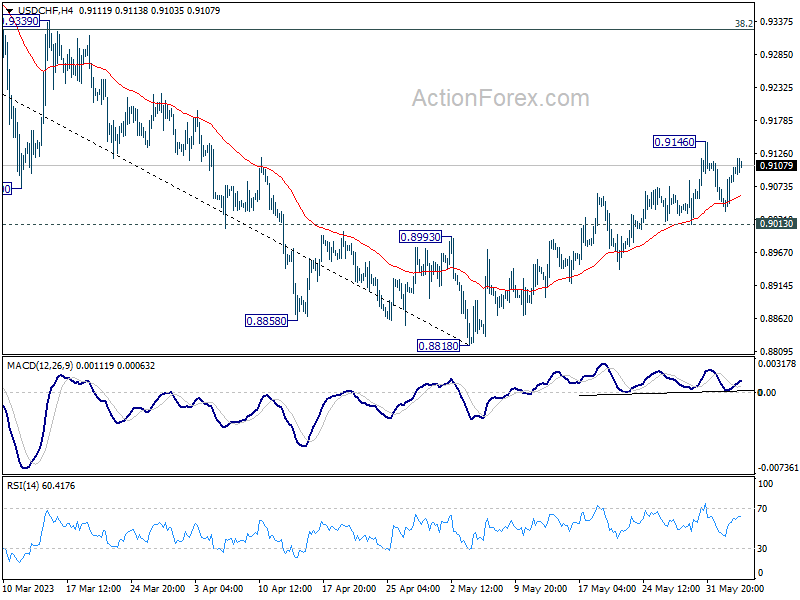
USD/CHF is staying in consolidation below 0.9146 and intraday bias remains neutral. Further rally is expected as long as 0.9013 minor support holds. Rise from 0.8818 short term bottom is seen as corrective whole down trend from 1.0146. Above 0.9146 will target 38.2% retracement of 1.0146 to 0.8818 at 0.9325. On the downside, however, break of 0.9013 will turn bias back to the downside for retesting 0.8818 low instead.
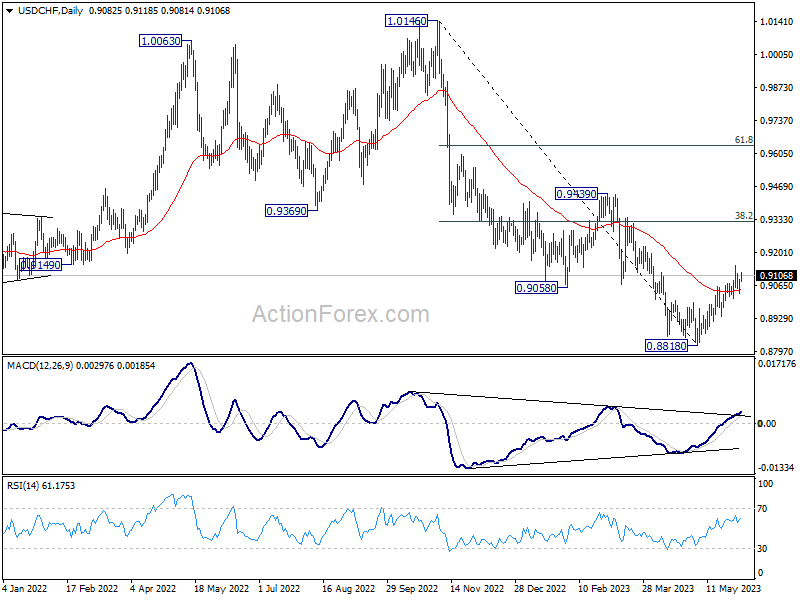
In the bigger picture, fall from 1.1046 (2022 high) is seen as a leg in the long term range pattern from 1.0342 (2016 high), which might have completed at 0.8818 already, just ahead of 0.8756 long term support. Sustained trading above 0.9058 support turned resistance should confirm medium term bottoming. Further break of 0.9439 resistance will confirm bullish trend reversal.
GBP/USD Mid-Day Outlook
Daily Pivots: (S1) 1.2414; (P) 1.2480; (R1) 1.2517; More...
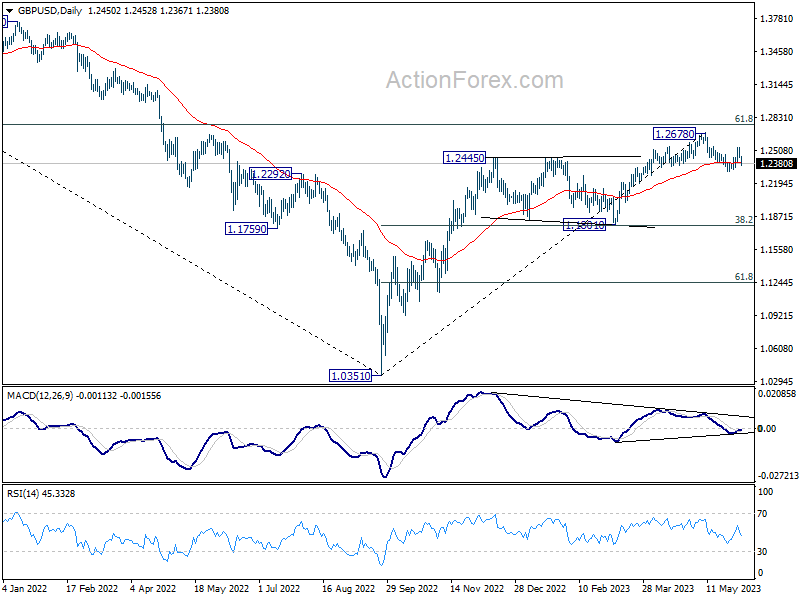
Intraday bias in GBP/USD stays neutral at this point. On the downside, break of 1.2306 will resume the correction from 1.2678. Deeper decline would then be seen to 1.1801 cluster support (38.2% retracement of 1.0351 to 1.2678 at 1.1789). On the upside, above 1.2543 will resume the rebound from 1.2306 to retest 1.2678 high.
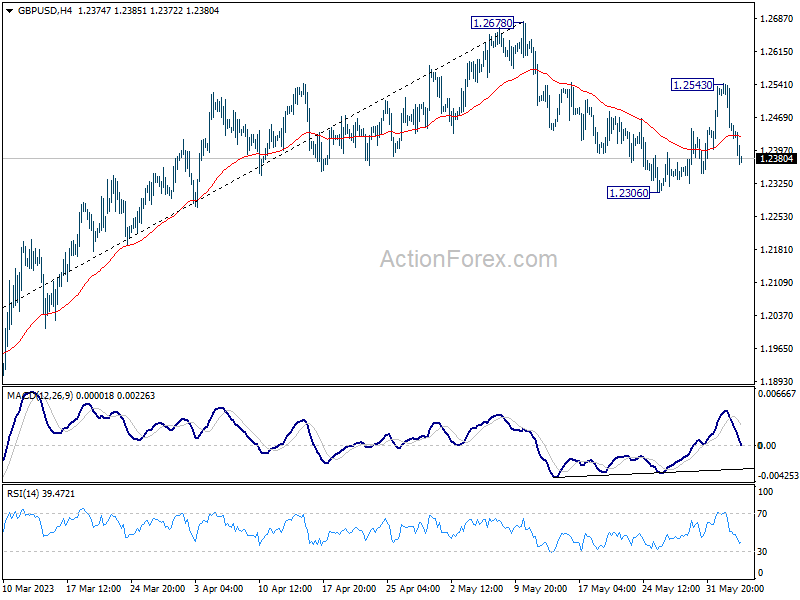
In the bigger picture, as long as 1.1801 support holds, rise from 1.0351 medium term bottom (2022 low) is expected to extend further. Sustained break of 61.8% retracement of 1.4248 (2021 high) to 1.0351 at 1.2759 will add to the case of long term bullish trend reversal. However, firm break of 1.1801 will indicate rejection by 1.2759, and bring deeper decline, even as a correction.