

Sample Category Title
Chinese Yuan Moves Have Global Implications
This week, the yuan broke above the 7.0000 handle against the dollar and continued to rise. Generally, the Chinese currency isn't a popular trade because it's officially kept within a trading band. The government allowed that band to drift above the technically and psychologically important level for the first time since late last year.
The weakness in the yuan is seen as another indicator that the expected boom following lifting of covid restrictions has not arrived. The currency initially gained against the dollar back in December because many traders were anticipating the Chinese economy to grow substantially. But, Q1 results have been lackluster, and the latest PMIs show the industrial sector is falling back into contraction. But, this appears to be a more global story.
The dollar is still king
The Chinese Ministry of Finance blamed the latest move in their currency to strength in the dollar. The greenback has been appreciating most of the week despite the ongoing political debate over raising the debt ceiling. While politicians make dire warnings about the US potentially falling into default, no one in the markets actually thinks that's a real possibility. The possibility of economic uncertainty around how the debt ceiling issue is resolved might cause some weakness in the markets, however. Which, in turn, has raised demand for the dollar as a safe-haven.
The other factor is that more and more traders are coming around to the idea that the Fed might raise rates at the next meeting. At the start of the month, the narrative was a broad expectation that the FOMC would pause, but that view has now dropped to just 60%, from 85% just a week ago.
Beyond China
Turning to the inflation issue, a weaker yuan could contribute to lowering costs in most economies. As the largest manufacturing center in the world, the strength of the Chinese currency correlates with the cost of goods imported from China. If the currency weakens, it implies goods made in China become cheaper, which could help filter through to lower consumer prices. That would be particularly relevant for the US in Europe which import more from China.
On the other hand, a weaker yuan means it's more expensive for Chinese firms to buy imported goods, such as from Japan, Australia, New Zealand and Germany. Those economies could feel a pinch if the yuan keeps trending in its current direction. Although the Euro has also weakened in the last few days as traders have speculated the ECB might not be as aggressive at the next meeting. But the latest data suggests that the RBNZ and RBA might be in line for more hikes, which could improve their currencies in the short term at the cost of lower economic performance in the long term.
Hiding a recession
But what could be the biggest worry for most market participants is that a weaker yuan implies weaker demand for Chinese exports. That would be one of the first expected signs of an impending global slowdown, if not outright recession.
Chinese state banks have been buying up yuan on the offshore market in an effort to prop up the currency. While this is in line with the domestic policies of the Chinese government, it means that had the yuan been left to its own, it might have become even weaker. That would be an even bigger sign that global demand was falling and mask a warning sign of just how much of a global recession could be coming.
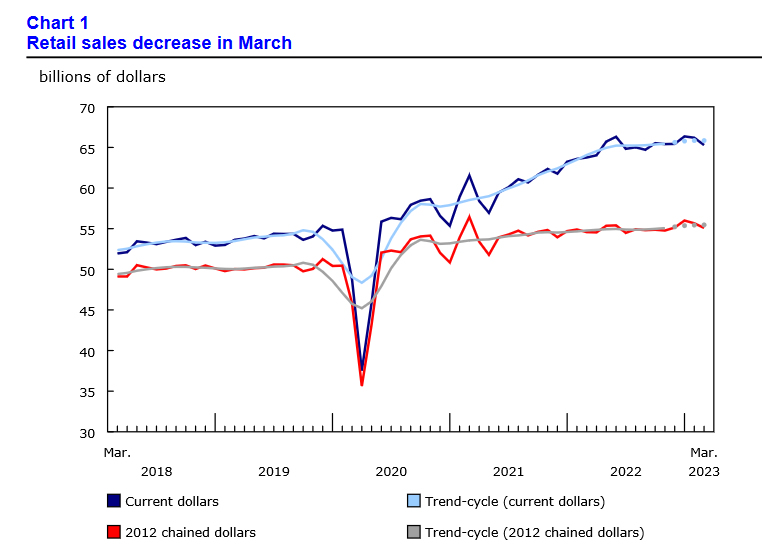
Canada retail sales down -1.4% mom in March
Canada retail sales decreased -1.4% mom to CAD 65.3B in March, slightly worse than expectation of -1.3% mom. Sales decreased in 5 of the 9 subsectors, representing 55.5% of retail trade, led by decreases at motor vehicle and parts dealers (-4.4%) and gasoline stations and fuel vendors (-3.9%).
Core retail sales—which exclude gasoline stations and fuel vendors and motor vehicle and parts dealers—increased 0.3% mom.
In volume terms, retail sales decreased -1.0% mom.
Advance estimate suggests that sales increased 0.2% mom in April.
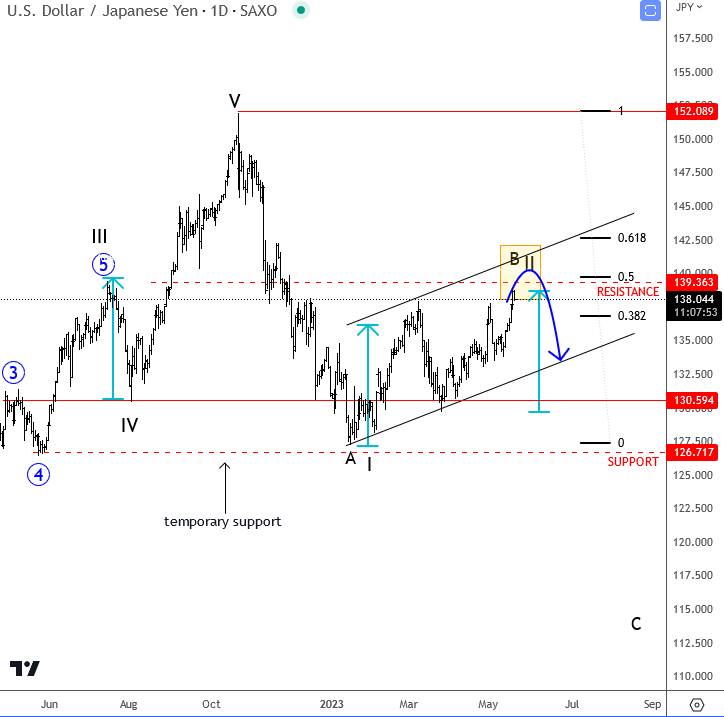
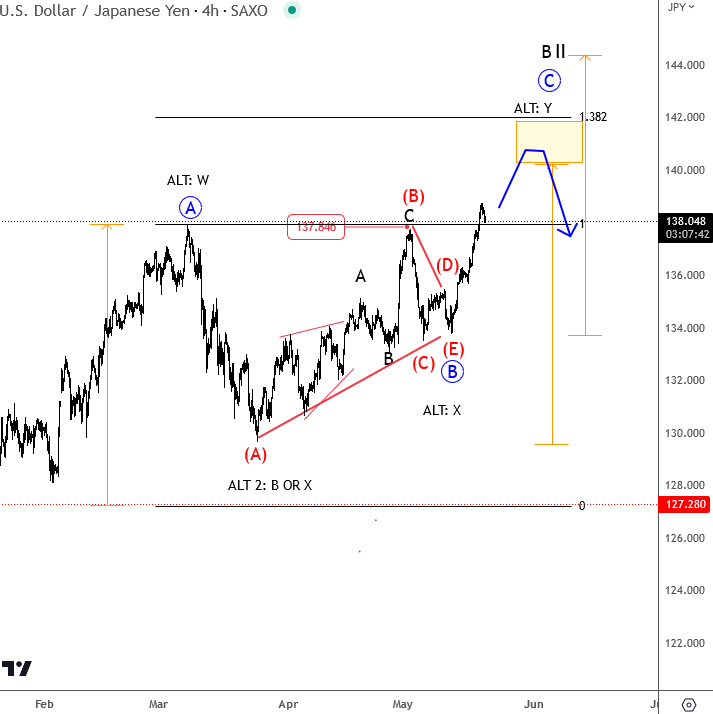
USD/JPY Headed into Big 140-142 Area
BoJ Ueda is fine with the current policy and he highlighted that they will continue easing with yield curve control. At the same time we have higher US yeilds and higher stocks which are bearish for JPY. As result USDJPY is trading higher.
USDJPY made a sharp reversal in 2022 on a daily chart, and touched 126-130 area after BoJ policy YCC adjustment back in December. However that drop appears completed as we have seen rally in the 4h chart, but it's just another corrective recovery that is still in progress now. Ideally, its going to be an A-B-C move up to 140-142 resistance area where we will expect a bearish turn still this year. Alternatively, this can even be W-X-Y from 127 lows, but still a corrective and temporary higher degree pause for wave B/II.
GBP/USD: Bears to Position for Attack at Key Supports
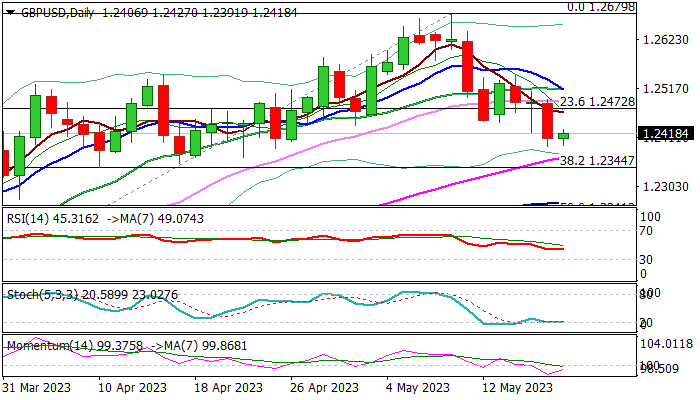
Cable is consolidating after 0.6% drop on Thursday, as bears faced headwinds at 1.2400 zone, prompting some profit-taking.
Upticks seen as price adjustment ahead of fresh push lower and expected to stall under 1.2470 zone (5DMA / broken Fibo 23.6% of 1.1802/1.2679), to offer better levels for attack at strong supports at 1.2344/35 (Fibo 38.2% / top of rising daily cloud).
Bearishly aligned daily studies support scenario as 14-d momentum is still in negative territory and MA’s (5/10/20) formed multiple bear-crosses.
Caution on close above 1.2470, which would weaken bears, but lift through 1.2514 (converged 10/20DMA) is needed to confirm signal and bring bulls back to play.
Res: 1.2444; 1.2470; 1.2514; 1.2546.
Sup: 1.2391; 1.2344; 1.2335; 1.2268.
Will Retail Sales Weigh on Canadian Dollar?
- Canadian retail sales expected to decline
- Fed Chair and two FOMC members will speak later
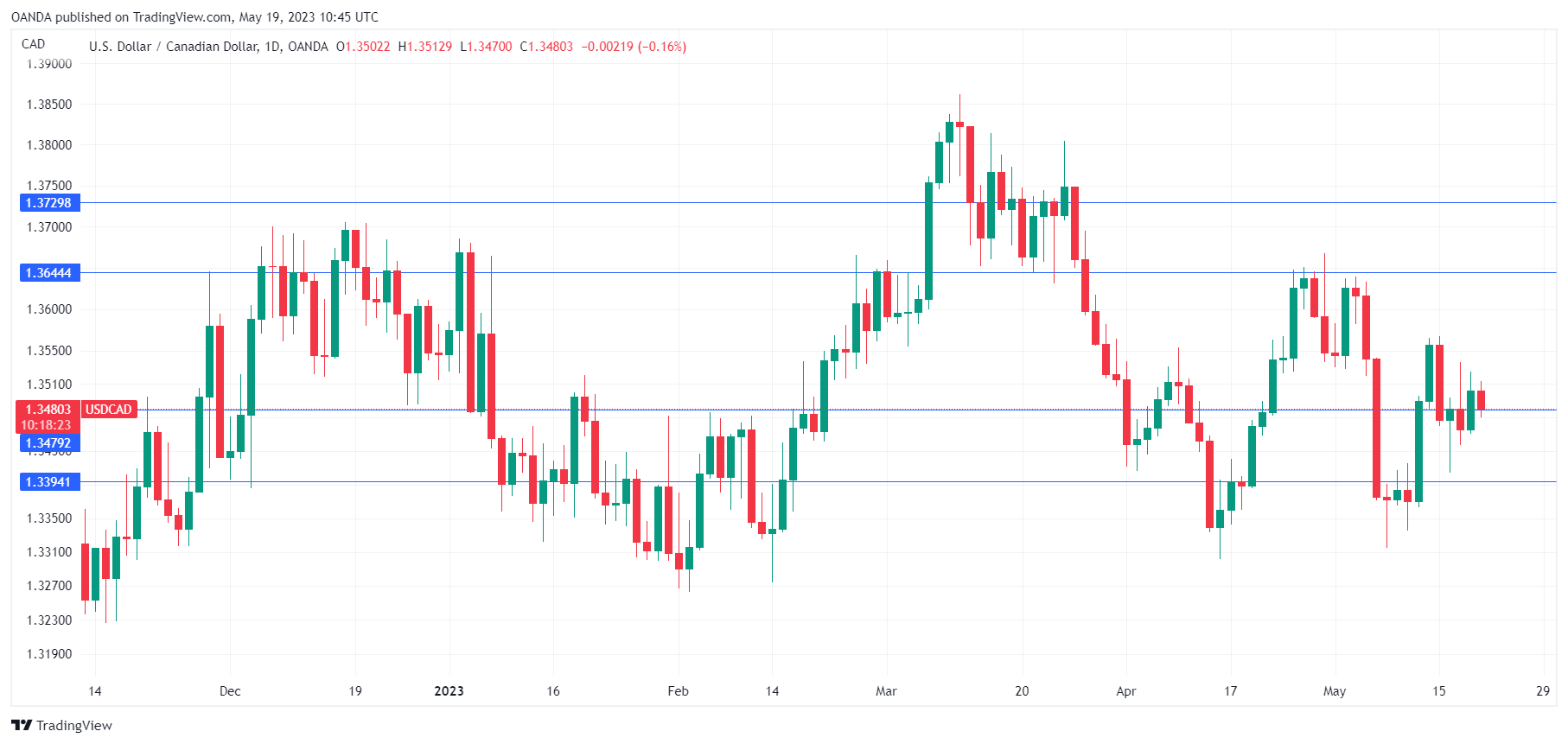
The Canadian dollar is trading quietly ahead of a key retail sales report later today. USD/CAD is trading in Europe at 1.3484, down 0.13%.
Markets brace for soft Canadian retail sales
The Canadian consumer is holding tightly to their wallet, which is not all that surprising in the current economic climate. Inflation ticked higher in April, rising from 4.3% to 4.4%. Add in high interest rates and it’s not hard to sympathize with consumers who are struggling with the cost of living.
The April retail sales report may show that things are getting worse – headline retail sales is expected to slow to -1.4%, down from -0.2% in March, and the core rate is expected to fall from -0.7% to -0.8%. Not exactly a winning recipe for economic growth. A decline in today’s report could unnerve investors and send the Canadian dollar lower.
The Bank of Canada will not be pleased with the slight increase in inflation, although the core rate, which is a more reliable gauge of inflation trends, did move lower. The BoC meets next on June 7th and there is only one more tier-1 release before the meeting, that being GDP. If retail sales contracts for a second straight month as expected, there will be more support for the BoC to continue to hold rates at 4.50%, where they have been pegged since March.
It’s a bare economic calendar in the US today, with no data releases. The markets will have a chance to focus on Fedspeak, with Jerome Powell and two FOMC members delivering public remarks. Just a few weeks ago, the markets had priced in a pause at the June meeting at over 90%. That has changed to a 66% chance of a pause and a 33% chance of a hike of 25 basis points, according to CME’s FedWatch. That downward revision is due to a consistently hawkish message from the Fed and a solid US economy.
USD/CAD Technical
- USD/CAD is testing support at 1.3479. Below, there is support at 1.3394
- 1.3644 and 1.3729 are the next resistance lines
Nikkei 225 Heading Towards the Peak of the 1990s Bubble
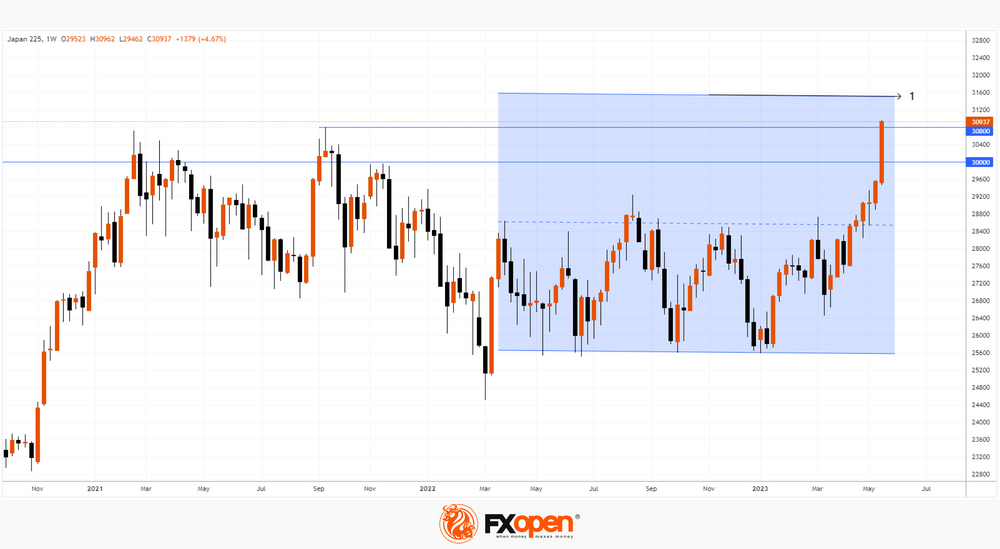
On Friday, the Japanese stock market index Nikkei 225 once again updated the maximum of the year. During this week, the bulls have overcome:
→ the psychological level of USD 30k;
→ the 2022 high around 30,800.
The strong momentum in the Nikkei 225 market is driven by:
→ the weak yen;
→ a strong reporting season for Japanese companies;
→ the news about foreign investment, including Warren Buffett's.
Today's bullish momentum is supported by the latest news that US lawmakers may reach an agreement on a debt ceiling. A bipartisan deal is scheduled to be voted on in the coming days to prevent a default in the US.
The Nikkei 225 chart shows that in case of further growth, the index value may encounter resistance in the 31,500 area — here lies the line (1) of the parallel channel, which is built on a series of important extremes in 2022-2023. At the same time, reasonable investors can take advantage of optimism to take profits on longs.
AUDUSD in Tight Range; Decisive Breakout Needed
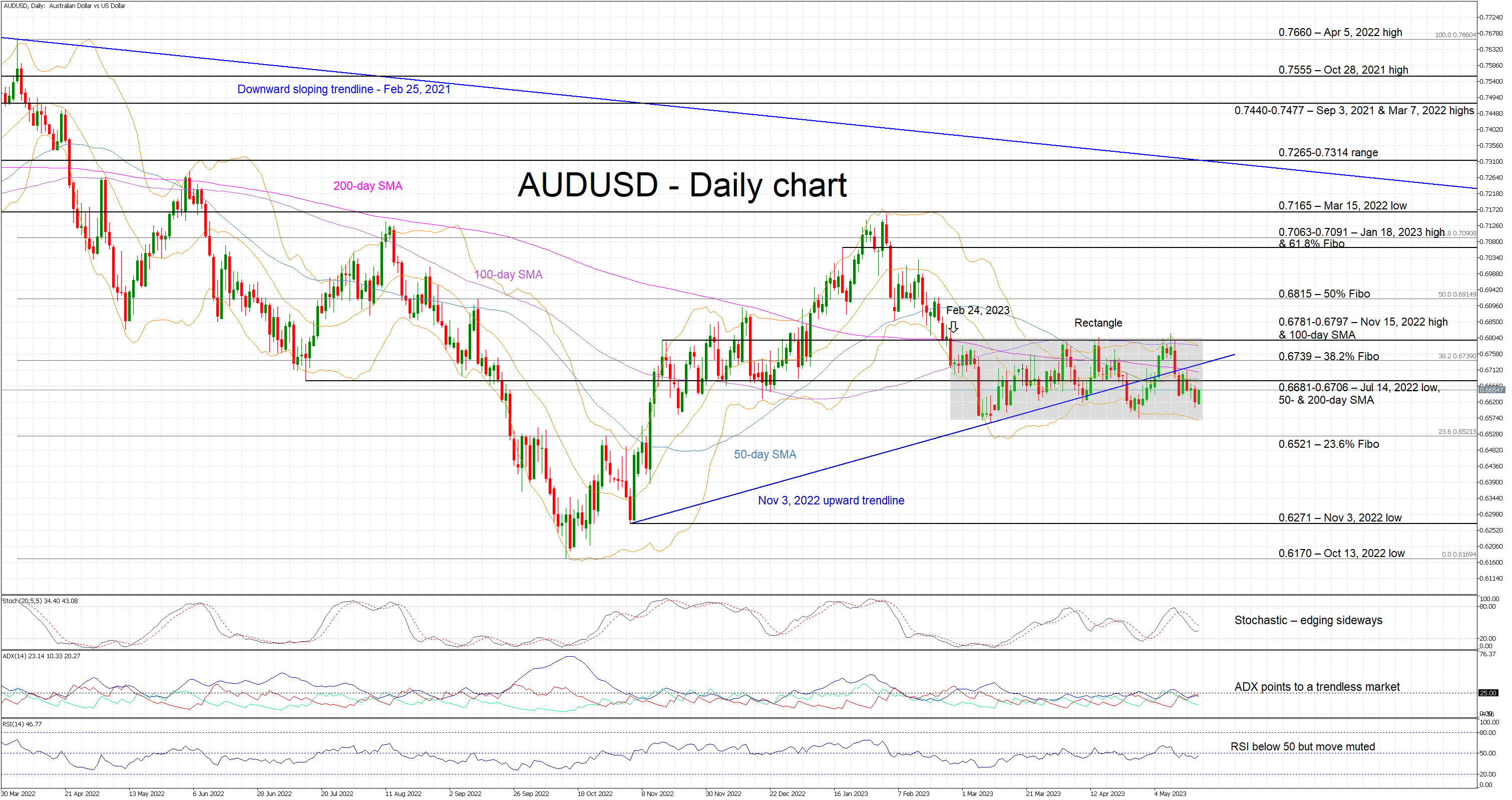
AUDUSD is edging higher today but remains well inside the rectangle that has formed since February 24. This recent range-trading is a depiction of the indecisiveness of market participants to commit to a specific move. As the direction of the breakout is unknown ahead of time, the focus turns to the momentum indicators for valuable information.
However, the subdued Average Directional Movement Index (ADX) confirms the current range-trading theme, and the RSI is just a tad below its 50-threshold. In addition, the usually volatile stochastic oscillator is hovering below its moving average but appears to be moving sideways now. More interestingly, there is a convergence of the simple moving averages (SMAs), just above the current AUDUSD pricing, that is usually associated with an imminent move.
Should the bears manage to break the current rectangle, they would quickly come up against the 23.6% Fibonacci retracement of the April 5, 2022 – October 13, 2022 downtrend at 0.6521. The path then appears to be clear until the November 3, 2022 low of 0.6271.
On the other hand, if the bulls decide to take market control, they will try to clear the busy 0.6681-0.6706 area populated by the 50- and 200-day SMAs, and the July 14, 2022 low. They would then aim for 0.6739, before setting their eyes on the key 0.6781-0.6797 range, where the upper boundary of the rectangle lies.
To conclude, AUDUSD range-trading continues as market participants remain on the sidelines. A sizeable move appears to be on the cards, but a rectangle breakout is needed first.
EUR/USD: Euro Likely to Weaken Further After Consolidation
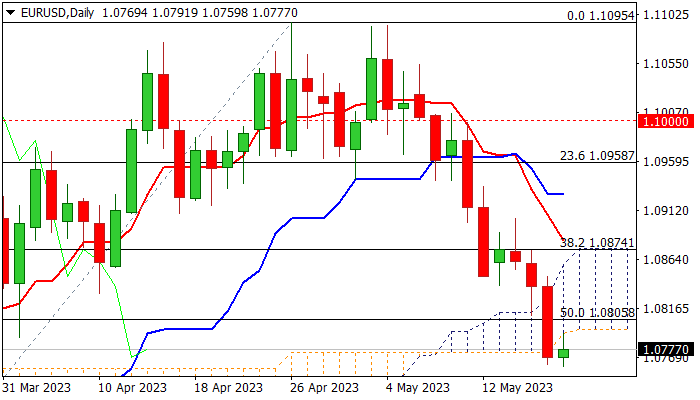
The Euro is consolidating above new multi-week low in early Friday’s trading, as bears take a breather after acceleration on Thursday which resulted in 0.64% daily drop and break of key supports.
Thursday’s close below 1.0805/1.0791 pivots (50% retracement of 1.0516/1.1095/daily cloud base) generated strong bearish signal and added to negative near-term outlook, opening prospects for further weakness.
The pair is on track for the second consecutive weekly drop, with Friday’s close below daily cloud to confirm signal and keep bears firmly in play for extension towards 1.0737/00 (Fibo 61.8% of 1.0516/1.1095/psychological).
Negative momentum remains strong on daily chart and moving averages are in bearish setup, though oversold conditions may slow bears for consolidation/limited correction.
Broken cloud base and Fibo 50% reverted to solid resistances which should ideally cap.
Only bounce and close above daily cloud would sideline bears and shift near-term focus to the upside.
Firm dollar on growing optimism about debt ceiling deal and signals that US interest rates will stay higher for some time, add pressure on the single currency.
Res: 1.0791; 1.0805; 1.0874; 1.0884.
Sup: 1.0760; 1.0737; 1.0700; 1.0652.
JPY Sinks Further
USD/JPY breaks major resistance
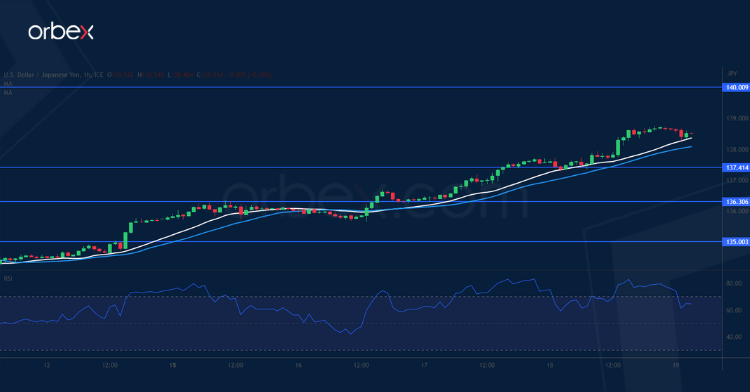
The Japanese yen recouped some losses after a jump in April’s CPI. A close above the double top (137.60) on the daily chart signals a comeback of the dollar and could pave the way for an extension towards 142.00. The psychological level of 140.00 would be the first hurdle. The RSI’s repeatedly overbought situation may briefly temper the bullish drive to let the bulls catch their breath with the base of the latest breakout at 137.40 as a fresh support. Further down, 136.30 would be the bulls’ second level of defence.
XAG/USD struggles for bids
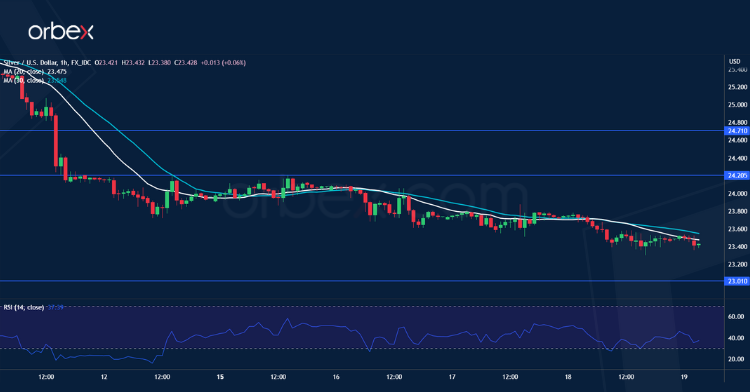
Silver slides as traders stay optimistic about the US avoiding a potential default. After hitting a roadblock at a 13-month high of 26.00, a bearish MA cross on the daily chart suggests that sentiment has soured. A fall below the lower end of the consolidation range at 24.60 led to more exits from buyers, turning the area into a supply one in the process. The psychological level of 23.00 sits at the 50% retracement of the March rally and is a key level to expect renewed buying interests. 24.20 is the first resistance to lift should this happen.
SP 500 bounces higher
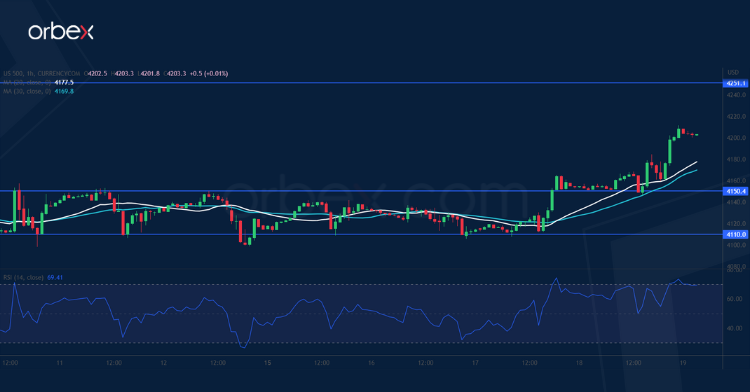
The S&P 500 rallied after Washington signalled a possible deal to raise the federal debt ceiling. A pop above 4150 and the consolidation range has put the index back on track, prompting the short side to cover. A close above the recent peak and daily resistance of 4185 would reinforce the bullish mood and resume the recovery in the medium-term, with 4250 then the August 2022 high of 4310 as potential targets. On the downside, 4150 at the start of the breakout is important in keeping the current momentum intact.
BoJ Ueda: It’s necessary to continue with monetary easing
BoJ Governor Kazuo Ueda, in a speech today, reinforced the necessity "to continue with monetary easing" in Japan, citing the country's vulnerability to a decelerating global economy and doubts surrounding the sustainability of wage increases.
Ueda cautioned against hasty modifications to the prevailing policy, emphasizing the high stakes involved. "The cost of prematurely shifting policy, and nipping the bud towards achieving 2% inflation, is extremely large," he stated.
Earlier, Ueda warned the parliament about the potential fallout from a US. debt default, which he believes could trigger turbulence in markets and have a significant impact on the global economy. He assured that BoJ is committed to maintaining market stability, pledging to respond flexibly with a keen eye on economic, price, and financial developments.