Sample Category Title
EUR/USD Mid-Day Outlook
Daily Pivots: (S1) 1.0932; (P) 1.0970; (R1) 1.0999; More...
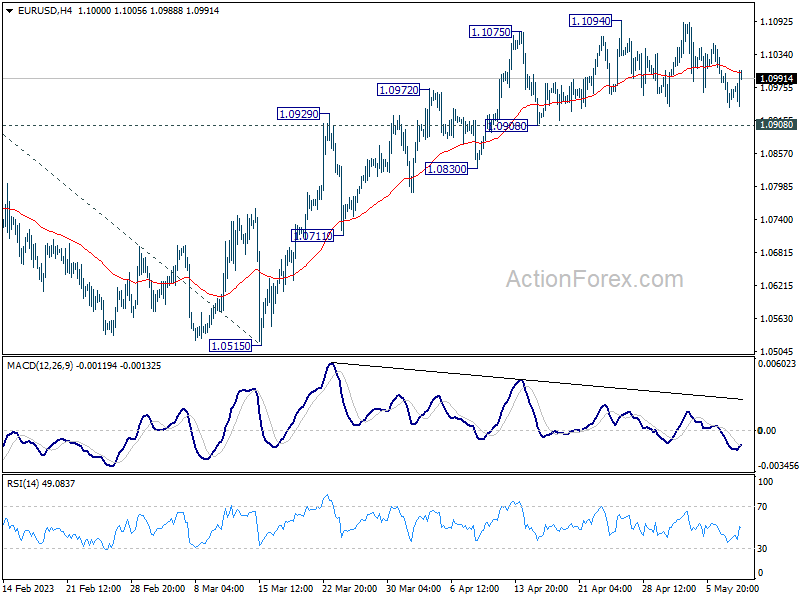
Intraday bias in EUR/USD remains neutral for the moment as consolidation from 1.1094 is extending. With 1.0908 support intact, further rally could be seen. On the upside, firm break of 1.1094 will resume larger up trend to 1.1273 fibonacci level. Break there will target 61.8% projection of 0.9534 to 1.1032 from 1.0515 at 1.1441 However, considering bearish divergence condition in 4H MACD, break of 1.0908 support will indicate short term topping and turn bias back to the downside.
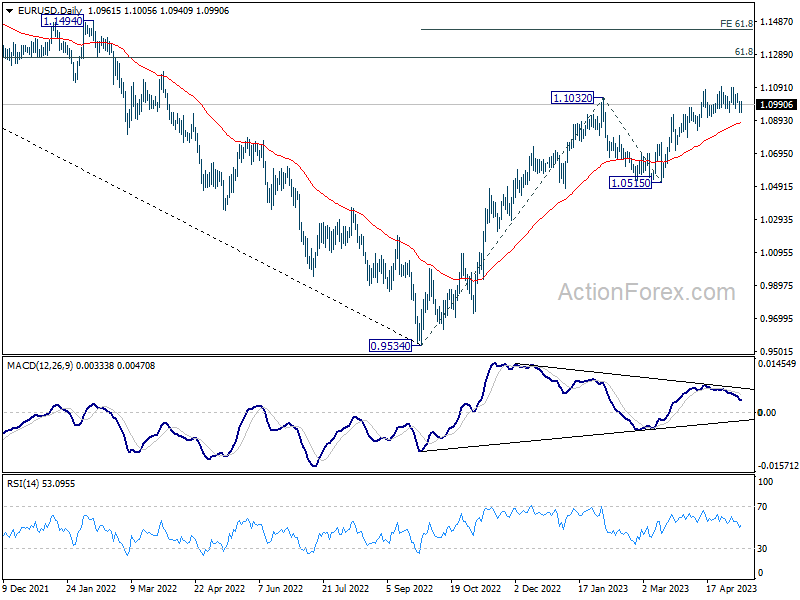
In the bigger picture, rise from 0.9534 (2022 low) is in progress for 61.8% retracement of 1.2348 (2021 high) to 0.9534 at 1.1273. Sustained break there will solidify the case of bullish trend reversal and target 1.2348 resistance next (2021 high). This will now remain the favored case as long as 1.0515 support holds, even in case of deeper pull back.
GBP/USD Mid-Day Outlook
Daily Pivots: (S1) 1.2587; (P) 1.2613; (R1) 1.2648; More...
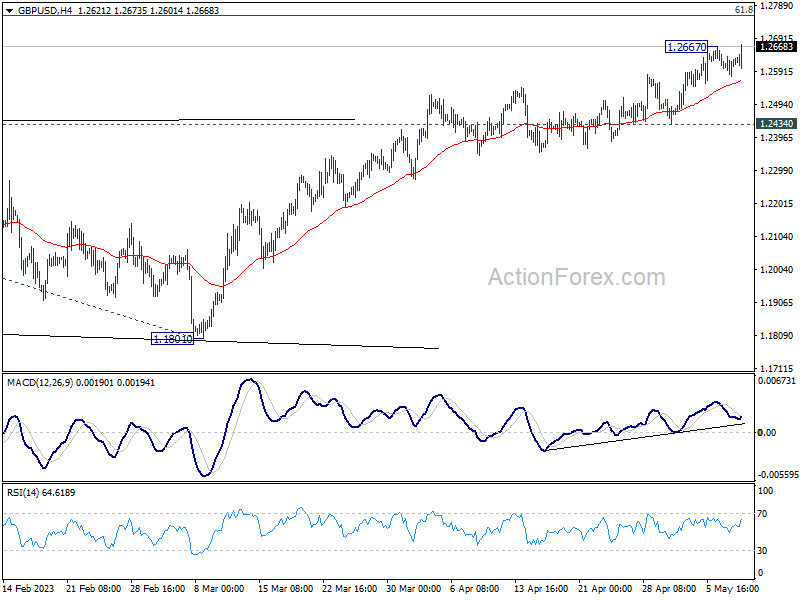
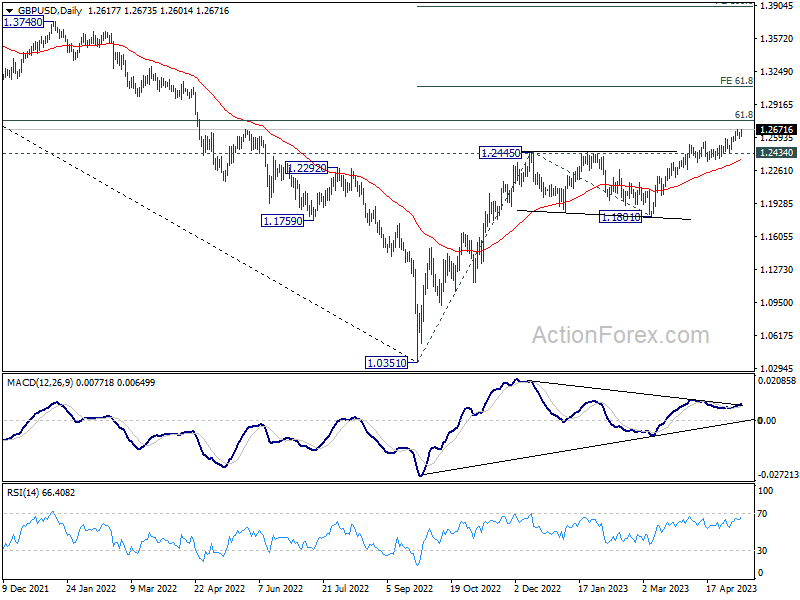
GBP/USD's up trend resumes by breaking 1.2667 temporary top. Intraday bias is back on the upside. Current rise should now target 1.2759 fibonacci level first. Firm break there will target 61.8% projection of 1.0351 to 1.2445 from 1.1801 at 1.3095. In any case, outlook will remain bullish as long as 1.2434 support holds.
In the bigger picture, the rise from 1.0351 medium term term bottom (2022 low) is in progress for 61.8% retracement of 1.4248 (2021 high) to 1.0351 at 1.2759. Sustained break there will add to the case of long term bullish trend reversal. Further break of 61.8% projection of 1.0351 to 1.2445 from 1.1801 at 1.3095 could prompt upside acceleration to 100% projection at 1.3895. For now, this will remain the favored case as long as 1.1801 support holds, even in case of deep pull back.
Dollar and Yield Down after US CPI, Aussie Firming Up
Dollar finds itself on the back foot in early US trading as data showed both headline and core CPI slowed in April. This data release has also sent 10-year yield plummeting below 3.5% mark. Japanese Yen is finding some strength, bolstered by the drop in yields. On the other hand, commodity currencies are regaining their footing, emerging as the strongest contenders at present, while European majors lag significantly. Euro, in particular, continues to show a lackluster response to hawkish comments from ECB officials.
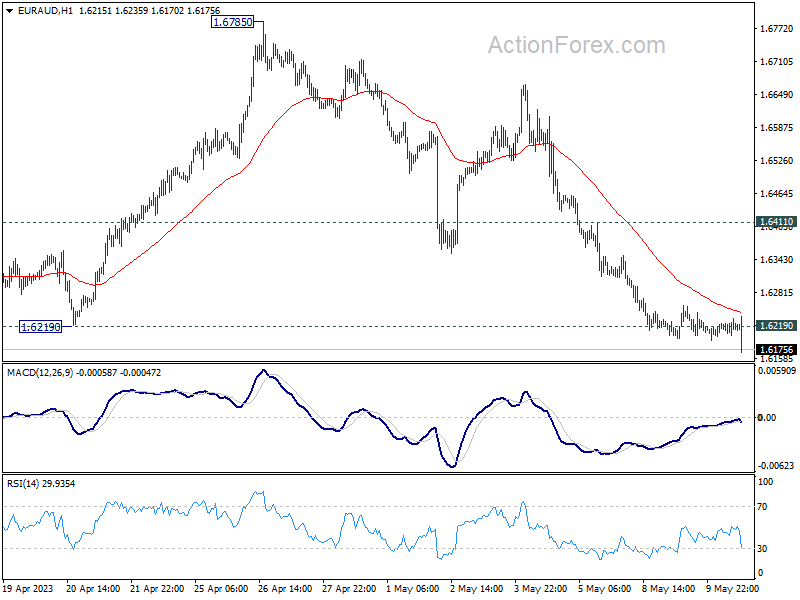
From a technical perspective, EUR/AUD pair seems to be gaining downside momentum, potentially breaking away from 1.6219 support level finally. Given that the drop from 1.6785 may be a correction of the entire uptrend that began at 1.4281, deeper decline back the 1.5976 resistance-turned-support level is anticipated.
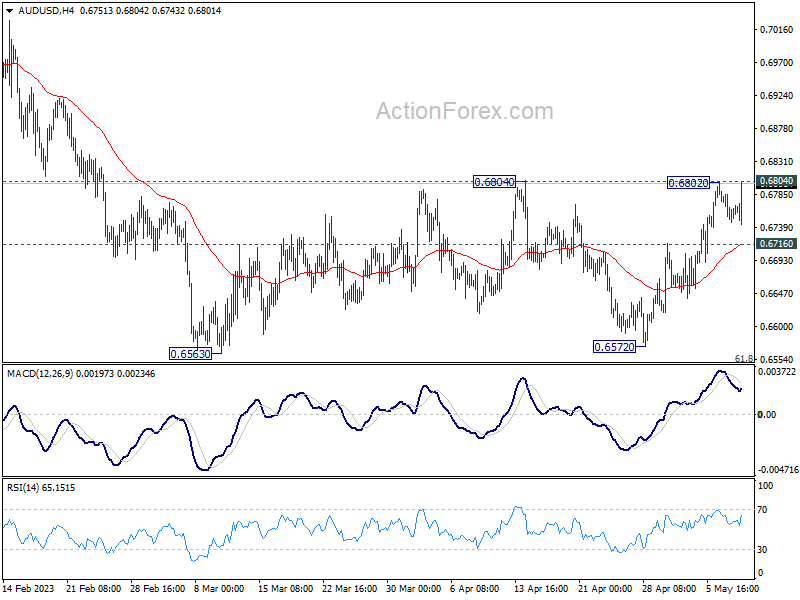
Meanwhile, AUD/USD pair's key resistance at 0.6804 should be closely watched. Sustained breach of this level would cement Aussie's near-term bullishness and could trigger a rally towards 0.7156 resistance level in AUD/USD.
In Europe, at the time of writing, FTSE is down -0.08%. DAX is down -0.25%. CAC is down -0.20%. Germany 10-year yield is down -0.064 at 2.284. Earlier in Asia, Nikkei dropped -0.41%. Hong Kong HSI dropped -0.53%. China Shanghai SSE dropped -1.15%. Singapore Strait Times dropped -0.02%. Japan 10-year JGB yield dropped -0.0090 to 0.416.
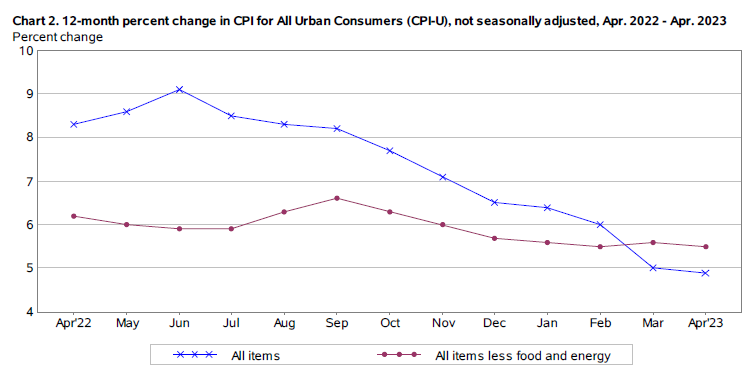
US CPI ticked down to 4.9% yoy in Apr, core CPI down to 5.5% yoy
In April, US headline CPI slowed from 5.0% yoy to 4.9% yoy, below expectation of 5.0% yoy. That was the smallest 12-month increased since April 2021. Core CPI (all items less food and energy) slowed from 5.6% yoy to 5.5% yoy, matched expectations. Energy index was down -5.1% yoy while food index was up 7.7% yoy.
For the month, CPI rose 0.4% mom while Core CPI also rose 0.4% mom. Both matched expectations. Energy index rose 0.6% mom. Food index was unchanged.
ECB Lagarde: We still have more ground to cover
ECB President Christine Lagarde said in a Nikkei interview, "we are determined to tame inflation, to bring it back to our 2% medium-term target in a timely manner." She acknowledged that "we have made a sizable adjustment already. But we still have more ground to cover".
Highlighting the importance of data, Lagarde said, "Our reaction function will be anchored in the inflation outlook, the dynamics of underlying inflation and the strength of monetary policy transmission, and this will dictate our decisions going forward."
She emphasized ECB's focus on headline inflation as the critical measure to ensure price stability. "That's our thermometer, that's what we are committed to doing," she stated.
However, Lagarde also pointed to the relevance of additional inflation measures. "Core" inflation is one such measure, but others exist, such as those that exclude more volatile items or focus more on domestic inflation pressures.
She explained, "It's to arrive at the 'heart' of inflation, the most persistent element in those price indexes that can help us understand where headline inflation is likely to settle in the medium term."
Lagarde cautioned that significant upside risks to inflation outlook still exist, and the path of inflation remains uncertain. Therefore, she stressed the need for the ECB to be "extremely attentive to those potential risks."
ECB Nagel: We're coming to the home stretch, but we need to stay stubborn
In an interview with Deutschlandfunk radio, Bundesbank President Joachim Nagel painted a cautiously optimistic picture of ECB's monetary policy landscape, implying that restrictive measures were beginning to bear fruit.
"We're coming to the home stretch in the sense that we are reaching the area in monetary policy that's considered restrictive," Nagel noted, suggesting that ECB's tightened policy stance was close to hitting its intended mark. He asserted his confidence that the monetary policy was indeed manifesting its effect.
However, he was quick to emphasize that ECB's task was far from complete. "But we are not done hiking yet," he added, "There is still work to be done on core inflation."
Nagel emphasized the importance of staying the course with the current monetary policy, urging persistence. "We need to stay stubborn," he said, reinforcing his commitment to seeing the central bank's measures through.
Addressing concerns about the potential impact of the ongoing banking sector upheaval in the US on German banks, Nagel sought to allay fears. "German banks are in a fundamentally solid position," he assured, indicating that he did not share the prevailing apprehensions over the stability of German banks.
ECB Stournaras: We can't yet say how many more rate hikes will happen
In an interview with Greece's Imerisia, ECB Governing Council member Yannis Stournaras indicated that while the end of the tightening cycle was in sight, it was not yet complete.
"We're close to the end," Stournaras remarked. But, "we're not there yet, so I agree with Madame Lagarde that we still have some distance to go."
Stournaras acknowledged the inherent uncertainty in projecting the number of additional rate hikes, with such decisions being heavily influenced by inflation forecasts, economic growth and the state of financial conditions.
"We can't yet say how many more rate hikes will happen," he said, tempering expectations for a concrete timeline. "As things stand today and if nothing dramatically changes, we can say that in 2023 rate hikes will end."
He also emphasized the persistence of current or potentially higher rates, a measure deemed necessary until inflation approaches the 2% target. "Rates will remain where they are today or higher for some time until inflation comes very close to the 2% target," he clarified.
BoJ Ueda: Too early to discuss exit strategy from massive stimulus
In an address to parliament today, BoJ Governor Kazuo Ueda stressed that it is premature to debate the specifics about exit strategy from the substantial stimulus program, which includes unloading its extensive holdings of exchange-traded funds.
He asserted that the central bank will discuss the exit strategy from its ultra-accommodative monetary policy and communicate this to the public only when conditions favor achieving stable inflation.
Governor Ueda pointed out that BoJ's ETF purchases have significantly contributed to bolstering consumption and capital expenditure. "We buy ETFs as part of our massive stimulus programme," he stated, suggesting that these purchases are critical components of Japan's broader economic stimulus efforts.
GBP/USD Mid-Day Outlook
Daily Pivots: (S1) 1.2587; (P) 1.2613; (R1) 1.2648; More...
GBP/USD's up trend resumes by breaking 1.2667 temporary top. Intraday bias is back on the upside. Current rise should now target 1.2759 fibonacci level first. Firm break there will target 61.8% projection of 1.0351 to 1.2445 from 1.1801 at 1.3095. In any case, outlook will remain bullish as long as 1.2434 support holds.
In the bigger picture, the rise from 1.0351 medium term term bottom (2022 low) is in progress for 61.8% retracement of 1.4248 (2021 high) to 1.0351 at 1.2759. Sustained break there will add to the case of long term bullish trend reversal. Further break of 61.8% projection of 1.0351 to 1.2445 from 1.1801 at 1.3095 could prompt upside acceleration to 100% projection at 1.3895. For now, this will remain the favored case as long as 1.1801 support holds, even in case of deep pull back.
Economic Indicators Update
| GMT | Ccy | Events | Actual | Forecast | Previous | Revised |
|---|---|---|---|---|---|---|
| 05:00 | JPY | Leading Economic Index Mar P | 97.50% | 97.90% | 98.00% | |
| 06:00 | EUR | Germany CPI M/M Apr F | 0.40% | 0.40% | 0.40% | |
| 06:00 | EUR | Germany CPI Y/Y Apr F | 7.20% | 7.20% | 7.20% | |
| 08:00 | EUR | Italy Industrial Output M/M Mar | -0.60% | 0.20% | -0.20% | |
| 12:30 | CAD | Building Permits M/M Mar | 11.30% | 2.30% | 8.60% | |
| 12:30 | USD | CPI M/M Apr | 0.40% | 0.40% | 0.10% | |
| 12:30 | USD | CPI Y/Y Apr | 4.90% | 5.00% | 5.00% | |
| 12:30 | USD | CPI Core M/M Apr | 0.40% | 0.30% | 0.40% | |
| 12:30 | USD | CPI Core Y/Y Apr | 5.50% | 5.50% | 5.60% | 5.50% |
| 14:30 | USD | Crude Oil Inventories | -2.2M | -1.3M |
US CPI ticked down to 4.9% yoy in Apr, core CPI down to 5.5% yoy
In April, US headline CPI slowed from 5.0% yoy to 4.9% yoy, below expectation of 5.0% yoy. That was the smallest 12-month increased since April 2021. Core CPI (all items less food and energy) slowed from 5.6% yoy to 5.5% yoy, matched expectations. Energy index was down -5.1% yoy while food index was up 7.7% yoy.
For the month, CPI rose 0.4% mom while Core CPI also rose 0.4% mom. Both matched expectations. Energy index rose 0.6% mom. Food index was unchanged.
USD/JPY Technical Analysis
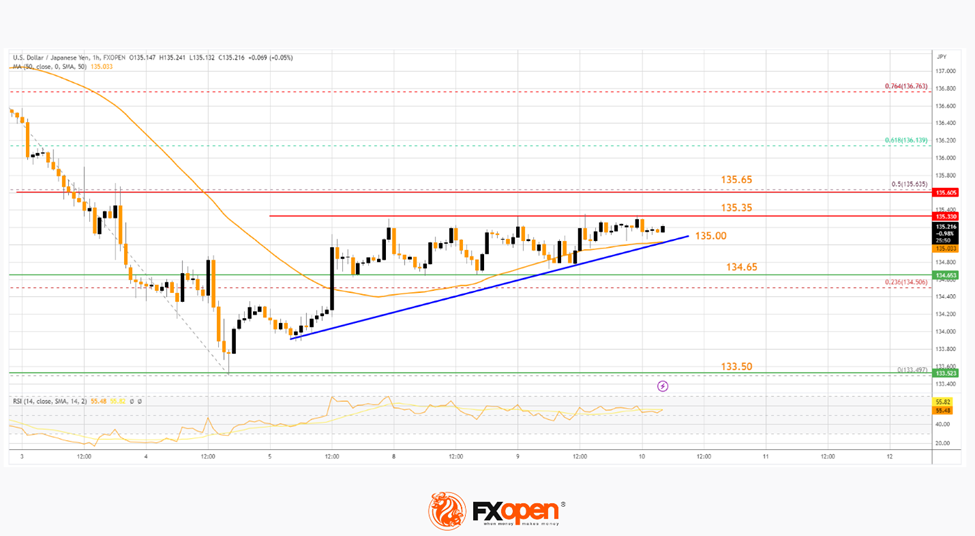
On the hourly chart of USD/JPY at FXOpen, the pair started a fresh increase from the 133.50 support zone. The US Dollar slowly moved higher above the 134.65 resistance zone against the Japanese Yen.
It is now consolidating above the 50-hour simple moving average. Immediate resistance on the upside is near the 135.35 level. The first major resistance is near the 135.65 level, above which the pair might start a decent increase.
The next major resistance is near the 137.30 zone. A clear break above the 137.30 resistance could push the price further higher toward 138.00.
If there is a fresh decline, support is near a bullish trend line at 135.00 and the 50-hour simple moving average. The next support sits near the 134.65 zone, below which there is a risk of more downsides toward the 133.50 level.
Crucial Days for Gold
Gold prices have stabilized at around $2,020 ahead of Tuesday's trading session, following last Friday's dip. Recent fluctuations in risk sentiment have been the driving force behind the pricing of the precious metal. How does this look on the charts? Let’s find out.
Treasury yields have increased across the board since the Federal Open Market Committee raised its target rate by 25 basis points to 5-5.25% last week. Similarly, real yields appear to have moved with an inverse correlation to the recent gold price. The gold price has been influenced by Wednesday's US CPI data for clues on the Fed's rate path going forward, and the market is anticipating headline inflation of 5.0% year-on-year to the end of April.
US Dollar - H4 Timeframe
The US Dollar based on the price action from the charts is currently consolidating inside a wedge pattern. As we look forward to the CPI figures and the aftermath of the publication, I am confident we should get to see a break out of the wedge pattern - a positive sign for trading opportunities. It is on this note that I will personally be following the price action in hopes of a clear breakout soon. In the meantime, my sentiment is that price will continue to tow its recent bearish path and possibly create a new low on the H4 timeframe.
Analyst’s Expectations:
- Direction: Bearish
- Target: 101.248
- Invalidation: 101.841

XAUUSD - Daily Timeframe
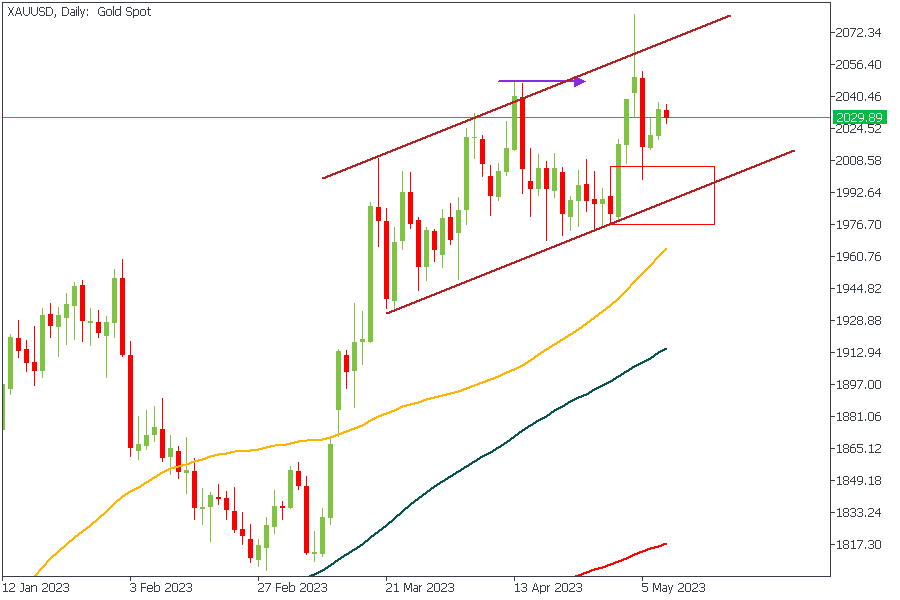
The daily timeframe on Gold (XAUUSD) is clearly bullish; as we can deduce from the recent break above the high I marked with a horizontal arrow. The rectangle overlapping the trendline support represents a drop-base-rally demand zone to which price has already reacted. Now let’s check the lower timeframe for confirmation.
XAUUSD - H1 Timeframe
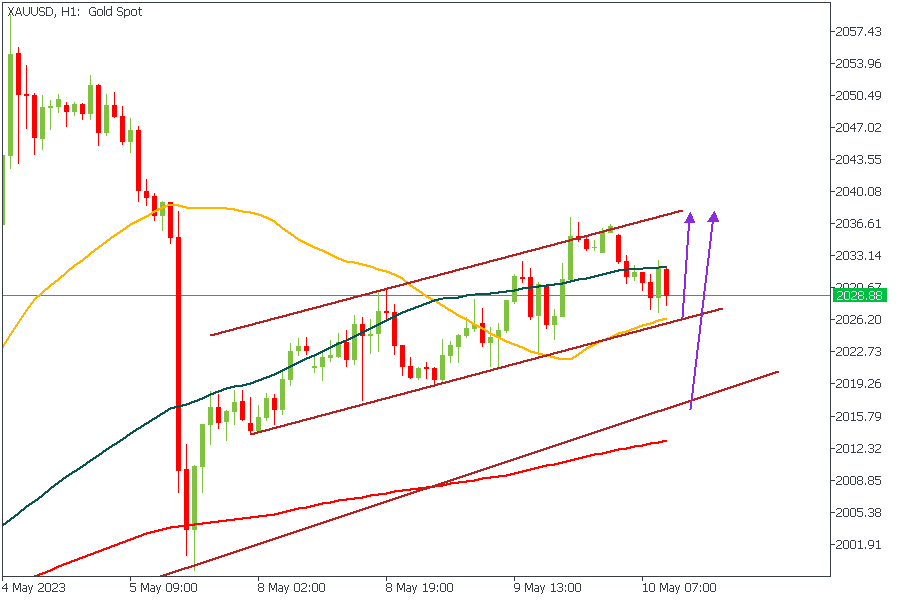
Now that we’ve confirmed the price action on XAUUSD to be bullish from the daily timeframe, what remains now is to establish the appropriate point of entry on the lower timeframe based on support and resistance levels. Looking at the 1-hour chart, I can see price consolidating to form a rising channel so my entry will be based on either of the two plotted support trendlines. The first one has extra confirmation based on the 50-period moving average, while the other one fits well within the vicinity of the 200-period moving average.
Analyst’s Expectations:
- Direction: Bullish
- Target: $2043.57
- Invalidation: $2014.50
CONCLUSION
The trading of CFDs comes at a risk. Thus, to succeed, you have to manage risks properly. To avoid costly mistakes while you look to trade these opportunities, be sure to do your due diligence and manage your risk appropriately.
German Inflation Slowing,But ECB Wants to Do More
German consumer inflation slowed to 7.2% y/y in April, Destatis said in its final estimate. The trend of decelerating price increases continues, although it remains well above the ECB’s target.
March data for other price indicators point to further easing of pressure. For example, the wholesale price index rose by only 2% y/y in March, and import prices were 4.8% lower than 12 months earlier. Gas prices at the European hub continue to fall, reaching $403 per 1,000 units. This is the lowest level since July 2021 and the upper limit of the typical price range since 2011.
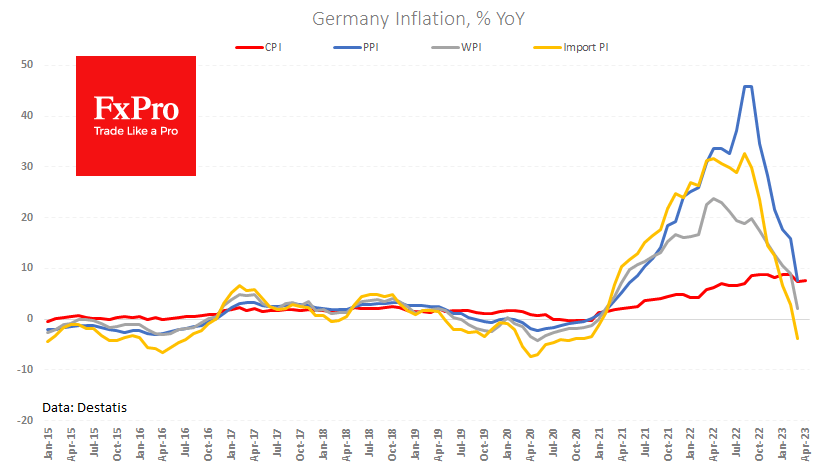
The slowdown in inflation allows the ECB to hold back and end the hiking cycle sooner, which is potentially negative for the euro. But now investors should pay more attention to how ECB officials assess the situation, as their job of taming inflation is not yet considered done.
In her speech today, Lagarde once again reminded us that more action needs to be taken to curb inflation, which implies further rate hikes. This stance is more hawkish than the Fed, hinting at a pause and an end to the tightening cycle.
Bitcoin Lurks at a Local Bottom
Market picture
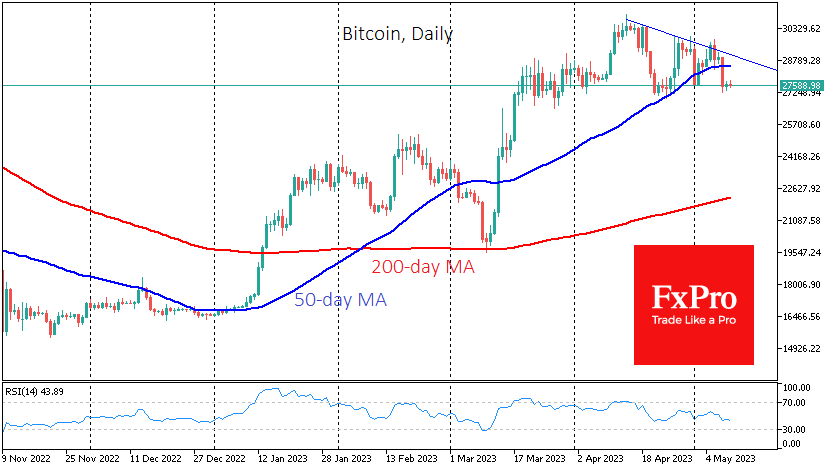
The crypto market capitalisation grew 0.28% over the last 24 hours, as much as Bitcoin over this period. The market is now in a wait-and-see mode after Monday’s sharp drop. The top 10 altcoins show mixed dynamics, ranging from -2% (Polygon) to +1.75% (Litecoin).
Bitcoin is trading around $27.6K, remaining near the lows of the last two months and below the 50-day moving average. The bulls can’t gain more than a pause in the slide, but the market has yet to return to the upside. Moving out of the $27-28.5K range can start a broader move towards a breakout with targets at $25K and $30K, respectively.
According to CoinShares, investments in crypto funds fell by $54 million last week, the third consecutive week of outflows. Bitcoin investments decreased by $32 million, Ethereum by $2 million, and inflows in funds allowing to short Bitcoin fell by a record $23 million.
Background to the news
According to a Goldman Sachs survey, the number of family offices “potentially interested” in cryptocurrencies has fallen from 45% to 12% by 2023.
Cryptocurrency exchange Bittrex filed for bankruptcy after ceasing operations in the US due to regulatory pressure. The default also applies to several of the exchange’s subsidiaries.
Brad Garlinghouse, Ripple Labs CEO, has advised cryptocurrency startups not to shop in the US to avoid regulatory harassment.
Hong Kong authorities have announced a “tough” approach to cryptocurrency regulation. From 1 June, all exchanges must be licensed by the Securities and Futures Commission (SFC). The authorities will also introduce a mandatory licensing regime for stablecoins by 2024.
Ireland’s central bank governor urged citizens to be sceptical about investing in cryptocurrencies, saying they are high-risk, dangerous and “too much like the lottery”.
British Pound Drifting ahead of US Inflation Report
- US inflation expected to remain steady
- BoE likely to raise rates
US inflation expected to stay unchanged
The US release the April inflation report later today, and the consensus is that headline inflation will remain steady at 5.0%. The core rate is projected to tick lower to 5.5%, down from 5.6% in March. That would mean that the disinflation process has stalled, which would pose a major headache for the Fed in its quest to bring inflation back to the 2% target.
The Fed has signalled that it will pause rates next month and just a day ago the markets agreed, with just an 8% chance of a hike, according to the CME Group. That has jumped to 21% today, and I would expect further repricing upwards if today’s inflation release is hotter than expected. A strong report would likely give a boost to the US dollar.
BoE projected to raise rates
The Bank of England is expected to raise rates by 25 basis points on Thursday, which would bring the benchmark cash rate to 4.50%. The BoE hasn’t been able to rein in inflation, which is above 10%, despite an aggressive rate-tightening cycle of 11 straight hikes. Core inflation has been sticky, raising fears that inflation expectations will rise and make it even more difficult to contain inflation. The cost of living crisis has hampered growth, but as in the US, the labour market has been surprisingly resilient to the central bank’s relentless tightening.
The BoE remains, somewhat surprisingly optimistic about inflation, projecting that it will decline all the way to 4% by the end of the year. This optimism will be hard to maintain if we don’t see a drop in the April inflation report. There are expectations of a terminal rate of 4.75%, which means that the BoE would likely deliver its final hike of 25-bp at the June meeting.
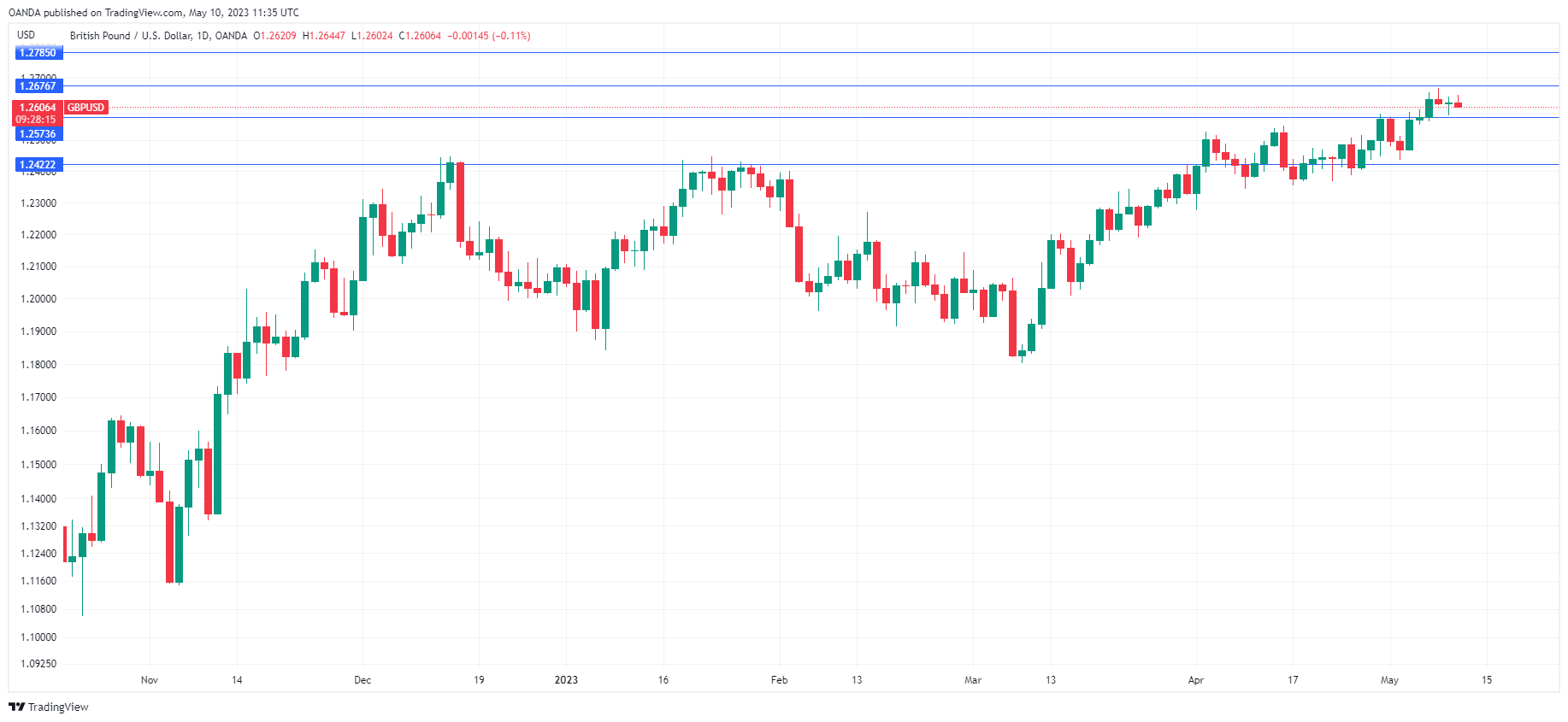
GBP/USD Technical
- 1.2573 and 1.2495 are providing support
- 1.2676 and 1.2785 are the next resistance lines
Will US CPI Shake Up Sleepy Yen?
- US inflation expected to remain at 5.0%
- BoJ to release Summary of Opinions
USD/JPY continues to have a quiet week and is almost unchanged, trading at 135.20.
Investors eye BoJ Summary of Opinions
The markets will be keeping a close eye on the Bank of Japan’s Summary of Opinions, which will be released later today. The summaries rarely move the dial on the yen, but this summary could be different, as it covers the April meeting which was the first chaired by Governor Kazuo Ueda. The BoJ did not change its policy settings at the meeting, but there are growing expectations that Ueda will take steps to normalize policy, which would boost the yen. At the meeting, the BoJ removed guidance on rate levels which committed to maintain rates at “current or lower levels” and announced it would review its monetary policy.
Ueda said on Tuesday that there were positive signs in inflation and inflation expectations, and said the BoJ would end its yield curve control (YCC) policy once it was clear that inflation would “sustainably and stably meet our 2% target”. The yen did not react to these comments, but it appears that Ueda is slowly but surely making plans to shift policy and gradually wind up former Governor Kuroda’s massive stimulus program, which has been the hallmark of BoJ policy for years.
US inflation expected to hold steady
The US release the April inflation report later today, and indications are that CPI remains sticky, which isn’t great news for the Fed. Headline inflation is expected to remain unchanged at 5.0%, while the core rate is projected to tick lower to 5.5%, down from 5.6% in March.
The Fed has signalled that it will pause rates next month, and this has been priced in by the markets at 78%, although there is a 21% of a rate hike, according to the CME Group. A hotter-than-expected inflation report would likely raise the probability of a rate hike and provide a boost to the US dollar.
USD/JPY Technical
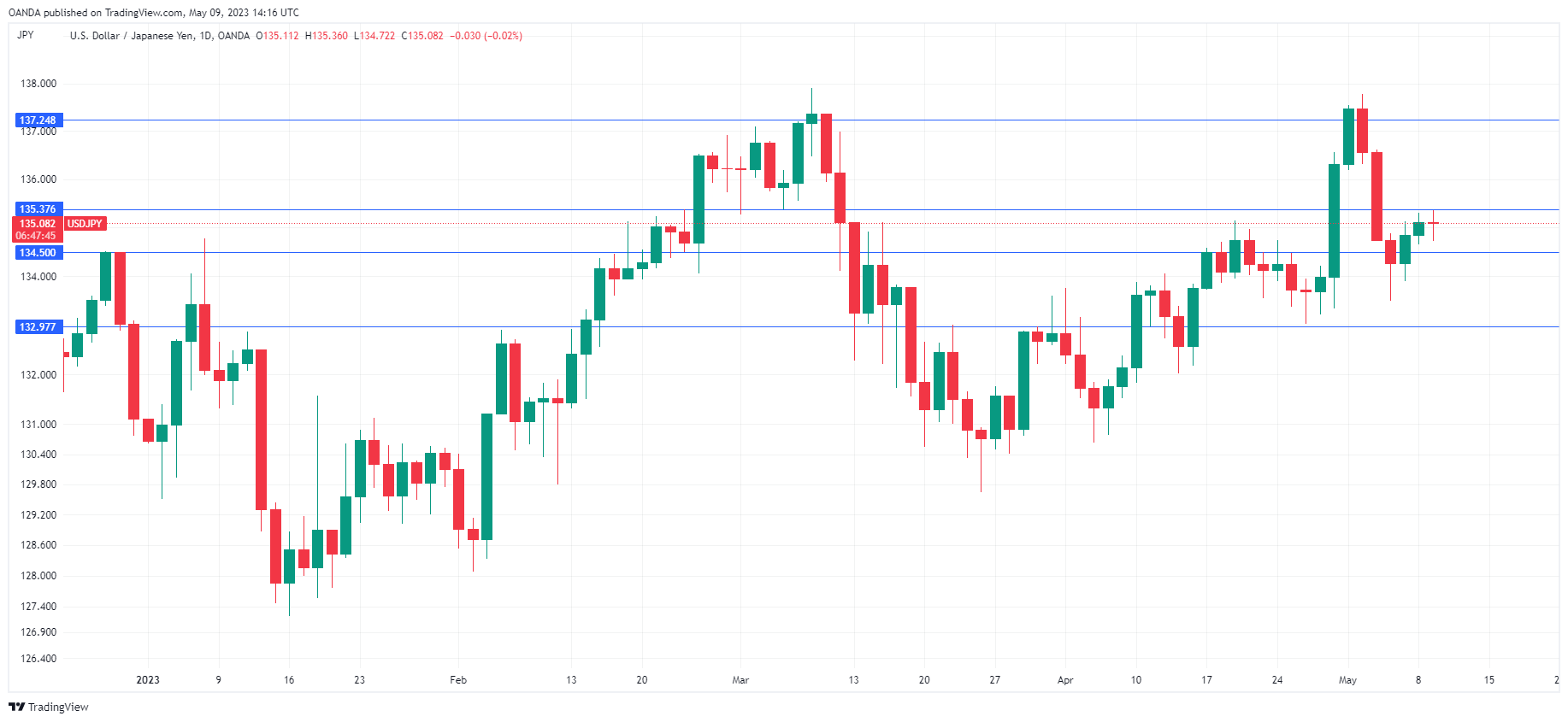
- USD/JPY tested resistance at 135.37 earlier in the day. Above, the next resistance line is 137.24
- There is support at 134.50 and 132.97